Abstract
Small and medium-sized enterprises (SMEs) in small island economies face constrained domestic markets, limited physical reach, and resource pressures that make expansion into new markets essential for sustainable growth. This study examines how financial and resource management, market adaptation strategy, and digital transformation influence SME market expansion in Zanzibar, with particular attention to the relative strength of each practice. A quantitative cross-sectional survey was conducted among 350 SME owners and managers operating in the tourism, trade, and agriculture sectors. The data were analysed using partial least squares structural equation modelling (PLS-SEM) with 5,000 bootstrap resamples to assess the hypothesised relationships. The results show that all three strategic practices have positive and statistically significant effects on market expansion. Digital transformation emerged as the strongest predictor (β = 0.721, p <.001), while financial and resource management (β = 0.161, p <.001) and market adaptation strategy (β = 0.160, p <.001) made smaller but significant contributions. Together, the three practices explained 56.7% of the variance in SME market expansion (R2 = 0.567). The study concludes that digital transformation is the principal driver of market expansion among Zanzibar SMEs, but its effectiveness is reinforced by sound financial and resource management and the capacity to adapt to changing market conditions. SME owners, policymakers, and business-support institutions should therefore prioritise digital capability while simultaneously strengthening financial discipline and market adaptability to support sustainable expansion beyond constrained local markets.
Keywords
Digital Transformation, Financial and Resource Management, Market Adaptation, Market Expansion, SME Growth,
Small Island Economies
1. Introduction
For a small and medium-sized enterprise (SME), growth is unlikely to be singular, and it comes in many guises of success. It can be improved profitability, or expanded sales (either new products, services and markets). Yet, in most studies of SME strategy
| [11] | Gherghina, S. C., Botezatu, M. A., Hosszu, A., & Simionescu, L. N. (2020). Small and medium-sized enterprises: The engine of economic growth through investments and innovation. Sustainability, 12(1), Article 347.
https://doi.org/10.3390/su12010347 |
[11]
, the multiple facets and metrics of these various dimensions of growth are used interchangeably as a proxy for “growth”. But in small island economies, with highly restricted domestic markets like Zanzibar, strategy is likely to be significantly geared towards gaining access to foreign customers and partners, such as growing internationally
| [14] | Ibarra-Cisneros, M. A., Hernandez-Perlines, F., & Rodriguez-Garcia, M. (2022). Entrepreneurial orientation, strategic flexibility and business performance of SMEs. International Entrepreneurship and Management Journal, 18(1), 397–420. |
[14]
. Good leadership is known to result in economic progress in similar contexts
| [3] | Alharbi, F. S. S. A., & Farea, M. M. (2021). Transformational leadership and economic development in Saudi Arabia. AJRSP, 3, 5–17. |
[3]
so understanding specific behaviours beyond simple leadership is critical for driving the success of SMEs in practice.
Zanzibar illustrates this challenge clearly. SMEs in tourism, trade, and agriculture operate in a small island economy where local market saturation and seasonal demand make market expansion, rather than financial optimisation alone, central to firms’ long-term viability
| [15] | Khamis, A. A., & Zhifang, C. (2022). Factors influencing the performance of small and medium enterprises in Tanzania: A case of Zanzibar. Asian Journal of Economics, Business and Accounting, 22(20), 32–43.
https://doi.org/10.9734/ajeba/2022/v22i2030673 |
| [25] | Zanzibar Planning Commission. (2021). Zanzibar Development Plan 2021–2026. Revolutionary Government of Zanzibar. |
[15, 25]
. Despite this, little empirical work has examined which specific management practices help SMEs in such settings expand into new markets and reach new customers.
This study addresses that gap by testing the effects of three practices on SME market expansion: financial and resource management, which underpins the operational discipline needed to fund expansion; market adaptation strategy, which allows firms to respond to shifting customer preferences and enter new segments; and digital transformation, which extends a firm's reach beyond its immediate physical market. Grounded in the resource-based view and dynamic capabilities theory
| [4] | Barney, J. (1991). Firm resources and sustained competitive advantage. Journal of Management, 17(1), 99–120.
https://doi.org/10.1177/014920639101700108 |
| [20] | Teece, D. J. (2007). Explicating dynamic capabilities: The nature and microfoundations of enterprise performance. Strategic Management Journal, 28(13), 1319–1350.
https://doi.org/10.1002/smj.640 |
| [21] | Teece, D. J., Pisano, G., & Shuen, A. (1997). Dynamic capabilities and strategic management. Strategic Management Journal, 18(7), 509–533.
https://doi.org/10.1002/(SICI)1097-0266(199708)18:7<509::AID-SMJ882>3.0.CO;2-Z |
[4, 20, 21]
, we treat these as complementary but analytically distinct capabilities and ask which contribute most to market expansion, and whether their effects are additive or interdependent.
This paper is part of a broader research programme examining strategic business management practices among Zanzibar SMEs. A companion study examines a different subset of practices strategic planning, business innovation, and competitive positioning — and their effect on financial performance, with digital transformation modelled there as a moderator. The present study instead treats digital transformation as a direct antecedent and focuses on market expansion as a distinct growth outcome, offering a complementary rather than overlapping contribution.
The remainder of the paper reviews the relevant theory and develops three hypotheses, describes the survey-based method used to test them, reports the results, and discusses what the findings mean for SME owners, managers, and the policymakers and support agencies that serve them.
2. Theoretical Background and Hypotheses
2.1. Financial and Resource Management
Financial and resource management refers to the practices through which a firm records, budgets, and allocates its financial and non-financial resources
| [17] | Mutambara, A. (2024). Strategic financial management framework to ensure performance and growth for small to medium enterprises. International Journal of Research in Business and Social Science, 13(7), 28–41.
https://doi.org/10.20525/ijrbs.v13i7.3631 |
| [18] | Mutambara, A., & Kader, A. D. (2025). The importance of strategic financial management practices for small and medium enterprises in emerging markets. Corporate and Business Strategy Review, 6(1), 53–63. https://doi.org/10.22495/cbsrv6i1art5 |
[17, 18]
. From a resource-based view, disciplined management of resources is a firm-specific capability that enables an SME to fund expansion activities such as opening a new outlet, entering a new market, and hiring staff to serve new customers without exhausting working capital or incurring unsustainable debt
. Firms that monitor cash flow, maintain a steady budget, and allocate funds resourcefully are better positioned to commit resources to expansion opportunities rather than being constrained by cash shortfalls. This capability is linked to the firm’s ability to create and use knowledge in its decision processes. Recent research shows that enterprise knowledge management practices can improve the quality and timing of resource-related decision making
| [2] | Aldubai, Maged & Marie, Ziyad & Al-Duais, Hani & Al-Ifan, Belal & Farea, Mazen & El-Ebiary, Ts. (2024). The impact of knowledge management strategy on the enterprise's decision making. https://doi.org/10.5281/zenodo.12515989 |
[2]
.
We therefore expect financial and resource management to support market expansion directly, by giving SMEs the financial capacity and discipline needed to pursue growth beyond their existing customer base.
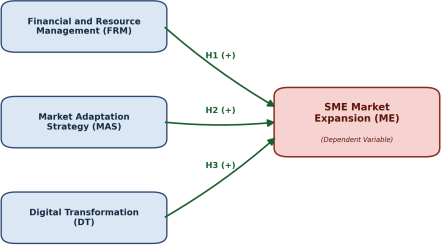
H1: Financial and resource management has a positive effect on SME market expansion.
2.2. Market Adaptation Strategy
Market adaptation strategy refers to a firm’s capacity to adjust its products, services and marketing method to changing customer preferences, competitive pressure and new opportunities
| [14] | Ibarra-Cisneros, M. A., Hernandez-Perlines, F., & Rodriguez-Garcia, M. (2022). Entrepreneurial orientation, strategic flexibility and business performance of SMEs. International Entrepreneurship and Management Journal, 18(1), 397–420. |
[14]
. According to dynamic capabilities theory, firms do not simply grow because they possess resources. Instead, firms grow by sensing changes in customer and market requirements, and configuring their offerings to align with these opportunities
| [20] | Teece, D. J. (2007). Explicating dynamic capabilities: The nature and microfoundations of enterprise performance. Strategic Management Journal, 28(13), 1319–1350.
https://doi.org/10.1002/smj.640 |
| [21] | Teece, D. J., Pisano, G., & Shuen, A. (1997). Dynamic capabilities and strategic management. Strategic Management Journal, 18(7), 509–533.
https://doi.org/10.1002/(SICI)1097-0266(199708)18:7<509::AID-SMJ882>3.0.CO;2-Z |
[20, 21]
.
For SMEs seeking to expand into new markets or reach new customer segments, adaptability is arguably a precondition: a firm that cannot adjust its products or messaging to a new market's preferences is unlikely to succeed there regardless of its financial resources. We therefore expect market adaptation strategy to be positively associated with market expansion.
H2: Market adaptation strategy has a positive effect on SME market expansion.
2.3. Digital Transformation
Digital transformation refers to the integration of digital tools, online platforms, digital payments, digital customer communication, and data-driven business management into a firm's operations
| [22] | Verhoef, P. C., Broekhuizen, T., Bart, Y., Bhattacharya, A., Dong, J. Q., Fabian, N., & Haenlein, M. (2021). Digital transformation: A multidisciplinary reflection and research agenda. Journal of Business Research, 122, 889–901.
https://doi.org/10.1016/j.jbusres.2019.09.022 |
| [23] | Vial, G. (2019). Understanding digital transformation: A review and a research agenda. Journal of Strategic Information Systems, 28(2), 118–144.
https://doi.org/10.1016/j.jsis.2019.01.003 |
[22, 23]
. Unlike financial management or market adaptation, which primarily strengthen a firm's existing operations, digital transformation has a direct geographic and demographic reach effect: a firm using digital marketing and e-commerce platforms can reach customers and markets that would otherwise be inaccessible through physical presence alone
| [1] | Adhikari, S. N., & Molla, N. (2024). Navigating the digital shift: Exploring the impact of technology on management practices in small and medium enterprises (SMEs) in Nepal. Nepalese Journal of Management and Technology, 2(2), 91–109.
https://doi.org/10.3126/njmt.v2i2.68730 |
| [8] | Costa Melo, D. I., Queiroz, G. A., Alves Junior, P. N., Sousa, T. B. de, Yushimito, W. F., & Pereira, J. (2023). Sustainable digital transformation in small and medium enterprises (SMEs): A review on performance. Heliyon, 9(3), Article e13908.
https://doi.org/10.1016/j.heliyon.2023.e13908 |
[1, 8]
.
In small island economies, where physical market expansion is constrained by geography and transport costs, this reach effect may be particularly consequential. Digital tools allow SMEs to test new markets at low cost, engage customers outside their immediate locality, and build the partnerships and visibility that underpin geographic and customer-base growth
| [6] | Chung, K. W., Chiu, W., Chen, G., & Liu, K. P. (2024). Digital transformation driving SME business model innovation: A dynamic capabilities perspective. Journal of Global Information Management, 32(1). https://doi.org/10.4018/jgim.350191 |
| [16] | Kraus, S., Durst, S., Ferreira, J. J., Veiga, P., Kailer, N., & Weinmann, A. (2021). Digital transformation in business and management research: An overview of the current status quo. International Journal of Information Management, 63, Article 102466. https://doi.org/10.1016/j.ijinfomgt.2021.102466 |
[6, 16]
. We therefore expect digital transformation to have the strongest association with market expansion among the three practices examined here. This pattern echoes recent evidence from Saudi Arabia showing that technological advancement significantly mediates the relationship between external market drivers and firms' participation in global value chains, reinforcing digital capability as a mechanism through which firms extend their reach beyond immediate, local markets
| [9] | Farea, M. M., & Aljofi, A. A. (2025). The influence of external market drivers on global value chain participation in Saudi Arabia: The mediating role of technological advancements. Sustainability, 17(9), 3946. https://doi.org/10.3390/su17093946 |
[9]
.
H3: Digital transformation has a positive effect on SME market expansion.
Figure 1 summarises the proposed model, in which financial and resource management, market adaptation strategy, and digital transformation are modelled as three independent, non-overlapping predictors of SME market expansion.
Figure 1. Conceptual model of the study.
3. Method
3.1. Design, Sample, and Procedure
This study used a quantitative, cross-sectional survey design. Data were collected from 350 SME owners and managers operating in the tourism, trade, and agriculture sectors of Zanzibar. The sampling frame of 4,144 eligible SME decision-makers was drawn from official registration records held by the Zanzibar Ministry of Trade and Industrial Development and the Business Registration and Licensing Agency; the required sample size of approximately 365 was determined using Yamane's formula
| [24] | Yamane, T. (1967). Statistics: An introductory analysis (2nd ed.). Harper & Row. |
[24]
(N = 4,144, e =.05), and stratified random sampling by sector was used to select respondents. After data screening, 350 complete and valid responses were retained for analysis. Respondents were evenly split by gender (50.0% male, 50.0% female), most were aged 25–44 (61.2%), and the sample was drawn from trade (36.6%), agriculture (36.0%), and tourism (27.4%) firms with a range of operating histories, from under a year to more than a decade.
3.2. Measures
Four reflective constructs were measured: (i) financial and resource management (FRM), (ii) market adaptation strategy (MAS), (iii) digital transformation (DT), and (iv) market expansion (ME). Each construct comprised five items measured on a five-point Likert scale (1 = strongly disagree to 5 = strongly agree), drawing on previous SME strategy and digital transformation research and adapted to the Zanzibar context. Market expansion was operationalised through items capturing new customer acquisition, entry into new geographic markets, introduction of new products or services, market-share growth relative to competitors, and the formation of partnerships that extend market reach—distinguishing it from the financial-performance indicators (revenue, profit, return on investment) used in the companion study on this dataset.
A pilot test with 30 SME respondents outside the main sample confirmed item clarity and acceptable reliability (Cronbach's alpha 0.85–0.89) before full data collection.
3.3. Analytical Approach
The measurement model was assessed using Cronbach's alpha, composite reliability (CR), and average variance extracted (AVE), and discriminant validity was assessed using the Fornell–Larcker criterion
| [10] | Fornell, C., & Larcker, D. F. (1981). Evaluating structural equation models with unobservable variables and measurement error. Journal of Marketing Research, 18(1), 39–50.
https://doi.org/10.1177/002224378101800104 |
| [12] | Hair, J. F., Hult, G. T. M., Ringle, C. M., & Sarstedt, M. (2022). A primer on partial least squares structural equation modeling (PLS-SEM) (3rd ed.). Sage. |
[10, 12]
. The structural model was estimated using standardised regression coefficients with 5,000-resample bootstrapping to establish significance, consistent with standard practice for partial least squares structural equation modelling (PLS-SEM) with reflective indicators
| [12] | Hair, J. F., Hult, G. T. M., Ringle, C. M., & Sarstedt, M. (2022). A primer on partial least squares structural equation modeling (PLS-SEM) (3rd ed.). Sage. |
| [13] | Hair, J. F., Risher, J. J., Sarstedt, M., & Ringle, C. M. (2019). When to use and how to report the results of PLS-SEM. European Business Review, 31(1), 2–24.
https://doi.org/10.1108/ebr-11-2018-0203 |
[12, 13]
. Effect sizes (f
2) were interpreted using Cohen's conventional benchmarks
| [7] | Cohen, J. (1988). Statistical power analysis for the behavioral sciences (2nd ed.). Lawrence Erlbaum Associates. |
[7]
.
3.4. Model Specification
The hypothesised relationships were tested using the general model shown in Equation (
1), in which SME market expansion is expressed as a linear function of the three predictors.
ME =β0+β1FRM +β2MAS +β3DT +ε(1)
In Equation (
1), ME denotes SME market expansion; FRM, MAS, and DT denote financial and resource management, market adaptation strategy, and digital transformation, respectively;
β0 is the intercept;
β1–
β3 are the standardised path coefficients; and
ε is the error term.
4. Results
4.1. Descriptive Statistics and Measurement Model
Table 1 presents the descriptive and reliability statistics. Mean scores ranged from 3.20 to 3.55, and skewness and kurtosis values fell within accepted limits for the planned analysis
| [5] | Byrne, B. M. (2010). Structural equation modeling with AMOS: Basic concepts, applications, and programming (2nd ed.). Routledge. https://doi.org/10.4324/9780203805534 |
| [19] | Tabachnick, B. G., & Fidell, L. S. (2013). Using multivariate statistics (6th ed.). Pearson. |
[5, 19]
. All four constructs showed strong internal consistency (Cronbach's alpha 0.907–0.975; composite reliability 0.931–0.980) and convergent validity (AVE 0.730–0.909), exceeding the recommended 0.70 and 0.50 thresholds respectively
| [10] | Fornell, C., & Larcker, D. F. (1981). Evaluating structural equation models with unobservable variables and measurement error. Journal of Marketing Research, 18(1), 39–50.
https://doi.org/10.1177/002224378101800104 |
| [12] | Hair, J. F., Hult, G. T. M., Ringle, C. M., & Sarstedt, M. (2022). A primer on partial least squares structural equation modeling (PLS-SEM) (3rd ed.). Sage. |
[10, 12]
.
Table 1. Descriptive statistics and measurement model.
Construct | Mean | SD | α | CR | AVE | √AVE |
FRM | 3.30* | 0.55* | 0.974 | 0.980 | 0.906 | 0.952 |
MAS | 3.30* | 0.55* | 0.975 | 0.980 | 0.909 | 0.953 |
DT | 3.198 | 0.528 | 0.971 | 0.978 | 0.897 | 0.947 |
ME | 3.30* | 0.55* | 0.907 | 0.931 | 0.730 | 0.854 |
Discriminant validity was supported by the Fornell–Larcker criterion: the square root of the AVE for each construct (0.854–0.953) exceeded its correlations with the other three constructs, the highest of which was 0.718 between digital transformation and market expansion — consistent with digital transformation's hypothesised role as the dominant driver of expansion. The three predictors were also essentially uncorrelated with one another (|r| ≤.07), and collinearity diagnostics confirmed this: all variance inflation factors were close to 1.0, well below the threshold of 5.0, indicating that financial and resource management, market adaptation strategy, and digital transformation function as independent, non-overlapping practices rather than facets of a single underlying strategy.
4.2. Hypothesis Testing
The three practices jointly explained 56.7% of the variance in SME market expansion (R
2 = 0.567). As shown in
Table 2, all three hypotheses were supported. Digital transformation had by far the strongest effect (β = 0.721, p <.001, f
2 = 1.194), while financial and resource management (β = 0.161, p <.001, f
2 = 0.060) and market adaptation strategy (β = 0.160, p <.001, f
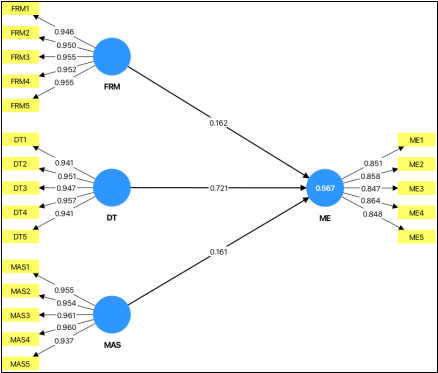
2 = 0.059) contributed smaller but statistically significant and practically comparable effects. Figure 2 presents the full structural model exactly as estimated in SmartPLS 4, showing the measurement model (outer loadings for all fifteen indicator items) together with the structural paths and the R
2 value for SME market expansion.
Figure 2. Structural model results (SmartPLS 4 output).
Note. This is the unedited SmartPLS 4 output for the estimated model. Outer loadings range from 0.937 to 0.961; standard-ised path coefficients are FRM → ME = 0.162, DT → ME = 0.721, and MAS → ME = 0.161 (R
2 = 0.567), consistent with the values reported in
Tables 1 and 2 (minor third-decimal differences reflect rounding between the SmartPLS estimation and the bootstrap regression reported in the text).
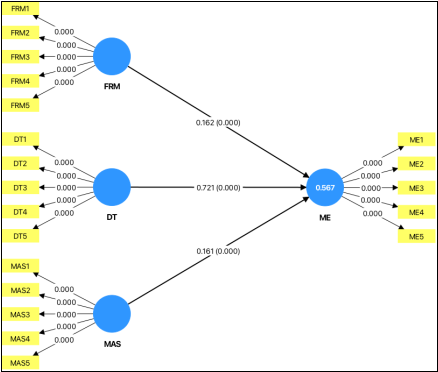
Figure 3. Bootstrapping results: path coefficients with p-values (SmartPLS 4 output, 5,000 subsamples).
Note. Values on the structural paths are standardised path coefficients with bootstrap p-values in parentheses; values on the measurement paths are the p-values for the corresponding outer loadings. All p-values are reported by SmartPLS as 0.000, i.e. p <.001. Bootstrapping used 5,000 subsamples with the no-sign-change option and two-tailed testing at the.05 significance level.
The bootstrapping output for the same model, in which inferential test results replace
Figure 2's coefficient-only display, is shown in
Figure 3. Three observations are notable. First, all structural paths were statistically significant: H1 (FRM → ME), H2 (MAS → ME), and H3 (DT → ME) each had bootstrap p-values reported by SmartPLS as 0.000, corresponding to p <.001.
The notation "p <.001" is used rather than "p = 0.000" because a bootstrap output of 0.000 indicates a probability smaller than the software's reporting precision; it does not imply that the true probability is exactly zero.
Therefore, H1, H2, and H3 are supported, indicating that the estimated structural relationships are unlikely to be attributable to sampling error. Second, all outer loadings were statistically significant, supporting the reliability of the measurement model. Third, statistical significance should be distinguished from practical importance; although all three structural paths were significant, their magnitudes differed substantially, as shown by the effect sizes reported in
Table 2.
Digital transformation had a substantially larger practical effect on market expansion (f2 = 1.194) than financial and resource management (f2 = 0.060) or market adaptation strategy (f2 = 0.059), while the model explained 56.7% of the variance in market expansion (R2 = 0.567).
These results indicate that digital transformation should receive priority when SMEs seek to expand their markets, while financial and resource management and market adaptation remain complementary capabilities that support sustainable expansion. Rather than treating the three practices as substitutes, SMEs should strengthen them in parallel, with digital capability serving as the strongest direct lever for reaching new customers and geographic markets.
For SMEs in a small island economy where physical market reach is constrained by geography and transport costs, this asymmetry is consistent with the theoretical argument developed in Section 2.3: digital tools do not merely improve existing operations, as financial discipline and adaptive capability largely do, but directly extend the geographic and demographic boundary of the market a firm can serve.
Table 2. Structural model results.
Hyp. | Path | β | t | p | f2 | Result | Decision |
H1 | FRM → ME | 0.161 | 4.549 | <.001 | 0.060 | Significant | Supported |
H2 | MAS → ME | 0.160 | 4.526 | <.001 | 0.059 | Significant | Supported |
H3 | DT → ME | 0.721 | 20.326 | <.001 | 1.194 | Significant | Supported |
Note. β = standardised path coefficient; f2 = effect size. Significance based on 5,000 bootstrap resamples. R2 (market expansion) = 0.567.
5. Discussion and Implications for Practice
5.1. Interpreting the Pattern of Effects
All three practices examined here support SME market expansion, but they do not do so equally. Digital transformation stands out as the dominant driver, with an effect roughly four-and-a-half times larger than either financial and resource management or market adaptation strategy. This is consistent with the reach-effect logic proposed earlier: digital tools do not simply make existing operations more efficient, they extend an SME's addressable market beyond what physical presence and word-of-mouth referral can achieve, which is directly relevant to acquiring new customers and entering new markets — the outcomes captured in our market-expansion measure.
Financial and resource management and market adaptation strategy contribute smaller but robust effects of nearly identical size. This suggests that operational discipline and adaptability are each necessary but individually modest contributors to expansion — they create the conditions under which a firm can pursue new markets (by having the resources to do so and the flexibility to adjust its offering) without being, on their own, the primary mechanism through which that expansion happens.
Another finding is methodologically and substantively important: the three practices were essentially uncorrelated with one another. This shows that in the studied SMEs, digital adoption, financial discipline, and market adaptability are being pursued (or disregarded) mostly independent of each other rather than as parts of one single coordinated strategic programme. For SMEs owners this is actionable. Progress in one area does not assume progress in another. Therefore each capability can be developed at the same time rather than one after the other.
5.2. Implications for SME Owners and Managers
For SME owners and managers seeking to grow beyond their existing customer base, the clearest implication is that digital transformation deserves priority investment when the goal is market expansion specifically, as distinct from improving financial performance within an existing market. Adopting digital marketing, e-commerce, and digital customer-communication tools appears to be the single most effective lever available to these firms for reaching new customers and markets.
Financial management and market adaptation are not optional, nevertheless. Two things matter, one remains paramount, a firm that draws up the digitalisation without the financial discipline to support growth or without the flexibility to adapt its offering to new markets is unlikely to convert digital access into lasting growth. The practical implication is one of balance, not succession. SMEs should not refrain from investing in digital tools while they seek to master financial management or adapt to the market. On the flip side, SMEs should not view digital adoption as a substitute for these other capabilities.
5.3. Implications for Policy and SME Support Programmes
For policymakers and business development agencies in Zanzibar and comparable small island or resource-constrained economies, these findings suggest that SME digitalisation programmes will have the largest impact on market expansion when they are the centrepiece of support efforts, but they should not be delivered in isolation. Bundling digital-adoption support with financial-literacy training and market-adaptation coaching rather than offering digital tools alone — is likely to produce more durable expansion outcomes, since the three capabilities operate as independent, additive contributors rather than as substitutes for one another.
6. Conclusion, Limitations, and Future Research
This study examined how financial and resource management, market adaptation strategy, and digital transformation contribute to the market expansion of SMEs in Zanzibar. All three practices were significant, positive predictors, with digital transformation emerging as the dominant driver of expansion into new markets and customer segments. The practices operated independently of one another, suggesting that SME owners and support agencies can build each capability in parallel.
The study has several limitations. Its cross-sectional design limits causal inference, and self-reported survey data may be subject to common-method considerations; future research could combine survey measures with objective indicators of market reach, such as verified new-customer counts or geographic sales data. The study also focused on SMEs in tourism, trade, and agriculture in a single small island economy; replication in other resource-constrained or island contexts would help establish the generalisability of the pattern reported here. Finally, because this study and its companion paper draw on the same dataset but examine different predictors and outcomes, future integrative work could model financial performance and market expansion jointly, to clarify whether they respond to strategic practices in the same way or represent genuinely distinct growth pathways.
Abbreviations
AVE | Average Variance Extracted |
CR | Composite Reliability |
DT | Digital Transformation |
FRM | Financial and Resource Management |
MAS | Market Adaptation Strategy |
ME | Market Expansion |
PLS-SEM | Partial Least Squares Structural Equation Modelling |
SME | Small and Medium-sized Enterprise |
SPSS | Statistical Package for the Social Sciences |
Author Contributions
Hafidh Ali Hafidh: Conceptualization, Data curation, Formal Analysis, Methodology, Software, Writing – original draft
Mazen Mohammed Farea: Project administration, Resources, Validation, Visualization, Writing – review & editing
Conflicts of Interest
The authors declare no conflicts of interest.
References
| [1] |
Adhikari, S. N., & Molla, N. (2024). Navigating the digital shift: Exploring the impact of technology on management practices in small and medium enterprises (SMEs) in Nepal. Nepalese Journal of Management and Technology, 2(2), 91–109.
https://doi.org/10.3126/njmt.v2i2.68730
|
| [2] |
Aldubai, Maged & Marie, Ziyad & Al-Duais, Hani & Al-Ifan, Belal & Farea, Mazen & El-Ebiary, Ts. (2024). The impact of knowledge management strategy on the enterprise's decision making.
https://doi.org/10.5281/zenodo.12515989
|
| [3] |
Alharbi, F. S. S. A., & Farea, M. M. (2021). Transformational leadership and economic development in Saudi Arabia. AJRSP, 3, 5–17.
|
| [4] |
Barney, J. (1991). Firm resources and sustained competitive advantage. Journal of Management, 17(1), 99–120.
https://doi.org/10.1177/014920639101700108
|
| [5] |
Byrne, B. M. (2010). Structural equation modeling with AMOS: Basic concepts, applications, and programming (2nd ed.). Routledge.
https://doi.org/10.4324/9780203805534
|
| [6] |
Chung, K. W., Chiu, W., Chen, G., & Liu, K. P. (2024). Digital transformation driving SME business model innovation: A dynamic capabilities perspective. Journal of Global Information Management, 32(1).
https://doi.org/10.4018/jgim.350191
|
| [7] |
Cohen, J. (1988). Statistical power analysis for the behavioral sciences (2nd ed.). Lawrence Erlbaum Associates.
|
| [8] |
Costa Melo, D. I., Queiroz, G. A., Alves Junior, P. N., Sousa, T. B. de, Yushimito, W. F., & Pereira, J. (2023). Sustainable digital transformation in small and medium enterprises (SMEs): A review on performance. Heliyon, 9(3), Article e13908.
https://doi.org/10.1016/j.heliyon.2023.e13908
|
| [9] |
Farea, M. M., & Aljofi, A. A. (2025). The influence of external market drivers on global value chain participation in Saudi Arabia: The mediating role of technological advancements. Sustainability, 17(9), 3946.
https://doi.org/10.3390/su17093946
|
| [10] |
Fornell, C., & Larcker, D. F. (1981). Evaluating structural equation models with unobservable variables and measurement error. Journal of Marketing Research, 18(1), 39–50.
https://doi.org/10.1177/002224378101800104
|
| [11] |
Gherghina, S. C., Botezatu, M. A., Hosszu, A., & Simionescu, L. N. (2020). Small and medium-sized enterprises: The engine of economic growth through investments and innovation. Sustainability, 12(1), Article 347.
https://doi.org/10.3390/su12010347
|
| [12] |
Hair, J. F., Hult, G. T. M., Ringle, C. M., & Sarstedt, M. (2022). A primer on partial least squares structural equation modeling (PLS-SEM) (3rd ed.). Sage.
|
| [13] |
Hair, J. F., Risher, J. J., Sarstedt, M., & Ringle, C. M. (2019). When to use and how to report the results of PLS-SEM. European Business Review, 31(1), 2–24.
https://doi.org/10.1108/ebr-11-2018-0203
|
| [14] |
Ibarra-Cisneros, M. A., Hernandez-Perlines, F., & Rodriguez-Garcia, M. (2022). Entrepreneurial orientation, strategic flexibility and business performance of SMEs. International Entrepreneurship and Management Journal, 18(1), 397–420.
|
| [15] |
Khamis, A. A., & Zhifang, C. (2022). Factors influencing the performance of small and medium enterprises in Tanzania: A case of Zanzibar. Asian Journal of Economics, Business and Accounting, 22(20), 32–43.
https://doi.org/10.9734/ajeba/2022/v22i2030673
|
| [16] |
Kraus, S., Durst, S., Ferreira, J. J., Veiga, P., Kailer, N., & Weinmann, A. (2021). Digital transformation in business and management research: An overview of the current status quo. International Journal of Information Management, 63, Article 102466.
https://doi.org/10.1016/j.ijinfomgt.2021.102466
|
| [17] |
Mutambara, A. (2024). Strategic financial management framework to ensure performance and growth for small to medium enterprises. International Journal of Research in Business and Social Science, 13(7), 28–41.
https://doi.org/10.20525/ijrbs.v13i7.3631
|
| [18] |
Mutambara, A., & Kader, A. D. (2025). The importance of strategic financial management practices for small and medium enterprises in emerging markets. Corporate and Business Strategy Review, 6(1), 53–63.
https://doi.org/10.22495/cbsrv6i1art5
|
| [19] |
Tabachnick, B. G., & Fidell, L. S. (2013). Using multivariate statistics (6th ed.). Pearson.
|
| [20] |
Teece, D. J. (2007). Explicating dynamic capabilities: The nature and microfoundations of enterprise performance. Strategic Management Journal, 28(13), 1319–1350.
https://doi.org/10.1002/smj.640
|
| [21] |
Teece, D. J., Pisano, G., & Shuen, A. (1997). Dynamic capabilities and strategic management. Strategic Management Journal, 18(7), 509–533.
https://doi.org/10.1002/(SICI)1097-0266(199708)18:7<509::AID-SMJ882>3.0.CO;2-Z
|
| [22] |
Verhoef, P. C., Broekhuizen, T., Bart, Y., Bhattacharya, A., Dong, J. Q., Fabian, N., & Haenlein, M. (2021). Digital transformation: A multidisciplinary reflection and research agenda. Journal of Business Research, 122, 889–901.
https://doi.org/10.1016/j.jbusres.2019.09.022
|
| [23] |
Vial, G. (2019). Understanding digital transformation: A review and a research agenda. Journal of Strategic Information Systems, 28(2), 118–144.
https://doi.org/10.1016/j.jsis.2019.01.003
|
| [24] |
Yamane, T. (1967). Statistics: An introductory analysis (2nd ed.). Harper & Row.
|
| [25] |
Zanzibar Planning Commission. (2021). Zanzibar Development Plan 2021–2026. Revolutionary Government of Zanzibar.
|
Cite This Article
-
APA Style
Hafidh, H. A. (2026). Effect of Resource Management, Market Adaptation, and Digital Transformation Drive on the SME Market Expansion in a Small Island Economy of Zanzibar. International Journal of Business and Economics Research, 15(5), 96-103. https://doi.org/10.11648/j.ijber.20261505.11
 Copy
|
Copy
|
 Download
ACS Style
Hafidh, H. A. Effect of Resource Management, Market Adaptation, and Digital Transformation Drive on the SME Market Expansion in a Small Island Economy of Zanzibar. Int. J. Bus. Econ. Res. 2026, 15(5), 96-103. doi: 10.11648/j.ijber.20261505.11
Copy
|
Download
AMA Style
Hafidh HA. Effect of Resource Management, Market Adaptation, and Digital Transformation Drive on the SME Market Expansion in a Small Island Economy of Zanzibar. Int J Bus Econ Res. 2026;15(5):96-103. doi: 10.11648/j.ijber.20261505.11
Copy
|
Download
-
@article{10.11648/j.ijber.20261505.11,
  author = {Hafidh Ali Hafidh},
  title = {Effect of Resource Management, Market Adaptation, and Digital Transformation Drive on the SME Market Expansion in a Small Island Economy of Zanzibar},
  journal = {International Journal of Business and Economics Research},
  volume = {15},
  number = {5},
  pages = {96-103},
  doi = {10.11648/j.ijber.20261505.11},
  url = {https://doi.org/10.11648/j.ijber.20261505.11},
  eprint = {https://article.sciencepublishinggroup.com/pdf/10.11648.j.ijber.20261505.11},
  abstract = {Small and medium-sized enterprises (SMEs) in small island economies face constrained domestic markets, limited physical reach, and resource pressures that make expansion into new markets essential for sustainable growth. This study examines how financial and resource management, market adaptation strategy, and digital transformation influence SME market expansion in Zanzibar, with particular attention to the relative strength of each practice. A quantitative cross-sectional survey was conducted among 350 SME owners and managers operating in the tourism, trade, and agriculture sectors. The data were analysed using partial least squares structural equation modelling (PLS-SEM) with 5,000 bootstrap resamples to assess the hypothesised relationships. The results show that all three strategic practices have positive and statistically significant effects on market expansion. Digital transformation emerged as the strongest predictor (β = 0.721, p 2 = 0.567). The study concludes that digital transformation is the principal driver of market expansion among Zanzibar SMEs, but its effectiveness is reinforced by sound financial and resource management and the capacity to adapt to changing market conditions. SME owners, policymakers, and business-support institutions should therefore prioritise digital capability while simultaneously strengthening financial discipline and market adaptability to support sustainable expansion beyond constrained local markets.},
 year = {2026}
}
Copy
|
Download
-
TY  - JOUR
T1  - Effect of Resource Management, Market Adaptation, and Digital Transformation Drive on the SME Market Expansion in a Small Island Economy of Zanzibar
AU  - Hafidh Ali Hafidh
Y1  - 2026/09/08
PY  - 2026
N1  - https://doi.org/10.11648/j.ijber.20261505.11
DO  - 10.11648/j.ijber.20261505.11
T2  - International Journal of Business and Economics Research
JF  - International Journal of Business and Economics Research
JO  - International Journal of Business and Economics Research
SP  - 96
EP  - 103
PB  - Science Publishing Group
SN  - 2328-756X
UR  - https://doi.org/10.11648/j.ijber.20261505.11
AB  - Small and medium-sized enterprises (SMEs) in small island economies face constrained domestic markets, limited physical reach, and resource pressures that make expansion into new markets essential for sustainable growth. This study examines how financial and resource management, market adaptation strategy, and digital transformation influence SME market expansion in Zanzibar, with particular attention to the relative strength of each practice. A quantitative cross-sectional survey was conducted among 350 SME owners and managers operating in the tourism, trade, and agriculture sectors. The data were analysed using partial least squares structural equation modelling (PLS-SEM) with 5,000 bootstrap resamples to assess the hypothesised relationships. The results show that all three strategic practices have positive and statistically significant effects on market expansion. Digital transformation emerged as the strongest predictor (β = 0.721, p 2 = 0.567). The study concludes that digital transformation is the principal driver of market expansion among Zanzibar SMEs, but its effectiveness is reinforced by sound financial and resource management and the capacity to adapt to changing market conditions. SME owners, policymakers, and business-support institutions should therefore prioritise digital capability while simultaneously strengthening financial discipline and market adaptability to support sustainable expansion beyond constrained local markets.
VL  - 15
IS  - 5
ER  -
Copy
|
Download





 Share This Article
 Twitter
 Linked In
 Facebook