In arid and semi-arid regions, dairy sheep production is constrained by the quality and availability of feed resources, which can negatively affect milk yield and milk quality. Therefore, exploring locally available feed resources such as Acacia albida leaves may provide practical dietary alternatives to improve dairy performance in small ruminants. This study was conducted to evaluate the effect of dietary supplementation with Acacia albida leaves on milk production and the chemical composition of milk from Arab ewes. A feeding trial was conducted from September 2020 to May 2021 at the Small Ruminant Station of the Institute of Research in Livestock for Development (IRED), N’Djamena, Chad. Forty-eight (48) Arab sheep (45 non-pregnant females and 3 males, for a sex ratio of 1 ram to 15 ewes), with an average weight of 20.3 ± 1.2 kg and approximately 2 years old, were divided into 3 groups of 15 ewes each. The control group R0 received a ration consisting solely of baseline forages (300 g of Dactyloctenium aegyptium, 300 g of Cenchrus ciliaris, and 600 g of Panicum maximum). Milk production was evaluated every 7 days starting from lambing. The supplementation improved milk production by 96.15% and 95.96%, respectively, for the groups supplemented with 400 g and 600 g of Acacia albida leaves. Although supplementation did not significantly influence the chemical composition of the ewes' milk, the lactose content of milk from supplemented animals was significantly higher than that of non-supplemented groups. Supplementing the diet of Arab ewes with Acacia albida leaves (400 g or 600 g) from the experimental period substantially increased milk production, while having limited effects on the overall chemical composition of milk. However, it significantly increased lactose content, suggesting a beneficial effect on milk carbohydrate fraction.
This is an Open Access article, distributed under the terms of the Creative Commons Attribution 4.0 International License (http://creativecommons.org/licenses/by/4.0/), which permits unrestricted use, distribution and reproduction in any medium or format, provided the original work is properly cited.
Improving animal nutrition is one of the major challenges in livestock development, as food insufficiency is a significant factor leading to reduced reproductive performance in animals, resulting in considerable economic losses
[1]
Ousseini. 2017. Practical use of legume by-products in livestock feeding in the Niamey urban community: A case study of cowpea leaves (haulms) and pods., Journal of Applied Biosciences 120: 12007 p.
. This loss is exacerbated during the dry season, when the diet of ruminants largely relies on the use of crop residues
[2]
Lemoufouet J, Pamo T E et Tendonkeng F. 2012. Manuel de nutrition et de santé animale en Afrique Sub-Saharienne: Effet de deux niveaux de supplémentation aux feuilles de manioc (Manihot esculenta) sur les performances de croissance, la charge parasitaire et quelques caractéristiques du sang chez la chèvre naine de Guinée. Editions Universitaires Européennes. 89p.
[3]
Tendonkeng F, Fogang Zogang B, Camara Sawa, Boukila B, Pamo TE. 2014. effect of inclusion level of Tithonia diversifolia in multinutrient block on intake and in vivo digestibility of brachiaria diversifolia ruziziensis straw in West Africa Dwarf goat. Accepted for publication in Trop. Anim. Health and Prod. (In press).
and the animal’s mobility in search of forage within the Sudano-Sahelian zone. This practice is particularly common in Sahelian areas, where ruminant livestock relies on extensive or semi-extensive systems with significant dependence on low-productive natural pastures
[4]
Amole, T., Augustine, A., Balehegn, M., & Adesogoan, A. T. (2022). Livestock feed resources in the West African Sahel. Agronomy Journal, 114, 26-45.
. This situation exposes small ruminants to food shortages that can lead to animal deaths, with newborns particularly affected. Most of these mortalities are due to insufficient maternal milk, the ewe's refusal to nurse her offspring, or the vulnerability of lambs at birth
[5]
Akouedegni G C., Adenile D A., Gbego S I & hounzangbe-adote S M. 2013. Efficacité des feuilles de spondias mombin. sur la production laitière et la croissance pondérale des ovins djallonké au sud-benin. Annales des Sciences Agro 17 (2): 137-148, 2013.
[5]
. According to Toukourou et al.
[6]
Toukourou Y., Abdoulaye M., Attakpa E Y., Alkoiret T I. 2016. Croissance des agneaux Djallonkés nourris avec du lait de soja. Tropicaltura, 2016, 34, 2, 150-157.
[6]
, to achieve better growth performance in young lambs during the nursing period, it is crucial that their nutritional needs at this life stage are adequately met. The importance of milk production for the growth of lambs before weaning is well established in several studies
[7]
Meziane A. A., Maarouf A., Boukeloua A., Ahmed. 2021. Contribution à l’étude de la variation pondérale à des différents âges des agneaux de la naissance jusqu’à la puberté. Mémoire master 2020-2022.
. During the period from birth to weaning, the growth of young lambs depends on the milk production of their mothers
[8]
Abassa K. P., Pessinaba J. et adeshola-ishola A. 1992. Croissance pré-sevrage des agneaux Djallonké au Centre de Kolokopé (Togo). Rev. Elev. Méd. Vét. Pays Trop., 45, 49-54.
[8]
. Unfortunately, the nutrition of these ewes is generally deficient in essential nutrients, such as proteins, which results in milk production that does not support rapid growth in the young, leading to persistently high pre-weaning mortality rates
[9]
Pamo T E, Tendonkeng F., Kana J R., Boukila B., et Nanda A. S. 2006. Effects of Calliandra calothyrsus and Leucaena leucocephala supplementary feeding on goat production in Cameroon. Small Ruminant Research, 65: 31-37.
[9]
. Increasing the milk production of Arab ewes through appropriate protein supplementation will lead to better weight productivity in lambs at birth and weaning. This study aims to determine the level of supplementation with fresh Acacia albida leaves to increase milk production in Arab ewes.
2. Material and Methods
2.1. Study Area
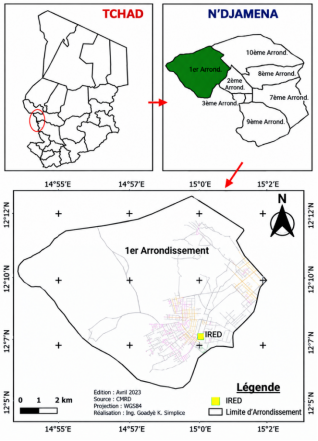
The study was conducted from September 2020 to May 2021 at the small ruminant station of the Institute of Research in Livestock for Development (IRED) in N'Djamena, Chad. The IRED is situated in the 1st arrondissement of N'Djamena, between 15°02′ East and 12°08′ North, at the confluence of the Chari and Logone rivers.
N'Djamena lies within the Sahelo-Saharan zone, characterized by a dry tropical climate. The year comprises two distinct seasons: the dry season and the rainy season. The rainy season lasts from June to September, with average rainfall ranging from 400 to 800 mm, depending on the North-South gradient
[10]
Doutoum A., Hamid A., Doungous M.D., Sakhaïroun A., TIDJANI A., Markhous A., Moukhtar R., SEYDI M., Abdourahamane B. 2020. Motifs de saisies de viandes rencontrées à l’abattoir frigorifique de Farcha (N’Djamena/Tchad). Revue Scientifique du Tchad - série B- janvier 2020.
[10]
. The dry season, which extends for 8 to 9 months, is marked by the harmattan, a hot and dry wind that sweeps across the region from Northeast to Southwest. Temperatures typically range between 20°C and 40°C. Figure 1 illustrates the location of the study area.
The vegetation is characterized by shrub savanna in the southern region, dominated by Acacia and Balanites species depending on soil type, alongside a herbaceous layer primarily composed of Andropogoneae. In the northern region, there is a steppe (or pseudo-steppe) characterized by widely spaced woody formations and a grass cover dominated by Aristida species. The fauna in this area is both abundant and diverse.
2.2. Animal Materials and Health Protection
Forty-eight (48) Arab sheep, comprising 45 non-pregnant females and 3 males (resulting in a sex ratio of 1 ram for every 15 ewes), were purchased from local markets for this study. These animals were housed in a raised structure made of wooden planks. They were taken to pasture every morning at 9 AM and returned to their pens at 5 PM. Their ages were assessed using a dentition analysis method, averaging approximately 20 months
[11]
Corcy J. C. 1991. La chèvre. La maison rustique. Paris. 273p.
[11]
. The animals were identifiable by collars worn around their necks.
The sheep underwent a 30-day acclimatization period at IRED, during which they received treatment with long-acting Oxytetracycline (1 ml/10 kg of body weight administered intramuscularly) and Levamisole 10% (1 ml/10 kg of body weight per animal monthly), both effective against adult gastrointestinal and pulmonary parasites.
2.3. Plant Material
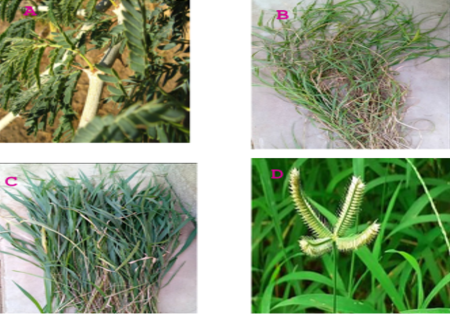
The plant material consisted of the most abundant forages in the grazing area: Dactyloctenium aegyptium, Cenchrus ciliaris, Panicum maximum, and the leaves of Acacia albida. These forages were harvested every morning for the animals’ feeding. Specifically, 300 g of Dactyloctenium aegyptium, 300 g of Cenchrus ciliaris, and 600 g of Panicum maximum were cut, chopped, and mixed to form the predominant forages available in the natural grazing areas.
Three different rations were formulated and randomly assigned to each group for the various studies. The rations were as follows:
R0: 300 g of Dactyloctenium aegyptium + 300 g of Cenchrus ciliaris + 600 g of Panicum maximum;
Figure 2. Acacia albida leave (A) and forages that dominate in the rangeland Cenchrus ciliaris (B), Panicum maximum (C), Dactyloctenium aeg (D).
In the evening, upon the animals' return from grazing, the formulated rations were served according to their respective groups.
2.4. Trial Management and Data Collection
The evaluation took place weekly, from lambing to weaning (12 weeks), using a double weighing method
[12]
Ouedraogo Z., Sawadogo L., et Nianogo J A. 2000. Influence du taux de coton dans la ration sur la production et la composition du lait chez la chevre du Sahel Burkinabé. Tropicultura, 18 (1), 32-36.
. The lamb was separated from its mother the evening before the milk production estimation. On the morning of the assessment, the lamb was weighed after fasting and then placed with its mother to nurse. After 10 minutes, the lamb was weighed again, isolated in a pen, and its mother was returned to the grazing area. This process was repeated three times daily (at 8 AM, 12 PM, and 4 PM). The daily yield was determined using the following formula:
Lamb weighing before and after nursing
Morning milk intake = P2 - P1
Noon milk intake= P4 - P3
Afternoon milk intake = P6 - P5
Total milk intake per day = (P2 - P1) + (P4 - P3) + (P6 - P5)
Which:
P1 = Weight of the lamb before nursing in the morning.
P2 = Weight of the lamb after nursing in the morning.
P3 = Weight of the lamb before nursing at noon.
P4 = Weight of the lamb after nursing at noon.
P5 = Weight of the lamb before nursing in the afternoon.
P6 = Weight of the lamb after nursing in the afternoon.
2.5. Data Analysis
Data on milk production were subjected to one-way analysis of variance (ANOVA) based on the feeding ration, following a completely randomized design. When significant differences were identified between treatments, Duncan's test was employed to separate the means at a significance level of 5% (Steel and Torrie, 1980). The statistical software SPSS 20.0 (Statistical Package for the Social Sciences) was utilized for these analyses, adhering to a linear model.
3. Results
3.1. Effect of Acacia Albida Leaf Supplementation on Feed Intake of Ewes
The intake of Acacia albida leaves, dominant rangeland forages and total nutrients by ewes is presented in Table 1. From this table, it appears that acacia leaf supplementation significantly (P<0.05) influenced the intake of dominant forages, dry matter (DM), organic matter (OM), crude protein (CP) and crude cellulose (CC) in Arab ewes. Indeed, increasing addition of the supplement in the ration allowed an increasing intake of the different nutrients as well as of the dominant forages.
Table 1. Acacia albida leaf supplementation on feed intake in ewes.
Feed intake (g MF/d/animal)
Control Lot
Lot 1
Lot 2
p
Acacia albida
/
400±0,00c
600±0,00b
0,001
Dominant forage on rangeland
Dactyloctenium aegyptium
205,73±4,05d
220,70±4,50c
231,54±2,10b
0,001
Cenchrus ciliaris
205,72±4,08d
220,90±5,31c
231,34±2,16b
0,001
Panicum maximum
411,45±8,50d
441,50±9,40c
462,88±5,13b
0,001
Total forage intake
822,90±16,63d
883,20±19,21c
925,76±9,39b
0,001
Total food ingested
Dry matter
1124,25±220,42d
1394,47±129,81c
1613,12±106,91b
0,001
Organic matter
1045,72±205,13d
1297,21±120,7c
1500,70±99,50b
0,001
Crude protein
296,78±26,43d
454,12±65,84c
580,32±62,75b
0,001
Crude cellulose
359,55±56,17d
427,90±34,90c
583,45±26,96b
0,001
a and b: Values marked with the same letter on the same row do not differ significantly (p > 0.05); Lot 0: Dominant forage from the grazing area without Acacia albida; Lot 1: Dominant forage from the grazing area + 400 g of Acacia albida; Lot 2: Dominant forage from the grazing area + 600 g of Acacia albida; P: Probability.
3.2. Effect of Supplementation with Acacia Albida Leaves on the Weight Gain of Lactating Ewes
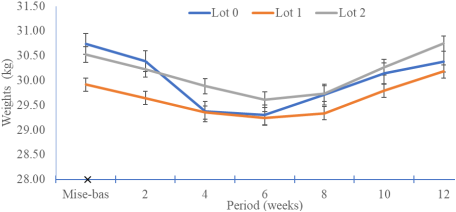
The influence of Acacia albida leaf supplementation on the weekly milk production of ewes is illustrated in Figure 3. It is evident that during this period, the average weekly weight of lactating females decreased until the sixth week, regardless of the group. Furthermore, in the initial weeks of lactation, the control group ewes had a higher weight compared to those in the supplemented groups. In contrast, from the second week of lactation until weaning, the weights of ewes receiving 600 g of Acacia albida leaves were higher than those of ewes in the control group and those receiving 400 g of Acacia albida leaves, respectively. The weight of ewes receiving 400 g of Acacia albida leaves remained consistently lower compared to the other groups throughout the trial.
Figure 3. Effect of Supplementation with Acacia Albida Leaves on the Weight Gain of Lactating Ewes.
Lot 0: Dominant forage from the grazing area without Acacia albida, Lot 1: Dominant forage from the grazing area + 400 g of Acacia albida, Lot 2: Dominant forage from the grazing area + 600 g of Acacia albida, P: Probability.
The influence of Acacia albida leaf supplementation on the weekly milk production of Arab ewes is presented in Table 2. From the first to the twelfth week, the milk production of ewes in the supplemented groups was consistently higher than that of the control group. By the fourth week, ewes supplemented with 400 g and 600 g of Acacia albida leaves produced 78.42% and 126.91% more milk, respectively, compared to those in the control group.
Peak lactation was observed in the second week for ewes receiving 400 g of Acacia albida leaves (1030.42 ± 85.53 g), in the fourth week for ewes receiving 600 g of Acacia albida leaves (973.00 ± 82.32 g), and in the eighth week for the control group (622.20 ± 60.06 g).
Table 2. Effect of Supplementation with Acacia Albida Leaves on Milk Production in Arab Ewes (kg).
Lots
post-partum Weeks
0
2
4
6
8
10
12
Lot0 (n=10)
562,00±12,68b
468,60±32,65b
428,80±38,01c
581,50±53,65b
622,20±60,06b
539,80±23,01b
311,50±35,75b
Lot1 (n=12)
997,08±81,91a
1030,42±85,53a
865,08±53,93b
825,58±87,49a
792,75±91,78a
585,08±45,84a
326,33±93,07a
Lot2 (n=10)
900,42±88,83a
930,58±29,85a
973,00±82,32a
897,50±22,91a
853,67±30,69a
570,25±79,23a
381,08±80,21a
P
0,002
0,000
0,000
0,000
0,002
0,001
0,002
a and b: Values marked with the same letter on the same row do not differ significantly (p > 0.05); Lot 0: Dominant forage from the grazing area without Acacia albida; Lot 1: Dominant forage from the grazing area + 400 g of Acacia albida; Lot 2: Dominant forage from the grazing area + 600 g of Acacia albida; P: Probability.
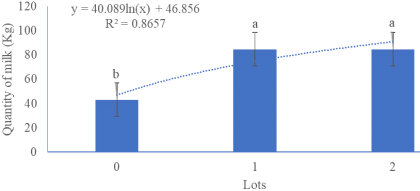
Ewes supplemented with 400 g and 600 g of Acacia albida leaves produced a total of 84.66 kg and 84.58 kg of milk, respectively, compared to 43.16 kg for those in the control group (Figure 4). Thus, the supplementation resulted in a respective increase of 96.15% and 95.96% in milk production for the Arab ewes receiving rations containing 400 g and 600 g of Acacia albida leave.
Figure 4. Effect of Supplementation with Acacia Albida Leaves on Total Milk Production (kg).

Control Group: Dominant forage from the grazing area without Acacia albida; Lot 1: Dominant forage from the grazing area + 400 g of Acacia albida; Lot 2: Dominant forage from the grazing area + 600 g of Acacia albida; P: Probability.
3.3. Effect of Supplementation with Acacia Albida Leaves on the Chemical Composition of Milk from Arab Ewes
The effect of supplementing rations with Acacia albida leaves on the chemical composition of milk from ewes indicates that the levels of dry matter, organic matter, ash, crude protein, and fat were comparable (p > 0.05), regardless of the ration (Table 3). However, it was noted that supplementation significantly (p < 0.05) improved lactose content. The lactose levels in the milk from supplemented animals were comparable (p > 0.05) among themselves and significantly higher (p < 0.05) than those from the non-supplemented groups.
Table 3. Effect of Supplementation with Acacia Albida Leaves on the Chemical Composition of Milk from Ewes.
Chemical Composition
Lot 0
Lot 1
Lot 2
p
DM (%)
14,72±0,51
14,11±0,48
15,07±0,52
0,218
OM (%MS)
14,01±0,52
14,40±0,48
14,35±0,51
0,216
Ash (%MS)
0,71±0,02
0,71±0,01
0,71±0,01
0,898
Crude Protein (%MS)
5,56±0,26
5,60±0,30
5,49±0,31
0,706
Fat (%MS)
8,35±1,90
7,91±1,18
8,55±1,95
0,698
Lactose (%MS)
4,47±0,15b
4,71±0,14a
4,64±0,22a
0,02
a and b: Values marked with the same letter on the same row do not differ significantly (p > 0.05); Lot 0: Dominant forage from the grazing area without Acacia albida; Lot 1: Dominant forage from the grazing area + 400 g of Acacia albida; Lot 2: Dominant forage from the grazing area + 600 g of Acacia albida; P: Probability.
4. Discussion
From the first to the twelfth week, the milk production of ewes in the supplemented groups was higher than that of the control group. The peak lactation was recorded in the second week (1030.42 ± 85.53 g) for ewes supplemented with 400 g of Acacia albida leaves and in the eighth week for the control group animals (622.20 ± 60.06 g). The fact that the lactation curve begins its downward phase from the second week in the control group, while it remains ascending for the supplemented ewes during the same period, appears to reflect the beneficial effect of supplementation on milk production. The milk production performance observed over the 12 weeks was superior to that reported by Rouissi et al.
[13]
Rouissi H., Rekik B., Selmi H., Hammami M et Ben Gara A. 2008. Performances laitières de la brebis Sicilo-Sarde Tunisienne complémenteé par un concentré local. Livestock Research for Rural Development 20 (7) 2008.
for Sicilo-Sarde Tunisian ewes supplemented with a local concentrate. This difference may be attributed to breed or genotype variations
[14]
Pamo T E., Niba A T., Fonteh F A., Tedonkeng F., Kana J R., Boukila B. et Tsachoung J. 2005. Effet de la supplémentation au Moringa oleifera ou au blocs multinutritionnels sur l'évolution du poids post partum et la croissance pré-sevrage des cobayes (Cavia porcellus L.). Livestok Research for Rural Developpement, Volume17, Article # 46. Retrieved August 28, 2009, from.
The chemical composition of the milk from the ewes demonstrated that the levels of dry matter, organic matter, ash, crude protein, and fat were comparable across all rations. However, the lactose content in the milk from the supplemented animals was comparable among themselves and significantly higher than that of the non-supplemented groups. This observed difference could be explained by the quality of the feed. The composition of milk from dairy ewes depends on genetic factors, the stage of lactation, the milking system, and, notably, nutrition
[15]
Atti N., Rouissi H 2003. La production de lait de brebis Sicilo Sarde: Effet de la nature de pâturage et du niveau de la complémentation. Annales INRA de Tunisie 76: 209-224.
[15]
. Adequate rations can enhance both the quantity and quality of milk during the lactation period
[16]
Bocquier F., Caja G 2001. Production et composition du lait de brebis: effets de l’alimentation. INRA Productions Animales 14: 129-140
. Indeed, the type of grass consumed and/or the hay distributed significantly affects the physicochemical quality of milk from Arab ewes
[15]
Atti N., Rouissi H 2003. La production de lait de brebis Sicilo Sarde: Effet de la nature de pâturage et du niveau de la complémentation. Annales INRA de Tunisie 76: 209-224.
[17]
Rouissi H., Atti N., Othmane M H 2005. Alimentation de la brebis Sicilo Sarde. Annales de l’I. N. R. A. de Tunisie 78: 147-161.
[15, 17]
.
5. Conclusion
The effect of supplementing with Acacia albida leaves on the production and chemical composition of milk from Arab ewes showed that supplementation led to an increase in milk production of 96.15% and 95.96% compared to the non-supplemented groups. However, supplementation did not significantly affect the chemical composition of the milk. Nonetheless, the lactose content in the milk from the supplemented animals was significantly higher than that of the non-supplemented groups.
Abbreviations
IRED
Research in Livestock for Development
DM
Dry Matter
OM
Organic Matter
CP
Crude Protein
CC
Crude Cellulose
Author Contributions
Oumar Moucthar Kodbe: Conceptualization, Writing – original draft
Ousmane Issa Abdel Djalil: Data curation, Methodology
The authors declare that they have no conflicts of interest.
References
[1]
Ousseini. 2017. Practical use of legume by-products in livestock feeding in the Niamey urban community: A case study of cowpea leaves (haulms) and pods., Journal of Applied Biosciences 120: 12007 p.
Lemoufouet J, Pamo T E et Tendonkeng F. 2012. Manuel de nutrition et de santé animale en Afrique Sub-Saharienne: Effet de deux niveaux de supplémentation aux feuilles de manioc (Manihot esculenta) sur les performances de croissance, la charge parasitaire et quelques caractéristiques du sang chez la chèvre naine de Guinée. Editions Universitaires Européennes. 89p.
[3]
Tendonkeng F, Fogang Zogang B, Camara Sawa, Boukila B, Pamo TE. 2014. effect of inclusion level of Tithonia diversifolia in multinutrient block on intake and in vivo digestibility of brachiaria diversifolia ruziziensis straw in West Africa Dwarf goat. Accepted for publication in Trop. Anim. Health and Prod. (In press).
Akouedegni G C., Adenile D A., Gbego S I & hounzangbe-adote S M. 2013. Efficacité des feuilles de spondias mombin. sur la production laitière et la croissance pondérale des ovins djallonké au sud-benin. Annales des Sciences Agro 17 (2): 137-148, 2013.
[6]
Toukourou Y., Abdoulaye M., Attakpa E Y., Alkoiret T I. 2016. Croissance des agneaux Djallonkés nourris avec du lait de soja. Tropicaltura, 2016, 34, 2, 150-157.
[7]
Meziane A. A., Maarouf A., Boukeloua A., Ahmed. 2021. Contribution à l’étude de la variation pondérale à des différents âges des agneaux de la naissance jusqu’à la puberté. Mémoire master 2020-2022.
Abassa K. P., Pessinaba J. et adeshola-ishola A. 1992. Croissance pré-sevrage des agneaux Djallonké au Centre de Kolokopé (Togo). Rev. Elev. Méd. Vét. Pays Trop., 45, 49-54.
[9]
Pamo T E, Tendonkeng F., Kana J R., Boukila B., et Nanda A. S. 2006. Effects of Calliandra calothyrsus and Leucaena leucocephala supplementary feeding on goat production in Cameroon. Small Ruminant Research, 65: 31-37.
[10]
Doutoum A., Hamid A., Doungous M.D., Sakhaïroun A., TIDJANI A., Markhous A., Moukhtar R., SEYDI M., Abdourahamane B. 2020. Motifs de saisies de viandes rencontrées à l’abattoir frigorifique de Farcha (N’Djamena/Tchad). Revue Scientifique du Tchad - série B- janvier 2020.
[11]
Corcy J. C. 1991. La chèvre. La maison rustique. Paris. 273p.
[12]
Ouedraogo Z., Sawadogo L., et Nianogo J A. 2000. Influence du taux de coton dans la ration sur la production et la composition du lait chez la chevre du Sahel Burkinabé. Tropicultura, 18 (1), 32-36.
Rouissi H., Rekik B., Selmi H., Hammami M et Ben Gara A. 2008. Performances laitières de la brebis Sicilo-Sarde Tunisienne complémenteé par un concentré local. Livestock Research for Rural Development 20 (7) 2008.
Pamo T E., Niba A T., Fonteh F A., Tedonkeng F., Kana J R., Boukila B. et Tsachoung J. 2005. Effet de la supplémentation au Moringa oleifera ou au blocs multinutritionnels sur l'évolution du poids post partum et la croissance pré-sevrage des cobayes (Cavia porcellus L.). Livestok Research for Rural Developpement, Volume17, Article # 46. Retrieved August 28, 2009, from.
Atti N., Rouissi H 2003. La production de lait de brebis Sicilo Sarde: Effet de la nature de pâturage et du niveau de la complémentation. Annales INRA de Tunisie 76: 209-224.
[16]
Bocquier F., Caja G 2001. Production et composition du lait de brebis: effets de l’alimentation. INRA Productions Animales 14: 129-140
Kodbe, O. M., Djalil, O. I. A., Mama, M., Julien, A., Emile, M., et al. (2026). Effect of Supplementation with Acacia Albida Leaves on Milk Production and Chemical Composition in Arab Ewes. International Journal of Animal Science and Technology, 10(4), 139-146. https://doi.org/10.11648/j.ijast.20261004.15
Kodbe, O. M.; Djalil, O. I. A.; Mama, M.; Julien, A.; Emile, M., et al. Effect of Supplementation with Acacia Albida Leaves on Milk Production and Chemical Composition in Arab Ewes. Int. J. Anim. Sci. Technol.2026, 10(4), 139-146. doi: 10.11648/j.ijast.20261004.15
Kodbe OM, Djalil OIA, Mama M, Julien A, Emile M, et al. Effect of Supplementation with Acacia Albida Leaves on Milk Production and Chemical Composition in Arab Ewes. Int J Anim Sci Technol. 2026;10(4):139-146. doi: 10.11648/j.ijast.20261004.15
@article{10.11648/j.ijast.20261004.15,
author = {Oumar Moucthar Kodbe and Ousmane Issa Abdel Djalil and Mouchili Mama and Azoutane Julien and Miegoue Emile and Tendonkeng Fernand},
title = {Effect of Supplementation with Acacia Albida Leaves on Milk Production and Chemical Composition in Arab Ewes},
journal = {International Journal of Animal Science and Technology},
volume = {10},
number = {4},
pages = {139-146},
doi = {10.11648/j.ijast.20261004.15},
url = {https://doi.org/10.11648/j.ijast.20261004.15},
eprint = {https://article.sciencepublishinggroup.com/pdf/10.11648.j.ijast.20261004.15},
abstract = {In arid and semi-arid regions, dairy sheep production is constrained by the quality and availability of feed resources, which can negatively affect milk yield and milk quality. Therefore, exploring locally available feed resources such as Acacia albida leaves may provide practical dietary alternatives to improve dairy performance in small ruminants. This study was conducted to evaluate the effect of dietary supplementation with Acacia albida leaves on milk production and the chemical composition of milk from Arab ewes. A feeding trial was conducted from September 2020 to May 2021 at the Small Ruminant Station of the Institute of Research in Livestock for Development (IRED), N’Djamena, Chad. Forty-eight (48) Arab sheep (45 non-pregnant females and 3 males, for a sex ratio of 1 ram to 15 ewes), with an average weight of 20.3 ± 1.2 kg and approximately 2 years old, were divided into 3 groups of 15 ewes each. The control group R0 received a ration consisting solely of baseline forages (300 g of Dactyloctenium aegyptium, 300 g of Cenchrus ciliaris, and 600 g of Panicum maximum). Milk production was evaluated every 7 days starting from lambing. The supplementation improved milk production by 96.15% and 95.96%, respectively, for the groups supplemented with 400 g and 600 g of Acacia albida leaves. Although supplementation did not significantly influence the chemical composition of the ewes' milk, the lactose content of milk from supplemented animals was significantly higher than that of non-supplemented groups. Supplementing the diet of Arab ewes with Acacia albida leaves (400 g or 600 g) from the experimental period substantially increased milk production, while having limited effects on the overall chemical composition of milk. However, it significantly increased lactose content, suggesting a beneficial effect on milk carbohydrate fraction.},
year = {2026}
}
TY - JOUR
T1 - Effect of Supplementation with Acacia Albida Leaves on Milk Production and Chemical Composition in Arab Ewes
AU - Oumar Moucthar Kodbe
AU - Ousmane Issa Abdel Djalil
AU - Mouchili Mama
AU - Azoutane Julien
AU - Miegoue Emile
AU - Tendonkeng Fernand
Y1 - 2026/11/24
PY - 2026
N1 - https://doi.org/10.11648/j.ijast.20261004.15
DO - 10.11648/j.ijast.20261004.15
T2 - International Journal of Animal Science and Technology
JF - International Journal of Animal Science and Technology
JO - International Journal of Animal Science and Technology
SP - 139
EP - 146
PB - Science Publishing Group
SN - 2640-1312
UR - https://doi.org/10.11648/j.ijast.20261004.15
AB - In arid and semi-arid regions, dairy sheep production is constrained by the quality and availability of feed resources, which can negatively affect milk yield and milk quality. Therefore, exploring locally available feed resources such as Acacia albida leaves may provide practical dietary alternatives to improve dairy performance in small ruminants. This study was conducted to evaluate the effect of dietary supplementation with Acacia albida leaves on milk production and the chemical composition of milk from Arab ewes. A feeding trial was conducted from September 2020 to May 2021 at the Small Ruminant Station of the Institute of Research in Livestock for Development (IRED), N’Djamena, Chad. Forty-eight (48) Arab sheep (45 non-pregnant females and 3 males, for a sex ratio of 1 ram to 15 ewes), with an average weight of 20.3 ± 1.2 kg and approximately 2 years old, were divided into 3 groups of 15 ewes each. The control group R0 received a ration consisting solely of baseline forages (300 g of Dactyloctenium aegyptium, 300 g of Cenchrus ciliaris, and 600 g of Panicum maximum). Milk production was evaluated every 7 days starting from lambing. The supplementation improved milk production by 96.15% and 95.96%, respectively, for the groups supplemented with 400 g and 600 g of Acacia albida leaves. Although supplementation did not significantly influence the chemical composition of the ewes' milk, the lactose content of milk from supplemented animals was significantly higher than that of non-supplemented groups. Supplementing the diet of Arab ewes with Acacia albida leaves (400 g or 600 g) from the experimental period substantially increased milk production, while having limited effects on the overall chemical composition of milk. However, it significantly increased lactose content, suggesting a beneficial effect on milk carbohydrate fraction.
VL - 10
IS - 4
ER -