Abstract
Small-scale irrigation in urban and peri-urban areas plays a key role in food security and livelihood improvement in Bamako, Mali. This study evaluates the performance and constraints of 10 irrigated market gardening sites using field surveys, soil and water analyses, and crop water requirement assessments. The objective was to assess the current status of irrigation practices, identify the main agronomic and environmental constraints, and propose feasible strategies for sustainable intensification in these production systems. Results show that soils are predominantly sandy (78–98%) with low organic matter (0–2%), making them poorly fertile and highly water demanding. These soil conditions reduce water retention capacity and increase the need for frequent irrigation, which may further aggravate inefficient water use. Irrigation water quality remains generally acceptable, with no significant heavy metal contamination (<0.01 mg/L), indicating that water sources are suitable for vegetable production under the studied conditions. However, irrigation practices were found to be inefficient, with applied water exceeding crop requirements by 2 to 8 times. Irrigation efficiency is estimated at 40–50%, reflecting substantial water losses and poor control of water application at field level. Correlation analysis indicates that crop yield is more related to water application than to irrigation efficiency, suggesting that farmers tend to compensate for low efficiency by over-applying water. While this practice may help maintain production in the short term, it is neither economically nor environmentally sustainable. Excessive irrigation may also contribute to nutrient leaching and long-term soil degradation.
Keywords
Small-scale Irrigation, Intensification, Irrigation Efficiency, Vegetable Crops, Bamako
1. Introduction
Small-scale garden irrigation refers to agriculture systems managed directly by individual farmers or community groups using localized water control methods to support crop production. Small-scale irrigation plays an essential role in improving agricultural productivity, food security, and income for smallholder farmers in Mali, particularly around the Bamako metropolitan area where market gardening is widespread. Access to reliable water pumping systems is crucial because rainfall in the Sudano-Sahelian climate is seasonal and irregular. Consequently, farmers rely on various water-lifting technologies to irrigate crops during the dry season.
These farming systems are particularly important in regions with unpredictable rainfall and limited formal irrigation infrastructure, such as Mali’s semi-arid context. Rainfed agriculture in Mali is also highly vulnerable to the strong rainfall variability associated with significant increasing trend of extreme events
| [1] | Sanogo, S., Fink, A. H., Omotosho, J. B., Ba, A., Redl, R., & Ermert, V. (2021). Spatio-temporal characteristics of recent rainfall recovery in West Africa. International Journal of Climatology, 41(3), 1649-1670.
https://doi.org/10.1002/joc.6737 |
[1]
. Such climatic variation makes irrigation a key tool to stabilize production, especially during dry seasons
. Bamako and surrounding areas such as Kati and Baguinéda are major centers of market gardening where irrigation water is typically extracted from wells, rivers, or shallow groundwater using different pumping technologies.
Manual irrigation technologies remain the most widely used systems among smallholder farmers in Bamako due to their low cost and accessibility. Many farmers extract water from wells using simple rope-and-bucket systems and then apply it to crops with watering cans or buckets. This method is common among resource-poor farmers but is highly labor-intensive and limits the irrigated area
| [3] | Kane, A. M., Lagat, J. K., Langat, J. K., & Teme, B. (2018). Determinants of technical efficiency of small-scale vegetables production under different irrigation systems in Koulikoro and Mopti Regions, Mali. American Journal of Agriculture and Forestry, 6(4), 71-77.
https://doi.org/10.11648/j.ajaf.20180604.12 |
[3]
.
Furthermore, motor pumps are increasingly used in market gardening areas around Bamako because they allow irrigation of larger areas and reduce labor. These pumps typically draw water from shallow groundwater, rivers, or reservoirs. Motor pumps are widely adopted by farmers with higher financial capacity, as they require fuel and maintenance costs. However, their reliability and high pumping capacity make them suitable for commercial vegetable production
| [3] | Kane, A. M., Lagat, J. K., Langat, J. K., & Teme, B. (2018). Determinants of technical efficiency of small-scale vegetables production under different irrigation systems in Koulikoro and Mopti Regions, Mali. American Journal of Agriculture and Forestry, 6(4), 71-77.
https://doi.org/10.11648/j.ajaf.20180604.12 |
[3]
.
From this perspective, urban and peri-urban market gardening is essential for ensuring food security and strengthening the economic resilience of urban households. Studies highlight that urban agriculture plays a major role in local food supply, job creation and poverty reduction
| [4] | Zipper, S. C., Schatz, J., Singh, A., Kucharik, C. J., Townsend, P. A., & Loheide, S. P. (2019). Urban land-use change and water resources: A review. Water Resources Research, 55, 112-129. https://doi.org/10.1029/2018WR023463 |
[4]
. Small-scale irrigation enables year-round vegetable production and increases household income and dietary diversity in Mali. It provides an adaptive mechanism to improve crop productivity, income, and household nutrition-critical factors for peri-urban agricultural landscapes surrounding Bamako, Mali’s capital. Furthermore, previous study demonstrate that regions around Bamako and southern Koulikoro have high potential for irrigation expansion based on proximity to surface water, groundwater availability, soil type, and land use; these biophysical potentials remain underutilized due to other limiting factors
| [4] | Zipper, S. C., Schatz, J., Singh, A., Kucharik, C. J., Townsend, P. A., & Loheide, S. P. (2019). Urban land-use change and water resources: A review. Water Resources Research, 55, 112-129. https://doi.org/10.1029/2018WR023463 |
[4]
. Nevertheless, Small-scale garden irrigation development remains constrained by socio-economic, institutional, and environmental challenges, while intensification strategies require careful design to be effective and sustainable. Those constraints include limited access to land, irrigation water quality and growing competition with urban land uses. Bamako, which is experiencing rapid population growth, is undergoing constant spatial expansion, putting increasing pressure on agricultural areas on the outskirts of the city. Many market gardening activities are carried out in a haphazard manner along the railway tracks, near cemeteries and in low-lying areas due to shallow groundwater levels
| [5] | Attia, A., Qureshi, A. S., Kane, A. M., Alikhanov, B., Kheir, A. M. S., Ullah, H., Datta, A., & Samasse, K. (2022). Selection of potential sites for promoting small-scale irrigation across Mali using remote sensing and GIS. Sustainability, 14(19), 12040. https://doi.org/10.3390/su141912040 |
[5]
. Rapid urbanization is causing a gradual decline in cultivated land and intensifying competition for access to water. Moreover, water distribution is uneven and water infrastructure is limited, leading to economic water scarcity that restricts farmers capacity to draw reliable water supplies for small gardens. Cheap, informal access to water is a coping mechanism, but lacks the sustainability needed for intensification
.
Vegetable irrigation in the Bamako region relies on a mix of traditional and modern, small-scale systems utilizing mainly the Niger River and shallow groundwater which require monitoring for contaminants
| [7] | Sangaré, L. O., Sun, H., Ba, S., Konté, M. S., Samaké, M., & Zheng, T. (2023). A multivariate approach to assessing the water quality of the Bamako reach of the Niger River in Mali as irrigation water. Water Environment Research, 95(10), e10933. https://doi.org/10.1002/wer.10933 |
[7]
. Key irrigation methods include manual watering, gravity-fed, Californian, sprinkler, and drip irrigation, with water often sourced from the Niger River or shallow wells. Manual methods like watering cans and motor pumps with hoses irrigation systems are the most widely used accounting for 30-42% of usage
| [3] | Kane, A. M., Lagat, J. K., Langat, J. K., & Teme, B. (2018). Determinants of technical efficiency of small-scale vegetables production under different irrigation systems in Koulikoro and Mopti Regions, Mali. American Journal of Agriculture and Forestry, 6(4), 71-77.
https://doi.org/10.11648/j.ajaf.20180604.12 |
[3]
.
While drip irrigation shows higher technical efficiency, adoption is limited by cost, with many farmers favoring low-cost, manually operated, or motorized pump systems
| [3] | Kane, A. M., Lagat, J. K., Langat, J. K., & Teme, B. (2018). Determinants of technical efficiency of small-scale vegetables production under different irrigation systems in Koulikoro and Mopti Regions, Mali. American Journal of Agriculture and Forestry, 6(4), 71-77.
https://doi.org/10.11648/j.ajaf.20180604.12 |
[3]
. The high costs for motorized pumps, the lack of equipment, and the limited training in efficient techniques like drip irrigation are major challenges for farmers
| [8] | Mabhaudhi, T., Dirwai, T. L., Taguta, C., Kanda, E. K., Nhamo, L., & Cofie, O. (2025). A systematic review of irrigation development and agricultural water management in Mali. In T. Mabhaudhi, V. G. P. Chimonyo, A. Senzanje, & P. P. Chivenge (Eds.), Enhancing Water and Food Security Through Improved Agricultural Water Productivity. Springer, Singapore.
https://doi.org/10.1007/978-981-96-1848-4_14 |
[8]
, although irrigation remains vital for food security and livelihood support
| [9] | Pona, Y., Mohomodou, W., Kanoute, M., & Diarra, B. G. (2023). Mapping of vegetable seed companies willing to adapt the solar irrigation system to produce in Mali. European Journal of Theoretical and Applied Sciences, 1(4), 1141-1150. https://doi.org/10.59324/ejtas.2023.1(4).106 |
[9]
.
Vegetable farming and fruit tree cultivation appear to be the most dynamic sectors of the urban agricultural economy. However, studies indicate that vegetable intake is often inadequate (below 240 g/day), with only 11.4% of adolescents that consumed adequate fruits and vegetables daily, contributing to micronutrient deficiencies
. According to the 1988–1989 Household Budget and Consumption Survey
, Bamako annually consumes 28,402.4 tons of various products, including 22,931.9 tons of vegetables, representing 80.7%.
Furthermore, vegetable consumption in Bamako is done within urban dietary patterns but it is influenced by market structures, cultural food practices, socioeconomic context, and health/safety concerns. Research points to a need for improved quantification of intake, targeted nutritional studies, and interventions that ensure safe, affordable, and nutritionally adequate vegetable consumption
| [12] | Endres, T., & Yang, R. Y. (2013). Vegetable production and consumption in Bamako, Mali. Tropentag, September 17-19, 2013, Stuttgart-Hohenheim, Germany. Available at:
https://www.tropentag.de/2013/ab |
[12]
.
Better understanding of constraints and potentials of small-scale garden irrigation systems is essential for any intensification strategies emphasizing on Mali contextual relevance to peri-urban agricultural systems around Bamako. The objective of this study is to assess the constraints related to the expansion of irrigation sites located in Bamako, evaluate the performance of market gardeners’ irrigation systems, and analyze potential improvement options. The study further proposes intensification strategies to increase production and promote the rational use of water throughout three cropping cycles (lettuce, carrot, and beetroot).
2. Theoretical Background
2.1. Soil Textural Fraction Classification
Soil textural fractions are the relative proportions of sand, silt, and clay particles in the fine earth fraction of soil. For better analyses of agricultural soils properties, the coarse element content of the soils is determined all the textural fractions as well with respect the standard soil classification of United States Department of Agriculture (USDA) in Table1.
Table 1. Limits distinguishing a textural fraction classification (USDA).
Sediment type | Diameter |
Clay | < 2 µm (0.002 mm) |
Silt | 2 µm to 50 µm (0.002 mm – 0.050 mm) |
Sand | 50 µm to 2 mm (0.050 mm - 2 mm) |
Gravel | 2 mm to 2 cm |
Pebble | 2 cm to 5 cm |
2.2. Soil Moisture Content and Density
The soil samples were dried in an oven at 105°C for 24 hours, and the initial moisture content (W (%)) is calculated as the ratio of the weight difference between the humid soil (mh) and dry soil (md) over the weight of humid soil (mh).
The dry soil is homogenized and a cylinder of known volume was weighed empty, then filled with a soil sample, after which the soil was weighed together with the cylinder, and the ratio of dry mass (msoil) to volume (V) was calculated to determine the soil density (dv).
The dry soil is weighed on a balance and sieved through a series of sieves with different mesh sizes, arranged in descending order from trop to bottom. The contents of each sieve were weighed to determine the textural class of the soils, with two tests per sample.
2.3. Soil Organic Matter Content
The soil organic matter content (OM) was determined. A wet sample with known weight is placed in an oven at 600°C for 24 hours. After cooling, the quantity of organic matter is calculated by calculating the difference between wet and dry masses.
2.4. Irrigation Water Analyses Metrics
The Irrigation efficiency (IE) is calculated as the ratio of water beneficially used (Wu) to the total water delivered (W).
Water productivity (WP) measures the output yield or economic value (Y) produced per unit of water consumed (Wc).
The Net irrigation water requirement (IWRnet) corresponds to the amount of water needed to satisfy the crop's water needs, regardless of losses. It is calculated from the reference evapotranspiration ET0, the crop coefficient Kc, and the effective rainfall (Peff) according to the following expression:
3. Materials and Methods
3.1. Description of Crop Varieties
Three types of crop varieties are subject of this study. They are part of the main vegetable crops use in irrigated land in urban and peri-urban of Bamako.
Lettuce:
Lettuce (Lactuca sativa L.) is an annual herbaceous plant widely cultivated in urban and peri-urban market gardening systems. It has a short production cycle ranging from 45 to 65 days, depending on climatic conditions and management practices.
Carrot:
Carrot (Daucus carota L.) is a biennial herbaceous plant cultivated as an annual crop for its edible root. Its production cycle generally varies between 60 and 90 days, depending on the variety and environmental conditions.
Beetroot:
Beetroot (Beta vulgaris L.) is a herbaceous plant cultivated for its swollen root. The length of its production cycle ranges from 60 to 120 days, depending on the variety, soil conditions, and irrigation practices.
3.2. Characteristics of the Study Area
3.2.1. Geographical Location of Irrigation Sites
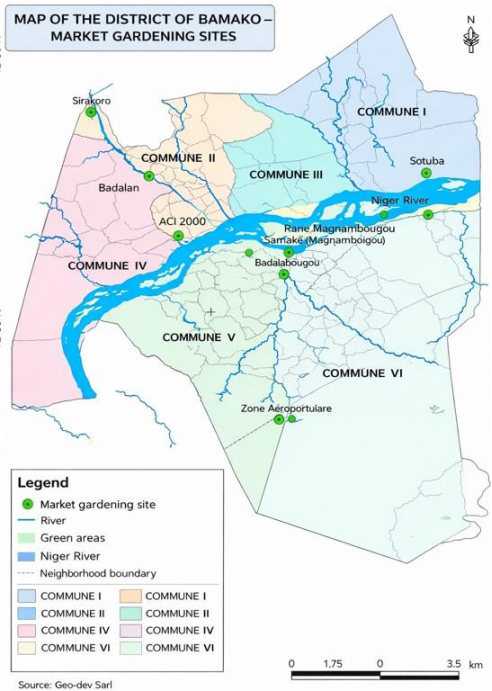
The study was conducted in the District of Bamako, located between longitude 7°59′ West and latitude 12°40′ North, along both banks of the Niger River. The district covers an area of approximately 267 km² and has a resident population of about 4,227,569 inhabitants according to the fifth General Population and Housing Census (RGPH5, 2023). Urban and peri-urban irrigation sites are mainly distributed along the riverbanks, lowlands, and areas with shallow groundwater, where water is accessible for market gardening activities.
Figure 1. Map of the Bamako district showing the selected sites.
3.2.2. Climate and Evapotranspiration
The climate of the District of Bamako is of the Sudanian type and is characterized by three distinct seasons throughout the year: a dry and cold season from November to February, a dry and hot season from March to May, and a rainy season from June to October. Average climatic data for the period 1981–2010 indicate a mean annual rainfall of approximately 928.1 mm, with an average of 76 rainy days per year. August is the wettest month, recording an average of about 19 rainy days. The climate is influenced by two main air-mass systems: the Harmattan, a dry air-mass blowing from the north and north-east between November and May, and the monsoon, a humid air-mass from the south and south-east prevailing from June to October.
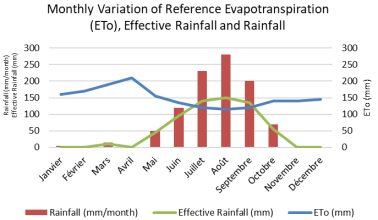
During the period June-October, effective rainfall is high (
Figure 2), and crops receive substantial rain water. This season is generally less favorable for irrigated market gardening since excessive rainfall may cause waterlogging, runoff, and flooding, especially in lowland and poorly drained areas. In contrast, the long period from November to May is characterized by very low or nearly zero rainfall.
This period is widely dedicated for market gardening because farmers can better control water application through irrigation and avoid excessive moisture conditions. The optimal period is particularly from December to April, when rainfall is almost absent. Nevertheless,
Figure 2 shows a reference evapotranspiration very high during those dry months, especially from January to April, which means that crop water demand is high and irrigation becomes essential.
Figure 2. Seasonal variation of monthly rainfall and reference evapotranspiration at the Bamako.
3.3. Data Sampling and Analyses
This study used soils chemical and hydrologic data, irrigated water chemical data and the amount of water used to irrigate daily. Climate data are used to estimate crops water needs. The yield data for the three selected crops is used to analyze the irrigation water productivity.
Soil samples were collected from three different depths: 0 to 5 cm, 5 to 15 cm and 15 to 30 cm. The depth was chosen based on the length of the plant roots, which reach up to 30 cm deep. The sampling process was carried out by taking five samples in a star pattern around a central point with a radius of 1 meter at each site. To ensure the representativeness of the samples at each site, at least 3 kg of soil was collected, packed in dry plastic bags, and then transported to the Laboratory of Optics, Spectroscopy and Atmospheric Sciences (LOSSA) for analysis. Thus, the soil moisture content and density, the organic matter content and the soils chemical properties are determined.
Water samples were taken from 10 points of different water sources (wells, backwaters and the river) used for irrigation of the study sites. The pH, salinity and conductivity of the water samples were measured for assessing the quality of the irrigation water of the sites.
Garden watering cans with known volume were used and samples were stored in a cooler before being transported to the laboratory on the same day. For all the sites, the quantity of water irrigated was measured at daily base and related to the surface area of each crop plot.
Yield is determined for each crop by weighting the harvest of selected plots and extrapolating the average value to the whole plots of the site. This measure has served to determine the irrigation water productivity using equation (4).
The amount of water needed to satisfy the crop's water needs, regardless of losses is estimated from climate data using equation (5).
3.4. Statistical Analysis
Data were analyzed using descriptive statistical methods to ensure robust interpretation of the results. Descriptive statistics, including mean, cross-correlation and standard deviation, were used to summarize soil properties, irrigation water quality, and crop yield data across the studied sites. Thus, Pearson correlation analysis was applied to evaluate the relationships between key variables, including soil parameters (pH, electrical conductivity, organic matter), irrigation water characteristics (pH, EC, Mg²⁺, Ca²⁺), irrigation efficiency, water productivity, and crop yield. This analysis allowed the identification of positive and negative associations between variables influencing irrigation performance. All statistical analyses were performed using Microsoft Excel and/or Python. Prior to analysis, data were checked for consistency and standardized where necessary. The significance of correlations was evaluated at a 95% confidence level (p < 0.05).
4. Results and Discussion
4.1. Land Constraint of Irrigated Small Scale Market Gardening
Most irrigated sites are located in narrow riverbanks and floodplains (
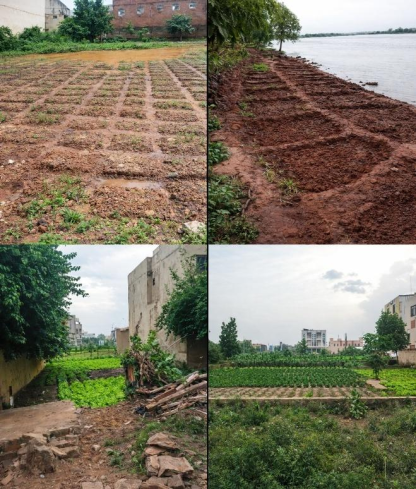
Figure 1). This creates physical land scarcity, as only specific lowland strips are suitable for irrigation. The existing irrigated market gardens are progressively reduced and fragmented (
Figure 3). Despite their importance for urban food supply and livelihoods, irrigated market gardening areas remain spatially vulnerable and institutionally weak within Bamako’s urban development framework. Market gardeners mainly access land through temporary loans, often in the form of leases on land belonging to the state or private owners. Land initially earmarked for housing construction in the City Council's urban development plans is increasingly sought after by farmers, which can lead to instability in market gardening areas as this land is taken away for the construction of housing, roads and infrastructure. This situation forces market gardeners to seek alternative locations, which they obtain with or without the agreement of local landowners in Bamako or its surroundings.
Figure 3. Illustration of the land constraints faced by irrigated small-scale market gardening in urban or peri-urban areas of Bamako.
Regarding the occupation of irrigation sites, plots are rented, and tenants share the proceeds of the farm with the owner in exchange for the payment of land fees. Loans are the most common means of access in Bamako, while legal owners show little interest in market gardening. In addition, the informal occupation of plots, whether registered or not, is a practice with no associated legal rights. Despite the broader recognition of the importance of urban gardening (as part of food security and employment), specific land security and irrigation support policies have remained weak or absent. Consequently, the total area devoted to market gardening has declined substantially over recent decades by 50% of reduction in cultivated surfaces between 1990 and 2020 due largely to urban encroachment and land-use change
| [14] | Diarra, B., Ballo, M., & Ampaud, J. (2003). Urban structure and spatial dynamics in Bamako, Mali. Bamako: Donniya. Available at:
https://horizon.documentation.ird.fr/exdoc/pleins_textes/divers17-05/010033911.pdf |
| [15] | Fomba, M., Osunde, Z. D., Traoré, S. S., Okhimamhe, A., Kleemann, J., & Fürst, C. (2024). Urban green spaces in Bamako and Sikasso, Mali: Land use changes and perceptions. Land, 13(1), 59.
https://doi.org/10.3390/land13010059 |
[14, 15]
. The photo in
Figure 2 highlights that the soil looks heavily worked but may be prone to compaction, erosion, or nutrient depletion due to continuous use and limited fallow periods. The presence of bare, freshly dug beds indicates active efforts to manage soil, but soil fertility and structure may be fragile.
4.2. Soil and Water Quality Constraints in Irrigated Small-Scale Market Gardening
Soil and water quality constraints in irrigated small-scale market gardening systems in urban floodplain areas of Bamako, stem from continuous intensive cultivation, use of contaminated irrigation water, poor drainage and urban pollution pressures.
The textural analysis of soils reveals that all market gardening sites are dominated by sand indicating high permeability, low water retention capacity and high risk of nutrient leaching. Regarding the organic matter content, several sites have 0% OM (Badialan, Daoudabougou, Zone aéroportuaire). The highest OM value was 3% at the Site 6 (ACI 2000), most sites range between 1 to 2% OM, which is considered low for agricultural soils.
Table 2 reveals that soil acidity is a major constraint in several Bamako sites, with pH levels as low as 4.20 at site 9 (Badjalan) and site 10 (Dianeguela). Such extreme acidity leads to aluminum and manganese toxicity, which stunts root growth and reduces the availability of essential nutrients like phosphorus, calcium, and magnesium. Most of the soil pollutants result from the chemical inputs as market gardeners intensively use a variety of synthetic pesticides and fertilizers to maintain yields in the face of pest pressure and soil nutrient depletion
| [16] | Le Bars, M., Maïga, A., Sacko, M., & Koïta, O. (2022). Pesticide contamination of water used for urban market gardening in Bamako (Mali). Current Research in Environmental Sustainability, 4, 100188.
https://doi.org/10.1016/j.crsust.2022.100188 |
[16]
.
Results highlight marked spatial variability in the physico-chemical characteristics of the sampled sites. Electrical conductivity ranges from 52 µS/cm at Site 10 (Dianeguela) to 587 µS/cm at Site 6 (airport zone) indicating differences in soluble salt content among sites. Most conductivity values remain relatively moderate, but the higher values at Site 6, airport zone and Site 4, Magnambougou (553 µS/cm) suggest comparatively greater mineralization. Soil (or sample) humidity is generally low, varying from 0.09% at Site 5 (Daoudabougou) to 0.27% at Site 8 (Sotuba). Indeed, urban market gardening often faces pollution from the use of pesticides, chemical fertilizers, and contaminated irrigation water (including wastewater). These practices can lead to the accumulation of heavy metals like zinc (Zn) and copper (Cu), which at high concentrations become toxic to both plants and consumers
| [13] | Samake, F., Babana, A., Yaro, F., Cisse, D., Traore, I., Kante, F., Kone, S., Diallo, A., Toure, H., & Toure, O. (2011). Health risks associated with the consumption of market garden products grown in urban and peri-urban areas of Bamako. Mali Public Health, 1(1), 27-31. Available at:
https://revues.ml/index.php/msp/article/view/133 |
[13]
.
Working on irrigation practices in Mali
| [8] | Mabhaudhi, T., Dirwai, T. L., Taguta, C., Kanda, E. K., Nhamo, L., & Cofie, O. (2025). A systematic review of irrigation development and agricultural water management in Mali. In T. Mabhaudhi, V. G. P. Chimonyo, A. Senzanje, & P. P. Chivenge (Eds.), Enhancing Water and Food Security Through Improved Agricultural Water Productivity. Springer, Singapore.
https://doi.org/10.1007/978-981-96-1848-4_14 |
[8]
highlight the risk of heavy metal accumulation (e.g., cadmium, chromium, zinc) in soils irrigated with polluted sources, especially where wastewater or urban effluent is used.
Table 2. Soils chemical characteristics in the surveyed market gardening sites in Bamako.
Sites | pH | EC (µs/cm) | Humidity (%) | Zn²⁺ (ppm) | Cu²⁺ (ppm) | OM (ppm) | Sand (%) | Loam (%) |
1 | 7.46 | 299 | 0.12 | 123 | 1 | 3.77 | 95 | 5 |
2 | 6.94 | 115.3 | 0.15 | 176 | 1 | 3.02 | 98 | 2 |
3 | 6.40 | 553 | 0.13 | 257 | 1 | 2.6 | 90 | 7 |
4 | 6.25 | 290 | 0.13 | 176 | 1 | 3.35 | 97 | 1.2 |
5 | 6.30 | 249 | 0.09 | 55 | 1 | 2.96 | 97 | 1.2 |
6 | 6.22 | 299 | 0.27 | 482 | 1 | 3.8 | 90 | 10 |
7 | 6.67 | 443 | 0.11 | 56 | 1 | 1.61 | 89 | 7 |
8 | 7.23 | 587 | 0.14 | 37 | 2.2 | 6.73 | 90 | 9 |
9 | 4.20 | 290 | 0.19 | 57 | 1 | 6.05 | 98 | 2 |
10 | 4.20 | 52 | 0.14 | 184 | 1 | 1.04 | 93 | 7 |
Table 3. Chemical characteristics of irrigation water in the surveyed market gardening sites.
Site | pH | EC (µS/cm) | Salinity | Mg²⁺ (mg/L) | Ca²⁺ (mg/L) | K⁺ (ppm) | OM (ppm) |
1 | 6.28 | 352 | 0 | 56 | 24 | 11.13 | < 0.03 |
2 | 6.73 | 374 | 0 | 40 | 20 | 11.91 | < 0.01 |
3 | 6.10 | 73.4 | 0 | 28 | 20 | 2.66 | < 0.01 |
4 | 7.10 | 340 | 0.1 | 64 | 16 | 11.16 | < 0.02 |
5 | 5.13 | 166 | 0 | 12 | 12 | 9.19 | < 0.01 |
6 | 7.50 | 268 | 0 | 100 | 60 | 3.71 | < 0.01 |
7 | 5.50 | 223 | 0 | 20 | 20 | 13.14 | < 0.01 |
8 | 5.77 | 49 | 0 | 20 | 12 | 3.41 | < 0.02 |
9 | 6.73 | 222 | 0 | 20 | 13 | 9 | < 0.01 |
10 | 4.5 | 175 | 0 | 10 | 13 | 11.13 | < 0.03 |
4.3. Irrigated Water and Crop Requirement
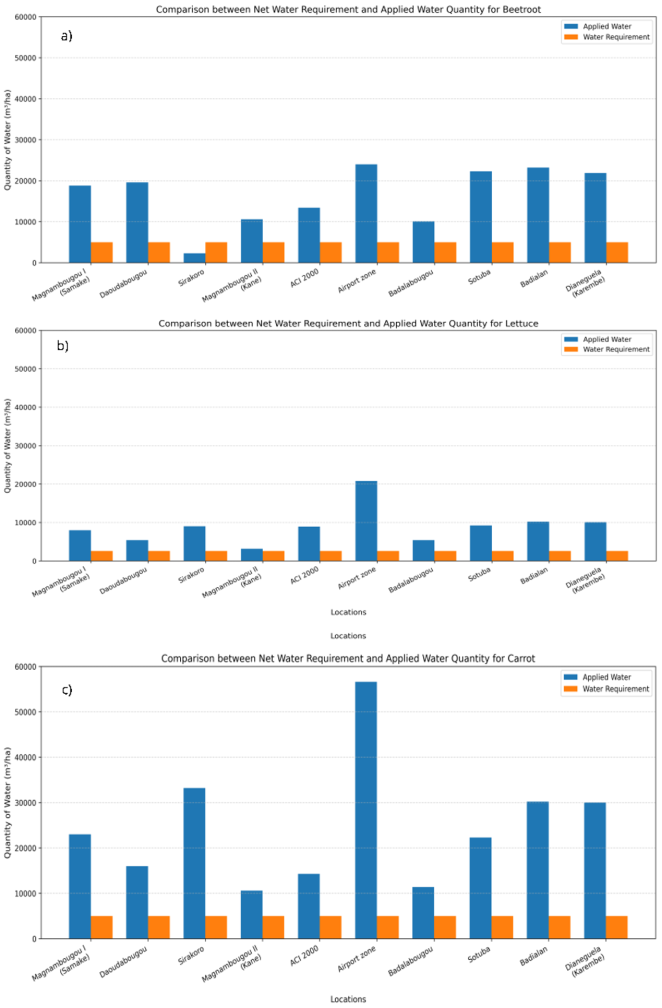
Figure 4 illustrates the comparison between the net irrigation water requirement (IWRnet) and the applied water quantity for beetroot, lettuce, and carrots across several market garden locations in Bamako. In nearly all sites and for all three crops, the applied water quantity significantly exceeds the net water requirement.
Indeed, farmers are applying about 2-4 times the required amount for beetroot crop (
Figure 4a). Lettuce has the lowest crop requirement, yet applied water is 3–8 times higher in many areas (
Figure 4b). This shows serious over-application despite lettuce being a shallow-rooted crop. Carrot production exhibits the largest gap between required and applied water, indicating the lowest irrigation efficiency among the three crops (
Figure 4c). The difference between applied water and crop requirement indicates low irrigation efficiency, as low as 40–50% in some areas. The excess use of water is induced by urban agriculture’s reliance on untreated wastewater and marginal water sources
which reflect both water scarcity and the absence of affordable, reliable irrigation infrastructure
| [8] | Mabhaudhi, T., Dirwai, T. L., Taguta, C., Kanda, E. K., Nhamo, L., & Cofie, O. (2025). A systematic review of irrigation development and agricultural water management in Mali. In T. Mabhaudhi, V. G. P. Chimonyo, A. Senzanje, & P. P. Chivenge (Eds.), Enhancing Water and Food Security Through Improved Agricultural Water Productivity. Springer, Singapore.
https://doi.org/10.1007/978-981-96-1848-4_14 |
[8]
.
The observed over-irrigation practices are consistent with previous studies in West African urban agriculture, where farmers tend to apply excessive water due to lack of efficient irrigation technologies and risk avoidance strategies. Similar findings were reported by previous studies
| [20] | Gerke, J. (2022). The central role of soil organic matter in soil fertility and carbon storage. Soil Systems, 6(2), 33.
https://doi.org/10.3390/soilsystems6020033 |
| [22] | Keraita, B., Drechsel, P., & Konradsen, F. (2022). Wastewater irrigation and urban vegetable farming in West Africa. Water International, 47(3), 355-372.
https://doi.org/10.1080/02508060.2022.2041234 |
[20, 22]
, confirming that irrigation inefficiency is a systemic issue in the region. This highlights the need for both technological solutions and farmer training programs.
Figure 4. Net irrigation water requirement (IWRnet) and the applied water quantity for the three crops at each site.
4.4. Correlation Between Irrigation Variables
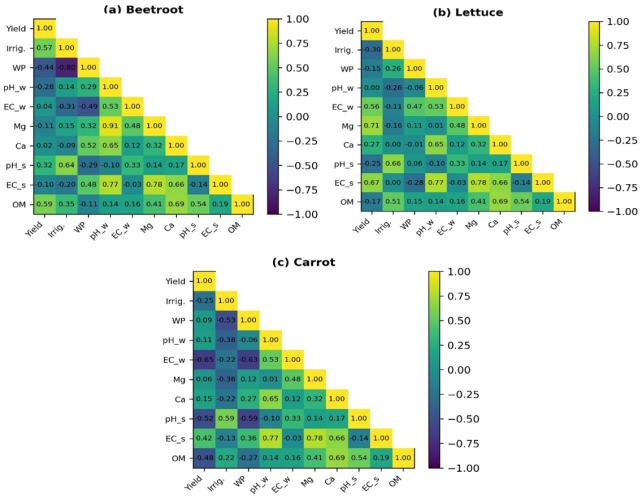
Figure 5 depicts correlation matrix established among irrigation variables: Yield, Irrigation efficiency (Irrig), water productivity (WP), Irrigation water quality (pH, CE, Mg2+, Ca2+) and Soil properties (pH, CE, OM). Strong positive correlations are observed among irrigation Water Quality Variables namely water pH, CE, Mg2+ and Ca2+ (
Figure 5). This indicates that irrigation water salinity (electrical conductivity) in study sites is mainly driven by calcium and magnesium concentrations. The irrigation water is therefore mineralized, and EC reflects dissolved alkaline earth salts.
Moreover, Irrigation performance indicators suggest that yield increases are mainly associated with higher water application rather than improved efficiency. Crop-specific yield relationships for beetroot (
Figure 5a) reveals that yield is positively correlated with irrigation efficiency (Irrig), soil pH and soil organic matter. But, the yield is negatively correlated with water productivity (WP). This observation indicates that beetroot yield increases with better irrigation management and improved soil fertility conditions. However, higher yields are associated with increased water use rather than higher water productivity.
Lettuce crop-specific yield relationships indicate positive correlation between yield and water EC, Mg²⁺, and soil EC while it is slightly negatively correlated with soil pH (
Figure 5b). The relationship of the yield with irrigation efficiency is very weak. Thus, the correlation analysis suggests that lettuce tolerates moderate salinity and benefits from dissolved minerals in irrigation water.
Figure 5. Correlation between market garden irrigation variables: Yield, Irrigation efficiency (Irrig), water productivity (WP), Irrigation water quality (pH, CE, Mg2+, Ca2+) and Soil properties (pH, CE, OM).
Carrot yield is negatively correlated with water EC (salinity) (-0.65), Soil pH (-0.52) and soil organic matter (-0.48) (
Figure 5c). Also, Carrot yield is more sensitive to salinity stress and prefers balanced soil pH (not strongly alkaline). Carrot crops appear to be the most sensitive crop to salinity and water quality issues among the three.
The cross-correlation analyses (
Figure 5) further reveal that market gardening in Bamako is characterized by strong dependence on soil fertility (OM, Mg, Ca), high sensitivity to water management and quality, an evidence of over-irrigation and salinity risks.
5. Improvement options for Intensification of Irrigation Systems
Because expanding irrigation areas is increasingly difficult at the studied sites, the priority should be to improve the productivity and water-use efficiency of the land that is already being cultivated. In the peri-urban context of Bamako, land pressure is high due to urban growth, infrastructure development, and competition with non-agricultural land uses. For this reason, future irrigation strategies should focus on optimizing existing market gardening plots through better field layout, improved irrigation practices, and adapted soil and water management techniques. Thus, effective irrigation intensification implies integrating efficient technology, Smart scheduling, Soil health, Water quality control and crop-specific management.
5.1. Integration of Market Garden Irrigated Land in Urban Planing
From a planning perspective, vegetable production land should be better integrated into municipal and peri-urban development schemes. In practice, suitable sites for market gardening should be maintained or developed in areas located between Bamako and neighboring towns, where land is still available and where farmers can access reliable water resources such as rivers, ponds, shallow groundwater, or other permanent water bodies. This spatial planning dimension is essential for the long-term sustainability of irrigation, because water availability and land accessibility directly determine production capacity, especially during the dry season. Better land-use planning and integrated territorial management are therefore necessary to protect strategic vegetable production areas in a rapidly expanding city
| [15] | Fomba, M., Osunde, Z. D., Traoré, S. S., Okhimamhe, A., Kleemann, J., & Fürst, C. (2024). Urban green spaces in Bamako and Sikasso, Mali: Land use changes and perceptions. Land, 13(1), 59.
https://doi.org/10.3390/land13010059 |
| [18] | Pramanik, A. (2025). Plant population dynamics: Crop density, plant geometry and planting geometry. In Fundamentals of Agronomy (pp. 56-65). Agriroot Publication House. Available at: https://www.researchgate.net/publication/395335501_Plant_Population_Dynamics_Crop_Density_Plant_Geometry_and_Planting_Geometry |
[15, 18]
.
5.2. Improvement Option in Flood-Prone Areas
Many of the studied sites are affected by seasonal flooding, waterlogging, or poor drainage during the rainy period. Under these conditions, the use of raised beds (solid beds) is a practical and effective improvement option. Raised beds elevate the crop root zone above the surrounding soil surface, which helps reduce excess moisture around roots, improves drainage, and limits crop damage caused by temporary inundation. This is particularly important for vegetables such as carrot and beetroot, which are sensitive to waterlogging and require well-aerated soils for proper root development.
Raised beds can also contribute to better irrigation management during the dry season. Since water is applied within a more structured planting system, irrigation can be directed more precisely to the crop rows, reducing runoff and improving infiltration near the root zone. In sandy soils, which dominate the study area, this approach can help farmers apply water in smaller and better-controlled amounts, thereby reducing unnecessary losses by deep percolation. Raised beds may also facilitate maintenance operations such as weeding, fertilization, and harvesting, which can improve overall labor efficiency.
5.3. Transition to Localized Irrigation (Drip/Micro-irrigation)
Water use efficiency can be improved by adopting Drip or Micro-irrigation which reduces water losses, improves uniformity, and delivers nutrients directly to the root zone (fertigation). Controlled deficit irrigation as Drip-irrigation improves water use efficiency since it applies slightly less than full ETc during non-sensitive stages. Indeed, drip irrigation systems offer higher technical efficiency up to 90–95% (Kane et al. 2018). This irrigation technique is particularly useful for carrot and beetroot.
5.4. Biochemical Soil Management for Intensification
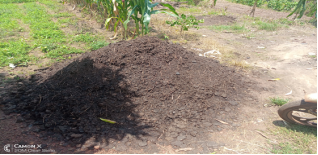
The rational use of organic fertilizers such as compost (carbon-based materials or plant residues,
Figure 6 is recommended on all sites, particularly those with 0% organic matter in the topsoil layer. Organic matter helps improve the soil’s fertility properties. This role of organic matter in improving soil fertility, structure, and water retention is well documented in the literature
| [17] | Kranjac-Berisavljevic, G., & Saba, C. K. S. (2021). Wastewater use in West African urban agriculture: Benefits and risks. In W. Leal Filho, A. M. Azul, L. Brandli, A. Lange Salvia, & T. Wall (Eds.), Clean Water and Sanitation. Encyclopedia of the UN Sustainable Development Goals. Springer, Cham. https://doi.org/10.1007/978-3-319-70061-8_169-1 |
| [19] | Azadi, H. (2025). Abstracts of the 2nd International Electronic Conference on Land. Environmental and Earth Sciences Proceedings, 36(1), 2.
https://doi.org/10.3390/eesp2025036002 |
[17, 19]
.
Figure 6. Compost made from animal residues.
The intensification of vegetable production requires the rational use of organic matter. Thus, sites with very low pH levels (acidic), such as Dianéguela and ACI 2000, can be treated with agricultural lime (0.5 kg per m²), which helps neutralize soil acidity and increase productivity.
Soils require organic matter to improve their physical, chemical, and biological properties. Manure should be applied before preparing the planting beds, followed by irrigation for 2 to 3 days prior to sowing or transplanting crops.
Vegetable growers can also use tree leaves and crop residues to enrich the soil, thereby increasing the soil’s water and nutrient retention capacity.
5.5. Increase of Planting Crop Density
Increasing the number of plants while respecting the minimum recommended spacing for each crop helps optimize the available space for vegetable production. Lettuce should be spaced 20 cm apart, with rows separated by 25 cm. Sowing depth should range between 0.5 and 1 cm. During transplanting, plants should be spaced 30 to 40 cm between rows and 20 to 30 cm within the row. For beetroot, the recommended spacing is 30 cm × 20 cm. Carrots are generally broadcast-sown. Optimizing planting geometry is therefore an important component of irrigation intensification in limited urban spaces
. This strategy of increased crop density can be relevant for larger agricultural land investments as demonstrated at the Office Niger irrigated land
| [23] | Sidibe, Y., & Williams, T. O. (2016). Agricultural land investments and water management in the Office du Niger, Mali: Options for improved water pricing. Water International, 41(5), 738-755. https://doi.org/10.1080/02508060.2016.1178900 |
[23]
.
6. Conclusion
Results from this study show that irrigated small-scale market gardening in Bamako is constrained by physical land scarcity, environmental vulnerability, and urban land pressure, limiting both productivity and sustainability. The study has led to the following key findings:
1) The market garden soils of Bamako (0–30 cm layer) are very sandy, low in organic matter, naturally and inherently low in fertility and highly dependent on irrigation and fertilization management.
2) Beetroot benefits most from improved soil conditions (pH and organic matter).
3) Lettuce is more influenced by irrigation water chemistry (especially EC and Mg).
4) Carrot is more sensitive to salinity and soil chemical imbalance.
5) Water quality management is especially critical for carrot production.
6) Soil pH optimization is particularly important for beetroot.
Since expanding irrigation areas is increasingly difficult, intensification remains the most viable option. Effective intensification of small-scale irrigated market gardening requires integration of market garden irrigated land in urban planning, improvement options in flood-prone areas, transition to localized irrigation (drip/micro-irrigation) and increase of planting crop density. To emphasize, the use of organic fertilizers is necessary across all sites to correct organic matter deficiencies.
The various strategies identified can contribute to the effective intensification of the market garden irrigation system of Bamako. From a future perspective, further studies extending to other localities are required, and the proposed intensification solutions should be subject to evaluation.
This study highlights that improving irrigation efficiency is more critical than increasing water supply. Sustainable intensification requires a combination of technical, agronomic, and institutional solutions adapted to urban agricultural systems. Future research should focus on scaling these solutions and testing their effectiveness across different agro-ecological conditions.
Abbreviations
mh | Mass of Humid Soil |
md | Mass of Dry Soil |
dv | Soil Density |
W (%) | Initial Moisture Content |
IWRnet | Net irrigation Water Requirement |
IE | Irrigation Efficiency |
WPr | Water Productivity |
Y | Yield Value per Unit of Water Consumed |
Wc | Water Consumed |
Wu | Water Effectively Used |
ET0 | Reference Evapotranspiration |
Kc | Crop Cultural Coefficient |
Author Contributions
Siaka Kodio: Conceptualization, Data curation, Formal Analysis, Investigation, Methodology, Visualization, Writing – original draft
Souleymane Sanogo: Conceptualization, Methodology, Supervision, Validation, Writing – review & editing
Boubacar Ziberou: Data curation, Investigation, Resources, Validation
Issiaka Traore: Formal Analysis, Investigation, Methodology, Validation, Writing – review & editing
Funding
The International Science Program (ISP/IPPS) provided research resources and workspace for this study through its granted research group MAL: 01. We are also grateful to the anonymous reviewers whose feedback helped to make the paper better.
Data Availability Statement
The data is available from the corresponding author upon reasonable request.
Conflicts of Interest
The authors declare no conflicts of interest.
References
| [1] |
Sanogo, S., Fink, A. H., Omotosho, J. B., Ba, A., Redl, R., & Ermert, V. (2021). Spatio-temporal characteristics of recent rainfall recovery in West Africa. International Journal of Climatology, 41(3), 1649-1670.
https://doi.org/10.1002/joc.6737
|
| [2] |
Roudier, P., Sultan, B., Quirion, P., & Berg, A. (2016). The impact of future climate change on West African crop yields. Climatic Change, 138, 445-461.
https://doi.org/10.1007/s10584-016-1702-3
|
| [3] |
Kane, A. M., Lagat, J. K., Langat, J. K., & Teme, B. (2018). Determinants of technical efficiency of small-scale vegetables production under different irrigation systems in Koulikoro and Mopti Regions, Mali. American Journal of Agriculture and Forestry, 6(4), 71-77.
https://doi.org/10.11648/j.ajaf.20180604.12
|
| [4] |
Zipper, S. C., Schatz, J., Singh, A., Kucharik, C. J., Townsend, P. A., & Loheide, S. P. (2019). Urban land-use change and water resources: A review. Water Resources Research, 55, 112-129.
https://doi.org/10.1029/2018WR023463
|
| [5] |
Attia, A., Qureshi, A. S., Kane, A. M., Alikhanov, B., Kheir, A. M. S., Ullah, H., Datta, A., & Samasse, K. (2022). Selection of potential sites for promoting small-scale irrigation across Mali using remote sensing and GIS. Sustainability, 14(19), 12040.
https://doi.org/10.3390/su141912040
|
| [6] |
Hamadoun, M. (1995). Industrial growth in Mali: The issue of waste in the Bamako industrial zone. Small Grants Program for Research on Population and Development, Synthesis Report, 12 p.
https://instat-mali.org/laravel-filemanager/files/shares/ca/sdsmli20-24_ca.pdf
|
| [7] |
Sangaré, L. O., Sun, H., Ba, S., Konté, M. S., Samaké, M., & Zheng, T. (2023). A multivariate approach to assessing the water quality of the Bamako reach of the Niger River in Mali as irrigation water. Water Environment Research, 95(10), e10933.
https://doi.org/10.1002/wer.10933
|
| [8] |
Mabhaudhi, T., Dirwai, T. L., Taguta, C., Kanda, E. K., Nhamo, L., & Cofie, O. (2025). A systematic review of irrigation development and agricultural water management in Mali. In T. Mabhaudhi, V. G. P. Chimonyo, A. Senzanje, & P. P. Chivenge (Eds.), Enhancing Water and Food Security Through Improved Agricultural Water Productivity. Springer, Singapore.
https://doi.org/10.1007/978-981-96-1848-4_14
|
| [9] |
Pona, Y., Mohomodou, W., Kanoute, M., & Diarra, B. G. (2023). Mapping of vegetable seed companies willing to adapt the solar irrigation system to produce in Mali. European Journal of Theoretical and Applied Sciences, 1(4), 1141-1150.
https://doi.org/10.59324/ejtas.2023.1(4).106
|
| [10] |
FAO. (2023). The State of Food and Agriculture 2023: Water for Sustainable Food Systems. FAO, Rome.
https://www.fao.org/publications/sofa/2023/en
|
| [11] |
DNSI. (2005). RGA Report. National Directorate of Statistics and Informatics, Statistical Master Plan, Bamako. Available at:
https://instat-mali.org/laravel-filemanager/files/shares/ca/sdsmli20-24_ca.pdf
|
| [12] |
Endres, T., & Yang, R. Y. (2013). Vegetable production and consumption in Bamako, Mali. Tropentag, September 17-19, 2013, Stuttgart-Hohenheim, Germany. Available at:
https://www.tropentag.de/2013/ab
|
| [13] |
Samake, F., Babana, A., Yaro, F., Cisse, D., Traore, I., Kante, F., Kone, S., Diallo, A., Toure, H., & Toure, O. (2011). Health risks associated with the consumption of market garden products grown in urban and peri-urban areas of Bamako. Mali Public Health, 1(1), 27-31. Available at:
https://revues.ml/index.php/msp/article/view/133
|
| [14] |
Diarra, B., Ballo, M., & Ampaud, J. (2003). Urban structure and spatial dynamics in Bamako, Mali. Bamako: Donniya. Available at:
https://horizon.documentation.ird.fr/exdoc/pleins_textes/divers17-05/010033911.pdf
|
| [15] |
Fomba, M., Osunde, Z. D., Traoré, S. S., Okhimamhe, A., Kleemann, J., & Fürst, C. (2024). Urban green spaces in Bamako and Sikasso, Mali: Land use changes and perceptions. Land, 13(1), 59.
https://doi.org/10.3390/land13010059
|
| [16] |
Le Bars, M., Maïga, A., Sacko, M., & Koïta, O. (2022). Pesticide contamination of water used for urban market gardening in Bamako (Mali). Current Research in Environmental Sustainability, 4, 100188.
https://doi.org/10.1016/j.crsust.2022.100188
|
| [17] |
Kranjac-Berisavljevic, G., & Saba, C. K. S. (2021). Wastewater use in West African urban agriculture: Benefits and risks. In W. Leal Filho, A. M. Azul, L. Brandli, A. Lange Salvia, & T. Wall (Eds.), Clean Water and Sanitation. Encyclopedia of the UN Sustainable Development Goals. Springer, Cham.
https://doi.org/10.1007/978-3-319-70061-8_169-1
|
| [18] |
Pramanik, A. (2025). Plant population dynamics: Crop density, plant geometry and planting geometry. In Fundamentals of Agronomy (pp. 56-65). Agriroot Publication House. Available at:
https://www.researchgate.net/publication/395335501_Plant_Population_Dynamics_Crop_Density_Plant_Geometry_and_Planting_Geometry
|
| [19] |
Azadi, H. (2025). Abstracts of the 2nd International Electronic Conference on Land. Environmental and Earth Sciences Proceedings, 36(1), 2.
https://doi.org/10.3390/eesp2025036002
|
| [20] |
Gerke, J. (2022). The central role of soil organic matter in soil fertility and carbon storage. Soil Systems, 6(2), 33.
https://doi.org/10.3390/soilsystems6020033
|
| [21] |
Bashir, H., Zafar, S. A., Rehman, R. S., Khalid, M. N., & Amjad, I. (2023). The importance of soil organic matter (SOM) on soil productivity and plant growth. Biological and Agricultural Sciences Research Journal, 2023, 11.
https://doi.org/10.54112/basrj.v2023i1.11
|
| [22] |
Keraita, B., Drechsel, P., & Konradsen, F. (2022). Wastewater irrigation and urban vegetable farming in West Africa. Water International, 47(3), 355-372.
https://doi.org/10.1080/02508060.2022.2041234
|
| [23] |
Sidibe, Y., & Williams, T. O. (2016). Agricultural land investments and water management in the Office du Niger, Mali: Options for improved water pricing. Water International, 41(5), 738-755.
https://doi.org/10.1080/02508060.2016.1178900
|
Cite This Article
-
APA Style
Kodio, S., Sanogo, S., Ziberou, B., Traore, I. (2026). Intensification Strategies for Small-Scale Irrigation Systems in Urban Areas: Case Study of Bamako District. International Journal of Applied Agricultural Sciences, 12(2), 36-47. https://doi.org/10.11648/j.ijaas.20261202.13
 Copy
|
Copy
|
 Download
ACS Style
Kodio, S.; Sanogo, S.; Ziberou, B.; Traore, I. Intensification Strategies for Small-Scale Irrigation Systems in Urban Areas: Case Study of Bamako District. Int. J. Appl. Agric. Sci. 2026, 12(2), 36-47. doi: 10.11648/j.ijaas.20261202.13
Copy
|
Download
AMA Style
Kodio S, Sanogo S, Ziberou B, Traore I. Intensification Strategies for Small-Scale Irrigation Systems in Urban Areas: Case Study of Bamako District. Int J Appl Agric Sci. 2026;12(2):36-47. doi: 10.11648/j.ijaas.20261202.13
Copy
|
Download
-
@article{10.11648/j.ijaas.20261202.13,
  author = {Siaka Kodio and Souleymane Sanogo and Boubacar Ziberou and Issiaka Traore},
  title = {Intensification Strategies for Small-Scale Irrigation Systems in Urban Areas: Case Study of Bamako District},
  journal = {International Journal of Applied Agricultural Sciences},
  volume = {12},
  number = {2},
  pages = {36-47},
  doi = {10.11648/j.ijaas.20261202.13},
  url = {https://doi.org/10.11648/j.ijaas.20261202.13},
  eprint = {https://article.sciencepublishinggroup.com/pdf/10.11648.j.ijaas.20261202.13},
  abstract = {Small-scale irrigation in urban and peri-urban areas plays a key role in food security and livelihood improvement in Bamako, Mali. This study evaluates the performance and constraints of 10 irrigated market gardening sites using field surveys, soil and water analyses, and crop water requirement assessments. The objective was to assess the current status of irrigation practices, identify the main agronomic and environmental constraints, and propose feasible strategies for sustainable intensification in these production systems. Results show that soils are predominantly sandy (78–98%) with low organic matter (0–2%), making them poorly fertile and highly water demanding. These soil conditions reduce water retention capacity and increase the need for frequent irrigation, which may further aggravate inefficient water use. Irrigation water quality remains generally acceptable, with no significant heavy metal contamination (<0.01 mg/L), indicating that water sources are suitable for vegetable production under the studied conditions. However, irrigation practices were found to be inefficient, with applied water exceeding crop requirements by 2 to 8 times. Irrigation efficiency is estimated at 40–50%, reflecting substantial water losses and poor control of water application at field level. Correlation analysis indicates that crop yield is more related to water application than to irrigation efficiency, suggesting that farmers tend to compensate for low efficiency by over-applying water. While this practice may help maintain production in the short term, it is neither economically nor environmentally sustainable. Excessive irrigation may also contribute to nutrient leaching and long-term soil degradation.},
 year = {2026}
}
Copy
|
Download
-
TY  - JOUR
T1  - Intensification Strategies for Small-Scale Irrigation Systems in Urban Areas: Case Study of Bamako District
AU  - Siaka Kodio
AU  - Souleymane Sanogo
AU  - Boubacar Ziberou
AU  - Issiaka Traore
Y1  - 2026/04/21
PY  - 2026
N1  - https://doi.org/10.11648/j.ijaas.20261202.13
DO  - 10.11648/j.ijaas.20261202.13
T2  - International Journal of Applied Agricultural Sciences
JF  - International Journal of Applied Agricultural Sciences
JO  - International Journal of Applied Agricultural Sciences
SP  - 36
EP  - 47
PB  - Science Publishing Group
SN  - 2469-7885
UR  - https://doi.org/10.11648/j.ijaas.20261202.13
AB  - Small-scale irrigation in urban and peri-urban areas plays a key role in food security and livelihood improvement in Bamako, Mali. This study evaluates the performance and constraints of 10 irrigated market gardening sites using field surveys, soil and water analyses, and crop water requirement assessments. The objective was to assess the current status of irrigation practices, identify the main agronomic and environmental constraints, and propose feasible strategies for sustainable intensification in these production systems. Results show that soils are predominantly sandy (78–98%) with low organic matter (0–2%), making them poorly fertile and highly water demanding. These soil conditions reduce water retention capacity and increase the need for frequent irrigation, which may further aggravate inefficient water use. Irrigation water quality remains generally acceptable, with no significant heavy metal contamination (<0.01 mg/L), indicating that water sources are suitable for vegetable production under the studied conditions. However, irrigation practices were found to be inefficient, with applied water exceeding crop requirements by 2 to 8 times. Irrigation efficiency is estimated at 40–50%, reflecting substantial water losses and poor control of water application at field level. Correlation analysis indicates that crop yield is more related to water application than to irrigation efficiency, suggesting that farmers tend to compensate for low efficiency by over-applying water. While this practice may help maintain production in the short term, it is neither economically nor environmentally sustainable. Excessive irrigation may also contribute to nutrient leaching and long-term soil degradation.
VL  - 12
IS  - 2
ER  -
Copy
|
Download





 Share This Article
 Twitter
 Linked In
 Facebook