Abstract
Informal groups are important yet often overlooked components of organizational life that significantly influence leadership practices, communication processes, and decision-making outcomes. This study explored the influence of informal groups on leadership practices in Ethiopian Agricultural Technical and Vocational Education and Training (ATVET) Colleges. Guided by Social Capital Theory, Social Network Theory, Distributed Leadership Theory, and Organizational Culture Theory, A qualitative research design was employed using an open-ended questionnaire administered to fifteen purposively selected information-rich participants from five Agricultural TVET colleges. including institutional leaders, instructors, and administrative staff, who were purposively selected from five ATVET Colleges. Data were collected through semi-structured interviews and focus group discussions and analyzed using thematic analysis. The findings revealed five major themes: (1) the nature and characteristics of informal groups, (2) the influence of informal groups on leadership practices, (3) the relationship between organizational culture and informal groups, (4) formal and informal communication, and (5) opportunities and challenges associated with informal groups. The results demonstrated that friendship networks, professional interest groups, and trust-based relationships positively influenced leadership consultation, collaborative decision-making, information sharing, employee engagement, and organizational coordination. Organizational culture was found to moderate the effectiveness of informal groups by either strengthening or constraining their contribution to institutional performance. Despite these benefits, informal groups also created challenges related to favoritism, exclusion, unequal access to information, and governance transparency. The study concludes that effective leadership in Ethiopian ATVET Colleges requires balancing formal organizational structures with informal social networks to enhance institutional effectiveness. By providing context-specific empirical evidence from the Ethiopian TVET sector, the study contributes to the literature on educational leadership and organizational behavior and offers practical recommendations for leadership development, institutional governance, and the effective management of informal social dynamics in educational organizations.
|
Published in
|
Innovation Education (Volume 1, Issue 4)
|
|
DOI
|
10.11648/j.iedu.20260104.12
|
|
Page(s)
|
206-225 |
|
Creative Commons
|

This is an Open Access article, distributed under the terms of the Creative Commons Attribution 4.0 International License (http://creativecommons.org/licenses/by/4.0/), which permits unrestricted use, distribution and reproduction in any medium or format, provided the original work is properly cited.
|
|
Copyright
|
Copyright © The Author(s), 2026. Published by Science Publishing Group
|
Keywords
Informal Groups, Leadership Practices, Organizational Culture, Social Networks, Educational Leadership
1. Introduction
1.1. Back Ground of the Study
Leadership practices play a critical role in shaping organizational effectiveness, employee engagement, and institutional performance within Technical and Vocational Education and Training (TVET) institutions. Effective leadership fosters collaboration, enhances staff motivation, and contributes to the achievement of educational objectives. In Ethiopia, Agricultural TVET Colleges are strategically positioned to produce competent agricultural professionals capable of supporting national agricultural transformation, food security, and rural development initiatives. Ethiopian Agricultural TVET Colleges operate within the broader national education reform agenda, which emphasizes improving institutional governance, leadership effectiveness, and workforce development to support national economic transformation
| [18] | Ministry of Education [MoE]. (2018). Ethiopian education development roadmap (2018-2030). Ministry of Education. |
[18]
. Consequently, leadership effectiveness within these institutions has become increasingly important for ensuring quality training and institutional sustainability
| [32] | Teferi, M. T., & Beyene, D. (2023). The strategic leadership practices in public higher education institutions of Ethiopia: Evidences from Jimma University. Ethiopian Journal of Education and Sciences, 18(1), 14-32. |
[32]
. Strengthening leadership and institutional coordination within Agricultural TVET Colleges is also essential for improving agricultural extension services and developing a skilled agricultural workforce in Ethiopia
. Informal groups emerge naturally among employees and stakeholders through shared interests, professional interactions, and social ties. These networks facilitate communication, knowledge sharing, collaboration, and influence over organizational decisions. In many organizations, informal groups complement formal leadership structures by enhancing coordination and problem-solving; however, they may also challenge official authority and affect leadership legitimacy and decision-making processes
| [9] | Cross, R., Rebele, R., & Grant, A. (2021). Collaborative overload and network leadership. Harvard Business Review, 99(1), 36-45. |
| [31] | Tadesse, Y. M., Regassa, T., & Geleta, A. (2025). Informal networks: Its power and influence in higher education institutions as perceived by university leaders: A phenomenography research. South Asian Journal of Business and Management Cases, 14(1), 42-55.
https://doi.org/10.1177/22779779241295678 |
[9, 31]
.
Recent studies have demonstrated that informal networks significantly influence leadership practices, organizational culture, and institutional performance in educational settings. For example,
| [31] | Tadesse, Y. M., Regassa, T., & Geleta, A. (2025). Informal networks: Its power and influence in higher education institutions as perceived by university leaders: A phenomenography research. South Asian Journal of Business and Management Cases, 14(1), 42-55.
https://doi.org/10.1177/22779779241295678 |
[31]
found that informal networks frequently operate alongside formal institutional structures and often shape leadership decisions, communication patterns, and governance processes in Ethiopian higher education institutions. Their findings further revealed that leaders sometimes underestimate the extent to which informal networks influence organizational effectiveness and institutional culture.
Therefore, this study seeks to explore the influence of informal groups on leadership practices within Ethiopian Agricultural TVET Colleges through a qualitative inquiry. Specifically, the study aims to generate context-specific insights into how informal networks shape decision-making processes, communication patterns, leadership legitimacy, and organizational relationships. The findings are expected to contribute to the growing body of knowledge on educational leadership and provide practical implications for improving leadership effectiveness and governance within Ethiopia’s TVET sector.
This study explored the influence of informal groups on leadership practices in Ethiopian Agricultural Technical and Vocational Education and Training (ATVET) Colleges. A qualitative multiple-case study design was employed involving 15 participants selected from five ATVET Colleges through purposive sampling. Data were collected using focus group discussions and analyzed through thematic analysis. The findings revealed that informal groups positively influenced leadership through trust-building, cooperation, information sharing, and employee engagement, while also generating challenges related to favoritism, exclusion, and governance concerns. The study contributes context-specific insights into educational leadership and provides practical recommendations for leaders seeking to balance informal social dynamics with formal organizational structures.
1.2. Problem Statement
Leadership practices in Technical and Vocational Education and Training (TVET) institutions are generally guided by formal policies, organizational structures, and administrative procedures designed to ensure effective governance and institutional performance. In Ethiopia, Agricultural TVET Colleges operate within national TVET frameworks that emphasize accountability, quality assurance, stakeholder participation, and alignment with labor market demands. However, organizational research indicates that leadership effectiveness is influenced not only by formal structures but also by informal social networks and group dynamics that emerge naturally among employees and stakeholders
| [19] | Northouse, P. G. (2022). Leadership: Theory and practice (9th ed.). SAGE Publications. |
| [31] | Tadesse, Y. M., Regassa, T., & Geleta, A. (2025). Informal networks: Its power and influence in higher education institutions as perceived by university leaders: A phenomenography research. South Asian Journal of Business and Management Cases, 14(1), 42-55.
https://doi.org/10.1177/22779779241295678 |
[19, 31]
.
Informal groups often function as alternative channels of communication, influence, and resource mobilization within organizations. These groups can facilitate trust, cooperation, and knowledge sharing, thereby supporting leadership effectiveness and organizational performance. Conversely, they may also create resistance to change, promote favoritism, generate informal power structures, and undermine formal decision-making processes
| [15] | Kilduff, M., & Brass, D. J. (2021). Organizational social network research: Core ideas and key debates. Academy of Management Annals, 15(1), 175-225.
https://doi.org/10.5465/annals.2019.0089 |
| [31] | Tadesse, Y. M., Regassa, T., & Geleta, A. (2025). Informal networks: Its power and influence in higher education institutions as perceived by university leaders: A phenomenography research. South Asian Journal of Business and Management Cases, 14(1), 42-55.
https://doi.org/10.1177/22779779241295678 |
[15, 31]
. Contemporary leadership studies suggest that understanding the interaction between formal authority and informal influence is essential for improving organizational governance and institutional effectiveness
| [3] | Bolden, R., Gosling, J., O'Brien, A., Peters, K., Ryan, M., & Haslam, S. A. (2023). Leadership, power and organizational dynamics. Leadership, 19(4), 415-432.
https://doi.org/10.1177/17427150231174321 |
[3]
. Previous studies have emphasized the need for institutional reforms and stronger leadership capacities in agricultural tertiary education to improve organizational effectiveness and responsiveness
| [27] | Salm, M. (2018). The need for institutional change in capacity development of tertiary agricultural education. Royal Tropical Institute (KIT). |
[27]
. The relevance of this issue is particularly evident in Ethiopian Agricultural TVET Colleges, where leaders are expected to address multiple institutional challenges, including limited resources, increasing demands for educational quality, staff turnover, technological changes, and the need to align training programs with labor market requirements
| [23] | Regassa, M. S., & Desissa, T. D. (2025). Technology integration status in TVET colleges: Evidence from Sheger City, Ethiopia. Discover Education, 4(1), 100-115.
https://doi.org/10.1007/s44217-025-00100-y |
| [32] | Teferi, M. T., & Beyene, D. (2023). The strategic leadership practices in public higher education institutions of Ethiopia: Evidences from Jimma University. Ethiopian Journal of Education and Sciences, 18(1), 14-32. |
[23, 32]
. Within such environments, informal groups among instructors, administrative staff, and students may significantly influence leadership decisions related to resource allocation, curriculum implementation, conflict management, and disciplinary practices. Despite these potential influences, little empirical evidence exists regarding how informal groups shape leadership practices within Ethiopian Agricultural TVET Colleges. Furthermore, previous studies in Ethiopia have largely concentrated on leadership styles, strategic leadership, institutional performance, and governance issues in higher education and TVET institutions
| [11] | Duressa, W. T., & Kidane, B. Z. (2024). Indirect effects of leadership behaviors on departmental performance via organizational learning in Ethiopian public research universities. Cogent Education, 11(1), Article 2354969.
https://doi.org/10.1080/2331186X.2024.2354969 |
| [32] | Teferi, M. T., & Beyene, D. (2023). The strategic leadership practices in public higher education institutions of Ethiopia: Evidences from Jimma University. Ethiopian Journal of Education and Sciences, 18(1), 14-32. |
[11, 32]
. Comparatively little attention has been given to examining the mechanisms through which informal groups influence leadership behavior and decision-making processes. Similarly, the role of organizational culture in mediating the relationship between informal groups and leadership practices remains insufficiently explored, despite evidence suggesting that organizational culture significantly shapes employee interactions, communication patterns, and leadership effectiveness
| [28] | Schein, E. H., & Schein, P. A. (2021). Organizational culture and leadership (6th ed.). Wiley. |
[28]
.
Therefore, a significant knowledge gap exists concerning the nature, influence, and implications of informal groups on leadership practices within Agricultural TVET Colleges in Ethiopia. Addressing this gap is important for both theory and practice because a better understanding of informal group dynamics can contribute to improved leadership effectiveness, organizational governance, and institutional performance. Accordingly, this study seeks to explore how informal groups influence leadership practices in Ethiopian Agricultural TVET Colleges through a qualitative inquiry, with particular attention to decision-making processes, organizational culture, communication patterns, and leadership effectiveness.
1.3. Objectives of the Study
1.3.1. General Objective
To explore the influence of informal groups on leadership practices in Ethiopian Agricultural TVET Colleges.
1.3.2. Specific Objectives
1) To explore the nature and characteristics of informal groups within Ethiopian Agricultural TVET Colleges.
2) To examine how informal groups among administrative staff, trainers, and supportive staff influence leadership practices and decision-making processes.
3) To investigate how organizational culture shapes the relationship between informal groups and leadership practices in Agricultural TVET Colleges.
4) To explore the role of formal and informal communication channels in influencing leadership practices and organizational interactions.
5) To identify the opportunities and challenges that informal groups create for leadership effectiveness and institutional governance in Agricultural TVET Colleges.
1.4. Research Questions
1.4.1. General Research Question
How do informal groups influence leadership practices in Ethiopian Agricultural TVET Colleges?
1.4.2. Specific Research Questions
1) What are the major informal groups that exist within Ethiopian Agricultural TVET Colleges, and how are they characterized?
2) In what ways do informal groups among administrative staff, trainers, and supportive staff influence leadership practices and decision-making processes?
3) How does organizational culture shape the interaction between informal groups and leadership practices in Agricultural TVET Colleges?
4) What roles do formal and informal communication channels play in influencing leadership practices and organizational relationships?
5) What opportunities and challenges do informal groups present for leadership.
1.5. Significance of the Study
This study is expected to contribute to policy, practice, and academic scholarship by providing empirical evidence on the influence of informal groups on leadership practices within Ethiopian Agricultural Technical and Vocational Education and Training (TVET) Colleges. From a policy perspective, the findings may provide valuable insights for the Ethiopian Ministry of Agriculture, the Federal TVET Institute, and other relevant stakeholders seeking to strengthen leadership and governance frameworks in Agricultural TVET institutions. Understanding how informal groups shape leadership processes can assist policymakers in designing more responsive and participatory management systems that enhance institutional effectiveness and accountability
| [19] | Northouse, P. G. (2022). Leadership: Theory and practice (9th ed.). SAGE Publications. |
| [26] | Robbins, S. P., & Judge, T. A. (2022). Organizational behavior (19th ed.). Pearson. |
[19, 26]
. Practically, the study may help college leaders, department heads, and institutional managers better understand the interaction between formal authority and informal influence within their organizations. Such understanding can support the development of effective communication strategies, conflict management mechanisms, and participatory decision-making approaches that promote positive organizational cultures and improve institutional performance
| [23] | Regassa, M. S., & Desissa, T. D. (2025). Technology integration status in TVET colleges: Evidence from Sheger City, Ethiopia. Discover Education, 4(1), 100-115.
https://doi.org/10.1007/s44217-025-00100-y |
| [28] | Schein, E. H., & Schein, P. A. (2021). Organizational culture and leadership (6th ed.). Wiley. |
[23, 28]
. Academically, this study contributes to the growing body of literature on organizational behavior, educational leadership, and informal organizational networks. Although informal group dynamics have been widely studied in corporate and higher education settings, limited empirical research exists within Agricultural TVET institutions in Ethiopia. Consequently, the study extends leadership and organizational behavior scholarship by providing context-specific evidence from Ethiopian Agricultural TVET Colleges, thereby addressing an important knowledge gap in the literature
| [15] | Kilduff, M., & Brass, D. J. (2021). Organizational social network research: Core ideas and key debates. Academy of Management Annals, 15(1), 175-225.
https://doi.org/10.5465/annals.2019.0089 |
| [31] | Tadesse, Y. M., Regassa, T., & Geleta, A. (2025). Informal networks: Its power and influence in higher education institutions as perceived by university leaders: A phenomenography research. South Asian Journal of Business and Management Cases, 14(1), 42-55.
https://doi.org/10.1177/22779779241295678 |
[15, 31]
.
1.6. Scope and Limitations of the Study
1.6.1. Scope of the Study
The study focuses on exploring the influence of informal groups on leadership practices in selected Ethiopian Agricultural TVET Colleges. Specifically, the investigation will be conducted in five Agricultural TVET Colleges: Alage Agricultural TVET College, Agarfa Agricultural TVET College, Ardaita Agricultural TVET College, Woreta Agricultural TVET College, and Agarfa ATVET College the study concentrates on three categories of participants who are actively involved in institutional operations and leadership processes:
1) Administrative staff
2) Leaders of Colleges
3) Trainers (Instructors)
The inquiry examines participants’ perceptions and experiences regarding informal groups, communication patterns, decision-making processes, organizational culture, and leadership effectiveness within their respective institutions.
1.6.2. Limitations of the Study
Several limitations may affect the study. First, the study employs a qualitative research approach, which prioritizes in-depth understanding of participants' experiences rather than statistical generalization. Consequently, the findings may not be generalized to all TVET institutions in Ethiopia
| [7] | Creswell, J. W., & Poth, C. N. (2018). Qualitative inquiry and research design: Choosing among five approaches (4th ed.). SAGE Publications. |
[7]
. Second, data will primarily be collected through interviews and open-ended questionnaires. Therefore, findings may be influenced by participants' subjective perceptions, memory recall, and willingness to disclose sensitive organizational experiences, potentially introducing response bias. Third, variations in organizational culture, leadership styles, institutional history, and resource availability across Agricultural TVET Colleges may affect the comparability of findings among participating institutions. Finally, because informal groups often operate outside formal organizational structures, some aspects of their influence may remain difficult to observe directly, potentially limiting the completeness of the data collected.
2. Review of Related Literature
2.1. Introduction
This chapter reviews theoretical, conceptual, and empirical literature related to informal groups and leadership practices within organizational settings, particularly educational institutions. The review examines the concept of informal groups, their influence on leadership practices, communication processes, organizational culture, and decision-making systems. It further explores empirical evidence from educational institutions and TVET settings, identifies existing knowledge gaps, and presents the theoretical and conceptual frameworks guiding the study.
2.2. Conceptual Review
Informal groups are naturally emerging social networks that develop within organizations based on shared interests, interpersonal relationships, mutual trust, and common experiences rather than formal organizational structures. Unlike formal groups, which are established through official policies and defined roles, informal groups operate through social interactions, unwritten norms, and interpersonal influence. In educational institutions, including Agricultural Technical and Vocational Education and Training (ATVET) colleges, these groups can significantly shape communication patterns, information sharing, employee motivation, collaboration, and leadership practices. Leadership practices refer to the behaviors, strategies, and decision-making processes employed by leaders to guide organizational members toward achieving institutional goals. The interaction between informal groups and leadership practices may produce both positive outcomes, such as enhanced cooperation, knowledge exchange, and staff commitment, and negative consequences, including resistance to organizational change, favoritism, conflict, and reduced managerial effectiveness. Understanding these dynamics is essential for explaining how informal social relationships influence leadership effectiveness and organizational performance within Ethiopian Agricultural TVET colleges.
Concept of Informal Groups: Informal groups refer to naturally occurring social networks that emerge among organizational members based on shared interests, interpersonal relationships, common experiences, or social interactions rather than official organizational structures
| [26] | Robbins, S. P., & Judge, T. A. (2022). Organizational behavior (19th ed.). Pearson. |
[26]
. Earlier organizational behavior literature also recognized that informal groups emerge naturally through interpersonal interactions and shared interests, serving important social and informational functions within organizations
| [25] | Robbins, S. P., & Judge, T. A. (2019). Organizational behavior (18th ed.). Pearson. |
[25]
. Unlike formal groups, which are intentionally established to accomplish organizational objectives, informal groups evolve spontaneously and often serve social, emotional, and informational functions within organizations. Recent organizational studies indicate that informal groups play an essential role in facilitating information exchange, trust building, knowledge sharing, and collaboration among employees
. Such groups frequently develop around professional interests, friendship networks, cultural affiliations, or shared organizational experiences. Consequently, informal groups often become influential channels through which employees interpret organizational decisions and respond to leadership actions
| [8] | Cross, R., & Parker, A. (2020). The hidden power of social networks: Understanding how work really gets done in organizations. Harvard Business Review Press. |
[8]
. Within educational institutions, informal groups may include instructor networks, administrative alliances, staff friendship circles, and professional communities of practice. These groups can significantly influence institutional culture, employee engagement, and organizational effectiveness
| [3] | Bolden, R., Gosling, J., O'Brien, A., Peters, K., Ryan, M., & Haslam, S. A. (2023). Leadership, power and organizational dynamics. Leadership, 19(4), 415-432.
https://doi.org/10.1177/17427150231174321 |
[3]
.
Leadership Practices in Educational Institutions: Leadership practices refer to the behaviors, actions, and strategies employed by leaders to influence individuals and achieve organizational objectives
| [19] | Northouse, P. G. (2022). Leadership: Theory and practice (9th ed.). SAGE Publications. |
[19]
. Effective leadership in educational institutions involves creating a shared vision, facilitating communication, motivating staff, resolving conflicts, and promoting collaboration among stakeholders.
Recent studies suggest that educational leaders increasingly operate in complex environments characterized by multiple stakeholders, competing priorities, and rapid organizational change
| [6] | Bush, T. (2022). Theories of educational leadership and management (6th ed.). SAGE Publications. |
[6]
. Leadership within Ethiopian educational institutions increasingly involves balancing international policy expectations with local organizational realities, making leadership practices more complex and context dependent
| [14] | Kebede, M. (2020). Transnational educational leadership of international organizations working in Ethiopia: Walking the local-global development tightrope (Doctoral dissertation, Pennsylvania State University). Electronic Theses and Dissertations. |
[14]
. Consequently, successful leadership depends not only on formal authority but also on leaders' ability to navigate informal relationships and organizational networks. In TVET institutions, leadership practices are particularly important because these institutions require continuous collaboration among instructors, administrators, industry partners, and students. Effective leadership in TVET institutions requires strategic vision, participatory decision-making, and continuous stakeholder engagement to enhance institutional performance
| [2] | Amonde, M. R. (2024). Effective leadership of TVET institutions: An exploration of the perspectives of TVET leaders. Caribbean Journal of Education and Development, 11(2), 73–89. https://doi.org/10.46425/cjed501047445 |
[2]
. Leadership effectiveness influences educational quality, institutional innovation, staff commitment, and graduate employability outcomes
| [33] | UNESCO. (2023). Transforming TVET for sustainable development: Global strategic updates. UNESCO. |
[33]
. Recent evidence from Ethiopian public universities indicates that leadership behavior significantly influences organizational change management and employee commitment
| [13] | Jinga, A. A., Oumer Hussen, J., Gezahagn Negash, H., & Bezabih Estifanos, A. (2024). Leadership behavior and organizational change management in selected public universities of Ethiopia: Exploring the impact of leadership influences and change processes. Heliyon, 10(18), Article e37149.
https://doi.org/10.1016/j.heliyon.2024.e37149 |
[13]
.
Informal Groups and Leadership Practices: Informal groups exert considerable influence on leadership practices through communication, decision-making, organizational culture, and power relations. Research indicates that leaders often rely on informal networks to obtain information, build support for initiatives, and understand employee concerns
. Informal groups can positively influence leadership by facilitating trust, collaboration, and organizational learning. However, they may also create challenges such as resistance to change, favoritism, exclusion, and informal power structures that undermine formal leadership processes
| [3] | Bolden, R., Gosling, J., O'Brien, A., Peters, K., Ryan, M., & Haslam, S. A. (2023). Leadership, power and organizational dynamics. Leadership, 19(4), 415-432.
https://doi.org/10.1177/17427150231174321 |
[3]
Studies conducted in higher education institutions demonstrate that informal networks significantly affect leadership legitimacy and organizational effectiveness by shaping how leadership decisions are interpreted and implemented by organizational members
| [31] | Tadesse, Y. M., Regassa, T., & Geleta, A. (2025). Informal networks: Its power and influence in higher education institutions as perceived by university leaders: A phenomenography research. South Asian Journal of Business and Management Cases, 14(1), 42-55.
https://doi.org/10.1177/22779779241295678 |
[31]
.
. Communication Channels and Informal Influence: Communication is a central mechanism through which informal groups influence organizational behavior. Formal communication follows officially established structures and procedures, whereas informal communication emerges through interpersonal relationships and social interactions
| [26] | Robbins, S. P., & Judge, T. A. (2022). Organizational behavior (19th ed.). Pearson. |
[26]
. Recent research demonstrates that informal communication channels often transmit information more rapidly than formal systems and can significantly influence employee perceptions, attitudes, and behaviors
| [17] | Men, L. R. (2021). Leaders as communication agents. In L. R. Men & A. Tkalac Verčič (Eds.), Current Trends and Issues in Internal Communication: Theory and Practice (pp. 19–38). Palgrave Macmillan.
https://doi.org/10.1007/978-3-030-78213-9_2 |
[17]
. In educational organizations, informal communication networks frequently shape organizational culture, conflict management processes, and leadership effectiveness. Understanding the interaction between formal and informal communication systems is therefore essential for explaining how informal groups influence leadership practices within Agricultural TVET Colleges.
Organizational Culture and Informal Groups: Organizational culture refers to shared values, beliefs, assumptions, and behavioral norms that guide interactions within organizations (Schein & Schein, 2021)
| [28] | Schein, E. H., & Schein, P. A. (2021). Organizational culture and leadership (6th ed.). Wiley. |
[28]
. Informal groups contribute substantially to the development and maintenance of organizational culture because they influence how employees interpret organizational events and respond to leadership actions. Earlier studies on organizational culture established that shared assumptions, values, and norms shape employees' behaviors and interactions within organizations
| [12] | Edgar, H. (2010). Organizational culture and leadership (4th ed.). National Academic Digital Library of Ethiopia. |
[12]
. Recent evidence suggests that organizational cultures characterized by trust, openness, and collaboration tend to facilitate positive relationships between formal leadership structures and informal networks
| [1] | Alvesson, M., & Sveningsson, S. (2023). Changing organizational culture (3rd ed.). Routledge. |
[1]
. Conversely, cultures characterized by mistrust and poor communication may strengthen informal resistance and reduce leadership effectiveness.
2.3. Theoretical Framework
This study is anchored in Social Network Theory, which explains how patterns of interpersonal relationships and social connections influence individual behavior, leadership processes, and organizational outcomes. Developed through the contributions of scholars such as Mark Granovetter and further advanced by Ronald S. Burt, the theory emphasizes that organizational actors are embedded within networks of formal and informal relationships through which information, influence, trust, and resources flow. In Agricultural TVET colleges, informal groups emerge from these social networks and often shape communication, collaboration, decision-making, and employee attitudes toward institutional leaders. Leaders who recognize and effectively engage with these informal networks are more likely to build trust, facilitate organizational change, and enhance institutional performance, whereas ignoring them may result in resistance, misinformation, and weakened leadership effectiveness. Therefore, Social Network Theory provides a suitable theoretical lens for examining how informal group interactions influence leadership practices and organizational functioning within Ethiopian Agricultural TVET colleges.
Organizational Behavior Theory: The study is attached in Organizational Behavior (OB) Theory, which examines individual and group behavior within organizations and its influence on organizational effectiveness. OB theory emphasizes the importance of understanding interpersonal relationships, group dynamics, communication processes, and leadership practices in organizational settings
.
The theory suggests that organizational outcomes are influenced not only by formal structures but also by informal social systems operating within organizations. Therefore, OB theory provides a useful foundation for examining how informal groups influence leadership practices in Agricultural TVET Colleges. Institutional Theory further explains that organizational behaviors and leadership practices are shaped by institutional norms, rules, and expectations operating within organizational environments
| [24] | Risi, D., Wickert, C., & Spence, L. J. (2023). Institutional theory and organizational behavior: Institutionalizing change in public frameworks. Academy of Management Review, 48(3), 412-435. https://doi.org/10.5465/amr.2020.0435 |
[24]
.
Social Capital Theory: Social Capital Theory, advanced by
| [21] | Putnam, R. D. (2000). Bowling alone: The collapse and revival of American community. Simon & Schuster. |
[21]
, emphasizes the value of social relationships, trust, networks, and norms in facilitating collective action and organizational performance. According to the theory, social networks constitute valuable resources that individuals can utilize to access information, support, and influence.
Within Agricultural TVET Colleges, informal groups may represent important sources of social capital that shape communication, collaboration, and leadership processes. The theory helps explain how informal relationships influence organizational decision-making and leadership effectiveness.
Leadership Practice Theory: Leadership Practice Theory views leadership as a socially constructed process emerging through interactions among organizational members rather than solely from the actions of formal leaders
| [22] | Raelin, J. A. (2016). Leadership-as-practice: Theory and application. Routledge. |
[22]
. The theory recognizes that leadership practices are influenced by social relationships, communication processes, and collective organizational experiences.
This perspective is particularly relevant for understanding how informal groups contribute to leadership processes and organizational governance within educational institutions.
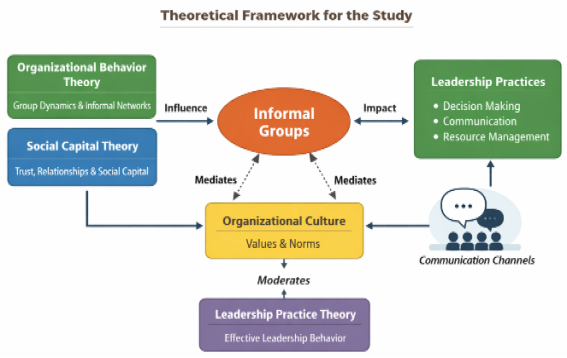
Figure 1. Theoretical frame Work.
The study integrates Social Capital Theory, Social Network Theory, and Organizational Culture Theory to provide a comprehensive understanding of informal group dynamics. Social Capital Theory explains how trust, reciprocity, and social relationships facilitate cooperation among organizational members. Social Network Theory helps explain patterns of interaction, information exchange, and influence within informal groups. Organizational Culture Theory provides insight into how shared values, norms, and beliefs shape collective behavior and leadership practices. Together, these perspectives offer a multidimensional framework for understanding both the opportunities and challenges associated with informal groups in educational organizations.
2.4. Empirical Literature Review
Recent international studies have reported strong associations between informal organizational networks and leadership effectiveness. For example,
found that informal networks significantly influence organizational decision-making, communication patterns, and employee engagement across various sectors. Similarly,
| [3] | Bolden, R., Gosling, J., O'Brien, A., Peters, K., Ryan, M., & Haslam, S. A. (2023). Leadership, power and organizational dynamics. Leadership, 19(4), 415-432.
https://doi.org/10.1177/17427150231174321 |
[3]
reported that leadership effectiveness is often enhanced when leaders successfully integrate formal authority with informal influence structures. Within educational institutions,
| [31] | Tadesse, Y. M., Regassa, T., & Geleta, A. (2025). Informal networks: Its power and influence in higher education institutions as perceived by university leaders: A phenomenography research. South Asian Journal of Business and Management Cases, 14(1), 42-55.
https://doi.org/10.1177/22779779241295678 |
[31]
found that informal networks play a substantial role in shaping leadership decisions and institutional governance within Ethiopian universities. Their findings indicated that informal networks frequently influence communication flows, policy implementation, and perceptions of leadership legitimacy. In the TVET sector,
| [33] | UNESCO. (2023). Transforming TVET for sustainable development: Global strategic updates. UNESCO. |
[33]
reported that institutional effectiveness increasingly depends on collaborative leadership approaches that recognize the importance of both formal governance mechanisms and informal stakeholder relationships. Similarly,
observed that organizational collaboration and communication networks significantly affect innovation and performance within Ethiopian TVET institutions. Evidence from Ethiopian universities shows that organizational factors continue to affect the implementation of institutional strategies, highlighting the importance of effective leadership and governance practices
| [29] | Shamelo, M. A. (2024). Perceived factors affecting the strategy implementation practices in comprehensive universities in Ethiopia. Journal of Education and Training Research, 12(1), 45-62. |
[29]
.
Despite these developments, empirical evidence concerning informal group influence on leadership practices in Ethiopian Agricultural TVET Colleges remains extremely limited. Existing studies largely focus on leadership styles, strategic leadership, educational quality, and institutional performance while neglecting the role of informal organizational dynamics. This gap highlights the need for context-specific research exploring how informal groups shape leadership practices within Agricultural TVET institutions.
2.5. Research Gap
The reviewed literature reveals three major gaps.
First, there is a scarcity of empirical studies examining informal group influence within Ethiopian Agricultural TVET Colleges. Most existing studies focus on formal leadership structures and governance systems. Second, limited evidence exists regarding how organizational culture mediates the relationship between informal groups and leadership practices within vocational education institutions. Third, insufficient attention has been given to understanding how formal and informal communication channels interact to influence leadership effectiveness in Agricultural TVET settings.
Therefore, this study seeks to address these gaps by exploring the influence of informal groups on leadership practices in Ethiopian Agricultural TVET Colleges through a qualitative inquiry.
2.6. Conceptual Framework
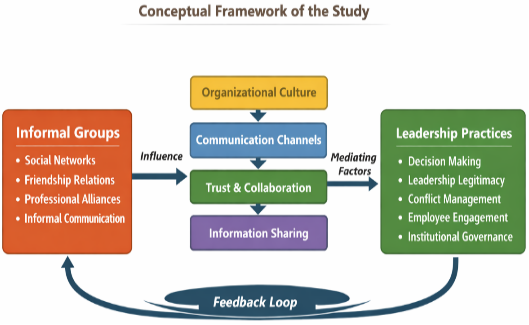
Based on the reviewed literature and theoretical foundations, the study proposes that informal groups influence leadership practices through multiple organizational mechanisms.
Independent Variable: Informal Groups such as; Social networks, Friendship relations, Professional alliances and Informal communication networks.
Mediating Variables: Organizational Culture, Communication Channels, Trust and Collaboration and Information Sharing.
Dependent Variable: Leadership Practices: Such as; Decision-making effectiveness, Leadership legitimacy, Conflict management, Employee engagement and Institutional governance. The framework assumes that informal groups directly and indirectly influence leadership practices through organizational culture and communication processes.
Figure 2. Conceptual frame Work.
The existing literature demonstrates that informal organizational groups can simultaneously function as sources of social support and as mechanisms of exclusion. While previous studies have documented the influence of informal networks on communication, collaboration, and organizational performance, findings remain inconsistent regarding their impact on leadership effectiveness and organizational governance. Moreover, most studies have been conducted in Western contexts or formal organizational environments, with limited evidence from Ethiopian educational institutions. This gap highlights the need for context-specific research examining how informal groups shape leadership practices within Agricultural TVET Colleges.
3. Research Methodology
3.1. Introduction
This chapter presents the methodological procedures employed to investigate the influence of informal groups on leadership practices in Ethiopian Agricultural TVET Colleges. It describes the research approach, research design, study area, target population, sampling techniques, sample size determination, data collection instruments, procedures for data collection, data analysis methods, trustworthiness of the study, ethical considerations, and measures for ensuring research quality.
3.2. Research Approach and Design
Approach: This study adopts a qualitative research approach. Qualitative research is appropriate when the objective is to understand individuals' experiences, perceptions, beliefs, and interpretations of social phenomena within their natural contexts
| [7] | Creswell, J. W., & Poth, C. N. (2018). Qualitative inquiry and research design: Choosing among five approaches (4th ed.). SAGE Publications. |
[7]
The approach is suitable because the influence of informal groups on leadership practices involves social interactions, informal relationships, organizational dynamics, and subjective experiences that cannot be adequately captured through quantitative measures alone.
Design: The study employs a qualitative multiple-case study design. A case study design enables researchers to explore complex social phenomena within real-life organizational settings and allows for a detailed examination of leadership practices and informal group dynamics across multiple institutions
| [34] | Yin, R. K. (2018). Case study research and applications: Design and methods (6th ed.). SAGE Publications. |
[34]
. The selected Agricultural TVET Colleges constitute individual cases through which similarities and differences in informal group influence can be explored and compared.
3.3. Study Area
The study will be conducted in five Ethiopian Agricultural TVET Colleges:
1) Alage Agricultural TVET College
2) Agarfa Agricultural TVET College
3) Ardaita Agricultural TVET College
4) Mezian –Tepi Agricultural TVET College
5) Gawane Agricultural TVET College
These institutions represent major Agricultural TVET Colleges operating under the Ministry of Agriculture and now governed by Ministry of Labor and Skills which are play significant roles in preparing skilled agricultural professionals.
3.4. Population of the Study
The target population comprises employees working in the selected Agricultural TVET Colleges.
The study specifically focuses on:
1) Administrative Staff
2) Trainers (Instructors)
3) Leaders of the Colleges
These groups were selected because they are directly involved in organizational operations and possess substantial knowledge regarding leadership practices, communication systems, and informal group dynamics within their institutions.
3.5. Sampling Technique and Size
Sampling Technique: This study employed purposive sampling to select participants who possessed relevant knowledge and experience regarding informal group dynamics, leadership practices, organizational culture, and communication processes within Ethiopian Agricultural Technical and Vocational Education and Training (ATVET) Colleges. Purposive sampling is widely used in qualitative research because it enables the researcher to identify information-rich participants capable of providing in-depth insights into the phenomenon under investigation
| [20] | Patton, M. Q. (2015). Qualitative research & evaluation methods: Integrating theory and practice (4th ed.). SAGE Publications. |
[20]
.
The participants were selected based on their organizational roles, years of experience, involvement in institutional activities, and familiarity with both formal and informal organizational interactions. By targeting individuals who were directly engaged in leadership-related processes and workplace relationships, the study sought to obtain detailed perspectives on how informal groups influence leadership practices and institutional governance within Agricultural TVET Colleges.
Sample Size: In qualitative research, sample size is determined by the depth and richness of information rather than statistical representativeness. Therefore, this study involved fifteen (15) purposively selected participants drawn from five Agricultural TVET Colleges. Three participants were selected from each college based on their experience and ability to provide relevant information concerning informal groups, leadership practices, communication processes, and organizational culture.
Table 1. Distribution of Participants.
Category | Participants per College | Number of Colleges | Total |
Key Informants | 3 | 5 | 15 |
Total | 3 | 5 | 15 |
Source: Survey Data (2026)
The selected participants represented diverse organizational experiences and perspectives relevant to the study objectives. Data collection continued until sufficient depth of information was obtained and thematic saturation was reached, meaning that no substantially new themes emerged from participant responses. The sample size is therefore considered adequate for exploring the influence of informal groups on leadership practices within Ethiopian Agricultural TVET Colleges. For a qualitative journal article, a sample of 15 key informants (3 from each of the 5 Agricultural TVET Colleges) can be justified if participants are information-rich and thematic capacity is achieved.
The study involved eighteen participants drawn from three Agricultural TVET Colleges. Participants were selected purposively based on their experience, institutional knowledge, and active involvement within the colleges. The sample included instructors, department heads, middle-level leaders, and administrative staff with varying years of professional experience. This diversity enabled the study to capture multiple perspectives regarding the operation and influence of informal groups within institutional leadership processes.
Table 2. Distribution of Participants.
Participant Category | Per College | Total |
College Dean/Vice Dean or Department Head | 1 | 5 |
Trainer | 1 | 5 |
Senior Administrative or Support Staff | 1 | 5 |
Total | 3 | 15 |
Source: Survey Data (2026)
The distribution of participants was designed to capture diverse perspectives from key stakeholders within each Agricultural TVET College. College Deans, Vice Deans, or Department Heads were included because of their direct involvement in leadership and institutional decision-making processes. Trainers were selected due to their close interaction with both management and staff, providing valuable insights into organizational practices and informal group dynamics. Senior administrative or support staff were included because of their extensive experience in day-to-day organizational operations and their familiarity with informal relationships within the colleges.
3.6. Data Collection Instruments
Data will be collected using:
Semi-Structured Interviews: Semi-structured interviews will serve as the primary data collection instrument. The interviews will allow participants to describe their experiences regarding informal groups, leadership practices, communication processes, and organizational relationships.
Open-Ended Google Form Questionnaire: An open-ended Google Form questionnaire will be used to complement interview data and capture participants' perceptions regarding:
1) Existence of informal groups
2) Influence of informal groups on leadership decisions
3) Communication channels
4) Organizational culture
5) Leadership effectiveness
6) Challenges and opportunities associated with informal networks
3.7. Data Analysis Procedures
Thematic analysis will be employed to analyze qualitative data.
The analysis process will involve:
1) Data transcription
2) Familiarization with data
3) Initial coding
4) Category development
5) Theme generation
6) Interpretation of findings
The study was followed
| [5] | Braun, V., & Clarke, V. (2022). Thematic analysis: A practical guide. SAGE Publications. |
[5]
thematic analysis framework to identify recurring patterns and themes related to informal group influence and leadership practices.
Data analysis followed a systematic thematic coding process. First, all focus group discussion transcripts were transcribed verbatim and reviewed repeatedly to achieve familiarity with the data. Second, open coding was conducted to identify meaningful statements and recurring ideas. Third, related codes were grouped into broader categories based on conceptual similarity. Finally, categories were refined into overarching themes that reflected participants’ experiences regarding informal groups and leadership practices. The coding process involved continuous comparison across transcripts to ensure consistency and thematic coherence.
3.8. Trustworthiness of the Study
To ensure research quality, the study will employ the following criteria:
1) Credibility through member checking.
2) Transferability through detailed contextual descriptions.
3) Dependability through documentation of research procedures.
4) Conformability through maintaining an audit trail and reflective notes (Lincoln & Guba, 1985)
| [16] | Lincoln, Y. S., & Guba, E. G. (1985). Naturalistic inquiry. SAGE Publications. |
[16]
.
To enhance methodological rigor, several quality assurance procedures were employed throughout the study. Data credibility was strengthened through prolonged engagement with participants, member checking, and triangulation across multiple focus group discussions conducted in three Agricultural TVET Colleges. Dependability was ensured by maintaining detailed records of data collection and analysis procedures, while confirmability was supported through systematic documentation of coding decisions and reflective notes. Furthermore, data collection continued until thematic saturation was achieved, meaning that no substantially new themes emerged from subsequent discussions. These procedures increased the trustworthiness and reliability of the findings.
4. Findings and Analysis
Prior to theme development, interview transcripts were subjected to open coding following
thematic analysis procedure. Similar codes were grouped into categories, which were subsequently organized into sub-themes and major themes.
Table 3 presents examples of the analytical process through which participants' statements were transformed into the final thematic structure.
Table 3. Preliminary Thematic Analysis Matrix.
Representative Participant Statement | Initial Codes | Category | Sub-Theme | Major Theme |
“We usually discuss issues with close colleagues before meetings.” | Informal discussion; peer consultation | Informal interaction | Informal Consultation | Informal Groups and Leadership Practices |
“Friendship helps us solve problems quickly.” | Friendship; cooperation; support | Social relationships | Friendship-Based Networks | Nature and Characteristics of Informal Groups |
“Teachers with similar professional backgrounds often exchange ideas informally.” | Professional collaboration; knowledge sharing | Professional interaction | Professional Interest Groups | Nature and Characteristics of Informal Groups |
“People trust information coming from colleagues they know well.” | Trust; reliability | Social cohesion | Trust and Social Cohesion | Nature and Characteristics of Informal Groups |
“Most decisions are discussed informally before official meetings.” | Informal influence; pre-meeting discussion | Leadership influence | Influence on Decisions | Informal Groups and Leadership Practices |
“Leaders often seek advice from experienced staff before making decisions.” | Consultation; advice seeking | Decision support | Informal Consultation | Informal Groups and Leadership Practices |
“Training opportunities are sometimes shared through personal networks.” | Access to opportunities; networking | Resource management | Influence on Resource Allocation | Informal Groups and Leadership Practices |
“Our college encourages teamwork and collaboration among staff.” | Teamwork; collaboration | Organizational interaction | Collaborative Culture | Organizational Culture and Informal Groups |
“Formal procedures can be slow, so staff often rely on informal channels.” | Bureaucracy; informal communication | Organizational structure | Hierarchical Culture | Organizational Culture and Informal Groups |
“Trust and mutual respect help staff work together effectively.” | Shared values; trust | Cultural integration | Shared Values and Trust | Organizational Culture and Informal Groups |
“Information spreads quickly through informal conversations.” | Information sharing; networking | Communication networks | Information Sharing Networks | Formal and Informal Communication |
“Formal communication is supported by informal discussions.” | Communication support | Communication systems | Complementary Communication Systems | Formal and Informal Communication |
“Rumors sometimes create misunderstandings among employees.” | Rumors; misinformation | Communication barriers | Communication Challenges | Formal and Informal Communication |
“Informal groups help leaders understand staff concerns.” | Employee participation; engagement | Leadership benefits | Leadership Opportunities | Opportunities and Challenges |
“Some groups create favoritism and exclusion.” | Favoritism; exclusion | Governance concerns | Governance Challenges | Opportunities and Challenges |
“Leaders should engage informal groups through transparent communication.” | Transparency; inclusion | Improvement mechanisms | Strategies for Improvement | Opportunities and Challenges |
Source: Survey Data (2026)
4.1. Introduction
This chapter presents the findings of the study exploring the influence of informal groups on leadership practices within Ethiopian Agricultural TVET Colleges. Data obtained through semi-structured interviews were analyzed using thematic analysis. The analysis generated five major themes and fifteen sub-themes that address the research objectives. The themes include: (1) Nature and Characteristics of Informal Groups, (2) Informal Groups and Leadership Practices, (3) Organizational Culture and Informal Groups, (4) Formal and Informal Communication, and (5) Opportunities and Challenges.
Table 4. Final Thematic Analysis Matrix.
Sample Codes | Categories | Sub-Themes | Major Themes | Research Objectives |
Friendship, personal relationships, social support, mutual assistance | Social Relationships | Friendship-Based Networks | Nature and Characteristics of Informal Groups | Objective 1 |
Professional collaboration, knowledge sharing, common interests | Professional Interaction | Professional Interest Groups | Nature and Characteristics of Informal Groups | Objective 1 |
Trust, loyalty, mutual respect, cohesion | Social Cohesion | Trust and Social Cohesion | Nature and Characteristics of Informal Groups | Objective 1 |
Informal meetings, pre-discussion, consultation | Decision Support Mechanisms | Informal Consultation | Informal Groups and Leadership Practices | Objective 2 |
Group influence, consensus building, persuasion | Leadership Influence Processes | Influence on Decisions | Informal Groups and Leadership Practices | Objective 2 |
Access to opportunities, committee membership, training allocation | Resource Management Practices | Influence on Resource Allocation | Informal Groups and Leadership Practices | Objective 2 |
Teamwork, collaboration, participation | Organizational Collaboration | Collaborative Culture | Organizational Culture and Informal Groups | Objective 3 |
Authority structures, chain of command, bureaucratic procedures | Organizational Structure | Hierarchical Culture | Organizational Culture and Informal Groups | Objective 3 |
Shared beliefs, organizational values, trust | Cultural Integration | Shared Values and Trust | Organizational Culture and Informal Groups | Objective 3 |
Informal information exchange, networking, social interaction | Communication Networks | Information Sharing Networks | Formal and Informal Communication | Objective 4 |
Formal meetings, official memos, complementary communication | Communication Systems | Complementary Communication Systems | Formal and Informal Communication | Objective 4 |
Rumors, misinformation, communication gaps | Communication Challenges | Communication Challenges | Formal and Informal Communication | Objective 4 |
Employee engagement, innovation, participation | Leadership Benefits | Leadership Opportunities | Opportunities and Challenges | Objective 5 |
Favoritism, exclusion, resistance, unequal influence | Governance Issues | Governance Challenges | Opportunities and Challenges | Objective 5 |
Transparency, inclusiveness, participatory leadership | Improvement Strategies | Strategies for Improvement | Opportunities and Challenges | Objective 5 |
Source; Survey Data (2026)
Table 4: Reveals that informal groups are deeply embedded within the organizational life of Ethiopian Agricultural TVET Colleges. They influence leadership practices, communication processes, resource allocation, and organizational culture. The findings further suggest that the impact of informal groups is both beneficial and challenging. When managed effectively through transparent, inclusive, and participatory leadership approaches, informal groups can enhance collaboration, trust, employee engagement, and institutional effectiveness. Conversely, inadequate management of these groups may lead to governance challenges such as favoritism, exclusion, and communication problems. Therefore, understanding and strategically engaging informal groups is essential for improving leadership effectiveness and organizational performance within the colleges.
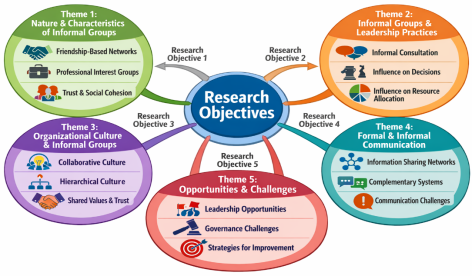
Figure 3. Proposed Thematic Map.
Figure 3 presents the proposed thematic map that guides the qualitative investigation of how informal groups influence leadership practices in Ethiopian Agricultural TVET colleges. The map organizes the study into five interconnected themes aligned with the research objectives: (1) the nature and characteristics of informal groups, emphasizing friendship-based networks, professional interest groups, and trust and social cohesion; (2) the influence of informal groups on leadership practices through consultation, decision-making, and resource allocation; (3) the role of organizational culture, including collaborative, hierarchical, and shared value dimensions, in shaping informal group dynamics; (4) the interaction between formal and informal communication systems, highlighting both complementary relationships and communication challenges; and (5) the opportunities and challenges associated with informal groups, focusing on leadership development, governance issues, and improvement strategies. Together, these themes provide a comprehensive analytical framework for exploring participants' experiences and understanding how informal group dynamics shape leadership practices and organizational effectiveness within Ethiopian Agricultural TVET colleges.
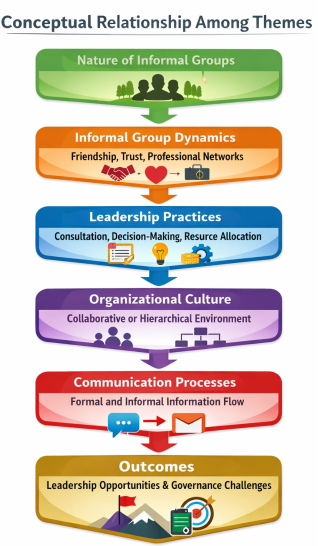
Figure 4. Conceptual Relationship Among Themes.
Figure 4: presents the conceptual relationship among the major themes identified in this study regarding the influence of informal groups on leadership practices within Ethiopian Agricultural TVET Colleges. The figure illustrates a sequential and interconnected process through which informal groups shape leadership outcomes within educational institutions.
The process begins with the Nature of Informal Groups, which represents the foundational characteristics of informal groups identified by participants. These groups emerge naturally within the organization and are primarily formed through social interactions, common interests, and workplace relationships. This theme establishes the context within which informal group activities occur.
The second level, Informal Group Dynamics, consists of friendship networks, trust-based relationships, and professional connections among staff members. The findings revealed that these dynamics serve as the driving forces behind informal group influence. Trust and friendship strengthen social cohesion, while professional networks facilitate collaboration, information exchange, and mutual support among employees.
These informal group dynamics subsequently influence Leadership Practices, particularly through informal consultation, decision-making processes, and resource allocation. Participants reported that leaders frequently engage trusted colleagues in informal discussions before making formal decisions. Consequently, leadership effectiveness is shaped not only by formal authority but also by the influence of informal relationships and networks within the institution. The figure further indicates that the influence of informal groups is moderated by Organizational Culture. The findings demonstrated that collaborative organizational cultures encourage constructive interactions between formal leaders and informal groups, whereas hierarchical cultures often increase dependence on informal networks as alternative channels for communication and influence. Thus, organizational culture either strengthens or constrains the impact of informal groups on leadership practices.
The next stage involves Communication Processes, which function as the mechanism through which informal group influence is transmitted across the organization. Formal and informal communication channels interact to facilitate information sharing, coordination, and collective understanding. Participants emphasized that informal communication often complements formal communication systems by accelerating information flow and enhancing organizational responsiveness. Finally, these interconnected processes result in various Outcomes, including both leadership opportunities and governance challenges.
On the positive side, informal groups contribute to employee engagement, collaboration, innovation, and participatory leadership. However, they may also generate challenges such as favoritism, exclusion, unequal access to information, and concerns regarding transparency and accountability. Overall, the figure demonstrates that informal groups influence leadership practices through a complex chain of relationships involving social dynamics, organizational culture, and communication processes. The model suggests that effective leadership in Ethiopian Agricultural TVET Colleges requires balancing formal organizational structures with informal social networks to maximize leadership opportunities while minimizing governance challenges.
4.2. Presentation of Themes
Theme 1: Nature and Characteristics of Informal Groups
This theme addresses the first research objective by examining the nature, formation, and characteristics of informal groups within Ethiopian Agricultural TVET Colleges. Participants described informal groups as naturally occurring social structures formed through friendship, professional interests, trust, and shared experiences.
Sub-theme 1.1 Friendship-Based Networks
Participants consistently reported that friendship networks constitute the most common type of informal group within their colleges.
Participant 3 stated: "Many staff members interact beyond office hours, and these friendships continue to influence cooperation during working hours."
Participant 7 explained: "People usually seek advice and support from colleagues with whom they have long-standing personal relationships."
Participant 11 added: "Friendship groups create strong bonds among employees and make collaboration easier." These findings suggest that friendship-based networks serve as important social support systems and facilitate workplace cooperation.
Sub-theme 1.2 Professional Interest Groups
Participants reported the existence of informal groups organized around professional interests and shared expertise.
Participant 5 remarked: "Trainers from similar fields often meet informally to discuss teaching methods and student-related issues."
Participant 9 noted: "We usually exchange professional ideas outside formal meetings because it is easier and more practical." The findings indicate that professional interest groups promote knowledge sharing and collaborative problem-solving.
Sub-theme 1.3 Trust and Social Cohesion
Trust emerged as a central feature of informal groups.
Participant 2 stated: "People trust information coming from colleagues they know well."
Participant 14 explained: "Trust helps members discuss sensitive issues openly without fear."
These findings demonstrate that trust strengthens group cohesion and sustains informal relationships within the colleges.
Theme 2: Informal Groups and Leadership Practices
This theme explores how informal groups influence leadership practices, decision-making processes, and institutional governance.
Sub-theme 2.1 Informal Consultation
Participants indicated that leaders frequently consult influential individuals informally before making decisions.
Participant 1 stated: "Before official meetings, leaders often discuss issues with experienced staff to understand possible reactions."
Participant 8 remarked: " Informal discussions help leaders identify practical solutions before formal decisions are made." These findings suggest that informal consultation serves as a valuable leadership tool.
Sub-theme 2.2 Influence on Decisions
Many participants reported that informal groups shape organizational decisions.
Participant 4 explained: "Most major decisions are discussed informally before they reach formal committees."
Participant 10 noted: "When respected members support a proposal, leaders find it easier to gain acceptance." The findings demonstrate that informal groups significantly influence organizational decision-making.
Sub-theme 2.3 Influence on Resource Allocation
Participants reported that informal networks occasionally affect access to opportunities and resources.
Participant 6 stated: "Information about training opportunities often spreads first through informal networks."
Participant 12 explained: "Recommendations from trusted colleagues sometimes influence committee appointments." These findings indicate that informal relationships can influence resource distribution processes.
Theme 3: Organizational Culture and Informal Groups
This theme addresses how organizational culture shapes and is shaped by informal groups.
Sub-theme 3.1 Collaborative Culture
Participants reported that collaborative environments strengthen positive informal interactions.
Participant 13 stated: "In our college, informal groups help staff work together more effectively."
Participant 7 explained: "Cooperation becomes easier when people have strong informal relationships." These findings indicate that collaborative cultures encourage constructive informal group activities.
Sub-theme 3.2 Hierarchical Culture
Participants noted that hierarchical structures often increase dependence on informal communication.
Participant 5 stated: "When formal channels are slow, staff rely more on informal networks."
Participant 9 explained: "People sometimes prefer informal discussions because official procedures take too much time." The findings suggest that hierarchical cultures encourage alternative communication pathways.
Sub-theme 3.3 Shared Values and Trust
Participants consistently linked informal groups with shared organizational values.
Participant 2 noted: "Groups function effectively when members share common goals and trust one another."
Participant 15 remarked: "Trust and mutual respect strengthen both relationships and institutional commitment." These findings highlight the importance of shared values in sustaining positive informal group dynamics.
Theme 4: Formal and Informal Communication
This theme explores communication patterns within the colleges.
Sub-theme 4.1 Information Sharing Networks
Participants described informal groups as effective channels for information dissemination.
Participant 11 stated: "Important information often reaches staff through colleagues before official announcements."
Participant 3 explained: "Informal networks help spread information quickly across departments." The findings indicate that informal groups facilitate rapid information exchange.
Sub-theme 4.2 Complementary Communication Systems
Participants emphasized that formal and informal communication systems operate together.
Participant 1 stated: "Formal communication provides official guidance, while informal communication helps clarify issues."
Participant 14 remarked: "Both systems are necessary for effective institutional functioning."
These findings suggest a complementary relationship between communication systems.
Sub-theme 4.3 Communication Challenges
Participants also identified challenges associated with informal communication.
Participant 6 stated: "Sometimes rumors spread faster than official information."
Participant 10 explained: "Misinformation occasionally creates confusion among staff."
These findings indicate that informal communication may generate unintended consequences.
Theme 5: Opportunities and Challenges
This theme examines both the positive and negative consequences of informal group influence.
Sub-theme 5.1 Leadership Opportunities
Participants identified several benefits associated with informal groups.
Participant 4 stated: "Informal groups help leaders understand employee concerns more effectively."
Participant 8 remarked: "These groups encourage participation and generate innovative ideas."
The findings indicate that informal groups contribute positively to leadership effectiveness.
Sub-theme 5.2 Governance Challenges
Participants also identified governance-related concerns.
Participant 12 explained: "Strong informal groups sometimes create perceptions of favoritism."
Participant 5 stated: "Some employees feel excluded from important discussions."
These findings suggest potential risks to transparency and fairness.
Sub-theme 5.3 Strategies for Improvement
Participants proposed several strategies for improving relationships between leaders and informal groups. Participant 7 stated: "Leaders should engage informal groups rather than ignore them. "Participant 15 remarked: "Transparent communication can reduce misunderstandings and build trust. "Participant 2 added: "Inclusive decision-making processes help balance formal and informal influences." These findings indicate that proactive leadership strategies can maximize benefits while minimizing risks. The findings suggest that informal groups operate as important social structures that influence leadership effectiveness beyond formal organizational arrangements. Consistent with Social Capital Theory, participants emphasized that trust-based relationships facilitated cooperation, information exchange, and collective problem-solving. However, the findings also reveal that informal networks may reinforce exclusionary practices and unequal access to information, supporting arguments within Social Network Theory regarding the unequal distribution of influence across organizational networks. These findings indicate that informal groups represent both valuable organizational resources and potential governance challenges that require careful management by educational leaders.
5. Discussion, Conclusions, and Recommendations
5.1. Introduction
This chapter discusses the findings presented in Chapter Four in relation to the study objectives, existing literature, and relevant theoretical perspectives. The discussion focuses on how informal groups influence leadership practices within Ethiopian Agricultural TVET Colleges. The chapter further presents theoretical implications, practical implications, conclusions, recommendations, limitations of the study, and directions for future research.
5.2. Discussion of Findings by Research Objectives
This section discusses the major findings of the study in relation to the research objectives, relevant theories, and existing empirical literature. The discussion follows a structured approach in which each objective is examined through four interconnected components:
1) The major findings that emerged from the thematic analysis,
2) comparison of these findings with previous studies, particularly recent research published between 2020 and 2026,
3) Theoretical interpretation using relevant frameworks including Social Capital Theory, Social Network Theory, Distributed Leadership Theory, Organizational Culture Theory, Communication Network Theory, and Governance Theory, and
4) The contribution and practical implications of the findings for leadership practices within Ethiopian Agricultural TVET Colleges. This approach enables a comprehensive understanding of how informal groups influence leadership practices and highlights the study's contribution to the existing body of knowledge on educational leadership and organizational behavior.
Objective 1: To Examine the Nature and Characteristics of Informal Groups within Ethiopian Agricultural TVET Colleges
Major Finding: The study found that informal groups within Ethiopian Agricultural TVET Colleges are primarily characterized by friendship-based networks, professional interest groups, and trust-based relationships. These groups emerge naturally through interpersonal interactions, shared experiences, and common professional interests. Trust and social cohesion were identified as fundamental factors sustaining group membership and promoting collaboration among employees.
Comparison with Literature: This finding is consistent with recent studies indicating that informal organizational networks are primarily formed through interpersonal trust, shared values, and professional relationships. Recent research in educational organizations demonstrates that informal networks facilitate collaboration, information exchange, and collective problem-solving through trust-based social connections. Similarly, studies on social capital in higher education institutions suggest that friendship and professional networks strengthen organizational cohesion and employee engagement.
Theoretical Interpretation: The finding is strongly explained by Social Capital Theory, which argues that trust, reciprocity, and social relationships constitute valuable organizational resources that facilitate cooperation and knowledge sharing. The finding is also supported by Social Network Theory, which emphasizes that organizational behavior is shaped by patterns of interpersonal relationships rather than formal structures alone. From these theoretical perspectives, friendship networks and trust-based relationships represent important channels through which resources, information, and support flow within organizations.
Contribution and Implications: This finding contributes to the limited literature on informal groups within Ethiopian TVET institutions by demonstrating that informal groups are not merely social associations but important organizational resources. The finding suggests that leaders should recognize and leverage trust-based relationships to strengthen collaboration, employee engagement, and institutional effectiveness.
Objective 2: To Explore How Informal Groups Influence Leadership Practices
Major Finding: The study found that informal groups influence leadership practices through informal consultation, decision-making processes, and resource allocation mechanisms. Leaders frequently consult trusted colleagues before making formal decisions, and many institutional issues are discussed informally before official meetings.
Comparison with Literature: This finding supports recent leadership research indicating that informal networks significantly influence organizational decision-making and leadership effectiveness.
Previous studies have shown that leadership is increasingly viewed as a relational process emerging through interactions among organizational members rather than solely through formal authority structures. Similar findings have been reported in educational institutions where informal consultations enhance decision quality and facilitate consensus-building.
Theoretical Interpretation: The finding is consistent with Social Network Theory, which suggests that influence is embedded within organizational relationships. Leadership effectiveness is enhanced when leaders access information and expertise through informal networks. The finding is further explained by Distributed Leadership Theory, which proposes that leadership functions are shared among multiple actors rather than concentrated in formal leadership positions. Informal groups therefore act as important sources of leadership influence and organizational knowledge.
Contribution and Implications: This finding extends existing leadership literature by demonstrating how informal groups shape leadership processes within Agricultural TVET Colleges. The implication is that leaders should engage informal networks constructively while ensuring transparency and accountability in decision-making and resource allocation practices.
Objective 3: To Analyze the Relationship between Organizational Culture and Informal Groups
Major Finding: The findings revealed that organizational culture significantly influences the operation and effectiveness of informal groups. Collaborative organizational cultures promote positive informal interactions, whereas hierarchical cultures increase dependence on informal communication channels.
Comparison with Literature: The finding aligns with contemporary organizational culture research, which suggests that collaborative environments foster knowledge sharing, trust, and employee participation. Previous studies have shown that supportive organizational cultures strengthen informal networks and facilitate organizational learning.
Conversely, highly bureaucratic environments often encourage employees to rely on informal channels to compensate for rigid formal structures.
Theoretical Interpretation: The finding is explained by Organizational Culture Theory, which argues that shared values, beliefs, norms, and assumptions shape employee behavior and organizational interactions. Organizational culture functions as a contextual mechanism that either facilitates or constrains the effectiveness of informal groups. Collaborative cultures encourage constructive informal interactions, while hierarchical cultures may amplify informal influence as an alternative to formal communication systems.
Contribution and Implications: The finding contributes to understanding the contextual factors that shape informal group influence within TVET institutions. The implication is that institutional leaders should cultivate collaborative cultures characterized by trust, participation, and openness in order to maximize the positive contributions of informal groups.
Objective 4: To Examine the Role of Informal Communication in Leadership Processes
Major Finding: The study found that informal communication networks play a critical role in information sharing, coordination, and organizational responsiveness. Information frequently circulates through informal channels before reaching employees through formal communication systems.
Comparison with Literature: This finding is consistent with recent communication research suggesting that informal communication complements formal communication by increasing information flow, improving coordination, and enhancing organizational responsiveness. Similar studies have reported that informal communication networks facilitate rapid dissemination of information and strengthen workplace relationships. However, previous research also highlights risks associated with rumors and misinformation.
Theoretical Interpretation: The finding can be understood through Social Network Theory and Communication Network Theory. These theories emphasize that communication effectiveness depends not only on formal channels but also on informal relational networks that facilitate information exchange. Informal communication networks therefore serve as important mechanisms through which organizational information is transmitted and interpreted.
Contribution and Implications: The finding contributes to understanding how communication processes support leadership effectiveness in educational institutions. Leaders should strengthen formal communication systems while simultaneously recognizing the importance of informal communication networks in facilitating organizational coordination.
Objective 5: To Identify Opportunities and Challenges Associated with Informal Groups
Major Finding: The findings revealed that informal groups create both opportunities and challenges for organizational leadership. Opportunities include enhanced collaboration, employee engagement, innovation, participation, and collective problem-solving. Challenges include favoritism, exclusion, unequal access to information, and governance concerns.
Comparison with Literature: The finding is consistent with recent studies indicating that informal networks produce both positive and negative organizational outcomes. Previous research demonstrates that informal groups strengthen cooperation and employee commitment while simultaneously creating risks related to power imbalances, exclusion, and inequitable access to resources.
Theoretical Interpretation: This finding is explained by Social Capital Theory and Governance Theory. Social Capital Theory highlights the benefits of trust and social relationships for organizational effectiveness, whereas Governance Theory emphasizes the importance of transparency, accountability, and fairness in organizational processes. The coexistence of benefits and challenges reflects the dual nature of informal networks within organizations.
Contribution and Implications: The finding contributes to the growing literature on informal organizational dynamics by demonstrating that informal groups represent both strategic assets and governance challenges. The implication is that leaders should leverage the positive aspects of informal groups while implementing transparent procedures that minimize favoritism, exclusion, and inequitable practices.
Summary of Theory Finding Alignment
Table 5. Summary of Theory Finding Alignment.
Objectives | Major Theme | Dominant Theory | Key Explanation |
Objective 1 | Nature and Characteristics of Informal Groups | Social Capital Theory + Social Network Theory | Trust and relationships create social resources and networks |
Objective 2 | Informal Groups and Leadership Practices | Social Network Theory + Distributed Leadership Theory | Leadership influence emerges through relationships and shared leadership |
Objective 3 | Organizational Culture and Informal Groups | Organizational Culture Theory | Culture shapes the effectiveness of informal groups |
Objective 4 | Formal and Informal Communication | Communication Network Theory + Social Network Theory | Informal networks facilitate information flow |
Objective 5 | Opportunities and Challenges | Social Capital Theory + Governance Theory | Informal groups generate both organizational benefits and governance risks |
5.3. Summary of Major Findings
The study revealed that informal groups are an integral component of organizational life within Ethiopian Agricultural TVET Colleges. The findings showed that friendship networks, professional interest groups, and trust-based relationships form the foundation of informal group structures. These groups significantly influence leadership practices through informal consultation, decision-making processes, and resource allocation mechanisms. The findings further indicated that organizational culture shapes the effectiveness of informal groups, while informal communication networks facilitate information sharing and organizational coordination. Although informal groups provide opportunities for collaboration, innovation, and employee engagement, they also present challenges related to favoritism, exclusion, and governance. Overall, the study demonstrates that effective leadership requires balancing formal organizational structures with informal social dynamics.
5.4. Theoretical Implications
This study contributes to Social Capital Theory by demonstrating the importance of trust, reciprocity, and interpersonal relationships in facilitating organizational cooperation and leadership effectiveness. The findings support Social Network Theory by showing that influence, information, and resources flow through informal networks that operate alongside formal structures. The study also extends Distributed Leadership Theory by illustrating how leadership functions are shared among formal leaders and influential group members. Furthermore, the findings reinforce Organizational Culture Theory by highlighting the role of organizational values and norms in shaping informal group behavior and leadership outcomes.
5.5. Practical Implications for Ethiopian Agricultural TVET Colleges
The findings suggest that institutional leaders should recognize informal groups as important organizational actors rather than viewing them solely as informal social formations. College leaders should strengthen participatory leadership practices, promote transparent communication, and create inclusive decision-making mechanisms. Institutions should also establish fair procedures for resource allocation and professional development opportunities while fostering collaborative organizational cultures that encourage trust, teamwork, and employee engagement.
5.6. Conclusions
This study explored the influence of informal groups on leadership practices in Ethiopian Agricultural Technical and Vocational Education and Training (ATVET) colleges. The findings demonstrate that informal groups are embedded within institutional life through friendship-based relationships, professional interest networks, and trust-based social cohesion. Rather than functioning solely as unofficial social structures, these groups actively shape leadership practices by facilitating informal consultation, influencing decision-making processes, affecting resource allocation, and strengthening interpersonal relationships among administrative staff, trainers, and supportive staff. The findings further reveal that organizational culture significantly influences whether informal groups become constructive partners in institutional development or sources of organizational tension. The study also highlights the important role of communication and organizational culture in mediating the influence of informal groups. Collaborative organizational cultures, characterized by trust, shared values, and open communication, enable informal groups to complement formal leadership structures by promoting knowledge sharing, collaboration, and timely information exchange. Conversely, highly hierarchical organizational environments and ineffective communication practices may limit the positive contributions of informal groups and create governance challenges, including unequal access to information, perceived favoritism, and reduced transparency in organizational decision-making. These findings suggest that leadership effectiveness is strengthened not by suppressing informal groups but by recognizing their existence and strategically integrating their positive contributions into formal organizational processes.
Based on these findings, the study concludes that informal groups should be viewed as valuable organizational assets capable of enhancing leadership effectiveness, institutional governance, and organizational learning when managed transparently and inclusively. Leaders of Agricultural TVET colleges should foster collaborative organizational cultures, strengthen trust-based relationships, encourage constructive informal consultation, and establish communication mechanisms that align informal interactions with institutional goals while minimizing potential governance risks. The study contributes to the growing body of qualitative research on leadership and organizational behavior in educational institutions and provides evidence-based insights for policymakers, institutional leaders, and practitioners seeking to improve leadership practices within the Ethiopian TVET system. Future research may extend these findings through comparative studies across different TVET contexts or by employing mixed-methods approaches to further examine the dynamic relationship between informal groups and leadership effectiveness.
5.7. Recommendations
A. Inclusive Engagement in Consultative Leadership: College deans and administrators should actively engage key informal influencers during early consultation stages. By involving diverse informal networks before formal policies are finalized, leaders can build broader consensus, reduce internal resistance, and improve policy implementation.
B. Institutionalizing Transparency and Accountability: To prevent informal networks from overriding fair processes, ATVET colleges must strengthen their formal compliance mechanisms. Administrative actions especially resource allocation, staff promotions, and professional development selection should follow clear, merit-based, and publicly auditable criteria to prevent favoritism.
C. Targeted Leadership Development Programs: The Ministry of Education and regional TVET bureaus should update their leadership training curricula to include organizational network management. Professional development programs should equip educational leaders with practical skills in mapping social networks, managing informal politics, and leveraging social capital to drive positive institutional change.
D. Fostering a Transparent and Collaborative Culture: Leaders should actively cultivate an open, inclusive institutional culture
. By creating formal cross-departmental teams, regular open forums, and collaborative feedback loops, institutions can build high levels of trust. This helps ensure that the psychological safety typically sought in informal cliques is integrated directly into the wider college community.
E. Upgrading Formal Communication Systems: To reduce the reliance on rumors and exclusive information networks, colleges need to establish reliable, transparent internal communication channels. Regularly updated digital notice boards, institutional emails, and brief weekly briefings can help ensure that accurate information reaches all staff members equitably and on time.
5.8. Limitations and Future Research
I. Study Limitations: This study has certain limitations that should be noted:
1) Geographic and Sector Scope: The research focused on selected agricultural TVET colleges in Ethiopia, meaning the findings may not fully apply to other technical fields or comprehensive universities with different funding and governance models.
2) Methodological Focus: The study relied primarily on qualitative interview data reflecting participants' personal views. It did not use long-term observational work or quantitative network mapping, which could offer deeper structural insights into these social dynamics.
II. Future Research Directions: To build on these findings, future research should explore the following areas:
1) Deploy Mixed-Methods Designs: Methodological Expansion. Combine qualitative insights with quantitative Social Network Analysis (SNA) to map and measure the actual size, density, and flow of informal networks in educational institutions.
2) Conduct Comparative Institutional Analyses (Sectorial Scope): Compare informal network dynamics across various institutional types, such as public vs. private TVET centers and engineering colleges vs. comprehensive universities.
3) Evaluate Institutional Performance Outcomes (Impact Metrics): Investigate how the strength and integration of informal networks directly correlate with key metrics like institutional efficiency, graduation rates, and staff retention.
4) Examine the Digital Network Footprint: Technological Context. Explore how digital communication platforms (such as Telegram, WhatsApp, and social media groups) shape modern informal networks and accelerate info-sharing outside formal channels.
5) Execute Longitudinal Field Research (Temporal Dynamics): Track educational institutions over multiple years to observe how informal networks shift during leadership transitions, major policy overhauls, or structural mergers.
Abbreviations
ATVET | Agricultural Technical and Vocational Education and Training |
TVET | Technical and Vocational Education and Training |
FDRE | Federal Democratic Republic of Ethiopia |
TI | Training Institute |
Author Contributions
Kedir Shenka Warra: Conceptualization, Data curation, Formal Analysis, Investigation, Methodology, Project administration, Validation, Visualization, Writing – original draft, Writing – review & editing
Conflicts of Interest
The authors declare no conflicts of interest.
References
| [1] |
Alvesson, M., & Sveningsson, S. (2023). Changing organizational culture (3rd ed.). Routledge.
|
| [2] |
Amonde, M. R. (2024). Effective leadership of TVET institutions: An exploration of the perspectives of TVET leaders. Caribbean Journal of Education and Development, 11(2), 73–89.
https://doi.org/10.46425/cjed501047445
|
| [3] |
Bolden, R., Gosling, J., O'Brien, A., Peters, K., Ryan, M., & Haslam, S. A. (2023). Leadership, power and organizational dynamics. Leadership, 19(4), 415-432.
https://doi.org/10.1177/17427150231174321
|
| [4] |
Braun, V., & Clarke, V. (2006). Using thematic analysis in psychology. Qualitative Research in Psychology, 3(2), 77-101.
https://doi.org/10.1191/1478088706qp063oa
|
| [5] |
Braun, V., & Clarke, V. (2022). Thematic analysis: A practical guide. SAGE Publications.
|
| [6] |
Bush, T. (2022). Theories of educational leadership and management (6th ed.). SAGE Publications.
|
| [7] |
Creswell, J. W., & Poth, C. N. (2018). Qualitative inquiry and research design: Choosing among five approaches (4th ed.). SAGE Publications.
|
| [8] |
Cross, R., & Parker, A. (2020). The hidden power of social networks: Understanding how work really gets done in organizations. Harvard Business Review Press.
|
| [9] |
Cross, R., Rebele, R., & Grant, A. (2021). Collaborative overload and network leadership. Harvard Business Review, 99(1), 36-45.
|
| [10] |
Davis, K. (2020). Review and recommendations for strengthening the agricultural extension system in Ethiopia. Gates Open Research, 4(1164), 1-22.
https://doi.org/10.12688/gatesopenres.13204.1
|
| [11] |
Duressa, W. T., & Kidane, B. Z. (2024). Indirect effects of leadership behaviors on departmental performance via organizational learning in Ethiopian public research universities. Cogent Education, 11(1), Article 2354969.
https://doi.org/10.1080/2331186X.2024.2354969
|
| [12] |
Edgar, H. (2010). Organizational culture and leadership (4th ed.). National Academic Digital Library of Ethiopia.
|
| [13] |
Jinga, A. A., Oumer Hussen, J., Gezahagn Negash, H., & Bezabih Estifanos, A. (2024). Leadership behavior and organizational change management in selected public universities of Ethiopia: Exploring the impact of leadership influences and change processes. Heliyon, 10(18), Article e37149.
https://doi.org/10.1016/j.heliyon.2024.e37149
|
| [14] |
Kebede, M. (2020). Transnational educational leadership of international organizations working in Ethiopia: Walking the local-global development tightrope (Doctoral dissertation, Pennsylvania State University). Electronic Theses and Dissertations.
|
| [15] |
Kilduff, M., & Brass, D. J. (2021). Organizational social network research: Core ideas and key debates. Academy of Management Annals, 15(1), 175-225.
https://doi.org/10.5465/annals.2019.0089
|
| [16] |
Lincoln, Y. S., & Guba, E. G. (1985). Naturalistic inquiry. SAGE Publications.
|
| [17] |
Men, L. R. (2021). Leaders as communication agents. In L. R. Men & A. Tkalac Verčič (Eds.), Current Trends and Issues in Internal Communication: Theory and Practice (pp. 19–38). Palgrave Macmillan.
https://doi.org/10.1007/978-3-030-78213-9_2
|
| [18] |
Ministry of Education [MoE]. (2018). Ethiopian education development roadmap (2018-2030). Ministry of Education.
|
| [19] |
Northouse, P. G. (2022). Leadership: Theory and practice (9th ed.). SAGE Publications.
|
| [20] |
Patton, M. Q. (2015). Qualitative research & evaluation methods: Integrating theory and practice (4th ed.). SAGE Publications.
|
| [21] |
Putnam, R. D. (2000). Bowling alone: The collapse and revival of American community. Simon & Schuster.
|
| [22] |
Raelin, J. A. (2016). Leadership-as-practice: Theory and application. Routledge.
|
| [23] |
Regassa, M. S., & Desissa, T. D. (2025). Technology integration status in TVET colleges: Evidence from Sheger City, Ethiopia. Discover Education, 4(1), 100-115.
https://doi.org/10.1007/s44217-025-00100-y
|
| [24] |
Risi, D., Wickert, C., & Spence, L. J. (2023). Institutional theory and organizational behavior: Institutionalizing change in public frameworks. Academy of Management Review, 48(3), 412-435.
https://doi.org/10.5465/amr.2020.0435
|
| [25] |
Robbins, S. P., & Judge, T. A. (2019). Organizational behavior (18th ed.). Pearson.
|
| [26] |
Robbins, S. P., & Judge, T. A. (2022). Organizational behavior (19th ed.). Pearson.
|
| [27] |
Salm, M. (2018). The need for institutional change in capacity development of tertiary agricultural education. Royal Tropical Institute (KIT).
|
| [28] |
Schein, E. H., & Schein, P. A. (2021). Organizational culture and leadership (6th ed.). Wiley.
|
| [29] |
Shamelo, M. A. (2024). Perceived factors affecting the strategy implementation practices in comprehensive universities in Ethiopia. Journal of Education and Training Research, 12(1), 45-62.
|
| [30] |
Tadesse Bogale, A., & Debela, K. L. (2024). Organizational culture: A systematic review. Cogent Business & Management, 11(1), Article 2340129.
https://doi.org/10.1080/23311975.2024.2340129
|
| [31] |
Tadesse, Y. M., Regassa, T., & Geleta, A. (2025). Informal networks: Its power and influence in higher education institutions as perceived by university leaders: A phenomenography research. South Asian Journal of Business and Management Cases, 14(1), 42-55.
https://doi.org/10.1177/22779779241295678
|
| [32] |
Teferi, M. T., & Beyene, D. (2023). The strategic leadership practices in public higher education institutions of Ethiopia: Evidences from Jimma University. Ethiopian Journal of Education and Sciences, 18(1), 14-32.
|
| [33] |
UNESCO. (2023). Transforming TVET for sustainable development: Global strategic updates. UNESCO.
|
| [34] |
Yin, R. K. (2018). Case study research and applications: Design and methods (6th ed.). SAGE Publications.
|
Cite This Article
-
APA Style
Warra, K. S. (2026). Exploring Informal Group Influence on Leadership Practices: A Qualitative Inquiry at Ethiopian Agricultural TVET Colleges. Innovation Education, 1(4), 206-225. https://doi.org/10.11648/j.iedu.20260104.12
 Copy
|
 Download
ACS Style
Warra, K. S. Exploring Informal Group Influence on Leadership Practices: A Qualitative Inquiry at Ethiopian Agricultural TVET Colleges. Innov. Educ. 2026, 1(4), 206-225. doi: 10.11648/j.iedu.20260104.12
Copy
|
Download
AMA Style
Warra KS. Exploring Informal Group Influence on Leadership Practices: A Qualitative Inquiry at Ethiopian Agricultural TVET Colleges. Innov Educ. 2026;1(4):206-225. doi: 10.11648/j.iedu.20260104.12
Copy
|
Download
-
@article{10.11648/j.iedu.20260104.12,
  author = {Kedir Shenka Warra},
  title = {Exploring Informal Group Influence on Leadership Practices: A Qualitative Inquiry at Ethiopian Agricultural TVET Colleges},
  journal = {Innovation Education},
  volume = {1},
  number = {4},
  pages = {206-225},
  doi = {10.11648/j.iedu.20260104.12},
  url = {https://doi.org/10.11648/j.iedu.20260104.12},
  eprint = {https://article.sciencepublishinggroup.com/pdf/10.11648.j.iedu.20260104.12},
  abstract = {Informal groups are important yet often overlooked components of organizational life that significantly influence leadership practices, communication processes, and decision-making outcomes. This study explored the influence of informal groups on leadership practices in Ethiopian Agricultural Technical and Vocational Education and Training (ATVET) Colleges. Guided by Social Capital Theory, Social Network Theory, Distributed Leadership Theory, and Organizational Culture Theory, A qualitative research design was employed using an open-ended questionnaire administered to fifteen purposively selected information-rich participants from five Agricultural TVET colleges. including institutional leaders, instructors, and administrative staff, who were purposively selected from five ATVET Colleges. Data were collected through semi-structured interviews and focus group discussions and analyzed using thematic analysis. The findings revealed five major themes: (1) the nature and characteristics of informal groups, (2) the influence of informal groups on leadership practices, (3) the relationship between organizational culture and informal groups, (4) formal and informal communication, and (5) opportunities and challenges associated with informal groups. The results demonstrated that friendship networks, professional interest groups, and trust-based relationships positively influenced leadership consultation, collaborative decision-making, information sharing, employee engagement, and organizational coordination. Organizational culture was found to moderate the effectiveness of informal groups by either strengthening or constraining their contribution to institutional performance. Despite these benefits, informal groups also created challenges related to favoritism, exclusion, unequal access to information, and governance transparency. The study concludes that effective leadership in Ethiopian ATVET Colleges requires balancing formal organizational structures with informal social networks to enhance institutional effectiveness. By providing context-specific empirical evidence from the Ethiopian TVET sector, the study contributes to the literature on educational leadership and organizational behavior and offers practical recommendations for leadership development, institutional governance, and the effective management of informal social dynamics in educational organizations.},
 year = {2026}
}
Copy
|
Download
-
TY  - JOUR
T1  - Exploring Informal Group Influence on Leadership Practices: A Qualitative Inquiry at Ethiopian Agricultural TVET Colleges
AU  - Kedir Shenka Warra
Y1  - 2026/11/25
PY  - 2026
N1  - https://doi.org/10.11648/j.iedu.20260104.12
DO  - 10.11648/j.iedu.20260104.12
T2  - Innovation Education
JF  - Innovation Education
JO  - Innovation Education
SP  - 206
EP  - 225
PB  - Science Publishing Group
SN  - 3071-494X
UR  - https://doi.org/10.11648/j.iedu.20260104.12
AB  - Informal groups are important yet often overlooked components of organizational life that significantly influence leadership practices, communication processes, and decision-making outcomes. This study explored the influence of informal groups on leadership practices in Ethiopian Agricultural Technical and Vocational Education and Training (ATVET) Colleges. Guided by Social Capital Theory, Social Network Theory, Distributed Leadership Theory, and Organizational Culture Theory, A qualitative research design was employed using an open-ended questionnaire administered to fifteen purposively selected information-rich participants from five Agricultural TVET colleges. including institutional leaders, instructors, and administrative staff, who were purposively selected from five ATVET Colleges. Data were collected through semi-structured interviews and focus group discussions and analyzed using thematic analysis. The findings revealed five major themes: (1) the nature and characteristics of informal groups, (2) the influence of informal groups on leadership practices, (3) the relationship between organizational culture and informal groups, (4) formal and informal communication, and (5) opportunities and challenges associated with informal groups. The results demonstrated that friendship networks, professional interest groups, and trust-based relationships positively influenced leadership consultation, collaborative decision-making, information sharing, employee engagement, and organizational coordination. Organizational culture was found to moderate the effectiveness of informal groups by either strengthening or constraining their contribution to institutional performance. Despite these benefits, informal groups also created challenges related to favoritism, exclusion, unequal access to information, and governance transparency. The study concludes that effective leadership in Ethiopian ATVET Colleges requires balancing formal organizational structures with informal social networks to enhance institutional effectiveness. By providing context-specific empirical evidence from the Ethiopian TVET sector, the study contributes to the literature on educational leadership and organizational behavior and offers practical recommendations for leadership development, institutional governance, and the effective management of informal social dynamics in educational organizations.
VL  - 1
IS  - 4
ER  -
Copy
|
Download





 Share This Article
 Twitter
 Linked In
 Facebook