Abstract
This study examines the role of commercial tricycle operations in employment creation and income generation within the Asokore Mampong Municipality. The findings reveal that tricycle transportation has emerged as a significant livelihood option for many residents, particularly in response to low wages and limited opportunities in the formal and informal job sectors. A considerable number of individuals who are engaged in tricycle riding for profit reported that their involvement was motivated by dissatisfaction with earnings from previous occupations, while others were drawn into the sector due to persistent unemployment. As a result, commercial tricycle operations have made a significant contribution to reducing unemployment by absorbing a substantial segment of the municipality’s jobless population. Survey results indicate that an overwhelming majority of respondents (94.68%) agree that the use of tricycles for commercial purposes has facilitated employment opportunities for unemployed residents in the municipality. Only a small proportion (5.31%) of respondents expressed disagreement, suggesting a broad consensus on the employment benefits associated with the tricycle transport sector. Beyond job creation, respondents also emphasised the economic advantages derived from the tricycle value chain, which includes riders, owners, mechanics, fuel vendors, and spare parts dealers. Interestingly, the study reveals that tricycle riders are perceived as the primary beneficiaries within this chain, even though most riders do not own the tricycles they operate. Instead, many riders work under ownership arrangements, renting or operating tricycles on a daily sales basis for private owners. Even under such arrangements, riders reportedly earn relatively higher and more stable incomes compared to other actors involved in the tricycle business. Overall, the findings suggest that commercial tricycle operations play a crucial role in livelihood diversification, employment creation, and economic resilience in the Asokore Mampong Municipality, highlighting their importance in local economic development strategies.
|
Published in
|
Innovation Economics (Volume 1, Issue 1)
|
|
DOI
|
10.11648/j.iecon.20260101.13
|
|
Page(s)
|
28-34 |
|
Creative Commons
|

This is an Open Access article, distributed under the terms of the Creative Commons Attribution 4.0 International License (http://creativecommons.org/licenses/by/4.0/), which permits unrestricted use, distribution and reproduction in any medium or format, provided the original work is properly cited.
|
|
Copyright
|
Copyright © The Author(s), 2026. Published by Science Publishing Group
|
Keywords
Transportation, Passengers, Tricycles, Commercial, Purpose, Employment
1. Introduction
A tricycle is known by many different names in many nations, areas, and communities across the world. For instance, in Accra and certain areas of Kumasi, they are known as Pragya; in Pakistan, they are known as Qingq; in India, they are known as Rickshaws; and in Ho and the Upper West of Ghana, they are known as Cambo
| [1] | Starke, P., Batool, Z, and Younis, M. W. (2019). The expansion of three-wheeler transport service: The case of Qing is in Pakistan, A paper presented at the 26th World Road Congress. |
[1]
, However, commuters choose tricycles as their preferred mode of transportation because of their safety, security, affordability, dependability, comfort, and efficiency
| [2] | Litman, T. (2020). Evaluating accessibility for transportation planning: Measuring people's ability to reach desired goods and activities. Victoria Transport Policy Institute, June 5, 2020. |
[2]
.
Tricycles are being used in Asian countries as a means of public transportation, especially in the Philippines, Thailand, Indonesia, and Bangladesh
| [3] | Agustin, C. P., Costales, N. C. Z. A., Gadingan, M. M., Francisco, L. M. & Fronda, E. P. (2018). |
[3]
. The country's use and ownership of motorbikes have increased over the past ten years, which has had a substantial influence on people's socioeconomic lives. Tricycles are a common kind of transportation for getting about. Commercial tricycles, also known as "Adedeta," were introduced in Ghana and into the rural areas, and gradually into the urban areas, with the government of Ghana's policy of liberalising public transportation. The Pregiya and Adedeta tricycle, which was recently introduced as a mode of transportation, has improved people's socioeconomic conditions and given formerly jobless adolescents jobs, particularly in recent years when unemployment has increased.
2. Problem Statement
Taxis, buses, and other forms of transportation have been in use for a long time, but there is still a need for an effective, efficient, and affordable mode of transportation. Additionally, the unemployment rate in the nation is on the rise. To address these issues, as well as the level of unemployment and underemployment, tricycle operations for commercial purposes must be legalised. The government has not been able to provide enough jobs for the jobless in our nation or offer accessible, inexpensive, and adequate mass transportation programs to its citizens. As a result, people create not just new mode of transportation for themselves, but also a channel for employment creation.
3. Aims and Objectives
The study is guided by the following objectives:
To appraise the socio-economic significance of the Tricycle Operation to the Operators.
To determine the level of employment created through Tricycle Operations.
To determine the Type of People involved in the tricycle operation for Commercial Purposes.
To highlight the Challenges of tricycle Operation for Commercial purposes.
4. Study Area
The Asokore Mampong Municipal Assembly (AMMA) was created out of the Kumasi Metropolitan Assembly by a Legislative Instrument (L. I. 2112) on 29 June 2012. This was in line with the overall decentralisation programme in Ghana, which seeks to improve local governance. The municipality covers a land mass of about 23.91 km². Geographically, the municipality is in the north-eastern part of the Kumasi Metropolitan Assembly. It is bounded by KMA to the east, south, and west, Kwabre East Municipal Assembly to the northwest, and Ejisu-Juaben Municipal Assembly to the southeast. Based on the 2021 Population and Housing Census, the total population of the Asokore Mampong Municipality was 191,402, consisting of 97,896 females (51.1%) and 93,506 males (48.9%), with a population density of 7,879 persons per square kilometre. The municipality is entirely within a 10-kilometre radius of Kumasi
| [4] | Ghana Statistical Service (Ghana Statistical Service Population and Housing Census Report, 2021). |
[4]
.
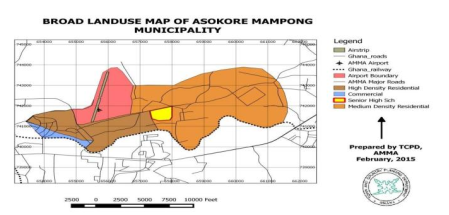
Map of Asokore Mampong Municipality
Figure 1. Land Use Map of Asokore Mampong.
From
Figure 1, it abuts the Kumasi Metropolis to the East and the Ejisu Municipality to the North and North-East, within the Kwabre East District. The entire Municipality is engulfed in a 10-kilometre radius from Kumasi. The location of the Municipality, availability of diverse economic activities, and increasing growth in industrial activities serve as a pull factor fueling in-migration. Over 56% of the migrant population (37% of the population) are from other regions other than Ashanti. The proportions of the migrant population along regional lines are as follows: The Northern Region (16%), the Upper East Region (10.2%), and the Central Region (6.7%). This notwithstanding, a closer look at the duration of stay indicated that the proportion of the migrant population that stays longer in the Municipality (more than 20 years) emanated from the Eastern Region (24.2%), followed by those from the Central Region (23.3%) and the Volta Region (23%). It can, therefore, be deduced that the factor that influences migration of people from the Upper East, West and Northern regions of Ghana is trade-induced, such that migrants from those regions do not stay long in the Asokore Mampong Municipality.
Land Ownership and Management
Asantehene is the overlord of lands in the region including Asokore Mampong. Asokore Mampong hene and other sub-chiefs in various communities take care of the lands in their areas but pay royalties to the overlord of the lands (Asantehene). Due to the high disparity in ethnicity in the Municipality, land ownership and management are in diverse possession. Lands found in areas like Aboabo No. 1 and 2, and Sawaba are owned and managed by the chiefs in those areas, whereas lands found in areas such as Asokore Mampong, Akurem, Adukrom, and Sepe-Tinpom are owned and managed by the local traditional authorities ofthe area. Lands in Asawase were acquired by the Government and given to the State Housing.
Company for the housing estate. Hence, Asawase lands are controlled by that institution.
5. Literature Review
Research conducted by
| [5] | Chinniah, A., & Kalimuthu, B. (2014). Problem and prospects of transport in Ethiopia. |
[5]
, in Ethiopia,
| [6] | Ipingbemi. O., & Adebayo, A. (2016). Tricycle as a mode of public transportation in Ibadan Metropolis. Ife Research Publications in Geography, 14(2), 87 – 100. |
[6]
, in Nigeria, and
| [7] | Adetunji, M. O., Oladejo, J. A., Oladiran, J. O., & Ojedokun, I. K. (2017). Factors associated with Poverty Status among Women Cassava Processors in Ogbomoso Agricultural Zone of Oyo State, Nigeria. Research Journal of Agronomy, 11(2). |
[7]
, in Nigeria, all confirm that the tricycle transit industry has provided employment opportunities for workers in the informal sector. According to
| [7] | Adetunji, M. O., Oladejo, J. A., Oladiran, J. O., & Ojedokun, I. K. (2017). Factors associated with Poverty Status among Women Cassava Processors in Ogbomoso Agricultural Zone of Oyo State, Nigeria. Research Journal of Agronomy, 11(2). |
[7]
, some individuals seeking employment have found comfort in the commercial tricycle transport business.
| [8] | Oluwaseun, B. (2016). The political economy of tricycle transportation business in Osogbo Metropolis: Lessons for a developing economy. Emerging Economy Studies, 2(2), 156–169. |
[8]
, revealed that many individuals have transitioned from other informal-sector occupations to the tricycle transport business due to its assurance of a daily income
| [9] | Jibrilla, H. M., & Fashola, O. M. (2017). International Digital Organisation for Scientific Research. IDOSR Journal of Humanities and Social Sciences, 2(3), 56-72. |
[9]
, concurred with
| [8] | Oluwaseun, B. (2016). The political economy of tricycle transportation business in Osogbo Metropolis: Lessons for a developing economy. Emerging Economy Studies, 2(2), 156–169. |
[8]
, that tricycle transport has significantly increased employment opportunities and income for young people.
In 2015, the government of Ghana distributed the ‘roofed tricycle’ popularly known in different parts of the country as either Pregiya, Adedetaa Mahama-Cambo, or yellow, among others, to some youth in Northern Ghana to ease the transportation challenges in that region and to create employment for the teeming youth
| [10] | Tamale Metropolitan Assembly (Producer). (2018). Yellow-Yellow Tricycles Collapsing Taxi Business in Tamale. |
[10]
. This youth empowerment program was organised by the Microfinance and Small Loans Centre (MASLOC).
The initiatives have spread throughout Ghana and have displaced shared taxi services in some parts of the country, especially the northern regional capital, Tamale.
MASLOC's establishment was enabled by Legislative Instrument 2180 that permits the use of three-wheeled vehicles to transport fare-paying passengers. However, this has complicated the enforcement of existing road traffic regulations used to prevent three-wheeled vehicles from operating commercial passenger services, notwithstanding these regulatory inconsistencies. The Commercial Services segment for three-wheeled vehicles is rapidly enlarging due to the contribution of these vehicles to employment and improving spatial mobility in countries faced with increasing Globalisation and Rapid Technological Developments, combined with a Young Labour Force
| [11] | Asuelinmen, G., Ojolo, S., & Ajayi, O. (2020). Investigating the lateral stability of a three-wheeled scooter taxi due to tyre-road forces. Nigerian Journal of Technology, 39(1), 189–195. |
[11]
. In addition, they are exceptionally Energy Efficient due to their Laterally Stable design and Low Rolling Resistance, providing significant Cost Savings over time (especially in areas where Fuel Prices change frequently and there is a Limited Daily Income), especially for those who use them as an Income-Generating Tool for Passenger Transport and Goods Delivery. Additionally, while Cycles have continued to evolve throughout the 20th Century, they can also be used for Recreation, Competitive Sports, Freight Movement and Public Transport
| [12] | Napper, R. (2023). Napper cycling typology: identifying and understanding different bicycle trip purposes. Transportation Research Interdisciplinary Perspectives, 17, 100740. |
[12]
.
In 2015, the Ghanaian government implemented a program wherein they distributed roofed tricycles, commonly referred to as Pregiya, Adedetaa Mahama-Cambo, or simply yellow, to address transportation challenges in Northern Ghana and generate employment opportunities for the youth. This youth empowerment initiative was orchestrated by the Microfinance and Small Loans Centre (MASLOC). The scheme's success has led to its expansion across Ghana and, notably, the displacement of shared taxi services in certain regions, particularly in the northern regional capital, Tamale.
The MASLOC project was launched following the enactment of LI2180 outlawing tricycles as commercial carriers of paying passengers, causing challenges in enforcing legislation aimed at restricting road use by three-wheeled vehicles providing passenger services. Regardless of these restrictions, tricycles that operate commercially serve as a major contributor to employment and the economic empowerment of people in a period of instability, with several drivers behind such mobility, including globalisation and the rapid introduction of advancing technology and growth in the labour force. As viable alternatives to taxis and minibuses, they are affordable and provide ease of use for short-distance travel within urban areas. As stated by Osoja
| [13] | , O. O., & Bonu, S. (2019). Effect of keke napep (tricycle) on last-mile transportation of commuters in Ojo Local Government Area of lagos. Nigeria, Glob Acad J Econ Buss, 1, 43–50. |
[13].
” and in addition to transporting people, they are widely used for transporting both goods and passengers and carrying food, water, and construction items. Employment creation and poverty alleviation among the country's youth. Some commuters have shown that they like tricycles as a mode of transportation because they are relatively available, affordable, and safe. Vehicles such as these provide a vital supporting function for micro-enterprises, allowing for low-cost transportation of both goods and people
| [14] | [Mapunda, G. (2023). A linguistic analysis of sayings on bajaj passenger tricycles in Dar es Salaam city. Utafiti, 18(1), 84–107. |
[14]
. In addition to being seen through and used in urban environments, these vehicles demonstrate their essential role in the economy as well as how infrastructure can adapt to meet this need.
Rodrigue, J. P.
| [15] | Rodrigue, J. P. (2017). Urban Transportation Challenges. New York: Routledge, 440. |
[15]
. there is a relationship between Transportation and job creation as well as the effect on economic growth, the added value of employment effect of transport service usually extends beyond those generated by the activity, the indirect effect is silent for example transportation companies buying their inputs and items like fuel, supplies, maintenance from the local supply chain the production of these inputs create additional employment in the economy. The suppliers also buy goods and services from the local supply chain
| [16] | Balaria, F. E., Pascual, M. P., Santos, M. D., Ortiz, A. F., Gabriel, A. G., & Mangahas, T. L. S. (2017). Sustainability of e-trike as an alternative mode of public transportation system: The case of Cabanatuan City, Philippines. Open Journal of Civil Engineering, 7(3), 362–377. |
[16]
.
6. Methodology
Both primary and secondary data sources were used. The primary data source involved the collection of data through direct contact with the operators of tricycles for commercial purposes, repairers of tricycles, riders, passengers, and union leaders, and the closed-ended questions were administered. The questionnaire contained questions on socio-economic characteristics, employment history, current employment status, and their view on tricycle operation for commercial purposes in the Municipality and the country. There was an identification of various routes plied by the commercial tricycle operators in the country, there was a survey of the major routes of study locations, and their major tricycle stations were identified. The secondary information was generated from the published and unpublished data sources, which include journals, books of reading, and records of various tricycle unions. The empirical data were subjected to the descriptive statistical tool.
7. Data Analysis and Presentation
The operators of tricycles were made up of full-time and part-time riders. The tricycle operators have formed an association to provide an efficient and affordable transportation system to augment the existing transport service in the municipality and the country in general. Theoretically, several factors can be added to explain the evolution of transport in any nation. A recent innovation within the tricycle ecosystem is the electric tricycle (or e-trike), which represents a more sustainable alternative to conventional models.
8. Demographic Characteristics of Respondents
Most of the respondents 57.44% were male while 42.55% were female and most respondents were between the age of 26-35 29.78% and only 2.12% represent 66 years or more shows tricycle riding is dominant in the youthful age group of the population as indicated in
Table 2, and 39.36% of the respondents had a basic education at junior high school level, while 2.12% of the respondents had a degree. The occupation of the respondents was trading, representing 21.27%, which is high in terms of the occupation of the respondents in
Table 4, and the least number of respondents is security, which is 2.12%.
Table 1. Personal Data of Respondents.
Variable | Number of Respondents | Percentage (%) |
Male | 54 | 57.44 |
Female | 40 | 42.55 |
Total | 94 | 100 |
Field survey, 2025
Table 2. Age of Respondents.
Age | Frequency | Percentage (%) |
17 or less | 12 | 12.76 |
18-25 | 19 | 20.21 |
26-35 | 28 | 29.78 |
36-45 | 22 | 23.40 |
46-55 | 7 | 7.44 |
56-65 | 4 | 4.25 |
66 or More | 2 | 2.12 |
Total | 94 | 100 |
3. Field Survey, 2025
Table 3. Educational Level of the Respondent.
Education | Frequency | Percentage (%) |
Primary | 22 | 23.40 |
JHS | 37 | 39.36 |
SHS | 28 | 29.78 |
Diploma | 5 | 5.31 |
Degree | 2 | 2.12 |
Masters | - | - |
PhD | - | - |
Others | - | - |
Total | 94 | 100 |
4. Field survey, 2025
Table 4. Occupation of Respondents.
Occupation | Frequency | Percentage (%) |
Traders | 20 | 21.27 |
Students | 15 | 15.95 |
Tricycle Riders | 18 | 19.14 |
Civil Servant | 5 | 5.31 |
Artisans | 7 | 7.44 |
Security Personal | 2 | 2.12 |
Self-employed | 11 | 11.70 |
Unemployed | 16 | 17.02 |
Total | 94 | 100 |
5. Field survey, 2025
Table 5. Reasons for selecting tricycles as a means of Transport.
Respondents | Frequency | Percentage (%) |
Comfortable | 16 | 17.02 |
Cheap and affordable | 34 | 36.17 |
Faster | 8 | 8.51 |
Always available and accessible | 13 | 13.82 |
Provide door-to-door service | 17 | 18.08 |
safe | 6 | 6.38 |
Field survey, 2025
Table 5 reveals that 36.17% of the population think it is a cheap and affordable means of transport, 18.08% are of the view that they provide door-to-door, 17.02% think is comfortable and cheap, 13.08% think is always available and accessible, service, while only 6.38% believe, 8.51% believe is faster and 6.38% is safe to use.
Table 6. Reasons why tricycle riders ride tricycles.
Respondents’ | Frequency | Percentage (%) |
Business failure | 3 | 3.19 |
Quick savings | 4 | 4.25 |
Unemployment | 52 | 55.31 |
To sustain the family | 13 | 13.82 |
Low income from other jobs | 15 | 15.95 |
To meet basic needs | 7 | 7.44 |
Total | 94 | 100 |
Field Survey, 2025
From
Table 6 a total of 52 respondents representing 55.31% believe is because of the unemployment situation, 15 respondents representing 15.95% ride tricycles to supplement their low income from other jobs, 13 of the respondents that are 13.83% believe the tricycle riders ride in other to sustain their family, 7 which represent 7.44% ride tricycle to meet the basic needs of their family, however, 4 which is 4.25% of respondent sees it as an avenue to save money quickly.
Table 7 below reveals that 57 of the respondents representing 60.63% believe that in the tricycle operation chain, the tricycle riders are the most beneficiaries of tricycle usage for commercial purposes, 21 of the respondents made up 22.34% of the respondents think the tricycle owners are the most beneficiaries, 9 respondent which is made up of 9.59% think tricycle sellers are most beneficiaries, while 5 which is 5.31% believe the tricycle fitters/ artisans are the most beneficiaries and 2 representing 2.12% think tricycle washers are the most beneficiaries.
Table 7. Which category of people in the tricycle operation chain are the most beneficiaries of tricycle usage for commercial purposes.
Responses | Frequency | Percentage (%) |
Tricycle fitters/Artisans | 5 | 5.31 |
Tricycle riders | 57 | 60.63 |
Tricycle owners | 21 | 22.34 |
Tricycle sellers | 9 | 9.59 |
Tricycle fitters | 5 | 5.31 |
Tricycle washers | 2 | 2.12 |
Total | 94 | 100 |
8. Field survey, 2025
Table 8. Do you think tricycle operations have created jobs in the Asokore Mampong Municipality.
Response | Frequency | Percentage% |
Yes | 89 | 94.68 |
No | 5 | 5.31 |
Total | 94 | 100 |
Field Survey, 2025
Table 8 indicates that 89 respondent which represents 94.68%, believe tricycle operation in the Asokore Mampong Municipality has created jobs, while 5, representing only 5.31% of the respondents, believe tricycle operation in the Municipality has not created employment.
Table 9. Tricycle Ownership.
Tricycle Ownership | Frequency | Percentage (%) |
Owned by someone | 71 | 75.53 |
Self-owned | 23 | 24.46 |
Total | 94 | 100 |
Field Survey, 2025
The result presented in
Table 7 indicates that most of the tricycles in the Asokore Mampong Municipality are not owned by the riders but rather are owned by someone else (75.52%), and (24.46%) are owned by the tricycle riders.
Table 10. What do you think are the challenges of tricycle operation for commercial purposes in the Asokore Mampong Municipality.
Responses | Frequency | Percentages% |
Ridders Attitude | 5 | 5.31 |
Frequent Accident | 45 | 47.87 |
Riders’ drug usage | 15 | 15.95 |
Frequent stopover | 5 | 5.31 |
Over speeding | 9 | 9.57 |
Stop by the police | 12 | 12.76 |
Passengers Attitude | 3 | 3.19 |
Total | 94 | 100 |
Field survey, 2025
Table 10 results from the respondents below reveal that 45 of them representing 47.87% think frequent accidents by the tricycles are the main challenges they are facing, 15 respondents which are made up the 15.95% think the challenges are the usage of drugs by the tricycles riders, 12 respondent which is made up of 12.76% think the challenges are the frequent stop over by police, 9 which is made up of 9.57% believe is over speeding, 5 which represent 5.31% think is riders attitude, another 5 which represent 5.31 also think is a frequent stopover and 3 respondent representing 3.19% believe is the passenger’s attitude.
9. Conclusion
The study sought to investigate tricycles as tools for job creation in the Asokore Mampong Municipality of Ghana. The study concludes that tricycle operation is an avenue for job creation in the municipality. Because 94.68% of the respondents believe it is an avenue for job creation for the unemployed youth teaming, while 5.31% think otherwise, and there has been a reduction in engagement in criminal activities within the municipality. Despite the job creation among the unemployed youth in the municipality, it has also been discovered that most of the tricycles are not owned by the riders but by someone else; however, most of the beneficiaries of the tricycle operation chain are the tricycle riders, and many of them are youth, less educated, and addicted to drugs.
10. Recommendations
The government ought to generate job prospects for the burgeoning population while also implementing streamlined and efficient urban transportation systems to alleviate the strain on the populace.
There should be an effective law enforcement regime to prevent more road accidents.
Government authorities can create a regulatory framework that encourages responsible lending to tricycle operators while protecting them from predatory lending practices.
Tricycle riders, vehicle licensing authorities, police departments, metropolitan, municipal, and district assemblies, as well as the public, should collectively advocate for the legalisation of tricycles for commercial use.
Abbreviations
MASLOC | Microfinance and Small Loans Centre |
AMMA | Asokore Mampong Municipal Assembly |
L. I | Legislative Instrument |
Author Contributions
Yahaya Mohammed is the sole author. The author read and approved the final manuscript.
Conflicts of Interest
I, Yahaya Mohammed, the author, do hereby state that I have perused the contents of this manuscript, agree with them, and declare to certify that the contents are my own, that there is no commitment or any form of monetary obligation, and that it has not undergone any further publication.
References
| [1] |
Starke, P., Batool, Z, and Younis, M. W. (2019). The expansion of three-wheeler transport service: The case of Qing is in Pakistan, A paper presented at the 26th World Road Congress.
|
| [2] |
Litman, T. (2020). Evaluating accessibility for transportation planning: Measuring people's ability to reach desired goods and activities. Victoria Transport Policy Institute, June 5, 2020.
|
| [3] |
Agustin, C. P., Costales, N. C. Z. A., Gadingan, M. M., Francisco, L. M. & Fronda, E. P. (2018).
|
| [4] |
Ghana Statistical Service (Ghana Statistical Service Population and Housing Census Report, 2021).
|
| [5] |
Chinniah, A., & Kalimuthu, B. (2014). Problem and prospects of transport in Ethiopia.
|
| [6] |
Ipingbemi. O., & Adebayo, A. (2016). Tricycle as a mode of public transportation in Ibadan Metropolis. Ife Research Publications in Geography, 14(2), 87 – 100.
|
| [7] |
Adetunji, M. O., Oladejo, J. A., Oladiran, J. O., & Ojedokun, I. K. (2017). Factors associated with Poverty Status among Women Cassava Processors in Ogbomoso Agricultural Zone of Oyo State, Nigeria. Research Journal of Agronomy, 11(2).
|
| [8] |
Oluwaseun, B. (2016). The political economy of tricycle transportation business in Osogbo Metropolis: Lessons for a developing economy. Emerging Economy Studies, 2(2), 156–169.
|
| [9] |
Jibrilla, H. M., & Fashola, O. M. (2017). International Digital Organisation for Scientific Research. IDOSR Journal of Humanities and Social Sciences, 2(3), 56-72.
|
| [10] |
Tamale Metropolitan Assembly (Producer). (2018). Yellow-Yellow Tricycles Collapsing Taxi Business in Tamale.
|
| [11] |
Asuelinmen, G., Ojolo, S., & Ajayi, O. (2020). Investigating the lateral stability of a three-wheeled scooter taxi due to tyre-road forces. Nigerian Journal of Technology, 39(1), 189–195.
|
| [12] |
Napper, R. (2023). Napper cycling typology: identifying and understanding different bicycle trip purposes. Transportation Research Interdisciplinary Perspectives, 17, 100740.
|
| [13] |
, O. O., & Bonu, S. (2019). Effect of keke napep (tricycle) on last-mile transportation of commuters in Ojo Local Government Area of lagos. Nigeria, Glob Acad J Econ Buss, 1, 43–50.
|
| [14] |
[Mapunda, G. (2023). A linguistic analysis of sayings on bajaj passenger tricycles in Dar es Salaam city. Utafiti, 18(1), 84–107.
|
| [15] |
Rodrigue, J. P. (2017). Urban Transportation Challenges. New York: Routledge, 440.
|
| [16] |
Balaria, F. E., Pascual, M. P., Santos, M. D., Ortiz, A. F., Gabriel, A. G., & Mangahas, T. L. S. (2017). Sustainability of e-trike as an alternative mode of public transportation system: The case of Cabanatuan City, Philippines. Open Journal of Civil Engineering, 7(3), 362–377.
|
Cite This Article
-
APA Style
Mohammed, Y. (2026). Appraisals of Tricycle Operations as Tools for Employment Creation in the Asokore Mampong Municipality of Ghana. Innovation Economics, 1(1), 28-34. https://doi.org/10.11648/j.iecon.20260101.13
 Copy
|
Copy
|
 Download
ACS Style
Mohammed, Y. Appraisals of Tricycle Operations as Tools for Employment Creation in the Asokore Mampong Municipality of Ghana. Innov. Econ. 2026, 1(1), 28-34. doi: 10.11648/j.iecon.20260101.13
Copy
|
Download
AMA Style
Mohammed Y. Appraisals of Tricycle Operations as Tools for Employment Creation in the Asokore Mampong Municipality of Ghana. Innov Econ. 2026;1(1):28-34. doi: 10.11648/j.iecon.20260101.13
Copy
|
Download
-
@article{10.11648/j.iecon.20260101.13,
  author = {Yahaya Mohammed},
  title = {Appraisals of Tricycle Operations as Tools for Employment Creation in the Asokore Mampong Municipality of Ghana},
  journal = {Innovation Economics},
  volume = {1},
  number = {1},
  pages = {28-34},
  doi = {10.11648/j.iecon.20260101.13},
  url = {https://doi.org/10.11648/j.iecon.20260101.13},
  eprint = {https://article.sciencepublishinggroup.com/pdf/10.11648.j.iecon.20260101.13},
  abstract = {This study examines the role of commercial tricycle operations in employment creation and income generation within the Asokore Mampong Municipality. The findings reveal that tricycle transportation has emerged as a significant livelihood option for many residents, particularly in response to low wages and limited opportunities in the formal and informal job sectors. A considerable number of individuals who are engaged in tricycle riding for profit reported that their involvement was motivated by dissatisfaction with earnings from previous occupations, while others were drawn into the sector due to persistent unemployment. As a result, commercial tricycle operations have made a significant contribution to reducing unemployment by absorbing a substantial segment of the municipality’s jobless population. Survey results indicate that an overwhelming majority of respondents (94.68%) agree that the use of tricycles for commercial purposes has facilitated employment opportunities for unemployed residents in the municipality. Only a small proportion (5.31%) of respondents expressed disagreement, suggesting a broad consensus on the employment benefits associated with the tricycle transport sector. Beyond job creation, respondents also emphasised the economic advantages derived from the tricycle value chain, which includes riders, owners, mechanics, fuel vendors, and spare parts dealers. Interestingly, the study reveals that tricycle riders are perceived as the primary beneficiaries within this chain, even though most riders do not own the tricycles they operate. Instead, many riders work under ownership arrangements, renting or operating tricycles on a daily sales basis for private owners. Even under such arrangements, riders reportedly earn relatively higher and more stable incomes compared to other actors involved in the tricycle business. Overall, the findings suggest that commercial tricycle operations play a crucial role in livelihood diversification, employment creation, and economic resilience in the Asokore Mampong Municipality, highlighting their importance in local economic development strategies.},
 year = {2026}
}
Copy
|
Download
-
TY  - JOUR
T1  - Appraisals of Tricycle Operations as Tools for Employment Creation in the Asokore Mampong Municipality of Ghana
AU  - Yahaya Mohammed
Y1  - 2026/02/24
PY  - 2026
N1  - https://doi.org/10.11648/j.iecon.20260101.13
DO  - 10.11648/j.iecon.20260101.13
T2  - Innovation Economics
JF  - Innovation Economics
JO  - Innovation Economics
SP  - 28
EP  - 34
PB  - Science Publishing Group
UR  - https://doi.org/10.11648/j.iecon.20260101.13
AB  - This study examines the role of commercial tricycle operations in employment creation and income generation within the Asokore Mampong Municipality. The findings reveal that tricycle transportation has emerged as a significant livelihood option for many residents, particularly in response to low wages and limited opportunities in the formal and informal job sectors. A considerable number of individuals who are engaged in tricycle riding for profit reported that their involvement was motivated by dissatisfaction with earnings from previous occupations, while others were drawn into the sector due to persistent unemployment. As a result, commercial tricycle operations have made a significant contribution to reducing unemployment by absorbing a substantial segment of the municipality’s jobless population. Survey results indicate that an overwhelming majority of respondents (94.68%) agree that the use of tricycles for commercial purposes has facilitated employment opportunities for unemployed residents in the municipality. Only a small proportion (5.31%) of respondents expressed disagreement, suggesting a broad consensus on the employment benefits associated with the tricycle transport sector. Beyond job creation, respondents also emphasised the economic advantages derived from the tricycle value chain, which includes riders, owners, mechanics, fuel vendors, and spare parts dealers. Interestingly, the study reveals that tricycle riders are perceived as the primary beneficiaries within this chain, even though most riders do not own the tricycles they operate. Instead, many riders work under ownership arrangements, renting or operating tricycles on a daily sales basis for private owners. Even under such arrangements, riders reportedly earn relatively higher and more stable incomes compared to other actors involved in the tricycle business. Overall, the findings suggest that commercial tricycle operations play a crucial role in livelihood diversification, employment creation, and economic resilience in the Asokore Mampong Municipality, highlighting their importance in local economic development strategies.
VL  - 1
IS  - 1
ER  -
Copy
|
Download





 Share This Article
 Twitter
 Linked In
 Facebook