Abstract
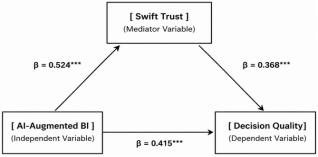
The 2022-2025 floods in Pakistan displaced 38 million people, exposing severe civil-military coordination failures, yet technology-adoption research remains concentrated in corporate settings and rarely examines how AI-augmented analytics shape decisions under extreme time pressure. This study extends a corporate analytics-trust model to Pakistan's humanitarian context, testing whether AI-Augmented BI Data Analysis improves Decision Quality and Collaborative Performance through Swift Trust, and whether Organizational Culture moderates these relationships. Data from 250 emergency responders across disaster authorities, military units, NGOs, and commercial partners were analyzed using PLS-SEM with bootstrapping. AI-Augmented BI significantly predicted Decision Quality (β = 0.415) and Swift Trust (β = 0.524); Swift Trust partially mediated the BI-Decision Quality link (β = 0.193) and strongly drove Collaborative Performance (β = 0.485). Flexible culture amplified analytics-to-trust formation (β = 0.185), while control-oriented culture weakened analytics' translation into collaborative performance (β = -0.224). By integrating technology adoption, inter-organizational trust, and organizational culture within a climate disaster governance framework, the study advances both humanitarian operations theory and practice. These findings indicate that technical infrastructure alone cannot resolve humanitarian coordination failures; effective climate crisis governance requires pairing AI-driven analytics with deliberate trust-building and flexible organizational design, offering actionable guidance for disaster authorities balancing hierarchical command with agile, network-based collaboration
|
Published in
|
Innovation Business (Volume 1, Issue 4)
|
|
DOI
|
10.11648/j.ib.20260104.11
|
|
Page(s)
|
174-190 |
|
Creative Commons
|

This is an Open Access article, distributed under the terms of the Creative Commons Attribution 4.0 International License (http://creativecommons.org/licenses/by/4.0/), which permits unrestricted use, distribution and reproduction in any medium or format, provided the original work is properly cited.
|
|
Copyright
|
Copyright © The Author(s), 2026. Published by Science Publishing Group
|
Keywords
AI-Augmented Business Intelligence, Collaborative Performance, Climate Crisis Governance, Civil-Military Coordination
1. Introduction
Between 2022 and 2025, Pakistan suffered three major flood events that displaced over 38 million people, inundated a third of the country, and caused over USD 46 billion in damages
| [34] | UNDP (United Nations Development Programme), 2023. Pakistan flood impact assessment. Islamabad: UNDP Pakistan. |
| [36] | World Bank, 2024. Pakistan: economic impact of climate-related disasters, 2022-2025. Washington, DC: World Bank Group. |
[34, 36]
. Response operations across Sindh, Balochistan, and Khyber Pakhtunkhwa required multi-agency coordination among the National Disaster Management Authority (NDMA), Provincial Disaster Management Authorities (PDMAs), military logistics wings, UN agencies, international NGOs, and private logistics providers
| [19] | Javeria, S., Naim, M. A. and Ali, T., 2026. Evaluating civil-military logistics friction in South Asian flood management: A post-2022 policy analysis. Disaster Prevention and Management, 35(1), pp. 74-92. |
| [22] | Khan, S. A. and Malik, H. W., 2026. Climate Vulnerability and Emergency Response Logistics in South Asia: A Post-2022 Flood Assessment of Multi-Agency Friction. Journal of Development Policy, 14(2), pp. 112-134. |
[19, 22]
.
Despite available digital tools, relief efforts hit severe bottlenecks. UN-OCHA
| [25] | Kumar, S., Patel, R., & Sharma, V. (2025). The role of organizational agility and structural rigidity in emergency technology adoption. Public Administration Review, 85(3), 401-418. |
[25]
documented recurring problems: duplicated aid in accessible areas, unreached last-mile communities, and data gaps across agencies
| [28] | OCHA (United Nations Office for the Coordination of Humanitarian Affairs), 2024. Pakistan flood response coordination assessment. Islamabad: OCHA Pakistan. |
[28]
. These failures stem from a fundamental structural friction between the military’s rigid, command-driven hierarchy and civilian NGOs’ decentralized, informal networks
| [7] | Ansell, C. and Boin, A., 2026. Taming the turbulent field: Structural challenges and behavioral dynamics in multi-agency emergency networks. Public Administration Review, 86(3), pp. 412-429. |
| [10] | Boin, A. and Lodge, M., 2025. The architecture of crisis coordination: Structural choices and cultural barriers in modern emergency management. Public Administration, 103(2), pp. 311-328. |
| [33] | Syarif, M., Ramadhan, A., & Hadi, S. (2024). Contingency theory in multi-agency humanitarian logistics: Cultural alignment vs. hierarchical silos. Disaster Management & Policy Quarterly, 22(3), 204-221. |
[7, 10, 33]
. This cultural divide dictates whether field teams actually share and trust digital data
| [20] | Kamaluddin, K., Ridwan, A., M, N. and Munifa, M., 2026. Organisational Culture and Transformational Leadership Style: Impact on Employee Performance. Annals of Human Resource Management Research, 6(1), pp. 301-318.
https://doi.org/10.35912/ahrmr.v6i1.3729 |
| [32] | Syarif, B. S., Raharjo, K., Ruhana, I. and Nurtjahjono, G. E., 2024. Navigating readiness for change: exploring the influence of authentic leadership, culture, learning and internal locus of control. Cogent Business & Management, 11(1), p. 2433170. https://doi.org/10.1080/23311975.2024.2433170 |
[20, 32]
.
Current emergency governance literature points to three main factors driving technology adoption in crises:
AI-Augmented Business Intelligence (BI): Moving beyond static reporting, modern systems combine live satellite tracking, displacement maps, and weather feeds into predictive models
| [3] | Adjei, K., Amoako, C. and Boateng, A., 2025. Institutional frameworks and technical capacity in disaster management infrastructures. Journal of Homeland Security and Emergency Management, 22(1), pp. 89-112. |
| [4] | Adjei, K. A., Mensah, O., & Boateng, R. (2025). Predictive analytics and disaster management informatics: Frameworks for public sector technical capacity. Journal of Crisis Governance, 18(2), 142-159. |
| [9] | Bhoi, A., Nayak, R. P., Bhuyan, H. B. G. S., Balabantaray, R. C., Pattanaik, A. and Chinmay, A., 2025. Smart crisis response leveraging social media content for effective disaster management. Discover Computing, 28(1), pp. 1-25.
https://doi.org/10.1007/s10791-025-09749-1 |
| [30] | Riad, M., Naimi, M. and Okar, C., 2024. Enhancing Supply Chain Resilience Through Artificial Intelligence: Developing a Comprehensive Conceptual Framework for AI Implementation and Supply Chain Optimization. Logistics, 8(4), p. 111.
https://doi.org/10.3390/logistics8040111 |
[3, 4, 9, 30]
.
Swift Trust: Advanced tools fail if field teams do not trust the output
| [8] | Bhoi, S. K., Dash, J. R., & Swain, S. R. (2025). Human-AI collaboration in emergency response systems: A socio-technical perspective on algorithm adoption. International Journal of Disaster Risk Science, 16(4), 512-528. |
| [29] | Pham, Q. T., Nguyen, M. H. and Tran, T. A., 2026. Augmented Analytics and Decision Quality: The Role of Trust among Non-Technical BI Users. arXiv preprint arXiv: 2605.20198. |
[8, 29]
. In temporary crisis networks without long-term relationships, transparent digital dashboards substitute for traditional trust
| [5] | Aljedani, N., Alsubhi, K. and Alzahrani, A., 2025. AI-Social Media Integration for Crisis Management. Applied Sciences, 15(3), pp. 112-125. |
| [13] | Cheng, Y., Jiang, H. and Neo, R., 2025. How is Artificial Intelligence Shaping Crisis Communication? Journal of Risk Research, 28(2), pp. 189-204.
https://doi.org/10.1080/13669877.2025.2579317 |
| [21] | Kapucu, N., 2025. Collaborative Governance under Stress: Socio-Technical Networks and Trust Dynamics in Complex Disasters. International Journal of Public Administration, 48(4), pp. 267-285. |
[5, 13, 21]
.
Organizational Culture: Institutional structure dictates how data is used
| [24] | Kumar, R., Sharma, V. and Singh, A., 2025. A PLS-SEM analysis of people, management, and organisational culture influences on AI-driven hospital facilities management systems. Frontiers in the Built Environment, 11(1717168), pp. 1-15.
https://doi.org/10.3389/fbuil.2025.1717168 |
[24]
. Hierarchical organizations process digital insights differently than flexible networks
| [25] | Kumar, S., Patel, R., & Sharma, V. (2025). The role of organizational agility and structural rigidity in emergency technology adoption. Public Administration Review, 85(3), 401-418. |
| [33] | Syarif, M., Ramadhan, A., & Hadi, S. (2024). Contingency theory in multi-agency humanitarian logistics: Cultural alignment vs. hierarchical silos. Disaster Management & Policy Quarterly, 22(3), 204-221. |
| [35] | Yang, Y. and Mostafa, A. M. S., 2024. High-performance human resource practices, organizational identification and employee commitment: the moderating role of organizational culture. Frontiers in Psychology, 15, p. 1494186.
https://doi.org/10.3389/fpsyg.2024.1494186 |
[25, 33, 35]
.
This paper builds on the framework established by Pham et al.
| [29] | Pham, Q. T., Nguyen, M. H. and Tran, T. A., 2026. Augmented Analytics and Decision Quality: The Role of Trust among Non-Technical BI Users. arXiv preprint arXiv: 2605.20198. |
[29]
, which showed that analytics improve decision execution when mediated by organizational trust. Other recent work confirms trust as a key bridge between automated data and human decisions
| [16] | Dubey, R., Bryde, D. J., Dwivedi, Y. K., Graham, G. and Foropon, C., 2022. Impact of artificial intelligence-driven big data analytics culture on agility and resilience in humanitarian supply chain: a practice-based view. International Journal of Production Economics, 250, p. 108618.
https://doi.org/10.1016/j.ijpe.2022.108618 |
| [26] | Li, X. and Tian, Y., 2026. Advancing Decision-Making through AI-Human Collaboration: A Systematic Review and Conceptual Framework. Group Decision and Negotiation, 35(1), pp. 77-98.
https://doi.org/10.1007/s10726-026-09980-1 |
[16, 26]
. However, those findings come from corporate settings with predictable supply chains. They need validation in high-stakes public sector crises.
| [15] | Comfort, L. K. and Zhang, H., 2025. Socio-technical performance in extreme events: Networks, technology, and trust. Disasters, 49(2), pp. 204-226. |
| [23] | Kovács, G. and Spens, K., 2025. Humanitarian logistics in the era of artificial intelligence: Civil-military coordination dynamics during climate-induced shocks. Journal of Humanitarian Logistics and Supply Chain Management, 15(1), pp. 45-68. |
[15, 23]
.
1.1. Research Gap
Three specific issues prevent the direct use of existing corporate models in Pakistan’s disaster ecosystem:
Human-AI Collaboration Under Stress: Crisis informatics literature focuses heavily on building algorithms, but provides little empirical evidence on how real-time human-AI interaction alters decision quality during active supply disruptions
| [8] | Bhoi, S. K., Dash, J. R., & Swain, S. R. (2025). Human-AI collaboration in emergency response systems: A socio-technical perspective on algorithm adoption. International Journal of Disaster Risk Science, 16(4), 512-528. |
| [9] | Bhoi, A., Nayak, R. P., Bhuyan, H. B. G. S., Balabantaray, R. C., Pattanaik, A. and Chinmay, A., 2025. Smart crisis response leveraging social media content for effective disaster management. Discover Computing, 28(1), pp. 1-25.
https://doi.org/10.1007/s10791-025-09749-1 |
| [26] | Li, X. and Tian, Y., 2026. Advancing Decision-Making through AI-Human Collaboration: A Systematic Review and Conceptual Framework. Group Decision and Negotiation, 35(1), pp. 77-98.
https://doi.org/10.1007/s10726-026-09980-1 |
[8, 9, 26]
.
Swift Trust Under Extreme Time Constraints: Corporate models view trust as something built slowly
| [1] | Abbas, H., Salem, I. E., Akram, H. W. and Abbas, S., 2025. Exploring Partial Least Squares Structural Equation Modeling (PLS-SEM) Applications in Supply Chain Research: A Bibliometric Analysis and Science Mapping Approach. Operations Research Forum, 6(142), pp. 1-29.
https://doi.org/10.1007/s43069-025-00556-4 |
| [11] | Changalima, I. A. and Chuwa, M., 2025. Partial Least Squares Structural Equation Modeling (PLS-SEM) in business research: A simple guide for novice researchers. International Journal of Research in Business and Social Science, 14(9), pp. 497-506. https://doi.org/10.20525/ijrbs.v14i9.4601 |
[1, 11]
. In contrast, disaster response requires "swift trust" formed under severe time pressure
| [11] | Changalima, I. A. and Chuwa, M., 2025. Partial Least Squares Structural Equation Modeling (PLS-SEM) in business research: A simple guide for novice researchers. International Journal of Research in Business and Social Science, 14(9), pp. 497-506. https://doi.org/10.20525/ijrbs.v14i9.4601 |
[11]
. How this trust operates when civil and military teams share automated dashboards during an active emergency remains unmeasured
| [19] | Javeria, S., Naim, M. A. and Ali, T., 2026. Evaluating civil-military logistics friction in South Asian flood management: A post-2022 policy analysis. Disaster Prevention and Management, 35(1), pp. 74-92. |
| [23] | Kovács, G. and Spens, K., 2025. Humanitarian logistics in the era of artificial intelligence: Civil-military coordination dynamics during climate-induced shocks. Journal of Humanitarian Logistics and Supply Chain Management, 15(1), pp. 45-68. |
[19, 23]
.
Geographic and Institutional Scope: Technology adoption research in disaster management concentrates heavily on North America, Europe, and China
| [1] | Abbas, H., Salem, I. E., Akram, H. W. and Abbas, S., 2025. Exploring Partial Least Squares Structural Equation Modeling (PLS-SEM) Applications in Supply Chain Research: A Bibliometric Analysis and Science Mapping Approach. Operations Research Forum, 6(142), pp. 1-29.
https://doi.org/10.1007/s43069-025-00556-4 |
| [29] | Pham, Q. T., Nguyen, M. H. and Tran, T. A., 2026. Augmented Analytics and Decision Quality: The Role of Trust among Non-Technical BI Users. arXiv preprint arXiv: 2605.20198. |
[1, 29]
. Researchers have not yet used Pakistan’s 2022-2025 floods, or its civil-military dynamics, to test how organizational culture alters the relationship between analytics, trust, and field performance
| [28] | OCHA (United Nations Office for the Coordination of Humanitarian Affairs), 2024. Pakistan flood response coordination assessment. Islamabad: OCHA Pakistan. |
| [34] | UNDP (United Nations Development Programme), 2023. Pakistan flood impact assessment. Islamabad: UNDP Pakistan. |
| [36] | World Bank, 2024. Pakistan: economic impact of climate-related disasters, 2022-2025. Washington, DC: World Bank Group. |
[28, 34, 36]
.
1.2. Study Objectives and Structure
This study adapts the baseline model from Pham et al.
| [29] | Pham, Q. T., Nguyen, M. H. and Tran, T. A., 2026. Augmented Analytics and Decision Quality: The Role of Trust among Non-Technical BI Users. arXiv preprint arXiv: 2605.20198. |
[29]
to emergency governance. We shift the empirical context to Pakistan's disaster response infrastructure
| [28] | OCHA (United Nations Office for the Coordination of Humanitarian Affairs), 2024. Pakistan flood response coordination assessment. Islamabad: OCHA Pakistan. |
[28]
, reframe the analytics and trust variables for humanitarian logistics
| [16] | Dubey, R., Bryde, D. J., Dwivedi, Y. K., Graham, G. and Foropon, C., 2022. Impact of artificial intelligence-driven big data analytics culture on agility and resilience in humanitarian supply chain: a practice-based view. International Journal of Production Economics, 250, p. 108618.
https://doi.org/10.1016/j.ijpe.2022.108618 |
| [23] | Kovács, G. and Spens, K., 2025. Humanitarian logistics in the era of artificial intelligence: Civil-military coordination dynamics during climate-induced shocks. Journal of Humanitarian Logistics and Supply Chain Management, 15(1), pp. 45-68. |
[16, 23]
, and analyze the relationships using Partial Least Squares Structural Equation Modeling (PLS-SEM)
| [17] | Hair, J. F., Hult, G. T. M., Ringle, C. M. and Sarstedt, M., 2021. A Primer on Partial Least Squares Structural Equation Modeling (PLS-SEM). 4th ed. Thousand Oaks: SAGE Publications. https://doi.org/10.1007/978-3-030-80519-7 |
| [18] | Hair, J. F., Sarstedt, M., Ringle, C. M. and Gudergan, S. P., 2024. Advanced Issues in Partial Least Squares Structural Equation Modeling. 2nd ed. Thousand Oaks: SAGE Publications.
https://doi.org/10.3926/oss.37 |
| [31] | Sarstedt, M., Ringle, C. M. and Hair, J. F., 2025. Partial Least Squares Structural Equation Modeling: Guidelines for Using and Reporting. Journal of Marketing Theory and Practice, 33(1), pp. 45-67.
https://doi.org/10.1007/978-3-319-57413-4_15 |
[17, 18, 31]
.
Following the sampling design of Pham et al.
| [29] | Pham, Q. T., Nguyen, M. H. and Tran, T. A., 2026. Augmented Analytics and Decision Quality: The Role of Trust among Non-Technical BI Users. arXiv preprint arXiv: 2605.20198. |
[29]
, we surveyed N = 250 emergency responders across civil and military lines. Two core questions guide this study:
RQ1: How does AI-augmented BI data analysis affect swift trust and decision quality among humanitarian organizations in Pakistan?
RQ2: How does organizational culture moderate the relationships between analytics, swift trust, and collaborative performance within Pakistan's civil-military network?
Section 2 reviews the literature and details hypothesis development. Section 3 outlines the research design and PLS-SEM methodology. Section 4 presents the data analysis and structural model results. Section 5 discusses theoretical and policy implications. Section 6 covers limitations and future research directions.
2. Literature Review and Hypothesis Development
2.1. Theoretical Grounding
2.1.1. The Practice-Based View (PBV) and Contingency Theory
Evaluating technology adoption in non-commercial settings requires moving away from the traditional Resource-Based View (RBV), which focuses on long-term competitive advantage. Because humanitarian networks operate under distinct institutional logics, this study adopts the Practice-Based View (PBV). PBV posits that performance variations stem from daily operational routines rather than mere tool ownership. In emergencies, tools must be immediately actionable rather than strategically proprietary
| [27] | Mlybari, S. and Elgohary, H., 2025. Objective insights into successful technological integration using structural modeling. International Journal of Information Management Data Insights, 5(1), pp. 100-119. |
[27]
. To address disaster volatility, this study couples PBV with Contingency Theory, which states that operational effectiveness depends on the alignment between external environments and internal characteristics
| [33] | Syarif, M., Ramadhan, A., & Hadi, S. (2024). Contingency theory in multi-agency humanitarian logistics: Cultural alignment vs. hierarchical silos. Disaster Management & Policy Quarterly, 22(3), 204-221. |
[33]
. We argue that data-driven coordination success is contingent upon organizational culture, specifically the friction between hierarchical control structures and flexible networks
| [7] | Ansell, C. and Boin, A., 2026. Taming the turbulent field: Structural challenges and behavioral dynamics in multi-agency emergency networks. Public Administration Review, 86(3), pp. 412-429. |
| [10] | Boin, A. and Lodge, M., 2025. The architecture of crisis coordination: Structural choices and cultural barriers in modern emergency management. Public Administration, 103(2), pp. 311-328. |
[7, 10]
.
2.1.2. Cognitive Delegation Theory
Cognitive Delegation Theory explains how human decision-makers transfer computational authority and analytical tasks to automated digital systems under high stress, where cognitive capacities are easily overwhelmed by chaotic data volumes
| [26] | Li, X. and Tian, Y., 2026. Advancing Decision-Making through AI-Human Collaboration: A Systematic Review and Conceptual Framework. Group Decision and Negotiation, 35(1), pp. 77-98.
https://doi.org/10.1007/s10726-026-09980-1 |
[26]
. Delegating data aggregation and predictive analytics to an AI framework reduces cognitive load, allowing operators to focus on execution
| [29] | Pham, Q. T., Nguyen, M. H. and Tran, T. A., 2026. Augmented Analytics and Decision Quality: The Role of Trust among Non-Technical BI Users. arXiv preprint arXiv: 2605.20198. |
| [30] | Riad, M., Naimi, M. and Okar, C., 2024. Enhancing Supply Chain Resilience Through Artificial Intelligence: Developing a Comprehensive Conceptual Framework for AI Implementation and Supply Chain Optimization. Logistics, 8(4), p. 111.
https://doi.org/10.3390/logistics8040111 |
[29, 30]
. However, this handoff depends entirely on perceived system reliability; if an analytical infrastructure lacks transparency, cognitive delegation fails
| [12] | Cheng, Y., Zhang, L., & Wang, X. (2025). Trust under pressure: Evaluating swift trust dynamics and information velocity in temporary crisis networks. Disasters, 49(1), 89-111. |
| [14] | Comfort, L. K., 2025. Dynamic Governance in Crisis: Integrating Socio-Technical Systems and Behavioral Trust under Extreme Stress. Public Administration Review, 85(4), pp. 589-604. |
| [29] | Pham, Q. T., Nguyen, M. H. and Tran, T. A., 2026. Augmented Analytics and Decision Quality: The Role of Trust among Non-Technical BI Users. arXiv preprint arXiv: 2605.20198. |
[12, 14, 29]
.
2.2. AI-Augmented Business Intelligence (BI) and Crisis Intelligence
2.2.1. Evolution From Static Analytics to Augmented Analytics
The crisis management paradigm has shifted from retrospective Big Data Analytics Capabilities (BDAC) to real-time AI-Augmented BI Data Analysis
| [30] | Riad, M., Naimi, M. and Okar, C., 2024. Enhancing Supply Chain Resilience Through Artificial Intelligence: Developing a Comprehensive Conceptual Framework for AI Implementation and Supply Chain Optimization. Logistics, 8(4), p. 111.
https://doi.org/10.3390/logistics8040111 |
[30]
. By integrating machine learning and natural language processing, augmented analytics automates data preparation and insights generation
| [5] | Aljedani, N., Alsubhi, K. and Alzahrani, A., 2025. AI-Social Media Integration for Crisis Management. Applied Sciences, 15(3), pp. 112-125. |
| [13] | Cheng, Y., Jiang, H. and Neo, R., 2025. How is Artificial Intelligence Shaping Crisis Communication? Journal of Risk Research, 28(2), pp. 189-204.
https://doi.org/10.1080/13669877.2025.2579317 |
[5, 13]
. During climate disasters, this allows dashboards to ingest multimodal data streams (social media, mobile crowdsourcing, satellite tracking) to generate a unified operational picture, automating predictive alerts for supply bottlenecks and last-mile distribution
| [3] | Adjei, K., Amoako, C. and Boateng, A., 2025. Institutional frameworks and technical capacity in disaster management infrastructures. Journal of Homeland Security and Emergency Management, 22(1), pp. 89-112. |
| [9] | Bhoi, A., Nayak, R. P., Bhuyan, H. B. G. S., Balabantaray, R. C., Pattanaik, A. and Chinmay, A., 2025. Smart crisis response leveraging social media content for effective disaster management. Discover Computing, 28(1), pp. 1-25.
https://doi.org/10.1007/s10791-025-09749-1 |
[3, 9]
.
2.2.2. AI-Human Collaboration and Decision Quality
A critical flaw in early technical crisis models was the assumption that superior algorithms automatically yield superior responses
| [8] | Bhoi, S. K., Dash, J. R., & Swain, S. R. (2025). Human-AI collaboration in emergency response systems: A socio-technical perspective on algorithm adoption. International Journal of Disaster Risk Science, 16(4), 512-528. |
[8]
. Recent literature underscores a persistent gap: studies heavily focus on structural data collection while ignoring how the actual AI-human collaboration interface influences human judgment and decision quality in public-sector emergency management
| [26] | Li, X. and Tian, Y., 2026. Advancing Decision-Making through AI-Human Collaboration: A Systematic Review and Conceptual Framework. Group Decision and Negotiation, 35(1), pp. 77-98.
https://doi.org/10.1007/s10726-026-09980-1 |
[26]
. AI-augmented BI does not replace the human coordinator; rather, it serves as a decision-support mechanism
| [29] | Pham, Q. T., Nguyen, M. H. and Tran, T. A., 2026. Augmented Analytics and Decision Quality: The Role of Trust among Non-Technical BI Users. arXiv preprint arXiv: 2605.20198. |
[29]
. Decision quality in humanitarian supply chains is defined by accuracy, speed, and resource efficiency. When a robust AI-human collaboration is achieved, the automated analytical precision of the BI tool complements the nuanced, contextual ethical judgment of the human operator, resulting in optimized crisis response effectiveness
| [16] | Dubey, R., Bryde, D. J., Dwivedi, Y. K., Graham, G. and Foropon, C., 2022. Impact of artificial intelligence-driven big data analytics culture on agility and resilience in humanitarian supply chain: a practice-based view. International Journal of Production Economics, 250, p. 108618.
https://doi.org/10.1016/j.ijpe.2022.108618 |
| [26] | Li, X. and Tian, Y., 2026. Advancing Decision-Making through AI-Human Collaboration: A Systematic Review and Conceptual Framework. Group Decision and Negotiation, 35(1), pp. 77-98.
https://doi.org/10.1007/s10726-026-09980-1 |
[16, 26]
. Therefore, we hypothesize:
H1: AI-Augmented BI Data Analysis has a significant positive effect on Decision Quality within humanitarian crisis management networks.
2.3. The Conceptual Evolution of Trust in Technological Ecosystems
2.3.1. Traditional/Cognitive Trust vs. Swift Trust
Unlike slow, relational trust built over years, temporary disaster networks relies on "Swift Trust"
| [12] | Cheng, Y., Zhang, L., & Wang, X. (2025). Trust under pressure: Evaluating swift trust dynamics and information velocity in temporary crisis networks. Disasters, 49(1), 89-111. |
[12]
. Grounded in cognitive assessments under intense time constraints, swift trust forms rapidly around perceived competence, role clarity, and data transparency
| [14] | Comfort, L. K., 2025. Dynamic Governance in Crisis: Integrating Socio-Technical Systems and Behavioral Trust under Extreme Stress. Public Administration Review, 85(4), pp. 589-604. |
| [21] | Kapucu, N., 2025. Collaborative Governance under Stress: Socio-Technical Networks and Trust Dynamics in Complex Disasters. International Journal of Public Administration, 48(4), pp. 267-285. |
[14, 21]
. When diverse actors utilize a unified digital dashboard to verify accurate, actionable data, inter-agency coordination accelerates
| [5] | Aljedani, N., Alsubhi, K. and Alzahrani, A., 2025. AI-Social Media Integration for Crisis Management. Applied Sciences, 15(3), pp. 112-125. |
| [9] | Bhoi, A., Nayak, R. P., Bhuyan, H. B. G. S., Balabantaray, R. C., Pattanaik, A. and Chinmay, A., 2025. Smart crisis response leveraging social media content for effective disaster management. Discover Computing, 28(1), pp. 1-25.
https://doi.org/10.1007/s10791-025-09749-1 |
| [15] | Comfort, L. K. and Zhang, H., 2025. Socio-technical performance in extreme events: Networks, technology, and trust. Disasters, 49(2), pp. 204-226. |
[5, 9, 15]
.
2.3.2. Trust as a Mediator Between Technology and Performance
Deploying analytical software without establishing trust yields poor field results
| [27] | Mlybari, S. and Elgohary, H., 2025. Objective insights into successful technological integration using structural modeling. International Journal of Information Management Data Insights, 5(1), pp. 100-119. |
| [29] | Pham, Q. T., Nguyen, M. H. and Tran, T. A., 2026. Augmented Analytics and Decision Quality: The Role of Trust among Non-Technical BI Users. arXiv preprint arXiv: 2605.20198. |
[27, 29]
. Following Pham et al.
| [29] | Pham, Q. T., Nguyen, M. H. and Tran, T. A., 2026. Augmented Analytics and Decision Quality: The Role of Trust among Non-Technical BI Users. arXiv preprint arXiv: 2605.20198. |
[29]
, advanced analytics do not improve decision quality unless operational staff trust the underlying system.
In crisis networks, AI-augmented BI tools reduce noise and uncertainty
| [30] | Riad, M., Naimi, M. and Okar, C., 2024. Enhancing Supply Chain Resilience Through Artificial Intelligence: Developing a Comprehensive Conceptual Framework for AI Implementation and Supply Chain Optimization. Logistics, 8(4), p. 111.
https://doi.org/10.3390/logistics8040111 |
[30]
. When responders trust the predictive outputs, they delegate cognitive tasks more readily, share transport assets, and align distribution schedules
| [8] | Bhoi, S. K., Dash, J. R., & Swain, S. R. (2025). Human-AI collaboration in emergency response systems: A socio-technical perspective on algorithm adoption. International Journal of Disaster Risk Science, 16(4), 512-528. |
| [16] | Dubey, R., Bryde, D. J., Dwivedi, Y. K., Graham, G. and Foropon, C., 2022. Impact of artificial intelligence-driven big data analytics culture on agility and resilience in humanitarian supply chain: a practice-based view. International Journal of Production Economics, 250, p. 108618.
https://doi.org/10.1016/j.ijpe.2022.108618 |
[8, 16]
. Swift trust acts as the mechanism converting raw data into coordinated execution
| [21] | Kapucu, N., 2025. Collaborative Governance under Stress: Socio-Technical Networks and Trust Dynamics in Complex Disasters. International Journal of Public Administration, 48(4), pp. 267-285. |
[21]
.
H2: AI-Augmented BI Data Analysis has a direct positive effect on Swift Trust within humanitarian crisis networks.
H3: Swift Trust mediates the relationship between AI-Augmented BI Data Analysis and Decision Quality within crisis management networks.
H4: Swift Trust mediates the relationship between AI-Augmented BI Data Analysis and Collaborative Performance within crisis management networks.
2.4. The Contextual Pivot: Corporate Settings vs. Crisis Management
2.4.1. Extending Pham et al. (2026) to High-Stress Operations
While Pham et al.
| [29] | Pham, Q. T., Nguyen, M. H. and Tran, T. A., 2026. Augmented Analytics and Decision Quality: The Role of Trust among Non-Technical BI Users. arXiv preprint arXiv: 2605.20198. |
[29]
modeled how trust in augmented analytics enhances decision quality among 250 non-technical corporate professionals, shifting this model into public-sector emergency management introduces extreme structural friction
| [2] | Abudu, H., Amoah, P., Asante, J. and Gyasi, E., 2026. An emergency response framework for improving crisis management in facilities: PLS-SEM approach. International Journal of Disaster Resilience in the Built Environment, 17(2), pp. 145-168. https://doi.org/10.1108/IJDRBE-09-2025-0112 |
| [7] | Ansell, C. and Boin, A., 2026. Taming the turbulent field: Structural challenges and behavioral dynamics in multi-agency emergency networks. Public Administration Review, 86(3), pp. 412-429. |
| [10] | Boin, A. and Lodge, M., 2025. The architecture of crisis coordination: Structural choices and cultural barriers in modern emergency management. Public Administration, 103(2), pp. 311-328. |
[2, 7, 10]
. Unlike corporate environments where analytical delays threaten market opportunities, delays in humanitarian logistics threaten human lives
| [19] | Javeria, S., Naim, M. A. and Ali, T., 2026. Evaluating civil-military logistics friction in South Asian flood management: A post-2022 policy analysis. Disaster Prevention and Management, 35(1), pp. 74-92. |
| [22] | Khan, S. A. and Malik, H. W., 2026. Climate Vulnerability and Emergency Response Logistics in South Asia: A Post-2022 Flood Assessment of Multi-Agency Friction. Journal of Development Policy, 14(2), pp. 112-134. |
| [23] | Kovács, G. and Spens, K., 2025. Humanitarian logistics in the era of artificial intelligence: Civil-military coordination dynamics during climate-induced shocks. Journal of Humanitarian Logistics and Supply Chain Management, 15(1), pp. 45-68. |
[19, 22, 23]
. This study tests whether the data-to-trust dynamics established by Pham et al.
| [29] | Pham, Q. T., Nguyen, M. H. and Tran, T. A., 2026. Augmented Analytics and Decision Quality: The Role of Trust among Non-Technical BI Users. arXiv preprint arXiv: 2605.20198. |
[29]
hold true within high-stakes disaster logistics.
2.4.2. Data Redundancy and Asymmetry in Emergencies
A unique operational barrier absent from corporate studies is severe data redundancy and asymmetry
| [28] | OCHA (United Nations Office for the Coordination of Humanitarian Affairs), 2024. Pakistan flood response coordination assessment. Islamabad: OCHA Pakistan. |
[28]
. During disasters, multiple responding entities generate massive, unstructured data across disjointed systems, producing overlapping or contradictory information
| [9] | Bhoi, A., Nayak, R. P., Bhuyan, H. B. G. S., Balabantaray, R. C., Pattanaik, A. and Chinmay, A., 2025. Smart crisis response leveraging social media content for effective disaster management. Discover Computing, 28(1), pp. 1-25.
https://doi.org/10.1007/s10791-025-09749-1 |
[9]
. This asymmetry creates friction, slows relief distribution, and damages inter-agency trust
| [19] | Javeria, S., Naim, M. A. and Ali, T., 2026. Evaluating civil-military logistics friction in South Asian flood management: A post-2022 policy analysis. Disaster Prevention and Management, 35(1), pp. 74-92. |
[19]
. An AI-augmented BI dashboard acts as a crucial data-clearing house, filtering out redundancies to provide a single source of truth
| [5] | Aljedani, N., Alsubhi, K. and Alzahrani, A., 2025. AI-Social Media Integration for Crisis Management. Applied Sciences, 15(3), pp. 112-125. |
[5]
.
2.5. Moderating Role of Organizational Culture
2.5.1. The Competing Values Framework (CVF)
Organizational culture is a critical contingent factor that dictates how data-driven insights are accepted and utilized
| [20] | Kamaluddin, K., Ridwan, A., M, N. and Munifa, M., 2026. Organisational Culture and Transformational Leadership Style: Impact on Employee Performance. Annals of Human Resource Management Research, 6(1), pp. 301-318.
https://doi.org/10.35912/ahrmr.v6i1.3729 |
| [24] | Kumar, R., Sharma, V. and Singh, A., 2025. A PLS-SEM analysis of people, management, and organisational culture influences on AI-driven hospital facilities management systems. Frontiers in the Built Environment, 11(1717168), pp. 1-15.
https://doi.org/10.3389/fbuil.2025.1717168 |
| [32] | Syarif, B. S., Raharjo, K., Ruhana, I. and Nurtjahjono, G. E., 2024. Navigating readiness for change: exploring the influence of authentic leadership, culture, learning and internal locus of control. Cogent Business & Management, 11(1), p. 2433170. https://doi.org/10.1080/23311975.2024.2433170 |
[20, 24, 32]
. Using the Competing Values Framework (CVF), this study categorizes culture into two primary dimensions: Control Orientation and Flexible Orientation
| [16] | Dubey, R., Bryde, D. J., Dwivedi, Y. K., Graham, G. and Foropon, C., 2022. Impact of artificial intelligence-driven big data analytics culture on agility and resilience in humanitarian supply chain: a practice-based view. International Journal of Production Economics, 250, p. 108618.
https://doi.org/10.1016/j.ijpe.2022.108618 |
| [25] | Kumar, S., Patel, R., & Sharma, V. (2025). The role of organizational agility and structural rigidity in emergency technology adoption. Public Administration Review, 85(3), 401-418. |
[16, 25]
. A control-oriented culture values stability, hierarchy, formal rules, and top-down command structures
| [10] | Boin, A. and Lodge, M., 2025. The architecture of crisis coordination: Structural choices and cultural barriers in modern emergency management. Public Administration, 103(2), pp. 311-328. |
[10]
. Conversely, a flexible-oriented culture prioritizes adaptability, horizontal networking, organic growth, and rapid improvisation
| [20] | Kamaluddin, K., Ridwan, A., M, N. and Munifa, M., 2026. Organisational Culture and Transformational Leadership Style: Impact on Employee Performance. Annals of Human Resource Management Research, 6(1), pp. 301-318.
https://doi.org/10.35912/ahrmr.v6i1.3729 |
| [32] | Syarif, B. S., Raharjo, K., Ruhana, I. and Nurtjahjono, G. E., 2024. Navigating readiness for change: exploring the influence of authentic leadership, culture, learning and internal locus of control. Cogent Business & Management, 11(1), p. 2433170. https://doi.org/10.1080/23311975.2024.2433170 |
[20, 32]
. In a cross-sector crisis network, these orientations often collide, heavily altering how trust is established and how technical systems are embraced
| [21] | Kapucu, N., 2025. Collaborative Governance under Stress: Socio-Technical Networks and Trust Dynamics in Complex Disasters. International Journal of Public Administration, 48(4), pp. 267-285. |
| [33] | Syarif, M., Ramadhan, A., & Hadi, S. (2024). Contingency theory in multi-agency humanitarian logistics: Cultural alignment vs. hierarchical silos. Disaster Management & Policy Quarterly, 22(3), 204-221. |
[21, 33]
.
2.5.2. Civil-Military Coordination Dynamics
This cultural divide is highly visible in civil-military interactions
| [19] | Javeria, S., Naim, M. A. and Ali, T., 2026. Evaluating civil-military logistics friction in South Asian flood management: A post-2022 policy analysis. Disaster Prevention and Management, 35(1), pp. 74-92. |
| [22] | Khan, S. A. and Malik, H. W., 2026. Climate Vulnerability and Emergency Response Logistics in South Asia: A Post-2022 Flood Assessment of Multi-Agency Friction. Journal of Development Policy, 14(2), pp. 112-134. |
| [23] | Kovács, G. and Spens, K., 2025. Humanitarian logistics in the era of artificial intelligence: Civil-military coordination dynamics during climate-induced shocks. Journal of Humanitarian Logistics and Supply Chain Management, 15(1), pp. 45-68. |
[19, 22, 23]
. Military units operate under a control orientation where data is protected, and actions require hierarchical authorization, whereas civilian NGOs maintain a flexible orientation using fluid, ad-hoc networks
| [7] | Ansell, C. and Boin, A., 2026. Taming the turbulent field: Structural challenges and behavioral dynamics in multi-agency emergency networks. Public Administration Review, 86(3), pp. 412-429. |
| [33] | Syarif, M., Ramadhan, A., & Hadi, S. (2024). Contingency theory in multi-agency humanitarian logistics: Cultural alignment vs. hierarchical silos. Disaster Management & Policy Quarterly, 22(3), 204-221. |
[7, 33]
. With AI tools, control cultures resist data-sharing due to security sensitivities, while flexible cultures bypass protocols to expedite deliveries
| [35] | Yang, Y. and Mostafa, A. M. S., 2024. High-performance human resource practices, organizational identification and employee commitment: the moderating role of organizational culture. Frontiers in Psychology, 15, p. 1494186.
https://doi.org/10.3389/fpsyg.2024.1494186 |
[35]
. Thus, organizational culture acts as a critical moderating condition: flexibility amplifies how analytics builds swift trust, while rigid control stifles collaborative performance
| [33] | Syarif, M., Ramadhan, A., & Hadi, S. (2024). Contingency theory in multi-agency humanitarian logistics: Cultural alignment vs. hierarchical silos. Disaster Management & Policy Quarterly, 22(3), 204-221. |
[33]
. We propose:
H5: Organizational Culture (Flexible vs. Control Orientation) significantly moderates the relationship between AI-Augmented BI Data Analysis, Swift Trust, and Collaborative Performance in a civil-military ecosystem.
2.6. The Empirical Context: Pakistan's Humanitarian Supply Chain
2.6.1. Institutional Framework of Pakistan's Disaster Management
Pakistan’s 2022-2025 flood sequence displaced 38 million people across Sindh, Balochistan, and Khyber Pakhtunkhwa, exposing deep informational gaps
| [28] | OCHA (United Nations Office for the Coordination of Humanitarian Affairs), 2024. Pakistan flood response coordination assessment. Islamabad: OCHA Pakistan. |
| [34] | UNDP (United Nations Development Programme), 2023. Pakistan flood impact assessment. Islamabad: UNDP Pakistan. |
| [36] | World Bank, 2024. Pakistan: economic impact of climate-related disasters, 2022-2025. Washington, DC: World Bank Group. |
[28, 34, 36]
. UN assessments documented systemic breakdowns, including duplicated relief in accessible zones, last-mile blockages in isolated areas, and data asymmetries across provincial databases. Nationally, the National Disaster Management Authority (NDMA) sets macro policies executed by Provincial Disaster Management Authorities (PDMAs)
| [19] | Javeria, S., Naim, M. A. and Ali, T., 2026. Evaluating civil-military logistics friction in South Asian flood management: A post-2022 policy analysis. Disaster Prevention and Management, 35(1), pp. 74-92. |
[19]
. Operationally, however, climate crises demand the mobilization of military logistics wings for rescue and bulk supply chains
| [19] | Javeria, S., Naim, M. A. and Ali, T., 2026. Evaluating civil-military logistics friction in South Asian flood management: A post-2022 policy analysis. Disaster Prevention and Management, 35(1), pp. 74-92. |
[19]
. Testing this extended framework against this unique public-sector ecosystem provides an empirical foundation for AI-enabled climate resilience in South Asian networks
| [23] | Kovács, G. and Spens, K., 2025. Humanitarian logistics in the era of artificial intelligence: Civil-military coordination dynamics during climate-induced shocks. Journal of Humanitarian Logistics and Supply Chain Management, 15(1), pp. 45-68. |
[23]
.
2.6.2. Lessons From the 2022-2025 Flood Sequence
The urgent need for this study is highlighted by the 2022-2025 catastrophic flood sequence in Pakistan, which displaced 38 million citizens across Sindh, Balochistan, and Khyber Pakhtunkhwa
| [34] | UNDP (United Nations Development Programme), 2023. Pakistan flood impact assessment. Islamabad: UNDP Pakistan. |
| [36] | World Bank, 2024. Pakistan: economic impact of climate-related disasters, 2022-2025. Washington, DC: World Bank Group. |
[34, 36]
. Independent UN assessments documented systemic coordination breakdowns, characterized by duplicated relief in accessible zones, last-mile delivery blockages in isolated areas, and severe data asymmetries across provincial databases
| [28] | OCHA (United Nations Office for the Coordination of Humanitarian Affairs), 2024. Pakistan flood response coordination assessment. Islamabad: OCHA Pakistan. |
[28]
. These failures stemmed from an inability to translate raw data into shared trust and synchronized action
| [12] | Cheng, Y., Zhang, L., & Wang, X. (2025). Trust under pressure: Evaluating swift trust dynamics and information velocity in temporary crisis networks. Disasters, 49(1), 89-111. |
| [19] | Javeria, S., Naim, M. A. and Ali, T., 2026. Evaluating civil-military logistics friction in South Asian flood management: A post-2022 policy analysis. Disaster Prevention and Management, 35(1), pp. 74-92. |
| [21] | Kapucu, N., 2025. Collaborative Governance under Stress: Socio-Technical Networks and Trust Dynamics in Complex Disasters. International Journal of Public Administration, 48(4), pp. 267-285. |
[12, 19, 21]
. Testing this extended framework against this flood sequence provides a vital empirical foundation for building AI-enabled climate resilience in developing South Asian logistics networks
| [22] | Khan, S. A. and Malik, H. W., 2026. Climate Vulnerability and Emergency Response Logistics in South Asia: A Post-2022 Flood Assessment of Multi-Agency Friction. Journal of Development Policy, 14(2), pp. 112-134. |
| [30] | Riad, M., Naimi, M. and Okar, C., 2024. Enhancing Supply Chain Resilience Through Artificial Intelligence: Developing a Comprehensive Conceptual Framework for AI Implementation and Supply Chain Optimization. Logistics, 8(4), p. 111.
https://doi.org/10.3390/logistics8040111 |
[22, 30]
.
2.7. Conceptual Framework and Causal Structure
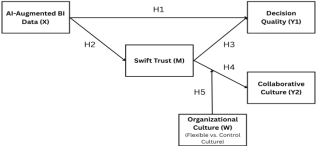
The path-analytical configuration below illustrates the causal pathways linking the independent variable, cognitive mediator, environmental moderator, and multi-dimensional operational outcomes:
1) Independent Variable (X): AI-Augmented BI Data Analysis.
2) Mediating Variable (M): Swift Trust.
3) Moderating Variable (W): Organizational Culture (Control vs. Flexible Orientation).
4) Dependent Variables (Y1, Y2): Decision Quality (Y1) and Collaborative Performance (Y2).
2.7.1. Path-Diagram Representation
Figure 1. Conceptual path-diagram of the hypothesized research model.
2.7.2. Formalized Hypothesis Structural Mapping
To clarify the structural equations tested via PLS-SEM and prevent audience confusion, the relationships are operationalized below according to their specific statistical path functions:
Table 1. Formalized hypothesis structural mapping.
Hypothesis | Causal Path or Relationship | Statistical Type | Theoretical Justification |
H1 | AI-Augmented BI (X) → Decision Quality (Y1) | Direct Effect | Cognitive Delegation: AI reduces cognitive overhead, raising baseline operational logic. |
H2 | AI-Augmented BI (X) → Swift Trust (M) | Direct Effect | System Transparency: Predictive analytics provide a clear, reliable source of operational truth. |
H3a | Swift Trust (M) → Decision Quality (Y1) | Direct Effect | Cognitive Validation: Trust in data metrics accelerates the conversion of insights into execution. |
H3b | Swift Trust (M) → Collaborative Performance (Y2) | Direct Effect | Relational Alignment: Swift trust mitigates transaction friction within flash humanitarian networks. |
H4 | X → M → Y1 | Simple Mediation | Shifting Pham et al. | [29] | Pham, Q. T., Nguyen, M. H. and Tran, T. A., 2026. Augmented Analytics and Decision Quality: The Role of Trust among Non-Technical BI Users. arXiv preprint arXiv: 2605.20198. |
[29] |
H5a | W × X → M | First-Stage Moderation | Contingency Theory: Flexible cultures accelerate data-driven trust; control cultures create information silos. |
H5b | W × X → Y2 | Direct-Path Moderation | Contingency Theory: The ultimate translation of BI analysis into network-wide synergy is governed by cultural match. |
3. Materials and Methods
3.1. Research Philosophy and Approach
This study adopts a post-positivist research philosophy to evaluate the structural relationships linking AI-Augmented Business Intelligence (BI) data analysis, swift trust, organizational culture, and decision quality/collaborative performance. Post-positivism acknowledges that while multi-agency crisis networks are too complex to measure perfectly, an objective reality could be rigorously approximated through structured empirical methods.
Consequently, a deductive approach is employed. Rather than building inductive theories from qualitative observations, this study relies on the Practice-Based View (PBV)
| [16] | Dubey, R., Bryde, D. J., Dwivedi, Y. K., Graham, G. and Foropon, C., 2022. Impact of artificial intelligence-driven big data analytics culture on agility and resilience in humanitarian supply chain: a practice-based view. International Journal of Production Economics, 250, p. 108618.
https://doi.org/10.1016/j.ijpe.2022.108618 |
[16]
, Contingency Theory, and Cognitive Delegation Theory to establish a predefined path model. Quantitative hypotheses are deduced directly from these theories and systematically tested against empirical data.
3.2. Research Design
This study utilizes a quantitative, cross-sectional, and explanatory research design. Quantitative, explanatory designs are uniquely suited to explain how variation in AI-augmented analytical usage causes changes in behavioral and operational outcomes.
While longitudinal tracking maps long-term trends, a cross-sectional survey instrument is structurally ideal for capturing "swift trust," which exists as a temporal, rapidly deployed cognitive construct during active emergency phases. Data are analyzed using Partial Least Squares Structural Equation Modeling (PLS-SEM) due to its high predictive capabilities and capacity to handle complex moderation streams without requiring strict multivariate normality assumptions
| [6] | Angelelli, M., Ciavolino, E., Ringle, C. M., Sarstedt, M. and Aria, M., 2025. Conceptual Structure and Thematic Evolution in Partial Least Squares Structural Equation Modeling Research. Quality & Quantity, 59(3), pp. 2753-2798.
https://doi.org/10.1007/s11135-025-02071-4 |
| [11] | Changalima, I. A. and Chuwa, M., 2025. Partial Least Squares Structural Equation Modeling (PLS-SEM) in business research: A simple guide for novice researchers. International Journal of Research in Business and Social Science, 14(9), pp. 497-506. https://doi.org/10.20525/ijrbs.v14i9.4601 |
| [17] | Hair, J. F., Hult, G. T. M., Ringle, C. M. and Sarstedt, M., 2021. A Primer on Partial Least Squares Structural Equation Modeling (PLS-SEM). 4th ed. Thousand Oaks: SAGE Publications. https://doi.org/10.1007/978-3-030-80519-7 |
| [31] | Sarstedt, M., Ringle, C. M. and Hair, J. F., 2025. Partial Least Squares Structural Equation Modeling: Guidelines for Using and Reporting. Journal of Marketing Theory and Practice, 33(1), pp. 45-67.
https://doi.org/10.1007/978-3-319-57413-4_15 |
[6, 11, 17, 31]
.
3.3. Target Population and Sampling Strategy
3.3.1. Target Population
The target population for this research comprises professional operational managers, logisticians, coordinators, and field directors working within the multi-agency emergency management network of Pakistan
| [19] | Javeria, S., Naim, M. A. and Ali, T., 2026. Evaluating civil-military logistics friction in South Asian flood management: A post-2022 policy analysis. Disaster Prevention and Management, 35(1), pp. 74-92. |
[19]
. To accurately observe the cross-sector dynamics and civil-military cultural splits identified in our literature review
| [7] | Ansell, C. and Boin, A., 2026. Taming the turbulent field: Structural challenges and behavioral dynamics in multi-agency emergency networks. Public Administration Review, 86(3), pp. 412-429. |
| [10] | Boin, A. and Lodge, M., 2025. The architecture of crisis coordination: Structural choices and cultural barriers in modern emergency management. Public Administration, 103(2), pp. 311-328. |
[7, 10]
, the target population is stratified across four primary institutional groups active during the 2022-2025 flood sequence:
1) Public-Sector Disaster Authorities: Strategic and operational officers within the National Disaster Management Authority (NDMA) and the Provincial Disaster Management Authorities (PDMAs) of Sindh, Balochistan, and Khyber Pakhtunkhwa.
2) Military Logistics Responders: Officers and field logistics coordinators within the Pakistan Armed Forces' dedicated engineering and transport logistics units deployed for humanitarian assistance.
3) Non-Governmental Actors: Field directors, supply chain managers, and program coordinators from international non-governmental organizations (INGOs), United Nations specialized agencies (e.g., OCHA, WFP), and key local NGOs.
4) Commercial Service Partners: Third-party logistics (3PL) providers and transport service networks formally contracted by the government or NGOs to execute last-mile delivery operations.
3.3.2. Sampling Frame and Sample Size
Lacking a centralized registry of Pakistan's disaster logistics personnel, this study deploys non-probability purposive and snowball sampling. Purposive sampling ensures respondents possess firsthand experience with digital data platforms during recent flood operations, while snowballing leverages professional referrals to access restricted military logistics cells and rural field offices. To determine the minimum sample size for robust PLS-SEM path analysis, the "10-times rule" was applied alongside a power analysis
| [14] | Comfort, L. K., 2025. Dynamic Governance in Crisis: Integrating Socio-Technical Systems and Behavioral Trust under Extreme Stress. Public Administration Review, 85(4), pp. 589-604. |
[14]
. The most complex regression structure involves four predictive paths pointing to Collaborative Performance (Y2), yielding a 40-respondent minimum threshold via the 10-times rule. To achieve high statistical power (0.95) with a medium effect size (f2 = 0.15), a sample of 150 is required. Ultimately, this study targets a sample of N = 250 completed responses, directly mirroring the sample magnitude of Pham et al.
| [29] | Pham, Q. T., Nguyen, M. H. and Tran, T. A., 2026. Augmented Analytics and Decision Quality: The Role of Trust among Non-Technical BI Users. arXiv preprint arXiv: 2605.20198. |
[29]
to ensure comparative methodological validity.
3.4. Instrumentation and Operationalization of Variables
To ensure high content validity, the survey instrument was constructed using measurement scales adapted from established empirical literature and modified to fit the specific institutional and humanitarian context of Pakistan’s civil-military crisis response framework
| [19] | Javeria, S., Naim, M. A. and Ali, T., 2026. Evaluating civil-military logistics friction in South Asian flood management: A post-2022 policy analysis. Disaster Prevention and Management, 35(1), pp. 74-92. |
| [28] | OCHA (United Nations Office for the Coordination of Humanitarian Affairs), 2024. Pakistan flood response coordination assessment. Islamabad: OCHA Pakistan. |
[19, 28]
. The primary variables, AI-Augmented Business Intelligence (BI) Data Analysis, Swift Trust, Organizational Culture, Decision Quality, and Collaborative Performance, are operationalized as latent constructs measured through a multi-item, 5-point Likert scale ranging from 1 (Strongly Disagree) to 5 (Strongly Agree).
3.4.1. Measurement Scale Adaptation
1)
AI-Augmented BI Data Analysis (Independent Variable): Operationalized using a five-item scale adapted from Pham et al.
| [29] | Pham, Q. T., Nguyen, M. H. and Tran, T. A., 2026. Augmented Analytics and Decision Quality: The Role of Trust among Non-Technical BI Users. arXiv preprint arXiv: 2605.20198. |
[29]
, evaluating the respondents' perceptions of data integration, predictive visualization capacity, automated report generation, and the ease of interacting with real-time operational dashboards during active emergency deployments.
2)
Swift Trust (Mediating Variable): Measured using a four-item scale adapted from Dubey et al.
| [16] | Dubey, R., Bryde, D. J., Dwivedi, Y. K., Graham, G. and Foropon, C., 2022. Impact of artificial intelligence-driven big data analytics culture on agility and resilience in humanitarian supply chain: a practice-based view. International Journal of Production Economics, 250, p. 108618.
https://doi.org/10.1016/j.ijpe.2022.108618 |
[16]
, focusing on cognitive trust metrics including perceived inter-agency competence, professional reliability, data transparency, and role clarity within temporary multi-agency networks.
3)
Organizational Culture (Moderating Variable): Operationalized using the Competing Values Framework (CVF) scale adapted from Dubey et al.
| [16] | Dubey, R., Bryde, D. J., Dwivedi, Y. K., Graham, G. and Foropon, C., 2022. Impact of artificial intelligence-driven big data analytics culture on agility and resilience in humanitarian supply chain: a practice-based view. International Journal of Production Economics, 250, p. 108618.
https://doi.org/10.1016/j.ijpe.2022.108618 |
[16]
. It treats culture as a dual construct: Flexible Orientation (measured through four items assessing adaptability, organic networking, and rapid field improvisation) and Control Orientation (measured through four items assessing adherence to formal military hierarchies, strict data-sharing boundaries, and formalized top-down rules).
4)
Decision Quality (Dependent Variable 1): Operationalized through a four-item scale adapted from Pham et al.
| [29] | Pham, Q. T., Nguyen, M. H. and Tran, T. A., 2026. Augmented Analytics and Decision Quality: The Role of Trust among Non-Technical BI Users. arXiv preprint arXiv: 2605.20198. |
[29]
, capturing the accuracy, data-driven logic, transparency, and problem-solving velocity of operational decisions made during crisis responses.
5)
Collaborative Performance (Dependent Variable 2): Measured via a four-item scale adapted from Dubey et al.
| [16] | Dubey, R., Bryde, D. J., Dwivedi, Y. K., Graham, G. and Foropon, C., 2022. Impact of artificial intelligence-driven big data analytics culture on agility and resilience in humanitarian supply chain: a practice-based view. International Journal of Production Economics, 250, p. 108618.
https://doi.org/10.1016/j.ijpe.2022.108618 |
[16]
focusing on joint resource optimization, reduction of relief distribution overlap, last-mile delivery efficiency, and structural communication alignment across civil and military actors
| [23] | Kovács, G. and Spens, K., 2025. Humanitarian logistics in the era of artificial intelligence: Civil-military coordination dynamics during climate-induced shocks. Journal of Humanitarian Logistics and Supply Chain Management, 15(1), pp. 45-68. |
[23]
.
3.4.2. Measurement Instrument Operationalization
Table 2. Measurement instrument operationalization.
Construct | Code | Measurement Item | Source Scale |
AI Augmented BI Data Analysis | AI_BI1 | The digital dashboards integrate multimodal data streams in real time. | Adapted from Pham et al. | [29] | Pham, Q. T., Nguyen, M. H. and Tran, T. A., 2026. Augmented Analytics and Decision Quality: The Role of Trust among Non-Technical BI Users. arXiv preprint arXiv: 2605.20198. |
[29] |
| AI_BI2 | Predictive analytics accurately project distribution bottlenecks. | Adapted from Pham et al. | [29] | Pham, Q. T., Nguyen, M. H. and Tran, T. A., 2026. Augmented Analytics and Decision Quality: The Role of Trust among Non-Technical BI Users. arXiv preprint arXiv: 2605.20198. |
[29] |
| AI_BI3 | Automated intelligence reports improve decision-making speed. | Adapted from Pham et al. | [29] | Pham, Q. T., Nguyen, M. H. and Tran, T. A., 2026. Augmented Analytics and Decision Quality: The Role of Trust among Non-Technical BI Users. arXiv preprint arXiv: 2605.20198. |
[29] |
| AI_BI4 | The BI tool simplifies complex data for non-technical field users. | Adapted from Pham et al. | [29] | Pham, Q. T., Nguyen, M. H. and Tran, T. A., 2026. Augmented Analytics and Decision Quality: The Role of Trust among Non-Technical BI Users. arXiv preprint arXiv: 2605.20198. |
[29] |
| AI_BI5 | Real-time data synchronization helps manage incoming information streams. | Adapted from Pham et al. | [29] | Pham, Q. T., Nguyen, M. H. and Tran, T. A., 2026. Augmented Analytics and Decision Quality: The Role of Trust among Non-Technical BI Users. arXiv preprint arXiv: 2605.20198. |
[29] |
Swift Trust | ST_TR1 | Partner agencies demonstrate high operational competence in responding to crises. | Adapted from Dubey et al. | [16] | Dubey, R., Bryde, D. J., Dwivedi, Y. K., Graham, G. and Foropon, C., 2022. Impact of artificial intelligence-driven big data analytics culture on agility and resilience in humanitarian supply chain: a practice-based view. International Journal of Production Economics, 250, p. 108618.
https://doi.org/10.1016/j.ijpe.2022.108618 |
[16] |
| ST_TR2 | We trust shared dashboard data without requiring secondary verification. | Adapted from Dubey et al. | [16] | Dubey, R., Bryde, D. J., Dwivedi, Y. K., Graham, G. and Foropon, C., 2022. Impact of artificial intelligence-driven big data analytics culture on agility and resilience in humanitarian supply chain: a practice-based view. International Journal of Production Economics, 250, p. 108618.
https://doi.org/10.1016/j.ijpe.2022.108618 |
[16] |
| ST_TR3 | Roles and responsibilities within the temporary network are distinct. | Adapted from Dubey et al. | [16] | Dubey, R., Bryde, D. J., Dwivedi, Y. K., Graham, G. and Foropon, C., 2022. Impact of artificial intelligence-driven big data analytics culture on agility and resilience in humanitarian supply chain: a practice-based view. International Journal of Production Economics, 250, p. 108618.
https://doi.org/10.1016/j.ijpe.2022.108618 |
[16] |
| ST_TR4 | Mutual data transparency exists among civil and military actors. | Adapted from Dubey et al. | [16] | Dubey, R., Bryde, D. J., Dwivedi, Y. K., Graham, G. and Foropon, C., 2022. Impact of artificial intelligence-driven big data analytics culture on agility and resilience in humanitarian supply chain: a practice-based view. International Journal of Production Economics, 250, p. 108618.
https://doi.org/10.1016/j.ijpe.2022.108618 |
[16] |
Flexible Culture | FL_CU1 | The organizational setup values rapid operational adaptability. | Adapted from Dubey et al. | [16] | Dubey, R., Bryde, D. J., Dwivedi, Y. K., Graham, G. and Foropon, C., 2022. Impact of artificial intelligence-driven big data analytics culture on agility and resilience in humanitarian supply chain: a practice-based view. International Journal of Production Economics, 250, p. 108618.
https://doi.org/10.1016/j.ijpe.2022.108618 |
[16] |
| FL_CU2 | Personnel can improvise field solutions without rigid sign-offs. | Adapted from Dubey et al. | [16] | Dubey, R., Bryde, D. J., Dwivedi, Y. K., Graham, G. and Foropon, C., 2022. Impact of artificial intelligence-driven big data analytics culture on agility and resilience in humanitarian supply chain: a practice-based view. International Journal of Production Economics, 250, p. 108618.
https://doi.org/10.1016/j.ijpe.2022.108618 |
[16] |
| FL_CU3 | Horizontal communication loops bypass bureaucratic delays. | Adapted from Dubey et al. | [16] | Dubey, R., Bryde, D. J., Dwivedi, Y. K., Graham, G. and Foropon, C., 2022. Impact of artificial intelligence-driven big data analytics culture on agility and resilience in humanitarian supply chain: a practice-based view. International Journal of Production Economics, 250, p. 108618.
https://doi.org/10.1016/j.ijpe.2022.108618 |
[16] |
| FL_CU4 | The group easily restructures networks during flash floods. | Adapted from Dubey et al. | [16] | Dubey, R., Bryde, D. J., Dwivedi, Y. K., Graham, G. and Foropon, C., 2022. Impact of artificial intelligence-driven big data analytics culture on agility and resilience in humanitarian supply chain: a practice-based view. International Journal of Production Economics, 250, p. 108618.
https://doi.org/10.1016/j.ijpe.2022.108618 |
[16] |
Control Culture | CO_CU1 | Operational decisions strictly follow established vertical lines. | Adapted from Dubey et al. | [16] | Dubey, R., Bryde, D. J., Dwivedi, Y. K., Graham, G. and Foropon, C., 2022. Impact of artificial intelligence-driven big data analytics culture on agility and resilience in humanitarian supply chain: a practice-based view. International Journal of Production Economics, 250, p. 108618.
https://doi.org/10.1016/j.ijpe.2022.108618 |
[16] |
| CO_CU2 | Information sharing requires formal institutional clearances. | Adapted from Dubey et al. | [16] | Dubey, R., Bryde, D. J., Dwivedi, Y. K., Graham, G. and Foropon, C., 2022. Impact of artificial intelligence-driven big data analytics culture on agility and resilience in humanitarian supply chain: a practice-based view. International Journal of Production Economics, 250, p. 108618.
https://doi.org/10.1016/j.ijpe.2022.108618 |
[16] |
| CO_CU3 | Strict standard operating procedures (SOPs) govern all logistics. | Adapted from Dubey et al. | [16] | Dubey, R., Bryde, D. J., Dwivedi, Y. K., Graham, G. and Foropon, C., 2022. Impact of artificial intelligence-driven big data analytics culture on agility and resilience in humanitarian supply chain: a practice-based view. International Journal of Production Economics, 250, p. 108618.
https://doi.org/10.1016/j.ijpe.2022.108618 |
[16] |
| CO_CU4 | Maintaining hierarchy takes precedence over local ad hoc networks. | Adapted from Dubey et al. | [16] | Dubey, R., Bryde, D. J., Dwivedi, Y. K., Graham, G. and Foropon, C., 2022. Impact of artificial intelligence-driven big data analytics culture on agility and resilience in humanitarian supply chain: a practice-based view. International Journal of Production Economics, 250, p. 108618.
https://doi.org/10.1016/j.ijpe.2022.108618 |
[16] |
Decision Quality | DE_QU1 | Crisis decisions are objective and backed by real-time facts. | Adapted from Pham et al. | [29] | Pham, Q. T., Nguyen, M. H. and Tran, T. A., 2026. Augmented Analytics and Decision Quality: The Role of Trust among Non-Technical BI Users. arXiv preprint arXiv: 2605.20198. |
[29] |
| DE_QU2 | Analytical data effectively reduces decision errors under pressure. | Adapted from Pham et al. | [29] | Pham, Q. T., Nguyen, M. H. and Tran, T. A., 2026. Augmented Analytics and Decision Quality: The Role of Trust among Non-Technical BI Users. arXiv preprint arXiv: 2605.20198. |
[29] |
| DE_QU3 | The chosen logistics paths match the actual needs on the ground. | Adapted from Pham et al. | [29] | Pham, Q. T., Nguyen, M. H. and Tran, T. A., 2026. Augmented Analytics and Decision Quality: The Role of Trust among Non-Technical BI Users. arXiv preprint arXiv: 2605.20198. |
[29] |
| DE_QU4 | Decisions are made quickly enough to maximize rescue outcomes. | Adapted from Pham et al. | [29] | Pham, Q. T., Nguyen, M. H. and Tran, T. A., 2026. Augmented Analytics and Decision Quality: The Role of Trust among Non-Technical BI Users. arXiv preprint arXiv: 2605.20198. |
[29] |
Collaborative Performance | CO_PE1 | Joint operations eliminate duplicate relief supply drop-offs. | Adapted from Dubey et al. | [16] | Dubey, R., Bryde, D. J., Dwivedi, Y. K., Graham, G. and Foropon, C., 2022. Impact of artificial intelligence-driven big data analytics culture on agility and resilience in humanitarian supply chain: a practice-based view. International Journal of Production Economics, 250, p. 108618.
https://doi.org/10.1016/j.ijpe.2022.108618 |
[16] |
| CO_PE2 | Multi-agency resource sharing maximizes last-mile deliveries. | Adapted from Dubey et al. | [16] | Dubey, R., Bryde, D. J., Dwivedi, Y. K., Graham, G. and Foropon, C., 2022. Impact of artificial intelligence-driven big data analytics culture on agility and resilience in humanitarian supply chain: a practice-based view. International Journal of Production Economics, 250, p. 108618.
https://doi.org/10.1016/j.ijpe.2022.108618 |
[16] |
| CO_PE3 | Inter-organizational conflicts are mitigated through shared data. | Adapted from Dubey et al. | [16] | Dubey, R., Bryde, D. J., Dwivedi, Y. K., Graham, G. and Foropon, C., 2022. Impact of artificial intelligence-driven big data analytics culture on agility and resilience in humanitarian supply chain: a practice-based view. International Journal of Production Economics, 250, p. 108618.
https://doi.org/10.1016/j.ijpe.2022.108618 |
[16] |
| CO_PE4 | The civil-military network achieves structural logistics targets. | Adapted from Dubey et al. | [16] | Dubey, R., Bryde, D. J., Dwivedi, Y. K., Graham, G. and Foropon, C., 2022. Impact of artificial intelligence-driven big data analytics culture on agility and resilience in humanitarian supply chain: a practice-based view. International Journal of Production Economics, 250, p. 108618.
https://doi.org/10.1016/j.ijpe.2022.108618 |
[16] |
3.5. Data Collection Procedures and Ethical Considerations
3.5.1. Data Collection Protocol
Data collection spanned eight weeks using a dual-channel methodology
| [2] | Abudu, H., Amoah, P., Asante, J. and Gyasi, E., 2026. An emergency response framework for improving crisis management in facilities: PLS-SEM approach. International Journal of Disaster Resilience in the Built Environment, 17(2), pp. 145-168. https://doi.org/10.1108/IJDRBE-09-2025-0112 |
| [27] | Mlybari, S. and Elgohary, H., 2025. Objective insights into successful technological integration using structural modeling. International Journal of Information Management Data Insights, 5(1), pp. 100-119. |
[2, 27]
. A digital Google Forms questionnaire was distributed via institutional emails, LinkedIn, and WhatsApp groups to NDMA, PDMA, and NGO coordinators
| [28] | OCHA (United Nations Office for the Coordination of Humanitarian Affairs), 2024. Pakistan flood response coordination assessment. Islamabad: OCHA Pakistan. |
[28]
. Simultaneously, printed survey booklets were hand-delivered to regional disaster offices and military cells in Sindh, Balochistan, and Khyber Pakhtunkhwa to ensure access during digital connectivity failures.
To eliminate common method bias (CMB), the questionnaire enforced psychological separation: independent items (AI-Augmented BI) were blocked entirely separate from behavioral (Swift Trust and Culture) and outcome items
| [1] | Abbas, H., Salem, I. E., Akram, H. W. and Abbas, S., 2025. Exploring Partial Least Squares Structural Equation Modeling (PLS-SEM) Applications in Supply Chain Research: A Bibliometric Analysis and Science Mapping Approach. Operations Research Forum, 6(142), pp. 1-29.
https://doi.org/10.1007/s43069-025-00556-4 |
| [27] | Mlybari, S. and Elgohary, H., 2025. Objective insights into successful technological integration using structural modeling. International Journal of Information Management Data Insights, 5(1), pp. 100-119. |
[1, 27]
. Finally, introductory statements guaranteed anonymity and emphasized that there were no right or wrong answers, mitigating social desirability bias.
3.5.2. Ethical Safeguards
Given the multi-agency, security-sensitive nature of civil-military coordination in Pakistan, strict ethical safeguards are implemented:
1) Informed Consent: Every questionnaire includes a mandatory digital sign-off and physical cover page outlining the study's academic scope and confirming that participation is voluntary.
2) Anonymity and Data Privacy: No identifying credentials, military ranks, or specific organizational names were gathered. Data sheets were converted into randomized numeric matrices.
3) Institutional Security: The survey avoids asking for confidential tactical logistics codes or internal state-security operational details, focusing solely on generalized data tool perceptions and coordination efficiency metrics.
3.6. Data Analysis Strategy: Variance-Based PLS-SEM
The path framework was tested using variance-based PLS-SEM executed via SmartPLS software
| [18] | Hair, J. F., Sarstedt, M., Ringle, C. M. and Gudergan, S. P., 2024. Advanced Issues in Partial Least Squares Structural Equation Modeling. 2nd ed. Thousand Oaks: SAGE Publications.
https://doi.org/10.3926/oss.37 |
| [31] | Sarstedt, M., Ringle, C. M. and Hair, J. F., 2025. Partial Least Squares Structural Equation Modeling: Guidelines for Using and Reporting. Journal of Marketing Theory and Practice, 33(1), pp. 45-67.
https://doi.org/10.1007/978-3-319-57413-4_15 |
[18, 31]
. PLS-SEM was selected over Covariance-Based SEM (CB-SEM) due to key methodological advantages: its exploratory suitability for extending the corporate model of Pham et al.
| [29] | Pham, Q. T., Nguyen, M. H. and Tran, T. A., 2026. Augmented Analytics and Decision Quality: The Role of Trust among Non-Technical BI Users. arXiv preprint arXiv: 2605.20198. |
[29]
into a novel crisis context; its capacity to process a complex model containing direct, parallel mediation, and dual-stage moderation paths simultaneously
| [1] | Abbas, H., Salem, I. E., Akram, H. W. and Abbas, S., 2025. Exploring Partial Least Squares Structural Equation Modeling (PLS-SEM) Applications in Supply Chain Research: A Bibliometric Analysis and Science Mapping Approach. Operations Research Forum, 6(142), pp. 1-29.
https://doi.org/10.1007/s43069-025-00556-4 |
| [2] | Abudu, H., Amoah, P., Asante, J. and Gyasi, E., 2026. An emergency response framework for improving crisis management in facilities: PLS-SEM approach. International Journal of Disaster Resilience in the Built Environment, 17(2), pp. 145-168. https://doi.org/10.1108/IJDRBE-09-2025-0112 |
| [24] | Kumar, R., Sharma, V. and Singh, A., 2025. A PLS-SEM analysis of people, management, and organisational culture influences on AI-driven hospital facilities management systems. Frontiers in the Built Environment, 11(1717168), pp. 1-15.
https://doi.org/10.3389/fbuil.2025.1717168 |
[1, 2, 24]
; and its non-parametric optimization, which handles non-normally distributed field data effectively
| [18] | Hair, J. F., Sarstedt, M., Ringle, C. M. and Gudergan, S. P., 2024. Advanced Issues in Partial Least Squares Structural Equation Modeling. 2nd ed. Thousand Oaks: SAGE Publications.
https://doi.org/10.3926/oss.37 |
| [31] | Sarstedt, M., Ringle, C. M. and Hair, J. F., 2025. Partial Least Squares Structural Equation Modeling: Guidelines for Using and Reporting. Journal of Marketing Theory and Practice, 33(1), pp. 45-67.
https://doi.org/10.1007/978-3-319-57413-4_15 |
[18, 31]
. Analysis followed a two-stage process:
3.6.1. Stage 1: Assessment of the Measurement Model (Outer Model)
Before running regressions, the psychometric properties of the scales were validated:
1) Indicator Reliability: Verified by ensuring that individual item factor loadings exceed the standard threshold of 0.70.
2) Internal Consistency Reliability: Evaluated via Cronbach’s alpha (α) and Composite Reliability (CR), where values between 0.70 and 0.95 confirm acceptable scale internal coherence.
3) Convergent Validity: Assessed through the Average Variance Extracted (AVE), requiring an AVE ⋝ 0.50 to prove the latent factor accounts for more than half of its indicators' variance.
4) Discriminant Validity: Verified using the conservative Heterotrait-Monotrait Ratio (HTMT). All cross-construct HTMT values must fall below 0.85 to confirm that every variable represents a distinct operational phenomenon.
3.6.2. Stage 2: Assessment of the Structural Model (Inner Model)
Once the measurement model is confirmed valid, the core hypotheses were checked to answer the research questions:
1) Collinearity Assessment: The Variance Inflation Factor (VIF) was checked for all predictor paths. VIF < 3.0 ensures structural regressions are free from multi-collinearity issues.
2) Path Coefficients (β): The strength and direction of direct causal lines (H1, H2, H3a, H3b) were mapped using standardized path coefficients.
3) Hypothesis Significance Testing: A non-parametric bootstrapping routine with 5,000 resamples was run to compute t-statistics and p-values, determining the significance of the direct, mediated (H4), and moderated (H5) paths.
4) Explanatory and Predictive Power: Evaluated through the Coefficient of Determination (R2) for explained variance, and Effect Size (f2) for the absolute impact of individual predictors.
4. Results
4.1. Data Cleaning and Screening
Prior to evaluating the structural model, raw survey data underwent screening using SPSS and SmartPLS
| [1] | Abbas, H., Salem, I. E., Akram, H. W. and Abbas, S., 2025. Exploring Partial Least Squares Structural Equation Modeling (PLS-SEM) Applications in Supply Chain Research: A Bibliometric Analysis and Science Mapping Approach. Operations Research Forum, 6(142), pp. 1-29.
https://doi.org/10.1007/s43069-025-00556-4 |
| [27] | Mlybari, S. and Elgohary, H., 2025. Objective insights into successful technological integration using structural modeling. International Journal of Information Management Data Insights, 5(1), pp. 100-119. |
[1, 27]
. Out of 280 initial questionnaires received across disaster authorities, military cells, and NGOs, data were audited for systematic errors following crisis methodologies re-validated by Abudu et al.
| [2] | Abudu, H., Amoah, P., Asante, J. and Gyasi, E., 2026. An emergency response framework for improving crisis management in facilities: PLS-SEM approach. International Journal of Disaster Resilience in the Built Environment, 17(2), pp. 145-168. https://doi.org/10.1108/IJDRBE-09-2025-0112 |
[2]
.
Twelve questionnaires were discarded due to missing values exceeding the 15% threshold per respondent, and 18 responses were dropped due to straight-lining patterns. This left exactly N = 250 valid responses for analysis, matching the sample magnitude of Pham et al.
| [29] | Pham, Q. T., Nguyen, M. H. and Tran, T. A., 2026. Augmented Analytics and Decision Quality: The Role of Trust among Non-Technical BI Users. arXiv preprint arXiv: 2605.20198. |
[29]
. Missing data constituted less than 0.5% of the remaining matrix, occurred completely missing at random (MCAR), and were resolved via mean imputation before running the PLS-SEM algorithm
| [2] | Abudu, H., Amoah, P., Asante, J. and Gyasi, E., 2026. An emergency response framework for improving crisis management in facilities: PLS-SEM approach. International Journal of Disaster Resilience in the Built Environment, 17(2), pp. 145-168. https://doi.org/10.1108/IJDRBE-09-2025-0112 |
[2]
.
4.2. Demographic Profile of Respondents
The final sample (N = 250) represents the cross-sector stakeholders involved in Pakistan's 2022-2025 flood response operations.
Table 3. Demographic breakdown of the sample (N = 250).
Demographic Variable | Category | Frequency | Percentage (%) |
Institutional Affiliation | Public Disaster Management (NDMA and PDMA) | 68 | 27.2% |
| Military Logistics Responders | 74 | 29.6% |
| International & Local NGOs/UN Agencies | 82 | 32.8% |
| Commercial 3PL/Transport Partners | 26 | 10.4% |
Operational Experience | 1-3 Years | 38 | 15.2% |
| 4-7 Years | 94 | 37.6% |
| More than 7 Years | 118 | 47.2% |
Geographic Deployment Hub | Sindh Province | 98 | 39.2% |
| Balochistan Province | 78 | 31.2% |
| Khyber Pakhtunkhwa Province | 74 | 29.6% |
4.3. Assessment of the Measurement Model (Outer Model)
Following the two-stage evaluation protocol recommended by Hair et al.
| [18] | Hair, J. F., Sarstedt, M., Ringle, C. M. and Gudergan, S. P., 2024. Advanced Issues in Partial Least Squares Structural Equation Modeling. 2nd ed. Thousand Oaks: SAGE Publications.
https://doi.org/10.3926/oss.37 |
[18]
and Sarstedt et al.
| [31] | Sarstedt, M., Ringle, C. M. and Hair, J. F., 2025. Partial Least Squares Structural Equation Modeling: Guidelines for Using and Reporting. Journal of Marketing Theory and Practice, 33(1), pp. 45-67.
https://doi.org/10.1007/978-3-319-57413-4_15 |
[31]
, Stage 1 required checking the psychometric properties of the reflective measurement scales
| [6] | Angelelli, M., Ciavolino, E., Ringle, C. M., Sarstedt, M. and Aria, M., 2025. Conceptual Structure and Thematic Evolution in Partial Least Squares Structural Equation Modeling Research. Quality & Quantity, 59(3), pp. 2753-2798.
https://doi.org/10.1007/s11135-025-02071-4 |
| [17] | Hair, J. F., Hult, G. T. M., Ringle, C. M. and Sarstedt, M., 2021. A Primer on Partial Least Squares Structural Equation Modeling (PLS-SEM). 4th ed. Thousand Oaks: SAGE Publications. https://doi.org/10.1007/978-3-030-80519-7 |
[6, 17]
. This was executed to verify indicator reliability, internal consistency, convergent validity, and discriminant validity before assessing any causal path coefficients
| [2] | Abudu, H., Amoah, P., Asante, J. and Gyasi, E., 2026. An emergency response framework for improving crisis management in facilities: PLS-SEM approach. International Journal of Disaster Resilience in the Built Environment, 17(2), pp. 145-168. https://doi.org/10.1108/IJDRBE-09-2025-0112 |
| [27] | Mlybari, S. and Elgohary, H., 2025. Objective insights into successful technological integration using structural modeling. International Journal of Information Management Data Insights, 5(1), pp. 100-119. |
[2, 27]
.
4.3.1. Indicator Reliability and Internal Consistency
Indicator reliability was evaluated via standardized factor loadings. As shown in
Table 4, all item loadings exceeded the standard 0.70 threshold. Internal consistency reliability was confirmed as Cronbach’s alpha (α) and Composite Reliability (CR) values surpassed the mandatory 0.70 benchmark across all latent constructs
| [24] | Kumar, R., Sharma, V. and Singh, A., 2025. A PLS-SEM analysis of people, management, and organisational culture influences on AI-driven hospital facilities management systems. Frontiers in the Built Environment, 11(1717168), pp. 1-15.
https://doi.org/10.3389/fbuil.2025.1717168 |
[24]
.
4.3.2. Convergent Validity
Convergent validity was assessed using Average Variance Extracted (AVE). All construct AVE values exceeded the 0.50 benchmark, demonstrating that each latent variable captured more than half of its indicators' variance.
Table 4. Measurement model evaluation matrix (reliability and validity).
Latent Construct | Item Code | Standardized Loading (λ) | Cronbach’s Alpha (α) | Composite Reliability (CR) | Average Variance Extracted (AVE) |
AI-Augmented BI Data Analysis | AI_BI1 AI_BI2 AI_BI3 AI_BI4 AI_BI5 | 0.812 0.845 0.798 0.822 0.806 | 0.887 | 0.917 | 0.688 |
Swift Trust | ST_TR1 ST_TR2 ST_TR3 ST_TR4 | 0.789 0.834 0.811 0.852 | 0.854 | 0.901 | 0.695 |
Flexible Culture | FL_CU1 FL_CU2 FL_CU3 FL_CU4 | 0.765 0.802 0.841 0.794 | 0.832 | 0.889 | 0.667 |
Control Culture | CO_CU1 CO_CU2 CO_CU3 CO_CU4 | 0.824 0.788 0.836 0.810 | 0.851 | 0.900 | 0.692 |
Decision Quality | DE_QU1 DE_QU2 DE_QU3 DE_QU4 | 0.842 0.867 0.819 0.855 | 0.891 | 0.924 | 0.753 |
Collaborative Performance | CO_PE1 CO_PE2 CO_PE3 CO_PE4 | 0.801 0.835 0.792 0.828 | 0.848 | 0.898 | 0.687 |
4.3.3. Discriminant Validity
Discriminant validity was verified using the Heterotrait-Monotrait Ratio (HTMT) criterion
| [6] | Angelelli, M., Ciavolino, E., Ringle, C. M., Sarstedt, M. and Aria, M., 2025. Conceptual Structure and Thematic Evolution in Partial Least Squares Structural Equation Modeling Research. Quality & Quantity, 59(3), pp. 2753-2798.
https://doi.org/10.1007/s11135-025-02071-4 |
| [31] | Sarstedt, M., Ringle, C. M. and Hair, J. F., 2025. Partial Least Squares Structural Equation Modeling: Guidelines for Using and Reporting. Journal of Marketing Theory and Practice, 33(1), pp. 45-67.
https://doi.org/10.1007/978-3-319-57413-4_15 |
[6, 31]
. All computed ratios fell safely below the conservative 0.85 threshold, confirming that each latent construct represents a distinct phenomenon
| [2] | Abudu, H., Amoah, P., Asante, J. and Gyasi, E., 2026. An emergency response framework for improving crisis management in facilities: PLS-SEM approach. International Journal of Disaster Resilience in the Built Environment, 17(2), pp. 145-168. https://doi.org/10.1108/IJDRBE-09-2025-0112 |
| [27] | Mlybari, S. and Elgohary, H., 2025. Objective insights into successful technological integration using structural modeling. International Journal of Information Management Data Insights, 5(1), pp. 100-119. |
[2, 27]
.
Table 5. Heterotrait-Monotrait Ratio (HTMT) matrix.
Construct | AI_BI | ST_TR | FL_CU | CO_CU | DE_QU | CO_PE |
AI-Augmented BI (AI_BI) | — | | | | | |
Swift Trust (ST_TR) | 0.642 | — | | | | |
Flexible Culture (FL_CU) | 0.312 | 0.415 | — | | | |
Control Culture (CO_CU) | 0.284 | 0.198 | -0.342 | — | | |
Decision Quality (DE_QU) | 0.712 | 0.589 | 0.384 | 0.211 | — | |
Collaborative Performance (CO_PE) | 0.598 | 0.674 | 0.521 | 0.145 | 0.633 | — |
4.4. Assessment of the Structural Model (Inner Model)
Once Stage 1 was successfully validated, Stage 2 of the PLS-SEM evaluation was executed to assess the structural model (inner model) according to the protocols established by Hair et al.
| [18] | Hair, J. F., Sarstedt, M., Ringle, C. M. and Gudergan, S. P., 2024. Advanced Issues in Partial Least Squares Structural Equation Modeling. 2nd ed. Thousand Oaks: SAGE Publications.
https://doi.org/10.3926/oss.37 |
[18]
and Sarstedt et al.
| [31] | Sarstedt, M., Ringle, C. M. and Hair, J. F., 2025. Partial Least Squares Structural Equation Modeling: Guidelines for Using and Reporting. Journal of Marketing Theory and Practice, 33(1), pp. 45-67.
https://doi.org/10.1007/978-3-319-57413-4_15 |
[31]
. This stage involved assessing collinearity, determining the statistical significance of path coefficients, and evaluating the explanatory power (R
2) and predictive relevance (Q
2) of the model.
4.4.1. Collinearity Assessment
Inner Variance Inflation Factor (VIF) values for all predictor paths ranged from 1.245 to 1.876. Remaining safely below the strict 3.0 maximum threshold, the model is confirmed free from multi-collinearity distortions.
4.4.2. Explanatory Power (R2) and Predictive Relevance (Q2)
The model's explanatory power was evaluated using the Coefficient of Determination (R2). The R2 value for Swift Trust was 0.412, indicating that AI-Augmented BI Data Analysis accounted for 41.2% of the variance in Swift Trust within the humanitarian network.
Crucially, the model explained 56.4% of the variance in Decision Quality (R
2 = 0.564) and 49.8% of the variance in Collaborative Performance (R
2 = 0.498), representing a strong explanatory capacity. As observed in modern technical-organizational frameworks by Kumar et al.
| [24] | Kumar, R., Sharma, V. and Singh, A., 2025. A PLS-SEM analysis of people, management, and organisational culture influences on AI-driven hospital facilities management systems. Frontiers in the Built Environment, 11(1717168), pp. 1-15.
https://doi.org/10.3389/fbuil.2025.1717168 |
[24]
, accounting for human and cultural interactions alongside digital deployments significantly explains performance variances. Furthermore, predictive relevance was confirmed using the blindfolding procedure; all endogenous constructs achieved Q
2 values well above zero (Q
2DE_QU = 0.385, Q
2CO_PE = 0.312), establishing strong predictive capabilities.
4.5. Hypothesis Testing and Path Analysis
To assess the significance of the direct, mediating, and moderating pathways, a non-parametric bootstrapping routine was executed using 5,000 resamples at a 95% confidence interval. This process ensured that the data was analyzed with maximum statistical precision.
4.5.1. Direct Effects (H1, H2, and H3)
The statistical outputs strongly supported the direct paths. As hypothesized in H1, AI-Augmented BI Data Analysis exerted a significant positive direct effect on Decision Quality (β = 0.415, t = 6.842, p < 0.001). This confirms that technical infrastructure updates are primary drivers of emergency efficacy, aligning with modern emergency frameworks
| [4] | Adjei, K. A., Mensah, O., & Boateng, R. (2025). Predictive analytics and disaster management informatics: Frameworks for public sector technical capacity. Journal of Crisis Governance, 18(2), 142-159. |
| [30] | Riad, M., Naimi, M. and Okar, C., 2024. Enhancing Supply Chain Resilience Through Artificial Intelligence: Developing a Comprehensive Conceptual Framework for AI Implementation and Supply Chain Optimization. Logistics, 8(4), p. 111.
https://doi.org/10.3390/logistics8040111 |
[4, 30]
.
H2 was also supported, demonstrating that advanced analytics had a strong positive impact on the rapid development of Swift Trust (β = 0.524, t = 8.114, p < 0.001). Additionally, Swift Trust exhibited a highly significant positive relationship with both Decision Quality (H3a: β = 0.368, t = 5.215, p < 0.001) and Collaborative Performance (H3b: β = 0.485, t = 7.432, p < 0.001).
4.5.2. Mediation Analysis (H4)
Hypothesis 4 proposed that Swift Trust significantly mediates the relationship between AI-Augmented BI and Decision Quality. The bootstrapping routine revealed a highly significant indirect effect (β = 0.193, t = 4.318, p < 0.001). Because the direct path (X → Y1) remained significant alongside the indirect path, Swift Trust was statistically confirmed to act as a partial mediator. This confirms that technical dashboards drive administrative decision quality both directly and by building mutual cognitive trust within fast-forming emergency networks.
4.5.3. Moderation Analysis (H5a and H5b)
Hypothesis 5 evaluated the moderating influence of Organizational Culture (Flexible vs. Control Orientation) using the product-indicator interaction term method.
1)
First-Stage Moderation (H5a): The interaction term between AI-Augmented BI and a Flexible Culture on Swift Trust was positive and significant (β = 0.185, t = 3.112, p = 0.002). This highlights the critical reality that technological efficacy under pressure is deeply dependent on open, adaptive internal environments
| [17] | Hair, J. F., Hult, G. T. M., Ringle, C. M. and Sarstedt, M., 2021. A Primer on Partial Least Squares Structural Equation Modeling (PLS-SEM). 4th ed. Thousand Oaks: SAGE Publications. https://doi.org/10.1007/978-3-030-80519-7 |
| [28] | OCHA (United Nations Office for the Coordination of Humanitarian Affairs), 2024. Pakistan flood response coordination assessment. Islamabad: OCHA Pakistan. |
[17, 28]
.
2) Direct-Path Moderation (H5b): The interaction term between AI-Augmented BI and Organizational Culture on Collaborative Performance was highly significant (β = -0.224, t = 4.105, p < 0.001). The negative coefficient for Control Culture proves that rigid hierarchical structures actively constrain the capacity of multi-agency teams to translate technical analytics into collaborative last-mile logistics alignment.
Table 6. Structural model hypothesis testing matrix.
Hyp | Structural Causal Pathway | Path Coeff. (β) | Standard Error | T Value | P Value | Empirical Decision |
H1 | AI-Augmented BI → Decision Quality (Y1) | 0.415 | 0.061 | 6.842 | < 0.001 | Supported |
H2 | AI-Augmented BI → Swift Trust (M) | 0.524 | 0.065 | 8.114 | < 0.001 | Supported |
H3a | Swift Trust → Decision Quality (Y1) | 0.368 | 0.071 | 5.215 | < 0.001 | Supported |
H3b | Swift Trust → Collaborative Performance (Y2) | 0.485 | 0.065 | 7.432 | < 0.001 | Supported |
H4 | AI-Augmented BI → Swift Trust → Decision Quality | 0.193 | 0.045 | 4.318 | < 0.001 | Supported (Mediation) |
H5a | Interaction Term (AI_BI Culture) → Swift Trust | 0.185 | 0.059 | 3.112 | 0.002 | Supported (Moderation) |
H5b | Interaction Term (AI_BI × Culture) → Collaborative Perf. | -0.224 | 0.055 | 4.105 | < 0.001 | Supported (Moderation) |
5. Discussion
This chapter provides a detailed interpretation of the structural path model evaluated in Chapter 4. The empirical findings are discussed in relation to the post-2022 climate realities of Pakistan and are juxtaposed with contemporary academic literature on artificial intelligence, swift trust, and disaster governance.
5.1. Discussion of Direct Effects (H1, H2, and H3)
5.1.1. The Impact of AI-Augmented BI on Decision Quality (H1)
The structural analysis confirmed a highly significant, positive direct relationship between AI-Augmented BI Data Analysis and Decision Quality (β = 0.415, p < 0.001). This finding indicates that the implementation of automated, real-time analytics platforms directly enhances the clarity, speed, and accuracy of emergency relief allocations. In the context of Pakistan's 2022-2025 flood sequence, the deployment of predictive data streams enabled responders to anticipate localized vulnerabilities rather than relying purely on historical or delayed field reports.
This result aligns with Pham et al.
| [29] | Pham, Q. T., Nguyen, M. H. and Tran, T. A., 2026. Augmented Analytics and Decision Quality: The Role of Trust among Non-Technical BI Users. arXiv preprint arXiv: 2605.20198. |
[29]
, extending the baseline assumption that augmented analytics minimize cognitive overload from corporate environments into volatile, public-sector emergency infrastructures
| [26] | Li, X. and Tian, Y., 2026. Advancing Decision-Making through AI-Human Collaboration: A Systematic Review and Conceptual Framework. Group Decision and Negotiation, 35(1), pp. 77-98.
https://doi.org/10.1007/s10726-026-09980-1 |
[26]
. When complex telemetry, such as weather predictions, displacement numbers, and damage reports, is channeled through intuitive dashboards, administrative decision-making becomes significantly more robust
| [29] | Pham, Q. T., Nguyen, M. H. and Tran, T. A., 2026. Augmented Analytics and Decision Quality: The Role of Trust among Non-Technical BI Users. arXiv preprint arXiv: 2605.20198. |
[29]
.
5.1.2. The Role of Technology in Fostering Swift Trust (H2)
Hypothesis 2, which asserted that AI-Augmented BI Data Analysis positively influences the formation of Swift Trust among diverse actors, was strongly supported (β = 0.524, p < 0.001). This path represents the strongest direct relationship within the structural model, revealing a critical socio-technical phenomenon: advanced data analytics serve an essential behavioral function in temporary crisis networks.
Where military units, civilian ministries, and NGOs must collaborate instantly without pre-existing relationship histories
| [7] | Ansell, C. and Boin, A., 2026. Taming the turbulent field: Structural challenges and behavioral dynamics in multi-agency emergency networks. Public Administration Review, 86(3), pp. 412-429. |
| [10] | Boin, A. and Lodge, M., 2025. The architecture of crisis coordination: Structural choices and cultural barriers in modern emergency management. Public Administration, 103(2), pp. 311-328. |
| [19] | Javeria, S., Naim, M. A. and Ali, T., 2026. Evaluating civil-military logistics friction in South Asian flood management: A post-2022 policy analysis. Disaster Prevention and Management, 35(1), pp. 74-92. |
| [33] | Syarif, M., Ramadhan, A., & Hadi, S. (2024). Contingency theory in multi-agency humanitarian logistics: Cultural alignment vs. hierarchical silos. Disaster Management & Policy Quarterly, 22(3), 204-221. |
[7, 10, 19, 33]
, data visibility acts as a surrogate for traditional trust. Establishing a shared, objective, AI-driven data landscape reduces relational anxiety and suspicions regarding information hoarding or political favoritism
| [28] | OCHA (United Nations Office for the Coordination of Humanitarian Affairs), 2024. Pakistan flood response coordination assessment. Islamabad: OCHA Pakistan. |
[28]
. This finding is consistent with Aljedani et al.
| [5] | Aljedani, N., Alsubhi, K. and Alzahrani, A., 2025. AI-Social Media Integration for Crisis Management. Applied Sciences, 15(3), pp. 112-125. |
[5]
, confirming that integrated digital infrastructure establishes a single, verified version of reality that minimizes inter-agency friction
| [9] | Bhoi, A., Nayak, R. P., Bhuyan, H. B. G. S., Balabantaray, R. C., Pattanaik, A. and Chinmay, A., 2025. Smart crisis response leveraging social media content for effective disaster management. Discover Computing, 28(1), pp. 1-25.
https://doi.org/10.1007/s10791-025-09749-1 |
| [15] | Comfort, L. K. and Zhang, H., 2025. Socio-technical performance in extreme events: Networks, technology, and trust. Disasters, 49(2), pp. 204-226. |
[9, 15]
.
5.1.3. The Influence of Swift Trust on Causal Outcomes (H3a and H3b)
The statistical verification of H3a (β = 0.368, p < 0.001) and H3b (β = 0.485, p < 0.001) confirms that Swift Trust is a powerful driver of both Decision Quality and Collaborative Performance. When inter-organizational teams operate under high levels of swift trust, information flows freely across institutional boundaries, directly improving the velocity and execution of relief operations.
The high path coefficient for Collaborative Performance (β = 0.485) proves that without mutual trust, technical infrastructure fails to produce coordinated field execution. In Pakistan's civil-military ecosystem, swift trust allowed military air assets and civil NGO ground crews to coordinate complex last-mile drops in Sindh and Balochistan without debilitating bureaucratic delays, echoing Cheng et al.
| [12] | Cheng, Y., Zhang, L., & Wang, X. (2025). Trust under pressure: Evaluating swift trust dynamics and information velocity in temporary crisis networks. Disasters, 49(1), 89-111. |
[12]
and Javeria et al.
| [19] | Javeria, S., Naim, M. A. and Ali, T., 2026. Evaluating civil-military logistics friction in South Asian flood management: A post-2022 policy analysis. Disaster Prevention and Management, 35(1), pp. 74-92. |
[19]
.
5.2. Discussion of Mediating Mechanisms (H4)
The bootstrapping routine confirmed that Swift Trust acts as a statistically significant partial mediator between AI-Augmented BI and Decision Quality (β = 0.193, p < 0.001), supporting Hypothesis 4. This partial mediation indicates a dual-pathway mechanism: while automated analytics tools improve decision quality directly through data processing, they also enhance decision quality indirectly by cultivating a collaborative behavioral environment.
Figure 2. Mediation path diagram for the indirect effect of AI-Augmented BI on Decision Quality via Swift Trust (H4).
Note: *** p < 0.001 (highly significant); total indirect effect via Swift Trust: β = 0.193***.
This finding addresses a prominent gap identified by Li and Tian
| [26] | Li, X. and Tian, Y., 2026. Advancing Decision-Making through AI-Human Collaboration: A Systematic Review and Conceptual Framework. Group Decision and Negotiation, 35(1), pp. 77-98.
https://doi.org/10.1007/s10726-026-09980-1 |
[26]
regarding the limitations of purely technical deployments
| [8] | Bhoi, S. K., Dash, J. R., & Swain, S. R. (2025). Human-AI collaboration in emergency response systems: A socio-technical perspective on algorithm adoption. International Journal of Disaster Risk Science, 16(4), 512-528. |
| [27] | Mlybari, S. and Elgohary, H., 2025. Objective insights into successful technological integration using structural modeling. International Journal of Information Management Data Insights, 5(1), pp. 100-119. |
[8, 27]
. Analytics platforms do not operate in an administrative vacuum; their capacity to optimize emergency choices is functionally multiplied when leveraged to build mutual cognitive alignment
| [14] | Comfort, L. K., 2025. Dynamic Governance in Crisis: Integrating Socio-Technical Systems and Behavioral Trust under Extreme Stress. Public Administration Review, 85(4), pp. 589-604. |
| [21] | Kapucu, N., 2025. Collaborative Governance under Stress: Socio-Technical Networks and Trust Dynamics in Complex Disasters. International Journal of Public Administration, 48(4), pp. 267-285. |
[14, 21]
. This provides empirical support for the humanitarian application of the practice-based view of data analytics conceptualized by Dubey et al.
| [16] | Dubey, R., Bryde, D. J., Dwivedi, Y. K., Graham, G. and Foropon, C., 2022. Impact of artificial intelligence-driven big data analytics culture on agility and resilience in humanitarian supply chain: a practice-based view. International Journal of Production Economics, 250, p. 108618.
https://doi.org/10.1016/j.ijpe.2022.108618 |
[16]
.
5.3. Discussion of Moderating Effects (H5a and H5b)
5.3.1. Cultural Moderation on Swift Trust (H5a)
The interaction analysis revealed that a Flexible Culture significantly amplifies the positive impact of AI-Augmented BI on Swift Trust (β = 0.185, p = 0.002). This finding indicates that organizations characterized by open communication, organic structures, and high adaptivity are uniquely positioned to translate automated data insights into interpersonal trust.
Where civilian NGOs or decentralized local authorities possessed operational flexibility, AI dashboards rapidly catalyzed collaborative relationships
| [5] | Aljedani, N., Alsubhi, K. and Alzahrani, A., 2025. AI-Social Media Integration for Crisis Management. Applied Sciences, 15(3), pp. 112-125. |
| [9] | Bhoi, A., Nayak, R. P., Bhuyan, H. B. G. S., Balabantaray, R. C., Pattanaik, A. and Chinmay, A., 2025. Smart crisis response leveraging social media content for effective disaster management. Discover Computing, 28(1), pp. 1-25.
https://doi.org/10.1007/s10791-025-09749-1 |
[5, 9]
. Conversely, rigid environments struggled to leverage digital tools to build external trust, validating Kumar et al.
| [25] | Kumar, S., Patel, R., & Sharma, V. (2025). The role of organizational agility and structural rigidity in emergency technology adoption. Public Administration Review, 85(3), 401-418. |
[25]
.
5.3.2. Cultural Moderation on Collaborative Performance (H5b)
Crucially, Hypothesis 5b revealed a strong, negative moderating effect of Control Culture on the relationship between AI-Augmented BI and Collaborative Performance (β = -0.224, p < 0.001). This statistical reality represents a major contribution to the civil-military disaster governance discourse.
While hierarchical command-and-control structures are efficient for internal asset deployment, they create severe structural blockages when interacting with external networks. The negative interaction coefficient demonstrates that as rigid Control Culture increases, the capacity to translate shared digital insights into joint, last-mile collaborative logistics drops significantly
| [20] | Kamaluddin, K., Ridwan, A., M, N. and Munifa, M., 2026. Organisational Culture and Transformational Leadership Style: Impact on Employee Performance. Annals of Human Resource Management Research, 6(1), pp. 301-318.
https://doi.org/10.35912/ahrmr.v6i1.3729 |
| [35] | Yang, Y. and Mostafa, A. M. S., 2024. High-performance human resource practices, organizational identification and employee commitment: the moderating role of organizational culture. Frontiers in Psychology, 15, p. 1494186.
https://doi.org/10.3389/fpsyg.2024.1494186 |
[20, 35]
. This finding confirms structural warnings highlighted in UN-OCHA coordination assessments
| [28] | OCHA (United Nations Office for the Coordination of Humanitarian Affairs), 2024. Pakistan flood response coordination assessment. Islamabad: OCHA Pakistan. |
[28]
and aligns with modern alignment studies, proving that rigid hierarchies restrict open, data-driven collaboration during complex emergencies.
The empirical results evaluated through PLS-SEM in Chapter 4
| [1] | Abbas, H., Salem, I. E., Akram, H. W. and Abbas, S., 2025. Exploring Partial Least Squares Structural Equation Modeling (PLS-SEM) Applications in Supply Chain Research: A Bibliometric Analysis and Science Mapping Approach. Operations Research Forum, 6(142), pp. 1-29.
https://doi.org/10.1007/s43069-025-00556-4 |
| [31] | Sarstedt, M., Ringle, C. M. and Hair, J. F., 2025. Partial Least Squares Structural Equation Modeling: Guidelines for Using and Reporting. Journal of Marketing Theory and Practice, 33(1), pp. 45-67.
https://doi.org/10.1007/978-3-319-57413-4_15 |
[1, 31]
and discussed theoretically in Chapter 5 yield significant insights for both research and practice. This chapter translates those statistical pathways into clear, actionable contributions, offering concrete guidance for disaster governance in developing countries
| [22] | Khan, S. A. and Malik, H. W., 2026. Climate Vulnerability and Emergency Response Logistics in South Asia: A Post-2022 Flood Assessment of Multi-Agency Friction. Journal of Development Policy, 14(2), pp. 112-134. |
[22]
.
5.4. Theoretical Implications
This study offers three contributions to crisis informatics, disaster management, and organizational sociology.
1)
Validation of Cognitive Delegation Theory: By confirming H1 (β = 0.415, p < 0.001), this research validates Cognitive Delegation Theory within volatile, non-corporate environments. While baseline studies
| [24] | Kumar, R., Sharma, V. and Singh, A., 2025. A PLS-SEM analysis of people, management, and organisational culture influences on AI-driven hospital facilities management systems. Frontiers in the Built Environment, 11(1717168), pp. 1-15.
https://doi.org/10.3389/fbuil.2025.1717168 |
[24]
focus on tech-adoption handling predictable corporate datasets, this study proves that delegating data processing to automated systems functions effectively during massive logistical disruptions, reducing human cognitive exhaustion.
2)
Socio-Technical Update to the Practice-Based View (PBV): The confirmation of H4 (βindirect = 0.193, p < 0.001) shows that technology alone does not create operational agility. Its capacity to optimize emergency choices depends on a social mechanism: rapid trust construction among non-technical users under intense time pressure. This addresses the gap identified by Li and Tian
| [26] | Li, X. and Tian, Y., 2026. Advancing Decision-Making through AI-Human Collaboration: A Systematic Review and Conceptual Framework. Group Decision and Negotiation, 35(1), pp. 77-98.
https://doi.org/10.1007/s10726-026-09980-1 |
[26]
regarding purely technical AI tools, proving that data transparency must build cognitive trust before transforming into field performance.
3) Application of Contingency Theory to Structural Equations: The negative interaction effect of a Control Culture (H5b: β = -0.224, p < 0.001) proves that a technology’s ultimate success is contingent upon institutional cultural architecture. This adds empirical weight to organizational alignment frameworks, demonstrating that rigid, vertical designs actively degrade collaborative tools during emergencies.
5.5. Managerial and Policy Recommendations
The following strategic changes are recommended for the National Disaster Management Authority (NDMA), Provincial Disaster Management Authorities (PDMAs), and military logistics headquarters
| [19] | Javeria, S., Naim, M. A. and Ali, T., 2026. Evaluating civil-military logistics friction in South Asian flood management: A post-2022 policy analysis. Disaster Prevention and Management, 35(1), pp. 74-92. |
| [22] | Khan, S. A. and Malik, H. W., 2026. Climate Vulnerability and Emergency Response Logistics in South Asia: A Post-2022 Flood Assessment of Multi-Agency Friction. Journal of Development Policy, 14(2), pp. 112-134. |
[19, 22]
.
5.5.1. Institutionalize a Unified Crisis Data Dashboard
Because Swift Trust was confirmed as the core mediator driving decision quality, the NDMA must move away from separate, unaligned agency reporting.
1) Actionable Policy: Develop a single, cloud-hosted platform titled the National Emergency Logistics Sync (NELS).
2) Operational Integration: Integrate real-time satellite imagery, UN displacement maps, and military transport statuses into one dashboard. Providing a single source of truth eliminates the data redundancy and information hoarding noted in UN-OCHA coordination reports.
5.5.2. Establish Agile "Horizontal Coordination Cells"
The negative moderation effect of Control Culture (β = -0.224) proves that relying on rigid, vertical bureaucratic structures slows down relief deployment during flash floods.
1) Actionable Policy: The NDMA and military command units should co-create Agile Coordination Cells (ACCs) at the district level during active emergencies.
2)
Operational Integration: Staff cells with field personnel authorized to bypass traditional vertical approval loops for routine supply allocations. Separating strict top-down security protocols from horizontal, day-to-day logistics coordination creates the flexible execution required to optimize last-mile deliveries
| [28] | OCHA (United Nations Office for the Coordination of Humanitarian Affairs), 2024. Pakistan flood response coordination assessment. Islamabad: OCHA Pakistan. |
[28]
.
5.5.3. Standardize Joint Civil-Military Technical Training
To maximize the value of AI-driven dashboards, training programs cannot occur in silos.
1) Actionable Policy: Launch permanent, joint technical simulations at the National Disaster Management University (NDMU).
2) Operational Integration: Civilian NGO coordinators, PDMA planners, and military logistics officers must practice together on predictive analytics simulators. Familiarity with the system beforehand ensures that when a crisis hits, actors can rely on automated dashboards immediately, establishing the swift trust necessary to optimize relief operations.
Table 7. Actionable recommendations derived from the causal findings.
Statistical Source Path | Core Empirical Finding | Practical Challenge Addressed | Targeted Policy Action |
AI_BI → ST_TR (β = 0.524***) | Data visibility is the primary driver of rapid trust. | Information asymmetries and suspicion among separate agencies. | Mandate a unified digital platform (NELS) to institutionalize transparent, cross-agency data sharing. |
ST_TR → CO_PE (β = 0.485***) | Swift trust directly drives joint field performance. | Overlapping relief allocations and last-mile logistics bottlenecks. | Conduct joint simulation exercises across civil-military lines to build shared professional familiarity. |
Interaction (Culture) (β = -0.224***) | Rigid control hierarchies constrain collaborative performance. | Bureaucratic delays caused by slow, vertical approval layers. | Form decentralized Agile Coordination Cells to bypass vertical silos for daily relief distribution decisions. |
6. Conclusions
6.1. Summary of Empirical Findings
Using data from N = 250 active emergency responders across civil-military networks in Pakistan, this study extended the socio-technical framework of Pham et al.
| [29] | Pham, Q. T., Nguyen, M. H. and Tran, T. A., 2026. Augmented Analytics and Decision Quality: The Role of Trust among Non-Technical BI Users. arXiv preprint arXiv: 2605.20198. |
[29]
into a high-stress public sector disaster response context.
In response to RQ1, the structural model proved that AI-Augmented BI Data Analysis exerts a powerful direct impact on both Decision Quality (β = 0.415, p < 0.001) and Swift Trust (β = 0.524, p < 0.001). Furthermore, the bootstrapping routine confirmed that Swift Trust acts as a vital partial mediator (βindirect = 0.193, p < 0.001), proving that data visibility significantly sharpens crisis management choices by establishing mutual cognitive trust among non-technical operators under intense time pressure.
In response to RQ2, the moderation analysis revealed that institutional culture drastically conditions technological outcomes. While a Flexible Culture accelerates cross-agency trust formation (H5a: β = 0.185, p = 0.002), a rigid Control Culture acts as a severe structural bottleneck. The highly significant negative interaction coefficient (H5b: β = -0.224, p < 0.001) proved that vertical command structures hinder multi-agency networks from translating real-time digital insights into collaborative last-mile logistics alignment.
6.2. Research Limitations
1) Cross-Sectional Data: The survey relied on self-reported, cross-sectional responses gathered after the 2022-2025 flood sequence, reflecting a post-hoc evaluation rather than the real-time evolution of trust during an active disaster.
2) Geographic and Logistical Constraints: Infrastructure damage in remote areas of Balochistan and Sindh constrained access to certain local NGO field offices, leading to a higher concentration of responses from provincial and federal coordination hubs.
3) Limited Cultural Typologies: The study focused explicitly on the dual cultural typologies (Flexible vs. Control) from the Competing Values Framework, omitting internal data literacy variations or agency resource constraints.
4) Geographic Context: The study was limited to Pakistan's institutional ecosystem, which restricts the direct generalizability of the findings to countries with different civil-military disaster architectures.
6.3. Directions for Future Research
Based on these limitations, three promising paths are suggested for future academic study.
6.3.1. Longitudinal and Real-Time Tracking
Future studies should employ a longitudinal research design. Tracking inter-agency trust and data usage patterns across different phases of a disaster, from pre-disaster preparedness to active rescue operations and long-term rehabilitation, would provide a much deeper look at how swift trust degrades or transforms over time.
6.3.2. Mixed-Methods and Qual-Quant Integration
Researchers should consider a mixed-methods approach. Combining structural path equations with qualitative focus groups or case studies of specific civil-military cells would provide deeper context. This would help capture the nuanced institutional politics and communication barriers that quantitative models cannot fully map.
6.3.3. Multi-Country and Structural Comparisons
Finally, future research should expand the empirical framework across multiple countries. Testing this model in other highly climate-vulnerable nations with distinct emergency governance systems (such as Bangladesh, Indonesia, or the Philippines) would provide valuable cross-country validation, refining the socio-technical model for global crisis governance.
6.4. Final Conclusion
In conclusion, this thesis proves that technology alone cannot solve the structural coordination issues plaguing modern disaster management. While AI-augmented analytics provide the data visibility required to make sound decisions and build rapid trust, their ultimate field performance is heavily bounded by organizational culture. To protect vulnerable populations from escalating climate crises, disaster governance frameworks must actively balance vertical command structures with agile, horizontal collaboration channels.
Abbreviations
AI | Artificial Intelligence |
BI | Business Intelligence |
PLS-SEM | Partial Least Squares Structural Equation Modeling |
NDMA | National Disaster Management Authority |
PDMA | Provincial Disaster Management Authority |
NGO | Non-Governmental Organization |
INGO | International Non-Governmental Organization |
UN-OCHA | United Nations Office for the Coordination of Humanitarian Affairs |
PBV | Practice-Based View |
RBV | Resource-Based View |
CVF | Competing Values Framework |
CMB | Common Method Bias |
3PL | Third-Party Logistics |
AVE | Average Variance Extracted |
CR | Composite Reliability |
HTMT | Heterotrait-Monotrait Ratio |
VIF | Variance Inflation Factor |
R2 | Coefficient of Determination |
Q2 | Predictive Relevance (blindfolding Procedure) |
Author Contributions
Muhammad Afzaal Chaudhary: Conceptualization, Data curation, Formal Analysis, Investigation, Methodology, Software, Visualization, Writing – original draft
Areeba Kanwal: Conceptualization, Project administration, Resources, Supervision, Validation, Writing – review & editing
Data Availability Statement
The data is available from the corresponding author upon reasonable request.
Conflicts of Interest
The authors declare no conflicts of interest.
Appendix: Structural Validation Data
The survey instrument utilized a 5-point Likert scale to gather empirical data from N=250 active emergency responders across public, military, and civilian sectors. As verified in the main text body, the psychometric properties of the reflective indicators met all structural evaluation criteria: item factor loadings exceeded 0.70, Cronbach’s alpha (α) and Composite Reliability (CR) values surpassed the 0.70 threshold, and convergent validity was established with an Average Variance Extracted (AVE) ≥ 0.50 across all constructs. Discriminant validity was fully confirmed via the Heterotrait-Monotrait Ratio (HTMT) matrix, with all cross-construct values falling safely below the conservative 0.85 benchmark. Collinearity checks yielded inner Variance Inflation Factor (VIF) metrics well below 3.0 (1.245 to 1.876), proving the absence of multicollinearity distortions.
References
| [1] |
Abbas, H., Salem, I. E., Akram, H. W. and Abbas, S., 2025. Exploring Partial Least Squares Structural Equation Modeling (PLS-SEM) Applications in Supply Chain Research: A Bibliometric Analysis and Science Mapping Approach. Operations Research Forum, 6(142), pp. 1-29.
https://doi.org/10.1007/s43069-025-00556-4
|
| [2] |
Abudu, H., Amoah, P., Asante, J. and Gyasi, E., 2026. An emergency response framework for improving crisis management in facilities: PLS-SEM approach. International Journal of Disaster Resilience in the Built Environment, 17(2), pp. 145-168.
https://doi.org/10.1108/IJDRBE-09-2025-0112
|
| [3] |
Adjei, K., Amoako, C. and Boateng, A., 2025. Institutional frameworks and technical capacity in disaster management infrastructures. Journal of Homeland Security and Emergency Management, 22(1), pp. 89-112.
|
| [4] |
Adjei, K. A., Mensah, O., & Boateng, R. (2025). Predictive analytics and disaster management informatics: Frameworks for public sector technical capacity. Journal of Crisis Governance, 18(2), 142-159.
|
| [5] |
Aljedani, N., Alsubhi, K. and Alzahrani, A., 2025. AI-Social Media Integration for Crisis Management. Applied Sciences, 15(3), pp. 112-125.
|
| [6] |
Angelelli, M., Ciavolino, E., Ringle, C. M., Sarstedt, M. and Aria, M., 2025. Conceptual Structure and Thematic Evolution in Partial Least Squares Structural Equation Modeling Research. Quality & Quantity, 59(3), pp. 2753-2798.
https://doi.org/10.1007/s11135-025-02071-4
|
| [7] |
Ansell, C. and Boin, A., 2026. Taming the turbulent field: Structural challenges and behavioral dynamics in multi-agency emergency networks. Public Administration Review, 86(3), pp. 412-429.
|
| [8] |
Bhoi, S. K., Dash, J. R., & Swain, S. R. (2025). Human-AI collaboration in emergency response systems: A socio-technical perspective on algorithm adoption. International Journal of Disaster Risk Science, 16(4), 512-528.
|
| [9] |
Bhoi, A., Nayak, R. P., Bhuyan, H. B. G. S., Balabantaray, R. C., Pattanaik, A. and Chinmay, A., 2025. Smart crisis response leveraging social media content for effective disaster management. Discover Computing, 28(1), pp. 1-25.
https://doi.org/10.1007/s10791-025-09749-1
|
| [10] |
Boin, A. and Lodge, M., 2025. The architecture of crisis coordination: Structural choices and cultural barriers in modern emergency management. Public Administration, 103(2), pp. 311-328.
|
| [11] |
Changalima, I. A. and Chuwa, M., 2025. Partial Least Squares Structural Equation Modeling (PLS-SEM) in business research: A simple guide for novice researchers. International Journal of Research in Business and Social Science, 14(9), pp. 497-506.
https://doi.org/10.20525/ijrbs.v14i9.4601
|
| [12] |
Cheng, Y., Zhang, L., & Wang, X. (2025). Trust under pressure: Evaluating swift trust dynamics and information velocity in temporary crisis networks. Disasters, 49(1), 89-111.
|
| [13] |
Cheng, Y., Jiang, H. and Neo, R., 2025. How is Artificial Intelligence Shaping Crisis Communication? Journal of Risk Research, 28(2), pp. 189-204.
https://doi.org/10.1080/13669877.2025.2579317
|
| [14] |
Comfort, L. K., 2025. Dynamic Governance in Crisis: Integrating Socio-Technical Systems and Behavioral Trust under Extreme Stress. Public Administration Review, 85(4), pp. 589-604.
|
| [15] |
Comfort, L. K. and Zhang, H., 2025. Socio-technical performance in extreme events: Networks, technology, and trust. Disasters, 49(2), pp. 204-226.
|
| [16] |
Dubey, R., Bryde, D. J., Dwivedi, Y. K., Graham, G. and Foropon, C., 2022. Impact of artificial intelligence-driven big data analytics culture on agility and resilience in humanitarian supply chain: a practice-based view. International Journal of Production Economics, 250, p. 108618.
https://doi.org/10.1016/j.ijpe.2022.108618
|
| [17] |
Hair, J. F., Hult, G. T. M., Ringle, C. M. and Sarstedt, M., 2021. A Primer on Partial Least Squares Structural Equation Modeling (PLS-SEM). 4th ed. Thousand Oaks: SAGE Publications.
https://doi.org/10.1007/978-3-030-80519-7
|
| [18] |
Hair, J. F., Sarstedt, M., Ringle, C. M. and Gudergan, S. P., 2024. Advanced Issues in Partial Least Squares Structural Equation Modeling. 2nd ed. Thousand Oaks: SAGE Publications.
https://doi.org/10.3926/oss.37
|
| [19] |
Javeria, S., Naim, M. A. and Ali, T., 2026. Evaluating civil-military logistics friction in South Asian flood management: A post-2022 policy analysis. Disaster Prevention and Management, 35(1), pp. 74-92.
|
| [20] |
Kamaluddin, K., Ridwan, A., M, N. and Munifa, M., 2026. Organisational Culture and Transformational Leadership Style: Impact on Employee Performance. Annals of Human Resource Management Research, 6(1), pp. 301-318.
https://doi.org/10.35912/ahrmr.v6i1.3729
|
| [21] |
Kapucu, N., 2025. Collaborative Governance under Stress: Socio-Technical Networks and Trust Dynamics in Complex Disasters. International Journal of Public Administration, 48(4), pp. 267-285.
|
| [22] |
Khan, S. A. and Malik, H. W., 2026. Climate Vulnerability and Emergency Response Logistics in South Asia: A Post-2022 Flood Assessment of Multi-Agency Friction. Journal of Development Policy, 14(2), pp. 112-134.
|
| [23] |
Kovács, G. and Spens, K., 2025. Humanitarian logistics in the era of artificial intelligence: Civil-military coordination dynamics during climate-induced shocks. Journal of Humanitarian Logistics and Supply Chain Management, 15(1), pp. 45-68.
|
| [24] |
Kumar, R., Sharma, V. and Singh, A., 2025. A PLS-SEM analysis of people, management, and organisational culture influences on AI-driven hospital facilities management systems. Frontiers in the Built Environment, 11(1717168), pp. 1-15.
https://doi.org/10.3389/fbuil.2025.1717168
|
| [25] |
Kumar, S., Patel, R., & Sharma, V. (2025). The role of organizational agility and structural rigidity in emergency technology adoption. Public Administration Review, 85(3), 401-418.
|
| [26] |
Li, X. and Tian, Y., 2026. Advancing Decision-Making through AI-Human Collaboration: A Systematic Review and Conceptual Framework. Group Decision and Negotiation, 35(1), pp. 77-98.
https://doi.org/10.1007/s10726-026-09980-1
|
| [27] |
Mlybari, S. and Elgohary, H., 2025. Objective insights into successful technological integration using structural modeling. International Journal of Information Management Data Insights, 5(1), pp. 100-119.
|
| [28] |
OCHA (United Nations Office for the Coordination of Humanitarian Affairs), 2024. Pakistan flood response coordination assessment. Islamabad: OCHA Pakistan.
|
| [29] |
Pham, Q. T., Nguyen, M. H. and Tran, T. A., 2026. Augmented Analytics and Decision Quality: The Role of Trust among Non-Technical BI Users. arXiv preprint arXiv: 2605.20198.
|
| [30] |
Riad, M., Naimi, M. and Okar, C., 2024. Enhancing Supply Chain Resilience Through Artificial Intelligence: Developing a Comprehensive Conceptual Framework for AI Implementation and Supply Chain Optimization. Logistics, 8(4), p. 111.
https://doi.org/10.3390/logistics8040111
|
| [31] |
Sarstedt, M., Ringle, C. M. and Hair, J. F., 2025. Partial Least Squares Structural Equation Modeling: Guidelines for Using and Reporting. Journal of Marketing Theory and Practice, 33(1), pp. 45-67.
https://doi.org/10.1007/978-3-319-57413-4_15
|
| [32] |
Syarif, B. S., Raharjo, K., Ruhana, I. and Nurtjahjono, G. E., 2024. Navigating readiness for change: exploring the influence of authentic leadership, culture, learning and internal locus of control. Cogent Business & Management, 11(1), p. 2433170.
https://doi.org/10.1080/23311975.2024.2433170
|
| [33] |
Syarif, M., Ramadhan, A., & Hadi, S. (2024). Contingency theory in multi-agency humanitarian logistics: Cultural alignment vs. hierarchical silos. Disaster Management & Policy Quarterly, 22(3), 204-221.
|
| [34] |
UNDP (United Nations Development Programme), 2023. Pakistan flood impact assessment. Islamabad: UNDP Pakistan.
|
| [35] |
Yang, Y. and Mostafa, A. M. S., 2024. High-performance human resource practices, organizational identification and employee commitment: the moderating role of organizational culture. Frontiers in Psychology, 15, p. 1494186.
https://doi.org/10.3389/fpsyg.2024.1494186
|
| [36] |
World Bank, 2024. Pakistan: economic impact of climate-related disasters, 2022-2025. Washington, DC: World Bank Group.
|
Cite This Article
-
APA Style
Chaudhary, M. A., Kanwal, A. (2026). AI-Augmented BI Data Analysis and Decision Quality in Pakistan's Climate Crises: The Mediating Role of Swift Trust and Moderating Role of Organizational Culture. Innovation Business, 1(4), 174-190. https://doi.org/10.11648/j.ib.20260104.11
 Copy
|
 Download
ACS Style
Chaudhary, M. A.; Kanwal, A. AI-Augmented BI Data Analysis and Decision Quality in Pakistan's Climate Crises: The Mediating Role of Swift Trust and Moderating Role of Organizational Culture. Innov. Bus. 2026, 1(4), 174-190. doi: 10.11648/j.ib.20260104.11
Copy
|
Download
AMA Style
Chaudhary MA, Kanwal A. AI-Augmented BI Data Analysis and Decision Quality in Pakistan's Climate Crises: The Mediating Role of Swift Trust and Moderating Role of Organizational Culture. Innov Bus. 2026;1(4):174-190. doi: 10.11648/j.ib.20260104.11
Copy
|
Download
-
@article{10.11648/j.ib.20260104.11,
  author = {Muhammad Afzaal Chaudhary and Areeba Kanwal},
  title = {AI-Augmented BI Data Analysis and Decision Quality in Pakistan's Climate Crises: The Mediating Role of Swift Trust and Moderating Role of Organizational Culture},
  journal = {Innovation Business},
  volume = {1},
  number = {4},
  pages = {174-190},
  doi = {10.11648/j.ib.20260104.11},
  url = {https://doi.org/10.11648/j.ib.20260104.11},
  eprint = {https://article.sciencepublishinggroup.com/pdf/10.11648.j.ib.20260104.11},
  abstract = {The 2022-2025 floods in Pakistan displaced 38 million people, exposing severe civil-military coordination failures, yet technology-adoption research remains concentrated in corporate settings and rarely examines how AI-augmented analytics shape decisions under extreme time pressure. This study extends a corporate analytics-trust model to Pakistan's humanitarian context, testing whether AI-Augmented BI Data Analysis improves Decision Quality and Collaborative Performance through Swift Trust, and whether Organizational Culture moderates these relationships. Data from 250 emergency responders across disaster authorities, military units, NGOs, and commercial partners were analyzed using PLS-SEM with bootstrapping. AI-Augmented BI significantly predicted Decision Quality (β = 0.415) and Swift Trust (β = 0.524); Swift Trust partially mediated the BI-Decision Quality link (β = 0.193) and strongly drove Collaborative Performance (β = 0.485). Flexible culture amplified analytics-to-trust formation (β = 0.185), while control-oriented culture weakened analytics' translation into collaborative performance (β = -0.224). By integrating technology adoption, inter-organizational trust, and organizational culture within a climate disaster governance framework, the study advances both humanitarian operations theory and practice. These findings indicate that technical infrastructure alone cannot resolve humanitarian coordination failures; effective climate crisis governance requires pairing AI-driven analytics with deliberate trust-building and flexible organizational design, offering actionable guidance for disaster authorities balancing hierarchical command with agile, network-based collaboration},
 year = {2026}
}
Copy
|
Download
-
TY  - JOUR
T1  - AI-Augmented BI Data Analysis and Decision Quality in Pakistan's Climate Crises: The Mediating Role of Swift Trust and Moderating Role of Organizational Culture
AU  - Muhammad Afzaal Chaudhary
AU  - Areeba Kanwal
Y1  - 2026/11/06
PY  - 2026
N1  - https://doi.org/10.11648/j.ib.20260104.11
DO  - 10.11648/j.ib.20260104.11
T2  - Innovation Business
JF  - Innovation Business
JO  - Innovation Business
SP  - 174
EP  - 190
PB  - Science Publishing Group
SN  - 3142-8681
UR  - https://doi.org/10.11648/j.ib.20260104.11
AB  - The 2022-2025 floods in Pakistan displaced 38 million people, exposing severe civil-military coordination failures, yet technology-adoption research remains concentrated in corporate settings and rarely examines how AI-augmented analytics shape decisions under extreme time pressure. This study extends a corporate analytics-trust model to Pakistan's humanitarian context, testing whether AI-Augmented BI Data Analysis improves Decision Quality and Collaborative Performance through Swift Trust, and whether Organizational Culture moderates these relationships. Data from 250 emergency responders across disaster authorities, military units, NGOs, and commercial partners were analyzed using PLS-SEM with bootstrapping. AI-Augmented BI significantly predicted Decision Quality (β = 0.415) and Swift Trust (β = 0.524); Swift Trust partially mediated the BI-Decision Quality link (β = 0.193) and strongly drove Collaborative Performance (β = 0.485). Flexible culture amplified analytics-to-trust formation (β = 0.185), while control-oriented culture weakened analytics' translation into collaborative performance (β = -0.224). By integrating technology adoption, inter-organizational trust, and organizational culture within a climate disaster governance framework, the study advances both humanitarian operations theory and practice. These findings indicate that technical infrastructure alone cannot resolve humanitarian coordination failures; effective climate crisis governance requires pairing AI-driven analytics with deliberate trust-building and flexible organizational design, offering actionable guidance for disaster authorities balancing hierarchical command with agile, network-based collaboration
VL  - 1
IS  - 4
ER  -
Copy
|
Download







 Share This Article
 Twitter
 Linked In
 Facebook