Research Article | | Peer-Reviewed

What Factors Determining Sesame Market Outlet Choice in the Western Zone of Tigray Region, Ethiopia

Received: 7 March 2025     Accepted: 20 February 2026     Published: 19 March 2026
Views:       Downloads:
Abstract

This study aimed to determine the factors that affected the sesame market outlet choice in Tigray region to enhance Humera sesame competitiveness. Four kebles was selected randomly based on their potential of sesame production and 130 sample households were selected based on systematic sampling and random sampling techniques. The descriptive statics indicated that sample households were 42.23 years old, 6.91 family size in number and grade five completed educational background in average. In addition to this, sesame market flows through four alternative market channels and four market outlet choices that are collectors (21.54%), whole sellers (36.96), Ethiopian commodity Exchange (15.38) and cooperatives (26.15%) to export market to international market. The Multiple variant probit model revealed that Educational background, market information, family size, sesame price, access to credit and land allocated to sesame production affects positively and statically significance 5%, 10%, 1% 5%, 1% and 10% respectively for the Whole sellers, ECX and Cooperative market outlet choice of sesame producer while Sesame farm experience was affected at 10% significance level and negatively of the collector market outlet choices of sesame producers in the study area. Therefore, intervention strategies and programs made by governmental and non-governmental organizations need to take into account the significantly influencing factors in order to bring Humera type of sesame become nationally and internationally competitive.

Published in Innovation Business (Volume 1, Issue 1)
DOI 10.11648/j.ib.20260101.17
Page(s) 85-97
Creative Commons

This is an Open Access article, distributed under the terms of the Creative Commons Attribution 4.0 International License (http://creativecommons.org/licenses/by/4.0/), which permits unrestricted use, distribution and reproduction in any medium or format, provided the original work is properly cited.

Copyright

Copyright © The Author(s), 2026. Published by Science Publishing Group

Keywords

Determinant, Market Outlet Choice, Competitive, Factor and MVP Model
1. Introduction
Ethiopia has a long history of sesame cultivation by farmers as cash crop, ranked fifth in production and third in export worldwide after India and Sudan Consequently, sesame is major export commodity next to coffee and accounts over 90% of the value of oilseeds exports . About 95% of the raw seed is exported and the rest 5% consumed locally in different forms . The major sesame growing regions of Ethiopia are Tigray, Amhara, Oromia and Benshangul-Gumuz under both smallholders and commercial farms. The Ethiopian commercial sesame varieties are known as Humera, Gonder and Wellega types with wide range applications. The uniform and large whitish Humera type has competitive advantage over the others for its aroma and sweet taste used to make suitable bakery products, Tahini and confections. The Gondar type is also suitable for the bakery market, and the darker brown Wellega type has high oil .
Hence, many countries’ showed demand of importing Ethiopian sesame seed, among these were China, Israel, Turkey, Jordan, Saudi Arabia and others. further, new importer countries were emerged such as Greece, Germany, Netherlands and United Kingdom are also coming. Only china shares 61% of the Ethiopia Sesame export value .
Oilseed sub-sector in Ethiopia is one of the fastest growing both in terms of its foreign exchange earnings and as source of income for millions of Ethiopians . Taking into account geographic differences on commodity specializations and the existence of favourable market and facilities (such as ECX); the government has received renewed attention in GTP-II towards smallholder farmers shift from low value production to high value products in order to capitalize the high growth in the global sesame market through value addition activities .
Furthermore, the government of Tigray region recognized sesame as export commodity in the western cluster economy of the region since 41% of national sesame production contributed from Tigray . This is to exploit the production potential, suitable agro-ecology, variety quality attributes, and take advantage of emerging new end markets. However, sesame is facing rainfall variability, high labour costs, poor post-harvest practices and traditional processing capacity . Sesame producers also complain on its regulatory and standard transactional procedures along the market chain. Above all, sesame world market price is becoming volatile due to large volume supply from emerging African countries like Nigeria and Burkina-Faso leads to inconsistency in export and foreign exchange earnings .
Different studies have been done on sesame by different scholars in different areas of Ethiopia. These studies were focused on input-output structure dimension of sesame value chain. However, the governance dimension that contributes significantly in selection of intervention areas to improve Humera sesame competitiveness is not studied yet. Because Porter (1985) argue that competitiveness of a commodity depends on, among others, how actors well-coordinated each other and influenced one another along the value chain, and efficient and effective market outlets. This study is, therefore, aimed at analysing sesame market outlet choice along sesame value chain in Tigray region to enhance Humera sesame competitiveness.
2. Methodology
2.1. Description of Study Area
Kafta Humeraworeda is part of the West Tigray Zone, bordered on the south by Tsegede, on the west by Sudan, then by the Tekezé River which separates Kafta Humera from Eritrea on the north and North western Zone on the east, and on the south east by Wolkayt. Towns in Kafta Humera include Adi Hirdi and Humera. The woreda located at 14°00′N latitude and 37°00′E longitude. Land under cultivation is 31.24% cereals, 0.94% pulses, 60.87% oilseeds, and 0.03% vegetables. 68.8% of the farmers both raise crops and livestock, while 27.97% only grow crops and 3.23% only raise livestock. Land tenure in this woreda is distributed amongst 74.74% owning their land, 25.09% renting, and those holding their land under other forms of tenure 0.17% . The economy of this woreda is centered on the production of sesame as the primary cash crop exported to Israel, Turkey, the Middle East, Japan and China. Large-scale investors cultivate an average 600 hectares of sesame, while local farmers cultivate up to 12 hectares each. Another important crop in Kafta Humera is sorghum, which both investment and local farmers cultivate as both cash and food crop .
2.2. Methods of Data Collection
For this study, both qualitative and quantitative data types were utilized from primary and secondary data sources. Primary data was collected from 130 sesame producers 20 traders/collectors, 8 exporters, 4 cooperatives, 4 stakeholders (considered as support service providers and influencers) and two processors structured questionnaires for each chain actor category through interview schedule. The questionnaire was pre-tested to check its appropriateness for some actors before data collection thereby necessary amendments has been taken. Hence, the interview was done via recruiting seven experienced experts under close supervision of the researcher. Key informants interview and focus group discussion was also being made having developed checklists stage by stage for core actors, service providers and business enablers for depth explanation.
2.3. Sampling Procedure and Sample Size
Multi-stage sampling procedure was used to select sample respondents. In the first stage, due to superior production and high sesame transaction made, Kafta Humera woreda is the target study area of western zone of Tigray. With the same basis, Ba’eker, Adebay, Mikadra and Bereket Tabias were selected randomly. Small holder sesame producers were also selected using systematic and simple random sampling technique combined by proportional probability to size of the keble sesame producers from the 2011 E.C cropping.
2.4. Methods of Data Analysis
Descriptive statistical tools and econometric models were applied to address the respective objectives using SPSS and STATA soft-wares.
2.4.1. Descriptive Statistics
Descriptive statistical tools such as ratios, frequencies, percentages, means and standard deviations were used to analyse characteristics of the sample respondents. Statistical results were presented using tables.
2.4.2. Econometric Model Selection
Multivariate Probit Model
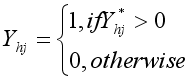
Multinomial logit (MNL) or multivariate probit (MVP) models can be used to estimate the effect of independent variables on a dependent variable involving multiple choices with unordered multiple categories . MNL does have assumptions, such as the assumption of independence among the dependent variable choices. This assumption states that the choice of one category is not related to the choice of another category (i.e., the dependent variable) which is not always desirable Studies of were applied MNL model under the assumption that producers likely choose single outlet from alternative choices. Whereas were applied MVP model because it simultaneously captures the influence of the set of explanatory variables on each of the different choices, while allowing the unobserved and/or unmeasured factors (error terms) to be freely correlated. Therefore, MVP model was applied to analyse the deteraminants of sesame producers’ decisions on market outlet choices; because producers more likely choose a different outlet choice simultaneously. The producers’ decision of whether or not to choose is considered under the general framework of utility or profit maximization. In this context, the utility of the economic agents is not observable, but the actions of the economic agents could be observed through the choices they made. In this study, the MVP model is characterized by a set of m binary dependent variables Yhj such that:
(1)
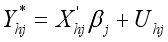
(2)
Where j = 1, 2, … m denote the market outlet choices available for h sesame producer, X´hj= is a vector of explanatory variables, Bj = denotes the vector of parameters to be estimated, Y*hj = observed dependent variable and Uhj,j = 1, 2 … m are random error terms distributed as multivariate normal distribution, each with zero means and variance-covariance matrix V, where V has values of 1 on the leading diagonal and correlation ρjm = ρmjas off-diagonal elements.
Variables and Working Hypothesis
Dependent variables:
Independent variables: are potential factors influencing sesame market outlet choice decisions. The following variables are hypothesized based on different empirical reviews.
Table 1. Summary of dependent and independent variables hypothesis.

Independent variable

Category

Measurement

Expected sign effect

Sex of the household head

Dummy

1=male, 0=female

+

Educational level of the head

Continuous

Years of schooling

+

Family size of household

Continuous

Man equivalent

+

Owned land size of household

Continuous

Hectare

+

Sesame production experience

Continuous

Years of production

+

Volume of sesame production

Continuous

Quintal/year/HH

+

Sesame price

Continuous

Birr/quintal

+

Credit use for sesame

Dummy

1=yes, 0=no

+

Market information access

Dummy

1=yes, 0=no

+

Cooperative membership

Dummy

1=yes, 0=no

+

Extension training

Dummy

1=yes, 0=no

+

Non/off-farm income

Continuous

Birr/year

-

Distance to nearest market centre

Continuous

Minutes

-

3. Results and Discussions
3.1. Descriptive Statistical Results
3.1.1. Sampled Households by Keble and Sex
Kafta-humera district is among the potential sesame producers in Western Tigray Region. To investigate the sesame producers value chain and market choice four kebles and 130 smallholder farmers of sesame producers were taken systematically and randomly. Based on this, Adebay, Rawiyan, May Kadra and Baekers are among the potential sesame producers kebles that selected for this study.
Based on total population of sesame producers in the kebles 44, 32, 28 and 26 sesame producers were selected from Rawiyan, May kadra, Baeker, and Adebay respectively. The sample gender composition is 76.92% of the sample households’ sesame producers are male while 23.08%s are female households .
Table 2. Sample households by Keble and Sex.

Sampled Keble

Sex of Respondents

Male

Female

Total

Adebay

22

4

26

Rawiyan

32

12

44

May Kadra

24

8

32

Baeker

22

6

28

Total

100

30

130

Source: Own Survey data (2020) Pearson Chi2(3) = 1.41 PR = 0.70
3.1.2. Demographic and Socio- Economic Characteristics of Sampled Households in Kafta-Humera District
As shown in Table 3, sesame producers in kafta-Humera that accessed to different market choice is 42.23 years old and have a family size of 6.91 person per family on average with standard deviation of 12.87 and 2.76 respectively. The sample households have owned a cultivated land 6.5 hectare and allocated 4 hectares for sesame production which is about 60% of their owned land with a standard deviation of 1.8 and 1.25 hectares respectively in the study area. The educational background of sesame producers in Kafta-humera districts are grade five completed on average with a standard deviation of 3.8 and minimum zero class and maximum 15 class completed.
Table 3. Demographic Characteristics of Sampled Households in Kafta-Humera.

Respondent Demography

Mean

Standard deviation

Min

Max

Age

42.23

12.87

20

80

Family Size

6.91

2.76

2

14

Education

4.87

3.8

0

15

Own Land

6.5

1.8

3

10

Allocate for Sesame

4

1.25

1.8

6

3.1.3. Sesame Producers Market Outlet Choice and Credit Accessibility
The sample Households of Sesame producers in Kafta-humera which accessed to different market choice were accessed to different credit services to produce quality sesame with more quantity. Sample households of sesame producers were get credits from different governmental and non-governmental institutions. Whole sellers, collectors, and cooperatives agents are giving credits to sesame producers to strong their connection with sesame producers as well as to sell their sesame product. Based on survey, about 75.38%(98) of sample households are accessed to credits and used the credit for production and transportation of sesame products in the study area. Sample households which are accessed to credit has significant effect at 1% on the market outlet choice of sesame producers that positively influenced to supply their products to their lenders during their challenges of accessing financial liquidity shortages Table 4.
Table 4. Sesame Producers Market Outlet Choice and Credit Accessibility.

Market Outlet Choice

Access to Credit

Yes

No

Total

Collectors

16

12

28

Whole Sellers

33

15

48

ECX

20

0

20

Cooperatives

29

5

34

Total

98

32

130

Source: Own Survey data (2020) Pearson Chi2(3) = 14.49 PR = 0.002
3.1.4. Sesame Producers Market Outlet Choice and Getting Sesame Output Price Information
The sample Households of Sesame producers in Kafta-humera are searching and getting their sesame output price information from different market outlet choice by television, radio, market information centres, relatives and development agents. Based on their searching and getting sesame out price information different constraints faced them, they sold their sesame output to different market outlet choice like Whole sellers, collectors, EXC and cooperatives market centres. Based on survey, about 66.15%(86) of sample households are accessed to credits market information in the study area. Sample households which are accessed to sesame market output price information has significant effect at 5% on the market outlet choice of sesame producers that positively influenced to supply their products based on their incentives gained from the market outlet choice Table 5.
Table 5. Sesame Producers Market Outlet Choice and getting Sesame Output Price Information.

Market Outlet Choice

Access to Sesame output price Information

Yes

No

Total

Collectors

17

11

28

Whole Sellers

29

9

40

ECX

19

1

20

Cooperatives

21

13

34

Total

86

44

130

Source: Own Survey data (2020) Pearson Chi2(3) = 8.80 PR = 0.03
3.1.5. Sesame Producers Market Outlet Choice and Trained by Agricultural Extension
The sample Households of Sesame producers in Kafta-humera are getting training on sesame production and marketing, handling, sesame output price and sesame market centres by different governmental and non-governmental organizations like Sesame Business Networking (SBN). Based on getting training from different governmental and non-governmental organizations, they are producing quality sesame products with more output of sesame and supplied to different market outlet choice like Whole sellers, collectors, EXC and cooperatives market centres. Based on survey, about 67.69%(88) of sample households are trained by GO and NGO in the study area. Sample households which are accessed to sesame market output price information has significant effect at 5% on the market outlet choice of sesame producers that positively influenced to supply their products based on their incentives gained from the market outlet choice Table 6.
Table 6. Sesame Producers Market Outlet Choice and Trained by Agricultural Extension.

Market Outlet Choice

Trained by Agricultural Extension

Yes

No

Total

Collectors

17

11

28

Whole Sellers

29

19

48

ECX

19

1

20

Cooperatives

23

11

34

Total

88

42

130

Source: Own Survey data (2020) Pearson Chi2(3) = 8.60 PR = 0.04
3.1.6. Sesame Producers Market Outlet Choice and Amount of Revenue Earned
Sesame production is the main source of livelihoods in Western Tigray region. Majority of sample households of sesame producers in Kafta-Humera district allocated their land for sesame production is reached 60 – 70% of their owned land or they cultivated land. Sample households of sesame producers in Kafta-Humera districts are sold their sesame product on different market outlet choices like Collectors (21.54%), Whole sellers (36.92%), EXC (15.38%) based on their sesame output price getting, socio – economic challenges and premium earned Table 8. The sample households of sesame producers in Kafta-Humera districts are produced 2732.04 quintal of sesame output and supplied 2207.11 quintal of sesame output on different market outlet choice and earned 108 million of ETHB in the 2019/2020 cropping season Table 7.
Table 7. Sesame Producers Market Outlet Choice and Amount of Revenue Earned.

Market Outlet Choice

Frequency

%

Volume of Sesame sold in Quintal

Revenue earned in ETB

%

Collectors

Total Sesame produced by sample Households in Quintal

28

21.54

502.6

28,888,496

26.55

Whole Sellers

48

36.92

805.53

45,532,208

41.85

ECX

20

15.38

323.75

1,837,443

1.69

Cooperatives

34

26.15

575.23

32,531,180

29.90

Total

2732.04

130

100

2207.11

108,789,327

100

Source: Own Survey data (2020)
3.1.7. Sesame Production
In Tigray, sesame producers are predominantly small-scale farmers, and majority of the farmers apply traditional way of farming practice such as broadcasting for planting, manual weeding, harvesting, drying and threshing, which are labour-intensive. Sesame production is the open farm business investors easily enter in to and exit from. There are also investors who cultivate sesame at large scale for export market. During 2019/2020 production season, the average cultivated land of 3.82 hectare with average productivity of sesame 5.47 quintal per hectare at harvesting cost of 180 – 200 ETB per Hilla or 400 Etirti. Thus, sesame producers supply their produce to different actors depending on their access to market and bulk of quantity. During the study year, sesame producers were supplied their produce to cooperatives/unions, local collectors and ECX; but they had complaint to supply to ECX due to low price fix by the government, which is maximum of 4,200 ETB per quintal selling price thereby sesame was lately supplied than ever to the world market; even some investors and traders have stored yet with the expectation to rise world market price.
Table 8. Sesame production and productivity of Sample Households.

Description

Mean

Standard deviation

Min

Max

Land allocated for sesame

3.82

1.09

1.8

6

Sesame yield per hectare (quintal)

5.47

2.13

2.5

8

Total Sesame produced in Quintal

21.02

6.87

8.1

36

Source: own survey result, 2020
3.2. Sesame Market Channels and Outlet Choices
A marketing channel is the people, organizations, and activities necessary to transfer the ownership of goods from the point of production to the point of consumption. It is the way products get to the end-user, the consumer; and is also known as a distribution channel. There are four main marketing channels for sesame sell in the Humera/Tigray. These are:
Channel I: Producers → Collectors/Traders → Ethiopian Commodity Exchange → Export market
Channel II: Producers → Whole Sellers → Ethiopian Commodity Exchange → Processors/Exporters
Channel III: Producers → Ethiopian Commodity Exchange → Export market
Channel IV: Producers → Cooperatives → Unions → Ethiopian Commodity Exchange → Export market
According to the field survey, urban traders had the highest potential for acquiring sesame directly from farmers in Humera. The sampled farmers sold above half of their produce to traders in primary markets established by the government within their Tabias. If producers have more than 50 quintals of sales volume, they will directly sell at ECX central market. Almost all traders traded their sesame to processors and exporters, who directly sell to the international market through EXC market outlet. But, sesame for export purpose should pass through ECX grading system and quarantine procedures. One of the major benefits of the new sesame trading operation is that the produces from each producing area are separately stored in the ECX field warehouses, protecting from adulteration and enabling the tracing of product origin. The new regulation of ECX also provide the smallholder producers, commercial farmers and cooperative unions the opportunity of selling in the central market or directly exporting the produce to foreign market. However, during the study year, with the declaration of ECX traders to supply their sesame produce to the warehouse.
3.3. Model Fitness, Probability and Correlation Matrix of the Market Outlet Choices
Sample households of sesame producers in Kafta-Humera have four market outlet choice alternatives for selling their sesame products. These are Collectors, wholesales, Ethiopia commodity exchanges, cooperatives. MVP was used to analyse the sesame producers’ market outlet choices among four different outlets included in the model. In this section, significance of the determinants influencing producers’ decision in market outlet choice is discussed based on results of the MVP model in Table 11. The Wald test (56) (χ2 = 115.18, ρ = 0.00) is strongly significant at 1% significant level, which indicates that the subset of coefficients of the model is jointly significant and that the explanatory power of the factors included in the model is satisfactory; thus, the MVP model fits the data reasonably well. The simulated maximum likelihood test (LR χ 2 (6) = 13.47(Prob > χ2 = 0.036) of the null hypothesis of independence between the market outlets decision (ρ21 = ρ31 = ρ41 = ρ32 = ρ42 = ρ43 = 0) is significant at 5% significant level. Therefore, the null hypothesis that all the ρ (Rho) values are jointly equal to 0 is rejected, indicating the goodness of fit of the model and supporting the use of MVP model over individual probit model. This verifies that separate estimation of choice decision of these outlets is biased, and the decisions to choose the four sesame marketing outlets are interdependent household decisions.
The simulation maximum likelihood estimation result indicates the marginal success probability of each market outlets. The likelihood of choosing whole seller market outlet (51.35%) was relatively high as compared to the probability of choosing cooperatives (46.40%), ECX (40.97%), and Collectors outlet (35.8%). With regard to the joint probabilities of success and failure of market outlet, choice decisions suggest that those households are more likely to jointly choose four market outlets. The likelihood of households to jointly choose the four market outlets is 4% compared to their failure of 2% to jointly choose the four market outlets.
The ρ values (ρij) indicate the degree of correlation between each pair of dependent variables. The ρ31 (correlation between the choice for ECX and Collectors) and ρ42 (correlation between Cooperatives and Whole sellers) are negatively interdependent and significant at 10% and 1% probability levels, respectively. From this finding, it is possible to conclude that those Sesame producers delivering to ECX are less likely to deliver to Collectors and vice versa. This indicates the competitive relationship of the ECX market outlet with Collectors’ market outlet. Likewise, those Sesame producers delivering to Cooperatives are less likely to deliver to Whole Sellers and vice versa. This indicates the competitive relationship of the whole seller market outlet with Cooperatives’ market outlet.
Table 9. Model Fitness, Probability and Correlation Matrix of the Market Outlet Choices.

Variables

Collectors

Whole sellers

ECX

Cooperatives

Predicting Probability

35.80

51.35

40.97

46.40

Joint Probability (Success)

0.04

Joint Probability (Failure)

0.02

Number of draws

5

Observations

130

Log like hood

317.72

Wald X2 (56)

115.18

Prob > X2

0.00

ρ1

ρ2

ρ3

ρ4

ρ1

1

ρ2

0.02(0.91)

1

ρ3

-0.24(0.09)*

-0.21(0.13)

1

ρ4

-0.12(0.38)

-0.33(0.00)***

-0.00(0.99)

1

Likelihood ratio test of rho 21 = rho 31 = rho 41 = rho32 = rho 42 = rho 43 = 0:

chi2(6) = 13.47

Prob > chi2 = 0.036

Note: *** and * indicate statistical significance at 1 and 10%, respectively. ρ1 = Collectors, ρ2 = Whole sellers, ρ3 = Ethiopian Commodity Exchange and ρ4 = Cooperatives
3.4. Factors Determining the Sesame Market Outlet Choice
In this study, two major sesame market outlets were identified as alternatives to farmers to sell majority of their sesame products. Accordingly, 57.8% of the sesame producer respondents sell their produce to collector traders and 36.3% sell to cooperatives/their unions. The model result showed that some of the variables were significant at both market outlets while some others are significant in one marketing outlet but not in the other outlet. Accordingly, land cultivated to sesame production, sesame market price, credit service access and distance to sesame market centre were significantly affect the sesame producers’ choice of collector outlet; while land cultivated to sesame production, sesame cultivation experience, amount of sesame production, sesame market price and cooperative membership were significantly affect the sesame producers’ choice of cooperative outlet. This implies that the discussion of the results focuses on the impact of the explanatory variables on a use of collectors and cooperatives.
To investigate the factors that determining the Sesame producers market outlet choices are included 14 explanatory variables in the MVP model and out of these variables Family size in Number (1%), Sesame price (10%) and Access to credits (1%) are statically significantly and affected positively the sesame producers ECX market outlet, Educational background in class completed (5%) and Market information (10%) of variables are statically significant and affected positively the sesame producers whole seller market outlet, Educational background in class completed (5%), Family size in Number (10%) and land allocated for sesame production variables are statically significant and positively affected the sesame producers of Cooperative’ market outlet, and sesame farm experience (10%) statically significant and negatively affected the sesame producers of collector market outlet choices at 1%, 5%, and 10% probability levels.
3.4.1. Sesame Farming Experience of Sample Households
The likelihood of choosing Collectors market outlet was negatively and significantly affected by farming experience at 10% significance level. This result indicated that more experienced households in sesame production were less likely to deliver pepper to collectors’ market outlet than less experienced farmers. This is because more experienced farmers in sesame production and marketing help the farmer to adjust their marketing link, trying to search other alternative market outlets other than collectors market outlet to increase market supply of sesame. In addition to that, experienced farmers had better knowledge of cost and benefits associated with various sesame marketing outlets; consequently, they are more likely to decrease the quantities supplied through the collectors’ market outlet and increase the quantity supplied to other attractive market outlets.
3.4.2. Educational Background of Sample Households
Educational background of sample households in Years were positively and significantly related with wholesaler outlet choice and cooperatives at 5% and 10% significant level respectively. Education is believed to give individuals the necessary knowledge that can be used to collect information, interpret the information received, and make productive and marketing decision. The more educated the farmer is, the more likely to sell sesame through wholesalers and cooperatives Wosene et al., Cogent Food & Agriculture (2018), because more educated farmers spend less time on doing marketing activities. The positive relationship between educational background and selling to wholesaler market outlet can be explained by the fact that being educated enhances the capability of farmers in making informed decisions with regard to the choice of marketing outlets to sell their farm output based on the marketing margin and marketing cost.
3.4.3. Market Information on Sesame Output Price of Sample Households
The probability of choosing whole seller market outlet was positively and significantly affected by the market information on sesame output price. The positive sign indicated that sample households supplied more quantity of sesame output to whole sellers than other market outlets based on the price of whole sellers given to bought sesame products from sesame producers. On the other hand, households who is well informed about the market outlet and their price allocated to bought sesame products incentivize to supply to whole seller market than other market outlets.
3.4.4. Sesame Price of Market Outlet Choices
The probability of choosing Ethiopian commodity exchange market outlet was positively and significantly affected at 5% significance level by the sesame price on sesame output price. The positive sign indicated that sample households supplied more quantity of sesame output to Ethiopian commodity than other market outlets based on the price of ECX given to bought sesame products from sesame producers. On the other hand, households who is well informed about the market outlet and their price allocated to bought sesame products incentivize to supply to ECX market than other market outlets.
3.4.5. Land Allocated of Sample Households for Sesame Production in Hectare
The probability of choosing Cooperatives market outlet was positively and significantly affected by land allocated for sesame production at 10% significant level. The positive sign indicates that those households allocating large farm land for sesame production have probability of producing large amount of sesame output and mostly prefer to use cooperative market outlet than other market outlets. land is a critical production asset having a direct bearing on production of a marketable surplus, ceteris paribus. This implies that those with large parcels of land are likely to participate more in markets especially in cooperatives market outlets as they have scale advantage to reduce costs to take products to distance market. On the other hand, households who allocate large land for sesame are produced a large output of sesame and accessed to cooperative market outlets compared to households who supply less because of cooperative capacity to purchase a large amount of sesame with a fair price.
3.4.6. Family Size of Sample Households in Number
according to the results, family size was positively influences ECX market outlet and Cooperative market outlets at 1% and 10% of significance level respectively. This indicated that the more family sizes have a probability of large labour forces and able to supply to more sesame products to both the market premiums such as ECX and Cooperatives than other market outlet options. The finding agrees with the prior expectation that large family size implies better labour endowment so that households are in a position to travel to get ECX and Cooperative market outlets in the district or nearby town markets.
3.4.7. Access to Credit of Sample Households
The probability of choosing Ethiopian commodity exchange market outlet was positively and significantly affected at 1% significance level due to access to credit. This indicated that access to credit have a probability of purchase more improved agricultural technologies and used for sesame production than non-credit users. This also implies, sample households who use credit may produce more output this might be due to use of credit provide for farm households a power to spend in input market that boost yield and thus leading to more marketable surplus. Likewise, use of credit eases liquidity constraints of households that contribute to market oriented production. Therefore, the result reveals using credit increase the probability of choosing Ethiopian Commodity exchange market outlet than other market outlets.
Table 10. Factors determining market outlet choice in Humera district.

Variables

Market Choice

Collectors

Coefficient

Robust Std. Err

Z Values

Sex

-0.26

0.29

-0.90

Age in Year

0.03

0.02

1.30

Education in Year

-0.01

0.04

-0.34

Family Size in Number

0.00

0.06

0.04

Sesame Land in Ha

-0.27

0.33

-0.80

Sesame Product in Quintal

0.05

0.05

0.91

Sesame Price

0.00

0.00

1.24

Sesame Farm Experience in Year

0.04

0.02

1.80*

Credit Access

-0.16

0.35

-0.45

Market Information

-0.22

0.27

-0.82

Member of Cooperative

0.30

0.24

1.27

Trained by Extension

0.04

0.27

0.16

Non-Farm income in ETB

-0.00

0.00

-0.29

Distant to Nearest market in Minute

-0.00

0.00

0.80

Constant

-5.58

4.51

-1.24

Table 11. Whole Sellers’ Market outlet choice.

Variables

Market Choice

Whole Sellers

Coefficients

Robust Std. Err

Z Values

Sex

-0.10

0.29

-.34

Age in Year

0.02

0.02

1.04

Education in Year

0.08

0.04

2.08**

Family Size in Number

0.08

0.07

1.27

Sesame Land in Ha

-0.66

0.32

-0.19

Sesame Product in Quintal

0.03

0.05

0.55

Sesame Price

-0.00

0.00

-1.09

Sesame Farm Experience in Year

-0.01

0.02

-0.25

Credit Access

0.16

0.39

-0.42

Market Information

0.47

0.27

1.72*

Member of Cooperative

0.18

0.25

0.72

Trained by Extension

-0.29

0.29

-1.02

Non-Farm income in ETB

0.00

0.00

0.94

Distant to Nearest market in Minute

0.01

0.004

01.44

Constant

2.70

4.55

0.59

Table 12. Ethiopian Commodity Exchange’ Market outlet choice.

Variables

Market Choice

Ethiopian Commodity Exchange

Coefficients

Robust Std. Err

Z Values

Sex

-0.03

0.28

-0.10

Age in Year

-0.00

0.02

-0.13

Education in Year

-0.03

0.04

-0.70

Family Size in Number

0.16

0.06

2.89***

Sesame Land in Ha

0.16

0.33

0.48

Sesame Product in Quintal

-0.06

0.05

-1.06

Sesame Price

0.00

0.00

2.04**

Sesame Farm Experience in Year

0.01

0.02

0.64

Credit Access

0.94

0.37

2.52***

Market Information

0.32

0.27

1.18

Member of Cooperative

0.01

0.25

0.04

Trained by Extension

0.17

0.28

0.61

Non-Farm income in ETB

-0.00

0.00

-0.06

Distant to Nearest market in Minute

-0.00

0.00

-0.51

Constant

-10.58

4.55

-2.32

Table 13. Cooperative Market outlet choice.

Variables

Market Choice

Cooperatives

Coefficients

Robust Std. Err

Z Values

Sex

-0.30

0.28

-1.08

Age in Year

-0.00

0.02

-0.15

Education in Year

0.07

0.04

1.85*

Family Size in Number

0.10

0.06

1.77*

Sesame Land in Ha

0.65

0.36

1.81*

Sesame Product in Quintal

-0.09

0.06

-1.59

Sesame Price

0.00

0.00

0.58

Sesame Farm Experience in Year

-0.01

0.02

-0.33

Credit Access

0.11

0.35

0.31

Market Information

-0.25

0.28

-0.92

Member of Cooperative

-0.04

0.25

-0.14

Trained by Extension

0.02

0.28

0.09

Non-Farm income in ETB

-0.00

0.00

0.65

Distant to Nearest market in Minute

-0.01

0.004

-1.46

Constant

-1.27

4.61

-0.27

4. Conclusion and Recommendation
Sesame is short harvest cycle cash crop well suited to smallholder farming mainly grown for its seed, which is source of cash, edible oil and other livestock feeds. Ethiopia has Humera, Gonder and Wellega type commercial verities; particularly, Humera type has competitive advantage over the others due to its distinct quality attributes. With this regard, the government of Tigray region recognized sesame as export commodity in the western cluster economy of the region. However, sesame is facing rainfall variability, high labour costs, poor post-harvest practices, traditional processing capacity and weak regulatory and standard transactional procedures coupled with world market price volatility due to large volume supply from emerging African countries which lead to variability in export and foreign exchange earnings. Previous studies done on sesame were focused on input-out structure dimension of sesame value chain which the governance dimension along the value chain ignored.
Hence, this study was aimed to investigated governance structure along sesame value chain and sesame market outlet choice in Tigray region to enhance Humera sesame competitiveness. Accordingly, 130 sample smallholder sesame producers were taken using systematic and random sampling techniques and analysed the socio-economic and demographic of sesame producers and its governance along the value chain using the descriptive statistics like mean and frequency and the factors affecting market outlet choices using multiple variant probit models. The descriptive statics indicated that sample households were 42.23 years old, 6.91 family size in number and grade five completed educational background in average. In addition to this, it investigated that the main actors of the value chains are input suppliers, producers, traders/traders, cooperatives, Ethiopian Commodity Exchange, processors and exporters. Furtherly, sesame market flows through four alternative market channels and four market outlet choices that are collectors (21.54%), whole sellers (36.96), Ethiopian commodity Exchange (15.38) and cooperatives (26.15%) to export market to international market. The Multiple variant probit model revealed that Educational background, market information, family size, sesame price, access to credit and land allocated to sesame production affects positively and statically significance 5%, 10%, 1% 5%, 1% and 10% respectively for the Whole sellers, ECX and Cooperative market outlet choice of sesame producer while Sesame farm experience was affected at 10% significance level and negatively of the collector market outlet choices of sesame producers in the study area.
The sesame value chain governance structure also identified as relational type. Furthermore, the value chain major constraints were identified as lack of finance, sesame market price variability from year to year, lack of storage facilities with respect to the susceptibility of the crop to pests, high inputs and production costs, and poor coordination and mistrust among actors; while the opportunities recognized as availability of potential land for sesame cultivation, high international demand for Humera type of sesame, good government and stakeholders attention given towards the sesame sub-sector.
Therefore, following the above findings, intervention strategies and programs made by governmental and non-governmental organizations need to take into account the significantly influencing factors in order to bring Humera type of sesame production become nationally and internationally competitive. Specifically, the following recommendations are forwarded.
Agricultural mechanization and open bidding at local market should be considered as possible alternatives for value chain upgrading/improvement. Therefore, the centralized Addis Ababa ECX market should be installed and launched at woreda level. In addition to this, Agro-processing companies should be established to process edible oil and the indigenous knowledge of local processing at farmers’ level should be substantiated with modern equipment’s for better product improvement.
Cooperatives and unions need to be strengthened through various intervention packages to become an umbrella of both producers and traders; and collective effort should be bestowed for the recognition and promotion of the Humera type of sesame so that bring competitive advantage nationally and internationally.
Author Contributions
Fisseha Kidu: Conceptualization, Data curation, Formal Analysis
Welay Tesfay: Conceptualization, Data curation, Formal Analysis, Investigation, Methodology, Software, Supervision, Validation, Visualization, Writing – review & editing
Tekle Meresa: Methodology, Supervision
Conflicts of Interest
The authors declare no conflicts of interest.
References
[1] Anilakumar, K. R., Pal, A., Khanum, F. and Bawa, A. S., 2010. Nutritional, medicinal and industrial uses of sesame (Sesamumindicum L.) seeds-an overview. Agriculturae Conspectus Scientificus, 75(4), pp. 159-168.
[2] ATA and BoARD, 2016. Sesame improvement and capacity building: a collaborative work of Agricultural Transformation Agency and Bureau of Agriculture and Rural Development of Tigray region.
[3] BezabihEmana, Mengistu K, Jeffreyson KM, Jemal Y., 2015. Factors affecting market outlet choice of potato producers in Eastern Hararghe Zone, Ethiopia. Journal of Economics and Sustainable Development 6(15): 159-172.
[4] Boere, A., Thijs, R., Daphne, W., Dawit, K. and Wannes, D., 2015. Business Opportunities Report Oilseeds and Pulses# 5 in the series written for the" Ethiopian Netherlands business event 5-6 November 2015. Rijswijk, The Netherlands, p. 9.
[5] CSA, 2014. Sesame production by regional State in Ethiopia, Central Statistical Authority in 2013/14.
[6] FAO, 2015. Analysis of price incentives for Sesame seed in Ethiopia, 2005-2012. Technical notes series, by KumaWorako, T., MasAparisi, A., Lanos, B., Rome.
[7] FikruTemesgen, Gobena, E. and Megersa, H., 2017. Analysis of Sesame Marketing Chain in Case of Gimbi Districts, Ethiopia. Journal of Education and Practice, 8(10), pp. 86-102. Free Press, New York.
[8] KassaTarekegn, Jema Haji and BosenaTegegne, 2017. Determinants of honey producer market outlet choice in Chena District, southern Ethiopia: a multivariate probit regression analysis: Springer Open Access Journal of Agricultural and Food Economics (2017) 5: 20.
[9] KIT, FaidaMaLi and IIRR (2006), Chain empowerment: Supporting African farmers to Develop markets. Royal Tropical Institute, Amsterdam; Faida Market Link, Arusha; and InternationalInstitute of Rural Reconstruction, Nairobi.
[10] LemlemWoldegebriel, 2017. Strategic Analysis of Sesame (SesamumindicumL.) Market Chain in Ethiopia a Case of Humera District. International Journal of Plant & Soil Science 15(4): 1-10.
[11] Meijerink, G., Eaton, D. and Bijman, J., 2008. Transaction risks in market chains. WageningenUniversity. Strategy& Policy Brief, (11-3).
[12] NPC, 2016. Federal Democratic Republic of Ethiopia, Growth and Transformation Plan - II (2015/16-2019/20) volume-I, National Planning Commission, May, 2016 Addis Ababa, Ethiopia.
[13] Porter, M., 1985. Competitive advantage: creating and sustaining superior performance. New York Free Press publisher.
[14] ShewayeAbera, 2016. Econometric analysis of factors affecting haricot bean market outlet choices in MisrakBadawacho District, Ethiopia. International Journal of Research Studies in Agricultural Sciences 2(9): 6-12.
[15] ShishayTeklay, MengistuKetema, and BosenaTegegn, 2016. Determinants of Producers’, Market Outlet Choices of Gesho (Rhamnusprinoides) in Central Tigray Regional State, Ethiopia. Proceedings of the National Conference on Agricultural Value Chains for Food Security and Pro-poor Development Co-organized by ValueSeC Project and HaramayaUniversity 16-17 December 2016, Haramaya, Ethiopia.
[16] Terefe, Negasa, 2016. Review of Sesame Value Chain in Ethiopia An International Peer-reviewed Journal, vol. 19, Available:
[17] TewodrosTefera, 2014. Analysis of chickpea value chain and determinants of market options choice in selected districts of southern Ethiopia. Journal of Agricultural Science, 6(10), p. 26.
[18] Tomek, W. and Robinson, K., 1990. Agricultural Product Prices Cornell.
[19] UNCTAD, 2018. National green exports review of Ethiopia, United Nation Conference on Trade and Development on leather and sesame seed.
[20] Yamane, T., 1967. Statistics: An Introductory Analysis, 2nd Ed., New York: Harper and Row.
Cite This Article
  • APA Style

    Kidu, F., Tesfay, W., Meresa, T. (2026). What Factors Determining Sesame Market Outlet Choice in the Western Zone of Tigray Region, Ethiopia. Innovation Business, 1(1), 85-97. https://doi.org/10.11648/j.ib.20260101.17

    Copy | Download

    ACS Style

    Kidu, F.; Tesfay, W.; Meresa, T. What Factors Determining Sesame Market Outlet Choice in the Western Zone of Tigray Region, Ethiopia. Innov. Bus. 2026, 1(1), 85-97. doi: 10.11648/j.ib.20260101.17

    Copy | Download

    AMA Style

    Kidu F, Tesfay W, Meresa T. What Factors Determining Sesame Market Outlet Choice in the Western Zone of Tigray Region, Ethiopia. Innov Bus. 2026;1(1):85-97. doi: 10.11648/j.ib.20260101.17

    Copy | Download

  • @article{10.11648/j.ib.20260101.17,
      author = {Fisseha Kidu and Welay Tesfay and Tekle Meresa},
      title = {What Factors Determining Sesame Market Outlet Choice in the Western Zone of Tigray Region, Ethiopia},
      journal = {Innovation Business},
      volume = {1},
      number = {1},
      pages = {85-97},
      doi = {10.11648/j.ib.20260101.17},
      url = {https://doi.org/10.11648/j.ib.20260101.17},
      eprint = {https://article.sciencepublishinggroup.com/pdf/10.11648.j.ib.20260101.17},
      abstract = {This study aimed to determine the factors that affected the sesame market outlet choice in Tigray region to enhance Humera sesame competitiveness. Four kebles was selected randomly based on their potential of sesame production and 130 sample households were selected based on systematic sampling and random sampling techniques. The descriptive statics indicated that sample households were 42.23 years old, 6.91 family size in number and grade five completed educational background in average. In addition to this, sesame market flows through four alternative market channels and four market outlet choices that are collectors (21.54%), whole sellers (36.96), Ethiopian commodity Exchange (15.38) and cooperatives (26.15%) to export market to international market. The Multiple variant probit model revealed that Educational background, market information, family size, sesame price, access to credit and land allocated to sesame production affects positively and statically significance 5%, 10%, 1% 5%, 1% and 10% respectively for the Whole sellers, ECX and Cooperative market outlet choice of sesame producer while Sesame farm experience was affected at 10% significance level and negatively of the collector market outlet choices of sesame producers in the study area. Therefore, intervention strategies and programs made by governmental and non-governmental organizations need to take into account the significantly influencing factors in order to bring Humera type of sesame become nationally and internationally competitive.},
     year = {2026}
    }
    

    Copy | Download

  • TY  - JOUR
    T1  - What Factors Determining Sesame Market Outlet Choice in the Western Zone of Tigray Region, Ethiopia
    AU  - Fisseha Kidu
    AU  - Welay Tesfay
    AU  - Tekle Meresa
    Y1  - 2026/03/19
    PY  - 2026
    N1  - https://doi.org/10.11648/j.ib.20260101.17
    DO  - 10.11648/j.ib.20260101.17
    T2  - Innovation Business
    JF  - Innovation Business
    JO  - Innovation Business
    SP  - 85
    EP  - 97
    PB  - Science Publishing Group
    UR  - https://doi.org/10.11648/j.ib.20260101.17
    AB  - This study aimed to determine the factors that affected the sesame market outlet choice in Tigray region to enhance Humera sesame competitiveness. Four kebles was selected randomly based on their potential of sesame production and 130 sample households were selected based on systematic sampling and random sampling techniques. The descriptive statics indicated that sample households were 42.23 years old, 6.91 family size in number and grade five completed educational background in average. In addition to this, sesame market flows through four alternative market channels and four market outlet choices that are collectors (21.54%), whole sellers (36.96), Ethiopian commodity Exchange (15.38) and cooperatives (26.15%) to export market to international market. The Multiple variant probit model revealed that Educational background, market information, family size, sesame price, access to credit and land allocated to sesame production affects positively and statically significance 5%, 10%, 1% 5%, 1% and 10% respectively for the Whole sellers, ECX and Cooperative market outlet choice of sesame producer while Sesame farm experience was affected at 10% significance level and negatively of the collector market outlet choices of sesame producers in the study area. Therefore, intervention strategies and programs made by governmental and non-governmental organizations need to take into account the significantly influencing factors in order to bring Humera type of sesame become nationally and internationally competitive.
    VL  - 1
    IS  - 1
    ER  - 

    Copy | Download

Author Information
  • Agricultural Economics, Aksum University Shire Campus Agricultural Economics, Shire, Ethiopia

  • Ethiopian Institute of Agricultural Research, Addis Ababa, Ethiopia

  • Agricultural Economics, Aksum University Shire Campus Agricultural Economics, Shire, Ethiopia

  • Abstract
  • Keywords
  • Document Sections

    1. 1. Introduction
    2. 2. Methodology
    3. 3. Results and Discussions
    4. 4. Conclusion and Recommendation
    Show Full Outline
  • Author Contributions
  • Conflicts of Interest
  • References
  • Cite This Article
  • Author Information