
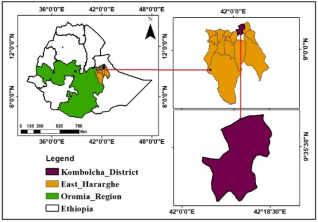
Efficient irrigation water management is critical for optimizing crop productivity and ensuring the sustainable use of limited water resources, particularly in semi-arid regions. This study was conducted during the 2022/23 and 2023/24 cropping seasons at Kombolcha District, East Hararghe Zone, Oromia regional state, Ethiopia. The purpose of the activity was to create optimal irrigation regimes (when and how much to irrigate) for onions and evaluate the effect of different irrigation timings on the water productivity and yield of the onion crop. The results showed that irrigation water, maximum irrigation frequency, and short irrigation intervals were achieved by scheduling irrigation at 60% of the ASMDL treatment. The next maximum irrigation frequency was obtained by scheduling irrigation at 80% of ASMDL treatment. Minimum irrigation frequency and minimum water consumed by scheduling irrigation at 140% ASMDL treatment. The results show that the maximum onion yield was obtained by scheduling irrigation at 60% of ASMDL treatment, followed by 80% ASMDL treatment. Statistically, there is no significant difference between 60% ASMDL and 80% ASMDL treatments in terms of onion yield. Maximum water productivity was obtained by scheduling irrigation at 80% ASMD treatment followed by 60% ASMDL treatment. Statistically, there is no significant difference between 60%, 100%, and 120% ASMDL treatments in terms of onion water productivity. The minimum water productivity was reached by scheduling irrigation at 140% ASMDL treatment. So, scheduling irrigation at 80% ASMDL is recommended for onion with 5-day, 6-day, 7-day, and 10-day irrigation intervals at initial, development, mid, and maturity stages of onion, respectively.
| Published in | Hydrology (Volume 14, Issue 1) |
| DOI | 10.11648/j.hyd.20261401.12 |
| Page(s) | 15-21 |
| Creative Commons |
This is an Open Access article, distributed under the terms of the Creative Commons Attribution 4.0 International License (http://creativecommons.org/licenses/by/4.0/), which permits unrestricted use, distribution and reproduction in any medium or format, provided the original work is properly cited. |
| Copyright |
Copyright © The Author(s), 2026. Published by Science Publishing Group |
Irrigation Scheduling, Onion, Water Demand
Treatment | Description of Treatment |
|---|---|
T1 | 60% of ASMDL |
T2 | 80% of ASMDL |
T3 | 100% of ASMDL* |
T4 | 120% of ASMDL |
T5 | 140% of ASMDL |
D (cm) | Sand | Clay | silt | Textural class | BD (g/cm3) | FC (%) | PWP (%) | TAW (mm/m) |
|---|---|---|---|---|---|---|---|---|
0-15 | 47 | 27 | 26 | Sandy clay loam | 1.31 | 30.60 | 19.20 | 149.34 |
15-30 | 43 | 30 | 27 | Clay loam | 1.20 | 30.20 | 18.00 | 146.40 |
30-45 | 43 | 33 | 24 | Clay loam | 1.13 | 32.40 | 20.20 | 137.86 |
45-60 | 41 | 35 | 24 | Clay loam | 1.14 | 35.30 | 22.80 | 142.50 |
Total available water in the effective root zone of mm/m | 144.02 | |||||||
Treatments | Depletion fraction (P) | Irrigation frequency | Irrigation interval | Water used (m3/ha) | |||
|---|---|---|---|---|---|---|---|
Initial | Mid | Dev | End | ||||
60% ASMDL | 0.21 | 22 | 4 | 5 | 6 | 9 | 5198.3 |
80% ASMDL | 0.28 | 19 | 5 | 6 | 7 | 10 | 4861.6 |
100% ASMDL* | 0.35 | 15 | 5 | 7 | 8 | 11 | 4713.3 |
120% ASMDL | 0.42 | 13 | 6 | 11 | 12 | 15 | 4603.3 |
140% ASMDL | 0.49 | 9 | 10 | 14 | 15 | 16 | 4271.6 |
Treatments | PH (cm) | Bulb diameter (cm) | Bulb yield (qt ha-1) |
|---|---|---|---|
60% ASMDL | 49.83 a | 5.083 a | 317.2 a |
80% ASMDL | 44.83 b | 4.350 b | 310.0 a |
100% ASMDL* | 42.50 c | 3.500 c | 277.8 b |
120% ASMDL | 36.17 d | 3.000 cd | 261.7 c |
140% ASMDL | 31.83 e | 2.833 d | 208.9 d |
CV | 3.1 | 13.7 | 4.7 |
LSD | 1.52 | 0.62 | 15.49 |
Treatments | Bulb yield (qt ha-1) | Water productivity (kg/m3) |
|---|---|---|
60% ASMDL | 317.2a | 10.171ab |
80% ASMDL | 310.0a | 10.627a |
100% ASMDL | 277.8b | 9.812b |
120% ASMDL | 261.7c | 10.064b |
140% ASMDL | 208.9d | 8.150c |
CV | 4.7 | 4.5 |
LSD | 15.489 | 0.523 |
Treatments | Yield (qt/ha) | Yield reduction (%) | Yield response factor Ky. |
|---|---|---|---|
60% ASMDL | 317.2a | - | - |
80% ASMDL | 310.0a | - | - |
100% ASMDL | 277.8b | * | * |
120% ASMDL | 261.7c | 5.79 | 2.46 |
140% ASMDL | 208.9d | 24.80 | 1.53 |
ANOVA | Analysis of Variance |
ASMDL | Allowed Soil Moisture Depletion Levels |
BD | Bulk Density |
CWR | Crop Water Requirement |
ETo | Reference Evapotranspiration |
FC | Field Capacity |
KPT | Kombolcha Polytechnique |
LSD | Least Significant Difference |
PE | Effective Rainfall |
PWP | Permanent Welting Point |
RCBD | Randomized Complete Block Design |
SMDL | Soil Moisture Depletion Levels |
TAW | Total Available Water |
USDA | United States Department of Agriculture |
| [1] | G. G. Haile, T. G. Gebremicael, M. Kifle, and T. Gebremedhin, “Effects of irrigation scheduling and different irrigation methods on onion and water productivity in Tigray, northern Ethiopia,” 2019. |
| [2] | M. Habtewold, D. Mengist, N. Resource, and M. Directorate, “Evaluating the impact of different furrow irrigation methods on onion bulb yield and water productivity: The case of Hadero Tunto district, Southern Ethiopia,” vol. 17, no. October 2024, pp. 175–185, 2025. |
| [3] | G. Ashemi, “Response of Onion (Allium cepa L.) to Different Irrigation Levels Under Conventional Furrow Irrigation With and Without Mulch at Melkassa, Central Rift Valley of Ethiopia,” vol. 89, pp. 21–31, 2021, |
| [4] | B. M. Mekonen and M. F. Moges, “Determination of Optimal Irrigation Scheduling for Onion (Allium cepa L) in Gumara Scheme, North Western Ethiopia,” no. February, 2022, |
| [5] | T. Bekele and M. Abebo, “Evaluation of Furrow Irrigation Systems on Onion Yield and Water Use Efficiency in Misrak Azernet Berbere woreda, Ethiopia,” 2019. |
| [6] | S. Kim et al., “Green Onion (Allium fistulosum): An Aromatic Vegetable Crop Esteemed for Food, Nutritional and Therapeutic Significance,” pp. 1–20, 2023. |
| [7] | M. Abera, A. Wale, Y. Abie, and T. Esubalew, “Verification of the Efficiency of Alternate Furrow Irrigation on the Amount of Water Productivity and Yield of Onion at Sekota Woreda,” vol. 9, no. September, pp. 1–5, 2020, |
| [8] | M. Derbie, A. A. Beyene, S. Asres, and M. Yenesew, “Modelling soil water and nutrient dynamics under different irrigation techniques of onion production,” Water Sci., vol. 38, no. 1, pp. 485–500, 2024, |
| [9] | A. H. Tefera, S. G. Kebede, and G. T. Mola, “Optimal Irrigation Scheduling for Garlic (Allium sativum L) in the Central Highland Vertisols Areas of Ethiopia,” vol. 5, no. 2, pp. 308–316, 2021, |
| [10] | A. Martínez-López, J. A.; López-Urrea, R.; Martínez-Romero, Á.; Pardo, J. J.; Montoya, F.; Domínguez, “Improving the Sustainability and Profitability of Oat and Garlic Crops in a Mediterranean Agro-Ecosystem under,” 2022. |
| [11] | U. K. Chaudhry, E. Coordination, and A. F. Gokce, “Effects of Salinity and Drought Stresses on the Physio-Morphological Attributes of Onion Cultivars at Bulbification Stage Effects of Salinity and Drought Stresses on the Physio-Morphological Attributes of Onion Cultivars at Bulbification Stage,” no. October 2020, 2021, |
| [12] | S. Lindi, B. Iticha, and M. Hone, “Response of Onion to Furrow Irrigation Methods under Different Deficit Irrigation Levels at Ziway Dugda District, Arsi Zone, Ethiopia,” no. December 2023, |
| [13] | K. Albala, Food and Agriculture Organization of the United Nations (FAO). 2015. |
| [14] | D. M. and S. C. Bharat Sharma1, “This document is discoverable and free to researchers across the globe due to the work of AgEcon Search. Help ensure our sustainability. Water use efficiency in agriculture : Measurement, current situation and trends,” 2018. |
| [15] | D. Kolleh, M. K. Lah, and D. M. Kokulo, “Investigating the Physical and Chemical Characteristics of Latosols Soil and its Influence on Plant Growth in Suakoko, Bong County,” vol. 3, no. 3, pp. 944–948, 2023. |
| [16] |
T. Gragn, O. Wolde, and A. Mamo, “Determination of Optimal Irrigation using Soil Moisture Depletion on Yield, Yield Component and Water Productivity of Onion at Odo Shakiso District, Guji zone, Southern Ethiopia,” no. May, 2023,
https://doi.org/10.37421/2168-9768.2023.12.370 ADDIN EN.REFLIST |
APA Style
Tade, A., Ofga, L., Nur, J. (2026). Determination of Optimal Irrigation Scheduling for Onion Under Furrow Irrigation Method in Eastern Hararghe Zone, Ethiopia. Hydrology, 14(1), 15-21. https://doi.org/10.11648/j.hyd.20261401.12
ACS Style
Tade, A.; Ofga, L.; Nur, J. Determination of Optimal Irrigation Scheduling for Onion Under Furrow Irrigation Method in Eastern Hararghe Zone, Ethiopia. Hydrology. 2026, 14(1), 15-21. doi: 10.11648/j.hyd.20261401.12
@article{10.11648/j.hyd.20261401.12,
  author = {Ayela Tade and Lalisa Ofga and Jemal Nur},
  title = {Determination of Optimal Irrigation Scheduling for Onion Under Furrow Irrigation Method in Eastern Hararghe Zone, Ethiopia},
  journal = {Hydrology},
  volume = {14},
  number = {1},
  pages = {15-21},
  doi = {10.11648/j.hyd.20261401.12},
  url = {https://doi.org/10.11648/j.hyd.20261401.12},
  eprint = {https://article.sciencepublishinggroup.com/pdf/10.11648.j.hyd.20261401.12},
  abstract = {Efficient irrigation water management is critical for optimizing crop productivity and ensuring the sustainable use of limited water resources, particularly in semi-arid regions. This study was conducted during the 2022/23 and 2023/24 cropping seasons at Kombolcha District, East Hararghe Zone, Oromia regional state, Ethiopia. The purpose of the activity was to create optimal irrigation regimes (when and how much to irrigate) for onions and evaluate the effect of different irrigation timings on the water productivity and yield of the onion crop. The results showed that irrigation water, maximum irrigation frequency, and short irrigation intervals were achieved by scheduling irrigation at 60% of the ASMDL treatment. The next maximum irrigation frequency was obtained by scheduling irrigation at 80% of ASMDL treatment. Minimum irrigation frequency and minimum water consumed by scheduling irrigation at 140% ASMDL treatment. The results show that the maximum onion yield was obtained by scheduling irrigation at 60% of ASMDL treatment, followed by 80% ASMDL treatment. Statistically, there is no significant difference between 60% ASMDL and 80% ASMDL treatments in terms of onion yield. Maximum water productivity was obtained by scheduling irrigation at 80% ASMD treatment followed by 60% ASMDL treatment. Statistically, there is no significant difference between 60%, 100%, and 120% ASMDL treatments in terms of onion water productivity. The minimum water productivity was reached by scheduling irrigation at 140% ASMDL treatment. So, scheduling irrigation at 80% ASMDL is recommended for onion with 5-day, 6-day, 7-day, and 10-day irrigation intervals at initial, development, mid, and maturity stages of onion, respectively.},
 year = {2026}
}
TY  - JOUR
T1  - Determination of Optimal Irrigation Scheduling for Onion Under Furrow Irrigation Method in Eastern Hararghe Zone, Ethiopia
AU  - Ayela Tade
AU  - Lalisa Ofga
AU  - Jemal Nur
Y1  - 2026/06/10
PY  - 2026
N1  - https://doi.org/10.11648/j.hyd.20261401.12
DO  - 10.11648/j.hyd.20261401.12
T2  - Hydrology
JF  - Hydrology
JO  - Hydrology
SP  - 15
EP  - 21
PB  - Science Publishing Group
SN  - 2330-7617
UR  - https://doi.org/10.11648/j.hyd.20261401.12
AB  - Efficient irrigation water management is critical for optimizing crop productivity and ensuring the sustainable use of limited water resources, particularly in semi-arid regions. This study was conducted during the 2022/23 and 2023/24 cropping seasons at Kombolcha District, East Hararghe Zone, Oromia regional state, Ethiopia. The purpose of the activity was to create optimal irrigation regimes (when and how much to irrigate) for onions and evaluate the effect of different irrigation timings on the water productivity and yield of the onion crop. The results showed that irrigation water, maximum irrigation frequency, and short irrigation intervals were achieved by scheduling irrigation at 60% of the ASMDL treatment. The next maximum irrigation frequency was obtained by scheduling irrigation at 80% of ASMDL treatment. Minimum irrigation frequency and minimum water consumed by scheduling irrigation at 140% ASMDL treatment. The results show that the maximum onion yield was obtained by scheduling irrigation at 60% of ASMDL treatment, followed by 80% ASMDL treatment. Statistically, there is no significant difference between 60% ASMDL and 80% ASMDL treatments in terms of onion yield. Maximum water productivity was obtained by scheduling irrigation at 80% ASMD treatment followed by 60% ASMDL treatment. Statistically, there is no significant difference between 60%, 100%, and 120% ASMDL treatments in terms of onion water productivity. The minimum water productivity was reached by scheduling irrigation at 140% ASMDL treatment. So, scheduling irrigation at 80% ASMDL is recommended for onion with 5-day, 6-day, 7-day, and 10-day irrigation intervals at initial, development, mid, and maturity stages of onion, respectively.
VL  - 14
IS  - 1
ER  -
Fadis Agricultural Research Center, Oromia Agricultural Research Institute, Harar, Ethiopia
Fadis Agricultural Research Center, Oromia Agricultural Research Institute, Harar, Ethiopia

Information



 Share This Article
 Twitter
 Linked In
 Facebook
 Copy
Copy Download