
 ,
Koffi Kouame,
Kouame Jerome,
Sangare Abou Dramane,
Oga Agbaya Serge Stephane,
Kouadio Luc
,
Koffi Kouame,
Kouame Jerome,
Sangare Abou Dramane,
Oga Agbaya Serge Stephane,
Kouadio Luc
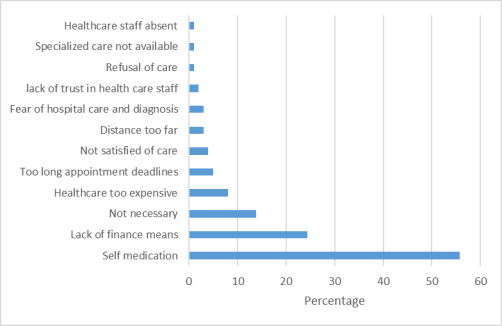
Universal Health Coverage was established to reduce financial barriers to healthcare. Nevertheless, inequalities in access—including cases of forgoing care—persist. This study analyzes the determinants of healthcare utilization in Côte d'Ivoire using data from the 2021 Harmonized Survey on Household Living Conditions. This study aims to analyse healthcare utilization in Côte d'Ivoire in the dual context of Universal health coverage scheme (CMU in Côte d’Ivoire) and the COVID-19 pandemic. The individual was taken as the unit of analysis. The analytical sample comprised 64,491 individuals drawn from 12,965 households. Analyses of healthcare utilization were restricted to the 17,220 individuals who reported a health problem in the preceding 30 days. Both the type of care sought and instances of forgone care were recorded. Logistic regression was used to assess associations between sociodemographic, socioeconomic and health-related characteristics and healthcare utilization. Among respondents, 11,017 (64.0%) had sought medical care, whereas 6,203 (36.0%) had renounced despite reporting a health problem. Self-medication was the principal reason for forgoing care. Healthcare utilization was positively associated with younger age (AOR = 2.50; 95% CI [2.03-3.08]), the presence of a chronic condition (AOR = 2.14; 95% CI [1.88-2.45]) and health insurance enrolment, particularly under the UHC scheme (AOR = 2.93; 95% CI [1.86-4.61]). Conversely, primary school education (AOR = 0.83; 95% CI [0.76-0.90]) and living in a household size with one person (AOR = 0.78; 95% CI [0.63-0.96]) were associated with lower odds of seeking care. Neither self-reported COVID-19 infection nor area of residence (rural versus urban) was significantly associated with healthcare utilization. Inequalities in access to care persist despite the introduction of CMU. Strengthening universal access will require both a broader benefit package for people living with chronic conditions and sustained action on health literacy.
| Published in | International Journal of Health Economics and Policy (Volume 11, Issue 3) |
| DOI | 10.11648/j.hep.20261103.12 |
| Page(s) | 148-158 |
| Creative Commons |
This is an Open Access article, distributed under the terms of the Creative Commons Attribution 4.0 International License (http://creativecommons.org/licenses/by/4.0/), which permits unrestricted use, distribution and reproduction in any medium or format, provided the original work is properly cited. |
| Copyright |
Copyright © The Author(s), 2026. Published by Science Publishing Group |
Access to Healthcare, Healthcare Utilization, Universal Health Coverage, COVID-19 Self Reported Infection, Ivory Coast
Variables | Category | Number | Percentage (%) |
|---|---|---|---|
Sex | Male | 31,661 | 49.1 |
Female | 32,830 | 50.9 | |
Sex ratio (M/F) | 1.0 | ||
Age (year) | 0 - 4 | 8241 | 12.8 |
5 - 14 | 19,968 | 31.0 | |
15 - 24 | 10,385 | 16.1 | |
25 - 34 | 7774 | 12.1 | |
35 - 44 | 7503 | 11.6 | |
45 - 54 | 4985 | 7.7 | |
55 - 64 | 3168 | 4.9 | |
65 and over | 2467 | 3.8 | |
Average age (standard deviation) | 23.86 (±19.28) | ||
Median (Min - Max) | 18 (0 - 122) | ||
Marital status (n=45 567) | Married/ Consensual union | 7758 | 17.0 |
Widowed/ Divorced | 1140 | 2.5 | |
Single | 36,669 | 80.5 | |
Schooling level (n=43 936) | None | 21,146 | 48.1 |
Primary | 14,408 | 32.8 | |
Secondary | 6376 | 14.5 | |
Superior level | 2006 | 4.6 | |
No formal schooling (n=373) | Yes | 1 | 0.3 |
No | 372 | 99.7 | |
Spending quintile | Q1 | 12,902 | 20 |
Q2 | 12,905 | 20 | |
Q3 | 12,893 | 20 | |
Q4 | 12,897 | 20 | |
Q5 | 12,894 | 20 | |
Aera of residence | Rural | 39,318 | 61.0 |
Urban | 25,173 | 39.0 | |
Household size | 1 | 1294 | 2.0 |
2 - 3 | 7416 | 11.5 | |
4 - 5 | 18,311 | 28.4 | |
6 - 7 | 16,728 | 25.9 | |
7 and over | 20,742 | 32.2 | |
Average (standard deviation) | 4.97 (±2.83) | ||
Median (Min - Max) | 5 (1 - 28) |
Variables | Category | Number | Percentage (%) |
|---|---|---|---|
Morbidity reported | Yes | 17,220 | 26.7 |
No | 47,271 | 73.3 | |
Chronic disease (n=17,220) | Yes | 1875 | 10.9 |
No | 15,345 | 89.1 | |
Distance to the primary healthcare facility (km) (n=11,017) | Less than 5 | 8462 | 76.8 |
[5 - 10] | 1247 | 11.3 | |
10 and over | 1308 | 11.9 | |
Health insurance affiliation | CMU | 687 | 1.1 |
MUGEFCI | 797 | 1.2 | |
Private insurance | 764 | 1.2 | |
None | 62,243 | 96.5 | |
Individuals benefited from special assistance | Yes | 993 | 1.5 |
No | 63,498 | 98.5 | |
COVID-19 self-reported | Only COVID-19 | 2412 | 3.7 |
COVID and other illness | 644 | 1.0 | |
Other illness | 687 | 1.1 | |
No | 60,748 | 94.2 |
Types of healthcare utilization | Number | Percentage (%) |
|---|---|---|
Renouncement to care | 6203 | 36.0 |
Healthcare utilization | 11,017 | 64.0 |
Type of health care | ||
Formal health care | 10,723 | 97.3 |
Traditional medicine | 294 | 2.7 |
Place of first consultation | ||
University teaching hospital | 94 | 0.9 |
Regional hospital | 243 | 2.2 |
General hospital | 2199 | 20.0 |
Urban health center | 1761 | 16.0 |
Rural health center/ dispensary | 3762 | 34.1 |
Other center | 92 | 0.8 |
Private hospitals/clinics | 1381 | 12.5 |
Medical/dental practice | 21 | 0.2 |
Nursing/care practice | 76 | 0.7 |
Pharmacy | 692 | 6.3 |
Company clinic / NGO | 271 | 2.5 |
Traditional medicine | 294 | 2.7 |
Home visit | 131 | 1.2 |
Hospitalization (12 last month) | ||
Yes | 663 | 3.9 |
No | 16,557 | 96.1 |
Variables | Category | Number | Utilization (%) | Renouncement (%) | p |
|---|---|---|---|---|---|
Sexe | Male | 8184 | 63.8 | 36.2 | 0.618 |
Female | 9036 | 64.2 | 35.8 | ||
Age (year) | 0-4 | 2955 | 77.0 | 23.0 | <0.001 |
5-14 | 4070 | 62.0 | 38.0 | ||
15-24 | 1833 | 54.8 | 45.2 | ||
25-34 | 1968 | 61.4 | 38.6 | ||
35-44 | 2237 | 63.0 | 37.0 | ||
45-54 | 1696 | 61.6 | 38.4 | ||
55-64 | 1266 | 64.1 | 35.9 | ||
65 and over | 1195 | 61.7 | 38.3 | ||
Marital status | Single | 14,711 | 63.4 | 36.6 | <0.001 |
Married or Consensual union | 2165 | 66.9 | 33.1 | ||
Widowed/ Divorced | 344 | 68.3 | 31.7 | ||
Schooling level (n=11 996) | None | 7280 | 65.2 | 34.8 | <0.001 |
Primary | 3480 | 58.2 | 41.8 | ||
Secondary | 800 | 63.6 | 36.4 | ||
Superior level | 436 | 62.4 | 37.6 | ||
Spending quintile | Q1 | 2514 | 51.3 | 48.7 | <0.001 |
Q2 | 3272 | 59.1 | 40.9 | ||
Q3 | 3272 | 61.1 | 38.9 | ||
Q4 | 3961 | 64.1 | 35.9 | ||
Q5 | 4201 | 66.5 | 33.5 | ||
Household size | 1 | 524 | 55.2 | 44.8 | <0.001 |
2-3 | 2545 | 62.6 | 37.4 | ||
4-5 | 5340 | 64.8 | 35.2 | ||
6-7 | 4231 | 66.1 | 33.9 | ||
7 and over | 4580 | 62.9 | 37.1 | ||
Chronic disease | Yes | 1875 | 76.7 | 23.3 | <0.001 |
No | 15,345 | 62.4 | 37.6 | ||
Distance ESPC* (n=11 017) | Less than 5 | 8462 | 100 | 0.0 | NA |
[5 - 10] | 1247 | 100 | 0.0 | ||
10 and over | 1308 | 100 | 0.0 | ||
Health insurance affiliation | CMU | 268 | 72,8 | 27,2 | <0.001 |
MUGEFCI | 237 | 82,3 | 17,7 | ||
Private insurance | 256 | 80,5 | 19,5 | ||
None | 16 459 | 63,3 | 36,7 | ||
Individuals benefited from special assistance | Yes | 354 | 81,9 | 18,1 | <0.001 |
No | 16 866 | 63,6 | 36,4 | ||
Area of residence | Rural | 10 532 | 63,9 | 36,1 | 0.692 |
Urban | 6 688 | 64.2 | 35.8 | ||
COVID 19 self reported | Only COVID-19 | 2412 | 63.2 | 36.8 | 0.301 |
COVID and other illness | 644 | 62.6 | 37.4 | ||
Other illness | 687 | 49.3 | 50.7 | ||
No | 13,183 | 63.4 | 36.6 |
Variables | Category | Adjusted OR | 95% CI | p |
|---|---|---|---|---|
Age (Ref: 65 and over) | 0-4 | 2.497 | [2.027 - 3.076] | <0.001 |
5-14 | 1.088 | [0.919 - 1.287] | 0.328 | |
15-24 | 0.892 | [0.749 - 1.062] | 0.199 | |
25-34 | 1.155 | [0.973 - 1.370] | 0.099 | |
35-44 | 1.141 | [0.967 - 1.346] | 0.118 | |
45-54 | 1.100 | [0.927 - 1.305] | 0.275 | |
55-64 | 1.144 | [0.956 - 1.369] | 0.141 | |
Marital status (Ref: Single) | Married or Consensual union | 1.227 | [1.084 - 1.387] | 0.001 |
Widowed/ Divorced | 1.120 | [0.849 - 1.477] | 0.422 | |
Schooling level (Ref: none) | Primary | 0.826 | [0.757 - 0.902] | <0.001 |
Secondary | 0.991 | [0.846 - 1.161] | 0.910 | |
Superior level | 0.953 | [0.766 - 1.187] | 0.670 | |
Household size (Ref: 7 and over) | 1 | 0.777 | [0.632 - 0.955] | 0.016 |
2-3 | 1.040 | [0.921 - 1.174] | 0.529 | |
4-5 | 1.016 | [0.917 - 1.125] | 0.760 | |
6-7 | 1.043 | [0.936 - 1.162] | 0.446 | |
Chronic disease (Ref: No) | Yes | 2.142 | [1.876 - 2.445] | <0.001 |
Health insurance affiliation (Ref: none) | CMU | 2.926 | [1.858 - 4.609] | <0.001 |
MUGEFCI | 1.557 | [1.164 - 2.082] | 0.003 | |
Private insurance | 1.923 | [1.431 - 2.583] | <0.001 | |
Individuals benefited from special assistance (Ref: No) | Yes | 1.824 | [1.338 - 2.486] | <0.001 |
AOR | Adjusted Odd Ratio |
CMU | Couverture Maladie Universelle |
| [1] |
World Health Organization. “The world health report: health systems financing: the path to universal coverage”. Available from.
https://iris.who.int/handle/10665/44372 [Accessed on 10 October 2025]. |
| [2] | Schokkaert, E., Steel, J., Van de Voorde, C. Out-of-Pocket Payments and Subjective Unmet Need of Healthcare. Appl Health Econ Health Policy. 2017; 15(5); 545-555. |
| [3] | Aday, L. A., Andersen, R. A framework for the study of access to medical care. Health Services Research. 1974, 9(3), 208‑220. |
| [4] | Fuchs, V. R., Eggleston, K. N. Who shall live? Health economics and social choice. 3rd Edition. Singapour: Word Scientific. 2023, pp. 3-27. |
| [5] |
Baggio, S., Vernaz, N., Spechbach, H., Salamun,. J, Jacquerioz, F., Stringhini,. S et al. Vulnerable patients forgo health care during the first wave of the COVID-19 pandemic. Prev Med. 2021, 150, 106696.
https://doi.org/10.1016/j.ypmed.2021.106696 Epub 2021 Jun 23 |
| [6] | Attia Konan, A. R., Oga, A. S. S., Touré, A., Kouadio, L. Determinants of utilization of modern health facilities in Côte d’Ivoire: evidence from a national household survey. African Journal of Health Economics. 2018; 7(1), 1 - 15. |
| [7] | Sackou-Kouakou, J. G., Kouamé, J., Tiadé, M. L., Desquith, A. A., Dagnogo, A., Hounsa- Alla, A. et al. Renoncement aux soins pour raisons financières des femmes d’un quartier périurbain d’Abidjan en Côte d’Ivoire. Santé Publique. 2021, 33(2): 285-293. |
| [8] | Atake, E. Socio‐economic inequality in maternal health care utilization in Sub‐Saharan Africa : Evidence from Togo. The International Journal of Health Planning and Management. 2021, 36(2), 288‑301. |
| [9] | Yap, A., Olatunji, B. T., Negash, S., Mweru, D., Kisembo, S., Masumbuko, F. et al. Out-of-pocket costs and catastrophic healthcare expenditure for families of children requiring surgery in sub-Saharan Africa. Surgery. 2023, 174(3), 567-573. |
| [10] |
Banda, P., Masiye, F., Kaonga, O., Bump, J., Berman, P. Determining household out of pocket payments, incidence of catastrophic expenditures and impoverishment among patients with malaria in Zambia's path towards Universal Health Coverage. PLoS One. 2024; 19(12): e0312906.
https://doi.org/10.1371/journal.pone.0312906.eCollection2024 |
| [11] | Koffi, K., Attia Konan, A. R., Kouame, J., Sangare, A. D., Oga, S. S., Kouadio, L. Factors Associated with Catastrophic Health Expenditure Among Households in Côte d'Ivoire. International Journal of Health Economics and Policy. 2026, 11(1): 40-48. |
| [12] | Kouamé, J., Attia-Konan, A. R., Koffi, K., Tiade, M. L., Aka, D., Kouakou, M. et al. Forgoing Healthcare Services: Evidence from a Household Survey in Abidjan (Côte d’Ivoire). International Journal of Health Economics and Policy. 2026, 11(2): 49-59. |
| [13] |
Ministère de la santé. "Loi-N°2014-13-dinstituant-la-Couverture-Maladie-Universelle. pdf. (s. d.)." Avalaible from:
https://ipscnam.ci/wp-content/uploads/2023/09/Loi-N%C2%B02014-131-dinstituant-la-Couverture-Maladie-Universelle.pdf?utm_source=chatgpt.com [Accessed on 28 August 2025]. |
| [14] | Koffi, K., Attia Konan, A. R., Kouame, J., Sangare, A. D., Tiade, M. L., Oga, S. S., Kouadio, L. Déterminants de la couverture en assurance maladie des ménages en Côte d’Ivoire. Cahier Santé Publique. 2023, 22(1): 54 - 69. |
| [15] | Eze, P., Lawani, L. O., Agu, U. J., Amara, L. U., Okorie, C. A., Acharya, Y. Factors associated with catastrophic health expenditure in sub-Saharan Africa : A systematic review. PLOS ONE. 2022; 17(10), e0276266. |
| [16] | Contoli, B., Marotta, D., Pettinicchio, V., Asta, F., Possenti, V., Minardi, V. et al. Healthcare renunciation among Italian older adults during the COVID-19 pandemic: insights from the PASSI d'Argento surveillance system. Eur J Public Health. 2025, 35(6): 1307 - 1313. |
| [17] |
World Health Organization. "Essential health services face continued disruption during COVID-19 pandemic" Available from
https://www.who.int/news/item/07-02-2022-essential-health-services-face-continued-disruption-during-covid-19-pandemic [Accessed on 10 October 2025]. |
| [18] | Kruk, M. E., Myers, M., Varpilah, S. T., Dahn, BT. What is a resilient health system? Lessons from Ebola. Lancet (London, England). 2015; 385(9980): 1910‑1912. |
| [19] |
Agence National de la statistique (ANSTAT). "Profil de Pauvreté de la Côte d’Ivoire 2021". Available from:
https://www.anstat.ci/assets/projet/ehcvm2021.pdf [Accessed on 10 October 2025]. |
| [20] | Dieng, M., Audibert, M., Le Hersan, J. Y., Dial, A. T. Déterminants de la demande de soins en milieu péri-urbain dans un contexte de subvention à Pikine, Sénégal. Etudes et documents n°15. 2014. France: CERDI. 26p. |
| [21] |
Direction de l'Information sanitaire (DIS). "Rapport annuel sur la situation sanitaire (RASS) 2019" Available from:
https://www.snisdiis.com/wp-content/uploads/2022/03/Rapport-Annuel-sur-la-Situation-Sanitaire-RASS-2019-VF.pdf [Accessed on 1st August 2026] |
| [22] |
Direction de l'Information sanitaire (DIS). "Rapport annuel sur la situation sanitaire (RASS) 2020" Available from:
https://dap.ci/wp-content/uploads/2021/10/RASS-2020-VF-3.pdf [Accessed on 1st August 2026] |
| [23] | Kruk, M. E., Gage, A. D., Arsenault, C., Jordan, K., Leslie, H. H., Roder-DeWan, S. et al. High-quality health systems in the Sustainable Development Goals era : Time for a revolution. The Lancet. Global Health. 2018, 6(11), e1196‑e1252. |
| [24] | Attia Konan, A. R., Kouakou Sackou, J. G., Kouamé, J. Hounsa Alla, A., Oga, A. S. S. Renouncement to medical follow-up by people living with type 2 diabetes in côte d’ivoire, 2018. Cahier santé publique. 2019, 18(1), 47-58. |
| [25] | Dupas, P., Fafchamps, M., Lestant, E. Panel data evidence on the effects of the COVID-19 pandemic on livelihoods in urban Côte d’Ivoire. PLOS ONE. 2023, 18(2), e0277559. |
APA Style
Regine, A. A., Kouame, K., Jerome, K., Dramane, S. A., Marie-Laure, T., et al. (2026). Healthcare Utilization in the Context of the Implementation of Universal Health Coverage and COVID 19: Evidence from the Household Living Standards Survey, Côte d’Ivoire. International Journal of Health Economics and Policy, 11(3), 148-158. https://doi.org/10.11648/j.hep.20261103.12
ACS Style
Regine, A. A.; Kouame, K.; Jerome, K.; Dramane, S. A.; Marie-Laure, T., et al. Healthcare Utilization in the Context of the Implementation of Universal Health Coverage and COVID 19: Evidence from the Household Living Standards Survey, Côte d’Ivoire. Int. J. Health Econ. Policy 2026, 11(3), 148-158. doi: 10.11648/j.hep.20261103.12
AMA Style
Regine AA, Kouame K, Jerome K, Dramane SA, Marie-Laure T, et al. Healthcare Utilization in the Context of the Implementation of Universal Health Coverage and COVID 19: Evidence from the Household Living Standards Survey, Côte d’Ivoire. Int J Health Econ Policy. 2026;11(3):148-158. doi: 10.11648/j.hep.20261103.12
@article{10.11648/j.hep.20261103.12,
  author = {Attia-Konan Akissi Regine and Koffi Kouame and Kouame Jerome and Sangare Abou Dramane and Tiade Marie-Laure and Oga Agbaya Serge Stephane and Kouadio Luc},
  title = {Healthcare Utilization in the Context of the Implementation of Universal Health Coverage and COVID 19: Evidence from the Household Living Standards Survey, Côte d’Ivoire},
  journal = {International Journal of Health Economics and Policy},
  volume = {11},
  number = {3},
  pages = {148-158},
  doi = {10.11648/j.hep.20261103.12},
  url = {https://doi.org/10.11648/j.hep.20261103.12},
  eprint = {https://article.sciencepublishinggroup.com/pdf/10.11648.j.hep.20261103.12},
  abstract = {Universal Health Coverage was established to reduce financial barriers to healthcare. Nevertheless, inequalities in access—including cases of forgoing care—persist. This study analyzes the determinants of healthcare utilization in Côte d'Ivoire using data from the 2021 Harmonized Survey on Household Living Conditions. This study aims to analyse healthcare utilization in Côte d'Ivoire in the dual context of Universal health coverage scheme (CMU in Côte d’Ivoire) and the COVID-19 pandemic. The individual was taken as the unit of analysis. The analytical sample comprised 64,491 individuals drawn from 12,965 households. Analyses of healthcare utilization were restricted to the 17,220 individuals who reported a health problem in the preceding 30 days. Both the type of care sought and instances of forgone care were recorded. Logistic regression was used to assess associations between sociodemographic, socioeconomic and health-related characteristics and healthcare utilization. Among respondents, 11,017 (64.0%) had sought medical care, whereas 6,203 (36.0%) had renounced despite reporting a health problem. Self-medication was the principal reason for forgoing care. Healthcare utilization was positively associated with younger age (AOR = 2.50; 95% CI [2.03-3.08]), the presence of a chronic condition (AOR = 2.14; 95% CI [1.88-2.45]) and health insurance enrolment, particularly under the UHC scheme (AOR = 2.93; 95% CI [1.86-4.61]). Conversely, primary school education (AOR = 0.83; 95% CI [0.76-0.90]) and living in a household size with one person (AOR = 0.78; 95% CI [0.63-0.96]) were associated with lower odds of seeking care. Neither self-reported COVID-19 infection nor area of residence (rural versus urban) was significantly associated with healthcare utilization. Inequalities in access to care persist despite the introduction of CMU. Strengthening universal access will require both a broader benefit package for people living with chronic conditions and sustained action on health literacy.},
 year = {2026}
}
TY  - JOUR
T1  - Healthcare Utilization in the Context of the Implementation of Universal Health Coverage and COVID 19: Evidence from the Household Living Standards Survey, Côte d’Ivoire
AU  - Attia-Konan Akissi Regine
AU  - Koffi Kouame
AU  - Kouame Jerome
AU  - Sangare Abou Dramane
AU  - Tiade Marie-Laure
AU  - Oga Agbaya Serge Stephane
AU  - Kouadio Luc
Y1  - 2026/09/24
PY  - 2026
N1  - https://doi.org/10.11648/j.hep.20261103.12
DO  - 10.11648/j.hep.20261103.12
T2  - International Journal of Health Economics and Policy
JF  - International Journal of Health Economics and Policy
JO  - International Journal of Health Economics and Policy
SP  - 148
EP  - 158
PB  - Science Publishing Group
SN  - 2578-9309
UR  - https://doi.org/10.11648/j.hep.20261103.12
AB  - Universal Health Coverage was established to reduce financial barriers to healthcare. Nevertheless, inequalities in access—including cases of forgoing care—persist. This study analyzes the determinants of healthcare utilization in Côte d'Ivoire using data from the 2021 Harmonized Survey on Household Living Conditions. This study aims to analyse healthcare utilization in Côte d'Ivoire in the dual context of Universal health coverage scheme (CMU in Côte d’Ivoire) and the COVID-19 pandemic. The individual was taken as the unit of analysis. The analytical sample comprised 64,491 individuals drawn from 12,965 households. Analyses of healthcare utilization were restricted to the 17,220 individuals who reported a health problem in the preceding 30 days. Both the type of care sought and instances of forgone care were recorded. Logistic regression was used to assess associations between sociodemographic, socioeconomic and health-related characteristics and healthcare utilization. Among respondents, 11,017 (64.0%) had sought medical care, whereas 6,203 (36.0%) had renounced despite reporting a health problem. Self-medication was the principal reason for forgoing care. Healthcare utilization was positively associated with younger age (AOR = 2.50; 95% CI [2.03-3.08]), the presence of a chronic condition (AOR = 2.14; 95% CI [1.88-2.45]) and health insurance enrolment, particularly under the UHC scheme (AOR = 2.93; 95% CI [1.86-4.61]). Conversely, primary school education (AOR = 0.83; 95% CI [0.76-0.90]) and living in a household size with one person (AOR = 0.78; 95% CI [0.63-0.96]) were associated with lower odds of seeking care. Neither self-reported COVID-19 infection nor area of residence (rural versus urban) was significantly associated with healthcare utilization. Inequalities in access to care persist despite the introduction of CMU. Strengthening universal access will require both a broader benefit package for people living with chronic conditions and sustained action on health literacy.
VL  - 11
IS  - 3
ER  -
Department of Analytical Sciences and Public Health, University of Felix Houphouet Boigny, Abidjan, Cote d’Ivoire;Research and Study Center on Population and Health Systems, National Institute of Public Health, Abidjan, Cote d’Ivoire
Department of Analytical Sciences and Public Health, University of Felix Houphouet Boigny, Abidjan, Cote d’Ivoire
Department of Analytical Sciences and Public Health, University of Felix Houphouet Boigny, Abidjan, Cote d’Ivoire;Research and Study Center on Population and Health Systems, National Institute of Public Health, Abidjan, Cote d’Ivoire
Department of Public Health, University of Felix Houphouet Boigny, Abidjan, Cote d’Ivoire
Department of Analytical Sciences and Public Health, University of Felix Houphouet Boigny, Abidjan, Cote d’Ivoire
Department of Analytical Sciences and Public Health, University of Felix Houphouet Boigny, Abidjan, Cote d’Ivoire

Information


 Share This Article
 Twitter
 Linked In
 Facebook
 Copy
Copy Download