
Major source of drinking water in the Patna region is ground water. This study focuses on assessing the impact of Municipal solid waste on ground water quality near around dumping site area in the Ramchak-Bairiya, Patna, Bihar, India. Dumping sites are in a risk zone of spilling of leachate through adjacent soil which leads to contaminated ground water. Surrounding area of dumping site can be a serious threat to the human health and environment. Huge quantity of municipal solid waste (MSW) dumps containing hazardous materials are a serious threat to the surrounding population of Patna. When these MSW are dumped at site, ground water began contaminating due to percolation of leachate to the porous ground surface. This leachate contains large number of contaminants which can pollute ground water. Ground water samples of different location adjacent to dumping sites were analyzed for microbiological, biochemical characterization, most probable number estimation and antibiotic sensitivity testing of isolated bacteria. The result of MPN test reveals heavy bacterial load in several sampling site which clearly indicates bacterial contamination inside source ground water. Presence of coliform confirms leachate infiltration into the ground water. Antibiotic susceptibility testing demonstrates a pattern of resistance against selective antibiotics. This may suggest the evolve of multidrug resistance (MDR) bacteria in contaminated ground water. Present investigation concludes that leachate of MSW from the Ramchak-Bairiya MSW dumping site severely contaminate the adjacent ground water quality, leading to serious Public health and environmental risks.
| Published in | Frontiers in Environmental Microbiology (Volume 12, Issue 2) |
| DOI | 10.11648/j.fem.20261202.11 |
| Page(s) | 16-22 |
| Creative Commons |
This is an Open Access article, distributed under the terms of the Creative Commons Attribution 4.0 International License (http://creativecommons.org/licenses/by/4.0/), which permits unrestricted use, distribution and reproduction in any medium or format, provided the original work is properly cited. |
| Copyright |
Copyright © The Author(s), 2026. Published by Science Publishing Group |
Municipal Solid Waste, Leachate, Ground Water, Coliform, Multi Drug Resistance, Most Probable Number, Bacteriological
S. No. | Abbreviation | Antibiotics | Concentration in mcg |
|---|---|---|---|
1 | A/S | Ampicillin/Sulbactam | 10/10 |
2 | C | Chloramphenicol | 30 |
3 | CIP | Ciprofloxacin | 5 |
4 | E | Erythromycin | 15 |
5 | GEN | Gentamicin | 10 |
6 | LF | Levofloxacin | 5 |
7 | OF | Ofloxacin | 5 |
8 | TE | Tetracycline | 30 |
S. No. | Sample | MPN Index | Total Coliform |
|---|---|---|---|
1 | BI01 | 1-3-1 | 10 |
2 | BI02 | 4-0-3 | 25 |
3 | BI03 | 5-0-1 | 31 |
4 | BI04 | 4-1-1 | 21 |
5 | BI05 | 3-2-0 | 14 |
6 | BI06 | 4-2-3 | 38 |
7 | BI07 | 4-3-1 | 33 |
8 | BI08 | 4-5-1 | 48 |
9 | BI09 | 3-5-0 | 25 |
10 | BI10 | 4-2-2 | 32 |
11 | BI11 | 3-2-0 | 14 |
12 | BI12 | 3-5-0 | 25 |
13 | BI13 | 5-4-0 | 130 |
14 | BI14 | 5-4-2 | 220 |
15 | BI15 | 5-2-4 | 150 |
16 | BI16 | 3-5-0 | 25 |
17 | BI17 | 3-2-0 | 14 |
18 | BI18 | 5-0-3 | 58 |
19 | BI19 | 5-4-3 | 280 |
20 | BI20 | 5-3-4 | 210 |
21 | BI21 | 3-3-2 | 24 |
22 | BI22 | 5-2-0 | 49 |
23 | BI23 | 4-0-2 | 21 |
24 | BI24 | 5-0-1 | 31 |
25 | BI25 | 4-5-1 | 48 |
S. No. | Sample | Indole | MR | VP | Citrate | Oxidase | Urease | Catalase | Probable Bacteria |
|---|---|---|---|---|---|---|---|---|---|
1 | SWA1 | +ve | +ve | +ve | +ve | +ve | +ve | +ve | Aeromonas spp. |
2 | SWA2 | +ve | -ve | +ve | +ve | +ve | +ve | +ve | Aeromonas spp. |
3 | SWA3 | +ve | -ve | +ve | +ve | -ve | +ve | +ve | Klebsiella oxytoca |
4 | SWA4 | +ve | -ve | +ve | +ve | -ve | +ve | +ve | Klebsiella oxytoca |
5 | SWA5 | +ve | -ve | +ve | +ve | -ve | +ve | +ve | Klebsiella oxytoca |
6 | SWA6 | +ve | -ve | +ve | +ve | -ve | +ve | +ve | Klebsiella oxytoca |
7 | SWA7 | +ve | -ve | +ve | +ve | -ve | +ve | +ve | Klebsiella oxytoca |
8 | SWA8 | +ve | -ve | +ve | +ve | -ve | +ve | +ve | Klebsiella oxytoca |
9 | SWA9 | +ve | +ve | -ve | -ve | +ve | +ve | +ve | Aeromonas spp. |
10 | SWA10 | +ve | +ve | -ve | +ve | -ve | Delay | +ve | Citrobacter koseri |
11 | SWA11 | +ve | +ve | -ve | -ve | -ve | +ve | +ve | Escherichia coli |
12 | SWA12 | +ve | +ve | -ve | +ve | -ve | Delay | +ve | Citrobacter koseri |
13 | SWA13 | +ve | +ve | -ve | -ve | -ve | +ve | +ve | Escherichia coli |
14 | SWA14 | +ve | -ve | +ve | +ve | -ve | +ve | +ve | Klebsiella oxytoca |
15 | SWA15 | +ve | +ve | -ve | +ve | -ve | +ve | +ve | Proteus spp. |
16 | SWA16 | +ve | +ve | +ve | -ve | -ve | -ve | +ve | Escherichia coli |
17 | SWA17 | +ve | +ve | +ve | -ve | -ve | -ve | +ve | Escherichia coli |
18 | SWA18 | +ve | +ve | -ve | -ve | -ve | +ve | +ve | Escherichia coli |
19 | SWA19 | +ve | +ve | -ve | -ve | -ve | +ve | +ve | Escherichia coli |
20 | SWA20 | +ve | +ve | -ve | -ve | -ve | +ve | +ve | Escherichia coli |
21 | SWA21 | +ve | -ve | +ve | +ve | -ve | +ve | +ve | Klebsiella oxytoca |
22 | SWA22 | +ve | +ve | -ve | -ve | -ve | +ve | +ve | Escherichia coli |
23 | SWA23 | +ve | +ve | -ve | +ve | +ve | +ve | +ve | Aeromonas spp. |
24 | SWA24 | +ve | +ve | -ve | -ve | -ve | +ve | +ve | Escherichia coli |
25 | SWA25 | +ve | +ve | -ve | -ve | +ve | Delay | +ve | Aeromonas spp. |
26 | SWA26 | +ve | +ve | -ve | +ve | +ve | +ve | +ve | Aeromonas spp. |
27 | SWA27 | +ve | -ve | +ve | +ve | -ve | +ve | +ve | Klebsiella oxytoca |
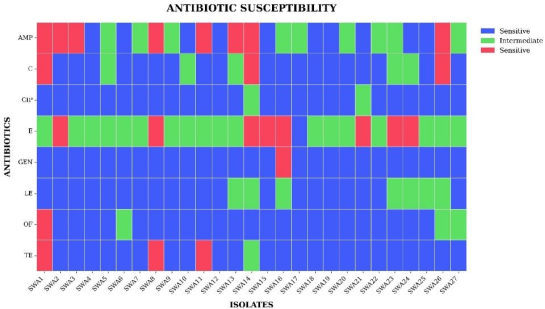
S. No. | Sample | AMP | C | CIP | E | GEN | LE | OF | TE |
|---|---|---|---|---|---|---|---|---|---|
1 | SWA1 | 12 | 12 | 30 | 20 | 30 | 22 | 11 | 6 |
2 | SWA2 | 12 | 28 | 34 | 13 | 35 | 26 | 22 | 22 |
3 | SWA3 | 2 | 24 | 40 | 22 | 42 | 28 | 25 | 24 |
4 | SWA4 | 17 | 18 | 34 | 22 | 25 | 24 | 22 | 17 |
5 | SWA5 | 16 | 17 | 35 | 18 | 36 | 24 | 24 | 24 |
6 | SWA6 | 17 | 25 | 30 | 22 | 30 | 23 | 15 | 17 |
7 | SWA7 | 15 | 22 | 33 | 16 | 40 | 26 | 22 | 17 |
8 | SWA8 | 6 | 18 | 31 | 8 | 45 | 22 | 22 | 6 |
9 | SWA9 | 16 | 22 | 34 | 16 | 30 | 25 | 22 | 22 |
10 | SWA10 | 17 | 15 | 30 | 14 | 35 | 22 | 19 | 22 |
11 | SWA11 | 6 | 20 | 35 | 15 | 32 | 23 | 17 | 6 |
12 | SWA12 | 18 | 32 | 37 | 17 | 31 | 25 | 22 | 24 |
13 | SWA13 | 6 | 16 | 33 | 18 | 30 | 20 | 19 | 21 |
14 | SWA14 | 6 | 12 | 25 | 13 | 30 | 17 | 18 | 13 |
15 | SWA15 | 20 | 20 | 32 | 13 | 20 | 24 | 21 | 24 |
16 | SWA16 | 16 | 27 | 35 | 10 | 6 | 20 | 16 | 20 |
17 | SWA17 | 16 | 22 | 32 | 27 | 40 | 22 | 22 | 24 |
18 | SWA18 | 20 | 20 | 30 | 17 | 40 | 22 | 22 | 22 |
19 | SWA19 | 17 | 24 | 32 | 21 | 40 | 24 | 22 | 22 |
20 | SWA20 | 15 | 28 | 28 | 17 | 35 | 24 | 22 | 24 |
21 | SWA21 | 17 | 22 | 25 | 12 | 42 | 21 | 17 | 19 |
22 | SWA22 | 16 | 20 | 30 | 20 | 31 | 22 | 18 | 20 |
23 | SWA23 | 16 | 16 | 28 | 12 | 34 | 20 | 17 | 22 |
24 | SWA24 | 19 | 16 | 30 | 11 | 31 | 20 | 18 | 15 |
25 | SWA25 | 17 | 28 | 30 | 20 | 34 | 20 | 16 | 22 |
26 | SWA26 | 6 | 6 | 26 | 15 | 36 | 20 | 15 | 30 |
27 | SWA27 | 15 | 29 | 34 | 16 | 37 | 23 | 15 | 32 |
MSW | Municipal Solid Waste |
MDR | Multidrug Resistance |
MPN | Most Probable Number |
Mcg | Microgram |
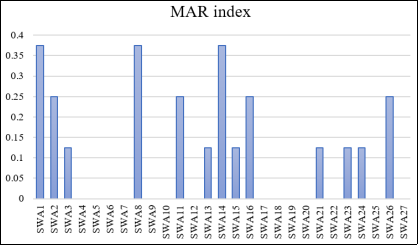
MAR | Multiple Antibiotic Resistance |
| [1] | Singh, V., & Mittal, A. K. (2011). Groundwater pollution by municipal solid waste landfill leachate: A case study of Okhla Landfill, Delhi. Proceedings of the IWRA World Water Congress, Pernambuco, Brazil. |
| [2] | Pandey, R. K., Tiwari, R. P., & Kirloskar, S. G. (2013). Impact of municipal solid waste on subsurface water quality near the landfill site. International Journal of Engineering Research and Technology (IJERT), 2(11), 3767–3772. |
| [3] | Ikem A., Osibanjo O., Sridhar, MKC. and Sobande, A. (2002), Evaluation of groundwater quality characteristics near two waste sites in Ibadan and Logas, Nigeria, Journal of Water, Air and Soil Pollution 140, pp 307-333. |
| [4] | Okecha, S. A. (2000). Pollution and Conservation of Nigeria's Environment. T Afrique International Associates, Owerri, Nigeria. |
| [5] | Mor, S., Ravindra, K., Dahiya, R. P., & Chandra, A. (2006). Leachate characterization and assessment of groundwater pollution near municipal solid waste landfill site. Environmental Monitoring and Assessment, 118(1–3), 435–456. 2. |
| [6] | Kjeldsen, P. et al. (2002) “Present and Long-Term Composition of MSW Landfill Leachate: A Review,” Critical Reviews in Environmental Science and Technology, 32(4), pp. 297–336. |
| [7] | Tripathi, K. N., Roy, S. and Ansari, M. R., 2024. Assessment of Leaching Pollutants in Subsoil and Ground Water Quality near Municipal Solid Waste Dump Site in Lucknow. International Research Journal of Engineering and Technology (IRJET), 11(12). |
| [8] | Archana, Daoud, A., Mohammad, Y. and Dutta, V. (2014). “Assessment of the Status of Municipal Solid Waste Management (MSWM) in Lucknow – Capital city of Uttar Pradesh, India,” Journal of Environmental Science, Toxicology and Food Technology, 8(5), pp. 41–49. |
| [9] | Saha, D., Dwivedi, S., & Singh, R. K. (2014). Aquifer system response to intensive pumping in urban areas of the Gangetic plains, India: the case study of Patna. Environmental Earth Sciences, 71, 1721-1735. |
| [10] | Singh et al. Physicochemical and Bacteriological Analysis of Drinking Water Samples from Urban Area of Patna District, Bihar, India. Int. J. Life. Sci. Scienti. Res., 2017; 3(5): 1355-1359. |
| [11] | Kanth, M. K., Singh, S. K., Kashyap, A., Gupta, V. K., Shalini, S., Kumari, S., Kumari, R., & Puja, K. (2017). Microbial Study of Drinking Water in the Government Hospitals of Patna District, Bihar, India. American Scientific Research Journal for Engineering, Technology, and Sciences (ASRJETS), 38(2), 161–167. |
| [12] | APHA., Standard methods for the examination of the water and wastewater, 19th edition: American Public Health Association, Washington, 1992. |
| [13] | AD Adoni; G Joshi; K Ghosh; SK Choursia; AK Vaishya; M Yadav., Workbook of Limnology: Pratiba Publication, Sagar, 1985, 216. |
| [14] | Lone, I. U. H., Kumar, A., Khan, F., Saxena, S., & Dar, A. I. (2012). Evaluating the effect of landfill leachate on groundwater quality in relation to physicochemical and bacteriological characteristics. Journal of Chemical and Pharmaceutical Research, 4(12), 5202–5214. |
APA Style
Bharti, S., Singh, S. K., Shreyansh, Anand, A., Mishra, P. (2026). Impact of Municipal Solid Waste Landfill Leachate on Groundwater Quality: A Case Study of Ramchak-Bairiya, Patna, Bihar. Frontiers in Environmental Microbiology, 12(2), 16-22. https://doi.org/10.11648/j.fem.20261202.11
ACS Style
Bharti, S.; Singh, S. K.; Shreyansh; Anand, A.; Mishra, P. Impact of Municipal Solid Waste Landfill Leachate on Groundwater Quality: A Case Study of Ramchak-Bairiya, Patna, Bihar. Front. Environ. Microbiol. 2026, 12(2), 16-22. doi: 10.11648/j.fem.20261202.11
@article{10.11648/j.fem.20261202.11,
  author = {Sweta Bharti and Sushil Kumar Singh and Shreyansh and Aparna Anand and Prem Mishra},
  title = {Impact of Municipal Solid Waste Landfill Leachate on Groundwater Quality: A Case Study of Ramchak-Bairiya, Patna, Bihar},
  journal = {Frontiers in Environmental Microbiology},
  volume = {12},
  number = {2},
  pages = {16-22},
  doi = {10.11648/j.fem.20261202.11},
  url = {https://doi.org/10.11648/j.fem.20261202.11},
  eprint = {https://article.sciencepublishinggroup.com/pdf/10.11648.j.fem.20261202.11},
  abstract = {Major source of drinking water in the Patna region is ground water. This study focuses on assessing the impact of Municipal solid waste on ground water quality near around dumping site area in the Ramchak-Bairiya, Patna, Bihar, India. Dumping sites are in a risk zone of spilling of leachate through adjacent soil which leads to contaminated ground water. Surrounding area of dumping site can be a serious threat to the human health and environment. Huge quantity of municipal solid waste (MSW) dumps containing hazardous materials are a serious threat to the surrounding population of Patna. When these MSW are dumped at site, ground water began contaminating due to percolation of leachate to the porous ground surface. This leachate contains large number of contaminants which can pollute ground water. Ground water samples of different location adjacent to dumping sites were analyzed for microbiological, biochemical characterization, most probable number estimation and antibiotic sensitivity testing of isolated bacteria. The result of MPN test reveals heavy bacterial load in several sampling site which clearly indicates bacterial contamination inside source ground water. Presence of coliform confirms leachate infiltration into the ground water. Antibiotic susceptibility testing demonstrates a pattern of resistance against selective antibiotics. This may suggest the evolve of multidrug resistance (MDR) bacteria in contaminated ground water. Present investigation concludes that leachate of MSW from the Ramchak-Bairiya MSW dumping site severely contaminate the adjacent ground water quality, leading to serious Public health and environmental risks.},
 year = {2026}
}
TY  - JOUR
T1  - Impact of Municipal Solid Waste Landfill Leachate on Groundwater Quality: A Case Study of Ramchak-Bairiya, Patna, Bihar
AU  - Sweta Bharti
AU  - Sushil Kumar Singh
AU  - Shreyansh
AU  - Aparna Anand
AU  - Prem Mishra
Y1  - 2026/07/17
PY  - 2026
N1  - https://doi.org/10.11648/j.fem.20261202.11
DO  - 10.11648/j.fem.20261202.11
T2  - Frontiers in Environmental Microbiology
JF  - Frontiers in Environmental Microbiology
JO  - Frontiers in Environmental Microbiology
SP  - 16
EP  - 22
PB  - Science Publishing Group
SN  - 2469-8067
UR  - https://doi.org/10.11648/j.fem.20261202.11
AB  - Major source of drinking water in the Patna region is ground water. This study focuses on assessing the impact of Municipal solid waste on ground water quality near around dumping site area in the Ramchak-Bairiya, Patna, Bihar, India. Dumping sites are in a risk zone of spilling of leachate through adjacent soil which leads to contaminated ground water. Surrounding area of dumping site can be a serious threat to the human health and environment. Huge quantity of municipal solid waste (MSW) dumps containing hazardous materials are a serious threat to the surrounding population of Patna. When these MSW are dumped at site, ground water began contaminating due to percolation of leachate to the porous ground surface. This leachate contains large number of contaminants which can pollute ground water. Ground water samples of different location adjacent to dumping sites were analyzed for microbiological, biochemical characterization, most probable number estimation and antibiotic sensitivity testing of isolated bacteria. The result of MPN test reveals heavy bacterial load in several sampling site which clearly indicates bacterial contamination inside source ground water. Presence of coliform confirms leachate infiltration into the ground water. Antibiotic susceptibility testing demonstrates a pattern of resistance against selective antibiotics. This may suggest the evolve of multidrug resistance (MDR) bacteria in contaminated ground water. Present investigation concludes that leachate of MSW from the Ramchak-Bairiya MSW dumping site severely contaminate the adjacent ground water quality, leading to serious Public health and environmental risks.
VL  - 12
IS  - 2
ER  -
Department of Botany, Patliputra University, Patna, India
Department of Botany, Anugrah Narayan College, Patna, India
Department of Biotechnology, Anugrah Narayan College, Patna, India
Department of Botany, Patliputra University, Patna, India
Department of Biotechnology, Anugrah Narayan College, Patna, India;Department of Biotechnology, Pondicherry University, Puducherry, India

Information



 Share This Article
 Twitter
 Linked In
 Facebook
 Copy
Copy Download