Abstract
Universities are increasingly expected to produce graduates with the ability to communicate across cultural boundaries, and in a multilingual country such as Nigeria this matters for domestic as well as international interaction. Academic libraries hold multicultural collections, offer access to digital resources and teach students to evaluate information, but the relationship between students’ use of these services and their intercultural communicative competence has rarely been examined, partly because suitable instruments and analytical procedures are lacking. This paper develops a proposed measurement instrument and an analytical framework for examining this relationship among undergraduate students of English and linguistics in Nigerian universities. Drawing on Byram’s model, intergroup contact theory and information literacy theory, it links four forms of library use, namely the frequency of library visits, multicultural collection use, access to digital resources and information literacy instruction, to the five dimensions of intercultural communicative competence, and proposes four testable hypotheses. The proposed instrument measures library utilisation with 20 items that distinguish services that are not offered, unknown or inaccessible from services that are simply unused, and self-reported competence with 35 items, five of them reverse-keyed, none of which refers to finding information or to the library. It is supported by a measure of scenario-based intercultural judgement, a social desirability scale, a marker variable and a library service checklist. The analytical framework specifies a class-based multisite design, sample size requirements determined through power analysis and Monte Carlo simulation, a content validation and piloting procedure, ethical safeguards, and a decision rule for each hypothesis, including model comparison for the library utilisation construct, estimation that allows for clustering in classes, correction for multiple testing and checks for common method variance. In an idealised simulation with independent, normally distributed data, about 480 students gave power of.93 to detect a latent association of.20; approximating class clustering through the effective sample size, rather than simulating it, reduced this to between.59 and.79, and power for the full clustered, covariate-adjusted model has not been established. The proposed instrument is an initial item pool for subsequent validation: expert review, piloting and psychometric testing have not yet been carried out, and no reliability or validity is claimed for it.
|
Published in
|
English Language, Literature & Culture (Volume 11, Issue 4)
|
|
DOI
|
10.11648/j.ellc.20261104.12
|
|
Page(s)
|
84-99 |
|
Creative Commons
|

This is an Open Access article, distributed under the terms of the Creative Commons Attribution 4.0 International License (http://creativecommons.org/licenses/by/4.0/), which permits unrestricted use, distribution and reproduction in any medium or format, provided the original work is properly cited.
|
|
Copyright
|
Copyright © The Author(s), 2026. Published by Science Publishing Group
|
Keywords
Academic Libraries, Intercultural Communicative Competence, Instrument Design, Information Literacy,
Multicultural Collections, Nigeria
1. Introduction
It Is Increasingly Common for Higher Education Institutions to Expect Their Graduates to Have Intercultural Competence in Addition to Knowledge of Their Subject
| [1] | Deardorff, D. K. Identification and assessment of intercultural competence as a student outcome of internationalization. Journal of Studies in International Education. 2006, 10(3), 241-266.
https://doi.org/10.1177/1028315306287002 |
[1]
. In Nigeria This Expectation Has a Particular Domestic Dimension. The Country Has More Than 500 Living Languages and Several Hundred Ethnic Groups
| [2] | Eberhard, D. M., Simons, G. F., Fennig, C. D., editors. Ethnologue: Languages of the World. 26th ed. Dallas, TX: SIL International; 2023. Available from: https://www.ethnologue.com |
| [3] | Adegbija, E. Multilingualism: A Nigerian Case Study. Trenton, NJ: Africa World Press; 2004. |
[2, 3]
, and Its Universities Bring Together Students from Many of Them, Often for the First Time. English Is the Language of Instruction in Higher Education
| [4] | Federal Republic of Nigeria. National Policy on Education. 6th ed. Lagos: Nigerian Educational Research and Development Council; 2013. |
| [5] | Bamgbose, A. Language and Exclusion: The Consequences of Language Policies in Africa. Münster: LIT Verlag; 2000. |
[4, 5]
, and Students of English and Linguistics Are Expected to Become Teachers, Translators, Editors and Communicators Who Will Work Across These Boundaries. Intercultural Communicative Competence (ICC), Defined by Byram
| [6] | Byram, M. Teaching and Assessing Intercultural Communicative Competence. Clevedon: Multilingual Matters; 1997. |
| [7] | Byram, M. Teaching and Assessing Intercultural Communicative Competence: Revisited. 2nd ed. Bristol: Multilingual Matters; 2021. https://doi.org/10.21832/9781800410251 |
[6, 7]
as the Ability to Interact Effectively and Appropriately with People from Other Cultures in a Foreign or Second Language, Is Therefore Relevant to These Programmes.
Academic libraries can make a valuable contribution to this competence. They hold collections representing many cultures, offer electronic access to scholarship and media from around the world, and teach students to locate, compare and evaluate information. The International Federation of Library Associations and Institutions and UNESCO describe the library as a gateway to a culturally diverse society
, and library scholars have argued that the library can be a setting in which people from different backgrounds meet and learn from one another
| [9] | Elmborg, J. K. Libraries as the spaces between us: Recognizing and valuing the third space. Reference & User Services Quarterly. 2011, 50(4), 338-350.
https://doi.org/10.5860/rusq.50n4.338 |
| [10] | Overall, P. M. Cultural competence: A conceptual framework for library and information science professionals. The Library Quarterly. 2009, 79(2), 175-204.
https://doi.org/10.1086/597080 |
[9, 10]
. Whether students’ actual use of library services is related to their ICC has, however, seldom been examined empirically. The authors are not aware of a published study of this question among Nigerian undergraduates, although the literature search that informed this paper was not systematic.
Research on this question faces several methodological risks, which are as much problems of measurement and design as of theory. If a measure of ICC contains items about finding information, its association with library use will be partly artificial. If students are selected because they already use the library, the range of library use will be restricted. If a service is not offered at a university, a student’s failure to use it says nothing about engagement. If prior intercultural experience, curricular exposure and English proficiency are not measured, any association may reflect these factors rather than library use. If students are recruited in classes, their responses are not independent. And if hypotheses and analyses are chosen after the data have been seen, results that happen to be significant may be reported selectively.
This paper responds to these risks by developing an instrument and an analytical framework. It has three aims: first, to set out the theoretical links between particular forms of library use and particular dimensions of ICC, and to derive testable hypotheses from them; second, to present a proposed measurement instrument, an initial item pool for subsequent validation, designed to avoid the problems described above; and third, to specify the design requirements, validation procedure and analytical decision rules needed to test the hypotheses rigorously. The contribution is methodological and theoretical: the instrument, the hypotheses and the analytical framework are offered for use by researchers and libraries, and their empirical validation is identified as the first step in their use.
2. Literature Review
2.1. Intercultural Communicative Competence
Byram’s
| [6] | Byram, M. Teaching and Assessing Intercultural Communicative Competence. Clevedon: Multilingual Matters; 1997. |
| [7] | Byram, M. Teaching and Assessing Intercultural Communicative Competence: Revisited. 2nd ed. Bristol: Multilingual Matters; 2021. https://doi.org/10.21832/9781800410251 |
[6, 7]
model, the most widely used framework in language education, describes ICC through five components, known as savoirs.
Attitudes of curiosity and openness involve a readiness to suspend disbelief about other cultures and belief about one’s own.
Knowledge concerns social groups, their practices and the processes of interaction.
Skills of interpreting and relating involve explaining a document or event from another culture and relating it to one’s own.
Skills of discovery and interaction involve acquiring new knowledge of a culture and using knowledge, attitudes and skills in real-time communication.
Critical cultural awareness is the ability to evaluate, on the basis of explicit criteria, perspectives and practices in one’s own and other cultures. Deardorff
| [1] | Deardorff, D. K. Identification and assessment of intercultural competence as a student outcome of internationalization. Journal of Studies in International Education. 2006, 10(3), 241-266.
https://doi.org/10.1177/1028315306287002 |
[1]
found broad agreement among intercultural scholars on a similar set of components and proposed that attitudes form the foundation from which knowledge, skills and desired outcomes develop.
Measuring these components is not easy. Fantini
| [11] | Fantini, A. E. Assessing intercultural competence: Issues and tools. In: Deardorff, D. K., editor. The SAGE Handbook of Intercultural Competence. Thousand Oaks, CA: SAGE; 2009, pp. 456-476. |
[11]
reviewed instruments for assessing intercultural competence and noted that most rely on self-report, that many combine attitudes with skills, and that instruments designed in one cultural setting need adaptation before use in another. Self-report measures capture students’ attitudes, knowledge and abilities as the students themselves see them, rather than their actual performance in intercultural encounters. The framework presented here therefore treats its main outcome as self-reported ICC, and it adds a brief measure of scenario-based intercultural judgement as a supplementary indicator obtained by a different method. Neither measure observes interpersonal performance.
2.2. Academic Libraries and Intercultural Learning
Library and information science has given increasing attention to cultural diversity. The IFLA/UNESCO Multicultural Library Manifesto
calls on libraries to reflect the cultural and linguistic diversity of the communities they serve in their collections and services. Overall
| [10] | Overall, P. M. Cultural competence: A conceptual framework for library and information science professionals. The Library Quarterly. 2009, 79(2), 175-204.
https://doi.org/10.1086/597080 |
[10]
proposed a framework of cultural competence for library professionals, and Mestre
| [12] | Mestre, L. S. Librarians working with diverse populations: What impact does cultural competency training have on their efforts? The Journal of Academic Librarianship. 2010, 36(6), 479-488. https://doi.org/10.1016/j.acalib.2010.08.003 |
[12]
found that only a small proportion of librarians had been trained to lead diversity and cultural competency efforts in their libraries. Elmborg
| [9] | Elmborg, J. K. Libraries as the spaces between us: Recognizing and valuing the third space. Reference & User Services Quarterly. 2011, 50(4), 338-350.
https://doi.org/10.5860/rusq.50n4.338 |
[9]
described the library as a third space between home and classroom, in which people with different backgrounds and kinds of knowledge can meet. Jackson and Sullivan
| [13] | Jackson, P. A., Sullivan, P., editors. International Students and Academic Libraries: Initiatives for Success. Chicago, IL: Association of College and Research Libraries; 2011. |
[13]
collected examples of library initiatives for international students, and Hughes, Hall and Pozzi
| [14] | Hughes, H., Hall, N., Pozzi, M. Library experience and information literacy learning of first year international students: An Australian case study. Communications in Information Literacy. 2017, 11(2), 302-323.
https://doi.org/10.15760/comminfolit.2017.11.2.4 |
[14]
found that first-year international students’ experiences of the library shaped their information literacy learning.
Language is an important part of these experiences. Ebiefung
described anxiety about using a foreign language as a barrier to information seeking among African graduate students, and Shimray, Kaba and Singh
examined library anxiety among postgraduate students whose first language was not English. Neither study examined intercultural competence, and neither concerned students in a multilingual African country.
In Nigeria, research has concentrated on information literacy programmes and on the use of library resources. Baro and Zuokemefa
surveyed 36 university libraries and found that information literacy was taught mainly through orientation and courses on the use of the library. Okeji, Ilika and Baro
| [18] | Okeji, C. C., Ilika, O. M., Baro, E. E. Assessment of information literacy skills: A survey of final year undergraduates of library and information science in Nigerian universities. Global Knowledge, Memory and Communication. 2020, 69(6/7), 521-535. https://doi.org/10.1108/GKMC-10-2019-0130 |
[18]
assessed the information literacy skills of final-year undergraduates, and Nwanekezie and Igbokwe
| [19] | Nwanekezie, N. P., Igbokwe, B. Assessing the use of library resources by faculty of Art students in Kingsley Ozumba Mbadiwe University, Ideato, Imo State. International Journal of Library Science. 2022, 10(1), 8-13.
https://doi.org/10.5923/j.library.20221001.02 |
[19]
examined the use of library resources by Faculty of Arts students. Recent conceptual work has proposed closer collaboration between university libraries and English departments
| [20] | Igbokwe, B., Nwanekezie, N. P. A conceptual model for integrating information literacy and task-based language teaching: Rethinking English language instruction in Nigerian secondary schools. International Journal of English Language, Literature and Translation Studies. 2026, 13(3), 121-134. http://ijelr.in |
| [21] | Igbokwe, B., Nwanekezie, N. P. Hedging, signposting and stance: A conceptual model of library-English department collaboration for developing metadiscourse competence in Nigerian undergraduate research proposals. Research Journal of English Language and Literature. 2026, 14(3), 508-522.
rjelal.com |
[20, 21]
. None of these studies, however, examined intercultural outcomes.
2.3. Mechanisms Linking Library Use to Intercultural Competence
Three mechanisms may link library use to ICC, and each connects particular forms of library use to particular dimensions of Byram’s model (
Table 1).
The first is
exposure to cultural content. Reading literature, scholarship and media produced in other cultures provides knowledge of those cultures and practice in interpreting texts from another perspective, which Kramsch
| [22] | Kramsch, C. Context and Culture in Language Teaching. Oxford: Oxford University Press; 1993. |
[22]
regarded as central to developing a sense of cultural context in language learning. This mechanism links multicultural collection use and digital resource access mainly to knowledge and to skills of interpreting and relating, and multicultural reading may also stimulate the curiosity that Byram treats as an attitude.
The second is
contact. Allport’s
| [23] | Allport, G. W. The Nature of Prejudice. Cambridge, MA: Addison-Wesley; 1954. |
[23]
contact hypothesis proposed that interaction between members of different groups reduces prejudice when it involves cooperation towards common goals and equal status, and a meta analysis by Pettigrew and Tropp
confirmed that intergroup contact is generally associated with reduced prejudice. Among adolescents in Lagos, Demarest and Langer
| [25] | Demarest, L., Langer, A. Ethnic diversity and intergroup relations among Nigerian adolescents: Testing intergroup contact and political deliberation theories. International Journal of Intercultural Relations. 2025, 105, 102149.
https://doi.org/10.1016/j.ijintrel.2025.102149 |
[25]
found that cross-group friendships were associated with more positive attitudes towards other groups, and concluded that positive contact matters more than mere exposure to diversity. Sitting in the same library as students from other groups is not, however, contact in Allport’s sense. Library visits are therefore expected to matter mainly when they involve cooperative interaction, such as group work with students from other ethnic groups, and one visit item in the instrument asks about this directly. Through this mechanism, library visits are linked mainly to attitudes and to skills of discovery and interaction.
The third is
critical evaluation. Information literacy instruction teaches students to compare sources, to recognise that authority is constructed in particular contexts and to identify perspective and bias
. These practices resemble critical cultural awareness, which involves evaluating perspectives and practices according to explicit criteria
| [6] | Byram, M. Teaching and Assessing Intercultural Communicative Competence. Clevedon: Multilingual Matters; 1997. |
[6]
. Participation in information literacy instruction is therefore linked mainly to critical cultural awareness and, secondarily, to skills of interpreting and relating.
Table 1. Expected links between forms of library use and Byram’s dimensions of intercultural communicative competence.
Form of library use | Proposed mechanism | Dimensions mainly expected to be associated | Related hypothesis |
Visit frequency, including group study with students from other ethnic groups | Intergroup contact during cooperative study | Attitudes; skills of discovery and interaction | H1; H4 (comparison) |
Multicultural collection use | Exposure to cultural content | Knowledge; skills of interpreting and relating; attitudes (curiosity) | H1; H2; H4 |
Digital resource access | Exposure to international perspectives | Knowledge; skills of interpreting and relating | H1; H4 |
Information literacy instruction | Critical evaluation of perspective and bias | Critical cultural awareness; skills of interpreting and relating | H1; H3 |
2.4. Rationale for an Instrument and Analytical Framework
The literature suggests plausible links between library use and ICC, but empirical evidence on these links is scarce, especially in multilingual African settings, and no instrument designed for the purpose is available. A rigorous test requires measures that do not overlap in content, a sample that includes students with low as well as high library use, a way of distinguishing unavailable services from unused ones, measurement of plausible confounders, an analysis that allows for the way students are recruited, and hypotheses and decision rules fixed in advance. These requirements are developed in the following sections.
3. Methods of Development
The instrument and framework were developed in five steps.
Literature synthesis. The literature on ICC and its assessment, academic libraries and cultural diversity, intergroup contact and information literacy was reviewed narratively rather than systematically. Sources were identified in Google Scholar and on publisher and journal websites, using combinations of terms such as “intercultural communicative competence”, “intercultural competence” with “assessment”, “academic library” with “multicultural”, “diversity” or “international students”, “information literacy”, “intergroup contact”, and “Nigeria” with “library use” or “information literacy”; reference lists of key works were followed. Sources were selected if they offered a foundational theoretical statement, a widely used model, a review of evidence or an empirical study bearing on the mechanisms linking library use to ICC, with priority given to evidence from Nigeria. The synthesis identified three mechanisms, which were stated as hypotheses (Sections 2.3 and 4.1).
Threats to inference. The threats described in the Introduction were listed, and a design or measurement feature was specified for each, such as the exclusion of information-seeking content from the ICC items, the separate recording of unavailable services and the adjustment for clustering in classes.
Item generation. The ICC items were written by the authors from Byram’s
| [6] | Byram, M. Teaching and Assessing Intercultural Communicative Competence. Clevedon: Multilingual Matters; 1997. |
| [7] | Byram, M. Teaching and Assessing Intercultural Communicative Competence: Revisited. 2nd ed. Bristol: Multilingual Matters; 2021. https://doi.org/10.21832/9781800410251 |
[6, 7]
definitions of the five dimensions, with reference to the issues in assessing intercultural competence discussed by Fantini
| [11] | Fantini, A. E. Assessing intercultural competence: Issues and tools. In: Deardorff, D. K., editor. The SAGE Handbook of Intercultural Competence. Thousand Oaks, CA: SAGE; 2009, pp. 456-476. |
[11]
, and refer both to other Nigerian ethnic groups and to cultures outside Nigeria. The library items were written to cover the four forms of use identified in the synthesis. In successive drafts, items referring to finding or retrieving information were removed from the ICC section, one item in each dimension was reworded negatively, the frequency anchors were supplemented by counts for infrequent activities, and the three nonuse responses were added. The scenarios were written by the authors to represent common intercultural situations in Nigerian universities. Table A1 in Appendix maps every item to its construct, and the questionnaire is presented as Version 1.0 (October 2026).
Expert input. No independent expert review has yet taken place. The items have so far been reviewed only by the authors, and the content validation described in Section 5.2 is the next step.
Sample size. The sample size requirements were established by an a priori power analysis and a Monte Carlo simulation, whose parameter values are reported in Section 4.3. No data were collected from students in preparing this paper.
4. The Analytical Framework
4.1. Hypotheses
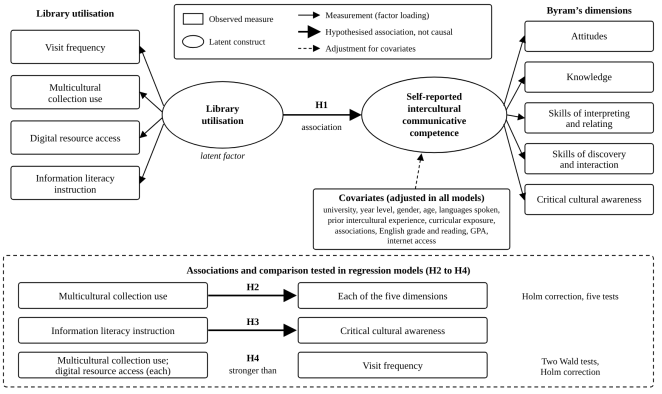
The framework yields four hypotheses, which are shown in
Figure 1 together with the covariates.
H1. Overall library utilisation is positively associated with self-reported ICC, after adjustment for covariates.
H2. Multicultural collection use is positively associated with each of the five dimensions of self-reported ICC, after adjustment for covariates and for the other forms of library use.
H3. Participation in library information literacy instruction is positively associated with self-reported critical cultural awareness, after adjustment for covariates and for the other forms of library use.
H4. Multicultural collection use and digital resource access are each more strongly associated with overall self-reported ICC than visit frequency.
Differences in these associations between universities and between year levels are treated as exploratory questions. In this paper the hypotheses are theoretical propositions, and the numerical values used in Section 4.3 are illustrative. The hypotheses become confirmatory only when a study applying the framework registers them, with its analysis plan, before data collection.
Figure 1. Hypothesised model. Rectangles are observed measures and ellipses are latent constructs. Thin arrows from a latent construct to its indicators represent measurement (factor loadings). The bold arrows represent hypothesised associations, estimated as structural or regression paths but not interpreted as causal effects. For simplicity, the four forms of use and the five dimensions are shown as observed scores; in the item-level models each is a latent factor measured by its items. The lower panel shows the associations tested in H2 and H3 and the comparison tested in H4. Covariates (dashed arrow) are adjusted for in all models. Source: the authors.
4.2. Design and Sampling Requirements
Design. Because the hypotheses concern associations, the framework specifies a cross-sectional survey, from which associations, but not causal effects, can be estimated. A multisite design is recommended, because the provision of library services and the cultural composition of student populations differ between universities and regions. In Nigeria, a suitable design includes one federal university with a programme in English and linguistics and a central library in each of several geopolitical zones, selected purposively to cover different linguistic and cultural regions.
Eligibility. The target population is registered undergraduates at all year levels in programmes in English, English language, linguistics or combined programmes with English, aged 18 years or older so that they can consent for themselves. Students should not be selected on the basis of how much they use the library, so that the full range of use, from little to much, is represented.
Class-based sampling. Within each university, the framework specifies selection by lottery of one compulsory course for each year level, with all eligible students present at a scheduled meeting invited to take part, a return visit to reach absentees, and a screening question to prevent repeat participation. The sample is then purposive at university level and class-based within universities, and is not a probability sample of all eligible students. The numbers enrolled, present, invited, responding and retained should be recorded for each class, so that participation can be reported both as a proportion of students present and as a proportion of students enrolled.
Table 2 shows an illustrative allocation for a design with four universities and four year levels. Equal allocation gives comparable precision for comparisons between universities and between levels; it does not represent the student population in proportion to its size, and results from such a design apply most directly to students of English and linguistics in the participating universities.
Table 2. Illustrative allocation for a design with four universities and four year levels.
University (zone) | 100 level | 200 level | 300 level | 400 level | Target invited | Expected valid (80%) |
Federal university (South West) | 38 | 38 | 37 | 37 | 150 | 120 |
Federal university (South East) | 38 | 38 | 37 | 37 | 150 | 120 |
Federal university (North West) | 38 | 38 | 37 | 37 | 150 | 120 |
Federal university (South South) | 38 | 38 | 37 | 37 | 150 | 120 |
Total | 152 | 152 | 148 | 148 | 600 | 480 |
4.3. Sample Size Requirements
Four considerations determine the sample size required. First, for the hierarchical regressions, a G*Power 3.1
| [27] | Faul, F., Erdfelder, E., Buchner, A., Lang, A.-G. Statistical power analyses using G*Power 3.1: Tests for correlation and regression analyses. Behavior Research Methods. 2009, 41(4), 1149-1160. https://doi.org/10.3758/BRM.41.4.1149 |
[27]
calculation for “Linear multiple regression: fixed model, R
2 increase”, with f
2 =.02, α =.05 (two sided), power =.80, one tested predictor and 21 predictors in total, gives a required sample size of 395; with 480 participants, the smallest effect detectable for the four utilisation indicators tested together is f
2 =.026. Second, a Monte Carlo simulation
was run with 1,000 replications per condition (random seed 20261019). The population model had two correlated latent factors, four utilisation indicators with standardised loadings of.55 to.65, five ICC dimension scores with loadings of.65 to.80, and residual variances equal to one minus the squared loading; data were independent and multivariate normal, the estimator was maximum likelihood, and the test was a likelihood ratio test at α =.05. The simulation showed that with 480 participants power to detect latent associations of.15,.20 and.30 was.74,.93 and above.99, with bias below 2% and no failed replications; with 400 participants it was.65,.88 and above.99. Third, clustering in 16 classes of about 30 students reduces the effective sample size by the design effect, 1 + 29ρ, where ρ is the class-level intraclass correlation. Applying the simulated power to the effective sample, rather than simulating correlated classes, gives approximate power for an association of.20 of.79 if ρ =.02 and.59 if ρ =.05. These figures are idealised: they assume independent normal data and omit covariates, item-level models and the clustered estimator, so they indicate the order of precision to be expected and do not establish power for the clustered, covariate-adjusted analysis. Fourth, university-specific analyses with about 120 participants each have power of only.34 for f
2 =.02, so university-specific estimates should be reported descriptively, with confidence intervals. On this basis the framework recommends inviting about 600 students in 16 classes, with at least 480 valid responses. This recommendation is provisional. Before the sample size for a study is fixed, power for the full analysis should be estimated by a Monte Carlo simulation that generates students within classes and includes the covariates, the item-level measurement model and the class-clustered estimator, using the intraclass correlations, item distributions and covariate associations observed in the pilot (Section 5.2); if this simulation gives power below.80 for an association of.20, the number of classes should be increased.
5. The Measurement Instrument
5.1. Structure and Scoring
The questionnaire has six sections, summarised in
Table 3 and reproduced in Appendix.
Table 3. Constructs, items and scoring.
Construct | Items | Response format | Example item | Score |
Visit frequency | 5 | Frequency or count, 1-5; three non-use responses | I work on group assignments in the library with students from ethnic groups other than my own. | Mean of common items (Section 5.1) |
Multicultural collection use | 5 | Frequency, 1-5; three non-use responses | I read literature (novels, plays or poetry) from other African countries. | Mean of common items (Section 5.1) |
Digital resource access | 5 | Frequency, 1-5; three non-use responses | I use the library’s electronic databases. | Mean of common items (Section 5.1) |
Information literacy instruction | 5 | Count, 1-5; three non-use responses | Library sessions on evaluating the credibility of sources. | Mean of common items (Section 5.1) |
Self-reported ICC: five dimensions | 35 (7 each; 5 reversed) | Agreement, 1-5 | I can recognise when a misunderstanding is caused by cultural differences. | Dimension and overall means |
Marker variable | 3 | Agreement, 1-5 | The university’s sports facilities meet my needs. | Mean of 3 items |
Social desirability | 13 | True or false | Reynolds short form | Sum, 0-13 |
Scenario-based intercultural judgement | 6 | Choice of 4 responses | Group assignment scenario | Proportion of retained scenarios keyed, 0-1 |
Section A: Background and covariates. This section records university, year level, programme, gender and age, together with the covariates. Prior intercultural experience is measured by four items: residence for six months or more outside the home state (yes = 1), travel outside Nigeria (yes = 1), the number of close friends from other ethnic groups (none = 0, one = 1, two or three = 2, four or more = 3) and shared accommodation with a student from another ethnic group (yes = 1); these are summed to an index from 0 to 6, with higher scores indicating more prior intercultural experience. Curricular intercultural exposure is the number of courses taken that dealt substantially with other cultures, and membership of cultural, international or interethnic student associations is recorded as yes or no. English proficiency is indicated by two imperfect measures, the grade in the general studies course in the use of English and a self rating of ease in reading academic English. The section also records the number of Nigerian languages spoken, the cumulative grade point average band as an indicator of academic achievement, and regular personal internet access outside the library. Students who do not yet have a grade in the use of English course or a grade point average are given an indicator variable, with the missing grade set to the sample mean, and the main analyses are repeated without them.
Section B: Library utilisation. Twenty items, five for each of four forms of use, ask how often during the current semester the student has engaged in particular library activities: visiting and using library spaces, including group study with students from other ethnic groups; using multicultural collections; using digital resources provided by the library; and taking part in information literacy instruction. Regular activities are rated on a five-point frequency scale from 1 (never) to 5 (about weekly or more). Library events and instruction sessions, which may be offered only once or twice a semester, are rated by the number of occasions, from 1 (none) to 5 (four or more). Every item also offers three further responses, which distinguish different reasons for nonuse: “this is not offered at my university”, “I do not know whether this is offered” and “this is offered, but I cannot access it”. A senior librarian at each university completes a library service checklist recording which services, events, instruction sessions and databases were offered during the semester. The checklist establishes institutional provision; combined with students’ responses, it distinguishes services that were not offered, services that were offered but of which a student was unaware, and services to which a student reported having no access. It cannot establish whether an individual student actually had access.
To keep scores comparable across students and universities, the primary utilisation score for each form of use is the mean of a common set of items, namely those that the checklists show to be offered at every participating university. The estimand of this score is utilisation of provided services, whatever the reason for nonuse: on the common items, a response that the service is unknown or inaccessible is coded 1 (never or none), and the reasons are reported separately. If fewer than three items in a form are offered at every university, scores for that form are not comparable across universities, because university fixed effects cannot make different item content equivalent; pooled analyses involving that form are then suspended, and the form is analysed within each university only, unless a common anchor set of at least three items allows the scores to be linked.
Because unawareness and lack of access differ from voluntary nonuse, a two-part availability and use analysis is specified as a sensitivity analysis. The first part is an awareness and access index, the proportion of common items that the student reports as both known and accessible. The second part is the intensity of use, the mean frequency among the items the student reports as known and accessible. Intensity is undefined for a student who reports none of the common items as both known and accessible. Such students are retained: they receive an awareness and access index of 0 and a structural-zero indicator equal to 1, and their intensity score is set to 0 so that it does not contribute to the estimate. All three terms, the index, the indicator and the intensity score, enter the models together. The coefficient for intensity is then interpreted as the association between frequency of use and ICC among students with at least one known and accessible service, and the coefficients for the index and the indicator describe the associations of awareness and access across all students. A further sensitivity analysis uses the mean of all items answered on the 1 to 5 scale, provided that at least three are so answered. Nonuse responses are not treated as missing data, because they are informative: treating them as missing would change the estimand to use among students who perceive a service as available, and would make missingness depend on unobserved awareness and access, so that the data would not be missing at random. An availability index, the number of items a student reports as not offered, unknown or inaccessible, is also reported.
Section C: Self-reported ICC. Thirty-five items, seven for each of Byram’s five dimensions, ask students to rate each statement on a five-point scale from 1 (strongly disagree) to 5 (strongly agree). One item in each dimension is negatively worded and scored in reverse, to reduce and allow modelling of acquiescence. No item refers to finding, searching for or retrieving information, and none refers to the library, so that the measure of competence does not overlap in content with the measure of library use. One instructed-response item asks students to select a particular answer and serves as an attention check. Dimension scores are the means of their seven items, and the overall score is the mean of the five dimension scores.
Section D: Marker variable. Three items on satisfaction with the university’s sports facilities serve as a marker variable for common method variance
| [30] | Podsakoff, P. M., MacKenzie, S. B., Lee, J.-Y., Podsakoff, N. P. Common method biases in behavioral research: A critical review of the literature and recommended remedies. Journal of Applied Psychology. 2003, 88(5), 879-903.
https://doi.org/10.1037/0021-9010.88.5.879 |
[30]
. Sports facilities were chosen because they are a campus service with no theoretical link to intercultural competence, and because the items share the agreement format of Section C, so that they can capture variance associated with that format. Measuring library use as reported frequency rather than satisfaction reduces, but does not remove, the risk that the marker reflects a general evaluation of the university that is also related to library responses.
Section E: Social desirability. The 13-item short form of the Marlowe-Crowne Social Desirability Scale developed by Reynolds
, answered true or false, estimates the tendency to give socially favourable answers. The items are not reproduced here and are available in the original source.
Section F: Scenario-based intercultural judgement. Six short scenarios describe intercultural situations that students may meet, each followed by four possible responses. They address interaction in a group assignment, a visitor’s inaccurate view of Nigeria, an unfamiliar custom at a ceremony, a generalisation about an ethnic group in a newspaper, an unfamiliar expression used by a lecturer and a shared room. An expert panel (Section 5.2) chooses the best response for each scenario independently, and a scenario is retained only if at least five of the six experts choose the same response; scenarios with ties or weaker agreement are dropped. The score is the proportion of retained scenarios answered with the keyed response, from 0 to 1, and the measure is not used if fewer than three scenarios are retained. It assesses judgement about described situations, not observed interpersonal performance, and its reliability is expected to be modest because it has few items.
5.2. Validation Procedure
Because the instrument is new, the framework requires it to be validated before it is used to test the hypotheses.
Content validation. A panel of six experts, two specialists in intercultural communication or English language education, two academic librarians and two specialists in educational measurement, rates the relevance of every item to its intended construct on a four-point scale. Items with an item-level content validity index below.78 are revised or removed, and the scale-level index, averaged across items, should reach at least.90
| [31] | Polit, D. F., Beck, C. T., Owen, S. V. Is the CVI an acceptable indicator of content validity? Appraisal and recommendations. Research in Nursing & Health. 2007, 30(4), 459-467.
https://doi.org/10.1002/nur.20199 |
[31]
. The panel also reviews whether the items are appropriate for students in each region, following the principles for adapting self-report measures to new settings described by Beaton et al.
, and sets the keyed responses to the scenarios.
Piloting. The revised questionnaire is piloted with about 60 students of English or linguistics at a university that is not among the main sites. Eight of these students take part in cognitive interviews, in which they explain how they understood selected items, including the frequency and count anchors in Section B. The pilot checks comprehension, completion time, item distributions and internal consistency, and about 30 students complete the questionnaire a second time after two weeks to estimate test-retest reliability. For each scenario, the proportion choosing the keyed response and the correlation with the remaining scenarios are reported. Items that are misunderstood, show very little variation or reduce internal consistency are revised, and pilot data are kept separate from the main analysis.
Psychometric testing. After content validation and piloting, the factor structure, reliability and validity of the revised instrument are tested in the main sample by the procedures in Section 6.2, before any hypothesis is tested. A scale is used to test a hypothesis only if its measurement model fits acceptably (CFI ≥.90 and RMSEA ≤.08) and its reliability, estimated by McDonald’s omega, is at least.70. If a scale fails these criteria, the hypotheses that depend on it are reported as not tested, and the scale is revised before any further use.
5.3. Administration and Ethical Safeguards
The instrument is designed for anonymous administration in class. Research assistants give every student present an information sheet, a questionnaire and an envelope, and lecturers leave the room while students complete it. Students who do not wish to take part place a blank questionnaire in the envelope, so that declining is not visible to others, and all envelopes are sealed and placed in a box. Consent is recorded anonymously, by a tick box on the first page of the questionnaire, so that no document links a name to a response; if an ethics committee requires signed consent, signed forms are collected separately and contain no information that can be matched to a questionnaire. Because questionnaires are anonymous, an individual response cannot be withdrawn after submission, and the information sheet says so. Repeat participation is prevented without identifying anyone, through a screening question and a self-generated code made from information known only to the student, which is checked for duplicates within each class and then deleted. Administration within a single semester ensures that all students report on comparable periods of library use. Ethical approval from each participating university is required before administration. Paper questionnaires and any signed consent forms should be stored separately in locked cabinets and destroyed after a stated retention period, and electronic data kept in encrypted, password-protected files. Before any dataset is shared, age should be grouped into bands, small categories merged, and combinations of university, year level, gender and age band checked to ensure that each contains at least five students; where this cannot be achieved, data should be shared under controlled access.
6. Analytical Procedures
6.1. Data Quality and Missing Data
Questionnaires with no responses in Section C are excluded, because they contain no information on the outcome. Responses are not excluded merely because all Section C items receive the same answer, since uniform agreement may be genuine. Instead, three quality indicators are recorded: failure of the attention check; identical responses across all Section C items, including the reverse-keyed items, which may reflect acquiescence, misunderstanding or inattention and is therefore flagged rather than interpreted; and completion of fewer than half the items in Section B or Section C. The main analyses include all retained questionnaires, and a sensitivity analysis excludes those flagged by any quality indicator.
Item-level missing data are distinguished from missing scale scores. In the structural equation models, missing item responses are handled by full information maximum likelihood estimation
| [33] | Enders, C. K. Applied Missing Data Analysis. New York, NY: Guilford Press; 2010. |
[33]
, which is compatible with the robust maximum likelihood estimator used for the main models. In the regressions, which use scale scores, a scale score is computed if at least four of seven ICC items, or three of five library utilisation items, are answered; remaining missing scale scores and covariates are handled by multiple imputation with 20 imputed datasets
| [33] | Enders, C. K. Applied Missing Data Analysis. New York, NY: Guilford Press; 2010. |
[33]
. The imputation model includes all analysis variables, the availability index, the quality indicators and university and class indicators, using predictive mean matching for scale scores and logistic or ordinal models for categorical covariates. Responses indicating that a service is not offered, unknown or inaccessible are substantive answers, not missing data, and are coded as described in Section 5.1 rather than imputed. The pattern of missing data is described, and Little’s
test is reported. The procedures can be carried out in R with the lavaan package
.
6.2. Measurement Models and Validity
Self-reported ICC. A confirmatory factor analysis tests the five-factor structure of the ICC items, and a second model tests whether the five dimensions load on a higher-order factor. A random intercept factor models acquiescence
: all 35 items, scored in their original direction, load on this factor with loadings fixed to 1, its variance is freely estimated, and it is uncorrelated with the substantive factors. The model is identified because the five reverse-keyed items allow acquiescence to be separated from the substantive factors; if it fails to converge or yields a negative or nonsignificant variance, the model without the random intercept is retained. The main estimator is robust maximum likelihood, because five-category items with approximately symmetrical distributions can be treated as continuous with little bias
| [37] | Rhemtulla, M., Brosseau-Liard, P. É., Savalei, V. When can categorical variables be treated as continuous? A comparison of robust continuous and categorical SEM estimation methods under suboptimal conditions. Psychological Methods. 2012, 17(3), 354-373. https://doi.org/10.1037/a0029315 |
[37]
and because this estimator allows full information maximum likelihood for missing data. All measurement and structural models are reestimated with the ordinal estimator WLSMV as a sensitivity analysis. Fit is judged by the comparative fit index (CFI ≥.95 good, ≥.90 acceptable), the root mean square error of approximation (RMSEA ≤.06 good, ≤.08 acceptable) and the standardised root mean square residual (SRMR ≤.08)
| [38] | Hu, L., Bentler, P. M. Cutoff criteria for fit indexes in covariance structure analysis: Conventional criteria versus new alternatives. Structural Equation Modeling. 1999, 6(1), 1-55.
https://doi.org/10.1080/10705519909540118 |
| [39] | Kline, R. B. Principles and Practice of Structural Equation Modeling. 4th ed. New York, NY: Guilford Press; 2016. |
[38, 39]
.
Validity beyond internal consistency. Reliability is estimated with Cronbach’s alpha and McDonald’s omega, and test-retest reliability from the pilot. Convergent validity is examined through the correlation between overall self-reported ICC and the scenario score, which is expected to be positive and modest because the two measures differ in method. Discriminant validity among the five dimensions is examined by comparing the average variance extracted for each dimension with its squared correlations with the other dimensions. Known-groups validity is examined by testing whether students with more prior intercultural experience report higher ICC. The correlation of ICC with social desirability is reported, and measurement invariance between female and male students is tested by comparing configural, metric and scalar models, with a decrease in CFI of more than.01 taken as evidence of noninvariance
. Students who choose “prefer not to say” are excluded from the invariance test only and are coded with a separate category in all other analyses.
Library utilisation. The four forms of use are distinct activities, and it cannot be assumed that they reflect a single underlying disposition. Within each form, the five items are treated as reflective indicators of engagement with that service, and a four-factor confirmatory factor analysis tests this. Two structural specifications are then compared. In Model A, the four forms load on a higher-order reflective factor of overall library utilisation, which is associated with latent self-reported ICC. In Model B, the four forms are correlated factors, each with its own path to latent ICC. With the first loading of each first-order factor fixed to 1, the latent covariance matrix among the four forms of use and ICC has 15 elements. Model B, with ten covariances among the forms, four paths and one disturbance variance, reproduces this matrix exactly, whereas Model A, with four higher-order loadings, four disturbance variances, one path and one disturbance variance, has ten parameters. Model A is therefore nested in Model B with five degrees of freedom. Both models are fitted to the same data with the same measurement model, including the random intercept factor if it is retained, so that they differ only in the structural part. This specification assumes that all five items in each form are common to every university; in an actual study the factor specifications must be generated from the verified common-item set, and identification and comparability reassessed if that set has fewer items in any form. The comparison is made in the models without covariates, using the scaled chi-square difference test
| [41] | Satorra, A., Bentler, P. M. A scaled difference chi-square test statistic for moment structure analysis. Psychometrika. 2001, 66(4), 507-514. https://doi.org/10.1007/BF02296192 |
[41]
under robust maximum likelihood, together with the change in CFI; AIC and BIC are reported as supplementary information under this estimator only. Under WLSMV, which provides no ordinary likelihood, the robust difference test available in lavaan is used, and information criteria are not reported.
6.3. Testing the Hypotheses
Clustering. Students are nested within classes and universities, and class membership may affect both library use and self-reported ICC. With few universities, multilevel models at university level are unreliable
, so university is entered as a fixed effect and year level as a covariate in all models. Fixed effects do not, however, remove dependence among students in the same class, so uncertainty is assessed with standard errors clustered by class. In the regressions, cluster-robust standard errors with the CR2 small-sample correction and Satterthwaite degrees of freedom are used
| [43] | Pustejovsky, J. E., Tipton, E. Small-sample methods for cluster-robust variance estimation and hypothesis testing in fixed effects models. Journal of Business & Economic Statistics. 2018, 36(4), 672-683.
https://doi.org/10.1080/07350015.2016.1247004 |
[43]
, an approach designed for few clusters and fixed effects. In the structural models, cluster-robust (sandwich) standard errors clustered by class are used, but no reliable small-sample correction for complex structural equation models with about 16 clusters is available, so the resulting intervals are treated as approximate and are not used alone for inference. The class-level intraclass correlation of each outcome is reported, and the main models are reestimated with class fixed effects as a sensitivity analysis. Ordinary individual-level standard errors are shown only for comparison and are not treated as valid.
Primary test of H1. H1 is tested by the standardised latent association between library utilisation and self-reported ICC in Model A, adjusted for covariates. Because inference from the structural model is approximate with about 16 classes, H1 is supported only if two conditions are both met: the latent association is positive with an approximate 95% confidence interval, based on class-clustered standard errors, that excludes zero; and the association between the overall utilisation index and overall self-reported ICC in the regression with CR2 standard errors is positive at p <.05. The latent estimate describes the size of the association, and the CR2 test provides the inferential safeguard. If Model A fits significantly worse than Model B (scaled difference test p <.05 and decrease in CFI greater than.01) or has CFI below.90, the higher-order factor is regarded as unsupported, and H1 is instead examined through an alternative operationalisation, labelled H1b: the association between a unit-weighted overall utilisation index, the mean of the four form scores treated as a formative composite, and latent self-reported ICC, with the same decision criterion. A result for H1b is reported as a test of a differently operationalised hypothesis, not as a test of the latent association in H1, and it provides no support for the higher-order utilisation construct.
Corroborative regression. For overall self-reported ICC and each of the five dimensions, a two-step regression is estimated. Step 1 includes the covariates: university, year level, gender, age, number of Nigerian languages spoken, prior intercultural experience, curricular intercultural exposure, association membership, use of English grade, self-rated reading in English, grade point average band, internet access and the indicators for missing grades. Step 2 adds the four utilisation indicators. All continuous predictors are standardised before entry, so that coefficients are expressed in standard deviation units. The change in R2 at Step 2 is reported with its F test, and the coefficients with 95% confidence intervals. For H1, the regression is corroborative only.
H2 to H4. H2 involves five tests, one for each dimension, and the Holm procedure controls the familywise error rate. H2 is fully supported if all five coefficients for multicultural collection use are positive and significant after correction, and partially supported if at least one is. H3 is supported if the coefficient for information literacy instruction predicting critical cultural awareness is positive and significant at α =.05. H4 involves two comparisons in the regression for overall self-reported ICC: the coefficient for multicultural collection use minus that for visit frequency, and the coefficient for digital resource access minus that for visit frequency. Each difference is tested with a Wald test, with the Holm procedure applied to the two tests. H4 is fully supported if both differences are positive and significant after correction, and partially supported if one is.
Table 4. Hypotheses, primary analyses and decision criteria.
Hyp | Predictor and outcome | Primary analysis | Criterion for support |
H1 | Library utilisation and overall self-reported ICC | Standardised latent association in Model A with covariates; if Model A is rejected, alternative operationalisation H1b with the unit-weighted index | Positive latent association with approximate 95% CI (class-clustered) excluding zero, and positive CR2 regression association, p <.05 |
H2 | Multicultural collection use and each of five dimensions | Five regressions with covariates and other utilisation indicators | Positive coefficients, p <.05 (CR2) after Holm correction; full support if all five, partial if at least one |
H3 | Information literacy instruction and critical cultural awareness | Regression with covariates and other utilisation indicators | Positive coefficient, p <.05 (CR2) |
H4 | Multicultural collection use and digital resource access, each compared with visit frequency | Two Wald tests of differences between standardised coefficients | Both differences positive, p <.05 after Holm correction (full); one (partial) |
6.4. Common Method Variance and Sensitivity Analyses
Because all main variables are measured by self-report on one occasion, common method variance could inflate the associations. Procedural remedies built into the instrument include anonymity, separation of the library and ICC sections, different response formats for the two sections, reverse-keyed ICC items and the absence of any reference to the library in the ICC items
| [30] | Podsakoff, P. M., MacKenzie, S. B., Lee, J.-Y., Podsakoff, N. P. Common method biases in behavioral research: A critical review of the literature and recommended remedies. Journal of Applied Psychology. 2003, 88(5), 879-903.
https://doi.org/10.1037/0021-9010.88.5.879 |
[30]
. Statistically, the main models are reestimated after partialling out the marker variable, after adding a latent method factor and after adjusting for social desirability, and the size of the changes is reported. These procedures indicate the likely influence of method variance but cannot eliminate it.
The framework specifies the following sensitivity analyses: estimation with WLSMV; exclusion of questionnaires flagged by the quality indicators; the alternative scorings of library utilisation described in Section 5.1; exclusion of students without a grade or grade point average; class fixed effects; prior intercultural experience modelled as a moderator; and exclusion of students who report never having visited the library during the semester. University-specific estimates and comparisons across year levels are exploratory.
6.5. Reporting and Interpretation
Studies applying the framework should report their results following the STROBE checklist for cross-sectional studies
| [44] | von Elm, E., Altman, D. G., Egger, M., Pocock, S. J., Gøtzsche, P. C., Vandenbroucke, J. P. The Strengthening the Reporting of Observational Studies in Epidemiology (STROBE) statement: Guidelines for reporting observational studies. The Lancet. 2007, 370(9596), 1453-1457.
https://doi.org/10.1016/S0140-6736(07)61602-X |
[44]
, including a flow diagram of students enrolled, present, invited, responding, excluded and analysed in each class and university, and should register their hypotheses and analyses before data collection. Effect sizes and confidence intervals should be emphasised over significance tests. Associations should not be taken as evidence that library use causes intercultural competence. Reverse causality is plausible, because students with higher competence may be more inclined to seek multicultural and international materials, and residual confounding is likely, because exposure through social media, family networks and other activities outside the library is not fully measured. Equally, a statistically nonsignificant result does not show that library use makes no contribution to intercultural learning, since it may reflect limited power, particularly under class clustering, measurement error, restricted provision of services or confounding; confidence intervals show which effect sizes remain compatible with the data.
7. Discussion
7.1. Contributions
The paper makes three contributions. Theoretically, it specifies three mechanisms through which particular forms of library use may be associated with particular dimensions of ICC, and it derives four testable hypotheses from them (
Table 1). Methodologically, it proposes an instrument, for subsequent validation, that separates the measurement of competence from the measurement of library use, distinguishes services that are not offered, unknown or inaccessible from services that are unused, and includes procedural and statistical safeguards against acquiescence, social desirability and common method variance. Analytically, it sets out design requirements, sample size calculations that can be reproduced, and decision rules for each hypothesis, including the treatment of clustering in classes, which is often ignored in classroom surveys. Together, these elements allow research on the intercultural role of academic libraries to be conducted rigorously and compared across universities.
7.2. Implications for Research and Practice
For researchers, the framework shows that a credible test of the relationship between library use and ICC depends as much on measurement and design as on theory: without the separation of content, the recording of service availability and the treatment of clustering, apparent associations may be artificial or spuriously precise. For libraries, it draws attention to what students read and view, and to the instruction they receive, rather than to visits alone, and the library service checklist offers a simple way of recording which intercultural services are provided. For English departments, the instrument offers a way of describing students’ self-reported intercultural attitudes, knowledge and skills, which may inform collaboration with libraries
| [20] | Igbokwe, B., Nwanekezie, N. P. A conceptual model for integrating information literacy and task-based language teaching: Rethinking English language instruction in Nigerian secondary schools. International Journal of English Language, Literature and Translation Studies. 2026, 13(3), 121-134. http://ijelr.in |
| [21] | Igbokwe, B., Nwanekezie, N. P. Hedging, signposting and stance: A conceptual model of library-English department collaboration for developing metadiscourse competence in Nigerian undergraduate research proposals. Research Journal of English Language and Literature. 2026, 14(3), 508-522.
rjelal.com |
[20, 21]
.
7.3. Limitations
The instrument is an initial item pool. It has been reviewed only by the authors, has not yet been reviewed by independent experts or piloted, and has not been administered to students; its factor structure, reliability and validity remain to be established through the procedure in Section 5.2. Recent validations of student ICC scales in an English-medium university, a teacher education programme and bachelor’s programmes in Kazakhstan have followed the same sequence of item generation, expert review and exploratory and confirmatory factor analysis that Section 5.2 specifies
| [45] | Ertay, Z., Gilanlioglu, I. The development and validation of an intercultural communicative competence scale for students. SAGE Open. 2024, 14(2).
https://doi.org/10.1177/21582440241252495 |
| [46] | Mardones, T. D. C., Francois Paulet, M., Ortiz, J. E., Díaz, E., Romero, M. Instrument to evaluate intercultural competence in pedagogy students. Education Sciences. 2024, 14(4), 381. https://doi.org/10.3390/educsci14040381 |
| [47] | Serikbayeva, A., Akizhanova, D., Shinetova, L., Altybayeva, S., Abdrasilov, B. Psychometric tools for assessing intercultural communicative competence: A case study for evaluating ICC in Kazakhstan. Frontiers in Education. 2026, 11, 1727766.
https://doi.org/10.3389/feduc.2026.1727766 |
[45-47]
, and one of them found a moderate positive association between ICC and English proficiency
| [47] | Serikbayeva, A., Akizhanova, D., Shinetova, L., Altybayeva, S., Abdrasilov, B. Psychometric tools for assessing intercultural communicative competence: A case study for evaluating ICC in Kazakhstan. Frontiers in Education. 2026, 11, 1727766.
https://doi.org/10.3389/feduc.2026.1727766 |
[47]
, which supports the adjustment for proficiency in this framework. Inference from structural models with about 16 classes is approximate, and the power figures reported are idealised: power for the full clustered, covariate-adjusted model has not been established, and it must be estimated as described in Section 4.3 before the sample size for a study is fixed. The main outcome is self-reported, and students may overestimate both their library use and their competence; the scenario-based judgement measure, which has few items and does not observe performance, and the checks for social desirability and common method variance can help to identify, but not remove, this problem. The cross-sectional design specified by the framework cannot establish causal relationships. A class-based design in purposively selected universities limits generalisation, and with about 16 classes, estimates of uncertainty that allow for clustering will themselves be imprecise; small-sample corrected cluster-robust standard errors such as CR2 generally perform acceptably with few clusters
| [48] | Zhang, Y., Lai, M. H. C. Evaluating two small-sample corrections for fixed-effects standard errors and inferences in multilevel models with heteroscedastic, unbalanced, clustered data. Behavior Research Methods. 2024, 56(6), 5930-5946.
https://doi.org/10.3758/s13428-023-02325-9 |
[48]
, but they do not make the structural models exact. The library service checklist records institutional provision but not individual access, and the use of English grade and the self rating of reading are imperfect measures of English proficiency. The framework was designed for undergraduate students of English and linguistics in Nigerian federal universities, and may need to be adapted for other disciplines, institutions and countries.
8. Conclusions
This paper has developed an instrument and an analytical framework for examining the relationship between academic library utilisation and self-reported intercultural communicative competence among undergraduate students of English and linguistics in Nigerian universities. It links four forms of library use to Byram’s five dimensions through three theoretical mechanisms, states four hypotheses as theoretical propositions for confirmatory testing in preregistered studies, and proposes a questionnaire, for subsequent validation, that separates the measurement of competence from the measurement of library use and distinguishes unavailable services from unused ones. It also specifies a class-based multisite design, sample size requirements, a validation procedure, ethical safeguards and decision rules that allow for clustering and multiple testing. These tools are intended to make research on the intercultural role of academic libraries in Nigeria more rigorous, more comparable and more useful to libraries and language departments.
Abbreviations
AIC | Akaike Information Criterion |
BIC | Bayesian Information Criterion |
CFI | Comparative Fit Index |
CI | Confidence Interval |
GPA | Grade Point Average |
ICC | Intercultural Communicative Competence |
IFLA | International Federation of Library Associations and Institutions |
RMSEA | Root Mean Square Error of Approximation |
SRMR | Standardised Root Mean Square Residual |
STROBE | Strengthening the Reporting of Observational Studies in Epidemiology |
UNESCO | United Nations Educational, Scientific and Cultural Organization |
WLSMV | Weighted Least Squares, Mean and Variance Adjusted |
Author Contributions
Basilia Igbokwe: Conceptualization, Methodology, Writing – original draft, Writing – review & editing
Nkechi Priscilla Nwanekezie: Conceptualization, Methodology, Writing – original draft, Writing – review & editing
Data Availability Statement
No new data were created or analysed in this study. The code used for the sample size calculations and the power simulation is available from the corresponding author on request.
Conflicts of Interest
The authors declare no conflicts of interest.
Appendix: Questionnaire
The questionnaire is reproduced below as Version 1.0 (October 2026), in the form proposed for content validation; Table A1 maps each item to its construct. Items marked (R) are scored in reverse. Researchers who use it should report any revisions made after content validation and piloting.
Table A1. Mapping of questionnaire items to constructs (Version 1.0).
Construct | Items | Reverse-keyed items |
Background and covariates | A1-A17 | None |
Visit frequency | B1-B5 | None |
Multicultural collection use | B6-B10 | None |
Digital resource access | B11-B15 | None |
Information literacy instruction | B16-B20 | None |
Attitudes | C1-C7 | C4 |
Knowledge | C8-C14 | C13 |
Skills of interpreting and relating | C15-C21 | C21 |
Attention check (not scored) | One item between C21 and C22 | Not applicable |
Skills of discovery and interaction | C22-C28 | C24 |
Critical cultural awareness | C29-C35 | C31 |
Marker variable | D1-D3 | None |
Social desirability | Section E, 13 items | Scored as in Reynolds |
Scenario-based intercultural judgement | F1-F6 | Not applicable |
Section A: Background. A1. University. A2. Programme (English; English language; linguistics; combined programme with English). A3. Year level (100; 200; 300; 400). A4. Gender (female; male; prefer not to say). A5. Age in years. A6. Have you already completed this questionnaire in an earlier class? (yes; no). Self-generated code: second letter of your mother’s first name; day of your birth (01-31); last digit of your telephone number. A7. In how many Nigerian languages can you hold a conversation? (one; two; three; four or more). A8. Have you lived for six months or more in a Nigerian state other than your home state? (yes; no). A9. Have you ever travelled outside Nigeria? (yes; no). A10. How many of your close friends belong to an ethnic group other than your own? (none; one; two or three; four or more). A11. Have you ever shared a room or flat with a student from another ethnic group? (yes; no). A12. How many courses have you taken that dealt substantially with other cultures, for example African or world literature, sociolinguistics, intercultural communication or a foreign language? (none; one; two or three; four or more). A13. Are you a member of a cultural, international or interethnic student association? (yes; no). A14. Grade obtained in the general studies course in the use of English (A; B; C; D; E; F; not yet available). A15. How easily can you read academic texts in English? (1 = with great difficulty to 5 = very easily). A16. Current cumulative grade point average (4.50-5.00; 3.50-4.49; 2.40-3.49; 1.50-2.39; below 1.50; not yet available). A17. Do you have regular personal access to the internet outside the library? (daily; sometimes; rarely or never).
Section B: Library utilisation. During this semester, how often have you done each of the following? Items B1-B3, B5 and B6-B15: 1 = never; 2 = once or twice in the semester; 3 = about once a month; 4 = about every two weeks; 5 = about weekly or more. Items B4 and B16-B20, how many times this semester: 1 = none; 2 = once; 3 = twice; 4 = three times; 5 = four or more. For every item, instead of a number, you may choose: X = this is not offered at my university; D = I do not know whether this is offered; U = this is offered, but I cannot access it.
Visit frequency. B1. I visit the university library in person. B2. I study in the library reading rooms. B3. I work on group assignments in the library with students from ethnic groups other than my own. B4. I attend library events such as exhibitions, book talks or cultural days. B5. I ask library staff for help.
Multicultural collection use. B6. I borrow or read books by authors from Nigerian ethnic groups other than my own. B7. I read literature (novels, plays or poetry) from other African countries. B8. I read books or articles about cultures outside Africa. B9. I use library materials in or about a Nigerian language other than my first language. B10. I use newspapers, magazines or audiovisual materials from other cultures in the library.
Digital resource access. B11. I use the library’s electronic databases. B12. I read electronic books provided through the library. B13. I use the library’s computers or internet connection for my studies. B14. I read international journals or newspapers online through the library’s subscriptions. B15. I use the library’s online catalogue or institutional repository.
Information literacy instruction. B16. Library orientation or user education sessions. B17. Library instruction sessions linked to my courses. B18. Library sessions on evaluating the credibility of sources. B19. Library sessions on comparing viewpoints from different sources. B20. Library sessions on recognising bias or perspective in information.
Section C: Self-reported intercultural communicative competence. How far do you agree with each statement? (1 = strongly disagree; 2 = disagree; 3 = neither agree nor disagree; 4 = agree; 5 = strongly agree).
Attitudes. C1. I am curious about the customs of Nigerian ethnic groups other than my own. C2. I enjoy conversations with people whose cultural background differs from mine. C3. I am willing to question my own assumptions about other cultures. C4. I would feel uncomfortable sharing a room with a student from a different ethnic group. (R) C5. I am interested in how people from other countries see Nigeria. C6. I try to understand other people’s behaviour before judging it. C7. I am willing to learn some words of a Nigerian language other than my own.
Knowledge. C8. I know the main customs, such as greetings, marriage and festivals, of at least two Nigerian ethnic groups other than my own. C9. I understand how cultural values influence the way people communicate. C10. I know some of the historical events that have shaped relations between ethnic groups in Nigeria. C11. I know how forms of respect and politeness differ across cultures. C12. I understand how English is used differently in Nigeria and in other English-speaking countries. C13. I know very little about the culture of any country outside Africa. (R) C14. I understand how stereotypes develop between cultural groups.
Skills of interpreting and relating. C15. I can explain a custom from another culture by comparing it with one from my own culture. C16. I can identify the cultural assumptions behind a text or film from another culture. C17. I can recognise when a misunderstanding is caused by cultural differences. C18. I can explain to others why a practice from another culture makes sense within that culture. C19. I can see how an event may be described differently by people from different cultural backgrounds. C20. I can relate a proverb or saying from another culture to a similar one in my own. C21. I find it difficult to see a situation from the point of view of someone from another culture. (R).
Attention check. For this statement, please select “disagree”. (Not scored.).
Skills of discovery and interaction. C22. I ask people from other cultures questions to understand their beliefs and practices. C23. I adjust my way of speaking when interacting with people from other cultural backgrounds. C24. I find it difficult to keep a conversation going with someone from a different cultural background. (R) C25. When I meet an unfamiliar practice, I ask about its meaning rather than ignore it. C26. I can manage a disagreement with someone from another culture politely. C27. I learn new things about other cultures from the people I interact with. C28. I can help two people from different cultures to understand each other when a misunderstanding arises.
Critical cultural awareness. C29. I critically evaluate practices in my own culture as well as in other cultures. C30. I can identify the values on which my judgements of other cultures are based. C31. I accept what is commonly said about other ethnic groups in Nigeria without questioning it. (R) C32. I can recognise bias in media reports about other cultural groups. C33. I can discuss controversial cultural practices while respecting the people involved. C34. I can explain the criteria I use when I evaluate a practice from another culture. C35. I can help to find an acceptable solution when cultural values conflict.
Section D: Marker variable. How far do you agree with each statement? (same scale as Section C) D1. The university’s sports facilities meet my needs. D2. The sports facilities on campus are well maintained. D3. I am satisfied with the sports facilities available to students.
Section E: Social desirability. The 13-item short form of the Marlowe-Crowne Social Desirability Scale developed by Reynolds
, answered true or false. The items are not reproduced here and should be taken from the original source.
Section F: Scenario-based intercultural judgement. Choose the response that is closest to what you would do or think. F1. In a group assignment, a classmate from another ethnic group says nothing when the group agrees a plan, but later does not do the agreed part. (a) Report the classmate to the lecturer at once. (b) Assume the classmate is lazy and do the work yourself. (c) Speak privately with the classmate to find out whether he or she had concerns that were not raised in the group. (d) Raise the matter in front of the whole group at the next meeting. F2. A visiting student from another country describes Nigeria in a way you consider inaccurate. (a) Correct the student sharply. (b) Say nothing. (c) Ask what the student has heard and share your own experience, with examples. (d) Change the subject. F3. At a friend’s family ceremony in another part of Nigeria, food is served and shared in a way that is unfamiliar to you. (a) Decline the food without explanation. (b) Watch what others do and follow, asking your friend quietly if you are unsure. (c) Behave as you would at a ceremony in your own community. (d) Leave the ceremony early. F4. A newspaper article makes a sweeping statement about the character of an ethnic group. (a) Accept it, because it appeared in a newspaper. (b) Consider who wrote it, why, and whether evidence supports it. (c) Share it with friends. (d) Conclude that newspapers cannot be trusted on any subject. F5. A lecturer from another part of Nigeria uses an expression in class that would be considered disrespectful in your community. (a) Complain loudly to your classmates. (b) Consider whether the expression may have a different meaning in the lecturer’s community, and ask politely if you are unsure. (c) Stop attending the lecturer’s classes. (d) Assume that the lecturer intended to insult the class. F6. Your roommate from another ethnic group follows a cultural or religious practice that affects how your shared room is used. (a) Insist that the roommate stops the practice. (b) Discuss with the roommate how you can both arrange the room and your times to respect each other’s needs. (c) Move out without discussing it. (d) Report the roommate to the hall warden at once.
References
| [1] |
Deardorff, D. K. Identification and assessment of intercultural competence as a student outcome of internationalization. Journal of Studies in International Education. 2006, 10(3), 241-266.
https://doi.org/10.1177/1028315306287002
|
| [2] |
Eberhard, D. M., Simons, G. F., Fennig, C. D., editors. Ethnologue: Languages of the World. 26th ed. Dallas, TX: SIL International; 2023. Available from:
https://www.ethnologue.com
|
| [3] |
Adegbija, E. Multilingualism: A Nigerian Case Study. Trenton, NJ: Africa World Press; 2004.
|
| [4] |
Federal Republic of Nigeria. National Policy on Education. 6th ed. Lagos: Nigerian Educational Research and Development Council; 2013.
|
| [5] |
Bamgbose, A. Language and Exclusion: The Consequences of Language Policies in Africa. Münster: LIT Verlag; 2000.
|
| [6] |
Byram, M. Teaching and Assessing Intercultural Communicative Competence. Clevedon: Multilingual Matters; 1997.
|
| [7] |
Byram, M. Teaching and Assessing Intercultural Communicative Competence: Revisited. 2nd ed. Bristol: Multilingual Matters; 2021.
https://doi.org/10.21832/9781800410251
|
| [8] |
International Federation of Library Associations and Institutions. IFLA/UNESCO Multicultural Library Manifesto: The Multicultural Library, a Gateway to a Cultural Diverse Society in Dialogue. The Hague: IFLA; 2008. Available from:
https://www.ifla.org/ifla-unesco-multicultural-library-manifesto/
|
| [9] |
Elmborg, J. K. Libraries as the spaces between us: Recognizing and valuing the third space. Reference & User Services Quarterly. 2011, 50(4), 338-350.
https://doi.org/10.5860/rusq.50n4.338
|
| [10] |
Overall, P. M. Cultural competence: A conceptual framework for library and information science professionals. The Library Quarterly. 2009, 79(2), 175-204.
https://doi.org/10.1086/597080
|
| [11] |
Fantini, A. E. Assessing intercultural competence: Issues and tools. In: Deardorff, D. K., editor. The SAGE Handbook of Intercultural Competence. Thousand Oaks, CA: SAGE; 2009, pp. 456-476.
|
| [12] |
Mestre, L. S. Librarians working with diverse populations: What impact does cultural competency training have on their efforts? The Journal of Academic Librarianship. 2010, 36(6), 479-488.
https://doi.org/10.1016/j.acalib.2010.08.003
|
| [13] |
Jackson, P. A., Sullivan, P., editors. International Students and Academic Libraries: Initiatives for Success. Chicago, IL: Association of College and Research Libraries; 2011.
|
| [14] |
Hughes, H., Hall, N., Pozzi, M. Library experience and information literacy learning of first year international students: An Australian case study. Communications in Information Literacy. 2017, 11(2), 302-323.
https://doi.org/10.15760/comminfolit.2017.11.2.4
|
| [15] |
Ebiefung, R. Xenoglossophobia and information seeking behavior of African graduate students. In: Proceedings of the ALISE Annual Conference; 2025.
https://doi.org/10.21900/j.alise.2025.2036
|
| [16] |
Shimray, S. R., Kaba, A., Singh, G. Exploring library anxiety among non-English-speaking postgraduate students. IFLA Journal. 2025, 51(4), 998-1012.
https://doi.org/10.1177/03400352251348244
|
| [17] |
Baro, E. E., Zuokemefa, T. Information literacy programmes in Nigeria: A survey of 36 university libraries. New Library World. 2011, 112(11/12), 549-565.
https://doi.org/10.1108/03074801111190428
|
| [18] |
Okeji, C. C., Ilika, O. M., Baro, E. E. Assessment of information literacy skills: A survey of final year undergraduates of library and information science in Nigerian universities. Global Knowledge, Memory and Communication. 2020, 69(6/7), 521-535.
https://doi.org/10.1108/GKMC-10-2019-0130
|
| [19] |
Nwanekezie, N. P., Igbokwe, B. Assessing the use of library resources by faculty of Art students in Kingsley Ozumba Mbadiwe University, Ideato, Imo State. International Journal of Library Science. 2022, 10(1), 8-13.
https://doi.org/10.5923/j.library.20221001.02
|
| [20] |
Igbokwe, B., Nwanekezie, N. P. A conceptual model for integrating information literacy and task-based language teaching: Rethinking English language instruction in Nigerian secondary schools. International Journal of English Language, Literature and Translation Studies. 2026, 13(3), 121-134.
http://ijelr.in
|
| [21] |
Igbokwe, B., Nwanekezie, N. P. Hedging, signposting and stance: A conceptual model of library-English department collaboration for developing metadiscourse competence in Nigerian undergraduate research proposals. Research Journal of English Language and Literature. 2026, 14(3), 508-522.
rjelal.com
|
| [22] |
Kramsch, C. Context and Culture in Language Teaching. Oxford: Oxford University Press; 1993.
|
| [23] |
Allport, G. W. The Nature of Prejudice. Cambridge, MA: Addison-Wesley; 1954.
|
| [24] |
Pettigrew, T. F., Tropp, L. R. A meta-analytic test of intergroup contact theory. Journal of Personality and Social Psychology. 2006, 90(5), 751-783.
https://doi.org/10.1037/0022-3514.90.5.751
|
| [25] |
Demarest, L., Langer, A. Ethnic diversity and intergroup relations among Nigerian adolescents: Testing intergroup contact and political deliberation theories. International Journal of Intercultural Relations. 2025, 105, 102149.
https://doi.org/10.1016/j.ijintrel.2025.102149
|
| [26] |
Association of College and Research Libraries. Framework for Information Literacy for Higher Education. Chicago, IL: American Library Association; 2016. Available from:
https://www.ala.org/acrl/standards/ilframework
|
| [27] |
Faul, F., Erdfelder, E., Buchner, A., Lang, A.-G. Statistical power analyses using G*Power 3.1: Tests for correlation and regression analyses. Behavior Research Methods. 2009, 41(4), 1149-1160.
https://doi.org/10.3758/BRM.41.4.1149
|
| [28] |
Muthén, L. K., Muthén, B. O. How to use a Monte Carlo study to decide on sample size and determine power. Structural Equation Modeling. 2002, 9(4), 599-620.
https://doi.org/10.1207/S15328007SEM0904_8
|
| [29] |
Reynolds, W. M. Development of reliable and valid short forms of the Marlowe-Crowne Social Desirability Scale. Journal of Clinical Psychology. 1982, 38(1), 119-125.
https://doi.org/10.1002/1097-4679(198201)38:1<119::AID-JCLP2270380118>3.0.CO;2-I
|
| [30] |
Podsakoff, P. M., MacKenzie, S. B., Lee, J.-Y., Podsakoff, N. P. Common method biases in behavioral research: A critical review of the literature and recommended remedies. Journal of Applied Psychology. 2003, 88(5), 879-903.
https://doi.org/10.1037/0021-9010.88.5.879
|
| [31] |
Polit, D. F., Beck, C. T., Owen, S. V. Is the CVI an acceptable indicator of content validity? Appraisal and recommendations. Research in Nursing & Health. 2007, 30(4), 459-467.
https://doi.org/10.1002/nur.20199
|
| [32] |
Beaton, D. E., Bombardier, C., Guillemin, F., Ferraz, M. B. Guidelines for the process of cross-cultural adaptation of self-report measures. Spine. 2000, 25(24), 3186-3191.
https://doi.org/10.1097/00007632-200012150-00014
|
| [33] |
Enders, C. K. Applied Missing Data Analysis. New York, NY: Guilford Press; 2010.
|
| [34] |
Little, R. J. A. A test of missing completely at random for multivariate data with missing values. Journal of the American Statistical Association. 1988, 83(404), 1198-1202.
https://doi.org/10.1080/01621459.1988.10478722
|
| [35] |
Rosseel, Y. lavaan: An R package for structural equation modeling. Journal of Statistical Software. 2012, 48(2), 1-36.
https://doi.org/10.18637/jss.v048.i02
|
| [36] |
Maydeu-Olivares, A., Coffman, D. L. Random intercept item factor analysis. Psychological Methods. 2006, 11(4), 344-362.
https://doi.org/10.1037/1082-989X.11.4.344
|
| [37] |
Rhemtulla, M., Brosseau-Liard, P. É., Savalei, V. When can categorical variables be treated as continuous? A comparison of robust continuous and categorical SEM estimation methods under suboptimal conditions. Psychological Methods. 2012, 17(3), 354-373.
https://doi.org/10.1037/a0029315
|
| [38] |
Hu, L., Bentler, P. M. Cutoff criteria for fit indexes in covariance structure analysis: Conventional criteria versus new alternatives. Structural Equation Modeling. 1999, 6(1), 1-55.
https://doi.org/10.1080/10705519909540118
|
| [39] |
Kline, R. B. Principles and Practice of Structural Equation Modeling. 4th ed. New York, NY: Guilford Press; 2016.
|
| [40] |
Cheung, G. W., Rensvold, R. B. Evaluating goodness-of-fit indexes for testing measurement invariance. Structural Equation Modeling. 2002, 9(2), 233-255.
https://doi.org/10.1207/S15328007SEM0902_5
|
| [41] |
Satorra, A., Bentler, P. M. A scaled difference chi-square test statistic for moment structure analysis. Psychometrika. 2001, 66(4), 507-514.
https://doi.org/10.1007/BF02296192
|
| [42] |
McNeish, D., Stapleton, L. M. Modeling clustered data with very few clusters. Multivariate Behavioral Research. 2016, 51(4), 495-518.
https://doi.org/10.1080/00273171.2016.1167008
|
| [43] |
Pustejovsky, J. E., Tipton, E. Small-sample methods for cluster-robust variance estimation and hypothesis testing in fixed effects models. Journal of Business & Economic Statistics. 2018, 36(4), 672-683.
https://doi.org/10.1080/07350015.2016.1247004
|
| [44] |
von Elm, E., Altman, D. G., Egger, M., Pocock, S. J., Gøtzsche, P. C., Vandenbroucke, J. P. The Strengthening the Reporting of Observational Studies in Epidemiology (STROBE) statement: Guidelines for reporting observational studies. The Lancet. 2007, 370(9596), 1453-1457.
https://doi.org/10.1016/S0140-6736(07)61602-X
|
| [45] |
Ertay, Z., Gilanlioglu, I. The development and validation of an intercultural communicative competence scale for students. SAGE Open. 2024, 14(2).
https://doi.org/10.1177/21582440241252495
|
| [46] |
Mardones, T. D. C., Francois Paulet, M., Ortiz, J. E., Díaz, E., Romero, M. Instrument to evaluate intercultural competence in pedagogy students. Education Sciences. 2024, 14(4), 381.
https://doi.org/10.3390/educsci14040381
|
| [47] |
Serikbayeva, A., Akizhanova, D., Shinetova, L., Altybayeva, S., Abdrasilov, B. Psychometric tools for assessing intercultural communicative competence: A case study for evaluating ICC in Kazakhstan. Frontiers in Education. 2026, 11, 1727766.
https://doi.org/10.3389/feduc.2026.1727766
|
| [48] |
Zhang, Y., Lai, M. H. C. Evaluating two small-sample corrections for fixed-effects standard errors and inferences in multilevel models with heteroscedastic, unbalanced, clustered data. Behavior Research Methods. 2024, 56(6), 5930-5946.
https://doi.org/10.3758/s13428-023-02325-9
|
Cite This Article
-
APA Style
Igbokwe, B., Nwanekezie, N. P. (2026). Library Use and Self-Reported Intercultural Communicative Competence Among Nigerian English Undergraduates: Instrument and Analytical Framework. English Language, Literature & Culture, 11(4), 84-99. https://doi.org/10.11648/j.ellc.20261104.12
 Copy
|
 Download
ACS Style
Igbokwe, B.; Nwanekezie, N. P. Library Use and Self-Reported Intercultural Communicative Competence Among Nigerian English Undergraduates: Instrument and Analytical Framework. Engl. Lang. Lit. Cult. 2026, 11(4), 84-99. doi: 10.11648/j.ellc.20261104.12
Copy
|
Download
AMA Style
Igbokwe B, Nwanekezie NP. Library Use and Self-Reported Intercultural Communicative Competence Among Nigerian English Undergraduates: Instrument and Analytical Framework. Engl Lang Lit Cult. 2026;11(4):84-99. doi: 10.11648/j.ellc.20261104.12
Copy
|
Download
-
@article{10.11648/j.ellc.20261104.12,
  author = {Basilia Igbokwe and Nkechi Priscilla Nwanekezie},
  title = {Library Use and Self-Reported Intercultural Communicative Competence Among Nigerian English Undergraduates: Instrument and Analytical Framework},
  journal = {English Language, Literature & Culture},
  volume = {11},
  number = {4},
  pages = {84-99},
  doi = {10.11648/j.ellc.20261104.12},
  url = {https://doi.org/10.11648/j.ellc.20261104.12},
  eprint = {https://article.sciencepublishinggroup.com/pdf/10.11648.j.ellc.20261104.12},
  abstract = {Universities are increasingly expected to produce graduates with the ability to communicate across cultural boundaries, and in a multilingual country such as Nigeria this matters for domestic as well as international interaction. Academic libraries hold multicultural collections, offer access to digital resources and teach students to evaluate information, but the relationship between students’ use of these services and their intercultural communicative competence has rarely been examined, partly because suitable instruments and analytical procedures are lacking. This paper develops a proposed measurement instrument and an analytical framework for examining this relationship among undergraduate students of English and linguistics in Nigerian universities. Drawing on Byram’s model, intergroup contact theory and information literacy theory, it links four forms of library use, namely the frequency of library visits, multicultural collection use, access to digital resources and information literacy instruction, to the five dimensions of intercultural communicative competence, and proposes four testable hypotheses. The proposed instrument measures library utilisation with 20 items that distinguish services that are not offered, unknown or inaccessible from services that are simply unused, and self-reported competence with 35 items, five of them reverse-keyed, none of which refers to finding information or to the library. It is supported by a measure of scenario-based intercultural judgement, a social desirability scale, a marker variable and a library service checklist. The analytical framework specifies a class-based multisite design, sample size requirements determined through power analysis and Monte Carlo simulation, a content validation and piloting procedure, ethical safeguards, and a decision rule for each hypothesis, including model comparison for the library utilisation construct, estimation that allows for clustering in classes, correction for multiple testing and checks for common method variance. In an idealised simulation with independent, normally distributed data, about 480 students gave power of.93 to detect a latent association of.20; approximating class clustering through the effective sample size, rather than simulating it, reduced this to between.59 and.79, and power for the full clustered, covariate-adjusted model has not been established. The proposed instrument is an initial item pool for subsequent validation: expert review, piloting and psychometric testing have not yet been carried out, and no reliability or validity is claimed for it.},
 year = {2026}
}
Copy
|
Download
-
TY  - JOUR
T1  - Library Use and Self-Reported Intercultural Communicative Competence Among Nigerian English Undergraduates: Instrument and Analytical Framework
AU  - Basilia Igbokwe
AU  - Nkechi Priscilla Nwanekezie
Y1  - 2026/11/13
PY  - 2026
N1  - https://doi.org/10.11648/j.ellc.20261104.12
DO  - 10.11648/j.ellc.20261104.12
T2  - English Language, Literature & Culture
JF  - English Language, Literature & Culture
JO  - English Language, Literature & Culture
SP  - 84
EP  - 99
PB  - Science Publishing Group
SN  - 2575-2413
UR  - https://doi.org/10.11648/j.ellc.20261104.12
AB  - Universities are increasingly expected to produce graduates with the ability to communicate across cultural boundaries, and in a multilingual country such as Nigeria this matters for domestic as well as international interaction. Academic libraries hold multicultural collections, offer access to digital resources and teach students to evaluate information, but the relationship between students’ use of these services and their intercultural communicative competence has rarely been examined, partly because suitable instruments and analytical procedures are lacking. This paper develops a proposed measurement instrument and an analytical framework for examining this relationship among undergraduate students of English and linguistics in Nigerian universities. Drawing on Byram’s model, intergroup contact theory and information literacy theory, it links four forms of library use, namely the frequency of library visits, multicultural collection use, access to digital resources and information literacy instruction, to the five dimensions of intercultural communicative competence, and proposes four testable hypotheses. The proposed instrument measures library utilisation with 20 items that distinguish services that are not offered, unknown or inaccessible from services that are simply unused, and self-reported competence with 35 items, five of them reverse-keyed, none of which refers to finding information or to the library. It is supported by a measure of scenario-based intercultural judgement, a social desirability scale, a marker variable and a library service checklist. The analytical framework specifies a class-based multisite design, sample size requirements determined through power analysis and Monte Carlo simulation, a content validation and piloting procedure, ethical safeguards, and a decision rule for each hypothesis, including model comparison for the library utilisation construct, estimation that allows for clustering in classes, correction for multiple testing and checks for common method variance. In an idealised simulation with independent, normally distributed data, about 480 students gave power of.93 to detect a latent association of.20; approximating class clustering through the effective sample size, rather than simulating it, reduced this to between.59 and.79, and power for the full clustered, covariate-adjusted model has not been established. The proposed instrument is an initial item pool for subsequent validation: expert review, piloting and psychometric testing have not yet been carried out, and no reliability or validity is claimed for it.
VL  - 11
IS  - 4
ER  -
Copy
|
Download





 Share This Article
 Twitter
 Linked In
 Facebook