
 ,
Srinivasa Reddy Yathapu,
Simadri Bhusan Nayak,
Sushanta Sahu,
Garima Gupta,
Apratim Sai Rajesh
,
Srinivasa Reddy Yathapu,
Simadri Bhusan Nayak,
Sushanta Sahu,
Garima Gupta,
Apratim Sai Rajesh
Global burden of Type 2 Diabetes Mellitus (T2DM) has reached alarming proportions, with prevalence surging from 200 million to over 830 million over three decades. India bears a disproportionate share of this crisis, with approximately 77 million individuals living with T2DM and an additional 25 million in the prediabetic range (HbA1c: 5.7–6.4%), collectively imposing significant threats to workforce productivity and national healthcare expenditure. While anti-hyperglycemic (AHG) agents combined with lifestyle modifications remain the cornerstone of T2DM management, long-term dependence on escalating pharmacological doses and the risk of chronic complications have intensified interest in adjunctive therapeutic strategies. In this context, the present study evaluated the adjunctive efficacy and safety of a proprietary ayurvedic formulation (sugar-free juice), DRDC/2025/010, in individuals with T2DM already on standard AHG therapy. This ethically approved, CTRI-registered clinical study enrolled 30 T2DM participants screened against predefined inclusion and exclusion criteria. Participants received 30 mL of DRDC/2025/010 diluted in 250 mL of drinking water, consumed twice daily for 90 days, alongside their existing AHG regimen, dietary guidance, and exercise routine. Efficacy endpoints included fasting blood sugar (FBS), random blood sugar (RBS), glycated hemoglobin (HbA1c), body mass index (BMI), and quality of life (QoL). Safety was monitored through biochemical parameters, vital signs, and adverse event (AE) surveillance throughout the study period. DRDC/2025/010 demonstrated statistically significant reductions in FBS at Day 60 (p < 0.05) and Day 90 (p < 0.0001), and in RBS at Day 60 (p < 0.05) and Day 90 (p < 0.0001), relative to baseline. A significant (P<0.0001) decrease in BMI levels of the diabetic participants was observed at 90th day (20.7±8.56 kg/m2) compared to baseline (25.1±3.00 kg/m2). Mean HbA1c levels also declined significantly at Day 90 (p = 0.024), accompanied by meaningful improvements in QoL. Notably, no adverse events were recorded, and biochemical parameters and vital signs remained stable throughout the intervention, affirming a favorable safety profile. These findings suggest that DRDC/2025/010 holds promising potential as a safe and effective adjunct to standard T2DM pharmacotherapy, contributing to improved glycemic control and patient well-being.
| Published in | European Journal of Preventive Medicine (Volume 14, Issue 4) |
| DOI | 10.11648/j.ejpm.20261404.15 |
| Page(s) | 94-102 |
| Creative Commons |
This is an Open Access article, distributed under the terms of the Creative Commons Attribution 4.0 International License (http://creativecommons.org/licenses/by/4.0/), which permits unrestricted use, distribution and reproduction in any medium or format, provided the original work is properly cited. |
| Copyright |
Copyright © The Author(s), 2026. Published by Science Publishing Group |
Type 2 Diabetes, Adjunctive Therapy, HbA1C, Anti-hyperglycemic (AHGs) Agents
Inclusion Criteria | Exclusion Criteria |
|---|---|
1. Subjects aged > 18 years of age who agreed to participate in the study and able to answer the questionnaire and give their written informed consent. 2. Participants were recruited with following criteria: For Diabetics: 1) Participant with initial HbA1c value 6.5% and above. 2) Patients who are under the treatment of oral antidiabetic drugs. 3) Patients who have not changed their medication in the last three months prior to signing up for the study. (However, dosage modifications were allowed and documented on CRF). For prediabetics: 1) Participant with initial HbA1c value 5.7 to 6.4%. 2) Known cases of pre-diabetes with fasting blood sugar not exceeding 130mg/dl with obesity and having family history of diabetes. 3. Subjects with Body Mass Index (BMI) >23 kg/m2 and <45 kg/m2 4. Women of childbearing potential must be willing to use double-barrier contraception for the entire study. | 1) Women with regular menstruation history having missed periods. 2) Confirmed cases of pregnancy and lactation. 3) Patients who are on insulin therapy. 4) Patients with a history of chronic illness type 1 diabetes and /or history of ketoacidosis. 5) Patients with Insulin use and/or hyperosmolar hyperglycaemic state. 6) Patients with secondary diabetes (including disease of the exocrine pancreas, endocrinopathies. 7) 7. Any condition of the patient which may have an impact on the objective and outcome of the trial example: patients currently undergoing major/minor surgical procedures. |
S. No. | QoL Parameter | Time Points | |
|---|---|---|---|
0th Day | 90th Day | ||
1 | Polyuria | 46 | 42 |
2 | Polyphagia | 35 | 35 |
3 | Polydipsia | 19 | 12 |
4 | Exhaustion / Tiredness | 77 | 65 |
5 | BW loss | 27 | 27 |
6 | Body ache | 77 | 65 |
7 | Giddiness | 65 | 62 |
8 | Polyneuritis | 73 | 58 |
9 | Visual Disturbances | 12 | 12 |
S. No. | Parameter | 0th Day | 90th Day |
|---|---|---|---|
Haematological Parameters | |||
1 | Hb (gm/dl) | 14.3±2.02 | 14.5±1.15 |
2 | RBC (×106/µL) | 5.6±0.64 | 5.3±0.54 |
3 | MCV | 84.9±9.05 | 93.2±7.29** |
4 | MCH | 25.5±3.13 | 27.6±3.18* |
5 | MCHC | 30.0±1.73 | 28.6±1.11** |
6 | WBC (×103/µL) | 8.6±1.92 | 8.1±1.45 |
7 | Neutrophil (%) | 61.3±6.32 | 61.9±6.64 |
8 | Lymphocyte (%) | 31.1±6.10 | 30.1±6.70 |
9 | Monocyte (%) | 3.2±3.33 | 3.2±0.78 |
10 | Eosinophil (%) | 4.2±3.11 | 4.2±1.69 |
11 | Basophil (%) | 0.59±0.298 | 0.47±0.201 |
12 | Platelet (×103/µL) | 285.1±73.41 | 247.7±72.05* |
ALP | Alkaline Phosphatase |
ATP | Adenosine Triphosphate |
BUN | Blood Urea Nitrogen |
DL | Decilitre |
FBS | Fasting Blood Sugar |
GM | Gram |
HB | Hemoglobin |
HbA1c | Hemoglobin A1c Also Called Glycated Hemoglobin |
HDL | High-density Lipoprotein |
LDL | Low-density Lipoprotein |
LFT | Liver Function Test |
MCHC | Mean Corpuscular Hemoglobin Concentration |
MCV | Mean Corpuscular Volume |
MG | Milligram |
QoL | Quality of Life |
RBC | Red Blood Cells |
RBS | Random Blood Sugar |
RFT | Renal Functional Test |
SGOT | Serum Glutamate Pyruvate Transaminase |
SGPT | Serum Glutamic-Oxaloacetic Transaminase |
T. Bil | Total Billirubin |
Trigly. | Triglyceride |
Ul | Micro-liter |
VLDL | Very-low-density Lipoprotein |
WBC | White Blood Cells |
| [1] | WHO (World Health Organization) Fact Sheet, 2014. |
| [2] | Mishra AB. Glucose A Universal Fuel: Indispensible In Diabetes Too. Eur. J. Cardiovasc. Med. 2025; 15: 182 - 185. |
| [3] | CDC (Centre for Disease Control and prevention): |
| [4] | Sekher T, Flood D, Green H et al. Prevalence, awareness, treatment, and control of diabetes in India: a nationally representative survey of adults aged 45 years and older. The Lancet Global Health, 2025; 13, e1543-e1552. |
| [5] | Vithian K., Hurel S. Microvascular complications: Pathophysiology and management. Clin. Med. 2010; 10: 505-509. |
| [6] | Migdalis I. N., Papanas N., Raptis A. E., Ioannidis I. M., Sotiropoulos A. E., Dimitriadis G. D. The prevalence of diabetic chronic kidney disease in adult Greek subjects with type 2 diabetes mellitus: A series from hospital-based diabetes clinics. Diabetes Res. Clin. Pract. 2020; 166: 108243. |
| [7] | Aarthy R, Mikocka-Walus A, Pradeepa R, Anjana RM, Mohan V, Aston-Mourney K. Quality of Life and Diabetes in India: A Scoping Review. Indian J Endocrinol Metab. 2021; 25(5): 365-380. |
| [8] | Gregg E. W., Zhuo X., Cheng Y. J., Albright A. L., Narayan K. M. V., Thompson T. J. Trends in lifetime risk and years of life lost due to diabetes in the USA, 1985-2011: A modeling study. Lancet Diabetes Endocrinol. 2014; 2: 867-874. |
| [9] | Tomic D., Morton J. I., Chen L., Salim A., Gregg E. W., Pavkov M. E., Arffman M., Balicer R., Baviera M., Dam E. B.-V., et al. Lifetime risk, life expectancy and years of life lost to type 2 diabetes in 23 high-income jurisdictions: A multinational, population-based study. Lancet Diabetes Endocrinol. 2022; 10: 795-803. |
| [10] |
American Diabetes Association:
https://diabetes.org/health-wellness/medication/oral-other-injectable-diabetes-medication |
| [11] | Pandey A, Tripathi P, Pandey R, Srivatava R, Goswami S. Alternative therapies useful in the management of diabetes: A systematic review. J Pharm Bioallied Sci. 2011 Oct; 3(4): 504-12. |
| [12] | Chattopadhyay RR. Possible mechanism of antihyperglycemic effect of Azadirachta indica leaf extract. Part IV. Gen Pharmacol 1996; 27: 431-4. |
| [13] | Surwit RS, van Tilburg MA, Zucker N, McCaskill CC, Parekh P, Fienglos MN, et al. Stress management improves long-term glycemic control in type 2 diabetes. Diabetes Care 2002; 25: cd30-4. |
| [14] | Kazeem, MI., Bankole, HA., Fatai, AA., Saibu, GM., Wusu, AD. Genus Aloe as sources of antidiabetic, antihyperglycemic and hypoglycemic agents: A review, South African Journal of Botany, 2022; 147: 1070-1077. |
| [15] | Mulkalwar, S., Vishwanath K., Teja D., Harshavardhan B., Abhi P., Tilak AV. “Antihyperglycemic Activity of Syzygium Cumini (Jamun) in Diabetic Rats”. Journal of Pharmaceutical Research International. 2021; 33 (35A): 12-19. |
APA Style
Mishra, B., Yathapu, S. R., Nayak, S. B., Sahu, S., Gupta, G., et al. (2026). Efficacy Evaluation of Dabur Dia Control Juice, an Ayurvedic Formulation as an Adjuvant in NIDDM. European Journal of Preventive Medicine, 14(4), 94-102. https://doi.org/10.11648/j.ejpm.20261404.15
ACS Style
Mishra, B.; Yathapu, S. R.; Nayak, S. B.; Sahu, S.; Gupta, G., et al. Efficacy Evaluation of Dabur Dia Control Juice, an Ayurvedic Formulation as an Adjuvant in NIDDM. Eur. J. Prev. Med. 2026, 14(4), 94-102. doi: 10.11648/j.ejpm.20261404.15
@article{10.11648/j.ejpm.20261404.15,
  author = {Baidyanath Mishra and Srinivasa Reddy Yathapu and Simadri Bhusan Nayak and Sushanta Sahu and Garima Gupta and Apratim Sai Rajesh},
  title = {Efficacy Evaluation of Dabur Dia Control Juice, an Ayurvedic Formulation as an Adjuvant in NIDDM},
  journal = {European Journal of Preventive Medicine},
  volume = {14},
  number = {4},
  pages = {94-102},
  doi = {10.11648/j.ejpm.20261404.15},
  url = {https://doi.org/10.11648/j.ejpm.20261404.15},
  eprint = {https://article.sciencepublishinggroup.com/pdf/10.11648.j.ejpm.20261404.15},
  abstract = {Global burden of Type 2 Diabetes Mellitus (T2DM) has reached alarming proportions, with prevalence surging from 200 million to over 830 million over three decades. India bears a disproportionate share of this crisis, with approximately 77 million individuals living with T2DM and an additional 25 million in the prediabetic range (HbA1c: 5.7–6.4%), collectively imposing significant threats to workforce productivity and national healthcare expenditure. While anti-hyperglycemic (AHG) agents combined with lifestyle modifications remain the cornerstone of T2DM management, long-term dependence on escalating pharmacological doses and the risk of chronic complications have intensified interest in adjunctive therapeutic strategies. In this context, the present study evaluated the adjunctive efficacy and safety of a proprietary ayurvedic formulation (sugar-free juice), DRDC/2025/010, in individuals with T2DM already on standard AHG therapy. This ethically approved, CTRI-registered clinical study enrolled 30 T2DM participants screened against predefined inclusion and exclusion criteria. Participants received 30 mL of DRDC/2025/010 diluted in 250 mL of drinking water, consumed twice daily for 90 days, alongside their existing AHG regimen, dietary guidance, and exercise routine. Efficacy endpoints included fasting blood sugar (FBS), random blood sugar (RBS), glycated hemoglobin (HbA1c), body mass index (BMI), and quality of life (QoL). Safety was monitored through biochemical parameters, vital signs, and adverse event (AE) surveillance throughout the study period. DRDC/2025/010 demonstrated statistically significant reductions in FBS at Day 60 (p ) and Day 90 (p ), and in RBS at Day 60 (p ) and Day 90 (p ), relative to baseline. A significant (Pth day (20.7±8.56 kg/m2) compared to baseline (25.1±3.00 kg/m2). Mean HbA1c levels also declined significantly at Day 90 (p = 0.024), accompanied by meaningful improvements in QoL. Notably, no adverse events were recorded, and biochemical parameters and vital signs remained stable throughout the intervention, affirming a favorable safety profile. These findings suggest that DRDC/2025/010 holds promising potential as a safe and effective adjunct to standard T2DM pharmacotherapy, contributing to improved glycemic control and patient well-being.},
 year = {2026}
}
TY  - JOUR
T1  - Efficacy Evaluation of Dabur Dia Control Juice, an Ayurvedic Formulation as an Adjuvant in NIDDM
AU  - Baidyanath Mishra
AU  - Srinivasa Reddy Yathapu
AU  - Simadri Bhusan Nayak
AU  - Sushanta Sahu
AU  - Garima Gupta
AU  - Apratim Sai Rajesh
Y1  - 2026/08/22
PY  - 2026
N1  - https://doi.org/10.11648/j.ejpm.20261404.15
DO  - 10.11648/j.ejpm.20261404.15
T2  - European Journal of Preventive Medicine
JF  - European Journal of Preventive Medicine
JO  - European Journal of Preventive Medicine
SP  - 94
EP  - 102
PB  - Science Publishing Group
SN  - 2330-8230
UR  - https://doi.org/10.11648/j.ejpm.20261404.15
AB  - Global burden of Type 2 Diabetes Mellitus (T2DM) has reached alarming proportions, with prevalence surging from 200 million to over 830 million over three decades. India bears a disproportionate share of this crisis, with approximately 77 million individuals living with T2DM and an additional 25 million in the prediabetic range (HbA1c: 5.7–6.4%), collectively imposing significant threats to workforce productivity and national healthcare expenditure. While anti-hyperglycemic (AHG) agents combined with lifestyle modifications remain the cornerstone of T2DM management, long-term dependence on escalating pharmacological doses and the risk of chronic complications have intensified interest in adjunctive therapeutic strategies. In this context, the present study evaluated the adjunctive efficacy and safety of a proprietary ayurvedic formulation (sugar-free juice), DRDC/2025/010, in individuals with T2DM already on standard AHG therapy. This ethically approved, CTRI-registered clinical study enrolled 30 T2DM participants screened against predefined inclusion and exclusion criteria. Participants received 30 mL of DRDC/2025/010 diluted in 250 mL of drinking water, consumed twice daily for 90 days, alongside their existing AHG regimen, dietary guidance, and exercise routine. Efficacy endpoints included fasting blood sugar (FBS), random blood sugar (RBS), glycated hemoglobin (HbA1c), body mass index (BMI), and quality of life (QoL). Safety was monitored through biochemical parameters, vital signs, and adverse event (AE) surveillance throughout the study period. DRDC/2025/010 demonstrated statistically significant reductions in FBS at Day 60 (p ) and Day 90 (p ), and in RBS at Day 60 (p ) and Day 90 (p ), relative to baseline. A significant (Pth day (20.7±8.56 kg/m2) compared to baseline (25.1±3.00 kg/m2). Mean HbA1c levels also declined significantly at Day 90 (p = 0.024), accompanied by meaningful improvements in QoL. Notably, no adverse events were recorded, and biochemical parameters and vital signs remained stable throughout the intervention, affirming a favorable safety profile. These findings suggest that DRDC/2025/010 holds promising potential as a safe and effective adjunct to standard T2DM pharmacotherapy, contributing to improved glycemic control and patient well-being.
VL  - 14
IS  - 4
ER  -
Department of Healthcare Research & Development, Dabur India Limited, Ghaziabad, India
Department of Medical Affairs and Clinical Research, Dabur India Limited, Ghaziabad, India
Department of Kayachikitsa, Government Ayurvedic College, Balangir, India
Department of Swasthavritta, Government Ayurvedic College, Balangir, India
Department of Medical Affairs and Clinical Research, Dabur India Limited, Ghaziabad, India
Department of Medical Affairs and Clinical Research, Dabur India Limited, Ghaziabad, India
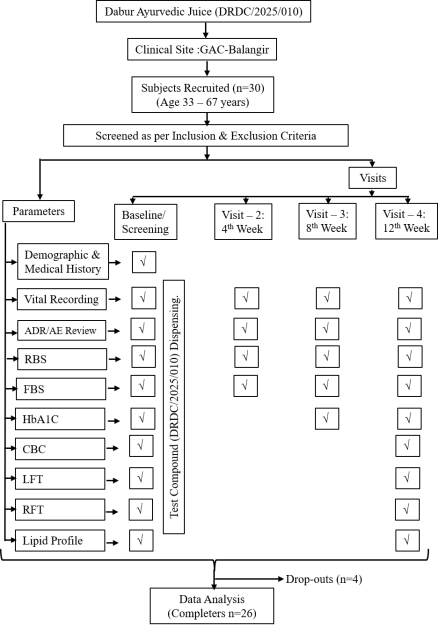
Figure 1. Schematic Flow of Study with Events & Visits. The information of the clinical sites, number of participants, screening through inclusion & exclusion criteria were shown. The events with timelines for follow-up visits and assessment activities was provided.
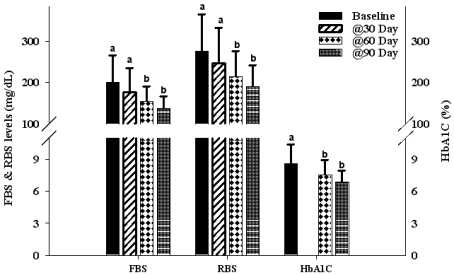
Figure 2. Diabetic Parameters - FBS, RBS & HbA1C levels. Bars represent mean±SD of FBS, RBS & HbA1C levels of the participants at different time points. Differ-ent superscripts indicated significantly difference from baseline to end of treatment. HbA1C levels were as-sessed at baseline, 30 days, 60 days and 90 days.
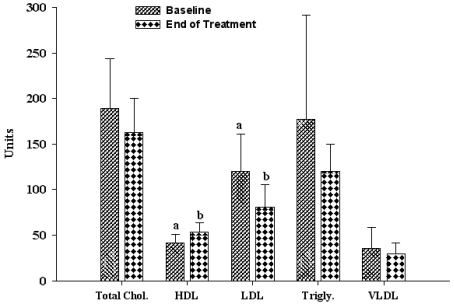
Figure 3. Lipid Profile of Participants – Total Cholesterol, HDL, LDL, Triglycerides, VLDL. Bars represent mean±SD of Total Cholesterol, HDL, LDL, Triglycerides, VLDL levels of the participants. Different superscripts indicated significantly difference from baseline to end of treatment. The lipid profile was assessed at baseline and at end of treatment (90 days).
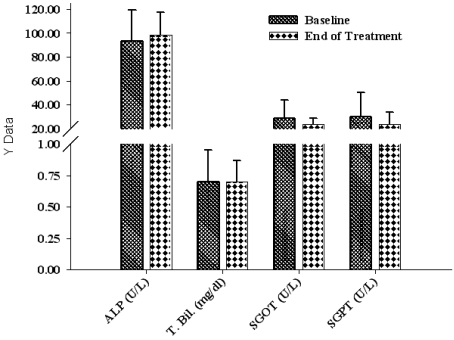
Figure 4. Liver Function Assessment of Participants – ALP, Total Bilirubin, SGPT, SGOT. Bars represent mean±SD of ALP, Total Bilirubin, SGPT, SGOT levels of the participants. Different superscripts indicated significantly difference from baseline to end of treatment. The lipid profile was assessed at baseline and at end of treatment (90 days).
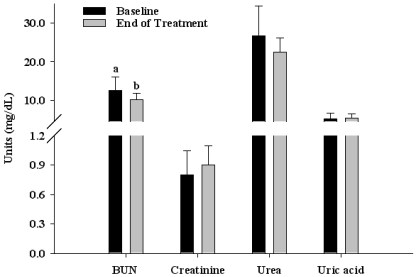
Figure 5. Renal Function Assessment of Participants – BUN, Creatinine, Urea, Uric Aci Bars represent mean±SD of BUN, Creatinine, Urea, Uric Acid levels of the participants. Different super-scripts indicated significantly difference from baseline to end of treatment. The lipid profile was assessed at baseline and at end of treatment (90 days).

Information


 Share This Article
 Twitter
 Linked In
 Facebook
 Copy
Copy Download