
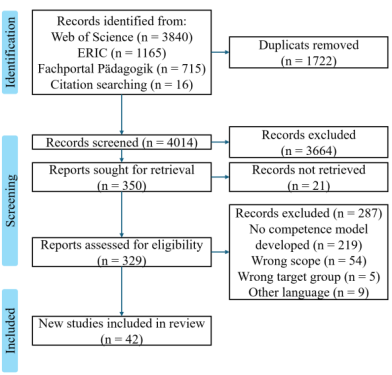
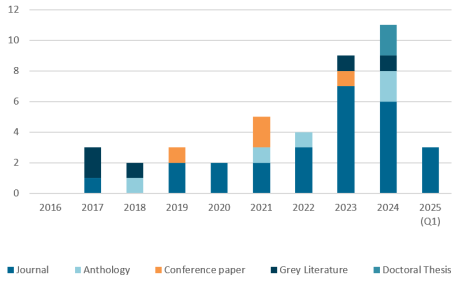
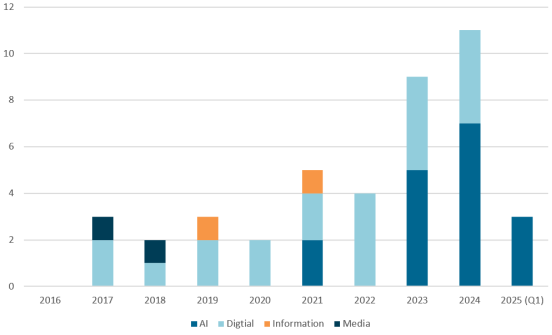
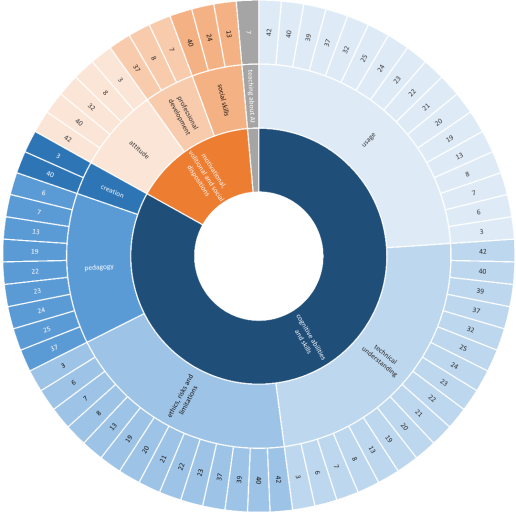
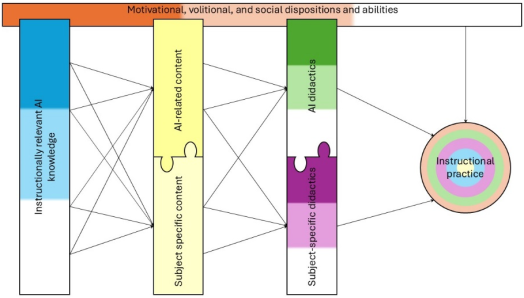
The increasing integration of AI into educational practice places new demands on teachers and requires an expanded, systematically grounded competence profile. While numerous studies address AI in education, a structured overview of existing AI-related competence models for teacher education remains lacking. This scoping review aims to systematically examine and synthesise competence models that address AI-related competences for teachers, with a particular focus on their conceptual foundations and competence dimensions. Therefore, a scoping review was conducted across three databases (Web of Science, ERIC, and Fachportal Pädagogik). Forty-two studies published between 2016 and March 2025 were included, of which seventeen explicitly focus on AI. Both independently developed competence models and adapted frameworks, including those based on TPACK or DPaCK, were analysed using a deductive-inductive qualitative content analysis grounded in Weinert’s competence definition with the help of Rayyan and MAXQDA. The results reveal a strong emphasis on cognitive competence dimensions, particularly technical understanding of AI systems, ethical reflection, and the pedagogical use of AI tools. In contrast, motivational, volitional, and social dimensions, as well as explicit competences related to teaching about AI, are scarcely addressed. Additionally, few models provide a coherent structure that integrates AI as both a teaching tool and a curricular subject. Based on these findings, the paper proposes a conceptual, layered competence model that integrates (1) instructionally relevant AI knowledge, (2) AI-related curricular content, (3) a distinct dimension of AI didactics focused on teaching about AI, (4) subject-specific didactics, and (5) transversal motivational, volitional, and social dispositions, complemented by progression levels. This model offers a structured foundation for curriculum design, teacher education, and future empirical validation of AI-related teacher competences.
| Published in | Education Journal (Volume 15, Issue 3) |
| DOI | 10.11648/j.edu.20261503.12 |
| Page(s) | 113-132 |
| Creative Commons |
This is an Open Access article, distributed under the terms of the Creative Commons Attribution 4.0 International License (http://creativecommons.org/licenses/by/4.0/), which permits unrestricted use, distribution and reproduction in any medium or format, provided the original work is properly cited. |
| Copyright |
Copyright © The Author(s), 2026. Published by Science Publishing Group |
AI-related Competence, Competence Model, Teacher Education, Systematic Literature Review
Inclusion | Exclusion |
|---|---|
Studies on competence models for teachers | Publications without development of a competence model |
Publications focusing on AI-specific competences (including outside education if transferable) | Non-educational studies with no AI-related competence focus |
Published 2016 – March 2025 | Models aimed specifically at students or other specific groups |
In German, English, or French | Publications older than 2016 |
Peer-reviewed articles, conference papers, academic theses, or monographs | Languages other than German, English, or French |
Autho | Year | Titel | Field | Publication Type | Main Target Group | Key Message |
|---|---|---|---|---|---|---|
Williams [ 38] | (2024) | Impact. AI: Democratizing AI through K-12 Artificial Intelligence Education | AI | Doctoral Thesis | Students | This framework is a competence model for AI education that integrates conceptual knowledge, practical application and critical reflection. Its goal is to empower students to act as technological change agents who not only understand AI but also engage with it ethically. |
Wu [ 39] | (2024) | Digital Literacy: Evolution, Evaluation and Enhancement. | Digital | Contribution in Blended learning | Teachers | This model comprises five dimensions – from digital awareness to professional development – and aims to prepare educators for a technology-driven educational landscape. It is based on international frameworks but was adapted to the Chinese educational context and validated by experts. |
Yue et al. [4 0] | (2025) | Students as AI Literate Designers: A Pedagogical Framework for Learning and Teaching AI Literacy in Elementary Education | AI | Article in Journal of Research on Technology in Education | Students | The competence model includes AI knowledge, skills, ethics, and attitudes as core competences, supported through an iterative design and research process. Additionally, an exemplary intervention within the SAIL framework is presented. |
Base model | Titlenumber in Appendix |
|---|---|
TPACK by Mishra and Koehler (2006) [ 31] | 3, 6, 13, 19, 23, 24, 25, 32 |
DpaCK by Döbeli Honegger (2021) [ 57], Huwer et al. (2019) [ 49], and Thyssen et al. (2023) [ 29] | 13, 22 |
DigCompEdu by Redecker (2017) [ 19] | 24 |
Partnership for 21st Century Learning (2019) [ 58] | 24 |
Long and Magerko (2020) [ 17] | 40 |
DiKoLAN by Becker et al. (2020) [59] | 13 |
UNESCO (2018) [41] | 37 |
Bloom (1956) [60] | 23, 24, 42 |
Weinert (2014) [ 21] | 32 |
Balfe, Sharples and Wilson (2018) [ 61] | 39 |
Calvani et al. (2008) [ 62] | 39 |
Without a base model | 7, 8, 20, 21 |
AI | Artificial Intelligence |
CK | Content Knowledge |
DigCompEdu | European Framework for the Digital Competence of Educators |
DiKoLan | Digitale Kompetenzen für das Lehramt in den Naturwissenschaften |
DPaCK | Digitality-related Pedagogical and Content Knowledge |
GenAI | Generative Artificial Intelligence |
PCK | Pedagogical Content Knowledge |
PK | Pedagogical Knowledge |
PRISMA | The Preferred Reporting Items for Systematic Reviews and Meta-Analyses |
RQ | Research Question |
TK | Technological Knowledge |
TCK | Technological Content Knowledge |
TPK | Technological Pedagogical Knowledge |
TPACK | Technological Pedagogical and Content Knowledge |
Nr. | Author | Year | Country | Area | Focus |
|---|---|---|---|---|---|
1 | Alarcón, R., Del Jiménez, E. P., Vicente-Yague, M. I. de [ 42] | 2020 | Spain | Digital | Development and validation of DIGIGLO, which considers external factors such as digital resources and adds two further areas. |
2 | Alberti, V., Strauch, A., Brandt, P. [48] | 2022 | Germany | Digital | Relationship between pedagogical and digital skills and representation in a competence model for teachers in adult and continuing education based on the GRETA model |
3 | Ayanwale, M. A., Adelana, O. P., Molefi, R. R., Adeeko, O., Ishola, A. M. [71] | 2024 | South Africa | AI | A quantitative study examining the AI competence of 529 teachers who are not yet established in their profession in areas such as ethics, use, recognition, and creation. |
4 | Borukhovich-Weis, S., Brinda, T., Burovikhina, V., Beißwenger, M., Bulizek, B., Cyra, K., Gryl, I., Tobinski, D., Barkmin, M. In: Passey, D., Leahy, D., Williams, L., Holvikivi, J., Ruohonen, M. (eds.) [75] | 2022 | Germany | Digital | Model of digital skills for teacher training. Integrates teaching with digital media and learning about digitalisation. |
5 | Castañeda, L., Esteve-Mon, F. M., Adell, J., Prestridge, S. [44] | 2022 | Spain | Digital | Qualitative study on a holistic framework for teaching in the digital age based on teachers' perspectives from their professional practice (cross-context, cross-cultural and cross-disciplinary) through interviews with experienced teachers from Australia, Europe, and Latin America. |
6 | Celik, I. [30] | 2023 | Finland | AI | Development of a scale for measuring teachers' AI knowledge by extending the TPACK model to include ethical aspects |
7 | Chiu, T. K. F., Ahmad, Z., Çoban, M. [45] | 2024 | China | AI | Scale development for measuring teachers' self-assessment of their AI competence (TAICS) in schools (K–12). Development of six dimensions: AI knowledge, AI didactics, AI assessment, AI ethics, human-centred education, professional development. |
8 | Delcker, J., Heil, J., Ifenthaler, D. [55] | 2025 | Germany | AI | A study involving 480 vocational schoolteachers examined requirements based on a six-dimensional competence model. The result: competencies vary greatly – there is a need for further training for teachers in education and the workplace. |
9 | Education and Training Foundation [80] | 2023 | England, GB | Digital | The DTPF is a revised competence model for digital teaching that combines pedagogical practice with technology and maps three competence levels. |
10 | Ergül, D. Y., Tasar, M. F. [81] | 2023 | Greece | Digital | The study develops TDiCoS, a valid and reliable scale for self-assessment of teachers' digital competences, based on international standards. |
11 | Falloon, G. [82] | 2020 | Australia | Digital | Expanding digital teaching skills beyond purely technical abilities to a holistic, interdisciplinary understanding that aims at ethical and safe participation in digital environments. |
12 | Herzig, B., Martin, A. In: Ladel, S., Knopf, J., Weinberger, A. (eds.) [51] | 2018 | Germany | Media | Competence structure model with three parts: media didactics, media education and media-related structural development, whereby beliefs, self-efficacy expectations and technical knowledge are aspects of media education. |
13 | Huwer, J., Becker-Genschow, S., Thyssen, C., Thoms, L.-J., von Kotzebue, L., Finger, A., Kremser, E., Berber, S., Brückner, M., Maurer, N., Bruckermann, T., Meier, M. In: Huwer, J., Becker-Genschow, S., Thyssen, C., Thoms, L.-J., Finger, A., von Kotzebue, L., Kremser, E., Meier, M., Bruckermann, T. (eds.) [28] | 2024 | Switzerland | AI | The DiKoLANKI competence model operationalises AI competence in science teaching as eight systematically structured areas of competence, which build on existing digital competence models in terms of content and have been specifically expanded to include AI-specific requirements. |
14 | Huwer, J., Irion, T., Kuntze, S., Schaal, S., Thyssen, C. [49] | 2019 | Switzerland | Digital | Extension of the TPaCK model to the DPaCK model, which considers not only technical knowledge but also pedagogical-didactic and subject-specific didactic competencies. |
15 | INTEF [83] | 2017 | Spain | Digital | The CDCFT consists of five competence areas with a total of twenty-one competencies. Each competence is assigned six competence levels based on the dimensions of knowledge, skills, and attitude. The five competence areas are information and data competence, communication and collaboration, digital content creation, safety and problem solving. |
16 | Jiang, L., Yu, N. [ 47] | 2024 | China | Digital | The TDCM is a comprehensive, theory-based, and empirically validated competence model for teachers at Chinese secondary schools. It integrates ethical, pedagogical, and developmental perspectives and explicitly highlights the promotion of students' digital competence as one of its six core dimensions. |
17 | Joshi, D. R., Neupane, U., Joshi, P. R. [ 84] | 2021 | Nepal | Digital | DEPSWALIC is a competence model that systematically maps the digital competencies of teachers at all levels of education. The model is divided into six competence areas, supplemented by two fundamental cross-cutting dimensions – ethical sensitivity and policy awareness. |
18 | Lameras, P., Arnab, S. [ 85] | 2021 | England, GB | Digital | Development of a competence model for teachers' digital skills; generated from expert interviews with six competence dimensions. |
19 | Lan, G., Feng, X., Du, S., Song, F., Xiao, Q. [ 62] | 2025 | China | AI | Development of the GenAI-TPACK model, which combines technical, pedagogical, and ethical knowledge for the use of generative AI by university lecturers. |
20 | Laupichler, M. C., Aster, A., Haverkamp, N., Raupach, T. [46] | 2023 | Germany | AI | Development of SNAIL, a scale for non-AI-experts with the dimensions Technical Understanding, critical appraisal, and practical usage |
21 | Long, D., Magerko, B. [17] | 2020 | USA | AI | Structuring AI competence into five subject areas, each of which contains specific competence goals and design principles. This is a literature-based, conceptual framework model that does not contain any psychometrically validated dimensions. |
22 | Lorenz, U., Romeike, R. In: Pellet, J.-P., Parriaux, G. (eds.) [56] | 2023 | Germany | AI | Expansion of DPaCK to AI-PACK with new AI-related requirements to support the design of holistic education and study programmes for teaching in the digitally networked ‘AI world,’ which give equal weight to user-oriented, technological, and socio-cultural perspectives. |
23 | Ng, D. T. K., Leung, J. K. L., Chu, S. K. W., Qiao, M. S. [13] | 2021 | China | AI | Exploratory review to conceptualise, define, teach, and evaluate the emerging concept of ‘AI competence’. |
24 | Ng, D. T. K., Leung, J. K. L., Su, J., Ng, R. C. W., Chu, S. K. W. [50] | 2023 | China | AI | Creation of a framework with key areas of expertise: teacher professional engagement, instructional design, content choice and learning competencies. |
25 | Ning, Y., Zhang, C., Xu, B., Zhou, Y., Wijaya, T. T. [72] | 2024 | China | AI | To construct a framework for integrating AI technology education content knowledge, which aims to clarify the complex interrelationships and synergy effects of AI technology, educational methods, and subject-specific content in the field of education. |
26 | Pérez-Escoda, A., García-Ruiz, R., Aguaded, I. [86] | 2019 | Spain | Digital | Development of an integrative competence model for digital competence based on the analysis of five international reference models. The model comprises four developmental dimensions with six overarching competence areas: information management, digital communication, content creation, digital identity, critical thinking, and problem solving. |
27 | Raffaghelli, J. E. In: Gómez Chova, L., López Martínez, A., Candel Torres, I. (eds.) [53] | 2019 | Spain | Infor-mation | Development of a competence model for teachers' data and information competence that ties in with the increasing datafication in the education sector. It consists of six dimensions, ranging from professional data practice to data-based teaching and learning, performance assessment and individual support, to the explicit teaching of data competence to students. |
28 | Reddy, P., Chaudhary, K., Sharma, B., Hussein, S. [87] | 2023 | Fiji | Digital | The competence model comprises six dimensions of digital competence: information competence, media competence, communication competence, visual competence, technology competence and computer competence. Each of these dimensions has been operationalised through specific skills. |
29 | Redecker, C. [19] | 2017 | Luxembourg | Digital | Development of a Europe-wide competence framework (DigCompEdu) for teachers' digital competences with the aim of promoting professional digital competences in all relevant areas. |
30 | Rozali, M. Z., Hong, G. C., Samshul, S. N., Ismail, A., Zakaria, A. F. [88] | 2014 | Malaysia | Digital | Validation of a digital competence framework (‘DIGIGLO’) for design and technology teachers in primary schools with the aim of assessing digital competences, identifying further training needs, and providing targeted teacher training. |
31 | Rubach, C., Lazarides, R. [54] | 2021 | USA | Infor-mation | Identification of six dimensions of teachers' fundamental beliefs about information competence. |
32 | Schmidt, J. M.-C. [64] | 2024 | Germany | AI | Development of a structural model for AI-related competence facets of (prospective) teachers in vocational education (dissertation) |
33 | Schultz-Pernice, F., von Kotzebue, L. von, Franke, U., Ascherl, C., Hirner, C., Neuhaus, B. J., Ballis, A., Hauck-Thum, U., Aufleger, M., Romeike, R., Frederking, V., Krommer, A., Haider, M., Schworm, S., Kuhbandner, C., Fischer, F. [52] | 2017 | Germany | Media | The article presents a framework model for media-related core competencies of teachers, which aims at professional lesson planning in a digitalised world. The model distinguishes between teachers' own media competencies and media-related teaching competencies, each of which is divided into a knowledge component and an action component. |
34 | Tang, L., Gu, J., Xu, J. [89] | 2022 | China | Digital | Creation of a reliable self-evaluation framework for the DC of teachers in service during online teaching; collection of data from 1,342 teachers with experience in online teaching; results: the constructed evaluation framework is consistent with the collected data. |
35 | Tondeur, J., Howard, S., van Zanten, M., Gorissen, P., van der Neut, I., Uerz, D., Kral, M. [73] | 2023 | Belgium | Digital | Development and validation of a framework for digital competences for teachers in higher education; The new framework covers four dimensions of teachers' digital competences: teaching practice, empowering students for a digital society, teachers' digital competence and teachers' professional development. |
36 | UNESCO [41] | 2018 | France | Digital | Definition of core digital competencies for teachers worldwide; combines digital technologies with pedagogical practice, aims at professional development and teaching improvement, and is aligned with global educational goals. |
37 | UNESCO [70] | 2024 | France | AI | First global AI competence framework for teachers introduced by UNESCO: defines which AI competencies are necessary for ethical, effective use in teaching, learning and assessment. |
38 | Vogel, S., Yadav, A., Phelps, D., Patel, A. [74] | 2024 | USA | Digital | The EnCITE framework model for integrating computer science and digital technologies into teacher training addresses technological, pedagogical, ideological, political, and developmental challenges. |
39 | Wang, B., Rau, P.-L. P., Yuan, T. [34] | 2023 | China | AI | Development of a quantitative scale to obtain accurate data on the AI competence of normal users by identifying primary core constructs of AI competence, including awareness, use, evaluation, and ethics. |
40 | Williams, R. [38] | 2024 | England, GB | AI | Investigation into how AI can be used in secondary education. The aim is to teach pupils AI skills at an early stage in order to promote participation, ethical awareness, and social engagement. |
41 | Wu, D. In: Ma, W. W. K., Chen, L., Fan, C. W., U, L. H., Lu, A. (eds.) [39] | 2024 | China | Digital | Development of a digital competence model for teachers. The model comprises five dimensions: digital awareness, technological knowledge and skills, digital application in teaching, digital social responsibility, and professional development through digital learning and innovation. |
42 | Yue, M., Jong, M. S.-Y., Dai, Y., Lau, W. W.-F. [40] | 2025 | China | AI | Development of a competence model for students (SAIL), whereby AI knowledge, skills, ethics, and attitudes are regarded as basic competencies that are strengthened through an iterative process of design and research. |
| [1] |
European Commission, Eurostat: Artificial intelligence by size class of enterprise.
http://data.europa.eu/88u/dataset/ifqsnnsxjtn8a536akg4a Accessed 2 June 2025. |
| [2] | Gillespie, N., Lockey, S., Ward, T., Macdade, A., Hassed, G.: Trust, attitudes and use of artificial intelligence: A global study 2025 (2025). |
| [3] |
European Parliament and Council: Regulation (EU) 2024/1689. EU AI Act. Official Journal of the European Union L 2024/1689, Article 4.
http://data.europa.eu/eli/reg/2024/1689/oj/1689 Accessed 30 May 2025. |
| [4] |
Council of Europe, Commissioner for Human Rights: Unboxing Artificial Intelligence: 10 steps to protect Human Rights.
https://rm.coe.int/unboxing-artificial-intelligence-10-steps-to-protect-human-rights-reco/1680946e64 Accessed 30 May 2025. |
| [5] |
Kultusministerkonferenz (KMK): Handlungsempfehlung für die Bildungsverwaltung zum Umgang mit Künstlicher Intelligenz in schulischen Bildungsprozessen. Beschluss der Bildungsministerkonferenz vom 10.10.2024.
https://www.kmk.org/fileadmin/veroeffentlichungen_beschluesse/2024/2024_10_10-Handlungsempfehlung-KI.pdf Accessed 4 April 2025. |
| [6] |
UNESCO: Recommendation on the Ethics of Artificial Intelligence. United Nations Educational, Scientific and Cultural Organization, Paris.
https://unesdoc.unesco.org/ark:/48223/pf0000381137 Accessed 27 April 2026. |
| [7] |
Bundesministerium für Bildung und Forschung (BMBF): BMBF-Aktionsplan "Künstliche Intelligenz".
https://www.bmftr.bund.de/SharedDocs/Downloads/DE/2023/230823-executive-summary-ki-aktionsplan.pdf?__blob=publicationFile&v=1 Accessed 27 April 2026. |
| [8] | Hattie, J.: Visible learning, the sequel. A synthesis of over 2,100 meta-analyses relating to achievement. Routledge Taylor & Francis Group, London, New York (2023). |
| [9] |
Jaschke, S., Klusch, M., Krupka, D., Losch, D., Michaeli, T., Opel, S., Schmid, U., Schwarz, R., Seegerer, S., Stechert, P.: Positionspapier der Gesellschaft für Informatik e.V. (GI): Künstliche Intelligenz in der Bildung. Gesellschaft für Informatik, Bonn (2023).
https://dl.gi.de/server/api/core/bitstreams/7c533204-8a9e-4436-91a8-069b7d74fc8d/content Accessed 27 April 2026. |
| [10] | Seyferth-Zapf, C., Mikula, L., Ehmann, M.: Förderung KI-bezogener Kompetenzen bei Lehramtsstudierenden. Praxis- und theorieorientierte Entwicklung und Evaluation eines hochschuldidaktischen Konzepts. Journal für Allgemeine Didaktik (2025). |
| [11] | Schmidt, J. M.-C.: Grundlagenwissen Zu Künstlicher Intelligenz Von Angehenden Lehrkräften. Modellbasierte Testentwicklung und Validierung. wbv, Bielefeld (2024). |
| [12] | Lameras, P., Moumoutzis, N.: Towards the Development of a Digital Competency Framework for Digital Teaching and Learning. In: 2021 IEEE Global Engineering Education, pp. 1226–1232 (2021). |
| [13] | Ng, D. T. K., Leung, J. K. L., Chu, S. K. W., Qiao, M. S.: Conceptualizing AI literacy: An exploratory review. Computers and Education: Artificial Intelligence (2021). |
| [14] | Sperling, K., Stenberg, C.-J., McGrath, C., Åkerfeldt, A., Heintz, F., Stenliden, L.: In search of artificial intelligence (AI) literacy in teacher education: A scoping review. Computers and Education Open (2024). |
| [15] | Lintner, T.: A systematic review of AI literacy scales. NPJ science of learning (2024). |
| [16] | Mak, S., Thomas, A.: Steps for Conducting a Scoping Review. Journal of graduate medical education (2022). |
| [17] | Long, D., Magerko, B.: What is AI Literacy? Competencies and Design Considerations. In: Proceedings of the CHI 2020 (2020). |
| [18] | OECD: The PISA 2003 assessment framework. Mathematics, reading, science and problem solving knowledge and skills. OECD Publishing, Paris (2004). |
| [19] | Redecker, C.: European framework for the digital competence of educators: DigCompEdu. Publications Office of the European Union, Luxemburg (2017). |
| [20] | Weinert, F. E.: Concept of competence: A conceptual clarification. In: Rychen, D. S., Salganik, L. H. (eds.) Defining and selecting key competencies, pp. 45–65. Hogrefe & Huber Publishers (2001). |
| [21] | Weinert, F. E.: Vergleichende Leistungsmessung in Schulen - eine umstrittene Selbstverständlichkeit. In: Weinert, F. E. (ed.) Leistungsmessungen in Schulen, 3rd edn., pp. 17–31. Beltz, Weinheim, Basel (2014). |
| [22] | Le Deist, F. D., Winterton, J.: What Is Competence? Human Resource Development International (2005). |
| [23] | Janssen, J., Stoyanov, S., Ferrari, A., Punie, Y., Pannekeet, K., Sloep, P.: Experts' views on digital competence: Commonalities and differences. Computers & Education (2013). |
| [24] | Levac, D., Colquhoun, H., O'Brien, K. K.: Scoping studies: advancing the methodology. Implementation science: IS (2010). |
| [25] | Page, M. J., McKenzie, J. E., Bossuyt, P. M., Boutron, I., Hoffmann, T. C., Mulrow, C. D., Shamseer, L., Tetzlaff, J. M., Akl, E. A., Brennan, S. E., Chou, R., Glanville, J., Grimshaw, J. M., Hróbjartsson, A., Lalu, M. M., Li, T., Loder, E. W., Mayo-Wilson, E., McDonald, S., McGuinness, L. A., Stewart, L. A., Thomas, J., Tricco, A. C., Welch, V. A., Whiting, P., Moher, D.: The PRISMA 2020 statement: an updated guideline for reporting systematic reviews. BMJ (Clinical research ed.) (2021). |
| [26] | Arksey, H., O'Malley, L.: Scoping studies: towards a methodological framework. International Journal of Social Research Methodology (2005). |
| [27] | Tricco, A. C., Lillie, E., Zarin, W., O'Brien, K. K., Colquhoun, H., Levac, D., Moher, D., Peters, M. D. J., Horsley, T., Weeks, L., Hempel, S., Akl, E. A., Chang, C., McGowan, J., Stewart, L., Hartling, L., Aldcroft, A., Wilson, M. G., Garritty, C., Lewin, S., Godfrey, C. M., Macdonald, M. T., Langlois, E. V., Soares-Weiser, K., Moriarty, J., Clifford, T., Tunçalp, Ö., Straus, S. E.: PRISMA Extension for Scoping Reviews (PRISMA-ScR): Checklist and Explanation. Annals of internal medicine (2018). |
| [28] | Huwer, J., Becker-Genschow, S., Thyssen, C., Thoms, L.-J., von Kotzebue, L., Finger, A., Kremser, E., Berber, S., Brückner, M., Maurer, N., Bruckermann, T., Meier, M.: Kompetenzen für den Unterricht mit und über Künstliche Intelligenz in den Naturwissenschaften: DiKoLANKI. In: Huwer, J., Becker-Genschow, S., Thyssen, C., Thoms, L.-J., Finger, A., von Kotzebue, L., Kremser, E., Meier, M., Bruckermann, T. (eds.) Kompetenzen für den Unterricht mit und über Künstliche Intelligenz. Perspektiven, Orientierungshilfen und Praxisbeispiele für die Lehramtsausbildung in den Naturwissenschaften, pp. 4–59. Waxmann Verlag GmbH (2024). |
| [29] | Thyssen, C., Huwer, J., Irion, T., Schaal, S.: From TPACK to DPACK: The “Digitality-Related Pedagogical and Content Knowledge”-Model in STEM-Education. Education Sciences (2023). |
| [30] | Celik, I.: Towards Intelligent-TPACK: An empirical study on teachers’ professional knowledge to ethically integrate artificial intelligence (AI)-based tools into education. Computers in Human Behaviour (2023). |
| [31] | Mishra, P., Koehler, M. J.: Technological Pedagogical Content Knowledge: A Framework for Teacher Knowledge. Teachers College Record: The Voice of Scholarship in Education (2006). |
| [32] | Krell, C., Lamnek, S.: Qualitative Sozialforschung. Mit Online-Material. Julius Beltz GmbH & Co. KG, Weinheim (2024). |
| [33] | Ouzzani, M., Hammady, H., Fedorowicz, Z., Elmagarmid, A.: Rayyan-a web and mobile app for systematic reviews. Systematic reviews (2016). |
| [34] | Karataş, F., Ataç, B. A.: When TPACK meets artificial intelligence: Analyzing TPACK and AI-TPACK components through structural equation modelling. Education and information technologies (2025). |
| [35] | Wimmer, R. D., Dominick, J. R.: Mass media research. An introduction. Wadsworth series in mass communication and journalism. Cengage, Boston, MA (2014). |
| [36] | Landis, J. R., Koch, G. G.: The Measurement of Observer Agreement for Categorical Data. Biometrics (1977). |
| [37] | Kuckartz, U., Rädiker, S.: Qualitative Inhaltsanalyse. Methoden, Praxis, Umsetzung mit Software und künstlicher Intelligenz, 6th edn. Juventa Verlag, Weinheim (2024). |
| [38] |
Williams, R.: Impact. AI: Democratizing AI through K-12 Artificial Intelligence Education. Dissertation, Massachusetts Institute of Technology.
https://www.media.mit.edu/publications/impact-ai-thesis/ Accessed 27 April 2026. |
| [39] |
Wu, D.: Digital Literacy: Evolution, Evaluation and Enhancement. In: Ma, W. W. K., Chen, L., Fan, C. W., U, L. H., Lu, A. (eds.) Blended learning. Intelligent computing in education: 17th international conference on blended learning, ICBL 2024, Macao SAR, China, July 29-August 1, 2024: proceedings, pp. 62–74. Springer, Singapore (2024).
HYPERLINK "
https://doi.org/10.1007/978-981-97-4442-8_5" https://doi.org/10.1007/978-981-97-4442-8_5 |
| [40] | Yue, M., Jong, M. S.-Y., Dai, Y., Lau, W. W.-F.: Students as AI literate designers: a pedagogical framework for learning and teaching AI literacy in elementary education. Journal of Research on Technology in Education (2025). |
| [41] |
UNESCO: UNESCO ICT Competency Framework for Teachers. United Nations Educational, Scientific and Cultural Organization, Paris. (2018).
https://unesdoc.unesco.org/ark:/48223/pf0000265721 Accessed 27 April 2026. |
| [42] | Alarcón, R., Del Jiménez, E. P., Vicente-Yague, M. I. de: Development and validation of the DIGIGLO, a tool for assessing the digital competence of educators. British Journal of Educational Technology (2020). |
| [43] | Wang, B., Rau, P.-L. P., Yuan, T.: Measuring user competence in using artificial intelligence: validity and reliability of artificial intelligence literacy scale. Behaviour & Information Technology (2023). |
| [44] | Castañeda, L., Esteve-Mon, F. M., Adell, J., Prestridge, S.: International insights about a holistic model of teaching competence for a digital era: the digital teacher framework reviewed. European Journal of Teacher Education (2022). |
| [45] | Chiu, T. K. F., Ahmad, Z., Çoban, M.: Development and validation of teacher artificial intelligence (AI) competence self-efficacy (TAICS) scale. Education and information technologies (2024). |
| [46] | Laupichler, M. C., Aster, A., Haverkamp, N., Raupach, T.: Development of the “Scale for the assessment of non-experts’ AI literacy” – An exploratory factor analysis. Computers in Human Behavior Reports (2023). |
| [47] | Jiang, L., Yu, N.: Developing and validating a Teachers’ Digital Competence Model and Self-Assessment Instrument for secondary school teachers in China. Education and information technologies (2024). |
| [48] | Alberti, V., Strauch, A., Brandt, P.: Digitale Kompetenzen Lehrender. Zur Möglichkeit ihrer Integration in Modelle generisch pädagogischer Kompetenzen am Beispiel von GRETA. Magazin Erwachsenenbildung. at (2022). |
| [49] | Huwer, J., Irion, T., Kuntze, S., Schaal, S., Thyssen, C.: Von TPaCK zu DPaCK. Digitalisierung im Unterricht erfordert mehr als technisches Wissen. MNU Journal 72, 358–364 (2019). |
| [50] | Ng, D. T. K., Leung, J. K. L., Su, J., Ng, R. C. W., Chu, S. K. W.: Teachers' AI digital competencies and twenty-first century skills in the post-pandemic world. Educational Technology Research and Development (2023). |
| [51] | Herzig, B., Martin, A.: Lehrerbildung in der digitalen Welt. In: Ladel, S., Knopf, J., Weinberger, A. (eds.) Digitalisierung und Bildung, pp. 89–113. Springer VS, Wiesbaden (2018). |
| [52] | Schultz-Pernice, F., von Kotzebue, L. von, Franke, U., Ascherl, C., Hirner, C., Neuhaus, B. J., Ballis, A., Hauck-Thum, U., Aufleger, M., Romeike, R., Frederking, V., Krommer, A., Haider, M., Schworm, S., Kuhbandner, C., Fischer, F.: Kernkompetenzen von Lehrkräften für das Unterrichten in einer digitalisierten Welt. Medien + Erziehung (2017). |
| [53] | Raffaghelli, J. E.: Developing a Framework for Educators’ Data Literacy in the European context: Proposal, Implications and Debate. In: Gómez Chova, L., López Martínez, A., Candel Torres, I. (eds.) EDULEARN19 Proceedings. 11th International Conference on Education and New Learning Technologies, Palma, Spain, 7/1/2019 - 7/3/2019, pp. 10520–10530. IATED (2019). |
| [54] | Rubach, C., Lazarides, R.: Addressing 21st-century digital skills in schools – Development and validation of an instrument to measure teachers' basic ICT competence beliefs. Computers in Human Behaviour (2021). |
| [55] | Delcker, J., Heil, J., Ifenthaler, D.: Evidence-based development of an instrument for the assessment of teachers’ self-perceptions of their artificial intelligence competence. Educational Technology Research and Development (2025). |
| [56] | Lorenz, U., Romeike, R.: What Is AI-PACK? – Outline of AI Competencies for Teaching with DPACK. In: Pellet, J.-P., Parriaux, G. (eds.) Informatics in Schools. Beyond Bits and Bytes: Nurturing Informatics Intelligence in Education. 16th International Conference on Informatics in Schools: Situation, Evolution, and Perspectives, pp. 13–25. Springer Nature Switzerland; Imprint Springer, Cham (2023). |
| [57] | Döbeli Honegger, B.: Covid-19 und die digitale Transformation in der Schweizer Lehrerinnen- und Lehrerbildung. Beiträge zur Lehrerinnen- und Lehrerbildung (2021). |
| [58] |
Partnership for 21st Century Learning: Framework for 21st Century Learning Definitions.
https://static.battelleforkids.org/documents/p21/P21_Framework_DefinitionsBFK.pdf Accessed 8 July 2025. |
| [59] | Becker, S., Bruckermann, T., Finger, A., Huwer, J., Kremser, E., Meier, M., Thoms, L.-J., Thyssen, C., von Kotzebue, L.: Orientierungsrahmen Digitale Kompetenzen für das Lehramt in den Naturwissenschaften – DiKoLAN. In: Becker, S., Meßinger-Koppelt, J., Thyssen, C. (eds.) Digitale Basiskompetenzen. Orientierungshilfe und Praxisbeispiele für die universitäre Lehramtsausbildung in den Naturwissenschaften, pp. 14–43. Joachim Herz Stiftung, Hamburg (2020) |
| [60] | Bloom, B. S.: Taxonomy of educational objectives, 1st edn. Cognitive domain, Handbook 1. McKay, New York (1956). |
| [61] | Balfe, N., Sharples, S., Wilson, J. R.: Understanding Is Key: An Analysis of Factors Pertaining to Trust in a Real-World Automation System. Human factors (2018). |
| [62] | Calvani, A., Cartelli, A., Fini, A., Ranieri, M.: Models and Instruments for assessing Digital Competence at School. Journal of e-Learning (2008). |
| [63] | Lan, G., Feng, X., Du, S., Song, F., Xiao, Q.: Integrating ethical knowledge in generative AI education: constructing the GenAI-TPACK framework for university teachers’ professional development. Education and information technologies (2025). |
| [64] | Schmidt, D. A., Baran, E., Thompson, A. D., M ishra, P., Koehler, M. J., Shin, T. S.: Technological Pedagogical Content Knowledge (TPACK). Journal of Research on Technology in Education (2009). |
| [65] | Koehler, M. J., Mishra, P., Cain, W.: What is Technological Pedagogical Content Knowledge (TPACK)? Journal of Education (2013). |
| [66] | Frederking, V.: Von TPACK und DPACK zu SEPACK. digital. Ein Alternativmodell für fachdidaktisches Wissen in der digitalen Welt nebst einigen Anmerkungen zu blinden Flecken und Widersprüchen in den KMK-Initiativen zur digitalen Bildung in Deutschland. In: Frederking, V., Romeike, R. (eds.) Fachliche Bildung in der digitalen Welt. Digitalisierung, Big Data und KI im Forschungsfokus von 15 Fachdidaktiken. Allgemeine Fachdidaktik Band 3, vol. 14. Fachdidaktische Forschungen, pp. 481–522. Waxmann, Münster/New York (2022). |
| [67] | Brinda, T., Brüggen, N., Diethelm, I., Knaus, T., Kommer, S., Kopf, C., Missomelius, P., Leschke, R., Tilemann, F., Weich, A.: Frankfurt-Dreieck zur Bildung in der digital vernetzten Welt. Ein interdisziplinäres Modell. In: Knaus, T., Merz, O. (eds.) Schnittstellen und Interfaces. Digitaler Wandel in Bildungseinrichtungen, pp. 157–167. kopaed, München (2020). |
| [68] | Weich, A.: Das „Frankfurt-Dreieck“. Medienimpulse, Bd. 57 Nr. 2 (2019): 2/2019 - Freies Heft (2019). |
| [69] | González-Mujico, F. d. L.: Measuring student and educator digital competence beyond self-assessment: Developing and validating two rubric-based frameworks. Education and information technologies (2024). |
| [70] | UNESCO: AI competency framework for teachers. United Nations Educational, Scientifi c and Cultural Organization, Paris (2024). |
| [71] | Ayanwale, M. A., Adelana, O. P., Molefi, R. R., Adeeko, O., Ishola, A. M.: Examining artificial intelligence literacy among pre-service teachers for future classrooms. Computers and Education Open (2024). |
| [72] | Ning, Y., Zhang, C., Xu, B., Zhou, Y., Wijaya, T. T.: Teachers’ AI-TPACK: Exploring the Relationship between Knowledge Elements. Sustainability (2024). |
| [73] | Tondeur, J., Howard, S., van Zanten, M., Gorissen, P., van der Neut, I., Uerz, D., Kral, M.: The HeDiCom framework: Higher Education teachers' digital competencies for the future. Educational Technology Research and Development (2023). |
| [74] | Vogel, S., Yadav, A., Phelps, D., Patel, A.: Entrypoints for Integrating Computing and Tech into Teacher Education: Addressing Problems and Opportunities with the EnCITE Framework. Journal of Technology and Teacher Education (2024). |
| [75] | Borukhovich-Weis, S., Brinda, T., Burovikhina, V., Beißwenger, M., Bulizek, B., Cyra, K., Gryl, I., Tobinski, D., Barkmin, M.: An Integrated Model of Digitalisation-Related Competencies in Teacher Education. In: Passey, D., Leahy, D., Williams, L., Holvikivi, J., Ruohonen, M. (eds.) Digital Transformation of Education and Learning - Past, Present and Future. OCCE 2021. IFIP Advances in Information and Communication Technology, vol. 642, pp. 3–14. Springer, Cham (2022). |
| [76] | European Commission: AI report. by the European Digital Education Hub’s Squad on Artificial. Publications Office of the European Union (2023). |
| [77] | Kattmann, U., Duit, R., Gropengießer, H., Komorek, M.: Das Modell der Didaktischen Rekonstruktion - Ein Rahmen für naturwissenschaftsdidaktische Forschung und Entwicklung. Zeitschrift für Didaktik der Naturwissenschaften: ZfDN (1997). |
| [78] | Diethelm, I., Dörge, C., Mesaros, A.-M., Dünnebier, M.: Die Didaktische Rekonstruktion für den Informatikunterricht. In: Thomas, M. (ed.) Informatik in Bildung und Beruf. 14. GI-Fachtagung "Informatik und Schule - INFOS 2011", pp. 77–86. Gesellschaft für Informatik, Bonn (2011). |
| [79] | Mikula, L.: Entwicklung und Operationalisierung eines Kompetenzmodells für Lehrkräfte zum Lehren und Lernen mit und über KI. Posterpräsentation, Frühjahrstagung der Sektion Medienpädagogik (DGfE), 19.-20. März 2025, Universität Rostock, Deutschland, 2025. |
| [80] |
Education and Training Foundation: Digital Teaching Professional Framework. Taking Learning to the Next Level. JISC, London.
https://www.et-foundation.co.uk/news/etf-launches-updated-digital-teaching-professional-framework/ Accessed 17 March 2025. |
| [81] | Ergül, D. Y., Tasar, M. F.: Development and Validation of the Teachers' Digital Competence Scale (TDiCoS). Journal of Learning and Teaching in Digital Age (2023). |
| [82] | Falloon, G.: From digital literacy to digital competence: the teacher digital competency (TDC) framework. Educational Technology Research and Development (2020). |
| [83] | INTEF: Common Digital Competence Framework for Teachers – October 2017 (2017). |
| [84] | Joshi, D. R., Neupane, U., Joshi, P. R.: Synthesis Review of Digital Frameworks and DEPSWALIC Digital Competency Framework for Teachers from Basic to University Level. Mathematics Teaching-Research Journal (2021). |
| [85] | Lameras, P., Arnab, S.: Power to the Teachers: An Exploratory Review on Artificial Intelligence in Education. Information (2022). |
| [86] | Pérez-Escoda, A., García-Ruiz, R., Aguaded, I.: Dimensions of digital literacy based on five models of development. Culture and Education (2019). |
| [87] | Reddy, P., Chaudhary, K., Sharma, B., Hussein, S.: Essaying the design, development and validation processes of a new digital literacy scale. Online Information Review (2023). |
| [88] | Rozali, M. Z., Hong, G. C., Samshul, S. N., Ismail, A., Zakaria, A. F.: A New Digital Competence Framework for Primary School Design and Technology Teachers. Journal of Technical Education and Training (2024). |
| [89] | Tang, L., Gu, J., Xu, J.: Constructing a Digital Competence Evaluation Framework for In-Service Teachers’ Online Teaching. Sustainability (2022). |
APA Style
Mikula, L. (2026). Towards a Comprehensive Model of AI-related Competences for Teachers: Insights from a Scoping Literature Review. Education Journal, 15(3), 113-132. https://doi.org/10.11648/j.edu.20261503.12
ACS Style
Mikula, L. Towards a Comprehensive Model of AI-related Competences for Teachers: Insights from a Scoping Literature Review. Educ. J. 2026, 15(3), 113-132. doi: 10.11648/j.edu.20261503.12
@article{10.11648/j.edu.20261503.12,
  author = {Luca Mikula},
  title = {Towards a Comprehensive Model of AI-related Competences for Teachers: Insights from a Scoping Literature Review},
  journal = {Education Journal},
  volume = {15},
  number = {3},
  pages = {113-132},
  doi = {10.11648/j.edu.20261503.12},
  url = {https://doi.org/10.11648/j.edu.20261503.12},
  eprint = {https://article.sciencepublishinggroup.com/pdf/10.11648.j.edu.20261503.12},
  abstract = {The increasing integration of AI into educational practice places new demands on teachers and requires an expanded, systematically grounded competence profile. While numerous studies address AI in education, a structured overview of existing AI-related competence models for teacher education remains lacking. This scoping review aims to systematically examine and synthesise competence models that address AI-related competences for teachers, with a particular focus on their conceptual foundations and competence dimensions. Therefore, a scoping review was conducted across three databases (Web of Science, ERIC, and Fachportal Pädagogik). Forty-two studies published between 2016 and March 2025 were included, of which seventeen explicitly focus on AI. Both independently developed competence models and adapted frameworks, including those based on TPACK or DPaCK, were analysed using a deductive-inductive qualitative content analysis grounded in Weinert’s competence definition with the help of Rayyan and MAXQDA. The results reveal a strong emphasis on cognitive competence dimensions, particularly technical understanding of AI systems, ethical reflection, and the pedagogical use of AI tools. In contrast, motivational, volitional, and social dimensions, as well as explicit competences related to teaching about AI, are scarcely addressed. Additionally, few models provide a coherent structure that integrates AI as both a teaching tool and a curricular subject. Based on these findings, the paper proposes a conceptual, layered competence model that integrates (1) instructionally relevant AI knowledge, (2) AI-related curricular content, (3) a distinct dimension of AI didactics focused on teaching about AI, (4) subject-specific didactics, and (5) transversal motivational, volitional, and social dispositions, complemented by progression levels. This model offers a structured foundation for curriculum design, teacher education, and future empirical validation of AI-related teacher competences.},
 year = {2026}
}
TY  - JOUR
T1  - Towards a Comprehensive Model of AI-related Competences for Teachers: Insights from a Scoping Literature Review
AU  - Luca Mikula
Y1  - 2026/05/30
PY  - 2026
N1  - https://doi.org/10.11648/j.edu.20261503.12
DO  - 10.11648/j.edu.20261503.12
T2  - Education Journal
JF  - Education Journal
JO  - Education Journal
SP  - 113
EP  - 132
PB  - Science Publishing Group
SN  - 2327-2619
UR  - https://doi.org/10.11648/j.edu.20261503.12
AB  - The increasing integration of AI into educational practice places new demands on teachers and requires an expanded, systematically grounded competence profile. While numerous studies address AI in education, a structured overview of existing AI-related competence models for teacher education remains lacking. This scoping review aims to systematically examine and synthesise competence models that address AI-related competences for teachers, with a particular focus on their conceptual foundations and competence dimensions. Therefore, a scoping review was conducted across three databases (Web of Science, ERIC, and Fachportal Pädagogik). Forty-two studies published between 2016 and March 2025 were included, of which seventeen explicitly focus on AI. Both independently developed competence models and adapted frameworks, including those based on TPACK or DPaCK, were analysed using a deductive-inductive qualitative content analysis grounded in Weinert’s competence definition with the help of Rayyan and MAXQDA. The results reveal a strong emphasis on cognitive competence dimensions, particularly technical understanding of AI systems, ethical reflection, and the pedagogical use of AI tools. In contrast, motivational, volitional, and social dimensions, as well as explicit competences related to teaching about AI, are scarcely addressed. Additionally, few models provide a coherent structure that integrates AI as both a teaching tool and a curricular subject. Based on these findings, the paper proposes a conceptual, layered competence model that integrates (1) instructionally relevant AI knowledge, (2) AI-related curricular content, (3) a distinct dimension of AI didactics focused on teaching about AI, (4) subject-specific didactics, and (5) transversal motivational, volitional, and social dispositions, complemented by progression levels. This model offers a structured foundation for curriculum design, teacher education, and future empirical validation of AI-related teacher competences.
VL  - 15
IS  - 3
ER  -
Department of Computer Science, University of Bayreuth, Bayreuth, Germany
Biography: Luca Mikula is a researcher at the University of Bayreuth, Department of Computer Science. He completed his Master of Education at the University of Bayreuth in 2024. His research focuses on teacher education and professional development, with a particular emphasis on AI-related competences, digital competence models, and the pedagogical implications of artificial intelligence in education. His work combines systematic literature reviews, qualitative content analysis, and design-oriented educational research to support the development of theoretically grounded and practice-relevant competence frameworks for teachers.
Research Fields: AI-related competences, teacher education, qualitative content analysis, design-oriented educational research, media education competences

Information



 Share This Article
 Twitter
 Linked In
 Facebook
 Copy
Copy Download