Research Article | | Peer-Reviewed

Optimization of Railway Track’s Preventive Maintenance Planning Based on Predicting the Increase in Maximum Defect Sizes (Vigral Method)

Received: 13 April 2026     Accepted: 3 May 2026     Published: 19 May 2026
Views:       Downloads:
Abstract

This article describes a solution for optimization of railway track’s preventive maintenance scheduling. Solution is based on predicting spontaneous increases of maximum defect sizes occurring between two consecutive track measurements. Predictions are made immediately after the latest measurement. The planning of preventive maintenance works is based on periodic measurements of geometric parameters’ values. Changes in the track condition manifest as an increase in the size of "large" defects and a decrease in "small" ones through superposition, and sometimes as an abrupt change in the maximum defect size. The process properties depend on the track's physical condition and the magnitude of train load. This process is associated both with changes in the size of existing defects and with the formation of new ones that exceed the existing ones in size. The abrupt appearance of defects exceeding the current maximum values, occurring at random times between measurements, significantly impacts the track's technical condition and must be considered when planning track maintenance works. Thus, optimizing preventive maintenance work requires obtaining information about the track condition in future immediately after each measurement. The problem of predicting the appearance of defects whose sizes exceed those recorded in the latest measurement has not been studied. Analysis has shown that this phenomenon occurs to varying degrees in 5-10% of track segments, when subsequent measurements register the appearance of new, larger defects that arose in the period between measurements. Information about the possible appearance of such defects allows optimization of the track maintenance process. The method for predicting changes in the track's technical condition described in this article allows, with high reliability, immediately after the latest measurement to predict the appearance, during interval before the next regular measurement, of defects whose sizes exceed the maximum recorded in the latest measurement. The method also allows identifying sudden spontaneous deterioration of the track. The method is based on analyzing the homogeneity (compactness) property of the values of the ISDF. This function shows the cumulative length of each-size track irregularity within a track segment. For classifying results and making decisions, the "nearest neighbor method" is used. The method has been tested for predicting track condition for future periods of 1, 2 and 3 months after the latest measurement. For surface defects, the probability of correctly predicting a spontaneous increase in maximum defect size is within 0.91-0.98 range, and the probability of false positives is between 0.03-0.09.

Published in American Journal of Traffic and Transportation Engineering (Volume 11, Issue 2)
DOI 10.11648/j.ajtte.20261102.11
Page(s) 24-32
Creative Commons

This is an Open Access article, distributed under the terms of the Creative Commons Attribution 4.0 International License (http://creativecommons.org/licenses/by/4.0/), which permits unrestricted use, distribution and reproduction in any medium or format, provided the original work is properly cited.

Copyright

Copyright © The Author(s), 2026. Published by Science Publishing Group

Keywords

Rail Track, Degradation, Track Condition Prediction

1. Current State
Planning of track maintenance works is carried out based on the results of periodic measurements of geometric characteristics, which describe its current technical condition only at the moment of measurement and do not reflect natural changes occurring between regular measurements. Track degradation has a significant impact on traffic safety; therefore, prediction of track degradation occurring between two consecutive measurements is very important in order to guarantee a high level of track technical condition, optimize maintenance schedules, and reduce maintenance costs. The problem is that during this period, there is not only a regular (stationary) change in the values of geometric characteristics, which, as a rule, does not lead to dangerous consequences, but also abrupt changes associated with unpredictable consequences.
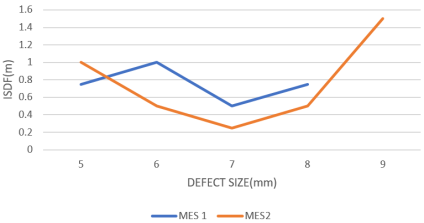
An example of such a phenomenon is shown in Figure 1, which shows the ISDF function values for two consecutive measurements of the same track segment conducted with an interval of 1 month.
Figure 1. Sudden change of maximum defect size.
In the first measurement, the maximum defect size was 8 mm (ISDF=0.75m), and in the second measurement one month later, it was 9 mm (ISDF= 1 m).
A large number of studies have been devoted to the analysis of the process of changing the sizes of defects recorded in the track . It should be noted that all prediction models described in well-known publications describe the behavior of the track with some inaccuracy, the magnitude of which depends on traffic loads, track structural characteristics, environmental factors, etc. Use of this approach is very problematic because of the large number of track parameters and the wide range of values for each parameter. A more realistic approach to solving this problem is considered in study .
As the analysis of the condition of 100 randomly selected track segments showed, defects larger than the maximum emerge in the period between measurements to varying degrees in 5%-10% of segments. Naturally, the spontaneous appearance of defects of critical sizes in the period between measurements can lead to undesirable consequences.
The process of defects superposition and prediction of sudden appearance of defects, larger than those recorded, occurring between measurements, has hardly been studied. The moment of occurrence of such defects is described by a random variable. The process of their occurrence corresponds to the concept of sudden failure used in reliability theory. A general theory for predicting sudden failures does not exist. Track degradation has a significant impact on traffic safety; therefore, prediction of emergence of maximum-size defects between measurements is very important in order to guarantee a high level of track technical condition, optimize maintenance plans, and reduce maintenance costs.
2. Problem Statement
Based on the analysis of the results of measurements of railway track geometric characteristics at time t1, determine whether the value of ISDF(n+1) (see Figure 2) will exceed the established threshold, i.e., divide the ISDF values into two classes according to the presence or absence of a predicted spontaneous increase in the maximum defect size. The analysis procedure is shown in Table 1.
Table 1. Analysis procedure.

IRREGULARITY SIZE (mm)

1

2

3

4

5

6

7

8

9

10

ISDF ACTUAL (m)

m1

m2

m3

m4

m5

m6

m7

m8

m9

0

ISDF CONTROL BASE (m)

n1

n2

n3

n4

n5

n6

n7

n8

n9

MAX PREDICT SIZE VALUE (mm)

PRED MAX

3. Basic Principles
To solve the problem, the property of homogeneity (compactness) of ISDF functions describing the results of consecutive measurements of the track condition over a fixed period of time is used. Sato first pointed out this property, noting the fact that track characteristics tend to gradually return to the values recorded before maintenance works. Lichtberger points out the phenomenon of track memory, which essentially also characterizes the property of homogeneity (compactness) of ISDF functions describing the track condition over time.
These properties indicate that, over time, the track's behavior (in terms of defects) tends to follow predictable patterns, and the consistency of measurements from one cycle to the next is a key factor in ensuring accurate predictions.
Our method is based on the following main principles:
1) only the results of previous measurements are used as baseline information about the track condition, without using a priori models;
2) the ISDF function and its least-squares exponential approximation are used to describe the track condition and its changes;
3) the property of homogeneity of the values of this function for consecutive measurement results over a fixed period of time is used to calculate the predicted values of the ISDF function;
4) the "nearest neighbor method" based on calculating the Euclidean distance for two defect size values is used to classify the obtained calculation results.
4. ISDF Function’s Properties
4.1. General
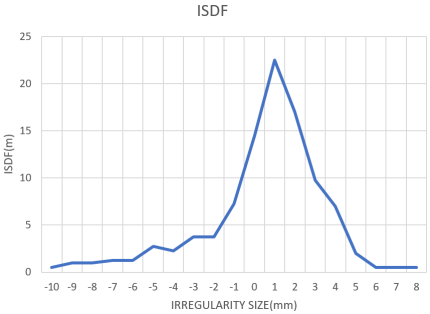
Figure 2. Irregularity size distribution function.
To describe the condition and changes in the geometric parameters of the track over time comprehensively and without distortion, it is necessary to use a function whose values uniquely characterize the process. For a complete and undistorted description of the track condition (unlike SD and TQI parameters) , we have proposed using a function of the original random process (which is comprised by the population of measurement results for each track segment) called the Irregularity Size Distribution Function (ISDF). ISDF shows the cumulative length of each-size track irregularity within a track segment of any fixed length . This function represents the results of direct (not indirect) measurements of the parameters that fully describe the track condition for each defect size.
An example of ISDF for a surface type defect is shown in Figure 2. The horizontal axis shows irregularity sizes, and the vertical axis shows ISDF values.
ISDF contains complete information about the track condition and describes the values of track geometric parameters and their changes over time objectively, unambiguously, without distortion, and with any pre-selected level of accuracy ∆S:
∆S = SI- SI-1(1)
On the graph, this level corresponds to 1 mm.
4.2. Property of Homogeneity (Compactness) of the ISDF Function
A necessary but not sufficient condition for homogeneity is that the samples come from the same population or that the samples represent observations of the same random variable. A sufficient condition for homogeneity is that the samples meet certain criteria. In this study, we analyze the conformity of the functions, which we use for analysis, using the coefficient of variation (CV) and correlation coefficient (CC) criteria.
4.2.1. Coefficient of Variation Criterion
The coefficient of variation shows the degree of data variability in the sample relative to the mean value and is calculated by the formula:
CV = σ / µ(2)
where:
σ is the standard deviation of the sample,
µ is the mean value.
The CV represents a statistical measure of dispersion of data relative to the mean value. Comparing the CV values for two samples allows one to assess their homogeneity.
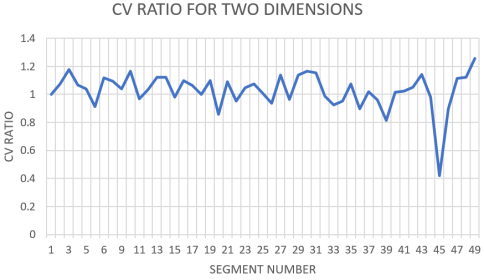
The graph (Figure 3) shows the values of K = CV(n)/CV(n+1) of the ISDF function for two ensembles of measurements of the same randomly selected track segments with a two-month interval. The average K value for 49 measurements is 1.03, and the minimum value exceeds 0.8, indicating a high degree of homogeneity between the realizations. The outlier of the K value for track segment 45 reflects the fact that track maintenance works were carried out in the period between measurements, which naturally disrupts the homogeneity of the samples.
The CV represents a statistical measure of the dispersion of data relative to the mean value. Comparing the CV values for two samples allows one to assess their homogeneity. The average value of the CV RATIO for 30 measurements is 1.03, and the minimum value exceeds 0.8, indicating a high degree of homogeneity between the realizations.
Figure 3. Coefficient of variation.
4.2.2. Correlation Coefficient (CC) Criterion
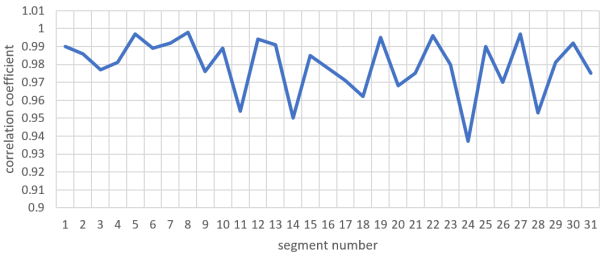
The correlation coefficient (CC) represents a quantitative measure of the statistical relationship between two processes. For this analysis, we used Spearman's rank correlation coefficient. This coefficient ranges from -1 to +1, where the value of +1 indicates a perfect positive correlation between the two processes being studied. Figure 4 shows, as an example, the results of calculating Spearman's correlation coefficient for randomly selected ISDF describing measurement results taken at a two-month interval.
Average CC value for 31 randomly selected ISDF values for two consecutive measurements of the same track segment is 0.979, and the standard deviation is 0.016. This section highlights the importance of using Spearman's rank correlation as a tool for analyzing the consistency of the ISDF function over multiple measurement cycles. A strong correlation is essential for ensuring that predictions of defect growth are based on reliable and consistent data, reinforcing the method's ability to predict unexpected defect changes between routine measurements.
Figure 4. Correlation coefficient.
5. Analytical Process
The analytical process for obtaining predicted ISDF (max) values includes the following stages:
1) calculation of current ISDF function values for each of the track geometric parameters,
2) approximation of the ISDF function using an exponential function by the least squares method,
3) classification of the results.
The calculation of current ISDF function values is performed by discretizing the measurement results over a 0.25-meter interval with a step of 1 mm. An example of presenting measurement results in ISDF format for a 100-meters long track segment for a surface defect type, is shown in Table 2.
Table 2. Measurements’ results in ISDF format.

Defect size (mm)

-11

-10

-9

-8

-7

-6

-5

-4

-3

-2

-1

0

ISDF (mes.1-m)

0,25

0,5

1,25

0,75

1,5

0,5

2,5

2,25

1,5

2,75

6,75

21

ISDF (mes.2-m)

0,5

0,25

1,25

0,75

1,25

1,5

3,25

2,25

2

2,75

9

19,5

To perform the analysis, an approximation of ISDF using an exponential function by the least squares method is used.
ISDF(EXP) = y * exp(g)(3)
where
y is the amplitude of the exponential,
g is the exponent index.
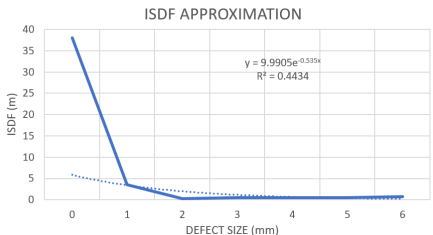
Figures 5 and 6 show examples of the exponential approximation function of ISDF values for maximum defect sizes of 6 mm and 10 mm respectively. As can be seen from the figures, the exponential values in the region of maximum defect sizes practically coincide with the real ones, which allows for effective use of the results in the analysis.
The efficiency of the approximation is described by the coefficient of determination R².
Figure 5. Example of ISDF function approximation.
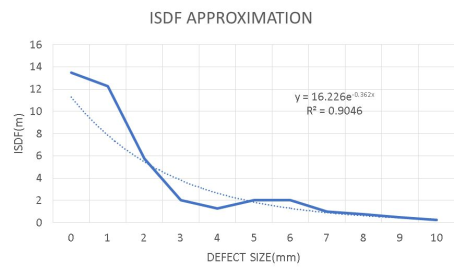
Figure 6. Example of ISDF function approximation.
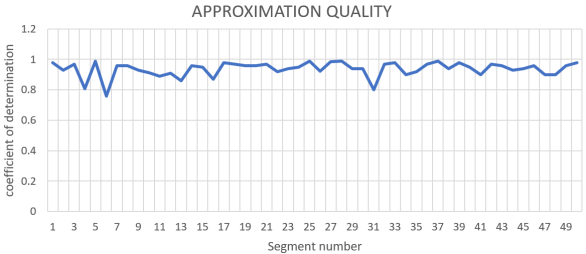
Figure 7. Distribution of R² values.
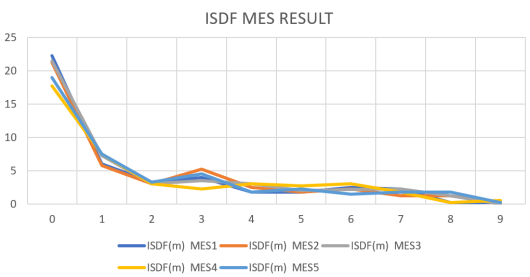
Figure 7 shows the distribution of R² values for 50 randomly selected track segments. The average value of this coefficient was 0.925. Thus, the exponential approximation describes the results of track geometric characteristic measurements with high accuracy, which allows to use these approximation results in the analysis procedure.
6. Classification Algorithm
As the analysis showed, the use of classical selection methods to solve the problem of identifying sudden failures in the form of a spontaneous increase in the maximum defect size proves ineffective. In this work, the "nearest neighbor" method is used for decision-making , which classifies data based on the similarity of results with already known ones stored in a control database. To determine the class of an object, the algorithm identifies the "nearest neighbors" in this database. The content of the database determines the quality of classification and should reflect the properties of the analyzed process as accurately as possible.
Considering the homogeneity property of the ISDF function for consecutive measurements, in this work we use as a control database the variable values of this function obtained in the previous measurement for the same track segment. This adaptive solution reflects the specifics of the process, allows to avoid artificial formation of a control base, fully takes into account the features of the track condition for a specific segment, and improves the quality of classification. The calculation scheme is shown in Figure 2.
From the perspective of the prediction procedure and the track condition, as a result of the analysis, it is necessary to determine which of the two possible values the ISDF function can take in the period after the current measurement:
Sᵢ ≤ N OR Sᵢ > N(4)
where N is the threshold value equal to 0.5 meters, i.e., to record the occurrence of a sudden failure, which manifests as an increase in the value of the maximum defect size.
7. Method Testing
7.1. Baseline Information
As baseline information on track characteristics for prediction, the results of previous measurements for each track segment are used, precisely referenced to their position within the track. The data are presented in the form of a table of measurement results with a distance between measurement points determined by the characteristics of the measuring system. In this work, data with a discreteness of 0.25 meters were used.
To analyze the accuracy of the method, a database was formed with the results of measuring the characteristics of the surface defect over five months with an interval of 1 month between measurements for defect sizes from 6 to 10 mm (Table 2). For each randomly selected of 100-meters segment, an exponential approximation was formed. In the subsequent analysis, we only used data from the segments where the approximation accuracy exceeded 0.6.
As a parameter for calculating the value of the "nearest neighbor," we use the Euclidean distance value Rε for the two penultimate points of the approximation function.
Rε represents the geometric distance in a multidimensional space. The nearest neighbor method uses the calculation of the difference between the current Rε values for the current function values and the corresponding values stored in the control database for that track segment. To make a decision, we determine the value of Rε between two points of the current measurement Pk, Qk and the points of the control database Pi, Qi for each track segment and select the 4 minimum values.
The calculation of Rε is performed using the relation:
Rε = SQRT((Pi - $Pk)^2 + (Qi - $Qk)^2)(5)
In the calculations, pairs of data ensembles were used for time intervals equal to one and two months between the date of the current measurements and the date of formation of the control database.
Table 3. Measurement results of ISDF (km xx, 300-400m).

IRREGULARITY SIZE (m)

0

1

2

3

4

5

6

7

8

9

ISDF(m) MES1

22.25

6

3.25

4

1.75

1.75

2.5

2.25

0.25

0.25

ISDF(m) MES2

21.25

5.75

3

5.25

2.5

1.75

2.25

1.25

1.25

0.25

ISDF(m) MES3

21.5

7.25

3

3.5

3

2

2.175

2.25

1.25

0

ISDF(m) MES4

17.75

7.5

3

2.25

3

2.75

3

1.75

0.25

0.5

ISDF(m) MES5

19

7.5

3.25

4.5

1.75

2.25

1.5

1.75

1.75

0.25

Figure 8. Measurement results of ISDF (km xx, 300-400m).
7.2. Analysis Results
The key issue of any prediction method is accuracy, in our case, the accuracy of predicting the PREDICTED ISDF VALUE. Prediction accuracy is characterized by two quality indicators:
PROBABILITY OF A CORRECT decision about the presence or absence of a spontaneous increase in the maximum defect size after the current measurement,
PROBABILITY OF A FALSE decision about the presence or absence of a spontaneous increase in the maximum defect size.
The calculation results are presented in Table 4.
Table 4. Results of calculating classification quality characteristics.

Prediction interval 1 month

NEAREST NEIGHBORS NUMBER

1

2

3

4

PROBABILITY OF CORRECTLY DETECTING

0.91

0.92

0.95

0.94

PROBABILITY OF FALSE POSITIVES

0.09

0.08

0.04

0.06

Prediction interval 2 months

NEAREST NEIGHBORS NUMBER

1

2

3

4

PROBABILITY OF CORRECTLY DETECTING

0.95

0.99

0.88

0.87

PROBABILITY OF FALSE POSITIVES

0.08

0.03

0.08

0.1

Prediction interval 3 months

NEAREST NEIGHBORS NUMBER

1

2

3

4

PROBABILITY OF CORRECTLY DETECTING

0.91

0.86

0.86

0.84

PROBABILITY OF FALSE POSITIVES

0.09

0.136

0.136

0.159

Analysis of the results shows high classification accuracy with a small number of erroneous decisions. As can be seen from the table, for a time interval of 1 month, the optimal choice is to use data from the third nearest neighbor, and for an interval of 2 months, the second, and for a 3-month interval, the first.
8. Conclusion
The article describes a solution for optimizing of scheduling of railway track’s predictive maintenance based on accurately predicting the spontaneous increases of the maximum defect size in track geometry between measurements.
The method used to solve the problem:
1) Delivers relevant information immediately after the current measurement,
2) Automatically accounts for the influence of all external factors on the changes in the geometric characteristics of the track; only the actual results of routine consecutive measurements of track geometry are used in the analysis.
The method has been tested over 1-, 2- and 3-months’ time intervals. For surface defects, the probability of correctly detecting a spontaneous increase in maximum defect size is between 0.91 and 0.99, and the probability of false positive falls within 0.03 - 0.09 range.
Abbreviations

ISDFF

Irregularity Size Distribution Function

Author Contributions
Gregory Krug: Conceptualization, Data curation, Formal Analysis, Investigation, Methodology, Resources
Conflicts of Interest
The author declares no conflicts of interest.
References
[1] Najafabadi et al. Degradation prediction of rail tracks: a review of the existing literature. The Open Transportation Journal, 2018, 12, 88-104.
[2] I. Soleimanmeigouni et al. Prediction of railway track geometry defects: A case study. Structure and Infrastructure Engineering. Volume 16, 2020, Issue 7.
[3] R. Dekker et al. (Erasmus University Rotterdam), Predicting rail geometry deterioration by regression models – (advances in safety, reliability and risk management - Berenguer, Clarr & Guedes Soares, London).
[4] C. Vale, M. Lurdes Simoes Prediction of Railway Track Condition for Preventive Maintenance by Using a Data -Driven Approach, Infrastructures 2022, 7(3), 34:
[5] Vale, C.; Simoes, M. L. Stochastic model for the geometrical rail deterioration process. Reliab. Eng. Syst. Saf. 2013, 116, 91-98.
[6] Bressi, S.; Santos. J.; Losa, M. Optimization of maintenance strategies for railway track-bad considering probabillistic degradation models and different reliability levels. Reliab. Eng. Syst. Saf. 2021, 207. 107359.
[7] G. Krug, Adaptive Multipoint Method for Predicting Geometric Parameters on the Railway Track based on Convergence Theory. American Journal of Mechanical and Industrial Engineering, vol 7, N1, 2022.
[8] Y. Sato, Convergence Theory Including Spot Tamping, Conference on Railway Engineering, pp. 507-511, Australia, 1998.
[9] B. Lichtberger, Track Compendium, Eurail press, 2022.
[10] Ciobanu, C.: Use of inherent standard deviations as track design parameters. The Journal of the Permanent Way Institution, October 2018, vol. 136, part 4.
[11] G. Krug, J. Madejski, Track Quality Assessment Problems. ZEVrail 142 (2018) 6-7 June-July, pp. 2-8.
[12] G. Krug, Analysis of Track Condition based on application of the Irregularity Length Cumulative Distribution Function. Lecture Notes in Civil Engineering, volume 49, Springer, 2020.
[13] B. Everitt, The Cambridge Dictionary of Statistics, Cambridge University Press, 1988.
[14] R. Nisbet et al. Handbook of Statistical Analysis and Data Mining Applications, Academic Press Inc. 2009.
[15] G. Krug, Predicting Spontaneous Increases in Maximum Size of Geometric Defects In Railway Tracks. American Journal of Mechanical and Industrial Engineering - volume 10, Issue 2, 2025.
Cite This Article
  • APA Style

    Krug, G. (2026). Optimization of Railway Track’s Preventive Maintenance Planning Based on Predicting the Increase in Maximum Defect Sizes (Vigral Method). American Journal of Traffic and Transportation Engineering, 11(2), 24-32. https://doi.org/10.11648/j.ajtte.20261102.11

    Copy | Download

    ACS Style

    Krug, G. Optimization of Railway Track’s Preventive Maintenance Planning Based on Predicting the Increase in Maximum Defect Sizes (Vigral Method). Am. J. Traffic Transp. Eng. 2026, 11(2), 24-32. doi: 10.11648/j.ajtte.20261102.11

    Copy | Download

    AMA Style

    Krug G. Optimization of Railway Track’s Preventive Maintenance Planning Based on Predicting the Increase in Maximum Defect Sizes (Vigral Method). Am J Traffic Transp Eng. 2026;11(2):24-32. doi: 10.11648/j.ajtte.20261102.11

    Copy | Download

  • @article{10.11648/j.ajtte.20261102.11,
      author = {Gregory Krug},
      title = {Optimization of Railway Track’s Preventive Maintenance Planning Based on Predicting the Increase in Maximum Defect Sizes (Vigral Method)},
      journal = {American Journal of Traffic and Transportation Engineering},
      volume = {11},
      number = {2},
      pages = {24-32},
      doi = {10.11648/j.ajtte.20261102.11},
      url = {https://doi.org/10.11648/j.ajtte.20261102.11},
      eprint = {https://article.sciencepublishinggroup.com/pdf/10.11648.j.ajtte.20261102.11},
      abstract = {This article describes a solution for optimization of railway track’s preventive maintenance scheduling. Solution is based on predicting spontaneous increases of maximum defect sizes occurring between two consecutive track measurements. Predictions are made immediately after the latest measurement. The planning of preventive maintenance works is based on periodic measurements of geometric parameters’ values. Changes in the track condition manifest as an increase in the size of "large" defects and a decrease in "small" ones through superposition, and sometimes as an abrupt change in the maximum defect size. The process properties depend on the track's physical condition and the magnitude of train load. This process is associated both with changes in the size of existing defects and with the formation of new ones that exceed the existing ones in size. The abrupt appearance of defects exceeding the current maximum values, occurring at random times between measurements, significantly impacts the track's technical condition and must be considered when planning track maintenance works. Thus, optimizing preventive maintenance work requires obtaining information about the track condition in future immediately after each measurement. The problem of predicting the appearance of defects whose sizes exceed those recorded in the latest measurement has not been studied. Analysis has shown that this phenomenon occurs to varying degrees in 5-10% of track segments, when subsequent measurements register the appearance of new, larger defects that arose in the period between measurements. Information about the possible appearance of such defects allows optimization of the track maintenance process. The method for predicting changes in the track's technical condition described in this article allows, with high reliability, immediately after the latest measurement to predict the appearance, during interval before the next regular measurement, of defects whose sizes exceed the maximum recorded in the latest measurement. The method also allows identifying sudden spontaneous deterioration of the track. The method is based on analyzing the homogeneity (compactness) property of the values of the ISDF. This function shows the cumulative length of each-size track irregularity within a track segment. For classifying results and making decisions, the "nearest neighbor method" is used. The method has been tested for predicting track condition for future periods of 1, 2 and 3 months after the latest measurement. For surface defects, the probability of correctly predicting a spontaneous increase in maximum defect size is within 0.91-0.98 range, and the probability of false positives is between 0.03-0.09.},
     year = {2026}
    }
    

    Copy | Download

  • TY  - JOUR
    T1  - Optimization of Railway Track’s Preventive Maintenance Planning Based on Predicting the Increase in Maximum Defect Sizes (Vigral Method)
    AU  - Gregory Krug
    Y1  - 2026/05/19
    PY  - 2026
    N1  - https://doi.org/10.11648/j.ajtte.20261102.11
    DO  - 10.11648/j.ajtte.20261102.11
    T2  - American Journal of Traffic and Transportation Engineering
    JF  - American Journal of Traffic and Transportation Engineering
    JO  - American Journal of Traffic and Transportation Engineering
    SP  - 24
    EP  - 32
    PB  - Science Publishing Group
    SN  - 2578-8604
    UR  - https://doi.org/10.11648/j.ajtte.20261102.11
    AB  - This article describes a solution for optimization of railway track’s preventive maintenance scheduling. Solution is based on predicting spontaneous increases of maximum defect sizes occurring between two consecutive track measurements. Predictions are made immediately after the latest measurement. The planning of preventive maintenance works is based on periodic measurements of geometric parameters’ values. Changes in the track condition manifest as an increase in the size of "large" defects and a decrease in "small" ones through superposition, and sometimes as an abrupt change in the maximum defect size. The process properties depend on the track's physical condition and the magnitude of train load. This process is associated both with changes in the size of existing defects and with the formation of new ones that exceed the existing ones in size. The abrupt appearance of defects exceeding the current maximum values, occurring at random times between measurements, significantly impacts the track's technical condition and must be considered when planning track maintenance works. Thus, optimizing preventive maintenance work requires obtaining information about the track condition in future immediately after each measurement. The problem of predicting the appearance of defects whose sizes exceed those recorded in the latest measurement has not been studied. Analysis has shown that this phenomenon occurs to varying degrees in 5-10% of track segments, when subsequent measurements register the appearance of new, larger defects that arose in the period between measurements. Information about the possible appearance of such defects allows optimization of the track maintenance process. The method for predicting changes in the track's technical condition described in this article allows, with high reliability, immediately after the latest measurement to predict the appearance, during interval before the next regular measurement, of defects whose sizes exceed the maximum recorded in the latest measurement. The method also allows identifying sudden spontaneous deterioration of the track. The method is based on analyzing the homogeneity (compactness) property of the values of the ISDF. This function shows the cumulative length of each-size track irregularity within a track segment. For classifying results and making decisions, the "nearest neighbor method" is used. The method has been tested for predicting track condition for future periods of 1, 2 and 3 months after the latest measurement. For surface defects, the probability of correctly predicting a spontaneous increase in maximum defect size is within 0.91-0.98 range, and the probability of false positives is between 0.03-0.09.
    VL  - 11
    IS  - 2
    ER  - 

    Copy | Download

Author Information