Abstract
This paper presents a comprehensive case study of how the African Regional Centre for Space Science and Technology Education in English (ARCSSTE-E) has systematically implemented Robotics in Education (RiE) across Nigeria's geopolitical zones through its Space Education Outreach Programme (SEOP). The initiative centres on a structured Robotics Education Program (REP) that employs space-themed, project-based robotics activities to foster STEM engagement, computational thinking, and problem-solving skills among students. By integrating low-cost robotic platforms with authentic space mission simulations - such as planetary exploration, crewed spaceflight operations, satellite assembly and operations, and habitat design - the program creates immersive learning experiences that transcend traditional classroom boundaries. The REP is grounded in constructionist learning theory, emphasizing hands-on, collaborative problem-solving where students actively construct knowledge through designing, building, and programming robotic systems. The program utilizes accessible platforms such as LEGO Mindstorms and Arduino-based kits, supported by a pedagogical progression from block-based to text-based programming languages. The implementation strategy employs a phased, zone-by-zone replication model supported by a robust multi-stakeholder partnership framework that provides sustained engagement, while teacher training programs have equipped educators with robotics pedagogy and technology integration skills. The evaluation framework builds upon foundational assessment methodologies developed during the Humano-Robot Learning (HuRL) project, which established baseline protocols involving 160 students across eight schools. HuRL outcomes demonstrated significant impact: 93.1% of students reported improved STEM learning, 91.3% showed enhanced understanding of robotics concepts, and 95.0% indicated increased academic motivation. These findings validate the pedagogical approach and have informed current REP practices. Assessment data indicate significant gains in student engagement, self-efficacy in technology use, and positive attitude shifts toward STEM careers. This paper details the program's pedagogical framework, implementation strategy, assessment outcomes, and alignment with international best practices. It concludes with evidence-based recommendations for sustainable scaling in developing countries, emphasizing the importance of institutional partnerships, contextual adaptation, and community engagement.
Keywords
Robotics in Education, Space Education, Educational Robotics, Project-Based Learning, STEM Outreach
1. Introduction
Robotics in Education (RiE) has emerged as an innovative pedagogical approach that enhances engagement, develops 21
st century skills, and bridges theoretical learning with hands-on application
| [1] | L. Screpanti, B. Miotti, and A. Monteriù, “Robotics in Education : A Smart and Innovative Approach to the Challenges of the 21st Century,” in Makers at School, Educational Robotics and Innovative Learning Environments, Lecture Notes in Networks and Systems 240, D. Scaradozzi, L. Guasti, M. Di Stasio, B. Miotti, A. Monteriù, and P. Blikstein, Eds., Springer, Cham, 2021, pp. 17–26.
https://doi.org/10.1007/978-3-030-77040-2_3 |
[1]
. As noted in contemporary literature, RiE encompasses a spectrum from assistive and social robotics to educational robotics (ER), where reprogrammable kits serve as “objects to think with” in constructionist learning environments. However, the effective integration of robotics into formal and informal education, given the apathy and declining interest in the technological sector - particularly in resource-constrained contexts - remains a significant challenge, characterized by a need for validated methodologies, teacher training, and scalable models
. This calls for a new approach, considering that robotics – a common feature in space exploration – provides a platform not only to reach out but also to inspire students and the general public on STEM
| [3] | X. Liu and Y. Deng, “Investigating the Educational Impact of Robotics Classrooms on Problem-Solving Skills and Cognitive Development Among Higher Education Students,” Eur. J. Educ., vol. 61, no. 1, p. e70459, Mar. 2026,
https://doi.org/10.1111/ejed.70459 |
[3]
.
The African Regional Centre for Space Science and Technology Education in English (ARCSSTE-E) - established under the auspices of the United Nations Office for Outer Space Affairs (UNOOSA) has pioneered a nationally scaled RiE initiative through its Space Education Outreach Programme (SEOP) in Nigeria. This program strategically leverages the motivational context of space exploration to deliver robotics education that is both aspirational and accessible to schools from primary to tertiary institutions.
This paper examines how ARCSSTE-E has carried out RiE through its Robotics Education Program (REP), which has been systematically replicated across the geopolitical zones of Nigeria. By aligning with ARCSSTE E’s focus areas of Robotics and AI in Schools and Exemplary Robotics Projects / Best Practices, this study addresses the following:
1) How can educational robotics be structured for scalability nationally in a developing country?
2) What pedagogical and logistical strategies are needed to ensure sustainability and impact?
3) How does the integration of space-themed programmes enhance the educational value of robotics activities?
The paper also highlights ARCSSTE-E's experience in integrating robotics into large-scale STEM outreach, offering insights for policymakers, educators, researchers, and other stakeholders working in a similar sector.
2. Theoretical and Conceptual Framework
2.1. Educational Robotics: From Tools to Transformation
Educational robotics (ER) involves the use of reprogrammable robotic kits to facilitate learning across disciplines. Grounded in constructionism, ER promotes learning-by-making, where students actively construct knowledge through designing, building, and programming robotic systems. A constructionist approach to teaching offers significant benefits, grounded in the principle that knowledge arises from experience. This foundation supports the creation of contexts conducive to meaningful learning
. Implementing constructionist methods within standard, time-constrained compulsory education, however, presents considerable challenges
| [5] | Q. Kameda, “A Case Study on Effective Approaches for Implementing Constructivist Teaching Strategies into a Mathematics Classroom,” Int. J. Educ. Learn. Dev., vol. 5, no. 11, pp. 23–33, 2017. |
[5]
. Educational Robotics, helpfully, is already rooted in constructionist theory. By offering an environment where students engage directly with their surroundings and tackle authentic problems, Educational Robotics serves as an excellent medium for delivering constructionist learning experiences
| [6] | K. Wang, G. Sang, L. Huang, and S. Li, “The Effectiveness of Educational Robots in Improving Learning Outcomes : A Meta-Analysis,” vol. 15, no. 5, 2023,
https://doi.org/10.3390/su15054637 |
[6]
. ER helps develop both hard skills -such as coding, engineering, and systems thinking - and soft skills, including collaboration, creativity, and problem-solving. This dual development aligns with the growing demand for holistic education that prepares learners for complex, technology-driven environments and the demands of a fast-changing world
| [7] | O. Erol, N. Sevim-Cirak, and V. G. B. Gülsoy, “The Effects of Educational Robotics Activities on Students’ Attitudes towards STEM and ICT Courses,” Int. J. Technol. Educ., vol. 6, no. 2 SE-Articles, pp. 203–223, https://doi.org/10.46328/ijte.365 |
[7]
.
2.2. The Role of Context: Space as an Engaging Theme
The use of thematic contexts-particularly space exploration - can significantly increase student motivation and provide authentic, interdisciplinary learning scenarios
| [8] | D. Rosu and C. Ceobanu, “Space Education Activities to Encourage Stem Studies - A Theoretical Perspective,” in European Proceedings of Educational Sciences EpES, 2022.
https://doi.org/10.15405/epes.23056.58 |
[8]
. Space-themed robotics activities naturally integrate STEM subjects, foster curiosity, and align with global educational trends emphasizing science for sustainable development. The aspirational nature of space science serves as a powerful catalyst for engagement, especially among young learners in regions where access to advanced technology is limited. By framing robotics challenges within space mission contexts/scenarios - such as planetary exploration, crewed spaceflight, satellite operations, or habitat design - educators can create immersive learning experiences that transcend traditional subject boundaries, allowing experts and researchers to assess and evaluate the impact of teaching STEM topics
| [9] | Y. Cheng, P. Sun, and N. Chen, “The essential applications of educational robot: requirement analysis from the perspectives of experts, researchers and instructors,” Comput. Educ., 2018,
https://doi.org/10.1016/j.compedu.2018.07.020 |
[9]
.
2.3. Scalability and Sustainability of Robots in Education
Effective scaling of RiE initiatives requires models that are cost-effective, context-adaptive, and institutionally supported. Key elements include teacher capacity building, community engagement, curricular integration, and multi-stakeholder partnerships
| [10] | W. S. Tung and T. O. Cheng, “Dual roles of educational robotics in management education : Pedagogical means and learning outcomes,” Educ. Inf. Technol., 2019,
https://doi.org/10.1007/s10639-019-10015-3 Dual. |
[10]
. In developing regions, sustainability often depends on the ability to leverage existing educational infrastructures, cultivate local expertise, and secure ongoing support from governmental and non-governmental entities. There is also an emphasis on the importance of phased implementation, where test/pilot programs are further refined – at a local level - before broader replication - and where evaluation mechanisms are embedded to inform continuous improvement using various feedback strategies.
3. The ARCSSTE-E Robotics Education Program (REP)
3.1. Institutional Mandate and Strategic Positioning
ARCSSTE-E operates with a tripartite mandate: postgraduate education, research and development, and public outreach. The Space Education Outreach Programme (SEOP) serves as the vehicle for inspiring young learners, with the REP as one of its technical education components. The REP was initiated in collaboration with several partners, including the Internet Laboratory of Obafemi Awolowo University (iLab-OAU). The REP was designed to inspire interest in STEM through hands-on robotics, develop problem-solving and computational thinking skills, cultivate mentorship networks across educational levels, and build indigenous capacity for international robotics competitions. This strategic positioning within a UN-affiliated centre provided institutional legitimacy, access to international networks, and alignment with global educational priorities.
3.2. Pedagogical Architecture
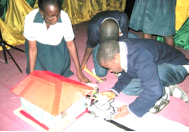
Figure 1. Demonstration by secondary school students at a competition organized by ARCSSTE-E on applications of robots in society.
The REP employs a project-based learning (PBL) framework
| [11] | J. K. Bada, M. Laamanen, and E. Miiro, “A Project-based Learning approach for teaching Robotics to Undergraduates,” Makerere J. High. Educ., vol. 5, no. 1, pp. 35–47, 2013,
http://dx.doi.org/10.4314/majohe.v5i1.3 |
[11]
, where students engage in space mission challenges such as planetary rover navigation and general space exploration tasks and experiments. Activities are structured around the engineering design cycle: define, design, build, program, test, and iterate. This approach mirrors real-world engineering practices and fosters resilience and iterative thinking. The pedagogical design emphasizes collaborative learning, with students working in teams to tackle open-ended problems that require both technical and creative solutions
| [12] | M. Lakkala, “The pedagogical design of technology enhanced collaborative learning,” Framew. e-learning Contents Eval. Proj., 2007. |
[12]
. By situating robotics within the context of space exploration, the program provides a compelling narrative that enhances relevance and motivation – with a direct impact on STEM subject performance.
3.3. Technological Platform and Resources
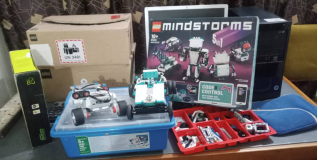
Consistent with recommendations for accessible educational robotics, the REP utilizes low-cost, durable platforms. Primary kits include LEGO Mindstorms and compatible Arduino-based systems, chosen for their versatility, scalability, and ease of use in varied educational settings. Software progression moves from block-based programming environments such as Scratch and mBlock to text-based languages like Python, allowing for differentiated instruction based on tasks, student age, and experience while enriching the learning environment and providing tangible connections to space science applications
| [13] | J.-M. Sáez-López, S. Redondo-Duarte, and S. D. L.-G. Cervigón, “Educational robotics with interactive and environmental projects using ‘ microbit ’ and ‘ Nezha ’ in nine primary schools,” Eurasia J. Math. Sci. Technol. Educ., vol. 22, no. 3, 2026, https://doi.org/10.29333/ejmste/18107 |
[13]
.
Figure 2. Lego Mindstorms Suite at the ARCSSTE-E Prep Lab.
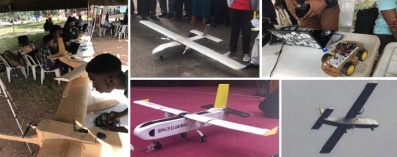
This multi-platform approach ensures adaptability to varying school infrastructure and resource levels, a critical consideration in the diverse Nigerian educational landscape. Space Clubs then take this further by spending time in groups to create interesting projects, including autonomous mobile robots (AMRs) and drones (UAVs).
Figure 3. Space Club members working on and testing projects - autonomous mobile robots and drones.
4. Implementation Strategy
4.1. The SEOP Ecosystem Approach
The REP does not operate in isolation but is embedded within a broader ecosystem of complementary activities:
Space Education Workshops serve as introductory sessions, using various presentation modes and space-themed hands-on projects to spark initial interest.
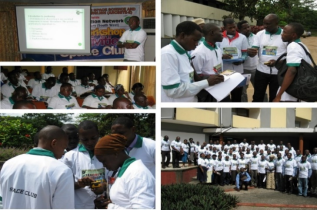
Figure 4. Teachers Training Program for Space Clubs at ARCSSTE-E.
World Space Week (WSW) Celebrations - celebrated annually in line with the United Nations General Assembly resolution of 6 December 1999 declaring 4 to 10 October every year as WSW to celebrate at the international level the contributions of space science and technology to the betterment of the human condition - the WSW celebrations provide national visibility, with robotics demonstrations and competitions attracting participation from schools across all geopolitical zones.
Space Clubs - established nationwide - offer sustained engagement beyond one-time workshops, creating communities of practice where students can deepen their skills over time while consolidating what the participants have learnt during various space education programmes.
Teacher/Resource Person Training Programs build local capacity in robotics pedagogy and technology integration, ensuring that educators are equipped to facilitate meaningful learning experiences. This ecosystem creates multiple entry points and reinforcement mechanisms, enhancing program sustainability and impact
| [14] | R. Silva, C. Costa, and F. Martins, “Pre-service teachers ’ perceptions towards integrating educational robotics in the primary school,” EURASIA J. Math. Sci. Technol. Educ., vol. 20, no. 4, 2024, https://doi.org/10.29333/ejmste/14356 |
[14]
.
4.2. Zonal Expansion Framework
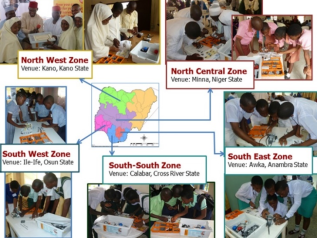
The REP employed a deliberate geographical scaling strategy, beginning with a pilot phase in South-West Nigeria where ARCSSTE-E is headquartered. This initial stage focused on curriculum refinement, master trainer development, and proof-of-concept validation, notably marked by Nigeria’s first participation in the World Robot Olympiad (WRO). The subsequent expansion phase targeted the South-South, South-East, and North-Central zones, emphasizing partnership development with State Ministries of Education and the establishment of zonal trainer networks. The final phase achieved national coverage by extending to the North-West and North-East zones, institutionalizing the program through school-based Space Clubs and integrating it with regional educational structures. This phased approach allowed for contextual adaptation, stakeholder buy-in, and iterative improvement based on lessons learned in earlier stages.
4.3. The Zonal Approach
The ARCSSTE-E Outreach Program adopted a replication strategy for the robotic workshops that was deliberately incremental to ensure easy adaptation and sustainable growth:
Proof-of-Concept: Initial REP workshops were held in the South-West zone (hosted by ARCSSTE-E), focusing on preliminary refinement and resource people as well as master-trainer development. Early success was marked by Nigeria’s first participation in the World Robot Olympiad.
Regional Expansion: Workshops were initially conducted in the South-South, South-East, and This phase emphasized partnership building with State Ministries of Education and the training of local teachers as facilitators.
National Coverage: The program was then extended to the North-Central and North-West zones. This phase involved the development of zonal coordinating centres and the integration of REP activities into the Centre’s outreach program.
Figure 5. Geopolitical reach of ARCSSTE-E REP.
4.4. Multi-Stakeholder Partnership Model
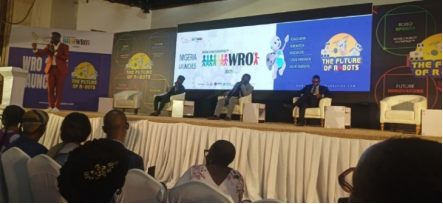
Successful implementation of the REP relied on strategic collaborations across sectors. Governmental partners, including the National Space Research and Development Agency (NASRDA) and State Education Ministries and host institutions, provided policy support, venues, and legitimacy. Academic collaboration with iLab-OAU ensured technical expertise and trainer development, while private sector engagement with ArcLights Nigeria facilitated kit provision and logistical support. International affiliation with UNOOSA offered global legitimacy, access to resources and opportunities for space science and technology learning. This multi-stakeholder model distributed responsibilities, mitigated resource constraints, and created a resilient support network for program sustainability. The Centre has recently partnered with ArcLight for the WRO program in Lagos, Nigeria – a reflection of mutual partnership between ARCSSTE-E and ArcLight.
Figure 6. ARCSSTE-E featuring at an ArcLight event during the WRO Launch in Nigeria - a testament to public-private partnership.
5. Strategy for Operationalization
Quantitative Reach and Participation: The outreach program achieved significant success in all the geopolitical zones visited, with participation of over 2,000 students engaged through workshops and clubs, alongside educators trained in robotics and space science integration. Several Space Clubs were also established in schools nationwide, creating lasting infrastructure for continued engagement.
Qualitative Impact: Student engagement and skill development are reflected in observed improvements in teamwork, problem-solving, and computational thinking during competitions, as well as increased interest in STEM careers reported by participants. Teacher capacity enhancement is evidenced by reported successful integration of knowledge from the trainings and workshops into their classrooms
| [15] | V. Listanto, A. Ramadhan, N. Firmansyah, and B. H. Susanti, “Learners Acceptance of u-KIT EDU as an Educational Application for Robot Building, Coding, and Controlling,” vol. 7, no. 2, pp. 279–288, 2023,
https://doi.org/10.23887/jet.v7i2.58622 |
[15]
.
Preliminary Findings: Assessment from participant surveys and observations indicate that the program not only builds technical skills but also influences perceptions and identities related to STEM engagement, an important outcome for long-term participation in science and technology fields.
6. Evaluation Framework and Outcomes
6.1. Evolution of Pedagogical Assessment: From HuRL to National Scaling
The evaluation framework employed in the current Robotics Education Program (REP) builds upon foundational assessment methodologies developed during the Humano-Robot Learning (HuRL) project, an early educational robotics initiative conducted by ARCSSTE-E
| [16] | S. Anih, “Humano-Robot Learning (HuRL): An Integrated Educational Robotics Approach,” in Proceedings of the International Astronautical Congress, IAC, 2013, pp. 9542–9549. |
[16]
. The HuRL project, which engaged 160 students across eight primary and secondary schools in South-Western Nigeria, established baseline evaluation protocols that have since been refined and scaled nationally.
The HuRL Pedagogical Innovation: The HuRL approach was conceived in response to challenges identified during initial robotics workshops, where students struggled to grasp abstract programming concepts and engineering design principles. Teachers reported that students needed to "demystify robotics" and make it "more friendly" while contributing directly to schoolwork, especially in STEM subjects
| [16] | S. Anih, “Humano-Robot Learning (HuRL): An Integrated Educational Robotics Approach,” in Proceedings of the International Astronautical Congress, IAC, 2013, pp. 9542–9549. |
[16]
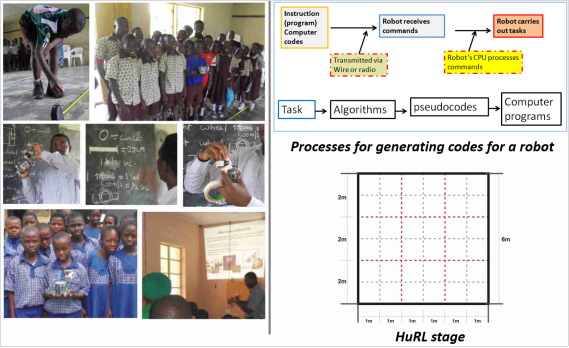
. HuRL addressed this by combining role-play - deeply rooted in Nigerian children's play traditions - with hands-on robotics activities. Students physically simulated robot movements within marked grids, acting out commands such as "move forward," "turn right," and "point-turn" before translating these sequences into actual robot programs. This embodied learning approach, grounded in constructivist and constructionist theories, proved highly effective in bridging abstract concepts and tangible understanding. This approach means that HuRL also provided a low-cost solution to robotics education while helping to build and entrench conceptual foundations.
Figure 7. The Humano-Robot Learning (HuRL) participants (left) with processes and stage design (right).
HuRL Assessment Outcomes: The HuRL project established a mixed-methods evaluation approach that has informed current REP practices. Pre- and post-activity questionnaires assessed shifts in student understanding and attitudes, with results showing:
STEM Learning Impact: 93.1% of participating students reported that HuRL helped them learn STEM topics discussed during the period (45.6% primary, 47.5% secondary).
Program Inclusion Demand: 99.4% expressed desire for the activity to be included in school programmes.
Robotics Understanding: 91.3% reported improved understanding of robotics concepts.
Collaborative Skills: 93.1% indicated the activity helped them work better with classmates.
Academic Motivation: 95.0% reported inspiration to study harder and perform better at school.
These early findings validated the pedagogical approach and established the importance of role-play and embodied learning in making robotics accessible to diverse learners.
6.2. REP Evaluation Framework
Building on the HuRL foundation, the current REP employs a comprehensive mixed-methods evaluation approach across four levels, aligned with established program evaluation frameworks:
Table 1. REP Evaluation Framework.
Level | Focus | Methods | Instruments | Frequency |
1: Reaction | Participant satisfaction and engagement | Post-workshop surveys, feedback forms | 5-point Likert scales, open-ended questions | After each event |
2: Learning | Knowledge and skill acquisition | Pre/post-tests, practical demonstrations | Robotics Concept Inventory, programming tasks | Workshop start/end |
3: Application | Transfer to the classroom/sustained engagement | Teacher observations, club activity logs | Structured observation protocols, project portfolios | Termly |
4: Impact | Long-term outcomes in career paths, attitudes | Longitudinal tracking, interviews | STEM Career Interest Scale, alumni interviews | Annual |
7. Discussion
7.1. ARCSSTE-E's Contribution to Robotics in Education
ARCSSTE-E’s approach to robotics in education through the REP demonstrates that educational robotics can be successfully scaled in developing country contexts using a phased approach and trainer development paired with localized delivery. This ensures activities are tailored to regional resources and educational realities, while integration with existing school structures - such as Space Clubs and annual events like World Space Week - creates sustainable ecosystems that extend beyond initial interventions.
The program also embodies several principles identified as critical to effective RiE, including constructionist pedagogy, which emphasizes hands-on, project-based learning with tangible outcomes. Thematic integration through space contexts provides authentic, interdisciplinary challenges that enhance relevance and motivation. Competitions during the various workshops serve as a motivational tool, fostering innovation and teamwork. At the same time, community building among educators and students creates support networks that sustain engagement and facilitate knowledge sharing.
7.2. Overcoming Implementation Hurdles
Common RiE implementation barriers were successfully navigated during the various programmes organized by ARCSSTE-E. Resource constraints were mitigated through the use of low-cost, versatile platforms. Teacher preparedness was addressed via structured training programs and ongoing support mechanisms. Sustainability was enhanced through institutional integration, multi-stakeholder partnerships, and constant engagement with the centre.
7.3. Innovative Educational Robotics Delivery
ARCSSTE-E’s model introduces several innovations, including the unique integration of robotics with space science applications, which provides a compelling narrative and interdisciplinary learning opportunities. The documented framework for nationwide, geopolitical zones spread offers a replicable blueprint for similar initiatives in other regions and countries on the African continent. The ecosystem approach - combining workshops, clubs, competitions, and teacher training - creates a holistic system that reinforces learning and builds community
.
8. Conclusion and Recommendations
The following recommendations are offered for stakeholders implementing educational robotics in developing countries and are mostly based on more than fifteen years of cumulative experience from various projects, including the Humano-Robot Learning (HuRL) through the national scaling of the Robotics Education Program.
For Practitioners:
1) Begin with embodied, culturally relevant pedagogy using role-play activities where students initially physically simulate robot movements before introducing technology; this approach requires no financial investment yet builds essential conceptual foundations and was validated through HuRL with 93 percent positive learning impact.
2) Establish cascading trainer models where master trainers prepare zonal coordinators who subsequently train school-based teachers, enabling sustainable capacity building even where educators lack engineering backgrounds.
3) Ensure that evaluation is embedded from the outset of any robotics education program using simple pre- and post-questionnaires. This is because even basic data on student engagement and learning gains will prove invaluable for stakeholder engagement and funding justification in the future.
4) Develop local manufacturing capacity for cheap robotics kits by partnering with technical colleges, universities, and innovators to fabricate components from locally available materials; in Nigeria, this strategy is expected to reduce costs substantially – for example, using acrylic chassis and 3D-printed parts.
For Educational Authorities and Policymakers:
1) Develop multi-year implementation plans with phased geographical expansion, allowing two to three years per phase for consolidation; Nigeria’s six-zone expansion over the years enabled contextual adaptation and iterative improvement.
2) Create enabling policies that recognize robotics activities within formal curriculum frameworks (for secondary schools and tertiary institutions). The integration with existing Space Clubs (within the schools) could provide an institutional platform without requiring new policy structures.
3) Establish regional resource centres for kit repair, teacher support, and materials development. The zonal coordinating centres, when established, would reduce equipment downtime substantially.
4) Incentivize teacher participation through certification, career progression recognition, and modest stipends for after-school club facilitation. This is expected to improve knowledge development and teacher retention.
5) Promote public-private partnerships (PPP) through matching grant schemes, making sure every fund contribution from the private sector in Nigeria leverages government in-kind support.
For Researchers:
1) Conduct longitudinal studies tracking robotics education participants through secondary school, tertiary education, and into careers; preliminary tracking shows increased STEM career interest, but longer-term data is required.
2) Develop and validate context-appropriate assessment instruments for robotics learning outcomes in developing country settings, as the robotics concept inventory requires further validation across languages and cultural contexts.
3) Examine gender dynamics in robotics participation and ensure adequate female participation, with attendant strategies for more equitable engagement.
4) Compare the effectiveness of embodied learning approaches, such as role-play, against technology-only interventions across different age groups and cultural contexts.
For International Organizations and Donors:
1) Support South-South collaboration in educational robotics implementation through the UN-affiliated regional centre network, enabling ARCSSTE-E’s experience to inform similar initiatives across Africa, Asia, and Latin America.
2) Fund open educational resource development for robotics curricula adaptable across languages and contexts, with particular attention to methodologies similar to HuRL that require no technology at the initial stages.
3) Invest in local manufacturing capacity for robotics components, such as investing in basic fabrication equipment with local content, which could serve an entire region, reducing dependency on imported kits.
4) Create flexible funding mechanisms that allow for contextual adaptation to reduce the prescription of specific technologies, such as LEGO Mindstorms kits that could cost 350 to 500 dollars per set, which essentially excludes many developing country participants.
5) Support policy dialogue between various institutions, such as education and space agencies, to mainstream space-themed STEM education, leveraging the credibility and existing networks of UN-affiliated organizations to facilitate such engagement.
Future directions for ARCSSTE-E involve deeper integration of AI and machine learning concepts within the robotics curriculum and development of open educational resources for wider dissemination, and pan-African knowledge sharing through the UN-affiliated regional centre network. The ARCSSTE-E experience demonstrates that with appropriate structuring, partnerships, and pedagogical foundations, educational robotics can be effectively implemented at scale to inspire the next generation of innovators and problem-solvers in developing countries.
Abbreviations
AI | Artificial Intelligence |
AMR | Autonomous Mobile Robot |
ARCSSTE-E | African Regional Centre for Space Science and Technology Education in English |
ER | Educational Robotics |
HuRL | Humano-Robot Learning |
iLab-OAU | Internet Laboratory of Obafemi Awolowo University |
NASRDA | National Space Research and Development Agency |
PBL | Project-Based Learning |
PPP | Public-Private Partnership |
REP | Robotics Education Program |
RiE | Robotics in Education |
SEOP | Space Education Outreach Programme |
STEM | Science, Technology, Engineering, and Mathematics |
UAV | Unmanned Aerial Vehicle |
UNOOSA | United Nations Office for Outer Space Affairs |
WRO | World Robot Olympiad |
WSW | World Space Week |
Author Contributions
Samuel Igbokwe Anih: Conceptualization, Investigation, Methodology, Project administration, Writing – original draft, Writing – review & editing, Visualization
Seyi Festus Olatoyinbo: Data curation, Formal Analysis, Investigation, Methodology, Validation, Writing – original draft, Writing – review & editing
Data Availability Statement
The data supporting the outcome of this research work have been reported in this manuscript.
Conflicts of Interest
The authors declare no conflicts of interest.
References
| [1] |
L. Screpanti, B. Miotti, and A. Monteriù, “Robotics in Education : A Smart and Innovative Approach to the Challenges of the 21st Century,” in Makers at School, Educational Robotics and Innovative Learning Environments, Lecture Notes in Networks and Systems 240, D. Scaradozzi, L. Guasti, M. Di Stasio, B. Miotti, A. Monteriù, and P. Blikstein, Eds., Springer, Cham, 2021, pp. 17–26.
https://doi.org/10.1007/978-3-030-77040-2_3
|
| [2] |
J. Ruiz-del-solar, “Robotics-Centered Outreach Activities : An Integrated Approach,” IEEE Trans. Educ., vol. 53, no. 1, pp. 38–45, 2010,
https://doi.org/10.1109/TE.2009.2022946
|
| [3] |
X. Liu and Y. Deng, “Investigating the Educational Impact of Robotics Classrooms on Problem-Solving Skills and Cognitive Development Among Higher Education Students,” Eur. J. Educ., vol. 61, no. 1, p. e70459, Mar. 2026,
https://doi.org/10.1111/ejed.70459
|
| [4] |
S. P. Chand, “Constructivism in theory and practice : implications for classroom pedagogy,” J. Adv. Educ. Sci., vol. 6, no. 1, pp. 23–29, 2026,
https://doi.org/10.64171/JAES.6.1.23-29
|
| [5] |
Q. Kameda, “A Case Study on Effective Approaches for Implementing Constructivist Teaching Strategies into a Mathematics Classroom,” Int. J. Educ. Learn. Dev., vol. 5, no. 11, pp. 23–33, 2017.
|
| [6] |
K. Wang, G. Sang, L. Huang, and S. Li, “The Effectiveness of Educational Robots in Improving Learning Outcomes : A Meta-Analysis,” vol. 15, no. 5, 2023,
https://doi.org/10.3390/su15054637
|
| [7] |
O. Erol, N. Sevim-Cirak, and V. G. B. Gülsoy, “The Effects of Educational Robotics Activities on Students’ Attitudes towards STEM and ICT Courses,” Int. J. Technol. Educ., vol. 6, no. 2 SE-Articles, pp. 203–223,
https://doi.org/10.46328/ijte.365
|
| [8] |
D. Rosu and C. Ceobanu, “Space Education Activities to Encourage Stem Studies - A Theoretical Perspective,” in European Proceedings of Educational Sciences EpES, 2022.
https://doi.org/10.15405/epes.23056.58
|
| [9] |
Y. Cheng, P. Sun, and N. Chen, “The essential applications of educational robot: requirement analysis from the perspectives of experts, researchers and instructors,” Comput. Educ., 2018,
https://doi.org/10.1016/j.compedu.2018.07.020
|
| [10] |
W. S. Tung and T. O. Cheng, “Dual roles of educational robotics in management education : Pedagogical means and learning outcomes,” Educ. Inf. Technol., 2019,
https://doi.org/10.1007/s10639-019-10015-3
Dual.
|
| [11] |
J. K. Bada, M. Laamanen, and E. Miiro, “A Project-based Learning approach for teaching Robotics to Undergraduates,” Makerere J. High. Educ., vol. 5, no. 1, pp. 35–47, 2013,
http://dx.doi.org/10.4314/majohe.v5i1.3
|
| [12] |
M. Lakkala, “The pedagogical design of technology enhanced collaborative learning,” Framew. e-learning Contents Eval. Proj., 2007.
|
| [13] |
J.-M. Sáez-López, S. Redondo-Duarte, and S. D. L.-G. Cervigón, “Educational robotics with interactive and environmental projects using ‘ microbit ’ and ‘ Nezha ’ in nine primary schools,” Eurasia J. Math. Sci. Technol. Educ., vol. 22, no. 3, 2026,
https://doi.org/10.29333/ejmste/18107
|
| [14] |
R. Silva, C. Costa, and F. Martins, “Pre-service teachers ’ perceptions towards integrating educational robotics in the primary school,” EURASIA J. Math. Sci. Technol. Educ., vol. 20, no. 4, 2024,
https://doi.org/10.29333/ejmste/14356
|
| [15] |
V. Listanto, A. Ramadhan, N. Firmansyah, and B. H. Susanti, “Learners Acceptance of u-KIT EDU as an Educational Application for Robot Building, Coding, and Controlling,” vol. 7, no. 2, pp. 279–288, 2023,
https://doi.org/10.23887/jet.v7i2.58622
|
| [16] |
S. Anih, “Humano-Robot Learning (HuRL): An Integrated Educational Robotics Approach,” in Proceedings of the International Astronautical Congress, IAC, 2013, pp. 9542–9549.
|
| [17] |
S. A. Chatzichristofis, “Recent Advances in Educational Robotics,” MDPI Electron., vol. 12, no. 4, 2023,
https://doi.org/10.3390/electronics12040925
|
Cite This Article
-
APA Style
Anih, S. I., Olatoyinbo, S. F. (2026). Embedding Space Exploration Scenarios into Educational Robotics for STEM Education: ARCSSTE-E’s Technical Approach and Validation. American Journal of Robotics and Intelligent Systems, 1(2), 57-65. https://doi.org/10.11648/j.ajris.20260102.11
 Copy
|
Copy
|
 Download
ACS Style
Anih, S. I.; Olatoyinbo, S. F. Embedding Space Exploration Scenarios into Educational Robotics for STEM Education: ARCSSTE-E’s Technical Approach and Validation. Am. J. Rob. Intell. Syst. 2026, 1(2), 57-65. doi: 10.11648/j.ajris.20260102.11
Copy
|
Download
AMA Style
Anih SI, Olatoyinbo SF. Embedding Space Exploration Scenarios into Educational Robotics for STEM Education: ARCSSTE-E’s Technical Approach and Validation. Am J Rob Intell Syst. 2026;1(2):57-65. doi: 10.11648/j.ajris.20260102.11
Copy
|
Download
-
@article{10.11648/j.ajris.20260102.11,
  author = {Samuel Igbokwe Anih and Seyi Festus Olatoyinbo},
  title = {Embedding Space Exploration Scenarios into Educational Robotics for STEM Education: ARCSSTE-E’s Technical Approach and Validation},
  journal = {American Journal of Robotics and Intelligent Systems},
  volume = {1},
  number = {2},
  pages = {57-65},
  doi = {10.11648/j.ajris.20260102.11},
  url = {https://doi.org/10.11648/j.ajris.20260102.11},
  eprint = {https://article.sciencepublishinggroup.com/pdf/10.11648.j.ajris.20260102.11},
  abstract = {This paper presents a comprehensive case study of how the African Regional Centre for Space Science and Technology Education in English (ARCSSTE-E) has systematically implemented Robotics in Education (RiE) across Nigeria's geopolitical zones through its Space Education Outreach Programme (SEOP). The initiative centres on a structured Robotics Education Program (REP) that employs space-themed, project-based robotics activities to foster STEM engagement, computational thinking, and problem-solving skills among students. By integrating low-cost robotic platforms with authentic space mission simulations - such as planetary exploration, crewed spaceflight operations, satellite assembly and operations, and habitat design - the program creates immersive learning experiences that transcend traditional classroom boundaries. The REP is grounded in constructionist learning theory, emphasizing hands-on, collaborative problem-solving where students actively construct knowledge through designing, building, and programming robotic systems. The program utilizes accessible platforms such as LEGO Mindstorms and Arduino-based kits, supported by a pedagogical progression from block-based to text-based programming languages. The implementation strategy employs a phased, zone-by-zone replication model supported by a robust multi-stakeholder partnership framework that provides sustained engagement, while teacher training programs have equipped educators with robotics pedagogy and technology integration skills. The evaluation framework builds upon foundational assessment methodologies developed during the Humano-Robot Learning (HuRL) project, which established baseline protocols involving 160 students across eight schools. HuRL outcomes demonstrated significant impact: 93.1% of students reported improved STEM learning, 91.3% showed enhanced understanding of robotics concepts, and 95.0% indicated increased academic motivation. These findings validate the pedagogical approach and have informed current REP practices. Assessment data indicate significant gains in student engagement, self-efficacy in technology use, and positive attitude shifts toward STEM careers. This paper details the program's pedagogical framework, implementation strategy, assessment outcomes, and alignment with international best practices. It concludes with evidence-based recommendations for sustainable scaling in developing countries, emphasizing the importance of institutional partnerships, contextual adaptation, and community engagement.},
 year = {2026}
}
Copy
|
Download
-
TY  - JOUR
T1  - Embedding Space Exploration Scenarios into Educational Robotics for STEM Education: ARCSSTE-E’s Technical Approach and Validation
AU  - Samuel Igbokwe Anih
AU  - Seyi Festus Olatoyinbo
Y1  - 2026/07/17
PY  - 2026
N1  - https://doi.org/10.11648/j.ajris.20260102.11
DO  - 10.11648/j.ajris.20260102.11
T2  - American Journal of Robotics and Intelligent Systems
JF  - American Journal of Robotics and Intelligent Systems
JO  - American Journal of Robotics and Intelligent Systems
SP  - 57
EP  - 65
PB  - Science Publishing Group
SN  - 3142-8673
UR  - https://doi.org/10.11648/j.ajris.20260102.11
AB  - This paper presents a comprehensive case study of how the African Regional Centre for Space Science and Technology Education in English (ARCSSTE-E) has systematically implemented Robotics in Education (RiE) across Nigeria's geopolitical zones through its Space Education Outreach Programme (SEOP). The initiative centres on a structured Robotics Education Program (REP) that employs space-themed, project-based robotics activities to foster STEM engagement, computational thinking, and problem-solving skills among students. By integrating low-cost robotic platforms with authentic space mission simulations - such as planetary exploration, crewed spaceflight operations, satellite assembly and operations, and habitat design - the program creates immersive learning experiences that transcend traditional classroom boundaries. The REP is grounded in constructionist learning theory, emphasizing hands-on, collaborative problem-solving where students actively construct knowledge through designing, building, and programming robotic systems. The program utilizes accessible platforms such as LEGO Mindstorms and Arduino-based kits, supported by a pedagogical progression from block-based to text-based programming languages. The implementation strategy employs a phased, zone-by-zone replication model supported by a robust multi-stakeholder partnership framework that provides sustained engagement, while teacher training programs have equipped educators with robotics pedagogy and technology integration skills. The evaluation framework builds upon foundational assessment methodologies developed during the Humano-Robot Learning (HuRL) project, which established baseline protocols involving 160 students across eight schools. HuRL outcomes demonstrated significant impact: 93.1% of students reported improved STEM learning, 91.3% showed enhanced understanding of robotics concepts, and 95.0% indicated increased academic motivation. These findings validate the pedagogical approach and have informed current REP practices. Assessment data indicate significant gains in student engagement, self-efficacy in technology use, and positive attitude shifts toward STEM careers. This paper details the program's pedagogical framework, implementation strategy, assessment outcomes, and alignment with international best practices. It concludes with evidence-based recommendations for sustainable scaling in developing countries, emphasizing the importance of institutional partnerships, contextual adaptation, and community engagement.
VL  - 1
IS  - 2
ER  -
Copy
|
Download







 Share This Article
 Twitter
 Linked In
 Facebook