
 ,
Abdulrahman Muhammad Haris,
Zakariyau Sulaiman,
Otaru Fatimat Oyiza,
Sulaiman Tijjani Nasiru,
,
Abdulrahman Muhammad Haris,
Zakariyau Sulaiman,
Otaru Fatimat Oyiza,
Sulaiman Tijjani Nasiru,
In this research, novel quinoline derivative as aluminium corrosion inhibitor was designed by utilizing twenty three (23) molecules of quinoline derivatives tested each as corrosion inhibitors for the aluminium in HCl solution; experimentally through weight loss method, and theoretical investigations using quantitative structure activity relationship (QSAR). The inhibition efficiencies of the quinoline derrivatives obtained from the weight lossshows that some quinoline derivatives such as 5-MeQ, 5-ClQ, 8-TMeQ, 6-ACQ and 7-OHQ inhibits the corrosion better than others as indicated by percentage inhibition efficiency (IE). Quantum chemical calculation indicated that the most popular parameters which play a prominent role are the eigenvalues of the highest occupied molecular orbital (HOMO) and lowest unoccupied molecular orbital (LUMO), the HOMO-LUMO gap (ΔE), chemical hardness and softness and the number of electrons transferred from inhibitor molecule to the metal surface. Base on the several physicochemical descriptors and investigation of the adsorption of these molecules on the aluminium surface by the QSAR study of twenty three quiniline derivatives with the aid of material studio, a model was developed and validated. On the basis of the physicochemical parameters, predicted inhibition efficiency of 97.7% obtained using experimental inhibition efficiencies at 303K in 0.4MHCl and 0.2g/mol inhibitor concentration, and the correlation matrix from the QSAR study; 5-chloro,7-hydroxy-quinoline (5-Cl,7-OH-C9H5N) was designed and accepted as new efficient and effective quinoline derivative inhibitor for aluminium corrosion in HCl acid solution.
| Published in | American Journal of Quantum Chemistry and Molecular Spectroscopy (Volume 10, Issue 1) |
| DOI | 10.11648/j.ajqcms.20261001.11 |
| Page(s) | 1-14 |
| Creative Commons |
This is an Open Access article, distributed under the terms of the Creative Commons Attribution 4.0 International License (http://creativecommons.org/licenses/by/4.0/), which permits unrestricted use, distribution and reproduction in any medium or format, provided the original work is properly cited. |
| Copyright |
Copyright © The Author(s), 2026. Published by Science Publishing Group |
Quinoline Derivatives, Aluminium, Corrosion, Qsar Study, Quantum Chemical, Inhibition Efficiency, Predicted
S/No | COMPOUND | S/No | COMPOUND | S/No | COMPOUND |
|---|---|---|---|---|---|
1 |
| 2 |
| 3 |
|
4 |
| 5 |
| 6 |
|
7 |
| 8 |
| ||
9 |
| 10 |
| 11 |
|
12 |
| 13 |
| 14 |
|
15 |
| 16 |
| 17 |
|
18 |
| 19 |
| 20 |
|
21 |
| 22 |
| 23 |
|
S/N | Molecule | Exp. %IE | Rotatable bond | H-bond (aceptor) | Pred. for C | Residual Value |
|---|---|---|---|---|---|---|
1 | 5ClQ | 70 | 0 | 1 | 71.83 | -1.827 |
2 | 8ACQ | 70 | 0 | 0 | 70.01 | -0.010 |
3 | 6NQ | 72 | 0 | 3 | 74.12 | -2.119 |
4 | 8AMQ | 73 | 0 | 2 | 73.01 | -0.015 |
5 | 7MeQ | 74 | 1 | 2 | 75.36 | -1.364 |
6 | 8ClQ | 74 | 1 | 2 | 73.02 | 0.981 |
7 | 8OHQ | 74 | 0 | 2 | 73.13 | 0.873 |
8 | 6FQ | 75 | 0 | 1 | 76.01 | -1.011 |
9 | 8MOQ | 75 | 1 | 2 | 74.90 | 0.105 |
10 | Core | 75 | 1 | 2 | 73.70 | 1.298 |
11 | 6MOQ | 75 | 1 | 2 | 76.24 | -1.244 |
12 | 6IpQ | 76 | 0 | 1 | 76.32 | -0.321 |
13 | 6OHQ | 76 | 0 | 1 | 73.97 | 2.026 |
14 | 6AMQ | 76 | 1 | 2 | 77.09 | -1.085 |
15 | 8MeQ | 76 | 1 | 2 | 75.78 | 0.224 |
16 | 6TMQ | 76 | 0 | 2 | 76.93 | -0.933 |
17 | 5ACQ | 76 | 1 | 2 | 73.88 | 2.121 |
18 | 6ClQ | 77 | 1 | 2 | 76.58 | 0.424 |
19 | 7OHQ | 78 | 1 | 2 | 77.53 | 0.469 |
20 | 8TMQ | 78 | 0 | 1 | 77.90 | 0.098 |
21 | 6ACQ | 78 | 0 | 1 | 77.34 | 0.662 |
22 | 7AMQ | 78 | 0 | 2 | 77.01 | 1.003 |
23 | 5MeQ | 78 | 1 | 1 | 79.73 | -1.724 |
24 | 5TMQ | 85 | 1 | 2 | 83.62 | 1.371 |
25 | Trial 1 | 2 | 3 | 97.77 | #N/A | |
26 | Trial 2 | 2 | 2 | 82.61 | #N/A |
S/N | Molecule | Exp. %IE | Rotatable bond | H-bond (aceptor) | Pred. for C | Residual Value |
|---|---|---|---|---|---|---|
1 | 5ClQ | 32 | 1 | 2 | 43.71 | -9.07 |
2 | 8ACQ | 32 | 1 | 2 | 42.40 | -9.07 |
3 | 6NQ | 32 | 0 | 3 | 41.21 | -6.01 |
4 | 8AMQ | 33 | 0 | 1 | 41.14 | -11.13 |
5 | 7MeQ | 33 | 0 | 1 | 41.12 | -11.13 |
6 | 8ClQ | 33 | 0 | 2 | 41.12 | -8.07 |
7 | 8OHQ | 34 | 1 | 2 | 41.11 | -7.07 |
8 | 6FQ | 34 | 0 | 2 | 41.10 | -7.07 |
9 | 8MoQ | 36 | 1 | 2 | 41.06 | -5.07 |
10 | Core | 40 | 0 | 1 | 40.15 | -4.13 |
11 | 6MoQ | 40 | 1 | 2 | 40.12 | -1.07 |
12 | 6IpQ | 43 | 1 | 1 | 40.10 | -1.13 |
13 | 6OHQ | 46 | 1 | 2 | 40.06 | 4.93 |
14 | 6AMQ | 47 | 0 | 1 | 40.02 | 2.87 |
15 | 8MeQ | 47 | 0 | 1 | 40.01 | 2.87 |
16 | 6TMQ | 47 | 1 | 2 | 40.01 | 5.93 |
17 | 5ACQ | 47 | 1 | 2 | 40.01 | 5.93 |
18 | 6ClQ | 47 | 0 | 2 | 40.00 | 5.93 |
19 | 7OHQ | 48 | 1 | 2 | 39.07 | 6.93 |
20 | 8TMQ | 50 | 1 | 2 | 39.03 | 8.93 |
21 | 6ACQ | 50 | 1 | 2 | 38.27 | 8.93 |
22 | 7AMQ | 52 | 0 | 1 | 38.12 | 7.87 |
23 | 5MeQ | 52 | 0 | 1 | 37.87 | 7.90 |
24 | 5TMQ | 52 | 0 | 2 | 34.13 | 10.9 |
25 | Trial 1 | 1 | 3 | 58.07 | #N/A | |
26 | Trial 2 | 1 | 2 | 48.01 | #N/A |
1 | 2 | 3 | 4 | 5 | 6 | 7 | 8 | 9 | 10 | ||
|---|---|---|---|---|---|---|---|---|---|---|---|
1 | Friedman LOF | 65.05 | 67.03 | 67.15 | 67.42 | 67.50 | 67.59 | 67.59 | 67.658 | 67.72 | 67.78 |
2 | R-squared | 0.44 | 0.820 | 0.919 | 0.415 | 0.813 | 0.712 | 0.612 | 0.8111 | 0.401 | 0.954 |
3 | Adjusted R-squared | 0.06 | -0.02 | -0.03 | -0.03 | -0.03 | -0.03 | -0.03 | -0.03 | -0.04 | -0.04 |
4 | Cross validated R-squared | -0.1 | -0.12 | -0.16 | -0.15 | -0.22 | -0.17 | -0.12 | -0.18 | -0.18 | -0.17 |
5 | Significant Regression | Yes | Yes | Yes | No | Yes | Yes | Yes | Yes | Yes | Yes |
6 | Significance-of-regression F-value | 1.141 | 0.455 | 0.416 | 0.326 | 0.300 | 0.272 | 0.272 | 0.249 | 0.228 | 0.210 |
7 | Critical SOR F-value (95%) | 4.303 | 4.303 | 4.303 | 4.303 | 4.303 | 4.303 | 4.303 | 4.303 | 4.303 | 4.303 |
8 | Replicate points | 0 | 0 | 0 | 0 | 0 | 0 | 0 | 0 | 0 | 0 |
9 | Computed experimental error | 0.000 | 0.000 | 0.000 | 0.000 | 0.000 | 0.000 | 0.000 | 0.000 | 0.000 | 0.000 |
10 | Lack-of-fit points | 22 | 22 | 22 | 22 | 22 | 22 | 22 | 22 | 22 | 22 |
11 | Min expt. error fornon-significant LOF (95%) | 6.08 | 6.17 | 6.18 | 6.19 | 6.19 | 6.20 | 6.20 | 6.20 | 6.20 | 6.21 |
Equation | 1 | 2 | 3 | 4 | 5 | 6 | 7 | 8 | 9 | 10 | |
|---|---|---|---|---|---|---|---|---|---|---|---|
1 | Friedman LOF | 5.80 | 5.95 | 7.21 | 7.55 | 7.69 | 7.79 | 7.81 | 7.85 | 7.85 | 7.91 |
2 | R-squared | 0.89 | 0.94 | 0.98 | 0.79 | 095 | 0.69 | 0.96 | 0.975 | 0.72 | 0.990 |
3 | Adjusted R-squared | 0.79 | 0.80 | 0.74 | 0.63 | 0.62 | 0.63 | 0.63 | 0.711 | 0.51 | 0.625 |
4 | Cross validated R-squared | 0.67 | 0.12 | 2.82 | 3.18 | 0.05 | 1.42 | 0.401 | -5.20 | 0.025 | 1.75 |
5 | Significant Regression | Yes | Yes | Yes | Yes | Yes | Yes | Yes | Yes | Yes | Yes |
6 | Significance-of-regression F-value | 19.3 | 19.2 | 9.88 | 9.65 | 9.35 | 10.82 | 10.81 | 9.02 | 9.02 | 10.59 |
7 | Critical SOR F-value (95%) | 2.79 | 2.794 | 4.608 | 3.257 | 3.257 | 2.94 | 2.94 | 3.257 | 3.25 | 2.945 |
8 | Replicate points | 0 | 0 | 0 | 0 | 0 | 0 | 0 | 0 | 0 | 0 |
9 | Computed experimental error | 0.00 | 0.00 | 0.00 | 0.00 | 0.00 | 0.00 | 0.00 | 0.00 | 0.00 | 0.00 |
10 | Lack-of-fit points | 23 | 18 | 21 | 20 | 20 | 22 | 19 | 20 | 20 | 22 |
11 | Min expt. error fornon-significant LOF (95%) | 1.07 | 1.08 | 1.83 | 1.66 | 1.67 | 1.46 | 1.46 | 1.690 | 1.69 | 1.47 |
DFT | Density Functional Theory |
MD | Molecular Dynamic |
HOMO | Highest Occupied Molecular Orbital |
LUMO | Lowest Unoccupied Molecular Orbital |
EHOMO | Energy of Highest Occupied Molecular Orbital |
ELUMO | Energy of Lowest Unoccupied Molecular Orbital |
| [1] | Abdul Rahiman, A. K., & Sethumanickam, S. (2014). Inhibition of mild steel corrosion using Juniperus plants as green inhibitor. African Journal of Pure and Applied Chemistry, 8(1), 9-22. |
| [2] | Abdul Rahiman, M., & Sethumanickam, A. (2014). Corrosion inhibition of aluminium using organic inhibitors in acidic medium. International Journal of Research in Chemical Science, 4(3), 22-30. |
| [3] | Abeng, F. E., Anadebe, V., Nkom, P. Y., Uwakwe, K. J., & Kamalu, E. G. (2022). Experimental and theoretical study on the corrosion inhibitor potential of quinazoline derivative for mild steel in hydrochloric acid solution. Journal of Electrochemical Science and Engineering, 12(3), 243–257. |
| [4] | Beltrán-Prieto, C., Serrano, A. A. A., Solís-Rodríguez, G., Martínez, A., Orozco-Cruz, R., Espinoza-Vázquez, A., & Miralrio, A. (2022). A General Use QSAR-ARX Model to Predict the Corrosion Inhibition Efficiency of Commercial Drugs on Steel Surfaces. International Journal of Molecular Sciences, 23(9), 5086. |
| [5] | Bostan, R., & Popa, A. (2012).Evaluation of some phenothiazine derivatives as corrosion inhibitors for bronze in weakly acidic solution. Journal of Applied Electrochemistry, 42(4), 321–328. ResearchGate. |
| [6] | Brycki, B., Szulc, A., Kowalczyk, I., & Koziróg, A. (2017).Organic corrosion inhibitors. International Journal of Corrosion and Scale Inhibition, 6(4), 354–372. |
| [7] | Chahul, H. F., Gbertyo, T. S., & Iorungwa, M. S. (2015). Adsorption and corrosion inhibition properties of Cissus populnea stem extract on aluminium in hydrochloric acid solutions. Journal of Materials and Environmental Science, 6(5), 1443-1452. |
| [8] | Dakeshwar Kumar Verma, Ruby Aslam, Jeenat Aslam and Mumtaz Ahmad Quraishi (2021). Cmputational Modeling: Theoretical Predictive Tools for Designing of Potential Organic Corrosion Inhibitors, Journal of Molecular Structure, 12(36):130-294. |
| [9] | Elfaydy M., Lgaz H., Salghi R., Larouj M., Jodeh S., Rbaa M., Oudda H., Toumiat K. and Lakhrissi B. (2016). Investigation of corrosion inhibition mechanism of quiniline Derivative on Mild steel in 1.0M HCl Solution: Experimental, Theoretical and Monte Carlo simulation, Journal of material and Environmental Science, 7(9) 3193-3210. |
| [10] | El-HassanAssiri Majid Driouch, Jamila LazrakZakariae, BensoudaAli ElhalouiandMouhcine Sfaira (2020).Development and validation of QSPR models for corrosion inhibition of carbon steel by some pyridazine derivatives in acidic medium, Heliyon, 15(13), 50-67. |
| [11] | Fu, J., Li, S., & Wang, Y. (2020).Computational and electrochemical studies of some amino acid compounds as corrosion inhibitors for mild steel in hydrochloric acid solution. Journal of Molecular Liquids, 309, 113102.Google Scholar. |
| [12] | Fu, J., Zhang, H., Wang, Y., Li, S., Chen, T., & Liu, X. (2012). Experimental and Theoretical Study on the Inhibition Performances of Quinoxaline and Its Derivatives for the Corrosion of Mild Steel in Hydrochloric Acid. Industrial & Engineering Chemistry Research, 51(16), 6377–6386. |
| [13] | Gece, G., & Bilgiç, S. (2010).A theoretical study on the inhibition efficiencies of some amino acids as corrosion inhibitors of nickel. Corrosion Science, 52(10), 3435–3443. |
| [14] | Giovanny Carvalho dos Santos, Roberta Oliveira Servilha, Eliézer Fernando de Oliveira, Francisco Carlos Lavarda, Valdecir Farias Ximenes, Luiz Carlos da Silva-Filho (2017). Theoretical-Experimental Photophysical Investigations of the Solvent Effect on the Properties of Green- and Blue-Light-Emitting Quinoline Derivatives,Journal of Fluorescence , 27(2) 709-1720. |
| [15] | Hackerman, N., & Snavely, E. S. (1984).Corrosion Basics: An Introduction. In Corrosion Basics: An Introduction (pp. 127–146). NACE International. |
| [16] | Hernández-Ayala, L. F., Guzmán-López, E. G., & Galano, A. (2023). Quinoline Derivatives: Promising Antioxidants with Neuroprotective Potential. Antioxidants, 12(10), 1853. |
| [17] | Ibrahim, J., et al. (2021).Corrosion inhibition potential of ethanol extract of Acacia nilotica leaves on mild steel in an acidic medium. Journal of Materials and Environmental Science, 12(1), 1–10.ResearchGate. |
| [18] | Khaled, K. F., & Amin, M. A. (2009).Experimental and theoretical study on corrosion inhibition of mild steel in hydrochloric acid by some new triazole derivatives. Corrosion Science, 51(9), 1964–1975. |
| [19] | Khaled, K. F., Al-Nafai, N. M., & Abdel-Shafi, N. S. (2016). QSAR of corrosion inhibitors by genetic function approximation, neural network and molecular dynamics simulation methods. Journal of Materials and Environmental Science, 7(6), 2121-2136. |
| [20] | Martins M. A. P, A. F. C. Flores, M. S. P. Meneghetti, M. R. Meneghetti (2017). FT-IR Spectroscopic and DFT Computational Study on Solvent Effects on 8-Hydroxy-2quinoline carboxylic Acid. Optics and Spectroscopy,11(8),376-384 |
| [21] | Murulana, L. C., Singh, A. K., Shukla, S. K., & Ebenso, E. E. (2012b). Experimental and quantum chemical studies of some bis(benzimidazole) derivatives as corrosion inhibitors for mild steel in hydrochloric acid solution. Industrial & Engineering Chemistry Research, 51(40), 13282-13299. |
| [22] | Obot, I. B., & Obi-Egbedi, N. O. (2011).Corrosion inhibition and adsorption behaviour for aluminium by extract of Aningeria robusta in HCl solution: Synergistic effect of iodide ions. Journal of Materials and Environmental Science, 2(1), 60–71.SCIRP. |
| [23] | Obot, I. B., et al. (2018). Density functional theory (DFT) as a powerful tool for designing new organic corrosion inhibitors. Part 1: An overview. Corrosion Science, 136, 1–12. Science Direct. |
| [24] | Prabhu, R. A., & Rao, P. R. (2013). Corrosion inhibition of aluminium in phosphoric acid solution using Coriandrum sativum seed extract. Journal of Materials and Environmental Science, 4(4), 515-528. |
| [25] | Quraishi, M. A., Sardar, R., & Jamal, D. (2007). Corrosion inhibition of aluminium in acid solutions by some imidazoline derivatives. Materials Chemistry and Physics, 98(1), 223-226. |
| [26] | Rodríguez-Valdez, L. M., Martínez-Villafañe, A., & Glossman-Mitnik, D. (2005). CHIH-DFT theoretical study of isomeric thiatriazoles and their potential activity as corrosion inhibitors. Journal of Molecular Structure: THEOCHEM, 716(1–3), 61–65. |
| [27] | Rybinska, A., Sosnowska, A., Barycki, M., & Puzyn, T. (2016). Geometry optimization method versus predictive ability in QSPR modeling for ionic liquids. Journal of Computer-Aided Molecular Design, 30(2), 103–114. |
| [28] | Saha S.K. and Banerjee P. A(2015). Theoretical approach to understand the inhibition mechanism of steel corrosion with two aminobenzonitrile inhibitors. RSC Adv.;5(87):71120. |
| [29] | Shuwei Xia *, Meng Qiu, Liangmin Yu, Fuguo Liu, Haizhou Zhao(2008). Molecular dynamics and density functional theory study on relationship between structure of imidazoline derivatives and inhibition performance, College of Chemistry and Chemical Engineering, Ocean University of China, Qingdao 266100, PR China. |
| [30] | Society of Petroleum Engineers (SPE). (2008).Proceedings of the SPE International Oilfield Corrosion Conference, Aberdeen, UK, May 2008. |
| [31] | Talari M., S.M. Nezhad, S.J. Alavi, M. Mohtashamipour, A. Davoodi, S. Hosseinpour, (2019). Experimental and computational chemistry studies of two imidazole-based compounds as corrosion inhibitors for mild steel in HCl solution, J. Mol. Liq. 286 110915, |
| [32] | Umoren, S. A., Obot, I. B., & Ebenso, E. E. (2006).Gum arabic as a potential corrosion inhibitor for aluminium in alkaline medium. Pigment & Resin Technology, 35(5), 284–292. |
| [33] | Verma, C., Ebenso, E. E., Quraishi, M. A., & Hussain, C. M. (2021). Recent developments in sustainable corrosion inhibitors: design, performance and industrial scale applications. Materials Advances, 2(11), 3806–3830. |
| [34] | Wazzan NA. (2015) "DFT calculations of thiosemicarbazide, arylisothiocynates, and 1-aryl-2, 5-dithiohydrazodicarbonamides as corrosion inhibitors of copper in an aqueous chloride solution. Journal Ind Eng Chem. Vol.26291. |
| [35] | Xiong, S., Sun, J. L., Xu, Y., & Yan, X. D. (2016). QSAR Study on Imidazole Derivatives as Corrosion Inhibitors by Genetic Function Approximation Method. Materials Science Forum, 850, 426-432.scientific.net |
| [36] | Yuhong, Z., Jingli, Y., & Haibo, Y. (2011). Computational and experimental studies on the corrosion inhibition of mild steel in acid media using organic inhibitors. Journal of Molecular Structure, 987(3), 74-81. |
| [37] | Zhao, P., Wang, Y., & Li, Y. (2017). Corrosion inhibition of aluminum alloy in hydrochloric acid solution by triazinedithiol inhibitors. Journal of Molecular Liquids, 225, 602-611. |
APA Style
Usman, A. M., Haris, A. M., Sulaiman, Z., Oyiza, O. F., Nasiru, S. T., et al. (2026). Designing Novel Quinoline Derivative as Corrosion Inhibitorfor Aluminium in Hydrochloric Acid Solutions. American Journal of Quantum Chemistry and Molecular Spectroscopy, 10(1), 1-14. https://doi.org/10.11648/j.ajqcms.20261001.11
ACS Style
Usman, A. M.; Haris, A. M.; Sulaiman, Z.; Oyiza, O. F.; Nasiru, S. T., et al. Designing Novel Quinoline Derivative as Corrosion Inhibitorfor Aluminium in Hydrochloric Acid Solutions. Am. J. Quantum Chem. Mol. Spectrosc. 2026, 10(1), 1-14. doi: 10.11648/j.ajqcms.20261001.11
@article{10.11648/j.ajqcms.20261001.11,
  author = {Abdulmumin Malam Usman and Abdulrahman Muhammad Haris and Zakariyau Sulaiman and Otaru Fatimat Oyiza and Sulaiman Tijjani Nasiru and Suleiman AliDaddy},
  title = {Designing Novel Quinoline Derivative as Corrosion Inhibitorfor Aluminium in Hydrochloric Acid Solutions},
  journal = {American Journal of Quantum Chemistry and Molecular Spectroscopy},
  volume = {10},
  number = {1},
  pages = {1-14},
  doi = {10.11648/j.ajqcms.20261001.11},
  url = {https://doi.org/10.11648/j.ajqcms.20261001.11},
  eprint = {https://article.sciencepublishinggroup.com/pdf/10.11648.j.ajqcms.20261001.11},
  abstract = {In this research, novel quinoline derivative as aluminium corrosion inhibitor was designed by utilizing twenty three (23) molecules of quinoline derivatives tested each as corrosion inhibitors for the aluminium in HCl solution; experimentally through weight loss method, and theoretical investigations using quantitative structure activity relationship (QSAR). The inhibition efficiencies of the quinoline derrivatives obtained from the weight lossshows that some quinoline derivatives such as 5-MeQ, 5-ClQ, 8-TMeQ, 6-ACQ and 7-OHQ inhibits the corrosion better than others as indicated by percentage inhibition efficiency (IE). Quantum chemical calculation indicated that the most popular parameters which play a prominent role are the eigenvalues of the highest occupied molecular orbital (HOMO) and lowest unoccupied molecular orbital (LUMO), the HOMO-LUMO gap (ΔE), chemical hardness and softness and the number of electrons transferred from inhibitor molecule to the metal surface. Base on the several physicochemical descriptors and investigation of the adsorption of these molecules on the aluminium surface by the QSAR study of twenty three quiniline derivatives with the aid of material studio, a model was developed and validated. On the basis of the physicochemical parameters, predicted inhibition efficiency of 97.7% obtained using experimental inhibition efficiencies at 303K in 0.4MHCl and 0.2g/mol inhibitor concentration, and the correlation matrix from the QSAR study; 5-chloro,7-hydroxy-quinoline (5-Cl,7-OH-C9H5N) was designed and accepted as new efficient and effective quinoline derivative inhibitor for aluminium corrosion in HCl acid solution.},
 year = {2026}
}
TY  - JOUR
T1  - Designing Novel Quinoline Derivative as Corrosion Inhibitorfor Aluminium in Hydrochloric Acid Solutions
AU  - Abdulmumin Malam Usman
AU  - Abdulrahman Muhammad Haris
AU  - Zakariyau Sulaiman
AU  - Otaru Fatimat Oyiza
AU  - Sulaiman Tijjani Nasiru
AU  - Suleiman AliDaddy
Y1  - 2026/01/23
PY  - 2026
N1  - https://doi.org/10.11648/j.ajqcms.20261001.11
DO  - 10.11648/j.ajqcms.20261001.11
T2  - American Journal of Quantum Chemistry and Molecular Spectroscopy
JF  - American Journal of Quantum Chemistry and Molecular Spectroscopy
JO  - American Journal of Quantum Chemistry and Molecular Spectroscopy
SP  - 1
EP  - 14
PB  - Science Publishing Group
SN  - 2994-7308
UR  - https://doi.org/10.11648/j.ajqcms.20261001.11
AB  - In this research, novel quinoline derivative as aluminium corrosion inhibitor was designed by utilizing twenty three (23) molecules of quinoline derivatives tested each as corrosion inhibitors for the aluminium in HCl solution; experimentally through weight loss method, and theoretical investigations using quantitative structure activity relationship (QSAR). The inhibition efficiencies of the quinoline derrivatives obtained from the weight lossshows that some quinoline derivatives such as 5-MeQ, 5-ClQ, 8-TMeQ, 6-ACQ and 7-OHQ inhibits the corrosion better than others as indicated by percentage inhibition efficiency (IE). Quantum chemical calculation indicated that the most popular parameters which play a prominent role are the eigenvalues of the highest occupied molecular orbital (HOMO) and lowest unoccupied molecular orbital (LUMO), the HOMO-LUMO gap (ΔE), chemical hardness and softness and the number of electrons transferred from inhibitor molecule to the metal surface. Base on the several physicochemical descriptors and investigation of the adsorption of these molecules on the aluminium surface by the QSAR study of twenty three quiniline derivatives with the aid of material studio, a model was developed and validated. On the basis of the physicochemical parameters, predicted inhibition efficiency of 97.7% obtained using experimental inhibition efficiencies at 303K in 0.4MHCl and 0.2g/mol inhibitor concentration, and the correlation matrix from the QSAR study; 5-chloro,7-hydroxy-quinoline (5-Cl,7-OH-C9H5N) was designed and accepted as new efficient and effective quinoline derivative inhibitor for aluminium corrosion in HCl acid solution.
VL  - 10
IS  - 1
ER  -
Department of Applied Chemistry, Federal University of Technology Babura, Jigawa, Nigeria
Department of Human Medicine, Prince Abdulmuhsin General Hospital, Alula, Saudi Arabia
Department of Applied Chemistry, Federal University of Technology Babura, Jigawa, Nigeria
Department of Chemistry, Federal College of Education (Technical) Bichi, Kano, Nigeria
Department of Applied Chemistry, Federal University of Technology Babura, Jigawa, Nigeria
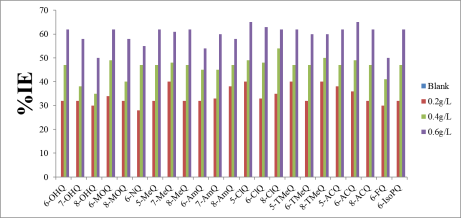
Figure 1. %IE for corrosion of aluminium in 0.4M HCl at 303Kin varying inhibitors concentrations.
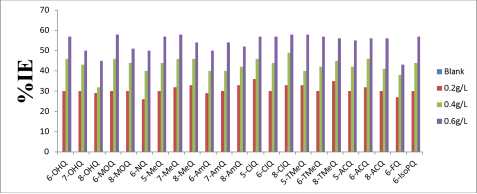
Figure 2. %IEfor corrosion of aluminium in 0.4M HCl at 313Kin varying inhibitors concentrations.
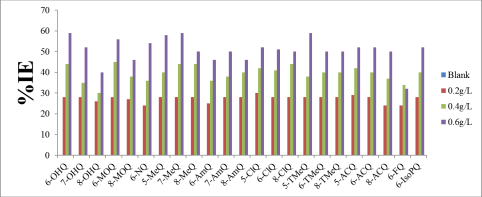
Figure 3. %IE for corrosion of aluminium in 0.4M HCl at 323Kin varying inhibitors concentrations.
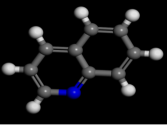
Figure 4. Optimized Core Quinoline.
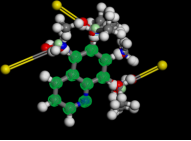
Figure 5. Collection of the inhibitor molecules.
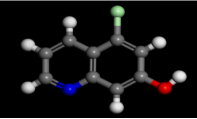
Figure 6. Trial Inhibitor 1.
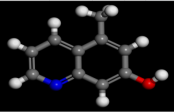
Figure 7. Trial Inhibitor 2.
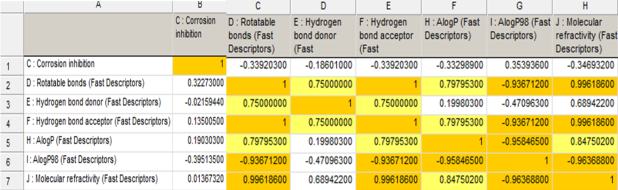
Figure 8. Correlation matrix for Run 1.
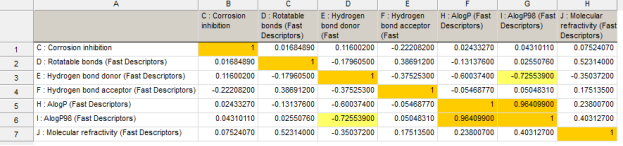
Figure 9. Correlation matrix for Run 2.

Information


 Share This Article
 Twitter
 Linked In
 Facebook


 Copy
Copy Download