Abstract
Secure deployment of neural networks (NNs) on edge and Internet of Things (IoT) devices is essential for real-time intelligence. However, it is challenged by latency variation, energy limits, adversarial attacks, privacy risks, memory scarcity, and hardware heterogeneity. This paper presents a secure NN deployment framework for edge/IoT using MATLAB-based simulation over 200 epochs and 200 inference requests. The framework evaluates latency, energy consumption, adversarial robustness, federated learning (FL) convergence under Differential Privacy (DP), compression-based memory reduction, side-channel power leakage, and throughput variability across 100 devices. Results show stable yet noisy latency of 80-88ms, centered near 83-84ms, and consistent energy demand with a mean of 1.07197×10^6mJ. At ε=0.1, unsecured model accuracy drops from 85.51% to 35.05%, while the defended model retains 75.50%, a 40.45 percentage-point gain. With DP noise of σ=0.03, FL global loss declines from 1.92 to about -0.05 by round 200, indicating convergence. Pruning and quantization from 20% to 50% reduce memory from 410.68 MB to 255.59 MB. Peak side-channel leakage reaches 1.62 V, and throughput varies from 4.24 to 16.50 million Ops/s. Despite simulation-only evaluation and limited adaptive-threat coverage, the study offers a practical metrics-driven blueprint for balancing security, privacy, and efficiency in edge/IoT AI deployment.
Keywords
Edge Computing, IoT Security, Neural Network Deployment, Side-channel Leakage, Differential Privacy,
Adversarial Robustness, Federated Learning, Resource Optimization
1. Introduction
Edge and Internet of Things (IoT) devices are increasingly expected to execute neural-network-based intelligence close to the data source in order to support real-time decision-making in smart homes, industrial automation, healthcare monitoring, transportation, and other latency-sensitive applications. Compared with cloud-centric artificial intelligence (AI), edge intelligence reduces communication delay, improves service availability, lowers bandwidth demand, and can better preserve data locality. However, deploying neural networks directly on edge/IoT devices introduces a difficult systems problem because these platforms operate under severe constraints in computation, memory, energy, and communication, while still being required to deliver accurate and timely inference. At the same time, the distributed and exposed nature of edge/IoT environments makes deployed models vulnerable to adversarial inputs, model poisoning, privacy leakage during collaborative learning, and device-level side-channel attacks. The major issues addressed in this paper is the secure and efficient deployment of neural networks on heterogeneous edge/IoT devices under joint resource, privacy, and threat constraints. This problem is challenging because relevant design objectives are tightly coupled rather than independent. Measures introduced to strengthen privacy may affect training stability and model utility; robustness mechanisms can increase latency and energy overhead; and aggressive compression can reduce memory footprint at the cost of predictive performance. In practical deployments, a secure edge intelligence pipeline must therefore balance multiple competing goals simultaneously: low inference latency, predictable energy use, compact memory footprint, resilience to adversarial and poisoning attacks, protection of distributed updates, and tolerance to hardware heterogeneity. Solving only one of these dimensions in isolation is insufficient for real-world deployment.
Recent studies have improved selected aspects of secure edge intelligence, including blockchain-supported trust management, privacy-preserving federated learning, intrusion detection, adversarial defense, and lightweight deployment strategies. Nevertheless, these efforts remain largely disjointed, with most works emphasizing one dimension of the problem while treating the others as secondary. As a result, there is still no unified framework that jointly evaluates efficiency metrics such as latency, energy, and memory together with privacy-utility behavior and robustness against multiple attack surfaces in heterogeneous, non-independent and identically distributed edge/IoT settings. This gap motivates the need for an integrated and metrics-driven approach that can better reflect the realities of practical deployment. To address this gap, we present a secure neural-network deployment framework for edge/IoT environments that combines privacy-preserving federated learning, adversarially resilient learning, and resource-aware model optimization within a single workflow. The proposed framework integrates differentially privacy federated learning through secure weighted aggregation with Gaussian noise injection, adversarial robustness through fast gradient sign method and projected gradient decent (FGSM/PGD) based training and perturbation-aware inference, and deployment efficiency through pruning and quantization for reduced memory and computational cost. The framework is evaluated in a MATLAB-based simulation environment designed to emulate heterogeneous edge/IoT conditions, multimodal workloads, and representative threat scenarios. Unlike prior studies that consider privacy, robustness, and deployment efficiency separately, the proposed approach examines their combined impact using metrics, including latency, energy consumption, memory footprint, convergence under privacy constraints, side-channel leakage indicators, and throughput variability across devices.
1.1. Key Contributions
The key contributions of this paper are threefold.
1) Proposing a unified secure deployment framework for neural networks on edge/IoT devices that jointly captures resource constraints and multi-surface threats, including latency and energy limits, adversarial inputs, poisoning, privacy leakage, and side-channel exposure.
2) Integrating privacy, robustness, and efficiency mechanisms in one workflow by combining differentially private federated learning with secure weighted aggregation, adversarially resilient training and inference using FGSM/PGD-based defenses, and resource-aware model compression through pruning and quantization.
3) Provision of a comprehensive metrics-driven evaluation in a MATLAB-based heterogeneous edge/IoT simulation environment, using latency, energy consumption, adversarial robustness, federated convergence, memory footprint, leakage traces, and throughput variability to demonstrate the practical trade-offs involved in secure edge AI deployment.
1.2. Paper Organization
The remainder of this paper is organized as follows. Section 2 reviews recent related work and highlights the limitations of existing approaches in jointly addressing security, privacy, robustness, and deployment efficiency for edge/IoT intelligence. Section 3 presents the system model, including the device model, neural-network inference model, threat model, federated learning with differential privacy, and the quantized/pruned deployment model. Section 4 describes the methodology, simulation environment, synthetic dataset generation, and the algorithms for adversarial-resilient training, secure deployment, and secure inference with federated updates. Section 5 presents and discusses the results on latency, energy, adversarial robustness, federated-learning convergence, memory optimization, side-channel leakage, and throughput heterogeneity. Section 6 concludes the paper with the main findings, limitations, and future research directions.
2. Related Work
Secure edge/Internet-of-Things (IoT) intelligence has progressed, but recent solutions remain fragmented. A field-programmable gate array (FPGA) system-on-chip (SoC) adaptive, multimodal Internet of Medical Things (IoMT) design prioritizes real-time efficiency, yet provides limited end-to-end security evaluation beyond system implementation
| [1] | N. B. Gaikwad, S. K. Khare, D. Mendhe, H. Mir, S. Kosta and U. R. Acharya, "FPGA SoC Implementation of Adaptive Deep Neural Network-Based Multimodal Edge Intelligence for Internet of Medical Things," in IEEE Access, vol. 13, pp. 134041-134056, 2025,
https://doi.org/10.1109/ACCESS.2025.3592729 |
[1]
. Accordingly, blockchain–deep learning approaches strengthen governance and privacy, but do not tightly quantify device-level constraints such as energy, memory, and latency jitter
| [2] | K. Swathi, P. Durga, K. V. Prasad, A. K. Chaitanya, K. Santhi, P. Vidyullatha and S. V. A. Rao “Secure blockchain integrated deep learning framework for federated risk-adaptive and privacy-preserving IoT edge intelligence sets” Scientific Reports 15, 41133 (2025).
https://doi.org/10.1038/s41598-025-24895-8 |
[2]
. Likewise, Advanced Encryption Standard (AES)-secured federated foundation-model learning improves communication security, but still leaves gaps in holistic robustness to adversarial inputs, privacy leakage, and physical side-channels
| [3] | M. K. Hasan, S. R. Kabir, S. Islam, S. Abdullah, H. S. Abbas, B. K. Pandey, "AES Cryptography Enabled Responsible Federated Foundation Model Using Transformer LLM and LSTM for Smart Grid IIoT Networks," in IEEE Internet of Things Journal, vol. 12, no. 23, pp. 49801-49810, 1 Dec.1, 2025, https://doi.org/10.1109/JIOT.2025.3608807 |
[3]
. For the meantime, blockchain-enabled cloud–edge federated learning improves collaboration integrity, but treats deployment efficiency and multi-surface attack resilience as secondary rather than as jointly optimized outcomes
| [4] | M. Kumar, J. K. Samriya, G. KaurWalia, P. Verma, H. Wu and S. S. Gill, "Blockchain Empowered Secure Federated Learning for Consumer IoT Applications in Cloud-Edge Collaborative Environment," in IEEE Transactions on Consumer Electronics, vol. 71, no. 2, pp. 3986-3996, May 2025,
https://doi.org/10.1109/TCE.2025.3532676 |
[4]
.
Recent Internet of Things (IoT) security research improves edge/IoT intrusion detection and federated learning (FL) protection, but the contributions are still scattered across different threat models and design goals. For intrusion detection, one approach frames distributed denial-of-service (DDoS) detection in consumer IoT healthcare as an adaptive decision process using off-policy reinforcement learning (RL) with a generative adversarial network (GAN), yet it remains focused on a single attack class rather than broader intrusion coverage
| [5] | J. Yang, V. Govindarajan, L. Y. Por, Z. A. Shaikh, Q. Xin, P. Bhattacharya, "DDoS Attack Detection in Consumer IoT-Based Healthcare Systems Using Improved Off-Policy Proximal Policy Optimization and Generative Adversarial Network," in IEEE Transactions on Consumer Electronics, vol. 71, no. 4, pp. 11662-11675, Nov. 2025,
https://doi.org/10.1109/TCE.2025.3605098 |
[5]
. Moving toward realistic edge settings, a blockchain-augmented FL intrusion detection system (IDS) handles non-independent and identically distributed (non-IID) edge-IoT data with robust aggregation, but it emphasizes secure collaboration more than unified deployment constraints and resilience to diverse attacks
| [6] | K. J. Mukisa, L. A. C. Ahakonye, D. -S. Kim and J. -M. Lee, "Blockchain-Augmented FL IDS for Non-IID Edge-IoT Data Using Adaptive Trimmed Mean Aggregation," in IEEE Internet of Things Journal, vol. 12, no. 21, pp. 45150-45159, 1 Nov.1, 2025, https://doi.org/10.1109/JIOT.2025.3598832 |
[6]
. Similarly, distributed convolutional neural network (CNN) collaboration is defended against adversarial perturbations, but the emphasis is mainly on noise resistance rather than end-to-end IDS performance under heterogeneous edge limitations
| [7] | M. Asif, M. K. Kazmi, M. A. Rahman, S. R. Hasan and S. Homsi, "SHEATH: Defending Horizontal Collaboration for Distributed CNNs Against Adversarial Noise," in IEEE Transactions on Information Forensics and Security, vol. 20, pp. 4353-4368, 2025, https://doi.org/10.1109/TIFS.2025.3556349 |
[7]
. A quantum reservoir–based IDS introduces modeling novelty, but practical feasibility on edge devices and integration with privacy-preserving collaboration remain open issues
| [8] | T. Ahmad, S. Khan, N. Nigar, E. Mohamed Obaid and S. Naaz, "Quantum Reservoir-Based Intrusion Detection for Edge-IoT Systems," in IEEE Transactions on Consumer Electronics, vol. 71, no. 4, pp. 11269-11278, Nov. 2025,
https://doi.org/10.1109/TCE.2025.3618827 |
[8]
. On the FL security side, privacy and trust mechanisms are strengthened, but often evaluated in isolation. Homomorphic-encryption (HE) FL improves confidentiality with an efficiency focus
| [9] | Y. Liu, H. Zhang, M. Wang, Q. Xie and L. Wang, "An Efficient Privacy-Enhanced Federated Learning with Single-Key Homomorphic Encryption," in IEEE Internet of Things Journal, vol. 12, no. 13, pp. 23598-23613, 1 July1, 2025,
https://doi.org/10.1109/JIOT.2025.3553134 |
[9]
. Lightweight and trustworthy FL supports decision-making on constrained edge-IoT nodes, yet does not fully unify robustness and deployment constraints
| [10] | A. Tariq, F. Sallabi, M. A. Serhani, E. S. Barka, T. Qayyum, I. Din, "AI-Driven Lightweight and Trustworthy Federated Learning Framework for Decision-Making in Resource-Constrained Edge-IoT," in IEEE Transactions on Consumer Electronics, vol. 71, no. 4, pp. 12166-12180, Nov. 2025, https://doi.org/10.1109/TCE.2025.3628207 |
[10]
. Poisoning prevention is enhanced via stateful proofs of execution (PoE) with differential privacy (DP), but it can still fall short of full system-wide efficiency validation under real edge conditions
| [11] | N. Rattanavipanon and I. De Oliveira Nunes, "SLAPP: Poisoning Prevention in Federated Learning and Differential Privacy via Stateful Proofs of Execution," in IEEE Transactions on Information Forensics and Security, vol. 20, pp. 4167-4182, 2025, https://doi.org/10.1109/TIFS.2025.3555179 |
[11]
. Private blockchain combined with FL supports secure sensing platforms, although overhead and scalability still require unified assessment
| [12] | M. J. Baucas and P. Spachos, "Private Blockchain and Federated Learning-Based Edge-Iot Platform for Secure Urban Noise Monitoring," ICC 2025 - IEEE International Conference on Communications, Montreal, QC, Canada, 2025, pp. 1145-1150, https://doi.org/10.1109/ICC52391.2025.11160895 |
[12]
.
Existing solutions are disjointed, addressing efficiency, blockchain trust, federated learning (FL) privacy by means of homomorphic encryption (HE) or differential privacy (DP), intrusion detection system (IDS)/distributed denial-of-service (DDoS) detection, or poisoning/adversarial defense in isolation. This leaves no end-to-end framework that cooperatively validates efficiency (latency/energy/memory), privacy–utility, and multi-surface robustness under heterogeneous, non-independent and identically distributed (non-IID) edge–Internet of Things (IoT) conditions. Our paper bridges this by unifying privacy-preserving FL, attack-resilient learning, and edge-efficient optimization in one workflow and evaluating them with consistent metrics for real edge-IoT deployment.
According to
| [13] | E. Manor and S. Greenberg, “Custom hardware inference accelerator for tensorflow lite for microcontrollers,” IEEE Access, vol. 10, pp. 73484–73493, 2022. |
[13]
the authors deployed the trained Temporal Convolutional Network (TCN) using the TensorFlow Lite (TFLite) framework to enable efficient execution on resource-constrained edge devices. They applied TensorFlow Lite's default post-training optimization techniques, including weight quantization and computational graph simplification, and enforced full-integer (INT8) quantization across all network layers. To ensure accurate quantization, a representative subset of approximately 300 samples from each dataset was used for activation-range calibration, while the complete test datasets were exported for reproducible inference on a Raspberry Pi 4 platform. The quantization process reduced the model size by approximately 75% by converting model parameters from FP32 to INT8 precision. Furthermore, the converted models employed INT8 data types for both input and output tensors, enabling inference through integer arithmetic and thereby reducing computational and memory requirements on the target hardware. Finally, the models were serialized into TensorFlow Lite's compact FlatBuffer format to facilitate efficient storage and deployment on edge devices.
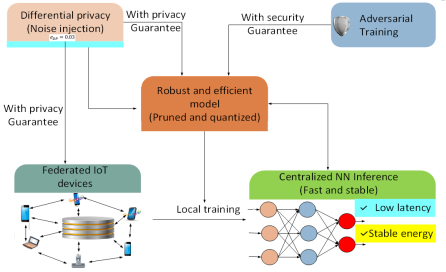
Figure 1 presents the overall secure neural-network deployment framework for edge/IoT systems. It illustrates how differential privacy, through noise injection, and security mechanisms, through adversarial training, are incorporated into the model development pipeline to produce a robust and efficient neural network. The resulting model is then pruned and quantized for lightweight deployment on federated IoT devices and used for centralized inference with low latency and stable energy consumption. Overall, the figure highlights the interaction between privacy preservation, security enhancement, model optimization, local training, and efficient inference in a unified edge/IoT AI architecture.
Figure 1. Conceptual framework linking differential privacy and adversarial robustness with a pruned/quantized model, enabling efficient federated learning and fast, stable neural-network inference on IoT devices.
Table 1 presents a summary of 12 related studies on secure edge and IoT intelligence. It includes the author and year, method used, strengths, limitations, and the way the current study addresses the identified gaps. The reviewed works span field-programmable gate array (FPGA) based edge intelligence, blockchain-supported federated learning, encrypted federated learning, adversarial defense, intrusion detection, and privacy-preserving IoT frameworks. Their major strengths include hardware efficiency, improved trust, privacy protection, robust aggregation, and effective attack detection. However, most of them are limited by narrow application scope and the lack of a unified treatment of privacy, robustness, and efficiency, as well as insufficient analysis of inference cost, memory reduction, side-channel leakage, and device heterogeneity. The current work addresses these limitations through a unified framework that jointly evaluates adversarial robustness, differential privacy in federated learning, pruning and quantization for memory optimization, inference latency, energy consumption, side-channel leakage, and throughput variation across heterogeneous edge/IoT devices.
Table 1. Summary of recent studies on secure edge/IoT intelligence and how the present work addresses their limitations.
Ref. | Method | Pros | Cons/Gap | How Current Work Addresses Gap |
| [1] | N. B. Gaikwad, S. K. Khare, D. Mendhe, H. Mir, S. Kosta and U. R. Acharya, "FPGA SoC Implementation of Adaptive Deep Neural Network-Based Multimodal Edge Intelligence for Internet of Medical Things," in IEEE Access, vol. 13, pp. 134041-134056, 2025,
https://doi.org/10.1109/ACCESS.2025.3592729 |
[1] | Adaptive Deep Neural Network (DNN) on Field-Programmable Gate Array (FPGA) System on Chip (SoC) for multimodal Internet of Medical Things (IoMT) edge inference | Hardware-aware, real-time, practical deployment | Focuses more on acceleration than unified security/privacy/robustness evaluation | Adds joint analysis of latency, energy, robustness, Differential Privacy Federated Learning (DP-FL), compression, and leakage |
| [2] | K. Swathi, P. Durga, K. V. Prasad, A. K. Chaitanya, K. Santhi, P. Vidyullatha and S. V. A. Rao “Secure blockchain integrated deep learning framework for federated risk-adaptive and privacy-preserving IoT edge intelligence sets” Scientific Reports 15, 41133 (2025).
https://doi.org/10.1038/s41598-025-24895-8 |
[2] | Blockchain-integrated deep learning with federated privacy-preserving edge intelligence | Strong trust, provenance, and privacy focus | Blockchain overhead; limited deployment-efficiency analysis | Evaluates security together with memory, energy, latency, and heterogeneity |
| [3] | M. K. Hasan, S. R. Kabir, S. Islam, S. Abdullah, H. S. Abbas, B. K. Pandey, "AES Cryptography Enabled Responsible Federated Foundation Model Using Transformer LLM and LSTM for Smart Grid IIoT Networks," in IEEE Internet of Things Journal, vol. 12, no. 23, pp. 49801-49810, 1 Dec.1, 2025, https://doi.org/10.1109/JIOT.2025.3608807 |
[3] | AES-secured federated foundation model using Transformer-based Large Language Model (Transformer-LLM) and Long Short-Term Memory (LSTM) | Strong cryptographic protection; smart-grid relevance | Domain-specific; less focus on lightweight deployment | Provides broader edge/IoT NN deployment framework with efficiency-security trade-offs |
| [4] | M. Kumar, J. K. Samriya, G. KaurWalia, P. Verma, H. Wu and S. S. Gill, "Blockchain Empowered Secure Federated Learning for Consumer IoT Applications in Cloud-Edge Collaborative Environment," in IEEE Transactions on Consumer Electronics, vol. 71, no. 2, pp. 3986-3996, May 2025,
https://doi.org/10.1109/TCE.2025.3532676 |
[4] | Blockchain-supported secure FL in cloud-edge IoT | Secure collaboration and trust | Limited focus on inference cost and model compression | Adds secure inference, pruning, and quantization analysis |
| [5] | J. Yang, V. Govindarajan, L. Y. Por, Z. A. Shaikh, Q. Xin, P. Bhattacharya, "DDoS Attack Detection in Consumer IoT-Based Healthcare Systems Using Improved Off-Policy Proximal Policy Optimization and Generative Adversarial Network," in IEEE Transactions on Consumer Electronics, vol. 71, no. 4, pp. 11662-11675, Nov. 2025,
https://doi.org/10.1109/TCE.2025.3605098 |
[5] | Proximal Policy Optimization Plus Generative Adversarial Network (PPO + GAN) for Distributed Denial of Service (DDoS) detection | Strong attack-detection capability | IDS-specific, not full NN deployment pipeline | Addresses broader secure deployment beyond only detection |
| [6] | K. J. Mukisa, L. A. C. Ahakonye, D. -S. Kim and J. -M. Lee, "Blockchain-Augmented FL IDS for Non-IID Edge-IoT Data Using Adaptive Trimmed Mean Aggregation," in IEEE Internet of Things Journal, vol. 12, no. 21, pp. 45150-45159, 1 Nov.1, 2025, https://doi.org/10.1109/JIOT.2025.3598832 |
[6] | Blockchain-augmented Federated Learning-based Intrusion Detection System (FL IDS) with robust aggregation | Handles Independent and Identically Distributed (non-IID) data; secure aggregation | Narrow Intrusion Detection System (IDS) scope | Extends to unified privacy, robustness, compression, and inference evaluation |
| [7] | M. Asif, M. K. Kazmi, M. A. Rahman, S. R. Hasan and S. Homsi, "SHEATH: Defending Horizontal Collaboration for Distributed CNNs Against Adversarial Noise," in IEEE Transactions on Information Forensics and Security, vol. 20, pp. 4353-4368, 2025, https://doi.org/10.1109/TIFS.2025.3556349 |
[7] | Defense against adversarial noise in distributed Convolutional Neural Network (CNN) collaboration | Strong adversarial robustness | Limited privacy and deployment-efficiency analysis | Combines adversarial defense with DP-FL and resource-aware optimization |
| [8] | T. Ahmad, S. Khan, N. Nigar, E. Mohamed Obaid and S. Naaz, "Quantum Reservoir-Based Intrusion Detection for Edge-IoT Systems," in IEEE Transactions on Consumer Electronics, vol. 71, no. 4, pp. 11269-11278, Nov. 2025,
https://doi.org/10.1109/TCE.2025.3618827 |
[8] | Quantum reservoir computing for intrusion detection | Innovative security method | Focused on IDS, not end-to-end deployment | Focuses on practical NN deployment trade-offs across full pipeline |
| [9] | Y. Liu, H. Zhang, M. Wang, Q. Xie and L. Wang, "An Efficient Privacy-Enhanced Federated Learning with Single-Key Homomorphic Encryption," in IEEE Internet of Things Journal, vol. 12, no. 13, pp. 23598-23613, 1 July1, 2025,
https://doi.org/10.1109/JIOT.2025.3553134 |
[9] | FL with single-key homomorphic encryption | Strong privacy-preserving aggregation | Limited adversarial robustness and compression study | Integrates privacy with robustness, memory reduction, and deployment metrics |
| [10] | A. Tariq, F. Sallabi, M. A. Serhani, E. S. Barka, T. Qayyum, I. Din, "AI-Driven Lightweight and Trustworthy Federated Learning Framework for Decision-Making in Resource-Constrained Edge-IoT," in IEEE Transactions on Consumer Electronics, vol. 71, no. 4, pp. 12166-12180, Nov. 2025, https://doi.org/10.1109/TCE.2025.3628207 |
[10] | Lightweight trustworthy FL for constrained edge-IoT | Resource-aware and practical | Mainly FL-centric | Adds secure inference, side-channel leakage, and device heterogeneity analysis |
| [11] | N. Rattanavipanon and I. De Oliveira Nunes, "SLAPP: Poisoning Prevention in Federated Learning and Differential Privacy via Stateful Proofs of Execution," in IEEE Transactions on Information Forensics and Security, vol. 20, pp. 4167-4182, 2025, https://doi.org/10.1109/TIFS.2025.3555179 |
[11] | Poisoning prevention using stateful proofs of execution | Strong poisoning defense and integrity assurance | Less emphasis on end-to-end deployment efficiency | Adds latency, energy, compression, and adversarial evaluation in one framework |
| [12] | M. J. Baucas and P. Spachos, "Private Blockchain and Federated Learning-Based Edge-Iot Platform for Secure Urban Noise Monitoring," ICC 2025 - IEEE International Conference on Communications, Montreal, QC, Canada, 2025, pp. 1145-1150, https://doi.org/10.1109/ICC52391.2025.11160895 |
[12] | Private blockchain with FL for secure urban noise monitoring | Good application-level validation | Domain-specific platform | Generalizes to broader secure NN deployment for heterogeneous edge/IoT systems |
3. System Model
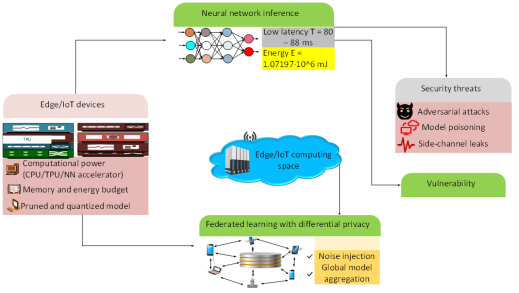
System model for secure neural network deployment in edge and Internet of Things (IoT) environments is presented in this section. It defines the network architecture, device roles, and communication links for inference and model updates, alongside key constraints such as computation, memory, energy, and latency as presented in
Figure 2. It illustrates the secure edge/IoT neural-network deployment environment and the interaction among deployment constraints, learning mechanisms, and security risks. It shows that edge/IoT devices operate with limited computational power, memory, and energy budgets, requiring pruned and quantized models for efficient execution. Within this environment, federated learning with differential privacy supports collaborative model updates through noise injection and global aggregation, while the deployed neural network performs inference under latency and energy constraints. The figure also highlights the exposure of the system to major security threats, including adversarial attacks, model poisoning, and side-channel leakage, which collectively contribute to system vulnerability. The figure summarizes the practical relationship between resource-constrained deployment, privacy-preserving learning, inference efficiency, and threat exposure in edge/IoT AI systems.
Figure 2. System model showing edge/IoT NN inference key security threats, and federated learning with DP for privacy-preserving aggregation.
1) Edge/IoT Device Model
Consider IoT devices, each with computational capacity , memory , and energy budget . Each device runs a local NN model , to process input , for inference . Other devices include Tensor Processing Unit/Neural Network (TPU/NN) accelerators or GPU cores to enhance performance. The device model is extended to account for: (i) CPU frequency , (ii) Accelerator operations per second , (iii) Quantized or pruned NN model for memory and energy efficiency, and (iv) Communication interface with bandwidth and latency .
2) Neural Network Inference Model
The inference latency
is modeled as presented in (
1):
(1)
where is the layers in the network, is the computation cycles per layer, is the neurons/operations per layer, is the CPU frequency, is the accelerator operations per second, is the accelerator efficiency factor, and is the network communication delay.
Whereas the Energy consumption
is expressed in (
2):
(2)
where is energy efficiency factor for accelerator use, and is the energy for data transmission.
3) Security Threat Model
We include up-to-date threats in edge/IoT NN deployment with the following assumptions as follows: (i) Adversarial examples as: , which may cause misclassification. (ii) Backdoor/model poisoning attacks that may occur during federated updates, (iii) Model inversion/data leakage from untrusted aggregation, (iv) Side-channel attacks exploiting power/latency information.
4) Federated Learning with Differential Privacy
We modeled the federated learning with differential privacy by considering the local model update at device
as presented in (
3):
while the global aggregation with secure weighted averaging and DP noise is modeled using the expression in (
4):
(4)
where
as expressed in (
3),
is the Gaussian noise added to the preserve privacy.
Quantized/Pruned NN Model for Edge Devices
For the quantized/pruned NN model for edge devices, model
is compressed to
to reduce memory foot-print
and computation as given in (
5):
, and(5)
This allows deployment on resource-constrained IoT devices without significant accuracy loss.
4. Methodology
This paper follows a model-driven, simulation-based approach. It first develops a system and mathematical model for secure neural network deployment on edge/Internet of Things (IoT) devices. It then designs security-aware methods for training, inference, and federated updates, combining adversarial resilience, privacy-preserving aggregation, and resource-aware optimization (e.g., pruning and quantization). The study uses a MATLAB-based simulation environment. The synthetic dataset used for the simulation was generated using the following dataset described as follows: (i) Device heterogeneity is CPU
, memory
, energy
, (ii) Data employed includes IoT sensor signals, images, time-series data, (iii) The Adversarial perturbations is FGSM/PGD attacks, (iv) Epochs range is between
for training and federated aggregation. Communication delays
. Model compression ratios:
for quantization/pruning. We generate a synthetic IoT dataset in a MATLAB-based simulation environment by sampling heterogeneous device constraints (central processing unit (CPU), memory, and energy) and producing multimodal inputs (sensor, time-series, and image-like data) with task-defined labels. We also create adversarial variants using FGSM and PGD to evaluate robustness under gradient-based attacks. This setup is representative because it jointly captures device heterogeneity, multimodal IoT workloads, and adversarial conditions in a controlled and repeatable manner. The simulation emulates edge inference and federated-learning cycles under heterogeneous device constraints and network conditions. Performance is assessed using latency, energy consumption, memory footprint reduction, convergence behavior under privacy constraints, and robustness to adversarial/poisoning effects, alongside indicators of potential leakage where applicable. Algorithms 1-4 define the operational framework of the proposed secure edge/IoT neural-network deployment system. Specifically, Algorithm 1 details the adversarially robust training strategy, Algorithm 2 formalizes the secure and compressed model deployment stage, Algorithm 3 describes the protected inference procedure on resource-constrained edge devices, and Algorithm 4 presents the privacy-aware federated learning update mechanism. Taken together, these algorithms provide an integrated end-to-end description of the proposed method and clarify how the framework simultaneously addresses robustness, privacy preservation, model optimization, and efficient distributed intelligence in heterogeneous edge/IoT environments. Key symbols, parameters, and notations used in the formulation of the proposed secure neural-network deployment framework is presented in
Table 2. It provides the analytical foundation for the system model by defining the principal variables associated with edge/IoT devices, neural-network inference, adversarial robustness, federated learning with differential privacy, and model compression.
Algorithm 1: Adversarial-Resilient Training: it presents the procedure for generating adversarial samples during training and updating model parameters to improve robustness against adversarial perturbations under edge/IoT constraints.
Algorithm 1: Secure NN Training with Adversarial Data Augmentation
a) for epoch to do
b) for each device do
c) Generate adversarial examples from the security threat model using FGSM/PGD
d) Update local model using combined loss:
e) end for
f) end for
g) Securely aggregate at central server (federated averaging)
Algorithm 2: Secure Model Deployment Algorithm: it represents the procedure for preparing and deploying a resource-efficient, security-aware model on edge/IoT devices, including pruning/quantization, integrity checks, and secure update/aggregation steps for reliable inference and distributed learning.
Algorithm 2: Resource-Constrained Secure Deployment with Model Compression
a) for each device do
b) Measure available resources
c) if full model fits resources, then deploy
d) else
e) Apply pruning/quantization:
f) Deploy
g) end if
h) end for
Algorithm 3: Edge/IoT Secure Inference and Federated Update: it shows a workflow for performing secure on-device inference, detecting anomalous/adversarial inputs, and periodically executing privacy-preserving federated updates with robust aggregation under heterogeneous edge constraints.
Algorithm 3: Edge/IoT Secure Inference and Federated Update
a) for each inference request do
b) Device receives input
c) Detect adversarial perturbation using threshold
d) if adversarial perturbation is detected, then
e) Reject input or apply defense (input preprocessing, randomized smoothing)
f) end if
g) Perform inference
h) Periodically update using averaging with DP and secure aggregation
i) end for
Simulation Parameters
Table 2. Simulation Parameters for Secure Neural Network Deployment on Edge/Internet of Things (IoT) Devices. It shows the summary of device, network, learning, security, and workload settings used to evaluate latency, energy, resource usage, and robustness under heterogeneous edge conditions.
Parameters | Values/Range |
Devices | |
CPU frequency | |
Memory | |
Energy | |
Inference epochs | |
Pruning/quantization ratio | |
Adversarial perturbation | |
Communication delay | |
Federated DP noise | |
5. Results and Discussions
This section presents the simulation outcomes that validate the proposed secure edge/IoT neural network deployment workflow. It analyzes how adversarial-resilient training, privacy-preserving federated updates, and resource-aware optimization (pruning/quantization) jointly affect key performance metrics, including inference latency, energy consumption, memory footprint, convergence behavior, and robustness under adversarial/poisoning conditions. The section further discusses trade-offs between security, privacy, and efficiency across heterogeneous devices and network conditions, highlighting practical implications for real-time, resource-constrained edge-IoT deployments.
5.1. Inference Latency Performance
The secure neural network deployment simulation produces clear quantitative patterns across the evaluated metrics.
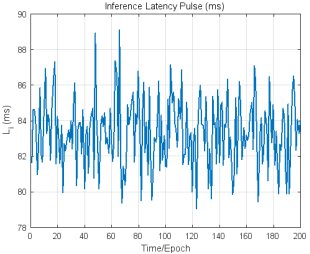
Figure 3 shows a time-series plot of
against time/epochs
. The curve is highly volatile, with persistent short-term fluctuations and noise, but no sustained upward or downward trend. Most values remain within a tight range of about
, with a typical level around
. Brief peaks approach
around epochs
, while the lowest points drop slightly below
. This shows that the behavior is consistent with latency variability (jitter) in a networked or edge-processing setting, where per-cycle delays vary but remain centered around a stable mean.
Figure 3. Inference latency time-series across 200 epochs, showing stable latency with short-term fluctuations (jitter) and no sustained trend, consistent with realistic edge/IoT processing variability.
5.2. Energy Consumption Profile
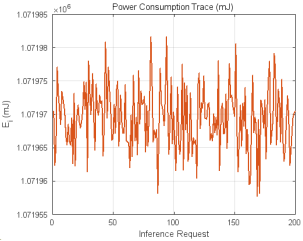
Figure 4 presents the energy consumption trace
per inference request, reflecting the power overhead of the deployed model across
requests. The curve shows rapid, high-frequency fluctuations and stochastic noise, indicating small per-cycle variations in energy use. Despite this jagged pattern, there is no sustained upward or downward drift over time, suggesting a stable computational workload throughout the simulation. Quantitatively, the signal is centered around a mean of approximately
, with most values confined to a narrow band of about
. The brief peaks and dips likely reflect transient switching activity and minor execution-path differences during inference. Overall, the results indicate relatively constant energy demand, supporting the suitability of the deployment for edge/IoT scenarios where predictable power usage is critical, especially for battery-powered devices.
Figure 4. Power consumption trace across 200 inference requests, showing high-frequency fluctuations around a stable mean, indicating consistent energy demand per inference cycle in the edge/IoT deployment.
5.3. Adversarial Robustness Evaluation
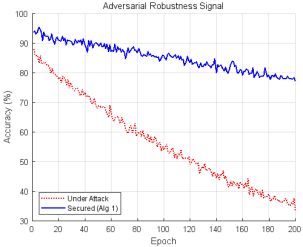
Figure 5. Adversarial robustness signal comparing model accuracy under increasing perturbation strength for the unsecured and secured configurations, demonstrating improved resilience of the defended model as attack intensity increases.
Figure 5 evaluates adversarial robustness by comparing model accuracy under increasing attack strength
for an unsecured baseline and a secured (defended) version. Without protection, accuracy falls sharply from
, indicating severe susceptibility to adversarial perturbations. With the defense enabled, accuracy degrades far more slowly, remaining at
at the same
level. This represents a
robustness gain at
, demonstrating that the proposed defense substantially improves resilience and reinforcing the need to embed robustness mechanisms during deployment in adversarial edge/IoT environments.
5.4. Federated Learning Convergence with Differential Privacy
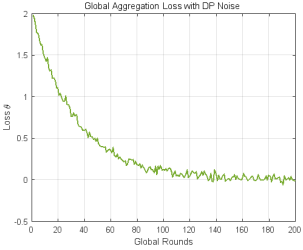
Figure 6 shows the convergence of the global aggregation loss
federated learning rounds under Differential Privacy (DP) noise. The loss starts at about
and decays in an approximately exponential manner as the global model learns from distributed updates. Although DP noise is injected with standard deviation
to protect privacy, the loss still converges toward zero and settles near
, reflecting small noise-induced fluctuations rather than true divergence. This trend suggest that privacy-preserving training can remain stable and convergent when the DP noise magnitude is appropriately balanced with the learning rate.
Figure 6. Global aggregation loss over federated learning rounds under Differential Privacy (DP) noise , showing stable convergence despite privacy-preserving perturbations.
5.5. Model Compression and Memory Optimization
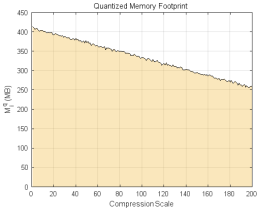
Figure 7 illustrates how model compression through pruning and quantization reduces memory usage. As the pruning level increases from
the quantized memory footprint
decreases in a near-linear manner. Memory drops from about
at the highest pruning level, yielding a reduction of
. This highlights a substantial storage optimization for resource-constrained IoT devices. The area plot further emphasizes that more aggressive pruning can markedly lower memory requirements, although these gains should be balanced against possible accuracy degradation, reflecting the efficiency–performance trade-off in model optimization.
Figure 7. Quantized memory footprint versus pruning/compression level, illustrating the reduction in model memory usage as pruning intensity increases for resource-constrained edge/IoT devices.
5.6. Side-Channel Leakage Power Trace
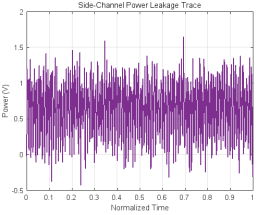
Figure 8. Side-channel power leakage trace showing voltage variations over normalized time, highlighting periodic power signatures and noise components that may reveal data-dependent leakage in edge/IoT hardware.
Figure 8 shows the side-channel power leakage trace used to assess physical security on the device. The plot captures voltage variations over normalized time, forming a periodic waveform with a peak of
and a mean of
. The oscillations, together with the observable noise floor, represent power or electromagnetic signatures that an attacker could correlate with internal computations to infer sensitive information, including cryptographic keys. These measured peaks provide a basis for designing countermeasures—such as masking and hiding—to reduce data-dependent leakage by weakening the link between processed values and observable power consumption.
5.7. Throughput Heterogeneity Across IoT Devices
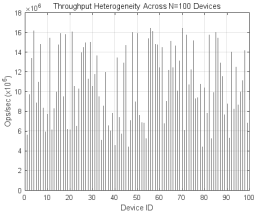
Figure 9 illustrates throughput heterogeneity across
, emphasizing performance variation in a diverse IoT ecosystem. Throughput spans from
, reflecting underlying differences in device capability. This spread aligns with the assumed CPU frequency range of
across the sampled devices, where higher-frequency nodes deliver substantially higher throughput. The stem plot highlights a long-tailed distribution, with top-performing edge nodes processing nearly four times faster than the most constrained devices. Accounting for this heterogeneity is essential for designing scheduling and load-balancing strategies that maintain consistent service quality in distributed secure model deployments.
Figure 9. Throughput heterogeneity across edge/IoT devices, showing the distribution of operations-per-second performance under varying device capabilities and highlighting variance that impacts scheduling and load balancing.
5.8. Summary of Results
Summary of key results from this work is presented in
Table 3. It summarizes the performance gains achieved by the proposed secure neural-network deployment framework relative to the baseline model across accuracy, federated-learning convergence, and memory efficiency. First, under adversarial perturbation at
, the baseline model records an accuracy of 35.05%, whereas the secured/proposed model maintains
corresponding to a gain of 40.45 percentage points. This result indicates that the proposed defense mechanism substantially improves model robustness against adversarial attacks and preserves prediction reliability in hostile edge/IoT environments. Second, both the baseline and secured models achieve the same initial accuracy of
yielding no gain at initialization. This shows that the security enhancements do not degrade the model’s original clean-data performance before attack conditions are introduced. Third, for federated learning with differential privacy at
, the global loss decreases from
at the start of training to approximately
by round
, representing a total reduction of
. This demonstrates that the proposed privacy-preserving learning mechanism remains stable and convergent despite the addition of DP noise. Finally, model compression through pruning from
reduces memory usage from
, producing a memory saving of 155.09 MB. This confirms that the proposed framework improves storage efficiency and makes deployment more practical for resource-constrained edge and IoT devices.
Table 3. Summary of key simulation results comparing unsecured and proposed secured deployment, suggesting possible gains in adversarial robustness, privacy-preserving federated convergence, and memory efficiency.
Metric | Baseline | Secured/Proposed | Gain |
Accuracy at | | | |
Initial accuracy | | | |
FL loss | | | |
Memory | | | |
6. Conclusion
This study presented a unified framework for the secure deployment of neural networks in edge and Internet of Things (IoT) environments by jointly addressing adversarial robustness, privacy preservation, and deployment efficiency under practical device constraints. The results showed that the proposed approach can maintain stable inference latency and energy behavior while significantly improving robustness against adversarial perturbations, supporting convergence in federated learning under differential privacy, and reducing model memory footprint through pruning and quantization. These findings confirm that secure edge/IoT intelligence should not be treated as a single-dimensional optimization problem, but rather as a careful balance among security, privacy, accuracy, and resource efficiency. Overall, the work contributes a metrics-driven and practically oriented framework that can guide the design of resilient and lightweight AI systems for heterogeneous edge environments.
Despite these contributions, the study has some limitations. The evaluation was conducted in a MATLAB-based simulation environment rather than on physical edge/IoT hardware, which means that real-world deployment effects such as hardware-specific timing behavior, thermal constraints, communication instability, and implementation overhead may not be fully captured. In addition, although the framework considers important threats such as adversarial attacks, privacy leakage, and side-channel exposure, it does not exhaustively evaluate fully adaptive attackers or all possible real-world attack combinations. Future work should therefore focus on hardware-based validation on diverse edge platforms, broader threat modeling with stronger adaptive adversaries, and deeper investigation of mitigation strategies for side-channel leakage and heterogeneous device behavior. Further research may also explore more advanced privacy mechanisms, lightweight defense techniques, and adaptive compression strategies to improve the scalability and practicality of secure edge/IoT AI deployment.
Abbreviations
AI | Artificial Intelligence |
PGD | Projected Gradient Decent |
FL | Federated Learning |
DP | Differential Privacy |
NN | Neural Networks |
IoMT | Internet of Medical Things |
IoT | Internet-of-Things |
FPG | Field-Programmable Gate Array |
Author Contributions
Daniel Ekpah: Conceptualization
Friday Oodee Philip-Kpae: Conceptualization
Agbotiname Lucky Imoize: Writing – review & editing
Conflicts of Interest
The authors declare no conflicts of interest.
References
| [1] |
N. B. Gaikwad, S. K. Khare, D. Mendhe, H. Mir, S. Kosta and U. R. Acharya, "FPGA SoC Implementation of Adaptive Deep Neural Network-Based Multimodal Edge Intelligence for Internet of Medical Things," in IEEE Access, vol. 13, pp. 134041-134056, 2025,
https://doi.org/10.1109/ACCESS.2025.3592729
|
| [2] |
K. Swathi, P. Durga, K. V. Prasad, A. K. Chaitanya, K. Santhi, P. Vidyullatha and S. V. A. Rao “Secure blockchain integrated deep learning framework for federated risk-adaptive and privacy-preserving IoT edge intelligence sets” Scientific Reports 15, 41133 (2025).
https://doi.org/10.1038/s41598-025-24895-8
|
| [3] |
M. K. Hasan, S. R. Kabir, S. Islam, S. Abdullah, H. S. Abbas, B. K. Pandey, "AES Cryptography Enabled Responsible Federated Foundation Model Using Transformer LLM and LSTM for Smart Grid IIoT Networks," in IEEE Internet of Things Journal, vol. 12, no. 23, pp. 49801-49810, 1 Dec.1, 2025,
https://doi.org/10.1109/JIOT.2025.3608807
|
| [4] |
M. Kumar, J. K. Samriya, G. KaurWalia, P. Verma, H. Wu and S. S. Gill, "Blockchain Empowered Secure Federated Learning for Consumer IoT Applications in Cloud-Edge Collaborative Environment," in IEEE Transactions on Consumer Electronics, vol. 71, no. 2, pp. 3986-3996, May 2025,
https://doi.org/10.1109/TCE.2025.3532676
|
| [5] |
J. Yang, V. Govindarajan, L. Y. Por, Z. A. Shaikh, Q. Xin, P. Bhattacharya, "DDoS Attack Detection in Consumer IoT-Based Healthcare Systems Using Improved Off-Policy Proximal Policy Optimization and Generative Adversarial Network," in IEEE Transactions on Consumer Electronics, vol. 71, no. 4, pp. 11662-11675, Nov. 2025,
https://doi.org/10.1109/TCE.2025.3605098
|
| [6] |
K. J. Mukisa, L. A. C. Ahakonye, D. -S. Kim and J. -M. Lee, "Blockchain-Augmented FL IDS for Non-IID Edge-IoT Data Using Adaptive Trimmed Mean Aggregation," in IEEE Internet of Things Journal, vol. 12, no. 21, pp. 45150-45159, 1 Nov.1, 2025,
https://doi.org/10.1109/JIOT.2025.3598832
|
| [7] |
M. Asif, M. K. Kazmi, M. A. Rahman, S. R. Hasan and S. Homsi, "SHEATH: Defending Horizontal Collaboration for Distributed CNNs Against Adversarial Noise," in IEEE Transactions on Information Forensics and Security, vol. 20, pp. 4353-4368, 2025,
https://doi.org/10.1109/TIFS.2025.3556349
|
| [8] |
T. Ahmad, S. Khan, N. Nigar, E. Mohamed Obaid and S. Naaz, "Quantum Reservoir-Based Intrusion Detection for Edge-IoT Systems," in IEEE Transactions on Consumer Electronics, vol. 71, no. 4, pp. 11269-11278, Nov. 2025,
https://doi.org/10.1109/TCE.2025.3618827
|
| [9] |
Y. Liu, H. Zhang, M. Wang, Q. Xie and L. Wang, "An Efficient Privacy-Enhanced Federated Learning with Single-Key Homomorphic Encryption," in IEEE Internet of Things Journal, vol. 12, no. 13, pp. 23598-23613, 1 July1, 2025,
https://doi.org/10.1109/JIOT.2025.3553134
|
| [10] |
A. Tariq, F. Sallabi, M. A. Serhani, E. S. Barka, T. Qayyum, I. Din, "AI-Driven Lightweight and Trustworthy Federated Learning Framework for Decision-Making in Resource-Constrained Edge-IoT," in IEEE Transactions on Consumer Electronics, vol. 71, no. 4, pp. 12166-12180, Nov. 2025,
https://doi.org/10.1109/TCE.2025.3628207
|
| [11] |
N. Rattanavipanon and I. De Oliveira Nunes, "SLAPP: Poisoning Prevention in Federated Learning and Differential Privacy via Stateful Proofs of Execution," in IEEE Transactions on Information Forensics and Security, vol. 20, pp. 4167-4182, 2025,
https://doi.org/10.1109/TIFS.2025.3555179
|
| [12] |
M. J. Baucas and P. Spachos, "Private Blockchain and Federated Learning-Based Edge-Iot Platform for Secure Urban Noise Monitoring," ICC 2025 - IEEE International Conference on Communications, Montreal, QC, Canada, 2025, pp. 1145-1150,
https://doi.org/10.1109/ICC52391.2025.11160895
|
| [13] |
E. Manor and S. Greenberg, “Custom hardware inference accelerator for tensorflow lite for microcontrollers,” IEEE Access, vol. 10, pp. 73484–73493, 2022.
|
Cite This Article
-
APA Style
Ekpah, D., Philip-Kpae, F. O., Imoize, A. L. (2026). Secure Deployment of Neural Networks in Edge and IoT Devices. American Journal of Neural Networks and Applications, 12(2), 87-98. https://doi.org/10.11648/j.ajnna.20261202.14
 Copy
|
 Download
ACS Style
Ekpah, D.; Philip-Kpae, F. O.; Imoize, A. L. Secure Deployment of Neural Networks in Edge and IoT Devices. Am. J. Neural Netw. Appl. 2026, 12(2), 87-98. doi: 10.11648/j.ajnna.20261202.14
Copy
|
Download
AMA Style
Ekpah D, Philip-Kpae FO, Imoize AL. Secure Deployment of Neural Networks in Edge and IoT Devices. Am J Neural Netw Appl. 2026;12(2):87-98. doi: 10.11648/j.ajnna.20261202.14
Copy
|
Download
-
@article{10.11648/j.ajnna.20261202.14,
  author = {Daniel Ekpah and Friday Oodee Philip-Kpae and Agbotiname Lucky Imoize},
  title = {Secure Deployment of Neural Networks in Edge and IoT Devices},
  journal = {American Journal of Neural Networks and Applications},
  volume = {12},
  number = {2},
  pages = {87-98},
  doi = {10.11648/j.ajnna.20261202.14},
  url = {https://doi.org/10.11648/j.ajnna.20261202.14},
  eprint = {https://article.sciencepublishinggroup.com/pdf/10.11648.j.ajnna.20261202.14},
  abstract = {Secure deployment of neural networks (NNs) on edge and Internet of Things (IoT) devices is essential for real-time intelligence. However, it is challenged by latency variation, energy limits, adversarial attacks, privacy risks, memory scarcity, and hardware heterogeneity. This paper presents a secure NN deployment framework for edge/IoT using MATLAB-based simulation over 200 epochs and 200 inference requests. The framework evaluates latency, energy consumption, adversarial robustness, federated learning (FL) convergence under Differential Privacy (DP), compression-based memory reduction, side-channel power leakage, and throughput variability across 100 devices. Results show stable yet noisy latency of 80-88ms, centered near 83-84ms, and consistent energy demand with a mean of 1.07197×10^6mJ. At ε=0.1, unsecured model accuracy drops from 85.51% to 35.05%, while the defended model retains 75.50%, a 40.45 percentage-point gain. With DP noise of σ=0.03, FL global loss declines from 1.92 to about -0.05 by round 200, indicating convergence. Pruning and quantization from 20% to 50% reduce memory from 410.68 MB to 255.59 MB. Peak side-channel leakage reaches 1.62 V, and throughput varies from 4.24 to 16.50 million Ops/s. Despite simulation-only evaluation and limited adaptive-threat coverage, the study offers a practical metrics-driven blueprint for balancing security, privacy, and efficiency in edge/IoT AI deployment.},
 year = {2026}
}
Copy
|
Download
-
TY  - JOUR
T1  - Secure Deployment of Neural Networks in Edge and IoT Devices
AU  - Daniel Ekpah
AU  - Friday Oodee Philip-Kpae
AU  - Agbotiname Lucky Imoize
Y1  - 2026/10/31
PY  - 2026
N1  - https://doi.org/10.11648/j.ajnna.20261202.14
DO  - 10.11648/j.ajnna.20261202.14
T2  - American Journal of Neural Networks and Applications
JF  - American Journal of Neural Networks and Applications
JO  - American Journal of Neural Networks and Applications
SP  - 87
EP  - 98
PB  - Science Publishing Group
SN  - 2469-7419
UR  - https://doi.org/10.11648/j.ajnna.20261202.14
AB  - Secure deployment of neural networks (NNs) on edge and Internet of Things (IoT) devices is essential for real-time intelligence. However, it is challenged by latency variation, energy limits, adversarial attacks, privacy risks, memory scarcity, and hardware heterogeneity. This paper presents a secure NN deployment framework for edge/IoT using MATLAB-based simulation over 200 epochs and 200 inference requests. The framework evaluates latency, energy consumption, adversarial robustness, federated learning (FL) convergence under Differential Privacy (DP), compression-based memory reduction, side-channel power leakage, and throughput variability across 100 devices. Results show stable yet noisy latency of 80-88ms, centered near 83-84ms, and consistent energy demand with a mean of 1.07197×10^6mJ. At ε=0.1, unsecured model accuracy drops from 85.51% to 35.05%, while the defended model retains 75.50%, a 40.45 percentage-point gain. With DP noise of σ=0.03, FL global loss declines from 1.92 to about -0.05 by round 200, indicating convergence. Pruning and quantization from 20% to 50% reduce memory from 410.68 MB to 255.59 MB. Peak side-channel leakage reaches 1.62 V, and throughput varies from 4.24 to 16.50 million Ops/s. Despite simulation-only evaluation and limited adaptive-threat coverage, the study offers a practical metrics-driven blueprint for balancing security, privacy, and efficiency in edge/IoT AI deployment.
VL  - 12
IS  - 2
ER  -
Copy
|
Download





 Share This Article
 Twitter
 Linked In
 Facebook
