Research Article | | Peer-Reviewed

Structural, Morphological, Magnetic, and Electrical Properties of ZrFe2−xBixO5 Nanoparticles (x = 0, 0.25, 0.50, 0.75 and 1.00) Synthesized via Sol-gel Auto-Combustion

Received: 1 June 2026     Accepted: 10 June 2026     Published: 26 June 2026
Views:       Downloads:
Abstract

ZrFe2−xBixO5 (x = 0, 0.25, 0.50, 0.75, 1.00) nanoparticles were synthesized using Sol-gel auto-combustion method and their structural, morphological, magnetic, and frequency-dependent electrical properties were systematically characterized at room temperature. X-ray diffraction analysis confirms single phase monoclinic C2/c formation for every composition, the principal interplanar spacing increases linearly from 2.9503 Å to 3.0034 Å, crystallite size decreases from 32.1 to 16.7 nm, and dislocation density grows nearly four times as x advances to unity. Scanning electron microscopy reveals a progressive transition from large, irregularly agglomerated grains to a finer, more densely packed nanoparticulate microstructure. All M-H loops measured over ±10 kOe identify soft ferromagnetic, multi-domain behavior (S < 0.5 throughout); saturation magnetization plummets from 16.46 to 1.67 emu g−1 while the coercive field rises from 102.24 to 182.22 G. Impedance measurements (100 Hz - 10 MHz) show that bulk resistance increases ten times over the substitution range, Nyquist plots fit to a two element equivalent circuit of two CPE-resistor pairs in series, and the extracted grain and grain-boundary resistances rise monotonically with x, establishing that Bi3+ incorporation progressively depletes the Fe3+/Fe2+ charge carrier pool. The dielectric constant follows Maxwell-Wagner-Sillars behavior and decreases with both frequency and Bi content, while AC conductivity spectra display a characteristic dual-peak pattern attributed to space-charge polarization at grain boundaries at low frequency and grain-interior Fe hopping at high frequency, both peaks diminishes with increasing Bi content. The correlated structure-property picture presented here establishes the Bi-substituted ZrFe2O5 system as a candidate for compositionally tunable soft-magnetic and dielectric applications.

Published in American Journal of Nanosciences (Volume 10, Issue 2)
DOI 10.11648/j.ajn.20261002.12
Page(s) 52-63
Creative Commons

This is an Open Access article, distributed under the terms of the Creative Commons Attribution 4.0 International License (http://creativecommons.org/licenses/by/4.0/), which permits unrestricted use, distribution and reproduction in any medium or format, provided the original work is properly cited.

Copyright

Copyright © The Author(s), 2026. Published by Science Publishing Group

Keywords

ZrFe2−xBixO5, AB2O5, Sol-gel Auto-combustion, Soft Ferromagnetism, Non Debye Relaxation, Maxwell-Wagner Polarization, Complex AC Conductivity

1. Introduction
The interplay of structural, magnetic, and dielectric degrees of freedom in complex transition-metal oxides has become one of the most fertile areas of contemporary material science research, driven equally by fundamental curiosity and by the demand for multifunctional ceramics in next-generation spintronics, high-frequency communication, magnetic hyperthermia, and energy-storage technologies . Within this broad landscape, compounds of the general formula AB2O5 attract growing attention because the structural versatility of their cation sublattice-accommodating diverse A and B occupants while retaining the characteristic 3: 5 cation-to-oxygen stoichiometry translates directly into a correspondingly rich portfolio of tunable properties . Pseudobrookite TiFe2O5, karrooite MgTi2O5, and the orthorhombic multiferroic TbMn2O5 illustrate distinct manifestations of this structural flexibility .
Zirconium iron oxide in the 1: 2: 5 stoichiometry (ZrFe2O5) occupies a structurally distinctive niche within the AB2O5 family. Its monoclinic C2/c crystal structure seats Zr4+ in an eight-coordinated polyhedron alongside two inequivalent Fe3+ sites in distorted octahedral environments, a connectivity that sustains frustrated spin pathways and active Fe3+/Fe2+ charge-transfer channels . Prior investigations have established that ZrFe2O5 nanoparticles display significant photocatalytic and Fenton-type reactivities and soft ferromagnetic behavior whose intensity depends sensitively on the synthesis protocol and annealing history . The related compound ZrFe2O4 has attracted parallel interest as a magnetic nano catalyst for organic synthesis and photodegradation applications . Systematic investigations of the AC impedance and dielectric response of pure and Ni-doped ZrFe2O5 were reported in our prior study , which revealed non-Debye relaxation and characteristic dual-peak AC conductivity spectra, and provided the structural and compositional baseline for the present work.
Chemical substitution at the B (iron) site is the most direct route to modify the magnetic exchange network and electrical transport properties of ZrFe2O5 while preserving the host crystal structure. In our earlier investigation , Ni2+ doping (up to x = 0.05) produced modest but measurable changes in lattice parameters, grain morphology, saturation magnetization, and dielectric relaxation dynamics, attributable to the moderate size mismatch (δr/r ≈ 7%) between Ni2+ (0.69 Å) and Fe3+ (0.645 Å). Extending the approach to Bi3+ substitution (r = 1.03 Å ) magnifies this mismatch to nearly 60% and introduces three additional physical effects absent in the Ni-doped system: (i) far greater lattice strain per dopant unit, enabling structural tuning over a wider single-phase composition range; (ii) a stereochemical active 6s2 lone pair that distorts local oxygen coordination and creates anisotropic dielectric response ; and (iii) a completely spin-inactive substituent that quantitatively dilutes the iron magnetic sublattice without contributing any compensating moment unlike Ni2+ (2 μB). These features make Bi3+ a uniquely informative probe of the structural property relationships in this system.
The sol-gel auto-combustion synthesis route exploited here combines the stoichiometric homogeneity of wet-chemical precursor mixing with the rapid exothermic ignition that produces finely divided, phase-pure powders at relatively low processing temperatures, circumventing the coarse microstructures and impurity phases typical of high-temperature solid-state reactions . No comprehensive study of Bi-substituted ZrFe2O5 spanning the full x = 0-1.00 range, and covering XRD, SEM, magnetic hysteresis, complex impedance, dielectric, and AC conductivity properties simultaneously, appears in the published literature. The present paper addresses this gap.
2. Synthesis and Experimental Techniques
Nanocrystalline ZrFe2−xBixO5 (x = 0, 0.25, 0.50, 0.75, 1.00) were prepared by the sol-gel auto-combustion method using citric acid as the organic fuel . Analytical reagent grade ferric nitrate [Fe(NO3)3·9H2O], bismuth nitrate [Bi(NO3)3·5H2O], zirconyl nitrate [ZrO(NO3)2·3H2O], and citric acid (C6H8O7) were dissolved in deionized water maintaining an oxidizer-to-fuel molar ratio of 1: 1. The solution was heated with continuous stirring at 80 °C until a viscous, amber gel formed; raising the temperature to 120 °C induced spontaneous ignition, producing a voluminous ashy precursor within seconds. The product was collected, ground in an agate mortar, and calcined and sintered at 500 °C for 5 h to eliminate organic residues and forming pure phase.
Room-temperature PXRD patterns were recorded on a diffractometer using Cu Kα radiation (λ = 1.5406 Å) over 2θ = 10-90°. Surface morphology and elemental composition were examined by scanning electron microscopy coupled with energy-dispersive X-ray spectroscopy. Magnetic hysteresis loops were recorded at 300 K on a home-built vibrating sample magnetometer (VSM) over ±10 kOe. For electrical measurements, sintered powders were mixed with 6 wt% poly(vinyl alcohol) binder, uniaxially pressed into 8 mm-diameter pellets at 50 kg cm−2, heated at 500 °C for 5 h, and contact-coated with silver paste cured at 100 °C for 30 min. Frequency-dependent impedance, dielectric, and AC conductivity data were acquired on a Wayne Kerr 6500B impedance analyzer at 300 K over 100 Hz to 10 MHz.
3. Results and Discussion
3.1. X-ray Diffraction Analysis
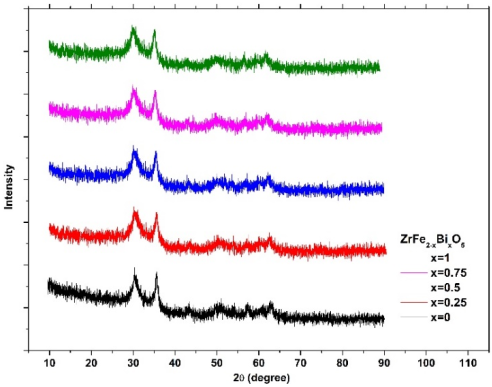
Every reflection in the parent compound indexes on a monoclinic unit cell, space group C2/c (No. 15), consistent with the polyhedral framework comprising Zr4+ in eight-coordination and two inequivalent Fe3+ sites in distorted octahedra . No secondary-phase reflections attributable to ZrO2, Fe2O3, or Bi2O3 were detected, confirming single-phase formation across the entire substitution range. The dominant reflection near 30° (2θ) shifts monotonically to 29.72° as x rises to 1.00, while the associated interplanar spacing expands from 2.9503 Å to 3.0034 Å, a linear variation that obeys Vegard’s law with a coefficient of determination R2 = 0.9994. The driving force is the ionic-size mismatch between Fe3+ (r = 0.645 Å) and Bi3+ (r = 1.03 Å) in six-fold coordination , a nearly 60% discrepancy that dilates the surrounding oxygen polyhedra at each Bi site, in accordance with Bragg’s law .
Figure 1. Room temperature PXRD patterns of ZrFe2−xBixO5 compositions.
Crystallite size D was evaluated from the Scherrer relation . D contracts from 32.1 nm (x = 0) to 16.7 nm (x = 1.00), a 48% reduction, following the established trend of crystallite suppression under large-ion doping . Williamson-Hall (W-H) plots (β cosθ vs. 4 sinθ) provide the micro-strain ε from the gradient and confirm that all broadening trends are tensile: ε rises from 0.93 × 10⁻³ to 1.81 × 10⁻³. Dislocation density ρ climbs nearly four times from 3.08 to 11.34 × 10¹³ m−2. No superlattice satellites appeared, confirming random Bi3+ distribution within the detection limit of the diffraction experiment. All derived parameters are given in Table 1.
Table 1. XRD-derived structural and microstructural parameters for ZrFe2−xBixO5 compositions.

Composition (x)

2θ (°)

Interplanar Spacing d (Å)

Crystalline Size D (nm)

Micro-Strain (W-H) ε (10−3)

Dislocation Density ρ=1D2 (1013 m−2)

0

30.27

2.9503

32.1

0.93

3.08

0.25

30.13

2.9636

27.5

1.14

4.20

0.50

29.99

2.9768

23.8

1.36

5.59

0.75

29.86

2.9901

20.1

1.58

7.83

1.00

29.72

3.0034

16.7

1.81

11.34

3.2. Surface Morphology and EDAX
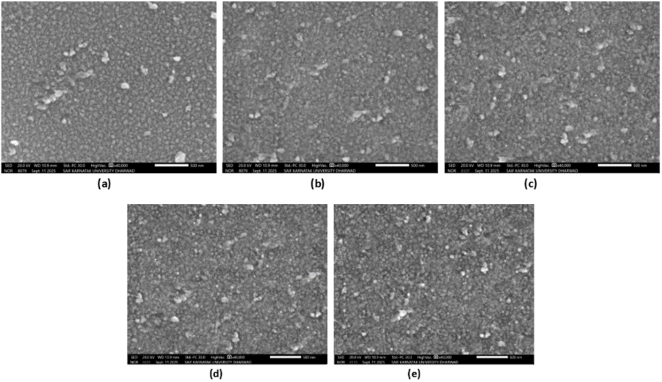
Figure 2. SEM images of ZrFe2−xBixO5 at (a) x = 0, (b) 0.25, (c) 0.50, (d) 0.75, (e) 1.00.
SEM images reveal a clear and progressive response of surface morphology to Bi substitution. The undoped parent compound (Figure 2a) shows large, irregularly shaped, angular grain clusters separated by conspicuous inter-grain voids. The comparatively broad particle size distribution and high porosity are consistent with the large crystallite size (32.1 nm) and low dislocation density (ρ = 3.08 × 10¹³ m−2) documented in Table 1; scattered bright protrusions are attributable to topographic secondary-electron contrast enhancement at surface asperities rather than chemical inhomogeneity .
As x increases from 0.25 to 1.00 (Figures 2b-2e), the microstructure evolves markedly toward a finer, more densely packed assembly. For x = 0.25 and 0.50, grains appear polygonal facets, inter-grain contact area grows with multi-domain grains, each encompassing several coherently scattering XRD crystallite domains. For x = 0.75 and 1.00, grain boundaries are sharply defined and porosity diminishes markedly. The grain-size with Bi content mirrors the crystallite refinement in Table 1 and is attributed to the elevated elastic energy around oversized Bi3+ centres impeding grain-boundary migration, an effect analogous to Zener pinning . EDAX analysis (Table 2) confirms Zr, Fe, Bi, and O in stoichiometric proportions without extraneous peaks, establishing phase purity consistent with the XRD data.
Table 2. EDAX elemental atomic percentages for ZrFe2−xBixO5 compositions.

Composition (x)

Atomic%

Zr

Fe

Bi

O

0

10.54 ± 0.6

23.02 ± 1.04

0

66.44 ± 3.05

0.25

10.58 ± 0.7

20.12 ± 0.8

3.04 ± 0.3

66.26 ± 3.08

0.50

10.56 ± 0.5

17.27 ± 0.6

5.77 ± 0.5

66.40 ± 3.02

0.75

10.59 ± 0.8

14.35 ± 0.3

8.86 ± 0.6

66.20 ± 3.11

1.00

10.53 ± 0.6

11.53 ± 0.3

11.01 ± 0.7

66.93 ± 3.15

3.3. Magnetic Properties
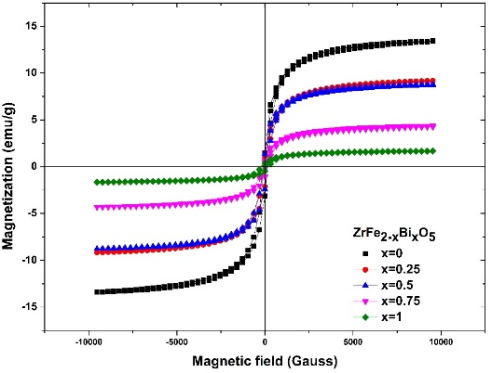
Figure 3. Room-temperature M-H loops of ZrFe2−xBixO5 compositions.
Room-temperature M-H loops recorded over ±10 kOe (Figure 3) are open and relatively narrow for every composition, the characteristic signature of soft ferromagnetic behaviour. The squareness ratio S ranges from 0.165 (x = 0) to 0.252 (x = 1.00), comfortably below the 0.5 threshold that the Stoner-Wohlfarth model identifies with single-domain particles. Such S values indicate a multi-domain ferromagnetic ground state in which reversal is governed by Bloch-wall displacement rather than coherent spin rotation, consistent with the SEM-derived apparent grain diameters of 45-90 nm that comfortably exceed the single-domain radius for iron-oxide-class ceramics . All derived magnetic parameters are collected in Table 3.
Ms falls from 16.46 emu g−1 at x = 0 to 1.67 emu g−1 at x = 1.00, a 90% suppression. Comparison with our previous investigation is instructive: over x = 0-0.05, Ni2+ doping reduced Ms by only ~31%. The disparity directly reflects the magnetic valence contrast between the two dopants Ni2+ (d8, 2 μB) partially maintains the sublattice moment, whereas Bi3+ (6s2, 0 μB) contributes no spin and simultaneously severs Fe-O-Fe superexchange bridges . Magnetic moment per formula unit nB was calculated using following formula nB .
nB=Molecular Weight XMs5585(1)
nB drops from 0.834 μB to 0.130 μB across the series. A marginal non-monotonic bump between x = 0.25 (0.527 μB) and x = 0.50 (0.565 μB) is a molecular-weight artefact, the formula weight increases by nearly 38 g mol−1 in this step while Ms barely changes and carries no independent physical significance .
Hc climbs monotonically from 102.24 G (x = 0) to 182.22 G (x = 1.00), a 78% overall gain that contrasts sharply with the near-constant coercive field (~100-103 G) in the Ni-doped system . Three independent mechanisms, each corroborated by XRD or SEM data, drive this coercivity increase. (i) Grain-boundary pinning: the denser grain-boundary network in finer-grained samples (Section 3.2) multiplies Bloch-wall pinning sites . (ii) Magnetoelastic coupling to lattice microstrain: the doubling of ε (Table 1) creates local anisotropy gradients that resist domain-wall motion . (iii) The stereochemically active Bi3+ 6s2 lone pair induces off-centre oxygen displacements that lower local symmetry and scatter walls. The disproportionate Hc jump between x = 0.75 (133.1 G) and x = 1.00 (182.22 G) is consistent with the lone-pair effect becoming percolative once Bi3+ is the majority B-site occupant.
Table 3. Room Temperature Magnetic parameters for ZrFe2−xBixO5 compositions.

Composition (x)

Saturation Magnetiszaton Ms (emu g−1)

Remanent Magnetization Mr (emu g−1)

Coercive Field Hc (Gauss)

Squareness Ratio S=MrMs

Magnetic Moment nB μB

0

16.46

2.71

102.24

0.1646

0.834

0.25

9.17

1.88

106.23

0.2050

0.527

0.50

8.78

1.56

125.20

0.1777

0.565

0.75

4.35

0.85

133.10

0.1954

0.310

1.00

1.67

0.42

182.22

0.2515

0.130

3.4. Impedance Properties
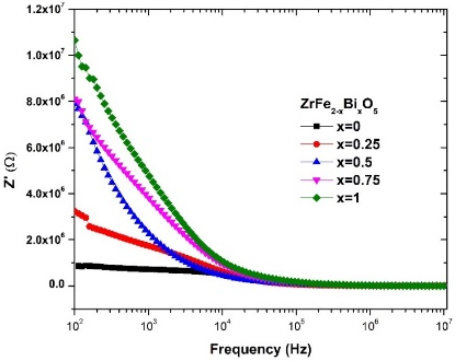
Figure 4. Real part of impedance Z′ versus frequency for ZrFe2−xBixO5 compositions.
The real component of impedance Z′ (Figure 4) is high at 100 Hz and decreases steadily with frequency for all compositions, all curves converging near zero above nearly 105 Hz. The magnitude at 100 Hz rises from nearly 0.8 MΩ (x = 0) to ~10.5 MΩ (x = 1.00), with intermediate compositions taking values of nearly 3.0, 6.0, and 8.0 MΩ. Within the Maxwell-Wagner-Koops microstructural model , the high Z′ at low frequency reflects the dominant role of highly resistive grain boundaries, while the convergence to low values at high frequency indicates that charge carriers interact principally with the more conductive grain interiors. Bi3+ incorporation reduces the concentration of mobile Fe3+/Fe2+ hopping pairs, simultaneously raising grain-bulk and grain-boundary resistance. Nickel doping in our prior study showed the same qualitative trend but with far smaller magnitudes, consistent with the much lower substitution levels used (x ≤ 0.05) and Ni2+ being only weakly hole-forming at the Fe site.
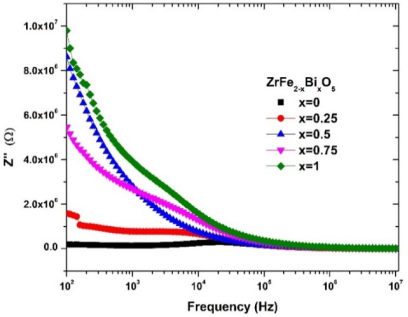
Figure 5. Imaginary part of impedance Z′′ versus frequency for ZrFe2−xBixO5 compositions.
The imaginary part Z″ (Figure 5) follows an analogous monotonic decay from large values at 100 Hz toward zero at high frequency, with the amplitude hierarchy x = 1.00 > 0.75 > 0.50 > 0.25 > 0 at any given low frequency. The absence of a resolved Z″ maximum within the measurement window (100 Hz-10 MHz) for x ≥ 0.50 indicates that the predominant relaxation frequency lies below 100 Hz, i.e., the grain-boundary arc is too large to be fully captured in the accessible frequency range. This is a direct consequence of the large Rgb values documented in the equivalent-circuit fitting. The combined Z′ and Z″ behaviour is characteristic of non-Debye type relaxation , arising from a distribution of relaxation times across grain-boundary regions of varying thickness, composition, and local Bi3+ enrichment.
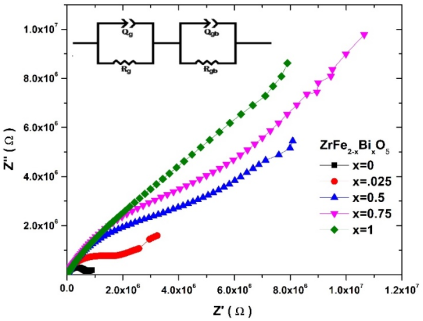
Figure 6. Nyquist plots (Z″ vs Z′) for ZrFe2−xBixO5 compositions with equivalent circuit.
Complex impedance Nyquist plots for all compositions are shown in Figure 6. For x = 0, the arc spans an extremely small impedance range compare to doped one and lies almost entirely within the noise floor of the plot, consistent with the high AC conductivity of this composition. For x = 0.25, a partially resolved, depressed semicircular arc is discernible. At x ≥ 0.50, the data trace large-radius arcs whose low-frequency limbs fall outside the measurement window (100 Hz), so only the ascending portions are captured. The depression of all arcs below the real axis confirms non-Debye type relaxation , arising from a distribution of relaxation times rather than a single exponential process.
All data were fitted to the equivalent circuit (Rg||CPEg) + (Rgb||CPEgb), where two parallel constant phase element and resistor units are connected in series, with the grain element (Rg||CPEg) dominating at high frequency and the grain-boundary element (Rgb||CPEgb) at low frequency . All fitted parameters are tabulated in Table 4.
Table 4. Equivalent circuit parameters from Nyquist plot fitting for ZrFe2−xBixO5 compositions.

Composition x

Grain Resistance Rg (Ω)

Grain CPE Qg (F)

Grain CPE Phase Exponent ng

Grain Boundary Resistance Rgb (Ω)

Grain Boundary CPE Qgb (F)

Gran Boundary CPE Phase Exponent ngb

Chi Square Value χ2

0

6.03×10⁵

3.55×10⁻¹¹

0.9079

1.28×10⁶

2.02×10⁻⁷

0.3912

6.63× 10⁻⁴

0.25

1.78×10⁶

1.43×10⁻¹⁰

0.7907

4.37×10⁶

2.61×10⁻⁹

0.7711

6.32× 10⁻³

0.50

3.24×10⁶

3.87×10⁻¹⁰

0.7600

6.48×10⁶

1.93×10⁻¹⁰

0.7923

1.15× 10⁻²

0.75

5.16×10⁶

6.94×10⁻¹⁰

0.7441

9.37×10⁶

1.14×10⁻¹⁰

0.8136

1.82× 10⁻²

1.00

7.82×10⁶

1.12×10⁻⁹

0.7218

1.36×10⁷

6.87×10⁻¹¹

0.8312

2.55× 10⁻²

Trends in Table 4 are evident that both Rg and Rgb increase monotonically from x = 0 through x = 1.00 (Rg: 6.03 × 10⁵ to 7.82 × 10⁶ Ω; Rgb: 1.28 × 10⁶ to 1.36 × 10⁷ Ω), confirming that Bi3+ incorporation progressively impedes charge transport in both microstructural regions. The CPE coefficient Qg rises steadily from 3.55 × 10⁻¹¹ to 1.12 × 10⁻⁹ F, consistent with the increase in grain-boundary-to-volume ratio documented by SEM, that is smaller grains = higher specific grain capacitance. Conversely, Qgb decreases by approximately three order of magnitude across the series (2.02 × 10⁻⁷ to 6.87 × 10⁻¹¹ F), reflecting the progressive reduction in grain-boundary capacitance as the boundary regions become more resistive and the charge accumulation is depleted. The grain phase exponent ng decreases gradually (0.908→0.722) while ngb increases (0.391→0.831), indicating that grain-interior relaxation becomes more heterogeneous while grain-boundary behaviour approaches that of a more idealised Debye-like capacitor with increasing Bi content, a trend reported for Bi-containing ferrite composites as well . For all compositions Rgb > Rg and Qgb > Qg, a well-established hallmark of polycrystalline ionic oxides where grain boundaries offer a higher energy barrier than bulk grains .
3.5. Dielectric Properties
The dielectric constant ε′ and dielectric loss ε″ are determined from the measured capacitance C and dissipation factor tan δ :
ε'=Cdε0A(2)
ε=ε'tanδ(3)
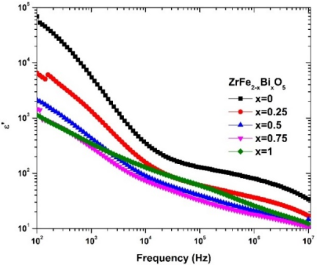
where d is pellet thickness, A the electrode area, and ε0 the permittivity of free space. At 100 Hz, ε′ spans nearly two decades across the series: from nearly 5 × 10⁴ for ZrFe2O5 to nearly 103 for x = 1.00 (Figure 7). By 10 MHz all curves converge to ε′ values in the range 10-30, where only intrinsic lattice polarization mechanisms contribute. The high low-frequency ε′ and its steep frequency dependence are the textbook signature of Maxwell-Wagner-Sillars (MWS) space-charge polarization : at low frequencies, charge carriers accumulate at resistive grain boundaries on a timescale exceeding the field period, generating giant effective permittivities; at high frequencies, carriers cannot follow the rapidly alternating field and ε′ plateaus near its intrinsic value. Bi substitution reduces ε′ because the Verwey-type Fe3+↔Fe2+ electron hopping that generates the mobile space charge is progressively diluted as Bi3+ occupies Fe sites, in direct analogy to the behaviour documented for Ni2+ doping in our prior study and for Bi3+-bearing spinel ferrites in the wider literature .
Figure 7. Dielectric constant ε′ vs frequency of ZrFe2−xBixO5 compositions.
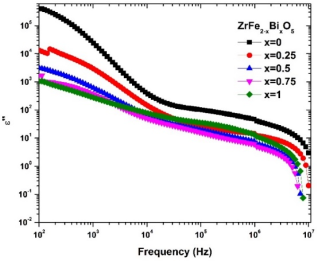
Figure 8. Loss tangent tanδ vs frequency of ZrFe2−xBixO5 compositions.
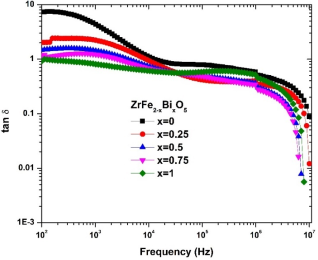
The dielectric loss ε″ (Figure 8) follows the same monotonically decreasing frequency dependence and scales proportionally with ε′ at each composition, as expected when ohmic conduction losses dominate at low frequencies. At high frequencies ε″ drops toward intrinsic polarization loss values and Bi doping reduces ε″ across the full frequency window, confirming suppression of conduction-driven polarization.
The loss tangent tanδ (Figure 9) begins at nearly 8-9 at 100 Hz for ZrFe2O5 and decreases to nearly 1-1.5 for x ≥ 0.50. A broad shoulder centred near 103-104 Hz for the x = 0 and 0.25 compositions signals a dielectric relaxation process; the absence of a sharp, symmetric Debye-type peak is the hallmark of non-Debye relaxation , arising from a distribution of relaxation times across grain-boundary regions of heterogeneous thickness and local composition. This shoulder attenuates and shifts with increasing Bi content as Fe hopping pairs become fewer . Above 106 Hz, tanδ drops sharply for all compositions, indicating that polarization mechanisms can no longer track the rapidly alternating field. The progressive suppression of tanδ with x suggests enhanced dielectric stability, analogous to the behaviour of Bi-doped nickel-cobalt ferrites and Ni-doped copper ferrite .
Figure 9. Dielectric loss ε′′ vs frequency of ZrFe2−xBixO5 compositions.
3.6. AC Conductivity
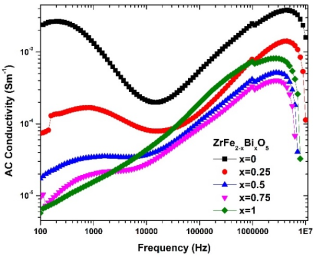
Figure 10. AC Conductivity vs frequency of ZrFe2−xBixO5 compositions.

The AC conductivity was calculated from :
σac=2πfε0ε'tanδ(4)
Figure 10 presents the σac spectra. The most revealing feature is the characteristic dual-peak structure prominently visible in the x = 0 (black) curve: a low-frequency peak at nearly 100-200 Hz (σac ≈ 2 × 10⁻³ S m−1), a conductivity minimum near 5 × 10³ Hz, and a second peak near 3 × 10⁶ Hz (σac ≈ 3 × 10⁻³ S m−1). This same fingerprint was documented in the Ni-doped analogue and is interpreted within an established framework. The low-frequency peak arises when the external field frequency matches the characteristic relaxation rate for space-charge accumulation at grain boundaries, including the resonance condition for Fe3+→Fe2+ carrier hopping across those boundaries; the intermediate conductivity minimum represents the DC-like plateau where neither boundary hopping nor grain-interior processes are resonant; and the high-frequency peak is assigned to short-range, localised Fe3+/Fe2+ hopping within grain interiors, generating transient dipoles that relax at the grain characteristic frequency .
For x = 0.25, both peaks persist at lower amplitudes (nearly1.5 × 10−4 and nearly 1.5 × 10⁻³ S m−1 for the low- and high-frequency peaks, respectively). From x ≥ 0.50, the low-frequency peak is no longer resolvable: the grain-boundary hopping carrier density is too dilute to sustain a measurable resonance, and only the high-frequency grain-interior peak remains, its amplitude decreasing from nearly 5 × 10⁻⁴ S m−1 (x = 0.50) to nearly 3 × 10⁻⁴ S m−1 (x = 0.75). The slight uptick at x = 1.00 (nearly 8 × 10⁻⁴ S m−1) may reflect the onset of percolating Bi-enriched interfacial pathways identified in the SEM micrographs. The universal power-law behaviour σac ωs (Jonscher’s law ) is broadly obeyed in the intermediate frequency plateau, providing an empirical signature of hopping-type conduction in disordered oxide systems .
4. Conclusion
A comprehensive sol-gel auto-combustion study of ZrFe2−xBixO5 (x = 0-1.00) has produced a self-consistent picture linking crystal structure, grain morphology, magnetic response, and broadband electrical behaviour across the full substitution range. Structurally, Bi3+ incorporation within the monoclinic C2/c framework obeys Vegard’s law (R2 = 0.9994), expanding the lattice by 1.80% while halving the crystallite size and nearly quadrupling the dislocation density. These XRD-derived changes manifest directly in the SEM microstructures progressive grain refinement, sharpening of grain boundaries, and appearance of Bi-enriched triple-junction inclusions all consistent with size-mismatch driven grain-boundary pinning. Magnetically, the complete spin inactivity of Bi3+ drives a 90% collapse of saturation magnetisation while the coercive field rises 78% through three concurrent mechanisms: denser grain-boundary Bloch-wall pinning, magnetoelastic coupling to the doubled lattice microstrain, and local anisotropy from the Bi3+ 6s2 lone pair. Complex impedance analysis reveals that both grain and grain-boundary resistances increase monotonically from x = 0 to 1.00 (nearly 10 times at 100 Hz), fitted by a two-element CPE equivalent circuit whose parameters evolve in a physically interpretable fashion. Dielectric permittivity decreases with both frequency and Bi content satisfying the Maxwell-Wagner-Sillars framework, and AC conductivity spectra exhibit a dual-peak nature whose progressive attenuation with x quantitatively shows the depletion of Fe3+/Fe2+ hopping carriers. All these results demonstrate that Bi3+ substitution in ZrFe2O5 provides a wide and experimentally accessible compositional arrangement for simultaneously tuning soft-magnetic coercivity, dielectric permittivity, and electrical resistance, establishing this system as a promising platform for multifunctional nanoceramics.
Abbreviations

XRD

X-Ray Diffraction

PXRDD

Powder X-Ray Diffraction

SEM

Scanning Electron Microscopy

EDAX

Energy Dispersive X-ray Analysis

VSM

Vibrating Sample Magnetometer

AC

Alternating Current

CPE

Constant Phase Element

MWS

Maxwell–Wagner–Sillars

W-H

Williamson–Hall

Acknowledgments
AM and SM acknowledge the Vision Group on Science and Technology for sanctioning the project under the "Center of Excellence in Science, Engineering and Medicine" (CESEM GRD No 852) Government of Karnataka. SM also, thanks to UGC-DAE Consortium of Scientific Research letter/Order No. 2021-22/03/587 dated 30/03/2022 for the financial support.
Author Contributions
Avadhut Manage: Data curation, Validation, Visualization, Writing – original draft, Writing – review & editing
Balachandra G. Hegde: Conceptualization, Methodology, Project administration, Resources, Supervision, Validation, Writing – review & editing
Shidaling Matteppanavar: Formal Analysis, Investigation, Resources, Validation, Supervision, Writing – review & editing
Conflicts of Interest
Authors don’t have any conflict of interest.
References
[1] Thapa, A.; Sharma, B. A review on novel low-dimensional materials based magnetic tunnel junctions: opportunities, challenges, and applications. Adv. Mater. Technol. 2025, e00133.
[2] Spaldin, N. A.; Cheong, S. W.; Ramesh, R. Multiferroics: past, present, and future. Phys. Today 2010, 63, 38-43.
[3] Han Yamin et al. Transition metal oxides: a new frontier in spintronics driven by novel quantum states and efficient charge-spin interconversion. Front. Mater. 2024, 11.
[4] Bhattacharya, A.; May, S. J. Magnetic oxide heterostructures. Annu. Rev. Mater. Res. 2014, 44, 65-90.
[5] Gao, X. M. et al. Characterisation of Fe2TiO5 nanocrystallites synthesised via homogeneous precipitation. Mater. Res. Innov. 2013, 19, 1-6.
[6] Mahmoud, M. H. H. et al. Physicochemical properties of pseudobrookite Fe2TiO5 synthesized from ilmenite ore. Physicochem. Probl. Miner. Process. 2019, 55, 290-300.
[7] Lennie, A. R.; Knight, K. S.; Henderson, C. M. B. Cation ordering in MgTi2O5 (karrooite). Am. Mineral. 2007, 92, 1165-1180.
[8] Dondi, M. et al. Pseudobrookite ceramic pigments: crystal structural, optical and technological properties. Solid State Sci. 2007, 9, 362-369.
[9] Lumpkin, G.; Aughterson, R. Perspectives on pyrochlores, defect fluorites, and related compounds. Front. Chem. 2021, 9, 778140.
[10] Newman, R. et al. Synthesis and structure of novel A2BO5 compounds. MRS Adv. 2018, 3, 1117-1122.
[11] The authors. Structural, morphological, magnetic, and electrical properties of ZrFe2−xNixO5 nanoparticles (x = 0-0.05) synthesized via sol-gel auto-combustion. Next Mater. 2026, 11, 101606.
[12] Shahid, S. et al. Characterization of newly synthesized ZrFe2O5 nanomaterial and its photocatalytic properties under visible light. J. Nanomater. 2013, 2013, 517643.
[13] Chakma, S.; Moholkar, V. S. Sonochemical synthesis of mesoporous ZrFe2O5 and its application for degradation of recalcitrant pollutants. RSC Adv. 2015, 5, 53529-53542.
[14] Mallan, K. P.; Jain, A.; Kalainathan, S. Preparation and magnetic properties of nano size zirconium ferrite particles using coprecipitation method. Int. J. ChemTech Res. 2014, 6, 2187-2189.
[15] Abdellahi, M. et al. Introducing ZrFe2O5 nanopowders for hyperthermia applications. Chin. J. Phys. 2018, 56, 880-885.
[16] Khosravi, B. et al. Design and development of a magnetic ZrFe2O4 nanostructure and its catalytic activities. J. Iran. Chem. Soc. 2020, 17.
[17] Kaur, N. et al. Impact of titanium doping on structural, optical, magnetic and photocatalytic properties of ZrFe2O4 nanoparticles. J. Solid State Chem. 2025, 350, 125471.
[18] Shannon, R. D. Revised effective ionic radii and systematic studies of interatomic distances in halides and chalcogenides. Acta Crystallogr. A 1976, 32, 751-767.
[19] Seshadri, R.; Hill, N. A. Visualizing the role of Bi 6s lone pairs in the off-center distortion in ferromagnetic BiMnO3. Chem. Mater. 2001, 13, 2892-2899.
[20] Roostaei, S. et al. Sol-gel auto-combustion synthesis of a novel ternary magnetic-recyclable ZnFe2O4/ZnO/CeO2 nano-photocatalyst. Appl. Water Sci. 2025.
[21] Niu, B. et al. Sol-gel autocombustion synthesis of nanocrystalline high-entropy alloys. Sci. Rep. 2017, 7, 3421.
[22] Pratheek et al. Design and development of a first order reversal curve measurement enabled variable temperature vibrating sample magnetometer. Phys. Scr. 2024, 99, 085932.
[23] Rodríguez-Carvajal, J. Recent advances in magnetic structure determination by neutron powder diffraction. Phys. B Condens. Matter 1993, 192, 55-69.
[24] Momma, K.; Izumi, F. VESTA 3 for three-dimensional visualization of crystal, volumetric and morphology data. J. Appl. Crystallogr. 2011, 44, 1272-1276.
[25] Vegard, L. The constitution of mixed crystals and the space filling of atoms. Z. Physik 5, 17–26 (1921).
[26] Denton, A. R.; Ashcroft, N. W. Vegard’s law. Phys. Rev. A 1991, 43, 3161-3164.
[27] Bragg, W. H.; Bragg, W. L. The reflection of X-rays by crystals. Proc. R. Soc. Lond. A 1913, 88, 428-438.
[28] Patterson, A. L. The Scherrer formula for X-ray particle size determination. Phys. Rev. 1939, 56, 978-982.
[29] Cullity, B. D.; Stock, S. R. Elements of X-ray Diffraction, 3rd ed.; Pearson: Upper Saddle River, NJ, 2001.
[30] Williamson, G. K.; Hall, W. H. X-ray line broadening from filed aluminium and wolfram. Acta Metall. 1953, 1, 22-31.
[31] Williamson, G. K.; Smallman, R. E. Dislocation densities in some annealed and cold-worked metals from X-ray Debye-Scherrer measurements. Philos. Mag. 1956, 1, 34-46.
[32] Goldstein, J. I. et al. Scanning Electron Microscopy and X-ray Microanalysis, 4th ed.; Springer: New York, 2018.
[33] Novikov, V. (2000). On Zener pinning in 3-D polycrystals. Scripta Materialia - SCRIPTA MATER. 42. 439-443.
[34] Yujie Yang et al. The effect of Bi substitution on the microstructure and magnetic properties of the Sr0.4Ba0.3La0.3Fe12−xBixO19 hexagonal ferrites J. Magn. Magn. Mater. 2017, 422, 209-215.
[35] Stoner, E. C.; Wohlfarth, E. P. A mechanism of magnetic hysteresis in heterogeneous alloys. Philos. Trans. R. Soc. Lond. A 1948, 240, 599-642.
[36] Coey, J. M. D. Magnetism and Magnetic Materials; Cambridge University Press: Cambridge, UK, 2010.
[37] Cullity, B. D.; Graham, C. D. Introduction to Magnetic Materials, 2nd ed.; Wiley-IEEE Press: Hoboken, NJ, 2009.
[38] Ahmad, I. et al. Effects of Ni doping on the structural properties and collapse of magnetic ordering in NdFe1−xNixO3. Chin. Phys. B 2016, 25, 028101.
[39] Joshi, S.; Kumar, M. Effect of Ni2+ substitution on structural, magnetic, dielectric and optical properties of mixed spinel CoFe2O4. Ceram. Int. 2016, 42, 18154-18165.
[40] Warsi, M. F. et al. New LiNi0.5PrxFe2−xO4 nanocrystallites. Ceram. Int. 2017, 43, 14807-14812.
[41] Gilani, Z. A. et al. New LiCo0.5PrxFe2−xO4 nanoferrites for high density storage application. Ceram. Int. 2018, 44, 1881-1885.
[42] Sheikh, F. A. et al. Effects of bismuth on structural and dielectric properties of cobalt-cadmium spinel ferrites. Chin. Phys. B 2019, 28, 088701.
[43] Desai, S. S. et al. Influence of Zn-Zr substitution on crystal chemistry and magnetic properties of CoFe2O4. Phys. B Condens. Matter 2020, 596, 412400.
[44] Amalthi, P.; Vijaya, J. J. Influence of Ni2+ doping in structural, magnetic and optical properties of MnFe2O4. Mater. Today: Proc. 2021.
[45] Koops, C. G. On the dispersion of resistivity and dielectric constant of some semiconductors at audio frequencies. Phys. Rev. 1951, 83, 121-124.
[46] Wagner, KW (1913), On the theory of imperfect dielectrics. Ann. Phys., 345: 817-855.
[47] Vaithyanathan, V. et al. Evolution of grain boundary conduction with increasing temperature in pure and Ti-doped Co ferrite materials. J. Appl. Phys. 2015, 118, 114102.
[48] Jonscher, A. K. The ‘universal’ dielectric response. Nature 1977, 267, 673-679.
[49] Sinclair, D. C.; West, A. R. Impedance and modulus spectroscopy of semiconducting BaTiO3 showing positive temperature coefficient of resistance. J. Appl. Phys. 1989, 66, 3850-3856.
[50] Srinivas, K.; Sarah, P.; Suryanarayana, S. V. Impedance spectroscopy study of polycrystalline Bi6Fe2Ti3O18. Bull. Mater. Sci. 2003, 26, 247-253.
[51] Adamczyk-Habrajska, M. et al. Impedance spectroscopy of Fe and La-doped BaTiO3 ceramics. Crystals 2024, 14, 131.
[52] Sheikh, F. A. et al. Dielectrically modified Dy3+ substituted nickel-cobalt ferrites for high frequency devices. Phys. B Condens. Matter 2023, 652, 414656.
[53] Naik, J. et al. Synthesis and characterization of multifunctional ZnBr2/PVA polymer dielectrics. J. Adv. Dielectr. 2016, 06, 1650028.
[54] Batoo, K. M. et al. Study of dielectric and AC impedance properties of Ti-doped Mn ferrites. Curr. Appl. Phys. 2009, 9, 1072-1078.
[55] Verwey, E. J.; Haayman, P. W.; Romeijn, F. C. Physical properties and cation arrangement of oxides with spinel structures II: Electronic conductivity. J. Chem. Phys. 1947, 15, 181-187.
[56] Nyathani, M. et al. Crystal chemistry, magnetic and dielectric properties of nickel-doped strontium ferrites. Biointerface Res. Appl. Chem. 2022, 12, 929-939.
[57] Halder, S. et al. Structural, dielectric and electrical characteristics of lead-free electro-ceramic Bi(Ni2/3Ta1/3)O3. Eng. Sci. Technol. Int. J. 2018, 22.
[58] Malik, R. A. et al. Grain size effects on dielectric, ferroelectric, and piezoelectric properties of modified bismuth sodium titanate ceramics. J. Eur. Ceram. Soc. 2019, 39, 1693-1701.
[59] Priyadharsini, R. et al. Impact of nickel substitution on structural, dielectric, magnetic, and electrochemical properties of copper ferrite nanostructures. J. Colloid Interface Sci. 2024, 653, 917-929.
[60] Rehman, F. et al. Grains and grain boundaries contribution to dielectric relaxations and conduction of Bi5Ti3FeO15 ceramics. J. Appl. Phys. 2015, 118, 214101.
Cite This Article
  • APA Style

    Manage, A., Hegde, B. G., Matteppanavar, S. (2026). Structural, Morphological, Magnetic, and Electrical Properties of ZrFe2−xBixO5 Nanoparticles (x = 0, 0.25, 0.50, 0.75 and 1.00) Synthesized via Sol-gel Auto-Combustion. American Journal of Nanosciences, 10(2), 52-63. https://doi.org/10.11648/j.ajn.20261002.12

    Copy | Download

    ACS Style

    Manage, A.; Hegde, B. G.; Matteppanavar, S. Structural, Morphological, Magnetic, and Electrical Properties of ZrFe2−xBixO5 Nanoparticles (x = 0, 0.25, 0.50, 0.75 and 1.00) Synthesized via Sol-gel Auto-Combustion. Am. J. Nanosci. 2026, 10(2), 52-63. doi: 10.11648/j.ajn.20261002.12

    Copy | Download

    AMA Style

    Manage A, Hegde BG, Matteppanavar S. Structural, Morphological, Magnetic, and Electrical Properties of ZrFe2−xBixO5 Nanoparticles (x = 0, 0.25, 0.50, 0.75 and 1.00) Synthesized via Sol-gel Auto-Combustion. Am J Nanosci. 2026;10(2):52-63. doi: 10.11648/j.ajn.20261002.12

    Copy | Download

  • @article{10.11648/j.ajn.20261002.12,
      author = {Avadhut Manage and Balachandra G. Hegde and Shidaling Matteppanavar},
      title = {Structural, Morphological, Magnetic, and Electrical Properties of ZrFe2−xBixO5 Nanoparticles (x = 0, 0.25, 0.50, 0.75 and 1.00) Synthesized via Sol-gel Auto-Combustion},
      journal = {American Journal of Nanosciences},
      volume = {10},
      number = {2},
      pages = {52-63},
      doi = {10.11648/j.ajn.20261002.12},
      url = {https://doi.org/10.11648/j.ajn.20261002.12},
      eprint = {https://article.sciencepublishinggroup.com/pdf/10.11648.j.ajn.20261002.12},
      abstract = {ZrFe2−xBixO5 (x = 0, 0.25, 0.50, 0.75, 1.00) nanoparticles were synthesized using Sol-gel auto-combustion method and their structural, morphological, magnetic, and frequency-dependent electrical properties were systematically characterized at room temperature. X-ray diffraction analysis confirms single phase monoclinic C2/c formation for every composition, the principal interplanar spacing increases linearly from 2.9503 Å to 3.0034 Å, crystallite size decreases from 32.1 to 16.7 nm, and dislocation density grows nearly four times as x advances to unity. Scanning electron microscopy reveals a progressive transition from large, irregularly agglomerated grains to a finer, more densely packed nanoparticulate microstructure. All M-H loops measured over ±10 kOe identify soft ferromagnetic, multi-domain behavior (S −1 while the coercive field rises from 102.24 to 182.22 G. Impedance measurements (100 Hz - 10 MHz) show that bulk resistance increases ten times over the substitution range, Nyquist plots fit to a two element equivalent circuit of two CPE-resistor pairs in series, and the extracted grain and grain-boundary resistances rise monotonically with x, establishing that Bi3+ incorporation progressively depletes the Fe3+/Fe2+ charge carrier pool. The dielectric constant follows Maxwell-Wagner-Sillars behavior and decreases with both frequency and Bi content, while AC conductivity spectra display a characteristic dual-peak pattern attributed to space-charge polarization at grain boundaries at low frequency and grain-interior Fe hopping at high frequency, both peaks diminishes with increasing Bi content. The correlated structure-property picture presented here establishes the Bi-substituted ZrFe2O5 system as a candidate for compositionally tunable soft-magnetic and dielectric applications.},
     year = {2026}
    }
    

    Copy | Download

  • TY  - JOUR
    T1  - Structural, Morphological, Magnetic, and Electrical Properties of ZrFe2−xBixO5 Nanoparticles (x = 0, 0.25, 0.50, 0.75 and 1.00) Synthesized via Sol-gel Auto-Combustion
    AU  - Avadhut Manage
    AU  - Balachandra G. Hegde
    AU  - Shidaling Matteppanavar
    Y1  - 2026/06/26
    PY  - 2026
    N1  - https://doi.org/10.11648/j.ajn.20261002.12
    DO  - 10.11648/j.ajn.20261002.12
    T2  - American Journal of Nanosciences
    JF  - American Journal of Nanosciences
    JO  - American Journal of Nanosciences
    SP  - 52
    EP  - 63
    PB  - Science Publishing Group
    SN  - 2575-4858
    UR  - https://doi.org/10.11648/j.ajn.20261002.12
    AB  - ZrFe2−xBixO5 (x = 0, 0.25, 0.50, 0.75, 1.00) nanoparticles were synthesized using Sol-gel auto-combustion method and their structural, morphological, magnetic, and frequency-dependent electrical properties were systematically characterized at room temperature. X-ray diffraction analysis confirms single phase monoclinic C2/c formation for every composition, the principal interplanar spacing increases linearly from 2.9503 Å to 3.0034 Å, crystallite size decreases from 32.1 to 16.7 nm, and dislocation density grows nearly four times as x advances to unity. Scanning electron microscopy reveals a progressive transition from large, irregularly agglomerated grains to a finer, more densely packed nanoparticulate microstructure. All M-H loops measured over ±10 kOe identify soft ferromagnetic, multi-domain behavior (S −1 while the coercive field rises from 102.24 to 182.22 G. Impedance measurements (100 Hz - 10 MHz) show that bulk resistance increases ten times over the substitution range, Nyquist plots fit to a two element equivalent circuit of two CPE-resistor pairs in series, and the extracted grain and grain-boundary resistances rise monotonically with x, establishing that Bi3+ incorporation progressively depletes the Fe3+/Fe2+ charge carrier pool. The dielectric constant follows Maxwell-Wagner-Sillars behavior and decreases with both frequency and Bi content, while AC conductivity spectra display a characteristic dual-peak pattern attributed to space-charge polarization at grain boundaries at low frequency and grain-interior Fe hopping at high frequency, both peaks diminishes with increasing Bi content. The correlated structure-property picture presented here establishes the Bi-substituted ZrFe2O5 system as a candidate for compositionally tunable soft-magnetic and dielectric applications.
    VL  - 10
    IS  - 2
    ER  - 

    Copy | Download

Author Information