Research Article | | Peer-Reviewed

Laser-based Heat Treatment Process Development for Laser Metal Deposition Layer/s on Heat-sensitive Alloy 17-4 PH: A Systematic Review

Received: 9 December 2025     Accepted: 20 December 2025     Published: 6 February 2026
Views:       Downloads:
Abstract

Laser Metal Deposition (LMD) is a powerful technique for fabricating and repairing complex metal components. However, it often results in residual stresses, uneven microstructures, and inconsistent mechanical properties due to the rapid thermal cycling. Laser-Based Heat Treatment (LBHT) offers a precise, localised post-processing solution to address these challenges, but its application to 17-4 PH stainless steel processed with LMD remains underexplored. This systematic review analysed 55 peer-reviewed studies published between 2015 and 2025, sourced from Scopus, Web of Science, Taylor & Francis Online, and IEEE Xplore. It focused on how LBHT processes parameters such as laser power, scan speed, laser beam diameter, and over-lap ratio affect microstructural evolution, stress relief, precipitation behaviour, and recovery of mechanical performance in LMD 17-4 PH. The review highlights the advantages of LBHT over conventional furnace heat treatments. However, significant gaps remain, including the lack of standardised process parameters, the minimal integration of in situ LBHT during LMD, and limited long-term performance data. Key recommendations include developing hybrid LMD-LBHT systems, applying machine learning to optimise process parameters, and establishing standardised testing and evaluation protocols. This review provides a comprehensive foundation for driving research and enabling reliable use of LBHT in the additive manufacturing of 17-4 PH components.

Published in American Journal of Materials Synthesis and Processing (Volume 11, Issue 1)
DOI 10.11648/j.ajmsp.20261101.11
Page(s) 1-22
Creative Commons

This is an Open Access article, distributed under the terms of the Creative Commons Attribution 4.0 International License (http://creativecommons.org/licenses/by/4.0/), which permits unrestricted use, distribution and reproduction in any medium or format, provided the original work is properly cited.

Copyright

Copyright © The Author(s), 2026. Published by Science Publishing Group

Keywords

Laser Metal Deposition, Laser-based Heat Treatment, 17-4 PH Stainless Steel, Additive Manufacturing, Microstructural Evolution, Mechanical Properties

1. Introduction
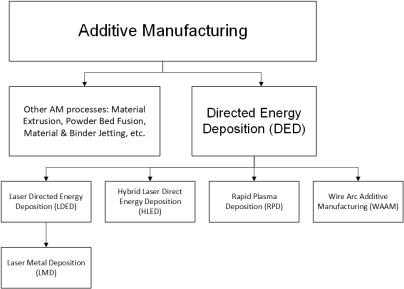
Additive manufacturing (AM) has redefined modern production, unlocking the ability to produce, refurbish, and repair intricate designs with customised properties. Laser Metal Deposition (LMD), which falls within the broader category of Directed Energy Deposition (DED), uses a laser to fuse metal powder or wire to build up a component layer by layer. LMD is attracting attention due to its ability to build and repair components while keeping material waste to a minimum . LMD is also known as Direct Metal Deposition (DMD) and Laser Cladding (LC). Additive manufacturing (AM) is classified into seven categories according to the ISO/ASTM 52900 standard, namely material extrusion, vat photopolymerization, binder jetting, material jetting, powder bed fusion, sheet lamination, and directed energy deposition . An overview of the classification categories is shown in Figure 1.
Figure 1. Overview of AM processes.
Laser Metal Deposition (LMD) uses the energy from a laser beam to form a molten pool on the surface of a metal part or substrate. During deposition, metal powder (or wire) is fed into the melt pool, where a metallurgical bond is formed with the base material upon solidification . The laser beam and the nozzle move simultaneously, adding material layer-by-layer to build up the part or surface. This process is used for applications such as the repair and remanufacturing of worn or damaged components, cladding to resist wear and corrosion, the manufacturing of difficult-to-machine materials, and the production of near-net shapes . LMD is widely used in industry on a variety of alloys, including the heat-sensitive precipitation hardening stainless steel alloy 17-4 PH (equivalent to AISI Grade 630, Werkstoff 1.4542, and X5CrNiCuNb16-4) .
17-4 PH, a martensitic precipitation hardening stainless steel, is a high-performance alloy, distinguished for its remarkable combination of high strength, good toughness, and excellent corrosion resistance . These properties are achieved primarily through precipitation strengthening, where fine copper-rich precipitates form within a martensitic matrix due to the age-hardening treatment . As a result of these excellent characteristics, 17-4 PH is widely used in the automotive (including electric vehicle components), aerospace, marine, chemical processing, and power generation industries.
In its conventional wrought form (condition A), 17-4 PH generally shows a fully martensitic microstructure with minor amounts of delta (δ) ferrite and no precipitates . The standard heat treatment cycle for this alloy includes solution heat treatment, which dissolves all alloying and trace elements, followed by an age-hardening treatment that results in the precipitation of coherent copper-rich clusters. These clusters significantly improve the mechanical properties of 17-4 PH . However, extended ageing can lead to the transformation of these precipitates into incoherent ε-Cu particles with a face-centred cubic (FCC) structure, an established phenomenon known as overaging, which results in a reduction in strength and hardness . The copper-rich precipitates hinder the movement of dislocations, thus improving the strength of the alloy .
When layers are built on 17-4 PH base material during LMD processes, 17-4 PH undergoes rapid heating and cooling cycles that can significantly alter its microstructure . The high thermal gradients and fast solidification rates characteristic of LMD can interfere with the controlled precipitation process that the alloy depends on for its mechanical performance . This introduces several challenges, including microstructural variations, residual stresses, and hardness variations . Rapid solidification can produce unwanted phases, such as retained austenite or brittle intermetallic, which negatively impact the mechanical properties of the alloy. Furthermore, thermal cycling introduces tensile residual stresses that can cause distortion or cracking . Additionally, if the heat input is not carefully controlled, the material may exhibit uneven hardness due to the improper ageing process and/or incomplete transformation to martensite of the deposited layer, which can compromise the overall performance of the component and will require a further heat treatment process to recover the desired properties .
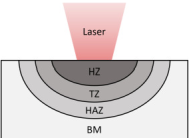
Laser-based heat treatment (LBHT) is a laser-assisted approach that aims to improve the microstructure of metal parts, reduce stresses generated during layer build-up, and improve their overall mechanical properties . It can be applied either during additive manufacturing processes, such as LMD, or as a post-processing method after part fabrication. Unlike conventional heat treatment processes, which involve heating an entire component in a furnace for extended periods , LBHT uses a defocused laser beam (Δf > 0) to induce heat on the surface/area of concern. This allows for the targeted heat treatment of specific zones, avoiding excess heat and reducing distortion, which is particularly beneficial for intricate shapes or thin-walled components . A schematic representation of the LBHT process is shown in Figure 2 .
Figure 2. Schematic of the LBHT process and associated zones within a steel alloy .
The high thermal gradients and rapid heating and cooling cycles during LBHT enable fine control over microstructural transformations, such as precipitation of strengthening phases . Heat treatments that prefer high thermal gradients typically involve rapid cooling processes, such as quench hardening and solution heat treatment, used to produce rapid micro-structural changes and form specific phases, such as martensite or supersaturated solid solutions, which require quick temperature decreases to prevent equilibrium phase formation . The thermal gradients can be controlled by adjusting laser parameters (power, scan speed, beam size), optimising laser scan strategies (pattern, length, angle), using in-process thermal management such as preheating the baseplate or using multiple beams, and employing real-time monitoring and closed-loop control systems to adjust parameters based on measured thermal data .
During in-situ applications, LBHT can be coordinated with the layer-by-layer laser scanning process to refine the micro-structure in real time and mitigate stress accumulation . As a post-process method, it can mitigate microstructural irregularities like a tempering or normalising heat treatment and relieve residual stresses induced by rapid solidification and thermal cycling during manufacturing. Unlike conventional heat treatment processes, LBHT offers faster processing times, higher energy efficiency, and a reduced risk of part distortion or cracking . These advantages make it a viable option to achieve localised improvements in mechanical properties and improve the performance of components manufactured using additive manufacturing techniques .
The objectives of this review article are to identify the essential parameters controlling the effectiveness of LBHT, to evaluate its influence on the mechanical and microstructural properties of 17-4 PH in the post-LMD state, and to identify gaps in the literature that limit the advancement of LBHT strategies for additively manufactured components. Unlike prior reviews that examined general laser post-treatments, this work exclusively focuses on LBHT applied to LMD-processed precipitation-hardening steels.
The remainder of this article is organised as follows. Section 2 outlines the systematic methodology used in this review, including the formulation of focused research questions and the structured process used to identify, select, and evaluate the articles selected for this study. Section 3 presents a comprehensive review of existing research on LMD of 17-4 PH stainless steel, highlighting its process characteristics, challenges, and the need for post-processing interventions. Section 4 reviews the application of LBHT to 17-4 PH stainless steel, with a focus on identifying critical process parameters and their effects on microstructural and mechanical properties in the post-LMD state. Section 5 synthesises the findings on laser-based heat treatment. Section 6 presents the main knowledge gaps, limitations, and unresolved issues in the current body of literature that hinder the effective implementation of localised heat treatment strategies in additive manufacturing. Also, it summarises the important findings and outlines recommendations for future research aimed at advancing the integration of LBHT in the additive manufacturing of heat-sensitive alloys such as 17-4 PH stainless steel.
2. Review Methodology
A systematic review of the literature on laser-based heat treatment (LBHT) was conducted for laser metal deposition (LMD) clad layers on heat-sensitive alloy 17-4 PH, adopting a transparent methodology to minimise potential bias . Due to the limited number of studies specifically addressing LBHT after LMD, this review also includes relevant literature on LBHT applied to as-built alloys. Primary research questions are derived from established methodologies, findings, and challenges highlighted in the literature on additive manufacturing, post-processing, and precipitation-hardened steels . The main research questions are:
1) Q1: What is the current state of knowledge regarding the effectiveness of laser-based heat treatment techniques in restoring the mechanical properties and microstructural integrity of 17-4 PH stainless steel after Laser Metal Deposition (LMD)?
2) Q2: What laser processing parameters have been reported in the literature, and how do these parameters influence the outcomes of heat treatment on the heat-affected zones and deposited layers of 17-4 PH stainless steel?
For Q1, existing literature was categorised according to the effectiveness of laser heat treatments in restoring hardness and refining the microstructure (reduced grain size and other structural features) in both the heat-affected zone (HAZ) and the deposited clad layer of 17-4 PH stainless steel after LMD. The review highlights the extent of mechanical property recovery, including measurable improvements in hardness, microstructural refinement, and the mitigation of undesirable effects such as over-ageing caused by initial additive manufacturing thermal cycles.
Answers for Q2 allowed for the analysis of reported laser processing parameters, including laser power, scan speed, beam spot diameter, and overlap, to uncover current best practices in parameter selection and optimisation for laser-based heat treatment. This evaluation aimed to define effective and reproducible process parameter windows that reduce thermal degradation, control phase transformations, promote grain refinement, and improve mechanical performance consistently across the HAZ and deposited layers.
Research articles included in this systematic literature review were selected based on the following criteria: (i) written in English, (ii) published between January 2015 and May 2025, (iii) sourced from peer-reviewed journals, and (iv) accessible through electronic academic databases. To ensure comprehensive inclusion, four major electronic databases were accessed, namely, Scopus, Web of Science, Taylor & Francis Online, and IEEE Xplore. The following search strings were used to search for suitable articles:
("LASER HEAT TREATMENT" OR "LASER-BASED HEAT TREATMENT" OR "LASER SURFACE TREATMENT" OR "LASER SURFACE HARDENING" OR "LASER METAL DEPOSITION")
AND
("17-4 PH" OR "17-4 PH" OR "PRECIPITATION HARDENING STAINLESS STEEL" OR "AISI 630" OR "PH STAINLESS STEEL" OR " STAINLESS STEEL 17-4 PH")
AND
("MECHANICAL BEHAVIOUR" OR "MATERIAL PROPERTIES" OR "STRUCTURAL PROPERTIES" OR "MECHANICAL CHARACTERISTICS" OR "MECHANICAL PERFORMANCE" OR "MECHANICAL PROPERTIES")
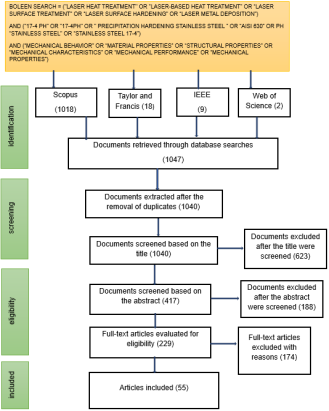
In Scopus, the advanced document search function was used to restrict the results to peer-reviewed journal articles within the subject areas of engineering, materials science, physics, and manufacturing. The search yielded a list of 1018 articles. For Web of Science, searches were limited to topics within materials engineering, metallurgy, and additive manufacturing. 18 articles were selected for in-depth review. In Taylor & Francis Online, filters were applied, including engineering and materials science, to narrow the results. The search yielded nine articles relevant to the scope of the investigation. In IEEE Xplore, the search focused on journals relevant to materials processing, manufacturing technologies, and laser applications. This search resulted in two relevant articles for preliminary screening. The PRISMA flowchart summarising the results is shown in Figure 3.
Figure 3. PRISMA flowchart outlining the framework used for article inclusion.
All searches were completed by May 31, 2025, and the resulting dataset was imported into a reference management system for subsequent screening and synthesis.
2.1. Inclusion and Exclusion Criteria
To ensure objectivity and consistency throughout the screening process, clear inclusion and exclusion criteria were established before the literature review. These criteria were applied systematically during the title, abstract, and full-text screening phases. Articles were included met all the following criteria:
1) Published in peer-reviewed journals.
2) Studies that are directly related to the research questions, particularly those focusing on laser-based heat treatment and the mechanical or microstructural behaviour of 17-4 PH stainless steel, stainless steel processed by LMD, or in the as-built condition.
3) Published between January 2015 and May 2025.
4) Falls within the disciplinary focus of materials engineering and metallurgical engineering.
5) Written in English and with full-text access available.
Studies were excluded based on the following criteria:
1) Duplicate entries or those without access to the full text.
2) Non-scholarly sources, including blog posts, editorials, or news articles.
3) Studies that do not include empirical evidence, experimental validation, or a rigorous methodological framework.
4) Studies determined to be off-topic or only of limited relevance to the defined research questions and review objectives.
The criteria were uniformly applied to all database search results to ensure transparency, minimise bias, and maintain the integrity of the systematic review process.
2.2. Quality Assessment
As part of the quality assessment process , all included studies were obtained from reputable peer reviewers following strict publication standards. To ensure a solid methodological framework and maintain the relevance of each article, a structured checklist derived from recognised assessment tools, such as the Joanna Briggs Institute (JBI) checklist , was adapted and applied uniformly in all eligible studies.
The following criteria (answered with Yes/No) were used to determine inclusion quality:
1) Does the paper clearly define the laser heat treatment process or parameters used for 17-4 PH stainless steel?
2) Does the study empirically investigate mechanical or microstructural properties post-LMD or LBHT?
3) Is the experimental design and/or simulation method clearly described and reproducible?
4) Are the results validated through appropriate testing methods (e.g., hardness test, scanning electron microscope (SEM), X-ray diffraction (XRD), tensile test)?
5) Does the study report on the influence of key laser parameters such as laser power, laser ?
6) Does the study evaluate the heat-affected zone (HAZ) and/or clad zone performance?
7) Is the sample size adequate, and are test repetitions reported?
8) Are statistical methods and sources of uncertainty reported?
9) Does the study compare findings to existing literature or established standards?
Each article was evaluated based on the number of "Yes" responses as shown in Table 1.
Table 1. Quality level descriptors.

Quality level of the article based on ‘Yes’ responses

Description

High quality: 7 to 9

Methodologically robust and directly relevant to the research questions

Moderate quality: 4 to 6

Methodologically sound but with minor limitations in scope or depth

Low quality: ≤ 4

Methodological shortcomings or insufficient relevance

Only studies rated as high or moderate quality were retained for synthesis. This methodological filtering ensures that only empirically grounded, robust, and technically relevant contributions informed the subsequent analysis and synthesis stages of the review.
2.3. Data Synthesis and Aggregation
The literature was structured by categorising studies based on laser process parameters, property restoration outcomes (e.g., hardness recovery, microstructural refinement), and methodology approaches (e.g., thermal simulation, FEM-based prediction). Further distinctions are made between experimental and simulation-based studies and localised vs. full-surface heat treatment strategies. Tables and Excel sheets were created to provide a summary of the data and support the analysis of research exploring the effect of post -deposition heat input on mechanical enhancement and microstructure transformation.
The tables were used to: (i) organise, visualise, and compare the key approaches and outcomes reported in the reviewed LBHT studies. (ii) They also helped address the main research questions by highlighting how effective laser heat treatment is and what processing parameters work best for 17-4 PH stainless steel. (iii) The tables supported the synthesis of findings by revealing consistent patterns, technical gaps, and possible directions for future research focused on developing sustainable repair processes for heat-sensitive alloys.
3. Descriptive Analysis
3.1. Publications by Year
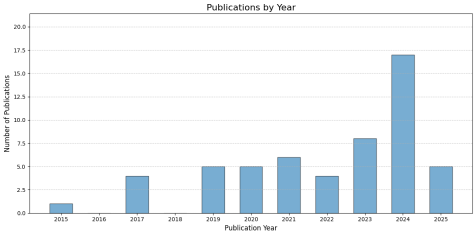
In recent years, a clear upward trend has been observed in the number of publications focusing on laser heat treatment of 17-4PH alloys following Laser Metal Deposition (LMD). As shown in Figure 4, research activity in this domain began in 2015, with a modest start of a publication.
Figure 4. Annual distribution of publications included in the literature review from 2015 to 2025.
After intermittent interest from 2016 to 2018, a consistent increase is evident from 2019 onwards. A significant rise in research output occurred from 2023, peaking in 2024 with 17 publications, the highest within 11 years. Overall, 45 of the 55 studies (approximately 81%) were published between 2019 and 2025, indicating a growing and sustained interest in optimising post-deposition heat treatment processes for 17-4 PH alloys. This surge suggests that researchers have increasingly recognised tailored heat treatment in improving microstructural and mechanical performance in LMD-fabricated parts, especially in heat-sensitive alloys such as 17-4 PH stainless steel.
3.2. Leading Contributors
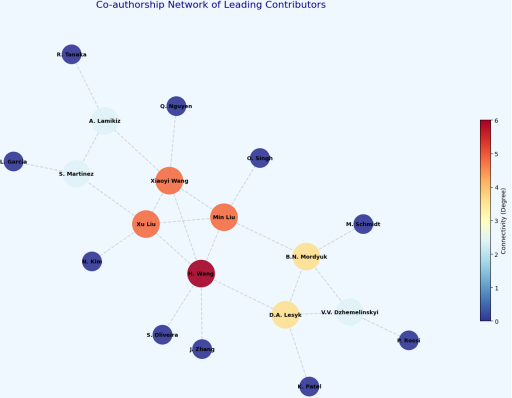
The list of contributing authors was extracted from the bibliographic dataset and analysed using VOS viewer. The analysis focused on identifying authors with multiple publications in the selected literature, as these individuals are often considered influential within the research domain and can serve as potential collaborators or thought leaders. Figure 5 shows that H. Wang, Xiaoyi Wang, Min Liu, and Xu Liu emerged as recurring contributors, each appearing in two publications related to the topic of interest. Additionally, D. A. Lesyk, B. N. Mordyuk, and V. V. Dzhemelinskyi, often affiliated with metallurgical and materials research, also appeared in two publications each, showing their active involvement in studies concerning materials processing and characterisation. S. Martinez and A. Lamikiz completed the list of high-frequency contributors, each contributing to two separate studies within the dataset.
Unlike many established research areas where a few authors dominate the publication landscape, the present analysis revealed a broadly distributed authorship pattern, with 161 authors appearing only once across the dataset. This high level of author dispersion indicates a decentralised research environment where contributions are being made independently and across diverse institutions or regions. The absence of dominant author clusters or sustained multi-paper contributions suggests that the research area is still developing, with scholars possibly working in parallel but not yet forming strong collaborative networks. Encouraging repeated engagement and co-authorship among these high-contributing authors could help connect ideas and accelerate the development of the field.
Figure 5. Map showing collaborating authors in this research field.
3.3. Distribution of Publications Across Journals
The credibility and prominence of publishing journals significantly influence the visibility and impact of scholarly work. The journal classification was extracted using the Excel tool. The Journal of Surface and Coatings Technology leads with four publications, followed by the Journal of Materials Science and Engineering: A – Structural Materials: Properties, Microstructure and Processing, Journal of Materials Research and Technology, and Journal of Materials Engineering and Performance, each with three publications. In addition, journals such as the CIRP Journal of Manufacturing Science and Technology, Materials & Design, and the International Journal of Advanced Manufacturing Technology each contributed two articles. The remaining publications were distributed in a variety of other journals, reflecting a broad interest in the subject in multiple reputable outlets. This distribution highlights the core journals that actively publish research on laser-based heat treatment and LMD, serving as valuable platforms for future submissions and literature tracking.
3.4. Geographical Contribution
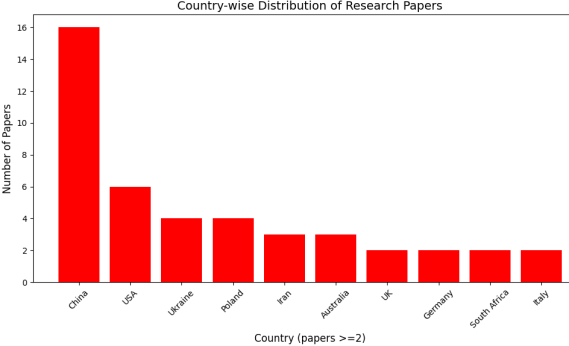
The authors' affiliations with various countries were extracted according to the first author’s institution. The data reveal that China leads the global research on the basis, contributing 16 out of the total papers. As shown in Figure 6, the USA follows with six publications, while Ukraine and Poland have four each. Iran and Australia each contributed three papers, and several other countries, which include the UK, Germany, South Africa, and Italy, have two publications each.
Countries such as Israel, Ireland, Chile, Malaysia, India, Korea, Turkey, the Netherlands, Canada, Lithuania, Mexico, and Japan contributed one paper each. This indicates a wide international interest in the topic, with the main research activity concentrated in Asia, North America, and parts of Europe, as shown in Figure 7. The findings underscore China’s strong presence in this field and highlight opportunities for increased research involvement from underrepresented regions.
Figure 6. Country-wise distribution of publications included in the literature review (countries with ≥2 papers).
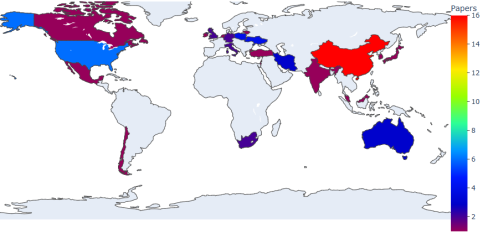
Figure 7. Schematic representation of the global distribution of publications.
3.5. Keywords Frequency
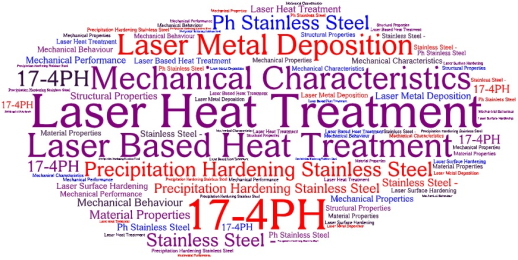
Figure 8 is a word cloud of all keywords, showing that the phrase ‘17-4 PH’ appeared most frequently in the title of publications, occurring 36 times out of 55 studies (approximately 65%). This was followed by ‘Laser Heat Treatment’, which appeared 16 times (29%), and ‘Mechanical Properties’, found in 12 titles (21%). Other terms, such as ‘17-4PH’, appeared seven times, while ‘Mechanical Performance’ and ‘Mechanical Characteristics’ appeared twice each, and ‘Mechanical Behaviour’ was mentioned once. Less used or absent phrases included ‘Laser Surface Treatment’, ‘Laser Surface Hardening’, ‘PH Stainless Steel’, and ‘AISI 630’, which were not found in any of the titles. This pattern suggests that authors tend to favour broader and more commonly recognised terms, especially those emphasising the material (17-4 PH steel) and processing technique (laser heat treatment) when drafting the focus of their research in titles.
Figure 8. Schematic representation of the keywords employed in the search process.
3.6. Classification Based on Research Type
A comprehensive analysis of the articles revealed that the overwhelming majority employed an experimental research approach. These studies focused on the physical implementation of LMD, LBHT, and conventional heat treatment processes on 17-4 PH stainless steel, followed by empirical evaluations such as hardness testing, microstructural characterisation (e.g., SEM, XRD), and residual stress measurements. This reflects the strong reliance of the research field on direct observation and practical validation.
As seen in Table 2, only two studies included analytical modelling, which is used to describe phase transformations or estimate thermal behaviour; in both cases, it complemented rather than replaced experimental methods. No study was found to be purely numerical or simulation based. Although computational modelling plays an important role in understanding thermal gradients, microstructure evolution, and residual stress development in laser-processed alloys, it appears that such approaches remain underutilised in the context of LBHT for LMD-processed 17-4 PH. This represents a potential gap in the literature and an opportunity for future research.
Table 2. Breakdown of included studies according to research approach.

Research Type

Number of Studies

Representation (%)

96.6%

55

96.6%

Analytical/Modelling

2 (combined with experimental)

3.4%

Numerical/Simulation

0

0%

4. Review of Existing Research on Laser Metal Deposition (LMD) of 17-4 PH Stainless Steel
4.1. LMD Process Parameters for 17-4 PH
The Laser Metal Deposition (LMD) process for 17-4 PH stainless steel has been widely investigated in various studies . Commonly reported parameters in-clude laser power, scanning speed, powder feed rate, and layer thickness, each playing a crucial role in defining the quality and consistency of the deposited tracks. Researchers revealed that the most frequently studied parameter of the LMD pro-cess was the scanning speed, reported in all the studies. Laser power and powder feed rate were also well documented, as seen in Table 3, while layer thickness was specifically ad-dressed in eight articles. These parameters typically varied within the following ranges: laser power: 70 to 2600W, scan speed: 1.5 to 45 mm/s, powder feed rate: 0.09 to 55 g/min, layer thickness: 0.117 to 10mm.
Table 3. Laser process parameters and associated microstructural/ mechanical outcomes from LMD literature.

Study ID

Laser Power (W)

Scan Speed (mm/s)

Feed Rate (g/min)

Layer Thickness (mm)

Main Findings

Morteza et al., 2024

350–550

8–12

0.09–0.27

0.177–0.670

Improved microhardness

Aruntapan et al., 2024

350–400

13.33–20

5.0

0.3

Increased compressive yield strength

Morales et al., 2023

1500–2500

10–20

6.7–20

0.19–1.01

Higher laser energy improved clad dilution

Chen et al., 2024

1665

5

12.98

Higher energy input improved clad dilution

Pilehrood et al., 2021

200–400

1.5–2

Dilution and aspect ratio reduced with higher scan speed

Wang et al., 2022

400–600

10

0.5

Laser power affected porosity, hardness, and strength

Yu et al., 2020

685

10

7

0.5

Laser remelting reduced porosity

Wang et al., 2024

2200

10

15

1.3

Solution ageing improved microstructure

Mathoho et al., 2020

300–400

7.62–12.7

4.7

Parameters influenced metallurgical characteristics

Wu et al., 2020

]

11.67

0.8

0.6

Enhanced austenite transformation via grain orientation

Wang et al., 2024

2200

10

15

Grain size reduced after solution hardening

Merlin et al., 2024

8–20

6.7–12

Heat-treated tracks showed increased strength

Muslim et al., 2022

1200–2200

6–15

3.5–5.0

10

Conditions influenced geometrical properties

Bayode, 2022

1400–2600

6

2

Max hardness at max power

Li et al., 2023

45

55

1.11–1.12

Laser shock peening reduced the wear rate

Steponaviciute et al., 2021

70–195

13.33

The highest power yielded the best microstructure

The reviewed studies revealed that laser power and scan speed had the most significant influence on melt pool geometry, directly affecting dilution rate, clad height, and bead width. It is also noted that they have a considerable effect on the microstructure and mechanical properties of the deposited materials . The consistency of track overlap was also found to be highly dependent on the combination of scan speed and layer thickness . A strong interdependence was observed between layer thickness, scan speed, and track overlap, indicating that variations in scan speed and overlap significantly influence the resulting layer thickness. Significantly, researchers observed that improper adjustment of these parameters led to various defects such as porosity, lack of fusion, poor surface finish, and incorrect geometry . Optimal process settings produced high-density deposits with uniform microstructure, excellent mechanical properties, and improved surface finish .
4.2. Microstructure Evolution in As-deposited 17-4 PH
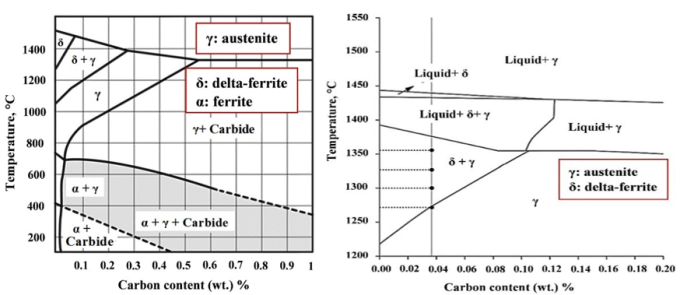
The microstructural evolution in as-deposited 17-4 PH stainless steel fabricated via Laser Metal Deposition (LMD) is complex and varies according to the chemical composition of the feedstock powders and the process parameters, following a characteristic solidification pathway influenced by both material chemistry and thermal conditions. In previous LMD studies , common solidification sequence was reported: from δ-ferrite to austenite to martensite, which is primarily influenced by the Cr/Ni ratio, cooling rates, and local thermal gradients, as schematically shown in Figure 9.
Figure 9. Phase transformation diagrams of Fe–C system (a) General equilibrium phases including δ-ferrite, austenite, and carbide regions. (b) Low-carbon region highlighting δ → γ solidification pathway relevant to 17-4 PH stainless steel .
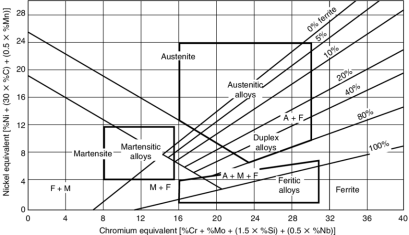
As presented by the Schaeffler diagram in Figure 10, a high Cr/Ni equivalent ratio is a key factor in controlling the solidification behaviour of 17-4 PH stainless steel, promoting the formation of δ-ferrite during solidification . As cooling progresses, the retained ferrite partially transforms to austenite, followed by a final transformation to martensite during rapid cooling due to steep thermal gradients as observed in LMD. A higher Cr/Ni ratio, therefore, generally promotes a ferritic solidification .
Figure 10. Schaeffler illustrating phase prediction and solidification behaviour in laser-processed 17-4 PH stainless steel .
Rapid solidification induced by laser processing was found to refine the grain structure significantly, which is a governing mechanism in improving the mechanical properties of the final components . However, Li et al. investigated the microstructure and wear behaviour of 17-4 PH, found that grain morphology varied based on deposition parameters and thermal history.
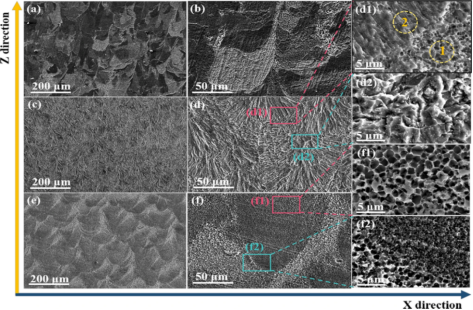
Lashgari et al. and Schroeder et al. reported that columnar grain growth oriented with the build direction dominated when the thermal gradient (G) was high and the solidification rate (R) was moderate (i.e., high G/R ratio). This observation is consistent with Zhao et al , they found significant grain refinement in 17-4 PH stainless steels through in-situ alloying with TiB2. The addition of TiB2 increased the solidification nucleation sites, promoting the formation of finer columnar grains, as shown in Figure 11. By contrast, a lower G/R ratio (or the presence of additional grain refining mechanisms such as inoculants or local remelting) promoted the formation of equiaxed grains .
Researchers has shown that microstructural inhomogeneity between layers, with grain coarsening or reheating zones appearing due to layer-by-layer thermal accumulation . These variations impact final mechanical properties, highlighting the need for tailored post-processing strategies such as heat treatment or in-situ thermal control.
Figure 11. SEM micrographs of as-built 17-4 PH samples showing columnar grain formation increases as the TiB₂ content rises: (a, b) without TiB₂, (c, d, d1, d2) with 1.5% TiB₂, and (e, f, f1, f2) with 3% TiB₂ .
4.3. Mechanical Properties of As-built 17-4 PH
The mechanical performance of as-built 17-4 PH stainless steel produced by LMD is directly affected by thermal cycles, rapid solidification, and microstructural gradients associated with the process . Researchers working on LMD processes consistently reported notable variations in hardness, tensile strength, and residual stress profiles in the as-deposited state. Hardness values typically ranged from 267 to 450 HV, with higher values usually linked to martensitic transformation and fine copper-rich precipitate microstructures resulting from rapid cooling and ageing . Mahmoudi et al. , Eskandari et al. , and Wu et al. reported tensile strengths in the range of 850–1100 MPa for additively manufactured 17-4 PH stainless steel. However, these authors also observed reduced ductility and instances of premature failure, primarily attributed to internal defects, micro-segregation, and residual stresses inherent in the as-built condition. Residual stress was identified as a significant issue in as-built 17-4 PH . Li et al. observed that tensile residual stresses predominantly occurred on the top and outer surfaces of the deposited layers, which they attributed to steep thermal gradients and rapid solidification shrinkage inherent in the laser cladding process. Such stresses, if not relieved, can lead to distortion, cracking, or premature fatigue failure during service.
Aripin et al. reported variations in mechanical properties across the deposited layers of 17-4 PH stainless steel, with noticeable differences between the top, middle, and bottom regions of the builds. This anisotropy was attributed to directional solidification, thermal accumulation between layers, and grain growth aligned with the build direction. Similarly, Wu et al. observed that vertically oriented samples typically exhibited lower elongation and higher stiffness compared to horizontally aligned counterparts, further confirming the directional dependence of mechanical behaviour in LMD-fabricated components . Researchers also highlight the effect that processing conditions, such as scan speed, laser power, and interlayer dwell time, have on mechanical properties. Steponaviciute et al. investigated the effects of laser parameters (laser power and scan speed) on the materials properties of 17-4 PH. They found that increasing laser power from 70 to 195 W improved yield stress, ultimate tensile stress, and the hardness due to enhanced densification. However, residual stresses increased as the scan speeds increased, while the tensile and young modulus of the materials decreased. Benjamin et al. also reported that slower scan speeds promoted deeper heat penetration and more uniform mechanical properties across layers but require careful management to avoid surface melting and ensure proper transformation.
4.4. Challenges and Need for Post-processing
Despite the advantages of LMD for fabricating 17-4 PH stainless steel components, several critical challenges persist in the as-built condition. Commonly observed issues include porosity, cracking, residual stresses, and non-uniform hardness, which collectively compromise the structural integrity and reliability of the manufactured parts, as shown in Table 4 .
Table 4. Summary of common defects in laser metal deposition, their occurrence frequency, primary causes, and impact on part quality and performance.

Defect Type

Occurrence Frequency

Primary Causes

Impact on Part

Porosity

>60%

Lack of fusion, entrapped gas, unstable powder flow

Reduces density and structural integrity

Cracking

Frequent

High thermal gradients, martensitic transformation

Initiates failure, lowers fatigue resistance

Residual Stress

Frequent

Rapid solidification, layer-by-layer thermal cycling

Causes distortion and early failure

Non-uniform Hardness

Common

Uneven cooling, phase imbalance, heterogeneous microstructure

Compromises mechanical performance

Lashgari et al. observed that inconsistencies in hardness, both between layers and within single tracks, were linked to uneven thermal histories and heterogeneous microstructure, particularly local imbalances in the distribution of martensite and austenite phases . As a result, the mechanical performance of as-built 17-4 PH usually falls below that of parts made by traditional processing. These challenges highlight the need for post-processing to achieve a reliable performance and component longevity . Conventional heat treatment processes, which involve solutionising and age hardening, are widely applied, but typically affect the entire component, which may not be efficient for complex or functionally graded parts .
To address these issues with greater precision, many recent studies advocate for localised laser-based heat treatment (LBHT). This approach enables targeted control of microstructure and residual stress at the layer or region level without requiring full-component thermal cycles . LBHT has shown promise in refining grain structure, improving hardness uniformity, and relieving tensile residual stresses, all while preserving the geometric integrity of the part . The integration of intelligent, localised post-processing, such as LBHT, is increasingly viewed as a critical enabler for translating LMD-fabricated 17-4 PH components from experimental success to industrial application.
5. Review of Laser-based Heat Treatment (LBHT) for 17-4 PH Stainless Steel
The application of laser-based heat treatment (LBHT) methods as post-processing techniques for metallic components has been extensively investigated in recent literature. Various LBHT approaches, including laser annealing, laser tempering, and laser re-hardening, have been widely explored. Numerous studies have demonstrated their effectiveness in improving mechanical performance and refining microstructural features of processed alloys .
5.1. Laser Annealing, Tempering, and Re-hardening
Przestacki et al. and Kuklinski et al. demonstrated that laser annealing is an effective technique for relieving residual stresses and refining microstructures without melting the substrate, thereby enhancing the dimensional stability and structural strength of metallic components .
Laser hardening was highlighted as an effective means of adjusting hardness and toughness, particularly in martensitic steels, through controlled tempering of the microstructure. Palmieri et al. and Lesyk et al. demonstrated that laser re-hardening can restore surface hardness by inducing rapid thermal cycles . However, some studies cautioned that the high cooling rates involved could lead to microstructural heterogeneity and potential performance inconsistencies .
5.2. Conventional Heat Treatment Versus Laser Heat Treatment
Peixinho et al. reported that localised LBHT offers significant advantages over traditional heat treatments, including reduced processing time, lower operational costs, and minimised thermal distortion, while achieving hardness and microstructural uni-formity comparable to or exceeding that of conventional furnace treatments . In contrast, Eisazadeh et al. reported that conventional heat treatments provide more uniform mechanical properties across the entire component, making them suitable for applications requiring consistency throughout the bulk material . Others emphasised that traditional furnace-based methods remain advantageous for simple geometries or large batch processing, owing to their lower equipment complexity and ease of implementation .
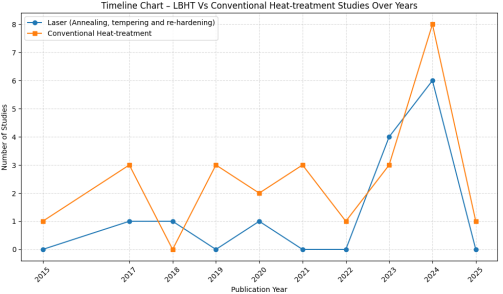
Figure 12. Prevalence of LBHT vs Conventional Methods in Reviewed Literature Over the Years.
Zhang et al. and Przestacki et al. observed that laser-based heat treatment procedures offer precise, localised thermal control and shorter processing times compared to conventional methods, although require careful parameter optimisation to avoid undesirable microstructural effects . Figure 12 shows the growing prevalence of laser heat treatment in recent years. While its usage is rapidly increasing, conventional methods remain widely used and are also experiencing growth.
5.3. Outcomes and Challenges
Many publications that investigated the effect of heat treatment reported improved mechanical performance, including increased hardness and reduced residual stresses . Mahmoudi et al. observed negligible improvements, suggesting that parameter optimisation is critical to realising LBHT benefits. Naskar et al. and Aripin et al. discussed challenges such as the risk of thermal gradients causing microstructural non-uniformity or distortion, underscoring the need for precise control . Overall, the literature strongly supports the use of LBHT methods as effective post-processing strategies that offer advantages in localised control and processing speed compared to conventional global treatments.
5.4. Critical LBHT Parameters
The effectiveness of laser-based heat treatment (LBHT) critically depends on the careful control of several process parameters. Among the reviewed works on LBHT, laser power, scanning speed, beam size, and overlap ratio were identified as the key parameters influencing treatment outcomes.
5.4.1. Laser Power, Scanning Speed, Beam Size, and Overlap Ratio
Laser power was found as a key factor controlling the peak temperature reached during treatment, as shown in Table 5. Laser power directly influences microstructural transformations and hardness . Scanning speed was reported in some studies, with slower speeds increasing energy input and dwell time, resulting in deeper heat penetration but also a higher risk of thermal distortion . However, other studies cautioned that excessively slow scanning speeds may cause overheating and grain coarsening, negatively affecting surface integrity and mechanical properties .
Beam size was shown to affect the heat-affected zone (HAZ) and treatment uniformity, with smaller beams providing higher precision but requiring more passes to cover larger areas . Overlap ratio was highlighted as essential for achieving uniform material modification and avoiding excessive heating or untreated gaps. Pilehrood et al. reported that inadequate overlap led to non-uniform hardness distributions.
Table 5. Summary of Key Laser-Based Heat Treatment (LBHT) Parameters and Their Effects on Process Outcomes.

Parameter

Effect

References

Laser Power

Controls peak temperature during treatment, affecting microstructural transformations and hardness. High power can lead to excessive melting, while low power may not fully induce desired transformations.

Optimal:

; Poor:

Scan Speed

Affects energy input and dwell time. Slower speeds increase heat penetration and improve depth of treatment but may cause thermal distortion. Excessively slow speeds may result in overheating and grain coarsening.

Optimal:

; Poor:

Beam Size

Smaller beams offer higher precision but may require more passes, affecting the heat-affected zone (HAZ) and uniformity. Larger beams can cover larger areas but might compromise precision.

Optimal:

; Poor:

Overlap Ratio

Essential for uniform material modification and avoiding gaps or overheating. Inadequate overlap can lead to non-uniform hardness.

Optimal:

; Poor:

5.4.2. Thermal Control: Peak Temperature, Dwell Time, and Cooling Rates
Morales et al. highlight that controlling peak temperature and dwell time is important for achieving desired phase and microstructural transformations withoutdamaging the substrate . Cooling rates, indirectly influenced by scanning parameters and beam size. Also, rapid cooling was often necessary to induce martensitic structures, but it risked generating residual stresses .
Schroeder et al. and Naskar et al. suggested that monitoring and feedback mechanisms, of which pyrometry and thermography were most common, play a crucial role in process control since they enable real-time temperature measurements and spatial thermal mapping . Such monitoring technologies that measure the thermal radiation intensity from the melt pool improved process repeatability and reduced defects. Real-time measurement of peak temperature and cooling behaviour monitoring allowed the fundamental laser processing parameters, including laser power, scanning speed, beam size, and overlap ratio, to be optimised to achieve targeted mechanical and microstructural improvements while minimising adverse effects .
5.5. Microstructural Modifications Observed After LBHT
Microstructural changes induced by laser-based operations were a major focus in the research studies, with most emphasising key modifications such as stress relief, martensite reversion, precipitation behaviour, and grain refinement. Wang D et al. reported that stress relief is the primary benefit of LBHT, often achieved by controlled heating that reduces residual stresses generated during prior manufacturing processes. In addition, the phenomenon of martensite reversion, where martensitic phases revert to softer austenitic or tempered structures, was observed by Ezkandari et al. . This reversion was linked to improved ductility and toughness in 17-4 PH stainless steel components . However, several studies caution that incomplete transformation could result in non-uniform mechanical properties . Some articles examined precipitation phenomena, particularly the growth of Cu-rich phases. It is agreed that LBHT promotes controlled precipitation, which improves hardness and strength via age-hardening effects . Excessive precipitates coarsening at higher laser powers or longer dwell times has been linked to reduced mechanical performance in some studies .
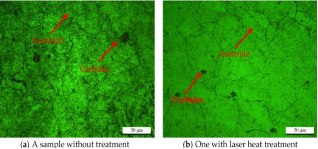
As shown in Figure 13, Zhang et al. investigated the effect of laser heat treatment on the microstructure of Alloy 800H. Mi-crostructural analysis showed recrystallization, grain growth, and carbide dissolution, leading to a more uniform structure . This treatment effectively enhances Alloy 800H’s performance for high-temperature use.
Figure 13. Microstructure diagrams of the alloy samples showing (a) the untreated sample and (b) the sample after treatment .
Grain refinement from rapid LBHT thermal cycles enhances strength. Substructure homogenisation, especially through re-ducing heterogeneities and refining dislocation networks . These changes contribute to improved uniformity of mechanical properties across the treated layer. However, prolonged thermal exposure can cause localised grain growth, indicating the need for careful control of process conditions . Literature consistently demonstrates that LBHT induces beneficial microstructural modifications that collectively improve the mechanical performance of heat-sensitive alloys, such as 17-4 PH stainless steel.
5.6. Mechanical Properties Observed After LBHT
Lesyk et al. and Benjamin et al highlight the impact of LBHT on the mechanical properties of metallic components, particularly heat-sensitive alloys such as 17-4 PH stainless steel. Their studies indicate that LBHT improved hardness, enhanced ductility, and extended fatigue life .
Significant improvements in hardness after LBHT have been reported, particularly in comparison to the as-built condition. For instance, Merlin et al. demonstrated that LBHT increased hardness by up to 35% over the as-built condition, which is attributed to microstructural refinement and precipitation hardening. In addition to hardness, ductility improvements were noted in some articles , although this usually happens at the cost of reduced tensile strength, with laser tempering processes effectively reducing brittleness commonly observed in as-built or conventionally heat-treated materials.
Comparative analyses between as-built, LBHT, and/or conventional heat treatment methods revealed that LBHT offers mechanical property enhancements comparable to or exceeding those achieved by traditional furnace treatments, with the added advantage of localised processing and reduced thermal distortion . For instance, Benjamin et al. observed that fatigue life was extended by approximately 15% in LBHT-treated samples relative to as-built counterparts, while for alloy 800H, it increased longevity by 28.6%. In contrast, conventional heat treatments resulted in similar but less localised improvements .
However, Benjamin et al. noted that poor control over laser parameters can result in inconsistent mechanical performance. They observed that using a specific energy density model for laser heat treatment on AISI 1045 steel resulted in inconsistent martensitic structures, with significant melting and reheating effects that created mixed microstructures and variable hardness . Similarly, Morales et al. observed that direct energy deposition (DED) can produce high-density 17-4 PH stainless steel parts; the process parameters strongly influence the resulting microstructure and porosity, which in turn affects mechanical behaviour . Other studies confirm that LBHT is a highly effective post-processing approach for improving mechanical properties such as hardness and ductility .
5.7. Limitations and Implementation Issues
Despite the demonstrated advantages of laser-based heat treatment (LBHT), several limitations and challenges have been reported in the literature that affect its application and outcomes, particularly concerning material properties, process control, and equipment integration, which impact its widespread implementation. Researchers discussed these constraints, highlighting issues related to process control complexity, treatment uniformity, and equipment integration.
5.7.1. Process Control Complexity
Process control remains one of the foremost challenges in LBHT applications; it is a critical factor for achieving desired materials properties. Lesyk et al. , highlights the difficulty of maintaining consistent laser parameters such as power, scanning speed, and beam focus during treatment, especially when dealing with complex geometries or multi-layered components, they found out that the complexity often arises from the need to precisely regulate parameters to control the thermal history of the workpiece, which in turn dictates the final microstructure and mechanical characteristics such as hardness and hardening depth.
5.7.2. Uniformity and Penetration Depth
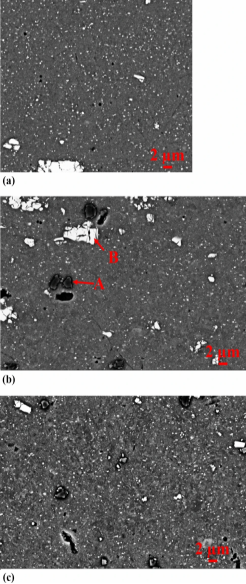
Uniformity of the heat treatment and control over thermal penetration depth were identified as critical factors influencing the quality of LBHT outcomes. As shown in Figure 14, Palmieri et al. reported that non-uniform hardness profiles and micro-structural heterogeneities due to uneven heat input or inadequate control of laser-material interaction parameters, also the inconsistencies are linked to variations in hardness across the treated area, the formation of distinct microstructural zones, and localised material properties that differ from the intended outcome . Proper control of process parameters like laser power, scanning speed, and interaction time is crucial to achieving uniform material modifications. The limited depth of thermal penetration in LBHT, while advantageous for localised treatment, poses challenges when deeper tempering or stress relief is required .
Figure 14. BSE-SEM images: (a) as-received material, (b) 10 mm from the specimen centre after the SLP-Vt5 cycle, and (c) 9 mm from the specimen centre after the SLP-Vt10 cycle, showing regions of minimum hardness with white and dark precipitates indicating micros .
5.7.3. Equipment Limitations in Hybrid Manufacturing Setups
As tabulated in Table 6, integrating Laser-Based Heat Treatment (LBHT) with other manufacturing processes, such as in hybrid setups, presents several equipment-related limitations and implementation challenges. These constraints can impact the range of applications, increase system complexity, and elevate overall costs, all of which demand careful consideration for industrial adoption. One key limitation arises from the laser and optical systems typically used in LBHT setups. Lesyk et al. reported that power level restricts the maximum hardening depth in iron–carbon alloys to less than 500 µm, beyond which surface melting begins to occur. The literature underscores that, while LBHT offers significant benefits, its practical application demands careful consideration of process control strategies, thermal management, and equipment design. Addressing these limitations is crucial for advancing LBHT from laboratory-scale studies to robust industrial deployment.
Table 6. Summary of Limitations in Laser-Based Heat Treatment (LBHT), Their Effects, and Possible Mitigation Strategies.

Limitation

Effect

Mitigation Strategies

Process Control Complexity

Difficulty in maintaining consistent laser parameters (power, speed, focus), especially with complex geometries.

Implement advanced feedback control systems, use real-time monitoring and adjustment of laser parameters - Develop for adaptive process control

.

Uniformity and Penetration Depth

Non-uniform hardness profiles and microstructural heterogeneities due to uneven heat input. Limited thermal penetration depth.

Optimize process parameters (laser power, speed, interaction time) - Utilize multi-pass or hybrid methods to improve uniformity and penetration depth

.

Equipment Limitations in Hybrid Setups

Integration challenges with other manufacturing processes, increasing system complexity, and costs.

Design more adaptable and scalable systems - Use high-efficiency lasers to enhance performance in hybrid setups – Reduce costs with modular systems

.

Laser and Optical Systems Limitations

Restricted maximum hardening depth due to laser power limits, affecting material properties beyond certain depths.

Use higher power lasers for deeper treatments (if applicable) - Investigate alternative laser or optical configurations to extend penetration depth

.

6. Conclusion
6.1. Synthesis of Key Findings and Knowledge Gaps
The comprehensive analysis of research articles reveals several consistent trends and critical insights regarding LMD and LBHT of 17-4 PH stainless steel. Predominantly, the relationship between LMD process parameters (e.g., laser power, scanning speed) and LBHT parameters (e.g., laser annealing duration, beam size) plays a decisive role in dictating microstructural evo-lution and mechanical outcomes. Numerous studies highlighted that optimising these parameters collaboratively leads to reduced residual stresses, refined grain structures, and enhanced hardness and fatigue resistance . Summary tables and correlation Figures included in this review consolidate key findings from 55 papers, illustrating trends such as the positive impact of optimised laser power and overlap ratios on microstructural homogeneity and mechanical performance.
Despite significant progress, several critical knowledge gaps remain. There is a lack of in-situ studies that combine Laser Metal Deposition (LMD) and Laser-Based Heat Treatment (LBHT) within a single experimental setup, which limits understanding of real-time microstructural evolution . Additionally, long-term performance data, particularly regarding fatigue life and in-service behaviour of LBHT-treated components, are limited . Furthermore, the absence of standardised LBHT parameters for 17-4 PH stainless steel contributes to inconsistencies in reported results. Fundamental understanding of phase kinetics under rapid laser heating conditions is insufficiently developed. This gap hinders the ability to predict phase changes and mi-crostructural stability during LBHT. Inconsistent microstructural uniformity and challenges in scaling the LBHT process for complex geometries continue to limit its reliability. The absence of robust predictive models for LBHT-induced microstructure evolution hampers efforts toward process optimisation. Industrially, high equipment costs and the difficulty of qualifying and certifying LBHT-treated components further restrict widespread adoption.
6.2. Summary of Main Findings
This review confirms that LBHT presents a viable solution to mitigate common as-built shortcomings in LMD-fabricated 17-4 PH stainless steel components, including residual stresses, heterogeneous microstructures, and compromised mechanical prop-erties. The body of evidence supports the effectiveness of LBHT in enhancing hardness, ductility, and fatigue life, often matching or exceeding conventional heat treatments. However, the realisation of these benefits depends heavily on the precise control of process parameters.
The application of LBHT in AM holds significant potential across aerospace, tooling, and energy sectors, where part per-formance and reliability are paramount. By enabling localised, rapid post-processing, LBHT can improve component lifespan and reduce production costs. Its integration into AM workflows may thus accelerate industrial uptake of 17-4 PH parts, ex-panding their functional use.
6.3. Recommendations for Future Research
To bridge existing gaps and advance LBHT in AM, future research should focus on the development of hybrid LMD-LBHT systems capable of real-time monitoring and adaptive control to ensure consistent microstructural outcomes. The exploration of machine learning techniques for optimising heat treatment profiles represents a promising avenue to enhance process efficiency. Furthermore, systematic long-term mechanical testing and service-life evaluations are essential to validate durability under operational conditions. Lastly, the establishment of standardised LBHT processing protocols will be critical to facilitate broader industrial adoption and certification.
Abbreviations

AM

Additive Manufacturing

DED

Directed Energy Deposition

DMD

Direct Metal Deposition

LC

Laser Cladding

LMD

Laser Metal Deposition

LBHT

Laser-Based Heat Treatment

PH

Precipitation Hardening

HAZ

Heat-Affected Zone

SEM

Scanning Electron Microscope

XRD

X-ray Diffraction

FCC

Face-Centred Cubic

FEM

Finite Element Method

PRISMA

Preferred Reporting Items for Systematic Reviews and Meta-Analyses

JBI

Joanna Briggs Institute

HV

Vickers Hardness

SLM

Selective Laser Melting

LPBF

Laser Powder Bed Fusion

Funding
This research was funded by the European Union's Intra-Africa Academic Mobility Scheme under the grant agreement No. 101144276 – NeDMEV. Views and opinions expressed are, however, those of the author(s) only and do not necessarily reflect those of the European Education and Culture Executive Agency. Neither the European Union nor the granting authority can be held responsible for them.
Data Availability Statement
The original contributions presented in this study are included in the article. Further inquiries can be directed to the corresponding author.
Conflicts of Interest
The authors declare no conflicts of interest.
References
[1] Morales, C.; Merlin, M.; Fortini, A.; Fortunato, A. Direct Energy Depositions of a 17-4 PH Stainless Steel: Geometrical and Microstructural Characterizations. Coatings 2023, 13(3).
[2] Additive Manufacturing-General Principles-Fundamentals and Vocabulary Fabrication Additive-Principes fundamental and vocabulary INTERNATIONAL STANDARD ISO/ASTM 52900 ISO/ASTM 52900: 2021(E) COPYRIGHT PROTECTED DOCUMENT.
[3] Bayode, A. Surface finish, microhardness and microstructure of laser metal deposited 17-4PH stainless steel. South African Journal of Science 2022, 118(9–10).
[4] Muslim, T.; Karagoz, T.; Kurama, S.; Sezer, P.; Yazici, O. F.; Ozkok, R. Laser metal deposition of 17–4 PH stainless steel: Geometrical, microstructural, and mechanical properties investigation for structural applications. CIRP Journal of Manufacturing Science and Technology 2023, 41, 69–79.
[5] Virgramet. 17-4PH, 1.4542, X5CrNiCuNb16-4 - stainless steel.
[6] Wang, Z.; Grimm, M.; Lindner, T.; Schubert, F.; Winkler, K.; Berger, R.; et al. Wear and corrosion properties of low-temperature nitrocarburized 17-4PH SLM components. Surface and Coatings Technology 2024, 494.
[7] Li, K.; Sridar, S.; Tan, S.; Xiong, W. Effect of Homogenization on Precipitation Behavior and Strengthening of 17-4PH Stainless Steel Fabricated Using Laser Powder Bed Fusion.
[8] Murayama, M.; Katayama, Y.; Hono, K. Microstructural Evolution in a 17-4 PH Stainless Steel after Aging at 400 C; 1999; Vol. 30.
[9] Wang, T.; Wang, Z. Y.; Wang, R.; Wang, M. S.; Wu, C. L.; Zhang, C. H.; et al. Effect of solution aging treatment on corrosion resistance and erosion resistance of laser metal deposition 17-4PHss. Engineering Failure Analysis 2025, 169.
[10] An, S.; Eo, D. R.; Sohn, I.; Choi, K. Homogenization on solution treatment and its effects on the precipitation-hardening of selective laser melted 17-4PH stainless steel. Journal of Materials Science and Technology 2023, 166, 47–57.
[11] Hsiao, C. N.; Chiou, C. S.; Yang, J. R. Aging Reactions in a 17-4 PH Stainless Steel; 2002; Vol. 74.
[12] Peixinho, N.; Pereira, R.; Carneiro, V.; Costa, S.; Blanco, V. Development of laser heat treatment process for assisted forming of aluminum alloys. In 2021 6th International Conference on Smart and Sustainable Technologies, SpliTech 2021; Institute of Electrical and Electronics Engineers Inc., 2021.
[13] Cheruvathur, S.; Lass, E. A.; Campbell, C. E. Additive Manufacturing of 17-4 PH Stainless Steel: Post-processing Heat Treatment to Achieve Uniform Reproducible Microstructure. JOM 2016, 68(3), 930–942.
[14] LeBrun, T.; Nakamoto, T.; Horikawa, K.; Kobayashi, H. Effect of retained austenite on subsequent thermal processing and resultant mechanical properties of selective laser melted 17-4 PH stainless steel. Materials and Design 2015, 81, 44–53.
[15] Swetlicki, A.; Walczak, M.; Szala, M.; Turek, M.; Chocyk, D. Effects of ageing heat treatment temperature on the properties of DMLS additive manufactured 17-4PH steel. Bulletin of the Polish Academy of Sciences: Technical Sciences 2023, 71(4).
[16] Lashgari, H. R.; Adabifiroozjaei, E.; Kong, C.; Molina-Luna, L.; Li, S. Heat treatment response of additively manufactured 17-4PH stainless steel. Materials Characterization 2023, 197.
[17] Li, N.; Wang, Q.; Niu, W.; Han, P.; Guo, N.; Li, S. Microstructure and wear behaviors of 17-4 PH stainless steel fabricated by laser cladding with post laser shock peening treatment. Wear 2024, 538–539.
[18] Ours, B.; Rehman, H. U.; Downard, S.; Cyders, T.; Wisner, B. Localized Laser Heat Treatment on AISI 1045 Steel Using a LPBF Laser. Engineering Reports 2024.
[19] Kramer, S.; Jarwitz, M.; Schulze, V.; Zanger, F. Local laser heat treatment of AlSi10Mg as-built parts produced by Laser Powder Bed Fusion. In Procedia CIRP; Elsevier B. V., 2024; Vol. 124, pp 74–77.
[20] Schüßler, P.; Damon, J.; Mühl, F.; Dietrich, S.; Schulze, V. Laser surface hardening: A simulative study of tempering mechanisms on hardness and residual stress. Computational Materials Science 2023, 221.
[21] Lesyk, D. A.; Mordyuk, B. M.; Alnusirat, W.; Martinez, S.; Dzhemelinskyi, V. V.; Goncharuk, O. O.; et al. ULTRASONIC SURFACE FINISHING OF AISI 1045 STEEL HARDENED BY LASER HEAT TREATMENT WITH FIBRE LASER AND SCANNING OPTICS: LAYERED-STRUCTURE-INDUCED HARDENING AND ENHANCED SURFACE MORPHOLOGY. Progress in Physics of Metals 2024, 25(4), 822–867.
[22] Lesyk, D. A.; Martinez, S.; Mordyuk, B. N.; Dzhemelinskyi, V. V.; Lamikiz; Prokopenko, G. I.; et al. Microstructure related enhancement in wear resistance of tool steel AISI D2 by applying laser heat treatment followed by ultrasonic impact treatment. Surface and Coatings Technology 2017, 328, 344–354.
[23] Merlin, M.; Morales, C.; Ferroni, M.; Fortini, A.; Soffritti, C. Influence of Heat Treatment Parameters on the Microstructure of 17-4 PH Single Tracks Fabricated by Direct Energy Deposition. Applied Sciences (Switzerland) 2024, 14(2).
[24] Wang, J.; Xia, J.; Liu, Z.; Xu, L.; Liu, J.; Xiao, Y.; et al. A comprehensive review of metal laser hardening: mechanism, process, and applications. International Journal of Advanced Manufacturing Technology. Springer Science and Business Media Deutschland GmbH October 1, 2024.
[25] Ali, M.; Almotari, A.; Qattawi, A. Influence of in situ heating and laser remelting on martensitic precipitation-hardening stainless steel fabricated by laser powder bed fusion. Progress in Additive Manufacturing 2024.
[26] Zhang, W.; Jiang, T.; Li, J.; Liu, L. Effect of laser heat treatment on the microstructure and properties of alloy 800H. Metals 2019, 9(3).
[27] Mullo, J. L.; Ramos-Grez, J. A.; Barrionuevo, G. O. Effect of Laser Heat Treatment on the Mechanical Performance and Microstructural Evolution of AISI 1045 Steel-2017-T4 Aluminum Alloy Joints during Rotary Friction Welding. Journal of Materials Engineering and Performance 2021, 30(4), 2617–2631.
[28] Morgan, S. D.; Gagnon, R. J. A systematic literature review of remanufacturing scheduling. International Journal of Production Research 2013, 51(16), 4853–4879.
[29] Pahlevan-Sharif, S.; Mura, P.; Wijesinghe, S. N. R. A systematic review of systematic reviews in tourism. Journal of Hospitality and Tourism Management 2019, 39, 158–165.
[30] Aromataris, E.; Fernandez, R.; Godfrey, C. M.; Holly, C.; Khalil, H.; Tungpunkom, P. Summarizing systematic reviews: Methodological development, conduct and reporting of an umbrella review approach. International Journal of Evidence-Based Healthcare 2015, 13(3), 132–140.
[31] Ilanlou, M.; Shoja Razavi, R.; Pirali, P.; Borhani, M. Additive manufacturing of functionally graded stellite6/17-4 PH fabricated via direct laser deposition. Journal of Materials Research and Technology 2024, 32, 985–999.
[32] Chen, H.; Du, Y.; Liang, Q.; Ma, W.; Tu, J. Effect of double aging treatment on the tribological properties of 15-5PH coating on 17-4PH stainless steel by laser cladding. Journal of Materials Research and Technology 2025, 35, 4378–4389.
[33] Pilehrood, A. E.; Mashhuriazar, A.; Baghdadi, A. H.; Sajuri, Z.; Omidvar, H. Effect of laser metal deposition parameters on the characteristics of stellite 6 deposited layers on precipitation-hardened stainless steel. Materials 2021, 14(19).
[34] Steponaviciute, A.; Selskiene, A.; Stravinskas, K.; Borodinas, S.; Mordas, G. 17-4 PH stainless-steel as a material for high resolution laser metal deposition. In Materials Today: Proceedings; Elsevier Ltd, 2021; Vol. 52, pp 2268–2272.
[35] Dash, A.; Bose, S.; Bandyopadhyay, A. Additively manufactured 17–4 PH stainless steels for fracture management devices. Virtual and Physical Prototyping 2024, 19(1).
[36] Wang, D.; Cheng, D.; Zhou, Z.; Wang, W.; Hu, B.; Xie, Y.; et al. Effect of laser power on the microstructure and properties of additive manufactured 17-4 PH stainless steel in different fabrication atmosphere. Materials Science and Engineering: A 2022, 839.
[37] Yu, Z.; Zheng, Y.; Chen, J.; Wu, C.; Xu, J.; Lu, H.; et al. Effect of laser remelting processing on microstructure and mechanical properties of 17-4 PH stainless steel during laser direct metal deposition. Journal of Materials Processing Technology 2020, 284.
[38] Wang, T.; Wang, M. S.; Xu, T. Z.; Wu, C. L.; Zhang, C. H.; Zhang, S.; et al. Enhancing Wear Resistance and Erosion Wear Performance of Laser Additive Manufactured 17-4PHss through Solution Aging Treatment. Journal of Thermal Spray Technology 2024, 33(7), 2350–2366.
[39] Mathoho, I.; Akinlabi, E. T.; Arthur, N.; Tlotleng, M. Impact of DED process parameters on the metallurgical characteristics of 17-4 PH SS deposited using DED. CIRP Journal of Manufacturing Science and Technology 2020, 31, 450–458.
[40] Li, G.; Wang, Z.; Yao, L.; Ding, J.; Gao, J. Component mixing in laser cladding processes: From single-track to single-layer multi-track and multi-layer multi-track. Surface and Coatings Technology 2023, 455.
[41] Przestacki, D.; Kukliński, M.; Bartkowska, A. Influence of laser heat treatment on microstructure and properties of surface layer of Waspaloy aimed for laser-assisted machining. International Journal of Advanced Manufacturing Technology 2017, 93(9–12), 3111–3123.
[42] Lashgari, H. R.; Xue, Y.; Onggowarsito, C.; Kong, C.; Li, S. Microstructure, Tribological Properties and Corrosion Behaviour of Additively Manufactured 17-4PH Stainless Steel: Effects of Scanning Pattern, Build Orientation, and Single vs. Double scan. Materials Today Communications 2020, 25.
[43] Mahmoudi, M.; Elwany, A.; Yadollahi, A.; Thompson, S. M.; Bian, L.; Shamsaei, N. Mechanical properties and microstructural characterization of selective laser melted 17-4 PH stainless steel. Rapid Prototyping Journal 2017, 23(2), 280–294.
[44] Lesyk, D. A.; Martinez, S.; Mordyuk, B. N.; Dzhemelinskyi, V. V.; Lamikiz, A.; Prokopenko, G. I. Effects of laser heat treatment combined with ultrasonic impact treatment on the surface topography and hardness of carbon steel AISI 1045. Optics and Laser Technology 2019, 111, 424–438.
[45] Schroeder, R.; Hammes, G.; Binder, C.; Klein, A. N. Plasma Debinding and Sintering of Metal Injection Moulded 17-4PH stainless steel. Materials Research 2011, 14(4), 564–568.
[46] Eskandari, H.; Lashgari, H. R.; Ye, L.; Eizadjou, M.; Wang, H. Microstructural characterization and mechanical properties of additively manufactured 17–4PH stainless steel. Materials Today Communications 2022, 30.
[47] Sabooni, S.; Chabok, A.; Feng, S. C.; Blaauw, H.; Pijper, T. C.; Yang, H. J.; et al. Laser powder bed fusion of 17–4 PH stainless steel: A comparative study on the effect of heat treatment on the microstructure evolution and mechanical properties. Additive Manufacturing 2021, 46.
[48] Zhao, Y.; Chen, J.; Zhao, G.; Yu, Z.; Ren, X.; Wang, Q.; et al. Significant Grain Refinement in 17-4PH Stainless Steels by In Situ Alloying with TiB2 Additives During Laser Powder-Bed Fusion. Metallurgical and Materials Transactions A: Physical Metallurgy and Materials Science 2024.
[49] Yu, D. T.; Wu, C. L.; Zhang, S.; Zhang, C. H.; Chen, H. T.; Tao, X. P. Effects of heat treatment on the nano-indentation, corrosion and cavitation erosion behavior of 17-4PH stainless steel by laser surface melting. Surface and Coatings Technology 2024, 484.
[50] Cooke, S.; Ahmadi, K.; Willerth, S.; Herring, R. Metal additive manufacturing: Technology, metallurgy and modelling. Journal of Manufacturing Processes. Elsevier Ltd September 1, 2020, pp 978–1003.
[51] Wu, C.; Chen, J.; Yu, Z.; Yu, C.; Xu, J.; Lu, H. Heterogeneous mechanical properties along the building direction in direct laser deposited 17-4 PH steel. Materials Science and Engineering: A 2021, 825.
[52] Lambert, P. K.; Piloseno, B. K.; Warner, J. D.; Gienger, E. B.; Choi, A.; Presley, M.; et al. Evaluating the impacts of surface roughness and microstructure on the size effect in two additively manufactured stainless steels. Materials and Design 2024, 246.
[53] Aripin, M. A.; Sajuri, Z.; Jamadon, N. H.; Baghdadi, A. H.; Syarif, J.; Mohamed, I. F.; et al. Effects of Build Orientations on Microstructure Evolution, Porosity Formation, and Mechanical Performance of Selective Laser Melted 17-4 PH Stainless Steel. Metals 2022, 12(11).
[54] Kukliński, M.; Szymański, M.; Przestacki, D. Laser heat treatment of nickel-based alloys – a review. Archives of Mechanical Technology and Materials 2019, 39(1), 46–53.
[55] Li, C.; Chen, Y.; Zhang, X.; Liu, T.; Peng, Y.; Wang, K. Effect of heat treatment on microstructure and mechanical properties of 17-4PH stainless steel manufactured by laser-powder bed fusion. Journal of Materials Research and Technology 2023, 26, 5707–5715.
[56] Naskar, S.; Suryakumar, S.; Panigrahi, B. B. Heat treatments effects on Wear performance of Laser based Powder Bed Fusion fabricated Inconel 718 alloy. Wear 2024, 556–557.
[57] Han, Q.; Jiao, Y. Effect of heat treatment and laser surface remelting on AlSi10Mg alloy fabricated by selective laser melting. International Journal of Advanced Manufacturing Technology 2019, 102(9–12), 3315–3324.
[58] Palmieri, M. E.; Tricarico, L. Investigation of Two Laser Heat Treatment Strategies for Local Softening of a Sheet in Age-Hardening Aluminum Alloy by Means of Physical Simulation. Journal of Materials Engineering and Performance 2024.
[59] Lesyk, D.; Dzhemelinskyi, V.; Mordyuk, B.; Martinez, S.; Kondrashev, P.; Grzesiak, D.; et al. SURFACE QUALITY IMPROVEMENT OF STEEL PARTS BY COMBINED LASER-ULTRASONIC TREATMENT: DETERMINATION ALGORITHM OF TECHNOLOGICAL PARAMETERS. Eastern-European Journal of Enterprise Technologies 2023, 2(12–122), 17–26.
[60] Eliaz, N.; Foucks, N.; Geva, D.; Oren, S.; Shriki, N.; Vaknin, D.; et al. Comparative quality control of titanium alloy Ti-6Al-4V, 17-4 PH stainless steel, and aluminum alloy 4047 either manufactured or repaired by laser engineered net shaping (LENS). Materials 2020, 13(18).
[61] Eisazadeh, H.; Khadka, S.; Wang, X.; Yuya, P. A comparative study of the mechanical characteristics of additively and conventionally fabricated 17-4 precipitation hardened stainless steel. Progress in Additive Manufacturing 2024.
[62] Zhang, Z.; Zhao, Y.; Shan, J.; Wu, A.; Gu, H.; Tang, X. Influence of heat treatment on microstructures and mechanical properties of K447A cladding layers obtained by laser solid forming. Journal of Alloys and Compounds 2019, 790, 703–715.
[63] Cholkar, A.; Chatterjee, S.; Kumar, S.; Sedaček, M.; Podgornik, B.; Kinahan, D.; et al. Combining Ultrafast Laser Texturing and Laser Hardening to Enhance Surface Durability by Improving Hardness and Wear Performance. Advanced Engineering Materials 2024.
[64] Maharjan, N.; Wu, N.; Zhou, W. Hardening efficiency and microstructural changes during laser surface hardening of 50crmo4 steel. Metals 2021, 11(12).
[65] Sabzi, H. E.; Lim, S. H.; Crociata, D. Della; Castellote-Alvarez, R.; Simonelli, M.; San-Martín, D.; et al. Genetic design of precipitation-hardening stainless steels for additive manufacturing. Acta Materialia 2024, 274.
[66] Zhang, H.; Xing, J.; Wang, L.; Yang, B.; Gu, D. Tailoring multiscale microstructures for balanced mechanical and thermal performance of difficult-to-process pure Al parts produced by laser powder bed fusion additive manufacturing. CIRP Journal of Manufacturing Science and Technology 2025, 59, 207–222.
[67] Al-Helli, A. H.; Hamza, A. K. Laser Treatment Influence on Estimated Fatigue Life of AA2017. IOP Conference Series: Materials Science and Engineering 2021, 1094(1), 012165.
[68] Telrandhe, S. V.; Bhagyaraj, J.; Mishra, S.; Karagadde, S. A new approach to control and optimize the laser surface heat treatment of materials. Journal of Materials Processing Technology 2018, 262, 492–502.
Cite This Article
  • APA Style

    Olabisi, M. F., Botes, A., Dreyer, B. (2026). Laser-based Heat Treatment Process Development for Laser Metal Deposition Layer/s on Heat-sensitive Alloy 17-4 PH: A Systematic Review. American Journal of Materials Synthesis and Processing, 11(1), 1-22. https://doi.org/10.11648/j.ajmsp.20261101.11

    Copy | Download

    ACS Style

    Olabisi, M. F.; Botes, A.; Dreyer, B. Laser-based Heat Treatment Process Development for Laser Metal Deposition Layer/s on Heat-sensitive Alloy 17-4 PH: A Systematic Review. Am. J. Mater. Synth. Process. 2026, 11(1), 1-22. doi: 10.11648/j.ajmsp.20261101.11

    Copy | Download

    AMA Style

    Olabisi MF, Botes A, Dreyer B. Laser-based Heat Treatment Process Development for Laser Metal Deposition Layer/s on Heat-sensitive Alloy 17-4 PH: A Systematic Review. Am J Mater Synth Process. 2026;11(1):1-22. doi: 10.11648/j.ajmsp.20261101.11

    Copy | Download

  • @article{10.11648/j.ajmsp.20261101.11,
      author = {Michael Femi Olabisi and Annelize Botes and Bernard Dreyer},
      title = {Laser-based Heat Treatment Process Development for Laser Metal Deposition Layer/s on Heat-sensitive Alloy 17-4 PH: A Systematic Review},
      journal = {American Journal of Materials Synthesis and Processing},
      volume = {11},
      number = {1},
      pages = {1-22},
      doi = {10.11648/j.ajmsp.20261101.11},
      url = {https://doi.org/10.11648/j.ajmsp.20261101.11},
      eprint = {https://article.sciencepublishinggroup.com/pdf/10.11648.j.ajmsp.20261101.11},
      abstract = {Laser Metal Deposition (LMD) is a powerful technique for fabricating and repairing complex metal components. However, it often results in residual stresses, uneven microstructures, and inconsistent mechanical properties due to the rapid thermal cycling. Laser-Based Heat Treatment (LBHT) offers a precise, localised post-processing solution to address these challenges, but its application to 17-4 PH stainless steel processed with LMD remains underexplored. This systematic review analysed 55 peer-reviewed studies published between 2015 and 2025, sourced from Scopus, Web of Science, Taylor & Francis Online, and IEEE Xplore. It focused on how LBHT processes parameters such as laser power, scan speed, laser beam diameter, and over-lap ratio affect microstructural evolution, stress relief, precipitation behaviour, and recovery of mechanical performance in LMD 17-4 PH. The review highlights the advantages of LBHT over conventional furnace heat treatments. However, significant gaps remain, including the lack of standardised process parameters, the minimal integration of in situ LBHT during LMD, and limited long-term performance data. Key recommendations include developing hybrid LMD-LBHT systems, applying machine learning to optimise process parameters, and establishing standardised testing and evaluation protocols. This review provides a comprehensive foundation for driving research and enabling reliable use of LBHT in the additive manufacturing of 17-4 PH components.},
     year = {2026}
    }
    

    Copy | Download

  • TY  - JOUR
    T1  - Laser-based Heat Treatment Process Development for Laser Metal Deposition Layer/s on Heat-sensitive Alloy 17-4 PH: A Systematic Review
    AU  - Michael Femi Olabisi
    AU  - Annelize Botes
    AU  - Bernard Dreyer
    Y1  - 2026/02/06
    PY  - 2026
    N1  - https://doi.org/10.11648/j.ajmsp.20261101.11
    DO  - 10.11648/j.ajmsp.20261101.11
    T2  - American Journal of Materials Synthesis and Processing
    JF  - American Journal of Materials Synthesis and Processing
    JO  - American Journal of Materials Synthesis and Processing
    SP  - 1
    EP  - 22
    PB  - Science Publishing Group
    SN  - 2575-1530
    UR  - https://doi.org/10.11648/j.ajmsp.20261101.11
    AB  - Laser Metal Deposition (LMD) is a powerful technique for fabricating and repairing complex metal components. However, it often results in residual stresses, uneven microstructures, and inconsistent mechanical properties due to the rapid thermal cycling. Laser-Based Heat Treatment (LBHT) offers a precise, localised post-processing solution to address these challenges, but its application to 17-4 PH stainless steel processed with LMD remains underexplored. This systematic review analysed 55 peer-reviewed studies published between 2015 and 2025, sourced from Scopus, Web of Science, Taylor & Francis Online, and IEEE Xplore. It focused on how LBHT processes parameters such as laser power, scan speed, laser beam diameter, and over-lap ratio affect microstructural evolution, stress relief, precipitation behaviour, and recovery of mechanical performance in LMD 17-4 PH. The review highlights the advantages of LBHT over conventional furnace heat treatments. However, significant gaps remain, including the lack of standardised process parameters, the minimal integration of in situ LBHT during LMD, and limited long-term performance data. Key recommendations include developing hybrid LMD-LBHT systems, applying machine learning to optimise process parameters, and establishing standardised testing and evaluation protocols. This review provides a comprehensive foundation for driving research and enabling reliable use of LBHT in the additive manufacturing of 17-4 PH components.
    VL  - 11
    IS  - 1
    ER  - 

    Copy | Download

Author Information
  • Abstract
  • Keywords
  • Document Sections

    1. 1. Introduction
    2. 2. Review Methodology
    3. 3. Descriptive Analysis
    4. 4. Review of Existing Research on Laser Metal Deposition (LMD) of 17-4 PH Stainless Steel
    5. 5. Review of Laser-based Heat Treatment (LBHT) for 17-4 PH Stainless Steel
    6. 6. Conclusion
    Show Full Outline
  • Abbreviations
  • Funding
  • Data Availability Statement
  • Conflicts of Interest
  • References
  • Cite This Article
  • Author Information