
Development research has today, through different technologies, boosted the solar panel manufacturing industry. These technologies allow these solar panels to make the most of solar radiation to produce electricity, and as a result, improve efficiency. These photovoltaic solar panels, whenever they are installed, often have their performance affected by faults and anomalies that lead to a drop in energy efficiency. Many studies have looked into diagnosing, detecting, and locating these faults using algorithms. Building on this research and the experience gained from these systems in operation, several faults have been identified in photovoltaic cells. The goal of this study was to design, based on these different defects, artificial intelligence algorithms to detect, classify, and predict defects on solar panels over time. The model was trained using a neural network with the public database available on GitHub (intended for researchers, public services, solar project developers, and decision-makers). It contains infrared imaging data highlighting anomalies in a photovoltaic solar field. This dataset, made up of 20,000 images, allowed us to create an approximator (neural network) linking the pixels of a thermal image of a photovoltaic module to the presence of defects. During model training, the decrease in training and validation losses shows that this model has learned and can improve its performance. Beyond 20 epochs, the model converges, which means that no additional learning can improve the model's performance. This developed, trained, and validated model was exported to Simulink and allowed us to classify and predict solar panel faults, with an average accuracy of over 95% for some faults and 100% for others.
| Published in | American Journal of Modern Energy (Volume 12, Issue 4) |
| DOI | 10.11648/j.ajme.20261204.11 |
| Page(s) | 59-69 |
| Creative Commons |
This is an Open Access article, distributed under the terms of the Creative Commons Attribution 4.0 International License (http://creativecommons.org/licenses/by/4.0/), which permits unrestricted use, distribution and reproduction in any medium or format, provided the original work is properly cited. |
| Copyright |
Copyright © The Author(s), 2026. Published by Science Publishing Group |
Diagnosis, Panel Defects, Neural Network, Photovoltaic Solar Panels
N° | Class Name | Number of images | Description |
|---|---|---|---|
0 | Single-cell | 1877 | Hot spot appearing on a square module |
1 | Multi-cell | 1288 | Hot spot appearing on a square module within a cell |
2 | Cracking | 941 | Cracking on the module's surface. |
3 | Hot Spot | 251 | Hot spot on a module |
4 | Hot-Spot-Multi | 247 | Multiple hot spots on a module |
5 | Shading | 1056 | Sunlight blocked by vegetation, man-made structures, or adjacent rows. |
6 | Diode | 1499 | One shunt diode is activated, typically affecting 1/3 of the module. |
7 | Multi-Diode | 175 | Several shunt diodes are activated, generally affecting 2/3 of the module. |
8 | Vegetation | 1639 | Panels blocked by vegetation. |
9 | Fouling | 205 | Dirt, dust, or other debris on the module's surface. |
10 | Module not connected to the grid | 828 | The entire module is overheating. |
11 | No anomalies | 10000 | Nominal solar module. |
STC | Standard Test Conditions |
ASTM | American Society for Testing and Materials |
ANN | Artificial Neural Networks |
DND | Deep Netwok Designer |
LSTM | Long Short-Term Memory |
CNN | Convolutional Neural Network |
| [1] | Oussema Aloulou ‘Use of Artificial Neural Networks for MPPT Control Optimization and Solar Panel Fault Detection’, University of Quebec in Abitibi-Témiscamingue, 2024. |
| [2] | Anouar boucheham, ‘Identification of Biomarkers and Non-Coding RNA Using Computational Intelligence-Based Approaches, Constantine 2 University, Abdelhamid Mehri, Faculty of New Information and Communication Technologies, Department of Fundamental Computer Science and Its Applications’, 2016. |
| [3] | R. Ross, Proc. 17th IEEE Photovoltaic Specialist Conf., 464–472, 1984. |
| [4] | C. Osterwald, ASTM Standards Development Status, Proc. 18th IEEE Photovoltaic Specialist Conf., 749–753, 1985. |
| [5] | Qualification Test Procedures for Photovoltaic Modules, Commission of the European communities, Joint Research Center, ISPRA Establishment, Specification 502, 1984. |
| [6] | K. Bücher, Site dependence of the energy collection of PV modules, Solar Energy Materials and Solar Cells, 47 85-94, 1997. |
| [7] | K. Bücher, G. Kleiss and D. Bätzner, Photovoltaic Modules in Buildings: Performance and Safety, Renewable Energy 15 545-551, 1998. |
| [8] | A. Parretta, A. Sarno and L. R. M. Vicari, Effects of irradiation conditions on the outdoor performance of photovoltaic modules, Optics Communications 153 153. |
| [9] | Mohamed Bentoum Tools for Detection and Classification: Application to the Diagnosis of Rail Surface Defects, Henri Poincaré University - Nancy I, 2006. |
| [10] | Veïs Oudjail, Spike Neural Networks Applied to Computer Vision, Ph. D. dissertation, University of Lille, 2022. |
| [11] | Erwann Martin’ Neural Networks at the Nanoscale: Which Learning Models? Dissertation, Paris-Saclay University’, 2022. |
| [12] | Guillaume Lacharme’ Optimization of Deep Learning Model Hyperparameters’ University of Tours Graduate School: MIPSIS University of Tours Graduate School, 2024. |
| [13] | youssef barkaoui ‘Deep Classification and Neural Networks: Applications in Data Science at the University of Quebec at Trois-Rivières ‘2022 Godi Tchere Moustapha.’ Detection and Inspection Using Neural Networks in Ellipsometric Scatterometry. Optics / Photonics. Jean Monnet University - Saint-Étienne’, 2023. Français. |
| [14] | Gabrielle Gregoire ‘On Nonlinear Autoregressive Models with Smooth Transitions and the Calculation of Their Forecasts University of Montreal Faculty of Graduate and Postdoctoral Studies toward the degree of Master of Science (M.Sc.) in Statistics’ 2019. |
| [15] | NOUAR Ahcene’ Numerical Solution of Nonlinear Equations Arising from Fluid Flow Using Stochastic AlgorithmsUuniversity BADJIMOKHTAR- ANNABA 2022. |
| [16] | Realini A. Mean Time before Failure of Photovoltaic Modules. Final Report (MTBF Project), Federal Office for Education and Science Tech. Rep., BBW 99.0579, 2003. |
| [17] | Carlson D. E., Romerol R., Willing F., Meakin D., Gonzalez L., Murphy R., Moutinho H. R., Al-Jassim M. “Corrosion Effects in Thin-Film Photovoltaic Modules”. Progress Photovoltaics: Research and Applications, 11: 377–386, 2003. |
| [18] | Lucie Pirot–Berson ‘Study of the degradation of photovoltaic modules based on heterojunction and TOPcon silicon technologies in a humid environment. Physics. Université Grenoble Alpes’, 2025. Français. |
| [19] | Mohamed Chakchouk. ‘Design of a smart mobile mechatronic system for observing molecules in the gas phase using IR spectroscopy. Mechanical Engineering [physics. class-ph]. Normandy University; University of Sfax (Tunisia)), 2024. Français. |
| [20] | Emilien ALVAREZ-VANHARD’ Synergies Between Drone- and Satellite-Based Optical Remote Sensing: Scale Change and Application to Wetland Grassland Conservation Thesis presented and defended in Rennes on October 25, 2021 LETG Research Unit (Coastal Zone - Environment - Remote Sensing - Geomatics) UMR 6554. |
| [21] | Hassina AIT ISSADD ‘Smart Drone Deployment for the Agriculture of the Future: Mouloud Mammeri University of Tizi-Ouzou ‘ 2020. |
| [22] | Antoine Acremont. ‘Deep Neural Networks for Object Classification in Infrared Imaging: Contributions of Learning from Synthetic Data and Anomaly Detection. Neural Network [cs. NE]. ENSTA Bretagne - National School of Advanced Technology of Brittany,’2020. Français. |
APA Style
Herve, M. V. B., Victorien, M. L. A., Michel, N. M., Bernard, M. M. (2026). Classification Panel Defects from Infrared Thermal Images Using Deep Neural Networks. American Journal of Modern Energy, 12(4), 59-69. https://doi.org/10.11648/j.ajme.20261204.11
ACS Style
Herve, M. V. B.; Victorien, M. L. A.; Michel, N. M.; Bernard, M. M. Classification Panel Defects from Infrared Thermal Images Using Deep Neural Networks. Am. J. Mod. Energy 2026, 12(4), 59-69. doi: 10.11648/j.ajme.20261204.11
@article{10.11648/j.ajme.20261204.11,
  author = {Mabikana Voula Boniface Herve and Mabiala Louboto Antoine Victorien and Nkombo Mazouka Michel and M’Passi Mabiala Bernard},
  title = {Classification Panel Defects from Infrared Thermal Images Using Deep Neural Networks},
  journal = {American Journal of Modern Energy},
  volume = {12},
  number = {4},
  pages = {59-69},
  doi = {10.11648/j.ajme.20261204.11},
  url = {https://doi.org/10.11648/j.ajme.20261204.11},
  eprint = {https://article.sciencepublishinggroup.com/pdf/10.11648.j.ajme.20261204.11},
  abstract = {Development research has today, through different technologies, boosted the solar panel manufacturing industry. These technologies allow these solar panels to make the most of solar radiation to produce electricity, and as a result, improve efficiency. These photovoltaic solar panels, whenever they are installed, often have their performance affected by faults and anomalies that lead to a drop in energy efficiency. Many studies have looked into diagnosing, detecting, and locating these faults using algorithms. Building on this research and the experience gained from these systems in operation, several faults have been identified in photovoltaic cells. The goal of this study was to design, based on these different defects, artificial intelligence algorithms to detect, classify, and predict defects on solar panels over time. The model was trained using a neural network with the public database available on GitHub (intended for researchers, public services, solar project developers, and decision-makers). It contains infrared imaging data highlighting anomalies in a photovoltaic solar field. This dataset, made up of 20,000 images, allowed us to create an approximator (neural network) linking the pixels of a thermal image of a photovoltaic module to the presence of defects. During model training, the decrease in training and validation losses shows that this model has learned and can improve its performance. Beyond 20 epochs, the model converges, which means that no additional learning can improve the model's performance. This developed, trained, and validated model was exported to Simulink and allowed us to classify and predict solar panel faults, with an average accuracy of over 95% for some faults and 100% for others.},
 year = {2026}
}
TY  - JOUR
T1  - Classification Panel Defects from Infrared Thermal Images Using Deep Neural Networks
AU  - Mabikana Voula Boniface Herve
AU  - Mabiala Louboto Antoine Victorien
AU  - Nkombo Mazouka Michel
AU  - M’Passi Mabiala Bernard
Y1  - 2026/08/11
PY  - 2026
N1  - https://doi.org/10.11648/j.ajme.20261204.11
DO  - 10.11648/j.ajme.20261204.11
T2  - American Journal of Modern Energy
JF  - American Journal of Modern Energy
JO  - American Journal of Modern Energy
SP  - 59
EP  - 69
PB  - Science Publishing Group
SN  - 2575-3797
UR  - https://doi.org/10.11648/j.ajme.20261204.11
AB  - Development research has today, through different technologies, boosted the solar panel manufacturing industry. These technologies allow these solar panels to make the most of solar radiation to produce electricity, and as a result, improve efficiency. These photovoltaic solar panels, whenever they are installed, often have their performance affected by faults and anomalies that lead to a drop in energy efficiency. Many studies have looked into diagnosing, detecting, and locating these faults using algorithms. Building on this research and the experience gained from these systems in operation, several faults have been identified in photovoltaic cells. The goal of this study was to design, based on these different defects, artificial intelligence algorithms to detect, classify, and predict defects on solar panels over time. The model was trained using a neural network with the public database available on GitHub (intended for researchers, public services, solar project developers, and decision-makers). It contains infrared imaging data highlighting anomalies in a photovoltaic solar field. This dataset, made up of 20,000 images, allowed us to create an approximator (neural network) linking the pixels of a thermal image of a photovoltaic module to the presence of defects. During model training, the decrease in training and validation losses shows that this model has learned and can improve its performance. Beyond 20 epochs, the model converges, which means that no additional learning can improve the model's performance. This developed, trained, and validated model was exported to Simulink and allowed us to classify and predict solar panel faults, with an average accuracy of over 95% for some faults and 100% for others.
VL  - 12
IS  - 4
ER  -
Laboratory of Electrical and Electronic Engineering, National Higher Polytechnic School, Marien NGOUABI University, Brazzaville, Republic of the Congo
Faculty of Science and Technology, Department of Physics, Marien Ngouabi University, Brazzaville, Republic of the Congo
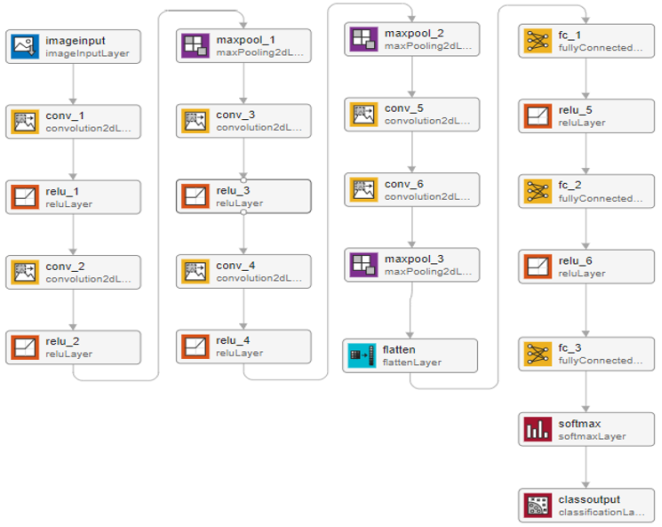
Figure 1. Classification of panel defects using Deep Network Designer (DND).
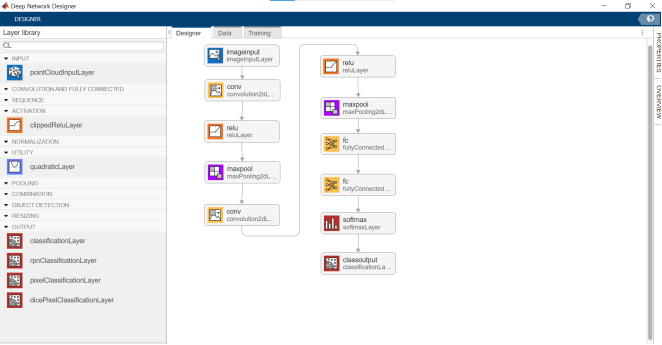
Figure 2. Network model for simulation.
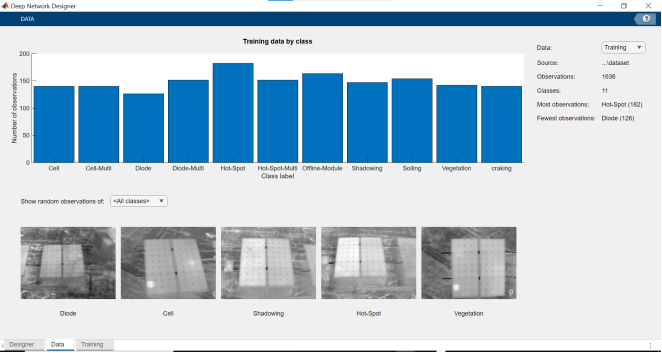
Figure 3. Importing Images.
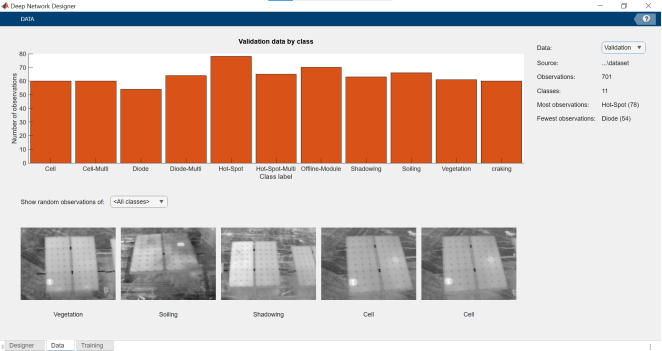
Figure 4. Data Validation.
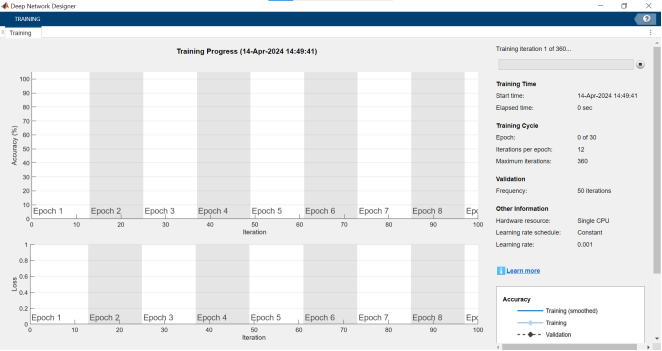
Figure 5. Launching the model for training.
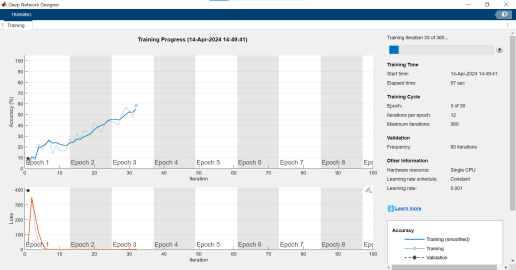
Figure 6. Training Curves.
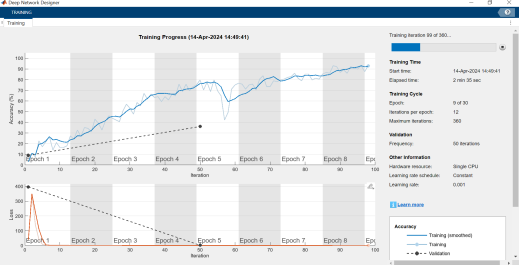
Figure 7. Evolution of the Training Process.
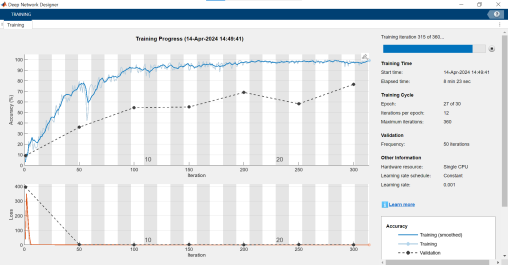
Figure 8. Evolution of the Training Process (continued).
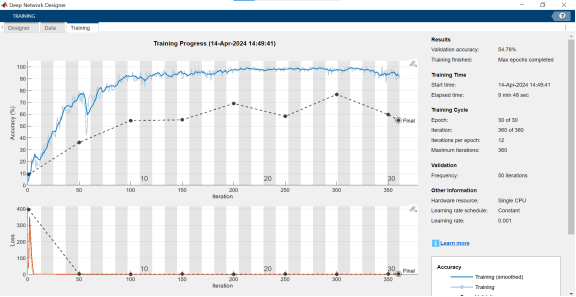
Figure 9. Evolution of the Training Process (continued).
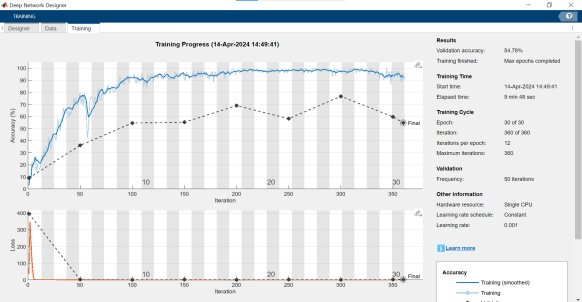
Figure 10. The End of the Training Process.

Figure 11. Simulation of the classification system.
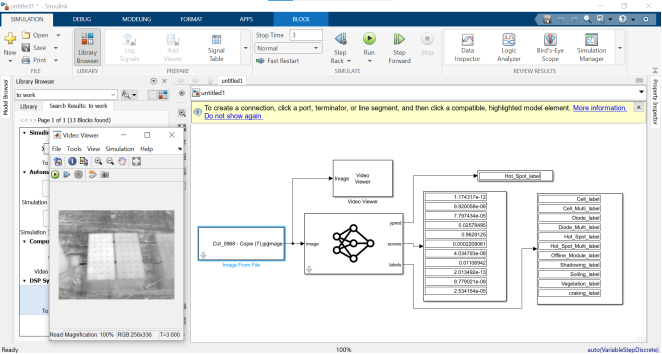
Figure 12. Identification of the Hot Spot Defect.
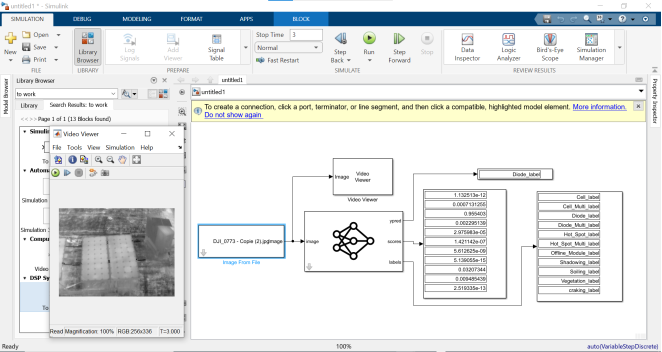
Figure 13. Diode Fault Identification.
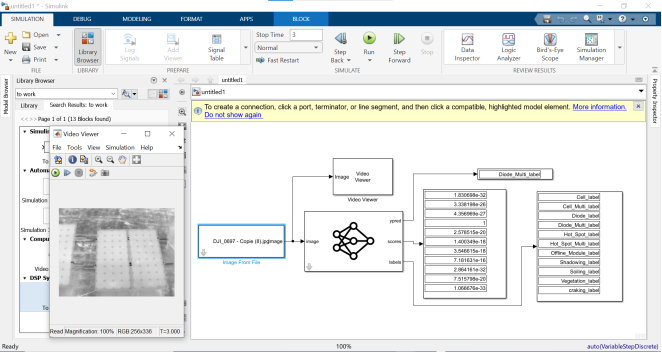
Figure 14. Diode Fault Diagnosis.

Information



 Share This Article
 Twitter
 Linked In
 Facebook
 Copy
Copy Download