
The sluggish kinetics of the hydrogen oxidation reaction (HOR) in alkaline media, primarily arising from the linear scaling relationship between H* and OH* adsorption energies on catalyst surfaces, remains a critical bottleneck for anion-exchange membrane fuel cells (AEMFCs). In this study, we propose a multifaceted approach to overcoming the current limitations of scaling by synthesising Ir-based ternary alloys with diverse oxophilic metals, including Mo, Ru, and Nb. The RuIrMo@MHCS catalyst, featuring a face-centred cubic single-phase solid solution with uniformly dispersed nanoparticles on hollow carbon spheres, exhibits a kinetic current density of 18.04 mA cm–2 at 50 mV overpotential and an exchange current density of 6.79 mA cm–2. This is a significant improvement over the performance of commercial Pt/C, with factors of 6.14 and 5.66, respectively. Additionally, the catalyst demonstrates excellent long-term stability. X-ray photoelectron spectroscopy reveals electron transfer from Ir to Ru upon Ru doping. Density functional theory calculations demonstrate that Ru incorporation downshifts the d-band centre of Ir, thereby moderately weakening H* adsorption (ΔGH* = –0.38 eV) while enhancing OH* adsorption on Mo sites. This adaptable calibration of intermediate adsorption energies circumvents the linear scaling constraint and substantially promotes alkaline HOR kinetics. The findings of this study corroborate the hypothesis that multicomponent alloying is an effective strategy for synergistic optimisation of H* and OH* binding, thus providing a rational design pathway for high-performance alkaline HOR catalysts.
| Published in | American Journal of Energy Engineering (Volume 14, Issue 3) |
| DOI | 10.11648/j.ajee.20261403.12 |
| Page(s) | 108-116 |
| Creative Commons |
This is an Open Access article, distributed under the terms of the Creative Commons Attribution 4.0 International License (http://creativecommons.org/licenses/by/4.0/), which permits unrestricted use, distribution and reproduction in any medium or format, provided the original work is properly cited. |
| Copyright |
Copyright © The Author(s), 2026. Published by Science Publishing Group |
Alkaline Hydrogen Oxidation Reaction, Iridium-based Catalyst, Multicomponent Alloy
HOR | Hydrogen Oxidation Reaction |
AEMFC | Anion-exchange Membrane Fuel Cells |
ΔGH* | Hydrogen Adsorption Free Energy |
HBE | Hydrogen Binding Energy |
OHBE | Hydroxyl Binding Energy |
MHCS | Mesoporous Hollow Carbon Spheres |
DFT | Density Functional Theory |
XRD | X-ray Diffraction |
SEM | Scanning Electron Microscopy |
TEM | Transmission Electron Microscopy |
XPS | X-ray Photoelectron Spectroscopy |
EDS | Energy-dispersive X-ray Spectroscopy |
RDE | Rotating Disk Electrode |
CV | Cyclic Voltammetry |
RHE | Reversible Hydrogen Electrode |
jk | Kinetic Current Density |
j0 | Exchange Current Density |
| [1] | Wang C, Wang P, Shi H, Yang J, Meng P, Yang Y, et al. Accelerating Kinetics of Alkaline Hydrogen Oxidation Reaction on Ru through Engineering Oxophilicity. ACS Materials Letters 2024; 6(10): 4491-4497. |
| [2] | Park J, Kim H, Kim S, Yi SY, Min H, Choi D, et al. Boosting Alkaline Hydrogen Oxidation Activity of Ru Single-Atom Through Promoting Hydroxyl Adsorption on Ru/WC1−x Interfaces. Advanced Materials 2024; 36(4): 2308899. |
| [3] | Li M, Xie Z, Zheng X, Li L, Li J, Ding W, et al. Revealing the Regulation Mechanism of Ir–MoO2 Interfacial Chemical Bonding for Improving Hydrogen Oxidation Reaction. ACS Catalysis 2021; 11(24): 14932-14940. |
| [4] | Durst J, Siebel A, Simon C, Hasché F, Herranz J, Gasteiger HA. New Insights Into the Electrochemical Hydrogen Oxidation and Evolution Reaction Mechanism. Energy & Environmental Science 2014; 7(7): 2255-2260. |
| [5] | Yang X, Ouyang B, Shen P, Sun Y, Yang Y, Gao Y, et al. Ru Colloidosome Catalysts for the Hydrogen Oxidation Reaction in Alkaline Media. Journal of the American Chemical Society 2022; 144(25): 11138-11147. |
| [6] | Wang X, Tong Y, Feng W, Liu P, Li X, Cui Y, et al. Embedding Oxophilic Rare-earth Single Atom in Platinum Nanoclusters for Efficient Hydrogen Electro-oxidation. Nature Communications 2023; 14(1): 3767. |
| [7] | Shi H, Dai T-Y, Sun X-Y, Zhou Z-L, Zeng S-P, Wang T-H, et al. Dual-Intermetallic Heterostructure on Hierarchical Nanoporous Metal for Highly Efficient Alkaline Hydrogen Electrocatalysis. Advanced Materials 2024; 36(38): 2406711. |
| [8] | Jin Y, Fan X, Cheng W, Zhou Y, Xiao L, Luo W. The Role of Phosphorus on Alkaline Hydrogen Oxidation Electrocatalysis for Ruthenium Phosphides. Angewandte Chemie International Edition 2024; 136(41): e202406888. |
| [9] | Tong Y, Xu J, Ding Y, Kong W, Li B, Wang J, et al. Theoretical Insights into the Hydrogen Oxidation Reaction on Single Metal Atoms Anchored on the Edge of MoS2 Nanosheets. Computational Materials Science 2023; 218(1): 111921. |
| [10] | Qin S, Duan Y, Zhang XL, Zheng LR, Gao FY, Yang PP, et al. Ternary Nickel-tungsten-copper Alloy Rivals Platinum for Catalyzing Alkaline Hydrogen Oxidation. Nature Communications 2021; 12(1): 2686. |
| [11] | Yao Z-C, Tang T, Jiang Z, Wang L, Hu J-S, Wan L-J. Electrocatalytic Hydrogen Oxidation in Alkaline Media: From Mechanistic Insights to Catalyst Design. ACS Nano 2022; 16(4): 5153-5183. |
| [12] | Wang Y, Sun L, Lv H, Zheng C, Liu B. Ordered Mesoporous Intermetallic PtP2 Nanoparticles with Enhanced Electrocatalytic Activity and Stability for Hydrogen Evolution. CCS Chemistry 2023; 5(8): 1896-1907. |
| [13] | Tong Y, Li X, Wang X, Zhao L, Luo W, Huang Z, et al. Entropy-Mediated Gradient Oxygenophilic Architecture on High-Entropy Alloy for Dynamic Spillover and Bifunctional Hydrogen Electrocatalysis. Advanced Materials 2026; 38(9): e17450. |
| [14] | Men Y, Wu D, Hu Y, Li L, Li P, Jia S, et al. Understanding Alkaline Hydrogen Oxidation Reaction on PdNiRuIrRh High-Entropy-Alloy by Machine Learning Potential. Angewandte Chemie International Edition 2023; 62(27): e202217976. |
| [15] | Tang T, Liu X, Luo X, Xue Z, Pan H-R, Fu J, et al. Unconventional Bilateral Compressive Strained Ni–Ir Interface Synergistically Accelerates Alkaline Hydrogen Oxidation. Journal of the American Chemical Society 2023; 145(25): 13805-13815. |
| [16] | Qin B, Yu H, Jia J, Jun C, Gao X, Yao D, et al. A Novel IrNi@PdIr/C Core–shell Electrocatalyst with Enhanced Activity and Durability for the Hydrogen Oxidation Reaction in Alkaline Anion Exchange Membrane Fuel Cells. Nanoscale 2018; 10(10): 4872-4881. |
| [17] | Ma X, Zhang S, Zhou Y, Lei W, Zhai Y, Zhao Y, et al. PtIrFeCoNiMo High-entropy Alloy Nanodendrites for Boosting the Alkaline Hydrogen Oxidation Performance. Journal of Materials Chemistry A 2024; 12(15): 8862-8868. |
| [18] | Liu D-Q, Luo Z, Zhang B, Zhao G, Guo W, Chen J, et al. Tailoring Interfacial Charge Transfer of Epitaxially Grown Ir Clusters for Boosting Hydrogen Oxidation Reaction. Advanced Energy Materials 2023; 13(1): 2202913. |
| [19] | Chen Z, Zeng H, Zhang C, Cai H, Jiang Y, Hu J, et al. Ru–Mo Solid–solution Catalyst for Hydrogen Evolution in Alkaline Electrolyte. Nano Research 2025; 18(5): 94907346. |
| [20] | Fang J, Wang H, Dang Q, Wang H, Wang X, Pei J, et al. Atomically Dispersed Iridium on Mo2C as An Efficient and Stable Alkaline Hydrogen Oxidation Reaction Catalyst. Nature Communications 2024; 15(1): 4236. |
APA Style
Tong, Y., Liu, Z., Li, X., Xing, W. (2026). Multicomponent Iridium-Based Alloy Catalysts for Enhanced Alkaline Hydrogen Oxidation Reaction. American Journal of Energy Engineering, 14(3), 108-116. https://doi.org/10.11648/j.ajee.20261403.12
ACS Style
Tong, Y.; Liu, Z.; Li, X.; Xing, W. Multicomponent Iridium-Based Alloy Catalysts for Enhanced Alkaline Hydrogen Oxidation Reaction. Am. J. Energy Eng. 2026, 14(3), 108-116. doi: 10.11648/j.ajee.20261403.12
@article{10.11648/j.ajee.20261403.12,
  author = {Yanfu Tong and Zhiyuan Liu and Xuejin Li and Wei Xing},
  title = {Multicomponent Iridium-Based Alloy Catalysts for Enhanced Alkaline Hydrogen Oxidation Reaction},
  journal = {American Journal of Energy Engineering},
  volume = {14},
  number = {3},
  pages = {108-116},
  doi = {10.11648/j.ajee.20261403.12},
  url = {https://doi.org/10.11648/j.ajee.20261403.12},
  eprint = {https://article.sciencepublishinggroup.com/pdf/10.11648.j.ajee.20261403.12},
  abstract = {The sluggish kinetics of the hydrogen oxidation reaction (HOR) in alkaline media, primarily arising from the linear scaling relationship between H* and OH* adsorption energies on catalyst surfaces, remains a critical bottleneck for anion-exchange membrane fuel cells (AEMFCs). In this study, we propose a multifaceted approach to overcoming the current limitations of scaling by synthesising Ir-based ternary alloys with diverse oxophilic metals, including Mo, Ru, and Nb. The RuIrMo@MHCS catalyst, featuring a face-centred cubic single-phase solid solution with uniformly dispersed nanoparticles on hollow carbon spheres, exhibits a kinetic current density of 18.04 mA cm–2 at 50 mV overpotential and an exchange current density of 6.79 mA cm–2. This is a significant improvement over the performance of commercial Pt/C, with factors of 6.14 and 5.66, respectively. Additionally, the catalyst demonstrates excellent long-term stability. X-ray photoelectron spectroscopy reveals electron transfer from Ir to Ru upon Ru doping. Density functional theory calculations demonstrate that Ru incorporation downshifts the d-band centre of Ir, thereby moderately weakening H* adsorption (ΔGH* = –0.38 eV) while enhancing OH* adsorption on Mo sites. This adaptable calibration of intermediate adsorption energies circumvents the linear scaling constraint and substantially promotes alkaline HOR kinetics. The findings of this study corroborate the hypothesis that multicomponent alloying is an effective strategy for synergistic optimisation of H* and OH* binding, thus providing a rational design pathway for high-performance alkaline HOR catalysts.},
 year = {2026}
}
TY  - JOUR
T1  - Multicomponent Iridium-Based Alloy Catalysts for Enhanced Alkaline Hydrogen Oxidation Reaction
AU  - Yanfu Tong
AU  - Zhiyuan Liu
AU  - Xuejin Li
AU  - Wei Xing
Y1  - 2026/08/06
PY  - 2026
N1  - https://doi.org/10.11648/j.ajee.20261403.12
DO  - 10.11648/j.ajee.20261403.12
T2  - American Journal of Energy Engineering
JF  - American Journal of Energy Engineering
JO  - American Journal of Energy Engineering
SP  - 108
EP  - 116
PB  - Science Publishing Group
SN  - 2329-163X
UR  - https://doi.org/10.11648/j.ajee.20261403.12
AB  - The sluggish kinetics of the hydrogen oxidation reaction (HOR) in alkaline media, primarily arising from the linear scaling relationship between H* and OH* adsorption energies on catalyst surfaces, remains a critical bottleneck for anion-exchange membrane fuel cells (AEMFCs). In this study, we propose a multifaceted approach to overcoming the current limitations of scaling by synthesising Ir-based ternary alloys with diverse oxophilic metals, including Mo, Ru, and Nb. The RuIrMo@MHCS catalyst, featuring a face-centred cubic single-phase solid solution with uniformly dispersed nanoparticles on hollow carbon spheres, exhibits a kinetic current density of 18.04 mA cm–2 at 50 mV overpotential and an exchange current density of 6.79 mA cm–2. This is a significant improvement over the performance of commercial Pt/C, with factors of 6.14 and 5.66, respectively. Additionally, the catalyst demonstrates excellent long-term stability. X-ray photoelectron spectroscopy reveals electron transfer from Ir to Ru upon Ru doping. Density functional theory calculations demonstrate that Ru incorporation downshifts the d-band centre of Ir, thereby moderately weakening H* adsorption (ΔGH* = –0.38 eV) while enhancing OH* adsorption on Mo sites. This adaptable calibration of intermediate adsorption energies circumvents the linear scaling constraint and substantially promotes alkaline HOR kinetics. The findings of this study corroborate the hypothesis that multicomponent alloying is an effective strategy for synergistic optimisation of H* and OH* binding, thus providing a rational design pathway for high-performance alkaline HOR catalysts.
VL  - 14
IS  - 3
ER  -
Shandong Key Laboratory of Intelligent Energy Materials, School of Materials Science and Engineering, China University of Petroleum (East China), Qingdao, China
Shandong Key Laboratory of Intelligent Energy Materials, School of Materials Science and Engineering, China University of Petroleum (East China), Qingdao, China
Shandong Key Laboratory of Intelligent Energy Materials, School of Materials Science and Engineering, China University of Petroleum (East China), Qingdao, China
Shandong Key Laboratory of Intelligent Energy Materials, School of Materials Science and Engineering, China University of Petroleum (East China), Qingdao, China
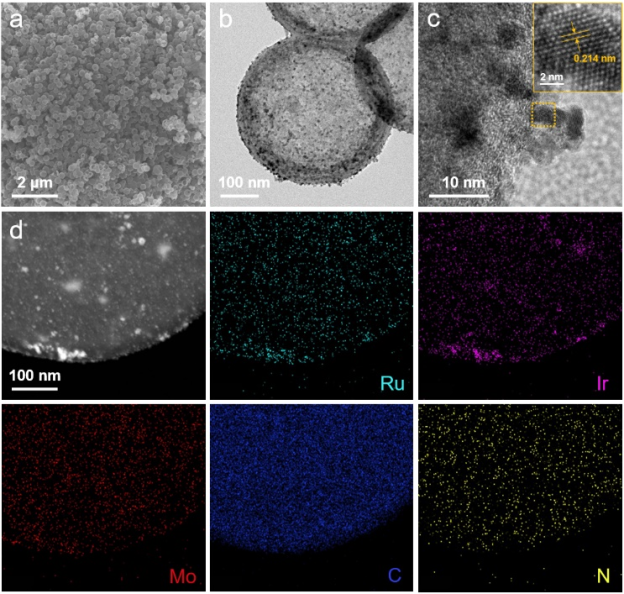
Figure 1. (a) SEM, (b, c) TEM, and (d) EDS mapping of RuIrMo@MHCS.
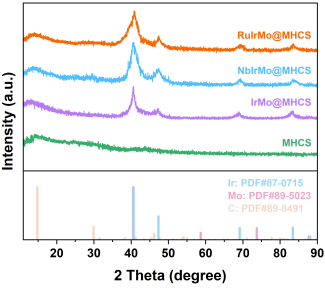
Figure 2. XRD patterns of RuIrMo@MHCS, NbIrMo@MHCS, IrMo@MHCS, and MHCS.
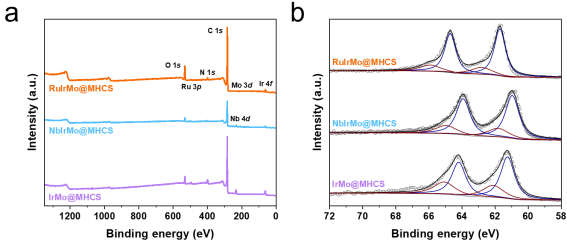
Figure 3. (a) XPS survey spectra and (b) Ir 4f XPS spectra of RuIrMo@MHCS, NbIrMo@MHCS, and IrMo@MHCS.
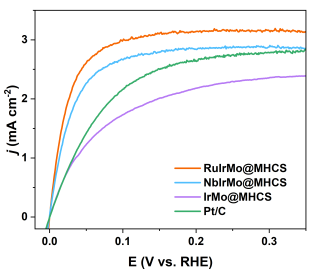
Figure 4. HOR polarization curves of RuIrMo@MHCS, NbIrMo@MHCS, IrMo@MHCS, and commercial Pt/C in H2-saturated 0.1 M KOH (1600 rpm, 1 mV s–1).
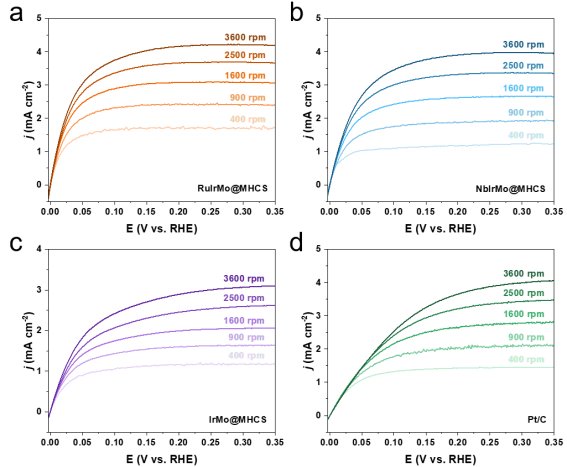
Figure 5. HOR polarization curves of (a) RuIrMo@MHCS, (b) NbIrMo@MHCS, (c) IrMo@MHCS, and (d) commercial 20 wt.% Pt/C at different rotation speeds.
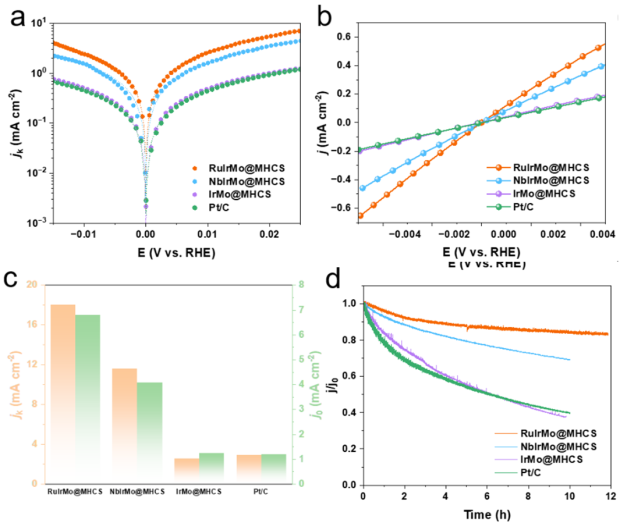
Figure 6. (a) jk versus potential; (b) Micro-polarization region fitting; (c) Comparison of jk at 50 mV and j0; (d) Chronoamperometric stability at 0.05 V.
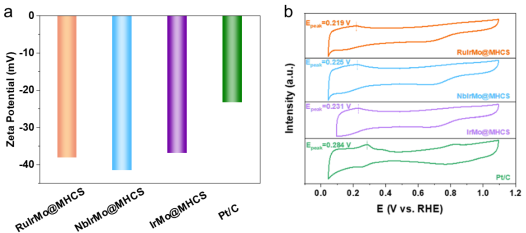
Figure 7. (a) Zeta potential; (b) Cyclic voltammograms in N2-saturated 0.1 M KOH.
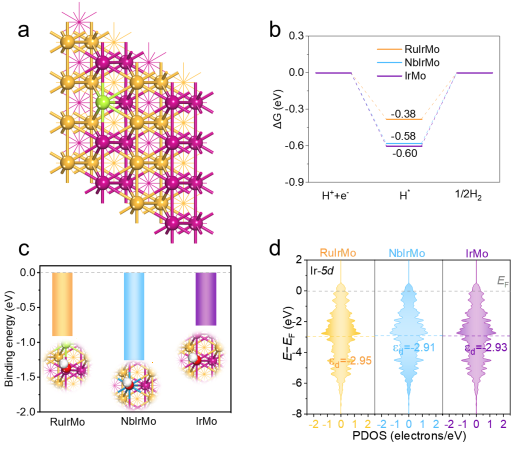
Figure 8. (a) Theoretical structural model of RuIrMo; (b) ΔGH* values; (c) OH* binding energies; (d) Projected density of states (PDOS) of Ir-d orbitals.

Information


 Share This Article
 Twitter
 Linked In
 Facebook
 Copy
Copy Download