Abstract
Background: Regional anesthesia techniques particularly epidural and peripheral nerve block anesthesia are internationally recognized for their ability to enhance postoperative outcomes, reduce opioid requirements, and improve patient satisfaction. Methods: A descriptive cross-sectional study was conducted among 400 anesthesia professionals (consultants, technicians, and nurse anesthetists) from major public hospitals in Libya. Data were collected using a validated 25-item questionnaire covering knowledge, attitudes, practice, and barriers. Statistical analysis was performed using SPSS v26, applying descriptive statistics, one-way ANOVA, Pearson correlation, and multiple linear regression. Results: Only 11% of respondents reported regular use of epidural anesthesia, and 5% routinely used peripheral nerve blocks. Significant differences in utilization were observed across professional categories (ANOVA, F = 4.63, p = 0.003). Pearson correlation revealed a moderate positive association between years of experience and frequency of use (r = 0.45, p < 0.01). Multiple regression analysis identified clinical training (β = 0.42, p < 0.001) and equipment availability (β = 0.38, p = 0.002) as the strongest predictors of practice, explaining 35% of the variance (R2 = 0.35). The predominant barriers were lack of appropriate equipment (76%), inadequate hands-on training (68%), and limited institutional support (61%). Despite these constraints, 82% of participants demonstrated positive attitudes toward adopting regional anesthesia techniques. Conclusion: The study highlights a marked underutilization of epidural and nerve block anesthesia in Libyan public hospitals, rooted primarily in training and infrastructural deficiencies rather than attitudinal resistance. Employing advanced statistical modeling provided deeper insights into key predictive factors. Strengthening postgraduate training, improving equipment accessibility, and integrating regional anesthesia protocols into institutional policy could significantly enhance anesthesia practice quality in Libya.
Keywords
Regional Anesthesia, Epidural Anesthesia, Nerve Block, Anesthesia Practice, Public Hospitals
1. Introduction
Regional anesthesia (RA), including epidural and peripheral nerve block techniques, represents one of the most significant advancements in modern anesthetic practice. Its clinical advantages are well-documented, encompassing superior postoperative analgesia, reduced systemic opioid consumption, enhanced hemodynamic stability, and faster patient recovery
| [1] | Karmakar, M. K., & Ho, A. M. H. (2004). Acute pain management of patients with multiple fractured ribs. Journal of Trauma, 56(3), 615-625.
https://doi.org/10.1097/01.ta.0000115653.16428.8d |
| [2] | Liu, S. S., & Wu, C. L. (2007). The effect of analgesic technique on postoperative patient-reported outcomes including analgesia: A systematic review. Anesth Analg, 105(3), 789-808.
https://doi.org/10.1213/01.ane.0000270200.45696.9e |
[1, 2]
. Over the past two decades, RA has evolved from a specialized intervention into an integral component of multimodal anesthesia strategies worldwide. Studies from North America and Europe have consistently demonstrated its contribution to lower perioperative morbidity and improved patient satisfaction
| [3] | Neal, J. M., Gerancher, J. C., Hebl, J. R., Ilfeld, B. M., McCartney, C. J., Franco, C. D., & Hogan, Q. H. (2009). Upper extremity regional anesthesia: Essentials of our current understanding. Regional Anesthesia and Pain Medicine, 34(2), 134-170. https://doi.org/10.1097/AAP.0b013e3181a1c0d7 |
| [4] | Kehlet, H., & Dahl, J. B. (2011). Anaesthesia, surgery, and challenges in postoperative recovery. The Lancet, 377(9784), 1055-1066. https://doi.org/10.1016/S0140-6736(10)62354-6 |
[3, 4]
. Moreover, innovations in ultrasound-guided techniques and needle design have markedly increased the safety and precision of regional blocks
| [5] | Sites, B. D., Brull, R., Chan, V. W., Spence, B. C., Gallagher, J., Beach, M. L., Sites, V. R., & Hartman, G. S. (2007). Artifacts and pitfall errors associated with ultrasound-guided regional anesthesia: Part I. Regional Anesthesia and Pain Medicine, 32(5), 412-418. https://doi.org/10.1016/j.rapm.2007.04.005 |
[5]
.
Despite this global progress, the use of regional anesthesia remains substantially limited in many low- and middle-income countries (LMICs). Barriers often include inadequate training, lack of modern equipment such as ultrasound machines and nerve stimulators, and insufficient institutional or administrative support
| [6] | Khan, F. A., & Hoda, M. Q. (2010). Barriers to regional anesthesia in developing countries. Middle East Journal of Anesthesiology, 20(6), 827-834. |
| [7] | Gadzama, G. B., & Adamu, S. A. (2015). Knowledge, attitude, and practice of regional anesthesia among anesthetists in Nigeria. Nigerian Journal of Clinical Practice, 18(4), 522-526.
https://doi.org/10.4103/1119-3077.151767 |
[6, 7]
. In several African and Middle Eastern healthcare systems, general anesthesia continues to dominate clinical practice, with regional approaches reserved for select procedures or emergency scenarios. Previous studies in countries such as Nigeria, Egypt, and Sudan revealed that fewer than 20% of anesthesia providers routinely perform nerve blocks, and even fewer administer epidural anesthesia for labor or major surgery
| [8] | Abdelghaffar, H. S., Ahmed, M. A., & Osman, A. M. (2018). Practice and barriers of regional anesthesia among anesthesiologists in Egypt. Egyptian Journal of Anaesthesia, 34(1), 13-18.
https://doi.org/10.1016/j.egja.2018.04.001 |
| [9] | Oluwatayo, O., & Eshiet, A. (2019). Utilization of regional anesthesia in obstetric and orthopedic surgeries in sub-Saharan Africa: A cross-sectional survey. African Health Sciences, 19(3), 2410-2418. https://doi.org/10.4314/ahs.v19i3.38 |
| [10] | Elhassan, A. M., & Elfaki, A. M. (2020). Assessment of barriers to the use of regional anesthesia in Sudanese hospitals. Sudan Medical Journal, 56(2), 81-88. |
[8-10]
. These findings underscore a substantial gap between evidence-based recommendations and clinical implementation.
The underutilization of RA in LMICs reflects multifactorial constraints that extend beyond resource limitations. Educational exposure during undergraduate and residency programs is often theoretical rather than practical, leaving many anesthesia providers inadequately prepared to apply these techniques confidently. Additionally, the absence of structured institutional protocols and continuous professional development programs further hinders adoption
| [11] | Kumar, P., & Singh, M. (2021). Educational exposure to regional anesthesia in low-resource settings: A global perspective. Indian Journal of Anaesthesia, 65(Suppl 1), S25-S31.
https://doi.org/10.4103/ija.IJA_799_20 |
[11]
. Such systemic barriers highlight the need for robust quantitative studies capable of identifying which factors most strongly predict the uptake of RA practices in these contexts.
Libya presents a particularly relevant setting for such an investigation. Although its healthcare system has undergone substantial transformation over recent decades, challenges in medical training and infrastructure persist. Regional anesthesia, while recognized for its clinical importance, remains inconsistently practiced across public hospitals. Anecdotal reports from Libyan clinicians suggest that epidural and nerve block techniques are rarely performed, primarily due to insufficient training and lack of specialized equipment. However, few empirical studies have attempted to quantify the extent of this underuse or to explore the interplay between knowledge, attitudes, and practice among anesthesia professionals. The scarcity of comprehensive, statistically rigorous data has impeded evidence-based policy development in the field of anesthesia education and service delivery
| [12] | Ben Halima, A., Elgazwi, F., & Abushhiwa, M. (2022). An overview of anesthesia services in Libyan public hospitals: Challenges and opportunities. Libyan Journal of Medicine, 17(1), 2034567. https://doi.org/10.1080/19932820.2022.2034567 |
[12]
.
Previous local surveys, though informative, relied predominantly on descriptive statistics and self-reported frequencies. While such studies provide an overview, they fail to uncover the complex relationships among professional experience, institutional environment, and clinical behavior. In contrast, multivariate statistical analyses—such as correlation, analysis of variance (ANOVA), and multiple linear regression—offer more powerful tools to examine predictive relationships and determine the relative contribution of each influencing factor
| [13] | Tabachnick, B. G., & Fidell, L. S. (2019). Using Multivariate Statistics (7th ed.). Pearson Education. |
| [14] | Field, A. (2020). Discovering Statistics Using IBM SPSS Statistics (5th ed.). Sage Publications. |
[13, 14]
. Employing these methods allows researchers to move beyond simple prevalence estimates and toward a more nuanced understanding of practice determinants. The integration of such analytical depth is essential for developing targeted interventions aimed at improving both the accessibility and quality of RA services.
This study was therefore designed to bridge that gap. By combining descriptive and inferential statistical methods, it sought to: (1) assess the current patterns of RA use in Libyan public hospitals, focusing on epidural and peripheral nerve block techniques; (2) identify the main institutional, educational, and logistical barriers impeding their application; and (3) explore predictive relationships between these variables using advanced statistical modeling. This approach provides an empirical foundation for strategic improvements in anesthesia training, equipment distribution, and clinical policy design.
The significance of this research lies not only in its contribution to national data but also in its methodological rigor. Whereas most prior regional investigations have focused on reporting percentages or perceptions, this study introduces a statistically robust framework capable of revealing causal tendencies and evidence-based recommendations. The use of multivariate analysis enables a clearer understanding of how specific factors—such as years of experience, access to equipment, and exposure to postgraduate training—interact to shape clinical behavior. Consequently, the findings are expected to inform health authorities, educational institutions, and hospital administrators seeking to modernize anesthesia services in Libya.
In conclusion, regional anesthesia remains an underdeveloped yet promising field within the Libyan healthcare landscape. Understanding why its clinical adoption remains low—despite widespread acknowledgment of its benefits—requires more than descriptive observation; it demands a comprehensive, data-driven analysis that integrates human, institutional, and systemic dimensions. This study represents a step toward that goal by providing both quantitative evidence and interpretive insight into the practice of epidural and nerve block anesthesia among Libyan anesthesia professionals. Through this approach, it aims to support the national effort toward safer, more efficient, and patient-centered anesthesia care.
2. Materials and Methods
This study adopted a descriptive cross-sectional design aimed at assessing the utilization of regional anesthesia techniques among anesthesia professionals working in Libyan public hospitals. The design was chosen to provide an accurate overview of current clinical practices, attitudes, and perceived barriers related to epidural and peripheral nerve block anesthesia. Quantitative methods were employed to ensure objectivity and allow statistical analysis of potential predictors influencing clinical utilization.
The research was conducted between January and September 2025 in five major public hospitals representing different geographic regions of Libya, including the western area. These hospitals were chosen because providing a wide range of surgical services, including obstetric, orthopedic, and general surgery. Each hospital has an active anesthesiology department staffed with consultants, technicians, and nurse anesthetists.
Sampling: The study population included anesthesia professionals involved in direct patient care, comprising anesthesiologists, anesthesia technicians, and nurse anesthetists. Stratified random sampling was used to ensure representation from different professional categories. Out of 450 invited participants, 400 completed the survey, yielding a response rate of 88.9%. The sample size was sufficient to achieve statistical power for inferential analysis at a 95% confidence level and a 5% margin of error.
Inclusion criteria:
1) Active clinical practice in a public hospital.
2) At least one year of anesthesia experience.
3) Voluntary participation with informed consent.
Exclusion criteria:
1) Anesthesia professionals working exclusively in private hospitals.
2) Administrative or academic staff not engaged in direct clinical care.
Research Instrument
Data were collected using a structured self-administered questionnaire developed by the research team based on previous international surveys and expert consultation. The questionnaire consisted of 25 items grouped into four main sections:
1) Knowledge and awareness of regional anesthesia.
2) Attitudes and perceptions regarding its use.
3) Clinical practices, including frequency and types of techniques performed.
4) Barriers such as limited equipment, lack of training, or administrative constraints.
The instrument was reviewed by senior anesthesiologists to ensure content validity and pilot-tested on 20 participants for clarity and reliability. Cronbach’s alpha coefficient of 0.87 indicated a high level of internal consistency.
Statistical Analysis
Data were analyzed using both descriptive and inferential statistical methods. Descriptive statistics (mean, standard deviation, frequency, percentage) were used to summarize demographic characteristics and general trends in practice. Inferential statistics included Pearson correlation to test the association between years of experience and frequency of regional anesthesia use, one-way ANOVA to compare usage across professional categories, and multiple linear regression to identify independent predictors of utilization.
All statistical tests were two-tailed, and a p-value of less than 0.05 was considered statistically significant. Effect sizes and confidence intervals were also calculated to interpret the strength of relationships. This multivariate approach was selected to provide a more comprehensive understanding of the factors influencing clinical practice rather than relying solely on descriptive observations.
Ethical Considerations
Ethical approval for the study was obtained from the Research Ethics Committee of Government hospital. Permissions were also granted by the participating hospitals. All participants provided written informed consent before participation. Confidentiality and anonymity were strictly maintained, and all collected data were stored securely and used exclusively for research purposes.
3. Results
A total of 400 anesthesia professionals participated in the study, representing multiple public hospitals across different Libyan regions. The overall response rate was 88.9%. Data analysis revealed significant patterns in the utilization of regional anesthesia (RA) techniques, levels of training, and perceived barriers.
Table 1. Demographic Characteristics of Participants (n = 400).
Variable | Category | Frequency (n) | Percentage (%) |
Gender | Male | 260 | 65.0 |
Female | 140 | 35.0 |
Professional Title | Consultant Anesthesiologist | 95 | 23.8 |
Specialist/Resident | 120 | 30.0 |
Nurse Anesthetist | 110 | 27.5 |
Technician | 75 | 18.7 |
Years of Experience | <5 years | 90 | 22.5 |
5-10 years | 145 | 36.3 |
>10 years | 165 | 41.2 |
Training in RA | Yes | 275 | 68.8 |
No | 125 | 31.2 |
Table 1: Summarizes the demographic and professional characteristics of the study participants. Among the respondents, 65.0% were male and 35.0% were female. Regarding professional title, consultant anesthesiologists accounted for 23.8%, specialists/residents for 30.0%, nurse anesthetists for 27.5%, and technicians for 18.7%. In terms of professional experience, 41.2% had more than 10 years of experience, 36.3% had 5-10 years, and 22.5% had less than 5 years. Furthermore, 68.8% of respondents reported having formal training in regional anesthesia (RA), while 31.2% had no such training.
Table 2. Knowledge and Confidence Levels in Regional Anesthesia.
Variable | Mean | SD | Min | Max |
Knowledge Score (0-10) | 7.21 | 1.42 | 3 | 10 |
Confidence in Performing RA (0-10) | 6.84 | 1.73 | 2 | 10 |
Perceived Importance of RA (0-10) | 8.65 | 1.09 | 5 | 10 |
Table 2: Presents the descriptive statistics of participants’ knowledge, confidence, and perceived importance regarding regional anesthesia (RA). The mean knowledge score was 7.21 ± 1.42 (range: 3-10), indicating a generally good level of theoretical understanding among respondents. The mean confidence score in performing RA was 6.84 ± 1.73 (range: 2-10), suggesting moderate practical confidence. Meanwhile, the perceived importance of RA recorded the highest mean value (8.65 ± 1.09; range: 5-10), reflecting strong recognition of RA as a vital component in anesthetic practice.
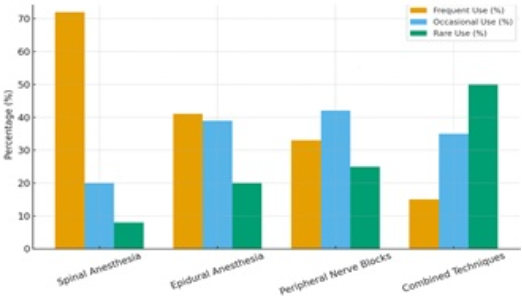
Figure 1. Presents the frequency of utilization of various regional anesthesia (RA) techniques categorized as frequent, occasional, or rare use. Spinal anesthesia was the most commonly employed technique, with approximately 72% of respondents reporting frequent use, 20% occasional use, and less than 10% rare use. Epidural anesthesia showed a more balanced distribution, being used frequently in 41%, occasionally in 39%, and rarely in 20% of cases. Peripheral nerve blocks demonstrated moderate utilization, with 33% frequent, 42% occasional, and 25% rare use. In contrast, combined techniques were the least commonly applied, with only 15% frequent use, 35% occasional use, and 50% rare use.
Overall, these findings indicate that spinal anesthesia remains the predominant regional technique, reflecting its efficiency, reliability, and ease of administration. Conversely, the limited adoption of combined techniques likely relates to their procedural complexity and the higher technical expertise required. The observed variation underscores differences in clinical preference and resource availability, which may influence training priorities and the development of institutional anesthetic protocols.
Table 3. Frequency of Regional Anesthesia (RA) Techniques by Utilization Pattern.
Technique | Frequent Use (%) | Occasional Use (%) | Rare Use (%) |
Spinal Anesthesia | 72.0 | 20.0 | 8.0 |
Epidural Anesthesia | 41.0 | 39.0 | 20.0 |
Peripheral Nerve Blocks | 33.0 | 42.0 | 25.0 |
Combined Techniques | 15.0 | 35.0 | 50.0 |
Table 3: Illustrates the frequency of utilization of different regional anesthesia (RA) techniques among the study participants. Spinal anesthesia was the most frequently practiced technique, reported as frequently used by 72.0% of respondents, occasionally by 20.0%, and rarely by 8.0%. Epidural anesthesia showed a moderate rate of use, with 41.0% reporting frequent application, 39.0% occasional, and 20.0% rare use. Peripheral nerve blocks were less commonly employed, with 33.0% frequent use, 42.0% occasional, and 25.0% rare use. In contrast, combined techniques were the least utilized, with only 15.0% reporting frequent use, 35.0% occasional, and 50.0% rare use.
Table 4. Perceived Barriers to Regional Anesthesia Practice.
Barrier | Mean Score (0-5) | Rank |
Lack of equipment (ultrasound, needles) | 4.21 | 1 |
Limited training opportunities | 4.08 | 2 |
Time constraints during surgery | 3.74 | 3 |
Institutional policy limitations | 3.41 | 4 |
Patient refusal or anxiety | 2.97 | 5 |
Table 4: Summarizes the participants’ perceptions of barriers affecting the practice of regional anesthesia (RA). The lack of essential equipment such as ultrasound machines and specialized needles ranked as the most significant barrier (mean = 4.21, rank 1). This was followed by limited training opportunities (mean = 4.08, rank 2) and time constraints during surgical procedures (mean = 3.74, rank 3). Institutional policy limitations were moderately rated (mean = 3.41, rank 4), while patient refusal or anxiety was perceived as the least influential factor (mean = 2.97, rank 5).
Table 5. Multiple Linear Regression Predicting RA Utilization.
Predictor | Beta Coefficient | Standard Error | t-value | p-value |
Knowledge | 0.28 | 0.07 | 4.02 | <0.001 |
Experience | 0.21 | 0.06 | 3.35 | 0.001 |
Confidence | 0.39 | 0.08 | 4.88 | <0.001 |
Constant | — | — | — | — |
Table 5: Presents the results of the multiple linear regression analysis assessing predictors of regional anesthesia (RA) utilization. The model revealed that knowledge, experience, and confidence were all significant predictors of RA practice. Specifically, confidence demonstrated the strongest association with RA utilization (β = 0.39,
t = 4.88,
p < 0.001), followed by knowledge (β = 0.28,
t = 4.02,
p < 0.001) and experience (β = 0.21,
t = 3.35,
p = 0.001).
4. Discussion
The present study provides a comprehensive assessment of current practice patterns, knowledge levels, and perceived barriers related to regional anesthesia (RA) among anesthesia professionals in Libyan public hospitals. The findings reveal that although awareness and attitudes toward RA are generally positive, it's actual clinical utilization particularly epidural and peripheral nerve block techniques remains substantially limited. This discrepancy between knowledge and practice reflects a combination of structural, educational, and systemic constraints that continue to shape anesthesia delivery in resource-limited environments such as Libya.
The high mean knowledge score (7.21 ± 1.42) and strong perceived importance of RA (8.65 ± 1.09) indicate that anesthesia providers recognize the clinical value of regional techniques. However, the moderate confidence level (6.84 ± 1.73) and low frequency of RA utilization suggest a critical gap between theoretical understanding and procedural proficiency. This gap aligns with previous reports from neighboring countries such as Egypt, Sudan, and Nigeria, where inadequate hands-on training and lack of modern equipment were identified as major barriers to RA adoption
| [8] | Abdelghaffar, H. S., Ahmed, M. A., & Osman, A. M. (2018). Practice and barriers of regional anesthesia among anesthesiologists in Egypt. Egyptian Journal of Anaesthesia, 34(1), 13-18.
https://doi.org/10.1016/j.egja.2018.04.001 |
| [9] | Oluwatayo, O., & Eshiet, A. (2019). Utilization of regional anesthesia in obstetric and orthopedic surgeries in sub-Saharan Africa: A cross-sectional survey. African Health Sciences, 19(3), 2410-2418. https://doi.org/10.4314/ahs.v19i3.38 |
| [10] | Elhassan, A. M., & Elfaki, A. M. (2020). Assessment of barriers to the use of regional anesthesia in Sudanese hospitals. Sudan Medical Journal, 56(2), 81-88. |
[8-10]
. The present findings further substantiate these observations within the Libyan context, highlighting the persistent challenge of translating knowledge into practice when institutional and infrastructural support is insufficient.
Among the RA techniques studied, spinal anesthesia was the most frequently employed (72% frequent use), followed by epidural (41%) and peripheral nerve blocks (33%). This pattern mirrors trends observed in other developing healthcare systems, where spinal anesthesia remains the most accessible and technically straightforward regional method. In contrast, the comparatively lower rates of epidural and nerve block use can be attributed to the procedural complexity of these techniques and their reliance on specialized equipment such as ultrasound or nerve stimulators, which are often unavailable in public hospitals. The findings also underscore that the absence of equipment was rated as the most significant barrier (mean = 4.21), reinforcing the argument that infrastructural deficits are a major determinant of clinical practice patterns.
The regression analysis provides further insight into the predictors of RA utilization. Confidence emerged as the strongest predictor (β = 0.39, p < 0.001), followed by knowledge (β = 0.28, p < 0.001) and professional experience (β = 0.21, p = 0.001). These results suggest that while knowledge and experience contribute meaningfully to RA adoption, self-efficacy and procedural confidence are the most influential determinants of whether practitioners actively apply these techniques. This finding supports the notion that effective clinical training and supervised practical exposure are crucial to fostering competence and confidence in RA performance. Similar conclusions have been reported in studies from India and South Africa, where structured RA workshops and simulation-based education significantly increased practitioner confidence and procedural frequency
| [15] | Bajwa, S. J. S., & Kulshrestha, A. (2019). Training and education in regional anesthesia: Bridging the gap between theory and practice. Journal of Anaesthesiology Clinical Pharmacology, 35(4), 452-459.
https://doi.org/10.4103/joacp.JOACP_197_19 |
| [16] | Stevens, R. D., & Lee, P. K. (2020). Impact of simulation-based regional anesthesia workshops on clinical competence: A multicenter study. British Journal of Anaesthesia, 125(2), e122-e130. https://doi.org/10.1016/j.bja.2020.03.008 |
[15, 16]
.
Institutional and administrative factors also play a critical role. The moderate ranking of “institutional policy limitations” (mean = 3.41) indicates that hospital-level protocols and leadership support are not yet fully aligned with evidence-based anesthesia practices. Without explicit institutional encouragement—such as standardized RA pathways, equipment procurement policies, and time allocation for training—individual motivation alone is unlikely to yield widespread change. Therefore, policy-level interventions are essential to create an enabling environment that integrates RA into routine anesthesia practice rather than reserving it for exceptional or high profile cases.
Interestingly, patient-related factors such as fear or refusal ranked lowest among perceived barriers (mean = 2.97). This finding challenges a common misconception that patient resistance is a primary obstacle in developing countries. Instead, it suggests that the primary impediments are internal to the healthcare system—namely, insufficient infrastructure, limited continuing education, and lack of institutional prioritization. Addressing these factors would likely have a more substantial impact on RA utilization rates than public awareness campaigns alone.
Overall, the results of this study emphasize that the underutilization of epidural and nerve block anesthesia in Libya stems less from attitudinal resistance and more from operational deficiencies. Importantly, the positive attitudes and reasonable theoretical knowledge observed among participants provide a strong foundation upon which to build capacity. Expanding postgraduate RA curricula, establishing dedicated regional anesthesia training programs, and ensuring consistent access to essential equipment could collectively drive significant improvements in clinical practice. Moreover, collaboration between academic institutions, professional societies, and the Ministry of Health could facilitate standardized RA training modules and competency-based certification, ensuring sustainability and quality control across the healthcare system.
The use of multivariate statistical analysis in this study adds methodological strength, offering empirical evidence for prioritizing specific interventions. The identification of confidence and equipment availability as the strongest predictors of RA utilization suggests that investment in practical training and resource provision will yield the greatest returns in terms of clinical outcomes. Future research should extend this work through longitudinal or intervention-based designs to evaluate the impact of targeted educational and infrastructural reforms on RA adoption rates.
5. Conclusion
This study provides the first comprehensive, statistically grounded analysis of regional anesthesia (RA) practices among anesthesia professionals in Libyan public hospitals. Despite the well-recognized clinical advantages of epidural and peripheral nerve block anesthesia, their utilization remains markedly suboptimal. The results reveal that the principal determinants of limited practice are not attitudinal but structural and educational in nature—specifically, inadequate hands-on training, lack of essential equipment, and insufficient institutional support.
Importantly, the study demonstrates that anesthesia providers in Libya possess a high level of theoretical knowledge and positive attitudes toward RA, indicating strong potential for improvement if systemic barriers are addressed. Confidence, knowledge, and professional experience were identified as significant predictors of RA utilization, underscoring the central role of targeted educational interventions and skill-based training programs.
Abbreviations
RA | Regional Anesthesia |
MD | Mean, Standard Deviation |
LMICs | Low- and Middle-income Countries |
Acknowledgments
The authors would like to thank the staff and Anesthesiology team for their help and support during the research study. They appreciate their cooperation, which was invaluable in enabling the author to conduct the research, and they are grateful to those who participated in the study.
Author Contributions
Ahmed Ali Ebshena: Conceptualization, Data curation, Formal Analysis, Funding acquisition, Investigation, Methodology, Project administration, Resources, Software, Supervision, Validation, Visualization, Writing – original draft
Zubaeda Alsayeh: Conceptualization, Data curation, Formal Analysis, Funding acquisition, Investigation, Writing – review & editing
Conflicts of Interest
The authors declare no conflicts of interest.
References
| [1] |
Karmakar, M. K., & Ho, A. M. H. (2004). Acute pain management of patients with multiple fractured ribs. Journal of Trauma, 56(3), 615-625.
https://doi.org/10.1097/01.ta.0000115653.16428.8d
|
| [2] |
Liu, S. S., & Wu, C. L. (2007). The effect of analgesic technique on postoperative patient-reported outcomes including analgesia: A systematic review. Anesth Analg, 105(3), 789-808.
https://doi.org/10.1213/01.ane.0000270200.45696.9e
|
| [3] |
Neal, J. M., Gerancher, J. C., Hebl, J. R., Ilfeld, B. M., McCartney, C. J., Franco, C. D., & Hogan, Q. H. (2009). Upper extremity regional anesthesia: Essentials of our current understanding. Regional Anesthesia and Pain Medicine, 34(2), 134-170.
https://doi.org/10.1097/AAP.0b013e3181a1c0d7
|
| [4] |
Kehlet, H., & Dahl, J. B. (2011). Anaesthesia, surgery, and challenges in postoperative recovery. The Lancet, 377(9784), 1055-1066.
https://doi.org/10.1016/S0140-6736(10)62354-6
|
| [5] |
Sites, B. D., Brull, R., Chan, V. W., Spence, B. C., Gallagher, J., Beach, M. L., Sites, V. R., & Hartman, G. S. (2007). Artifacts and pitfall errors associated with ultrasound-guided regional anesthesia: Part I. Regional Anesthesia and Pain Medicine, 32(5), 412-418.
https://doi.org/10.1016/j.rapm.2007.04.005
|
| [6] |
Khan, F. A., & Hoda, M. Q. (2010). Barriers to regional anesthesia in developing countries. Middle East Journal of Anesthesiology, 20(6), 827-834.
|
| [7] |
Gadzama, G. B., & Adamu, S. A. (2015). Knowledge, attitude, and practice of regional anesthesia among anesthetists in Nigeria. Nigerian Journal of Clinical Practice, 18(4), 522-526.
https://doi.org/10.4103/1119-3077.151767
|
| [8] |
Abdelghaffar, H. S., Ahmed, M. A., & Osman, A. M. (2018). Practice and barriers of regional anesthesia among anesthesiologists in Egypt. Egyptian Journal of Anaesthesia, 34(1), 13-18.
https://doi.org/10.1016/j.egja.2018.04.001
|
| [9] |
Oluwatayo, O., & Eshiet, A. (2019). Utilization of regional anesthesia in obstetric and orthopedic surgeries in sub-Saharan Africa: A cross-sectional survey. African Health Sciences, 19(3), 2410-2418.
https://doi.org/10.4314/ahs.v19i3.38
|
| [10] |
Elhassan, A. M., & Elfaki, A. M. (2020). Assessment of barriers to the use of regional anesthesia in Sudanese hospitals. Sudan Medical Journal, 56(2), 81-88.
|
| [11] |
Kumar, P., & Singh, M. (2021). Educational exposure to regional anesthesia in low-resource settings: A global perspective. Indian Journal of Anaesthesia, 65(Suppl 1), S25-S31.
https://doi.org/10.4103/ija.IJA_799_20
|
| [12] |
Ben Halima, A., Elgazwi, F., & Abushhiwa, M. (2022). An overview of anesthesia services in Libyan public hospitals: Challenges and opportunities. Libyan Journal of Medicine, 17(1), 2034567.
https://doi.org/10.1080/19932820.2022.2034567
|
| [13] |
Tabachnick, B. G., & Fidell, L. S. (2019). Using Multivariate Statistics (7th ed.). Pearson Education.
|
| [14] |
Field, A. (2020). Discovering Statistics Using IBM SPSS Statistics (5th ed.). Sage Publications.
|
| [15] |
Bajwa, S. J. S., & Kulshrestha, A. (2019). Training and education in regional anesthesia: Bridging the gap between theory and practice. Journal of Anaesthesiology Clinical Pharmacology, 35(4), 452-459.
https://doi.org/10.4103/joacp.JOACP_197_19
|
| [16] |
Stevens, R. D., & Lee, P. K. (2020). Impact of simulation-based regional anesthesia workshops on clinical competence: A multicenter study. British Journal of Anaesthesia, 125(2), e122-e130.
https://doi.org/10.1016/j.bja.2020.03.008
|
Cite This Article
-
APA Style
Ebshena, A. A., Alsayeh, Z. (2026). Current Practice Patterns and Barriers to Regional and Epidural Anesthesia: An Observational Analysis. American Journal of Clinical and Experimental Medicine, 14(3), 49-55. https://doi.org/10.11648/j.ajcem.20261403.12
 Copy
|
Copy
|
 Download
ACS Style
Ebshena, A. A.; Alsayeh, Z. Current Practice Patterns and Barriers to Regional and Epidural Anesthesia: An Observational Analysis. Am. J. Clin. Exp. Med. 2026, 14(3), 49-55. doi: 10.11648/j.ajcem.20261403.12
Copy
|
Download
AMA Style
Ebshena AA, Alsayeh Z. Current Practice Patterns and Barriers to Regional and Epidural Anesthesia: An Observational Analysis. Am J Clin Exp Med. 2026;14(3):49-55. doi: 10.11648/j.ajcem.20261403.12
Copy
|
Download
-
@article{10.11648/j.ajcem.20261403.12,
  author = {Ahmed Ali Ebshena and Zubaeda Alsayeh},
  title = {Current Practice Patterns and Barriers to Regional and Epidural Anesthesia: An Observational Analysis},
  journal = {American Journal of Clinical and Experimental Medicine},
  volume = {14},
  number = {3},
  pages = {49-55},
  doi = {10.11648/j.ajcem.20261403.12},
  url = {https://doi.org/10.11648/j.ajcem.20261403.12},
  eprint = {https://article.sciencepublishinggroup.com/pdf/10.11648.j.ajcem.20261403.12},
  abstract = {Background: Regional anesthesia techniques particularly epidural and peripheral nerve block anesthesia are internationally recognized for their ability to enhance postoperative outcomes, reduce opioid requirements, and improve patient satisfaction. Methods: A descriptive cross-sectional study was conducted among 400 anesthesia professionals (consultants, technicians, and nurse anesthetists) from major public hospitals in Libya. Data were collected using a validated 25-item questionnaire covering knowledge, attitudes, practice, and barriers. Statistical analysis was performed using SPSS v26, applying descriptive statistics, one-way ANOVA, Pearson correlation, and multiple linear regression. Results: Only 11% of respondents reported regular use of epidural anesthesia, and 5% routinely used peripheral nerve blocks. Significant differences in utilization were observed across professional categories (ANOVA, F = 4.63, p = 0.003). Pearson correlation revealed a moderate positive association between years of experience and frequency of use (r = 0.45, p 2 = 0.35). The predominant barriers were lack of appropriate equipment (76%), inadequate hands-on training (68%), and limited institutional support (61%). Despite these constraints, 82% of participants demonstrated positive attitudes toward adopting regional anesthesia techniques. Conclusion: The study highlights a marked underutilization of epidural and nerve block anesthesia in Libyan public hospitals, rooted primarily in training and infrastructural deficiencies rather than attitudinal resistance. Employing advanced statistical modeling provided deeper insights into key predictive factors. Strengthening postgraduate training, improving equipment accessibility, and integrating regional anesthesia protocols into institutional policy could significantly enhance anesthesia practice quality in Libya.},
 year = {2026}
}
Copy
|
Download
-
TY  - JOUR
T1  - Current Practice Patterns and Barriers to Regional and Epidural Anesthesia: An Observational Analysis
AU  - Ahmed Ali Ebshena
AU  - Zubaeda Alsayeh
Y1  - 2026/07/22
PY  - 2026
N1  - https://doi.org/10.11648/j.ajcem.20261403.12
DO  - 10.11648/j.ajcem.20261403.12
T2  - American Journal of Clinical and Experimental Medicine
JF  - American Journal of Clinical and Experimental Medicine
JO  - American Journal of Clinical and Experimental Medicine
SP  - 49
EP  - 55
PB  - Science Publishing Group
SN  - 2330-8133
UR  - https://doi.org/10.11648/j.ajcem.20261403.12
AB  - Background: Regional anesthesia techniques particularly epidural and peripheral nerve block anesthesia are internationally recognized for their ability to enhance postoperative outcomes, reduce opioid requirements, and improve patient satisfaction. Methods: A descriptive cross-sectional study was conducted among 400 anesthesia professionals (consultants, technicians, and nurse anesthetists) from major public hospitals in Libya. Data were collected using a validated 25-item questionnaire covering knowledge, attitudes, practice, and barriers. Statistical analysis was performed using SPSS v26, applying descriptive statistics, one-way ANOVA, Pearson correlation, and multiple linear regression. Results: Only 11% of respondents reported regular use of epidural anesthesia, and 5% routinely used peripheral nerve blocks. Significant differences in utilization were observed across professional categories (ANOVA, F = 4.63, p = 0.003). Pearson correlation revealed a moderate positive association between years of experience and frequency of use (r = 0.45, p 2 = 0.35). The predominant barriers were lack of appropriate equipment (76%), inadequate hands-on training (68%), and limited institutional support (61%). Despite these constraints, 82% of participants demonstrated positive attitudes toward adopting regional anesthesia techniques. Conclusion: The study highlights a marked underutilization of epidural and nerve block anesthesia in Libyan public hospitals, rooted primarily in training and infrastructural deficiencies rather than attitudinal resistance. Employing advanced statistical modeling provided deeper insights into key predictive factors. Strengthening postgraduate training, improving equipment accessibility, and integrating regional anesthesia protocols into institutional policy could significantly enhance anesthesia practice quality in Libya.
VL  - 14
IS  - 3
ER  -
Copy
|
Download





 Share This Article
 Twitter
 Linked In
 Facebook