Abstract
Although concrete is necessary for the world's infrastructure, its production has a substantial negative impact on the environment. The production of cement is responsible for about 8% of global CO2 emissions, and the extraction of natural aggregate depletes limited resources. In order to minimize landfill waste and preserve natural aggregates while preserving structural integrity, this study investigates the use of shredded plastic aggregates (SPA) from post-consumer waste (such as PET and HDPE) in concrete as a sustainable substitute. Concrete mixtures with 0.5–5% SPA replacement underwent compressive strength tests at 7, 14, 21, and 28 days of curing, in accordance with ASTM C39/C39M. Long-term reliability was evaluated using the Constant Failure Rate (CFR) model was obtained from strength development rates. The findings show that over the course of 28 days, plastic-modified concrete produced compressive strengths ranging from 21.858 to 24.156 N/mm2, with an average strength rate of 0.6905 and an annual failure rate of 0.00619 per year. For 15 years, reliability was above 90%; at 50 years, it dropped to 73.36%, indicating that it is appropriate for applications with a moderate service life (30–35 years). SPA concrete provides improved ductility and sustainability advantages despite having a lower compressive strength because of a weaker interfacial bond. Future studies into more sophisticated probabilistic models (such as Weibull and log-normal) and field validation are necessary because the CFR model's constant failure rate assumption makes it difficult to capture intricate degradation mechanisms. By promoting the use of waste plastics in construction, this study develops sustainable concrete technologies.
Keywords
Compressive Strength, Constant Failure Rate (CFR), Modified Concrete, Reliability Analysis, Shredded Plastic Aggregate, Sustainability
1. Introduction
Concrete is an essential component of contemporary infrastructure, serving as the foundation for roads, bridges, buildings, and other vital structures all over the world. But the environmental cost of its production is high, mostly because of the extraction of natural aggregates, which depletes limited resources and disturbs ecosystems, and the production of cement, which accounts for about 8% of global CO
2 emissions
| [15] | Mehta, P. K., & Monteiro, P. J. M. (2014). Concrete: Microstructure, Properties, and Materials (4th ed.). McGraw-Hill Education. |
[15]
. Researchers have looked into substitute materials to lessen the environmental impact of concrete in response to the global demand for sustainable building practices. One creative strategy is the use of waste plastic aggregates, which recycles non-biodegradable materials like polyethylene terephthalate (PET), high-density polyethylene (HDPE), and polypropylene (PP) that would otherwise end up in landfills or pollute the environment. In addition to reducing the need for virgin aggregates, this approach creates a useful construction resource out of waste
| [9] | Guo, P., Cheng, X., Lin, J., & Pan, W. (2023). Effects of recycled plastic aggregates on the mechanical and durability properties of concrete: A comprehensive review. Construction and Building Materials, 363, 129908. |
| [17] | Mohamedsalih, F., Abbas, M., & Omer, S. (2024). Sustainable concrete incorporating recycled waste plastics: Mechanical and durability performance. Journal of Cleaner Production, 425, 139715. |
| [20] | Siddique, R., Khatib, J., & Kaur, I. (2008). Use of recycled plastic in concrete: A review. Waste Management, 28(10), 1835–1852. |
| [22] | Záleská, M., Pavlíková, M., Jankovský, O., Pavlík, Z., & Černý, R. (2019). Sustainable use of recycled plastics in lightweight concrete composites. Sustainability, 11(23), 6555. |
[9, 17, 20, 22]
.
However, the mechanical and durability characteristics of concrete are significantly altered when shredded plastic aggregates are added. The lower density, smoother surface textures, and hydrophobic properties of plastic aggregates, in contrast to natural aggregates, can alter strength development, increase porosity, and jeopardize interfacial bonding with the cementitious matrix. While low-level replacements (usually 5–15% by volume) can improve ductility, impact resistance, and energy absorption, many studies have found that replacing natural aggregates with plastic usually lowers compressive strength because of the poor adherence between the plastic surface and cement paste
| [13] | Islam, M. T., Hossain, M. Z., & Al-Mamun, M. (2023). Static and impact behavior of concrete containing polypropylene plastic aggregates. Construction and Building Materials, 387, 131572. |
| [19] | Saikia, N., & de Brito, J. (2014). Mechanical properties and abrasion behaviour of concrete containing shredded PET bottle waste as a partial substitution of natural aggregate. Construction and Building Materials, 52, 236–244. |
| [21] | Shukur, M. M., Mustafa, M., & Razzak, M. (2023). Experimental study on the performance of recycled plastic aggregate concrete under mechanical and durability tests. Journal of Building Engineering, 71, 106543. |
[13, 19, 21]
. Furthermore, lightweight concrete can be produced thanks to the lower density of plastic aggregates, which may find use in precast components, insulation panels, and non-structural elements
| [1] | Albano, C., Camacho, N., Hernández, M., Matheus, A., & Gutiérrez, A. (2009). Influence of content and particle size of waste PET bottles on concrete behavior at different w/c ratios. Waste Management, 29(10), 2707–2716. |
| [5] | Choi, Y. W., Moon, D. J., Chung, J. S., & Cho, S. K. (2005). Effects of waste PET bottles aggregate on the properties of concrete. Cement and Concrete Research, 35(4), 776–781. |
[1, 5]
. Even with these advantages, little is known about how plastic-modified concrete will fare over time when subjected to environmental stresses like carbonation, chloride intrusion, or freeze-thaw cycles, especially when it comes to structural dependability.
A strong framework for calculating the likelihood that a structural element will carry out its intended function without malfunctioning over a given service life is offered by reliability engineering. Reliability analysis takes into consideration uncertainties in material properties, loading circumstances, exposure to the environment, and degradation mechanisms when discussing concrete structures. A popular methodology in reliability engineering, the Constant Failure Rate (CFR) model is described as follows:
where λ is the constant annual failure rate and R(t) is the reliability at time t (in years). A steady rate of deterioration over the structure's lifetime is implied by this model's assumption of an exponential distribution of failure times
| [2] | Adewuyi, A. P., & Adegoke, T. (2018). Reliability-based design of reinforced concrete structures under durability limit states. Journal of Building Engineering, 15, 216–225. |
| [16] | Melchers, R. E., & Beck, A. T. (2018). Structural Reliability Analysis and Prediction (3rd ed.). Wiley. |
[2, 16]
. This presumption provides a computationally effective and useful way to compare material performance and forecast long-term behavior, even though it simplifies the intricate, time-dependent degradation processes of concrete, such as chemical attacks, mechanical fatigue, or environmental weathering. In structural engineering, the CFR model has been used extensively to evaluate the dependability of fiber-reinforced composites, conventional concrete, and other building materials
| [6] | Frangopol, D. M., & Liu, M. (2007). Maintenance and management of civil infrastructure based on condition, safety, optimization, and life-cycle cost. Structure and Infrastructure Engineering, 3(1), 29–41. |
| [18] | Nowak, A. S., & Collins, K. R. (2012). Reliability of Structures (2nd ed.). CRC Press. |
[6, 18]
.
The Constant Failure Rate (CFR) model is used in this study, "Reliability-Based Evaluation of Shredded Plastic Modified Concrete Using the CFR Model," to assess the long-term dependability of concrete that contains shredded plastic aggregates. The failure rate (λ) and strength development rates are estimated using experimental data on compressive strength obtained at curing ages of 7, 14, 21, and 28 days. The dependability of different concrete mixtures is then projected using these rates over a longer service life, specifically at intervals of 1, 5, 10, 15, 20, 25, 30, 35, 40, 45, and 50 years. This study attempts to close a significant knowledge gap regarding the performance trends and durability of plastic-modified concrete under service-life conditions by combining short-term mechanical data with the CFR model. In addition to providing a quantitative basis for comparing plastic-modified concrete with conventional mixes and guiding its potential use in structural and non-structural applications, the findings add to the expanding body of knowledge on sustainable concrete technologies
| [3] | Al-Salloum, Y. A., Siddiqui, N. A., Elsanadedy, H. M., Abadel, A. A., & Aqel, M. A. (2016). Mechanical properties of concrete containing recycled plastic aggregates. Construction and Building Materials, 114, 701–710. |
| [8] | Gu, L., & Ozbakkaloglu, T. (2016). Use of recycled plastics in concrete: A critical review. Waste Management, 51, 19–42. |
| [11] | Hannawi, K., Kamali-Bernard, S., & Prince, W. (2010). Physical and mechanical properties of mortars containing PET and PC waste aggregates. Waste Management, 30(11), 2312–2320. |
[3, 8, 11]
. This study also supports the wider use of waste plastic in the production of concrete by highlighting the contribution of reliability-based methods to the development of environmentally friendly building materials.
2. Literature Review
The most commonly used building material in the world, concrete serves as the basis for vital infrastructure like buildings, bridges, highways, and dams. Although its production presents serious environmental challenges, its cost-effectiveness, durability, and versatility make it indispensable. About 8% of the world's CO
2 emissions come from the production of cement alone, and the extraction of natural aggregates damages ecosystems and depletes limited resources
| [4] | Andrew, R. M. (2018). Global CO2 emissions from cement production, 1928–2017. Earth System Science Data, 10(1), 2213–2239. |
| [15] | Mehta, P. K., & Monteiro, P. J. M. (2014). Concrete: Microstructure, Properties, and Materials (4th ed.). McGraw-Hill Education. |
[4, 15]
. Research into substitute materials that lessen environmental impact while preserving structural integrity has been prompted by the pressing need for sustainable building practices. Among these, adding recycled plastic aggregates (RPA) to concrete has shown promise. This method reduces the need for virgin aggregates, mitigates landfill accumulation, and adheres to the circular economy principles by recycling non-biodegradable plastic waste, such as polyethylene terephthalate (PET), high-density polyethylene (HDPE), and polypropylene (PP), into concrete
| [9] | Guo, P., Cheng, X., Lin, J., & Pan, W. (2023). Effects of recycled plastic aggregates on the mechanical and durability properties of concrete: A comprehensive review. Construction and Building Materials, 363, 129908. |
| [17] | Mohamedsalih, F., Abbas, M., & Omer, S. (2024). Sustainable concrete incorporating recycled waste plastics: Mechanical and durability performance. Journal of Cleaner Production, 425, 139715. |
| [20] | Siddique, R., Khatib, J., & Kaur, I. (2008). Use of recycled plastic in concrete: A review. Waste Management, 28(10), 1835–1852. |
[9, 17, 20]
. However, the mechanical, durability, and microstructural characteristics of concrete undergo intricate changes when shredded plastic aggregates are added. In terms of density, surface texture, and chemical compatibility with cement paste, plastic aggregates are very different from natural aggregates. These variations frequently lead to increased porosity, changed strength development, and weaker interfacial bonding within the concrete matrix.
Because plastic surfaces are hydrophobic and prevent adhesion with the cementitious matrix, research has repeatedly demonstrated that replacing natural aggregates with plastic tends to decrease compressive strength
| [13] | Islam, M. T., Hossain, M. Z., & Al-Mamun, M. (2023). Static and impact behavior of concrete containing polypropylene plastic aggregates. Construction and Building Materials, 387, 131572. |
| [19] | Saikia, N., & de Brito, J. (2014). Mechanical properties and abrasion behaviour of concrete containing shredded PET bottle waste as a partial substitution of natural aggregate. Construction and Building Materials, 52, 236–244. |
[13, 19]
. For example, a thorough review by
| [9] | Guo, P., Cheng, X., Lin, J., & Pan, W. (2023). Effects of recycled plastic aggregates on the mechanical and durability properties of concrete: A comprehensive review. Construction and Building Materials, 363, 129908. |
[9]
revealed that plastic inclusion can improve ductility, impact resistance, and energy absorption capacity, but it usually reduces compressive strength by 10–30% depending on substitution levels. In a similar vein,
| [13] | Islam, M. T., Hossain, M. Z., & Al-Mamun, M. (2023). Static and impact behavior of concrete containing polypropylene plastic aggregates. Construction and Building Materials, 387, 131572. |
[13]
examined the static and dynamic behavior of concrete made of polypropylene and found that the flexible nature of the plastic particles improved crack resistance under impact loading.
Incorporating up to 5% thermoplastic and PET aggregates, as shown by
| [7] | Gámez-García, D. C., García-González, J. M., & Rivera-Gómez, C. (2025). Sustainable use of thermoplastic and PET wastes as recycled plastic aggregates in concrete. Sustainability, 17(2), 1–16. |
[7]
produced strength losses below 8%, making such mixes suitable for non-structural and moderate-load applications like lightweight partitions or precast panels. Compressive strengths ranging from 33.8 to 45.2 N/mm
2 at 10% substitution were also reported by
| [10] | Gunat, S., Yilmaz, M., & Pappu, A. (2025). Conversion of shredded and crushed plastic waste into durable normal-weight concrete. Journal of Materials in Civil Engineering, 37(3), 04025022. |
[10]
, suggesting that normal-weight concrete with sufficient structural performance can be produced using appropriately graded and bonded plastic aggregates.
Despite these developments, there are still a lot of unanswered questions, especially about the durability and long-term dependability of plastic-modified concrete in actual service settings. The majority of studies pay little attention to long-term performance under prolonged loading, environmental exposure, or fatigue, instead concentrating on short-term mechanical properties like compressive and flexural strengths at 7, 14, or 28 days. Complex degradation mechanisms, such as carbonation, chloride ingress, freeze-thaw cycles, and creep, can worsen the effects of weak interfacial transition zones (ITZ) in plastic-modified mixes in concrete structures that are currently in use
| [3] | Al-Salloum, Y. A., Siddiqui, N. A., Elsanadedy, H. M., Abadel, A. A., & Aqel, M. A. (2016). Mechanical properties of concrete containing recycled plastic aggregates. Construction and Building Materials, 114, 701–710. |
| [11] | Hannawi, K., Kamali-Bernard, S., & Prince, W. (2010). Physical and mechanical properties of mortars containing PET and PC waste aggregates. Waste Management, 30(11), 2312–2320. |
[3, 11]
.
Deterministic testing methods are unable to fully capture the uncertainties introduced by the stochastic nature of these degradation processes as well as the variation in plastic aggregate characteristics (such as size, shape, and polymer type).
| [12] | Ibrahim, M., Atoyebi, O. D., & Adeleke, J. T. (2021). Reliability assessment of rubberized concrete under varying environmental conditions. Case Studies in Construction Materials, 15, e00723. |
[12]
, for example, examined the dependability of concrete modified with heated rubber tire aggregates, a substance that is similar to plastic in its lightweight and flexible qualities. They discovered that environmental factors and the ITZ had a significant impact on long-term performance, highlighting the necessity of using probabilistic models to evaluate durability
| [12] | Ibrahim, M., Atoyebi, O. D., & Adeleke, J. T. (2021). Reliability assessment of rubberized concrete under varying environmental conditions. Case Studies in Construction Materials, 15, e00723. |
[12]
.
By measuring the likelihood that a structural component will carry out its intended function without failure over a given service life, reliability engineering provides a strong framework to address these uncertainties. Reliability analysis provides a more thorough foundation for design and performance prediction than deterministic methods because it takes into consideration variations in material properties, loading circumstances, and environmental factors. A popular method in reliability engineering, the Constant Failure Rate (CFR) model is defined as follows:
, where λ is the constant annual failure rate and
is the reliability at time t (in years). A steady rate of degradation over time is implied by this model's assumption of an exponential distribution of failure times
| [12] | Ibrahim, M., Atoyebi, O. D., & Adeleke, J. T. (2021). Reliability assessment of rubberized concrete under varying environmental conditions. Case Studies in Construction Materials, 15, e00723. |
| [16] | Melchers, R. E., & Beck, A. T. (2018). Structural Reliability Analysis and Prediction (3rd ed.). Wiley. |
[12, 16]
.
This assumption offers a computationally effective way to connect short-term experimental data to long-term performance trends, even though it simplifies the intricate, time-dependent degradation mechanisms of concrete. The CFR model provides a baseline for comparing new mixes, such as plastic-modified concrete, and has been effectively used to assess the dependability of fiber-reinforced composites, conventional concrete, and other building materials
| [6] | Frangopol, D. M., & Liu, M. (2007). Maintenance and management of civil infrastructure based on condition, safety, optimization, and life-cycle cost. Structure and Infrastructure Engineering, 3(1), 29–41. |
| [18] | Nowak, A. S., & Collins, K. R. (2012). Reliability of Structures (2nd ed.). CRC Press. |
[6, 18]
.
By connecting short-term mechanical characteristics, like compressive strength, with long-term failure probabilities, the CFR model can be applied to shredded plastic concrete to enable a quantitative reliability assessment. The failure rate (λ) can be estimated from experimental data from early-age tests (e.g., 7, 14, 21, and 28 days), and it can then be extrapolated to predict reliability over longer service periods (e.g., 1 to 50 years). This method facilitates reliability-based mix design optimization by bridging the gap between laboratory testing and real-world performance. The nonlinear and multi-phase deterioration of plastic-modified concrete, however, may not be adequately captured by the CFR model's assumption of a constant failure rate, especially in light of variables like the heterogeneous ITZ, plastic particle geometry, and polymer degradation under environmental stressors
| [8] | Gu, L., & Ozbakkaloglu, T. (2016). Use of recycled plastics in concrete: A critical review. Waste Management, 51, 19–42. |
[8]
.
For instance, Ibrahim, M et. al. noted that ITZ weakening under temperature and moisture fluctuations caused rubber-modified concrete to show time-dependent changes in reliability
| [12] | Ibrahim, M., Atoyebi, O. D., & Adeleke, J. T. (2021). Reliability assessment of rubberized concrete under varying environmental conditions. Case Studies in Construction Materials, 15, e00723. |
[12]
. This suggests that plastic aggregates may face comparable difficulties
| [12] | Ibrahim, M., Atoyebi, O. D., & Adeleke, J. T. (2021). Reliability assessment of rubberized concrete under varying environmental conditions. Case Studies in Construction Materials, 15, e00723. |
[12]
.
More investigation is required to improve the CFR model parameters for plastic-modified concrete, taking into account variables like aggregate size distribution, surface treatment techniques (such as chemical or thermal activation), and exposure conditions to the environment. With encouraging outcomes in reducing strength losses, recent research has investigated surface modification techniques to enhance the bonding between plastic aggregates and cement paste
| [1] | Albano, C., Camacho, N., Hernández, M., Matheus, A., & Gutiérrez, A. (2009). Influence of content and particle size of waste PET bottles on concrete behavior at different w/c ratios. Waste Management, 29(10), 2707–2716. |
| [22] | Záleská, M., Pavlíková, M., Jankovský, O., Pavlík, Z., & Černý, R. (2019). Sustainable use of recycled plastics in lightweight concrete composites. Sustainability, 11(23), 6555. |
[1, 22]
.
Furthermore, the CFR model may be supplemented by probabilistic models that take into consideration time-dependent degradation mechanisms, such as Markov chain approaches or Monte Carlo simulations, to offer a more sophisticated understanding of long-term reliability
| [6] | Frangopol, D. M., & Liu, M. (2007). Maintenance and management of civil infrastructure based on condition, safety, optimization, and life-cycle cost. Structure and Infrastructure Engineering, 3(1), 29–41. |
[6]
. These developments are essential for bringing plastic-modified concrete from research to structural use, especially in areas with a high production of plastic waste and a shortage of natural aggregates.
In conclusion, adding recycled plastic aggregates to concrete has major mechanical and environmental advantages, but its use in structural applications necessitates a change from empirical to probabilistic reliability-based design. By connecting short-term mechanical data to service-life reliability, the CFR model offers designers a useful place to start when evaluating the long-term performance of plastic-modified concrete. In addition to supporting the wider integration of waste plastic into construction practices, this study fills research gaps in fatigue behavior, failure mechanisms, and long-term durability.
3. Methodology
3.1. Material Preparation and Mix Design
Ordinary Portland Cement (OPC) that complies with ASTM C150 Type I, clean natural fine aggregate (river sand), crushed granite coarse aggregate, potable water, and shredded plastic aggregates (SPA) from post-consumer waste were used to make the concrete mixtures. High-density polyethylene (HDPE) and recycled polyethylene terephthalate (PET), which are frequently found in water bottles and packaging containers, were the sources of the shreds of plastic. To ensure uniform gradation and consistent interfacial behavior with the cement matrix, the plastics were cleaned, allowed to air dry, and then mechanically shredded to particle sizes of 2 to 5 mm.
By volume of the total fine aggregate, the replacement levels of shredded plastic aggregates were set at 0.5%, 1%, 2.5%, and 5%. These values were chosen in light of earlier research that found significant environmental benefits and acceptable strength performance within low replacement thresholds (e.g.,
| [9] | Guo, P., Cheng, X., Lin, J., & Pan, W. (2023). Effects of recycled plastic aggregates on the mechanical and durability properties of concrete: A comprehensive review. Construction and Building Materials, 363, 129908. |
| [14] | Jain, A., Meena, S. R., & Saini, B. (2021). Influence of recycled plastic waste as partial replacement of fine aggregate in concrete mix: A review. Materials Today: Proceedings, 47, 4662–4667. |
[9, 14]
. The reference concrete used for comparison was the control mix, which contained zero percent SPA.
The DOE method was used to design the mix, keeping the water-to-cement ratio (w/c) constant between 0.45 and 0.50 to guarantee adequate hydration and workability. With the exception of the plastic aggregate fraction, all batches had the same cement content, fine and coarse aggregate ratios, and total mix volume. In order to prevent outside influences on the matrix's hydration and bonding properties, superplasticizer was not used.
To ensure homogeneity, concrete batching and mixing were done in a rotary drum mixer. After blending the dry ingredients (cement, sand, coarse aggregate, and shredded plastic) for about two minutes, water was added gradually and the mixture was mixed for three more minutes to achieve a consistent consistency.
In accordance with ASTM C192/C192M preparation and curing guidelines, specimens were cast in standard cylindrical molds measuring 150 mm in diameter by 300 mm in height. Three layers of material were poured into each mold, and any air spaces were compressed with a tamping rod. A steel trowel was used to level and finish the upper surface. To ensure proper hydration and strength development, the specimens were demolded and placed in a curing tank that was kept at 20–25°C and 95–100% relative humidity after a 24-hour period.
To ensure statistical reliability, at least three specimens per curing age (7, 14, 21, and 28 days) were tested for each mix proportion. Cumulative strength, strength rate, and reliability parameters were analyzed and subsequently calculated using average values.
A fair reliability-based evaluation under the Constant Failure Rate (CFR) model was supported by the methodical mix design and regulated curing process, which made sure that performance variations could be primarily attributed to the addition of shredded plastic aggregates.
3.2. Data Collection and Computation
Compressive strength tests were conducted at curing ages of 7, 14, 21, and 28 days, in accordance with ASTM C39/C39M. For each curing age interval, the average compressive strength of the specimens was recorded.
From these data, the cumulative strength and remaining strength were computed using the following formulas:
Cumulative strength at curing age :
Remaining strength at curing age :
with , and often approximated as the 28-day compressive strength or a higher reference value where available.
The strength rate for each curing interval was determined as:
The average strength rate was calculated as the arithmetic mean of the values across the four curing intervals (7, 14, 21, and 28 days):
Assuming a design life of years, the failure rate was estimated using the formula:
The reliability at time (in years) was then computed using the Constant Failure Rate (CFR) model:
Calculations of reliability were performed for (t) = 1, 5, 10, 15, 20, 25, 30, 35, 40, 45, and 50 years. These calculations were carried out using MATLAB and their accuracy was manually checked.
4. Results and Discussion
Both the control and the shredded-plastic modified concrete showed a progressive increase in compressive strength from 7 to 28 days; however, the latter's strength gain rate was marginally slower. The average compressive strength of the plastic-modified concrete was 21.858 N/mm
2 at 7 days and increased to 24.156 N/mm
2 at 28 days, as shown in
Table 1. Despite being tempered by the presence of plastic particles in the cementitious matrix, this shows a consistent trend in the development of strength and hydration.
The Constant Failure Rate (CFR) model defines reliability as:
where:
= constant failure rate (per year),
t = time in years,
= average strength rate, derived from
Table 1 provides a summary of the calculated parameters for compressive strength and related reliability analysis.
Table 1. Compressive Strength and Reliability Parameters for Plastic-Modified Concrete.
S/N | Days | Average Strength (σᵢ) [N/mm2] | Cumulative Strength (Qᵢ) [N/mm2] | Remaining Strength (Rᵢ) | Strength Rate (dᵢ) |
1 | 7 | 21.858 | 24.858 | 70.421 | 0.3108 |
2 | 14 | 22.600 | 44.805 | 47.821 | 0.4726 |
3 | 21 | 23.665 | 68.120 | 24.157 | 0.9779 |
4 | 28 | 24.156 | 92.276 | 0 | 1.0000 |
From the obtained strength data, the computed average strength rate was ( = 0.6905). Substituting into the CFR formula yields the failure rate: .
Consequently, the CFR model was used to calculate the modified concrete's reliability at various service years, as shown in
Table 2.
Table 2. Long-Term Reliability Projections for Plastic-Modified Concrete.
Time (Years) | Reliability R(t) | Percentage (%) |
1 | 0.99383 | 99.383 |
5 | 0.96967 | 96.967 |
10 | 0.94009 | 94.009 |
15 | 0.91146 | 91.146 |
20 | 0.88367 | 88.367 |
25 | 0.85677 | 85.677 |
30 | 0.83063 | 83.063 |
35 | 0.80524 | 80.524 |
40 | 0.78088 | 78.088 |
45 | 0.75741 | 75.741 |
50 | 0.73360 | 73.360 |
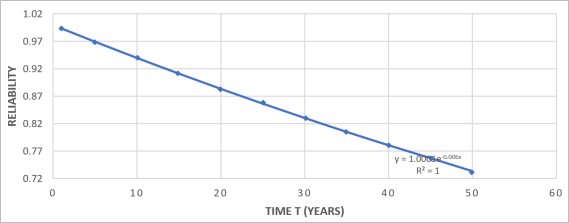
At 50 years, , indicating 73.36% reliability.
These findings demonstrate that the concrete modified with shredded plastic maintains high reliability with values above 90% during its early service life (up to 15 years). The reliability steadily declines to about 80% after 35 years and 73% after 50 years, indicating that this material is appropriate for applications requiring moderate service life (30–35 years) and little upkeep.
The impact of shredded plastics, which marginally decrease compressive strength because of their decreased stiffness, weaker cement–plastic interface bond, and increased matrix porosity, is reflected in the moderate failure rate (λ ≈ 0.00619 annually). However, by conserving natural aggregates, lowering concrete density, and decreasing plastic waste, such concrete helps promote sustainability.
However, complex deterioration mechanisms like fatigue loading, sulphate attack, freeze-thaw, and chloride ingress are not taken into account by the CFR model used here, which assumes a constant failure rate. Degradation may exhibit a non-constant pattern in practice. Therefore, advanced probabilistic models like Weibull or log-normal distributions and field-based validation are advised for future research in order to produce more realistic predictions.
Figure 1. Reliability graph.
5. Conclusions
1) This study uses the constant failure rate (CFR) model to evaluate concrete modified with shredded plastic aggregates based on reliability. The primary findings are:
2) When shredded plastic aggregate is used at low replacement levels (0.5–5% by volume), concrete with a respectable compressive strength development at 7, 14, 21, and 28 days can be produced, allowing for the determination of failure rate λ and strength rates.
3) According to the calculated failure rate (λ ≈ 0.00619 annually), the reliability is expected to be ~99.4% at 1 year, ~94% at 10 years, and ~73.4% at 50 years, indicating good early performance and moderate long-term reliability.
4) Although the CFR model is practical and provides first-approximation reliability predictions, its simplified exposure conditions and assumption of a constant failure rate should be used with caution.
5) Unless additional durability measures are included, shredded plastic modified concrete is better suited for non-critical structural elements (such as pavements, partitions, and low-traffic slabs) with moderate service-life requirements (such as ≤ 35 years).
6. Recommendation
To fully validate long-term performance, future work should incorporate life-cycle cost analysis, variable failure-rate reliability models, multi-mechanism deterioration modeling (e.g., thermal cycling, chloride ingress), and accelerated aging tests.
Abbreviations
CFR | Constant Failure Rate |
OPC | Ordinary Portland Cement |
HDPE | High-density Polyethylene |
Author Contributions
Ibrahim Abdulrazaq: Supervision
Giwa Momodu Jabir: Data curation, Methodology
John Wasiu: Validation
Conflicts of Interest
The authors declare no conflicts of interest.
References
| [1] |
Albano, C., Camacho, N., Hernández, M., Matheus, A., & Gutiérrez, A. (2009). Influence of content and particle size of waste PET bottles on concrete behavior at different w/c ratios. Waste Management, 29(10), 2707–2716.
|
| [2] |
Adewuyi, A. P., & Adegoke, T. (2018). Reliability-based design of reinforced concrete structures under durability limit states. Journal of Building Engineering, 15, 216–225.
|
| [3] |
Al-Salloum, Y. A., Siddiqui, N. A., Elsanadedy, H. M., Abadel, A. A., & Aqel, M. A. (2016). Mechanical properties of concrete containing recycled plastic aggregates. Construction and Building Materials, 114, 701–710.
|
| [4] |
Andrew, R. M. (2018). Global CO2 emissions from cement production, 1928–2017. Earth System Science Data, 10(1), 2213–2239.
|
| [5] |
Choi, Y. W., Moon, D. J., Chung, J. S., & Cho, S. K. (2005). Effects of waste PET bottles aggregate on the properties of concrete. Cement and Concrete Research, 35(4), 776–781.
|
| [6] |
Frangopol, D. M., & Liu, M. (2007). Maintenance and management of civil infrastructure based on condition, safety, optimization, and life-cycle cost. Structure and Infrastructure Engineering, 3(1), 29–41.
|
| [7] |
Gámez-García, D. C., García-González, J. M., & Rivera-Gómez, C. (2025). Sustainable use of thermoplastic and PET wastes as recycled plastic aggregates in concrete. Sustainability, 17(2), 1–16.
|
| [8] |
Gu, L., & Ozbakkaloglu, T. (2016). Use of recycled plastics in concrete: A critical review. Waste Management, 51, 19–42.
|
| [9] |
Guo, P., Cheng, X., Lin, J., & Pan, W. (2023). Effects of recycled plastic aggregates on the mechanical and durability properties of concrete: A comprehensive review. Construction and Building Materials, 363, 129908.
|
| [10] |
Gunat, S., Yilmaz, M., & Pappu, A. (2025). Conversion of shredded and crushed plastic waste into durable normal-weight concrete. Journal of Materials in Civil Engineering, 37(3), 04025022.
|
| [11] |
Hannawi, K., Kamali-Bernard, S., & Prince, W. (2010). Physical and mechanical properties of mortars containing PET and PC waste aggregates. Waste Management, 30(11), 2312–2320.
|
| [12] |
Ibrahim, M., Atoyebi, O. D., & Adeleke, J. T. (2021). Reliability assessment of rubberized concrete under varying environmental conditions. Case Studies in Construction Materials, 15, e00723.
|
| [13] |
Islam, M. T., Hossain, M. Z., & Al-Mamun, M. (2023). Static and impact behavior of concrete containing polypropylene plastic aggregates. Construction and Building Materials, 387, 131572.
|
| [14] |
Jain, A., Meena, S. R., & Saini, B. (2021). Influence of recycled plastic waste as partial replacement of fine aggregate in concrete mix: A review. Materials Today: Proceedings, 47, 4662–4667.
|
| [15] |
Mehta, P. K., & Monteiro, P. J. M. (2014). Concrete: Microstructure, Properties, and Materials (4th ed.). McGraw-Hill Education.
|
| [16] |
Melchers, R. E., & Beck, A. T. (2018). Structural Reliability Analysis and Prediction (3rd ed.). Wiley.
|
| [17] |
Mohamedsalih, F., Abbas, M., & Omer, S. (2024). Sustainable concrete incorporating recycled waste plastics: Mechanical and durability performance. Journal of Cleaner Production, 425, 139715.
|
| [18] |
Nowak, A. S., & Collins, K. R. (2012). Reliability of Structures (2nd ed.). CRC Press.
|
| [19] |
Saikia, N., & de Brito, J. (2014). Mechanical properties and abrasion behaviour of concrete containing shredded PET bottle waste as a partial substitution of natural aggregate. Construction and Building Materials, 52, 236–244.
|
| [20] |
Siddique, R., Khatib, J., & Kaur, I. (2008). Use of recycled plastic in concrete: A review. Waste Management, 28(10), 1835–1852.
|
| [21] |
Shukur, M. M., Mustafa, M., & Razzak, M. (2023). Experimental study on the performance of recycled plastic aggregate concrete under mechanical and durability tests. Journal of Building Engineering, 71, 106543.
|
| [22] |
Záleská, M., Pavlíková, M., Jankovský, O., Pavlík, Z., & Černý, R. (2019). Sustainable use of recycled plastics in lightweight concrete composites. Sustainability, 11(23), 6555.
|
Cite This Article
-
APA Style
Abdulrazaq, I., Jabir, G. M., Wasiu, J. (2026). Reliability-based Evaluation of Shredded Plastic Modified Concrete Using the Constant Failure Rate (CFR) Model. American Journal of Construction and Building Materials, 10(1), 40-46. https://doi.org/10.11648/j.ajcbm.20261001.14
 Copy
|
Copy
|
 Download
ACS Style
Abdulrazaq, I.; Jabir, G. M.; Wasiu, J. Reliability-based Evaluation of Shredded Plastic Modified Concrete Using the Constant Failure Rate (CFR) Model. Am. J. Constr. Build. Mater. 2026, 10(1), 40-46. doi: 10.11648/j.ajcbm.20261001.14
Copy
|
Download
AMA Style
Abdulrazaq I, Jabir GM, Wasiu J. Reliability-based Evaluation of Shredded Plastic Modified Concrete Using the Constant Failure Rate (CFR) Model. Am J Constr Build Mater. 2026;10(1):40-46. doi: 10.11648/j.ajcbm.20261001.14
Copy
|
Download
-
@article{10.11648/j.ajcbm.20261001.14,
  author = {Ibrahim Abdulrazaq and Giwa Momodu Jabir and John Wasiu},
  title = {Reliability-based Evaluation of Shredded Plastic Modified Concrete Using the Constant Failure Rate (CFR) Model},
  journal = {American Journal of Construction and Building Materials},
  volume = {10},
  number = {1},
  pages = {40-46},
  doi = {10.11648/j.ajcbm.20261001.14},
  url = {https://doi.org/10.11648/j.ajcbm.20261001.14},
  eprint = {https://article.sciencepublishinggroup.com/pdf/10.11648.j.ajcbm.20261001.14},
  abstract = {Although concrete is necessary for the world's infrastructure, its production has a substantial negative impact on the environment. The production of cement is responsible for about 8% of global CO2 emissions, and the extraction of natural aggregate depletes limited resources. In order to minimize landfill waste and preserve natural aggregates while preserving structural integrity, this study investigates the use of shredded plastic aggregates (SPA) from post-consumer waste (such as PET and HDPE) in concrete as a sustainable substitute. Concrete mixtures with 0.5–5% SPA replacement underwent compressive strength tests at 7, 14, 21, and 28 days of curing, in accordance with ASTM C39/C39M. Long-term reliability was evaluated using the Constant Failure Rate (CFR) model was obtained from strength development rates. The findings show that over the course of 28 days, plastic-modified concrete produced compressive strengths ranging from 21.858 to 24.156 N/mm2, with an average strength rate of 0.6905 and an annual failure rate of 0.00619 per year. For 15 years, reliability was above 90%; at 50 years, it dropped to 73.36%, indicating that it is appropriate for applications with a moderate service life (30–35 years). SPA concrete provides improved ductility and sustainability advantages despite having a lower compressive strength because of a weaker interfacial bond. Future studies into more sophisticated probabilistic models (such as Weibull and log-normal) and field validation are necessary because the CFR model's constant failure rate assumption makes it difficult to capture intricate degradation mechanisms. By promoting the use of waste plastics in construction, this study develops sustainable concrete technologies.},
 year = {2026}
}
Copy
|
Download
-
TY  - JOUR
T1  - Reliability-based Evaluation of Shredded Plastic Modified Concrete Using the Constant Failure Rate (CFR) Model
AU  - Ibrahim Abdulrazaq
AU  - Giwa Momodu Jabir
AU  - John Wasiu
Y1  - 2026/06/23
PY  - 2026
N1  - https://doi.org/10.11648/j.ajcbm.20261001.14
DO  - 10.11648/j.ajcbm.20261001.14
T2  - American Journal of Construction and Building Materials
JF  - American Journal of Construction and Building Materials
JO  - American Journal of Construction and Building Materials
SP  - 40
EP  - 46
PB  - Science Publishing Group
SN  - 2640-0057
UR  - https://doi.org/10.11648/j.ajcbm.20261001.14
AB  - Although concrete is necessary for the world's infrastructure, its production has a substantial negative impact on the environment. The production of cement is responsible for about 8% of global CO2 emissions, and the extraction of natural aggregate depletes limited resources. In order to minimize landfill waste and preserve natural aggregates while preserving structural integrity, this study investigates the use of shredded plastic aggregates (SPA) from post-consumer waste (such as PET and HDPE) in concrete as a sustainable substitute. Concrete mixtures with 0.5–5% SPA replacement underwent compressive strength tests at 7, 14, 21, and 28 days of curing, in accordance with ASTM C39/C39M. Long-term reliability was evaluated using the Constant Failure Rate (CFR) model was obtained from strength development rates. The findings show that over the course of 28 days, plastic-modified concrete produced compressive strengths ranging from 21.858 to 24.156 N/mm2, with an average strength rate of 0.6905 and an annual failure rate of 0.00619 per year. For 15 years, reliability was above 90%; at 50 years, it dropped to 73.36%, indicating that it is appropriate for applications with a moderate service life (30–35 years). SPA concrete provides improved ductility and sustainability advantages despite having a lower compressive strength because of a weaker interfacial bond. Future studies into more sophisticated probabilistic models (such as Weibull and log-normal) and field validation are necessary because the CFR model's constant failure rate assumption makes it difficult to capture intricate degradation mechanisms. By promoting the use of waste plastics in construction, this study develops sustainable concrete technologies.
VL  - 10
IS  - 1
ER  -
Copy
|
Download





 Share This Article
 Twitter
 Linked In
 Facebook