Abstract
Maize (Zea mays L.) is one of the worldwide food crops and plays a fundamental role due to its importance in terms of food, economics, and industry. However, its yields in farmers’ fields in Burkina Faso are low. This is due to production of this crop has low national yields, mainly due to climate variability, and low soil fertility. It is therefore essential to create new high-yielding maize varieties that are stable and adapted to the country’s agro-climatic conditions. This study aimed to contribute to improving maize production by identifying new high-performing and stable hybrids. The plant material, consisting of 36 single-cross white hybrids derived from a half-diallel cross of nine lines were evaluated using a three-replicate alpha-lattice experimental design. Grain yield and its components were recorded during evaluation. The results showed significant difference (p < 0.05) between the hybrids studied, environments and study years, as well as their interaction for most of the traits evaluated. T02058 x ELN41-1-1-4, PI601574 x T02058, and VL05616 x ELN41-1-1-4 were identified as high-performing hybrids and stable hybrids across environments. Four hybrids including, PI601574 x T02058, VL05616 x ELN41-1-1-4, PI601574 x ELN41-1-1-4, and PI601500 x T02058, recorded greater yield than the check Bondofa. Their yield advantage compared to Bondofa was at least 30%.
|
Published in
|
American Journal of BioScience (Volume 14, Issue 2)
|
|
DOI
|
10.11648/j.ajbio.20261402.11
|
|
Page(s)
|
20-28 |
|
Creative Commons
|

This is an Open Access article, distributed under the terms of the Creative Commons Attribution 4.0 International License (http://creativecommons.org/licenses/by/4.0/), which permits unrestricted use, distribution and reproduction in any medium or format, provided the original work is properly cited.
|
|
Copyright
|
Copyright © The Author(s), 2026. Published by Science Publishing Group
|
Keywords
Maize, Burkina Faso, Hybrids, Performance, Stability
1. Introduction
Maize is a worldwide cereal crops. It contributes to global food security
| [1] | FAO. (2016). FAO Cereal Supply and Demand Bulletin. 3p. |
[1]
. It is the staple food in most African countries, and food security in the region depends mainly on its availability
| [2] | Ba M. L., Houkpevi J. A., Souare M. L., Agate M., Balde M. S. S., Bah I., Tchacondo T. (2024). Evaluation of hybrid yellow maize (Zea mays L.) varieties grown in the Maritime Region of Togo. Afrique Science, 24(5) 48-60. |
[2]
. In Burkina Faso, the agricultural sector is a key pillar of the economy and contributes to food security. Maize is the most widely produced cereal and is used in various forms in Burkina Faso
| [3] | DGESS/MARAH. (2024). Permanent Agricultural Survey Final results of the 2023-2024 agricultural season, Burkina Faso. 50 pp. |
[3]
. At the national level, it contributes significantly to human and animal nutrition (poultry, cattle, etc.) and serves as a raw material in several industries (brewing, oil production, etc.). In addition to its nutritional qualities (rich in starch, protein, etc.), it is simple to produce and don’t require a lot of efforts at the harvesting. It is also the most energy-dense cereal
| [4] | Charcosset A., Gallais A. (2009). The emergence and development of the concept of hybrid maize varieties. The French Breeder, (60) 21-30p. |
[4]
. While, maize is the first ranked produced cereal in Burkina Faso, maize production at the national level remains low compared to user’s demand. To meet this demand, it is therefore imperative to develop maize genotypes that are stable with high-yield. These hybrids should have a high potential production compared to existing commercial hybrids. This study was design to assess the agronomic performance of thirty-six white maize hybrids resulting from the combination of nine temperate and tropical lines from INERA's germplasm. The goal of this study was to contribute to enhancing maize production in Burkina Faso. More specifically, it aimed to (i) determine the genetic variability within the hybrids evaluated, (ii) identify the best hybrids for each study environment, and (iii) select high-performing and stable hybrids in the population across all environments.
2. Materials and Methods
2.1. Experimental Sites
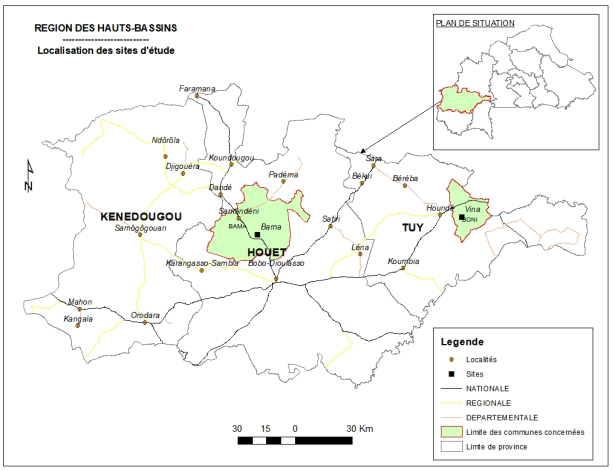
The current study was conducted in two sites in 2022 and 2023. Thus, the environment is considered to be the combination of the site (Hounde or Kou Valley plain) and evaluation period (rainy or dry seasons) in each year. The first site, located 130 km from Bobo-Dioulasso, is the village of Vina (Hounde / Tuy province), situated at 11° 34' north latitude and 3° 24' west longitude, at an altitude from 300 to 400 meters. In this site, the trials were conducted during the main season, under natural rainfall conditions, without additional irrigation. The second environment, located 25 km from Bobo-Dioulasso, is the Kou Valley plain. This area is located at 10° 20' north latitude and 4° 20' west longitude, 450 meters above sea level
| [5] | Guinko S. (1984). Contribution to the study of vegetation and flora in Upper Volta. Doctoral thesis in Natural Sciences. University of Bordeaux III. 318 p. |
[5]
. The hybrids were evaluated under optimal conditions in this site during rainy season. Then, they benefited from rainfall as well as supplemental irrigation in cas of drought’s pocket. The cumulative rainfall recorded during these two years was over 1,000 mm. Additionnaly, the third environment was conducted in the same plain (Kou Valley), but during the cold dry season. Water was supplied to the plants by gravity irrigation three times per week. The average temperature during this period varied from 23°C to 34°C
| [6] | METEO INERA. (2022-2023). Record of precipitation and temperatures during the 2021/2022 and 2022-2023 seasons. Weather stations in Houndé and the Kou Valley. |
[6]
.
Figure 1. Geographic location of study environments.
2.2. Plant Material
2.2.1. Material Tested
In this study, thirty-six single-cross white hybrids generated from half-diallel design were used. Nine temperate and tropical lines from INERA (Institute for the Environment and Agricultural Research) (
Table 1) were involved in the crosses. Among these lines, five (PI601361, PI601563, PI601362, PI601500, and PI601574) were from the North Central Regional Plant Introduction Station (NCRPIS), three (T02058, VL05616, and VL0511298) originated from CIMMYT, and one (ELN41-1-1-4) from INERA.
Table 1. Newest developed hybrids evaluated.
N° | Genotype | Hybrids | N° | Genotype | Hybrids |
1 | H1 | PI601361 x PI601563 | 19 | H19 | VL05616 x VL0511298 |
2 | H2 | PI601361 x VL05616 | 20 | H20 | VL05616 x T02058 |
3 | H3 | PI601361 x PI601362 | 21 | H21 | VL05616 x ELN41-1-1-4 |
4 | H4 | PI601361 x PI601500 | 22 | H22 | PI601362 x PI601500 |
5 | H5 | PI601361 x PI601574 | 23 | H23 | PI601362 x PI601574 |
6 | H6 | PI601361 x VL0511298 | 24 | H24 | PI601362 x VL0511298 |
7 | H7 | PI601361 x T02058 | 25 | H25 | PI601362 x T02058 |
8 | H8 | PI601361 x ELN41-1-1-4 | 26 | H26 | PI601362 x ELN41-1-1-4 |
9 | H9 | PI601563 x VL05616 | 27 | H27 | PI601500 x PI601574 |
10 | H10 | PI601563 x PI601362 | 28 | H28 | PI601500 x VL0511298 |
11 | H11 | PI601563 x PI601500 | 29 | H29 | PI601500 x T02058 |
12 | H12 | PI601563 x PI601574 | 30 | H30 | PI601500 x ELN41-1-1-4 |
13 | H13 | PI601563 x VL0511298 | 31 | H31 | PI601574 x VL0511298 |
14 | H14 | PI601563 x T02058 | 32 | H32 | PI601574 x T02058 |
15 | H15 | PI601563 x ELN41-1-1-4 | 33 | H33 | PI601574 x ELN41-1-1-4 |
16 | H16 | VL05616 x PI601362 | 34 | H34 | VL0511298 x T02058 |
17 | H17 | VL05616 x PI601500 | 35 | H35 | VL0511298 x ELN41-1-1-4 |
18 | H18 | VL05616 x PI601574 | 36 | H36 | T02058 x ELN41-1-1-4 |
legend: H = hybrid
2.2.2. Reference Material
The reference material consisted of nine varieties (
Table 2). Five of these are hybrids, namely AGRA 2, AGRA 6, Kabako, Bondofa, and Komsaya. The other four varieties, Barka, Espoir, KEB, and Wari, are composites. These commercial varieties have well-defined characteristics.
Table 2. List of reference material.
N° | Genotype | Varieties | Type of varieties |
1 | C1 | AGRA 2 | Hybrid |
2 | C2 | AGRA 6 | Hybrid |
3 | C3 | Kabako | Hybrid |
4 | C4 | Barka | Composite |
5 | C5 | Bondofa | Hybrid |
6 | C6 | Espoir | Composite |
7 | C7 | KEB | Composite |
8 | C8 | Komsaya | Hybrid |
9 | C9 | Wari | Composite |
Legend: C = control
2.3. Methods
2.3.1. Experimental Design
The experimental design used for the hybrids alongside with the nine checks evaluation was 9*5 alpha lattice design. The plot size was a single 5 m row for each genotype. The distance between rows was 0.80 m while inside row 0.40 m. At planting, three seeds were sowed per hole to thin at two seeds 14 days two weeks after sowing.
2.3.2. Trial Management
For land management, we carried out plowing and leveling. Weeding, ridging, fertilization, and treatments were the main maintenance operations during the evaluation. Five tons of compost per hectare were applied the day of planting in each trial. Maintenance fertilization (NPK 14-23-14) of 300 kg/ha combined with weeding was carried out on 14th day after planting (DAP). Top dressing (urea 46) was applied in two fractions. The first fraction was combined with a second weeding, at a rate of 100 kg/ha, on the 30th day after sowing (DAS), followed by ridging. The second fraction was applied at a rate of 50 kg/ha on the 45th day after sowing (DAS). For treatments, the total herbicide “Glyphosate 360 g/L” was combined with the pre-emergence herbicide “Atrazine 500 g/L” for weeds management. To control attacks by armyworms and locusts, an insecticide based on emamectin benzoate (50 g/kg) was used to minimize damage as soon as the first symptoms appeared.
2.3.3. Data Collection
Grain yield (GY), ear diameter (ED), ear length (EL), number of rows (NR), number of grains per row (NGR) were collected according to the method described by Tiama
et al.
| [7] | Tiama S., Dao A., Coulibaly T. S., Sanou J. and Sawadogo M. (2025). Analysis of the combining ability of temperate and tropical maize (Zea mays L.) lines in Burkina Faso. World Journal of Advanced Research and Reviews, 28(01), 215-226.
https://doi.org/10.30574/wjarr.2025.28.1.3401 |
[7]
.
2.3.4. Data Analysis
Microsoft Excel version 2016 was used for data typing, organizing and processing. Plots with a plant density at harvest (PD) less than 30% were considered as missing data.
After data processing and normalization, an analysis of variance was performed using R. 4.2.1 software to examine the variability among genotypes and between environments. For the ANOVA, each site combined with period of evaluation was taken as an environment. Then, six environments were considered. The combined means of each trait were used to compute Pearson correlation test between the studied variables and grain yield.
The same software was used to perform a GGE biplot analysis to determine the adapted environment for each hybrid and to conduct an analysis of grain yield stability to select the most productive and stable hybrids. Standard heterosis (HS) was also determined to identify the best-performing hybrids relative to the commercial control hybrid (Bondofa), according to the formula defined by
| [8] | Shull G. H. (1948). What is "heterosis"? Genetics 33, 439. |
[8]
:
3. Results
3.1. Description of the Genetic Variability of the Evaluated Hybrids
The results of the analysis of variance across all environments are shown in
Table 3. All traits allow for a highly significant distinction between genotypes and environments (P < 0.001), with the exception of the number of rows (NR), which is only significant for environments (P < 0.05). With the exception of the number of grains per row (NGR), a highly significant difference (P < 0.001) was observed between years for the other traits. However, three variables, namely average ear diameter (ED), number of rows (NR), and grain yield (GY), were highly significant (P < 0.001) for the “genotype-environment” interaction. In addition, the “environment-year” interaction was highly significant (P < 0.001) for most traits (ED, EL, NGR, NR). No significant differences were observed for the “genotype-year” interaction at the 5% threshold for all traits. Finally, only the average ear diameter (ED) showed a significant difference (P < 0.05) for the interaction of the three factors “genotype-environment-year,” while the other variables showed no significant differences (P > 0.05).
Table 3. Results of the analysis of variance of grain yield and its components.
Source | DF | ED | EL | NGR | NR | GY |
Geno | 44 | 7,93*** | 3,06*** | 2,83*** | 39,96*** | 3,39*** |
Env | 2 | 31,95*** | 62,50*** | 61,46*** | 6,95* | 16,61** |
Year | 1 | 334,66*** | 59,94*** | 0,01 | 122,64*** | 20,75*** |
Geno*Env | 88 | 2,35*** | 1,06 | 1,29 | 1,99*** | 2,17*** |
Env*Year | 2 | 232,61*** | 81,89*** | 46,44*** | 50,92*** | 0,48 |
Geno*Year | 44 | 1,24 | 0,94 | 1,20 | 1,30 | 1,15 |
Geno*Env*Year | 88 | 1,40* | 0,85 | 1,13 | 1,23 | 1,29 |
Legend: DF = degree of freedom, GY = grain yield, ED = ear diameter, EL = ear length, NGR = number of grains per row, NR = number of rows, Env = environment and *, **, *** = Significant at 0.05, 0.01 and 0.001 probability levels, respectively
3.2. Phenotypic Correlation Between Traits Measured in Study Environments
The relationships between the measured variables using the pool data of the different environments are shown in
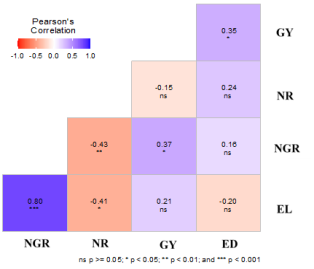
Figure 2. Moderate to strong correlation was present between the studied variables at the 5% threshold. A moderate positive and significant correlation was observed between grain yield and average ear diameter (r = 0.35), and number of kernels per row (r = 0.37). In addition, ear length (EL) was positively and strongly correlated (r = 0.80) with the number of kernels per row (NGR). Moderate and negative correlation was recorded between the number of kernels per row and the number of rows (r=-0.43) as well with between ear length (r = -0.41).
Figure 2. Correlation between grain yield trait and its components.
Legend: GY = grain yield, ED = ear diameter, EL = ear length, NGR = number of grains per row and NR = number of rows
3.3. Identification of Hybrids Adapted to Specific Environment Based on the Which-won-were
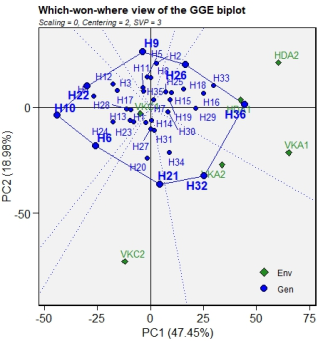
The significant difference observed between the studied environments justified the stability analysis of grain yield and the identification of specific environment for each hybrid. The first two principal components explained 66% of the variability in grain yield of the single-cross hybrids. In the polygon view of the which-won-where, the vertex hybrids were considered as the highest yielding hybrids in the environments that were within the sector. The biplot origin represented the average performance of all the hybrids. The genotypes closed to the origin represented the most stable while those which are further from the origin are most specific to an environment. There were eight vectors with hybrids H32 (PI601574 x T02058), H21 (VL05616 x ELN41-1-1-4), H36 (T02058 x ELN41-1-1-4), H9 (PI601563 x VL05616), H10 (PI601563 x PI601362), H22 (PI601362 x PI601500), H6 (PI601361 x VL0511298) and H26 (PI601362 x ELN41-1-1-4) as vertex hybrids. The hybrid H32 (PI601574 x T02058) is the best in the environment VKA2, H21 (VL05616 x ELN41-1-1-4) in VKC2. The hybrid H36 (T02058 x ELN41-1-1-4) is located in the same vector with the environments VKA1, HDA1, HDA2 indicating that it is the best in those environments but it performed better in HDA1. H26 (PI601362 x ELN41-1-1-4) was performing well also in VKA1, HDA1, HDA2. Hybrids H22 (PI601362 x PI601500), H10 (PI601563 x PI601362) and H6 (PI601361 x VL0511298) were the best in VKC1. While H9 (PI601563 x VL05616) was among the vertex hybrids, but it did not stand for any environment. H7 (PI601361 x T02058) is the most stable hybrid.
Figure 3. Selection of the best hybrids by environment.
Legend: H = hybrid, HDA = Hounde in rainy season, VKA = Kou Valley in rainy season and VKC = Kou Valley in dry season
3.4. Analysis of Grain Yield Stability of the Single-cross Hybrids Tested Across All Environments
The stability of white maize hybrid performance was determined based on the “average vs. stability” graph across all study environments (
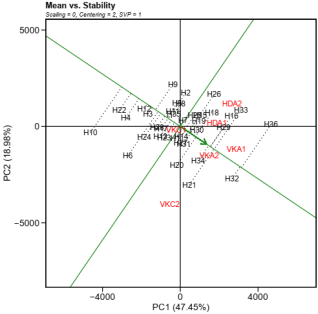
Figure 4). The first two principal components explain 66% of the variability in grain yield of single-cross white hybrids. In the figure, the vertical green line passing through the origin of the GGE biplot corresponds to the mean coordinate that separates the hybrids according to their yield. The further a hybrid from this line in the direction of the arrow, the better its yield, and vice versa. The horizontal green line with the arrow showed the stability of the hybrids. Thus, the shorter the projection of a hybrid on this line, the more stable the hybrid, and vice versa.
Based on these two criteria, the most outstanding hybrids were T02058 x ELN41-1-1-4 (H36), PI601574 x T02058 (H32), VL05616 x ELN41-1-1-4 (H21) and PI601574 x ELN41-1-1-4 (H33) and H29. The least productive hybrids were in ascending order, PI601563 x PI601362 (H10), PI601362 x PI601500 (H22), PI601361 x PI601500 (H4), PI601563 x PI601574 (H12) and PI601361 x PI601362 (H3) and H9. The most stable hybrids in all environments during the study were PI601361 x T02058 (H7), PI601563 x T02058 (H14), PI601563 x PI601574 (H12), PI601361 x PI601362 (H3), PI601500 x ELN41-1-1-4 (H30), PI601563 x T02058 (H14), and PI601574 x T02058 (H32). The hybrids PI601563 x PI601362 (H10) and T02058 x ELN41-1-1-4 (H36) were the least stable. Consequently, the PI601574 x T02058 (H32) hybrid was the only one to combine high yield with high stability in all environments. However, the T02058 x ELN41-1-1-4 (H36) hybrid was high performing but not stable.
Figure 4. Average performance and stability of simple white maize hybrids.
Legend: H = hybrid, HDA = Hounde in rainy season, VKA = Kou Valley in rainy season and VKC = Kou Valley in dry season
3.5. Identification of the Best Hybrids Compared to Controls
The standard heterosis results are shown in
Table 4. Average grain yields for the hybrids ranged from 4205.59 kg/ha for PI601362 x PI601500 (H22) to 6515.70 kg/ha for PI601574 x T02058 (H32). The control variety Bondofa recorded an average yield of 4701.86 kg/ha. Six hybrids had heterosis advantage of at least 25% compared to Bondofa. Four of these, "PI601574 x T02058 (H32), VL05616 x ELN41-1-1-4 (H21), PI601574 x ELN41-1-1-4 (H33), and PI601500 x T02058 (H29)", recorded yield advantage of at least 30% compared to the control Bondofa, with respective percentages of 38.58%, 33.30%, 31.78% and 29.98%. The other two hybrids, showed yield advantage of 26.03% and 24.85%, respectively for PI601361 x PI601563 (H1) and T02058 x ELN41-1-1-4 (H36). However, the combinations PI601361 x PI601500 (-1.31%), PI601563 x PI601362 (-6.18%), and PI601362 x PI601500 (-10.55%) showed negative heterosis effects compared to the Bondofa control.
Table 4. Results of standard heterosis in grain yield of hybrids compared to commercial control Bondofa.
HYBRIDS | GENO | GY (kg/ha) | HS (%) | HYBRIDS | GENO | GY (kg/ha) | HS (%) |
Bondofa | C5 | 4701,86 | 0,00 | Bondofa | C5 | 4701,86 | 0,00 |
PI601574 x T02058 | H32 | 6515,70 | 38,58 | PI601500 x ELN41-1-1-4 | H30 | 5457,07 | 16,06 |
VL05616 x ELN41-1-1-4 | H21 | 6267,64 | 33,30 | VL05616 x PI601362 | H16 | 5447,40 | 15,86 |
PI601574 x ELN41-1-1-4 | H33 | 6196,12 | 31,78 | PI601362 x T02058 | H25 | 5396,25 | 14,77 |
PI601500 x T02058 | H29 | 6111,37 | 29,98 | PI601361 x VL05616 | H2 | 5373,03 | 14,27 |
PI601361 x PI601563 | H1 | 5925,55 | 26,03 | PI601563 x VL0511298 | H13 | 5354,38 | 13,88 |
T02058 x ELN41-1-1-4 | H36 | 5870,43 | 24,85 | PI601361 x PI601574 | H5 | 5298,70 | 12,69 |
VL05616 x PI601574 | H18 | 5837,40 | 24,15 | PI601362 x PI601574 | H23 | 5136,27 | 9,24 |
PI601574 x VL0511298 | H31 | 5827,44 | 23,94 | VL05616 x PI601500 | H17 | 5102,94 | 8,53 |
PI601563 x ELN41-1-1-4 | H15 | 5826,36 | 23,92 | PI601500 x VL0511298 | H28 | 5001,69 | 6,38 |
VL0511298 x T02058 | H34 | 5825,97 | 23,91 | PI601361 x ELN41-1-1-4 | H8 | 5001,41 | 6,37 |
VL05616 x VL0511298 | H19 | 5709,68 | 21,43 | PI601361 x PI601362 | H3 | 4984,57 | 6,01 |
PI601563 x T02058 | H14 | 5603,38 | 19,17 | PI601362 x VL0511298 | H24 | 4827,93 | 2,68 |
VL05616 x T02058 | H20 | 5594,72 | 18,99 | PI601563 x VL05616 | H9 | 4812,47 | 2,35 |
PI601563 x PI601500 | H11 | 5579,58 | 18,67 | PI601563 x PI601574 | H12 | 4789,81 | 1,87 |
PI601500 x PI601574 | H27 | 5571,65 | 18,50 | PI601361 x VL0511298 | H6 | 4760,21 | 1,24 |
PI601362 x ELN41-1-1-4 | H26 | 5558,51 | 18,22 | PI601361 x PI601500 | H4 | 4640,45 | -1,31 |
PI601361 x T02058 | H7 | 5505,64 | 17,09 | PI601563 x PI601362 | H10 | 4411,19 | -6,18 |
VL0511298 x ELN41-1-1-4 | H35 | 5467,52 | 16,28 | PI601362 x PI601500 | H22 | 4205,59 | -10,55 |
Legend: GENO = genotype, GY = grain yield, HS = standard heterosis, H = hybrid and C = control
4. Discussion
Genetic variability is an essential factor for improving desired traits in a species selection program. The significant mean values observed indicate high genetic variability among the genotypes for most of the measured variables. These results are interesting because they allow rapid genetic gain to be achieved through the selection and identification of desirable hybrids in each evaluation area, as pointed out by
| [9] | Bonkoungou T. O., Badu-Apraku B., Adetimirin V. O., Nanema K. R., Adejumobi I. I. (2024). Performance and Stability Analysis of Extra-Early Maturing Orange Maize Hybrids under Drought Stress and Well-Watered Conditions. Agronomy, 14, 847. https://doi.org/10.3390/agronomy14040847 |
[9]
. In addition, Gbaguidi
et al.
| [10] | Gbaguidi A. A., Dansi A., Dossou-Aminon I., Gbemavo D. S. J. C., Orobiyi A., Sanoussi F., Yedomonhan H. (2018). Agromorphological diversity of local Bambara groundnut (Vigna subterranea (L.) Verdc.) collected in Benin. Genet. Resour. Crop E. vol. 65, 1159-1171.
https://doi.org/10.1007/s10722-017-0603-4 |
[10]
stated that the genetic heterogeneity of lines and testers was a fundamental prerequisite for obtaining high performance variability in their progenies. Furthermore, the mean environmental squares were significant for all the observed traits. This shows that the study environments influenced the expression of genotype traits from one year to the next. In summary, hybrids perform differently in different study environments revealing the importance of selecting genotypes for each specific environment. This information is crucial for identifying the most performing and stable hybrids in different environments
| [11] | Akaogu I. C., Badu-Apraku B., Adetimirin V. O., Vroh-Bi I., Oyekunle M., Akinwale R. O. (2013). Genetic diversity assessment of extra-early maturing yellow maize inbreds and hybrid performance in Striga-infested and Striga-free environments. J. Agric. 151, 519. https://doi.org/10.1017/s0021859612000652 |
| [12] | Akinwale R. O, Badu-Apraku B., Fakorede M. A. B., Vroh-Bi I. (2014). Heterotic grouping of tropical early-maturing maize inbred lines based on combining ability in Striga-infested and Striga-free environments and the use of SSR markers for genotyping. Field Crop. Res. 156, 48-62.
https://doi.org/10.1016/j.fcr.2013.10.015 |
[11, 12]
. In addition, some authors have stated that significant interaction between genotype and environment allows the best hybrids to be identified and selected
| [13] | Badu-Apraku B., Abamu F. J., Menkir A., Fakorede M. A. B., Obeng-Antwi K. (2003). Genotype by environment interactions in the regional early variety trials in West and Central Africa. Maydica. 48, 93-104. |
[13]
. These results therefore show that evaluating a new variety in several environments is essential for its registration and adoption by users. Badu-Apraku
et al.
| [14] | Badu-Apraku B., Annor B., Oyekunle M., Akinwale R., Fakorede M., Talabi A., Akaogu I., Melaku G., Fasanmade Y. (2015). Grouping of early maturing quality protein maize inbreds based on SNP markers and combining ability under multiple environments. Field Crops Res. 183, 169-183.
https://doi.org/10.1016/j.fcr.2015.07.015 |
[14]
emphasized that proposing a new variety to users necessarily involves evaluating it in several environments. In other words, the process of selecting genotypes that perform well and are stable in one or more environments is crucial for species improvement
| [15] | Ahakpaz F., Abdi H., Neyestani E., Hesami A., Mohammadi B., Mahmoudi K. N., Abedi-Asl G., Noshabadi M. R. J., Ahakpaz F., Alipour H. (2021). Genotype-by-environment interaction analysis for grain yield of barley genotypes under dryland conditions and the role of monthly rainfall. Agric. Water Manag. 245, 106665.
https://doi.org/10.1016/j.agwat.2020.106665 |
| [16] | Al-Ashkar I., Sallam M., Al-Suhaibani N., Ibrahim A., Alsadon A., Al-Doss A. (2022). Multiple Stresses of Wheat in the Detection of Traits and Genotypes of High-Performance and Stability for a Complex Interplay of Environment and Genotypes. Agronomy, 12, 2252.
https://doi.org/10.3390/agronomy12102252 |
| [17] | Gupta V., Kumar M., Singh V., Chaudhary L., Yashveer S., Sheoran R., Dalal M. S., Nain A., Lamba K., Gangadharaiah N. (2022). Genotype by Environment Interaction Analysis for Grain Yield of Wheat (Triticum aestivum (L.) em. Thell) Genotypes. Agriculture, 12, 1002.
https://doi.org/10.3390/agriculture12071002 |
[15-17]
.
The correlation between grain yield (GY), ear diameter (ED), and number of grains per row (NGR) means that these traits play a crucial role in plant grain yield. Similar results were observed by
| [18] | Ifie B. E., Badu‐Apraku B., Gracen V., Danquah E. Y. (2015). Genetic Analysis of Grain Yield of IITA and CIMMYT Early‐Maturing Maize Inbreds under Striga ‐Infested and Low-Soil‐Nitrogen Environments. Crop Sci. 55, 610-623.
https://doi.org/10.2135/cropsci2014.07.0470 |
[18]
, who found that yield-related traits, particularly ear weight and number of ears harvested, contribute most to inter-hybrid variation. For N’Da
et al.
| [19] | N’Da H. A., Konate D., N’Cho A. L., Kouakou K. R., Fondio L., Abo K. (2024). Evaluation of the performance of yellow maize (Zea mays L.) hybrid varieties under growing conditions in Ivory Coast northern. Journal of Animal & Plant Sciences. ISSN 2071-7024; Vol .62(2): 11577 -11592. |
[19]
, a positive correlation between yield and its various components is a good indicator for selecting hybrids to be reconstituted and distributed to producers. Thus, a parental line with good general combining ability for these variables would increase the yield of a hybrid resulting from a cross with those parents.
In a plant breeding program, identifying high-performing and stable individuals within a given population is a fundamental criterion for breeders. The results of the analyses carried out made it possible to select the highest-performing hybrids in each study environment. The PI601574 x T02058 (H32) hybrid showed high grain yield and great stability across environments. This genotype, which had significant performance and stability, is considered the ideotype in all environments. It can be evaluated in other environments in the country and be subject to participatory selection with users in order to confirm its results and release it for users. Pour-Aboughadareh
et al.
| [20] | Pour-Aboughadareh A., Sanjani S., Nikkhah-Chamanabad H., Mehrvar M. R., Asadi A., Amini A. (2021). Identification of salt-tolerant barley genotypes using multiple-traits index and yield performance at the early growth and maturity stages. Bull. Natl. Res. Cent. 45, 117.
https://doi.org/10.1186/s42269-021-00576-0 |
[20]
thus emphasized the importance of combining several characteristics associated with high production in a new variety.
Standard heterosis estimated from the commercial hybrid Bondofa revealed some hybrids that recorded at least 20% yield than the control. Four of these, “PI601574 x T02058 (H32), VL05616 x ELN41-1-1-4 (H21), PI601574 x ELN41-1-1-4 (H33), and PI601500 x T02058 (H29)’’, recorded heterosis greater than or equal to 30% compared to the yield of the Bondofa control. These high-performing hybrids are therefore suitable for commercialization, as they recorded high yields under different evaluation conditions during both wet and dry seasons. They could be used to renew the old released variety that are not performing well again because of climate change conditions. In a previous study, at least one parent in each combination showed good general combining ability (GCA) for grain yield, as well as other traits relevant to breeding
| [21] | Tiama S. (2020). Evaluation of the combination of temperate and tropical Zea mays L. lines in Burkina Faso. Master's Thesis in Biosciences, speciality: Applied Biological Sciences, Joseph KI-ZERBO University, Ouagadougou (Burkina Faso). 63p. |
[21]
. These hybrids could involve in the generation of open-pollinated varieties, double hybrids, and three-way hybrids. Bordes
| [22] | Bordes J. (2006). The creation of doubled haploid maize lines via in-situ induced gynogenesis: the refinement of the method and its integration into breeding programmes. Doctoral Thesis in Plant Biology. Blaise Pascal University - Clermont-Ferrand II. French. 133 pp. |
[22]
reported that a double hybrid should be generated from two single hybrids originated from two complementary groups and displaying good specific combining ability effects for the given trait. These hybrids could prove very beneficial for improving and increasing maize production in Burkina Faso in the short and medium term.
5. Conclusion
This study highlights considerable variability among the genotypes evaluated. Furthermore, the influence of environments and years of evaluation results in highly significant differences for all the traits studied. In addition, several hybrids, such as PI601574 x T02058, T02058 x ELN41-1-1-4, PI601574 x ELN41-1-1-4, PI601500 x T02058, and VL05616 x ELN41-1-1-4, showed very interesting performance and stability in the different study environments. However, the PI601574 x T02058 hybrid is the only one to combine high yield with high stability in all environments, making it a hybrid ideotype sought after by breeders and producers. Finally, four hybrids (PI601574 x T02058, VL05616 x ELN41-1-1-4, PI601574 x ELN41-1-1-4, and PI601500 x T02058) showed a yield greater than or equal to 30% compared to the yield of the commercial control Bondofa. In summary, this study highlights the richness of the genetic material available, which makes it possible to develop new high-performance maize hybrids that are stable and well adapted to the agro-climatic conditions of Burkina Faso.
Abbreviations
ANOVA | Analysis of Variance |
ED | Ear Diameter |
EL | Ear Length |
GCA | General Combining Ability |
GENO | Genotype |
GY | Grain Yield |
INERA | Institute of Environment and Agricultural Research |
HDA | Hounde in Rainy Season |
HS | Standard Heterosis |
NGR | Number of Grains per Row |
NR | Number of Rows |
VKA | Kou Valley in Rainy Season |
VKC | Kou Valley in Dry Season |
Acknowledgments
The authors are grateful to the ‘‘Projet d’Appui à l’Enseignement Superieur (PAES)’’ for financial support. Our gratitude goes to the Institute for the Environment and Agricultural Research (INERA) in Farako-Bâ, in particular the Maize, Wheat and Emerging Plants Section of the Traditional Cereals Program, for the genetic material and the study sites.
Author Contributions
Tiama Siaka: Conceptualization, Data Curation, Formal Analysis, Funding acquisition, Investigation, Methodology, Writing – original draft, Writing – review & editing
Dao Abdalla: Conceptualization, Formal Analysis, Methodology, Project administration, Supervision, Validation, Visualization, Writing – review & editing
Siri Kady Yassine: Data curation, Writing – review & editing
Bonkoungou Tégawendé Odette: Formal Analysis, Visualization, Writing – review & editing
Traoré Lamine: Data curation
Sawadogo Mahamadou: Supervision, Validation, Visualization, Writing – review & editing
Conflicts of Interest
The authors declare that they do not have any conflict of interest.
References
| [1] |
FAO. (2016). FAO Cereal Supply and Demand Bulletin. 3p.
|
| [2] |
Ba M. L., Houkpevi J. A., Souare M. L., Agate M., Balde M. S. S., Bah I., Tchacondo T. (2024). Evaluation of hybrid yellow maize (Zea mays L.) varieties grown in the Maritime Region of Togo. Afrique Science, 24(5) 48-60.
|
| [3] |
DGESS/MARAH. (2024). Permanent Agricultural Survey Final results of the 2023-2024 agricultural season, Burkina Faso. 50 pp.
|
| [4] |
Charcosset A., Gallais A. (2009). The emergence and development of the concept of hybrid maize varieties. The French Breeder, (60) 21-30p.
|
| [5] |
Guinko S. (1984). Contribution to the study of vegetation and flora in Upper Volta. Doctoral thesis in Natural Sciences. University of Bordeaux III. 318 p.
|
| [6] |
METEO INERA. (2022-2023). Record of precipitation and temperatures during the 2021/2022 and 2022-2023 seasons. Weather stations in Houndé and the Kou Valley.
|
| [7] |
Tiama S., Dao A., Coulibaly T. S., Sanou J. and Sawadogo M. (2025). Analysis of the combining ability of temperate and tropical maize (Zea mays L.) lines in Burkina Faso. World Journal of Advanced Research and Reviews, 28(01), 215-226.
https://doi.org/10.30574/wjarr.2025.28.1.3401
|
| [8] |
Shull G. H. (1948). What is "heterosis"? Genetics 33, 439.
|
| [9] |
Bonkoungou T. O., Badu-Apraku B., Adetimirin V. O., Nanema K. R., Adejumobi I. I. (2024). Performance and Stability Analysis of Extra-Early Maturing Orange Maize Hybrids under Drought Stress and Well-Watered Conditions. Agronomy, 14, 847.
https://doi.org/10.3390/agronomy14040847
|
| [10] |
Gbaguidi A. A., Dansi A., Dossou-Aminon I., Gbemavo D. S. J. C., Orobiyi A., Sanoussi F., Yedomonhan H. (2018). Agromorphological diversity of local Bambara groundnut (Vigna subterranea (L.) Verdc.) collected in Benin. Genet. Resour. Crop E. vol. 65, 1159-1171.
https://doi.org/10.1007/s10722-017-0603-4
|
| [11] |
Akaogu I. C., Badu-Apraku B., Adetimirin V. O., Vroh-Bi I., Oyekunle M., Akinwale R. O. (2013). Genetic diversity assessment of extra-early maturing yellow maize inbreds and hybrid performance in Striga-infested and Striga-free environments. J. Agric. 151, 519.
https://doi.org/10.1017/s0021859612000652
|
| [12] |
Akinwale R. O, Badu-Apraku B., Fakorede M. A. B., Vroh-Bi I. (2014). Heterotic grouping of tropical early-maturing maize inbred lines based on combining ability in Striga-infested and Striga-free environments and the use of SSR markers for genotyping. Field Crop. Res. 156, 48-62.
https://doi.org/10.1016/j.fcr.2013.10.015
|
| [13] |
Badu-Apraku B., Abamu F. J., Menkir A., Fakorede M. A. B., Obeng-Antwi K. (2003). Genotype by environment interactions in the regional early variety trials in West and Central Africa. Maydica. 48, 93-104.
|
| [14] |
Badu-Apraku B., Annor B., Oyekunle M., Akinwale R., Fakorede M., Talabi A., Akaogu I., Melaku G., Fasanmade Y. (2015). Grouping of early maturing quality protein maize inbreds based on SNP markers and combining ability under multiple environments. Field Crops Res. 183, 169-183.
https://doi.org/10.1016/j.fcr.2015.07.015
|
| [15] |
Ahakpaz F., Abdi H., Neyestani E., Hesami A., Mohammadi B., Mahmoudi K. N., Abedi-Asl G., Noshabadi M. R. J., Ahakpaz F., Alipour H. (2021). Genotype-by-environment interaction analysis for grain yield of barley genotypes under dryland conditions and the role of monthly rainfall. Agric. Water Manag. 245, 106665.
https://doi.org/10.1016/j.agwat.2020.106665
|
| [16] |
Al-Ashkar I., Sallam M., Al-Suhaibani N., Ibrahim A., Alsadon A., Al-Doss A. (2022). Multiple Stresses of Wheat in the Detection of Traits and Genotypes of High-Performance and Stability for a Complex Interplay of Environment and Genotypes. Agronomy, 12, 2252.
https://doi.org/10.3390/agronomy12102252
|
| [17] |
Gupta V., Kumar M., Singh V., Chaudhary L., Yashveer S., Sheoran R., Dalal M. S., Nain A., Lamba K., Gangadharaiah N. (2022). Genotype by Environment Interaction Analysis for Grain Yield of Wheat (Triticum aestivum (L.) em. Thell) Genotypes. Agriculture, 12, 1002.
https://doi.org/10.3390/agriculture12071002
|
| [18] |
Ifie B. E., Badu‐Apraku B., Gracen V., Danquah E. Y. (2015). Genetic Analysis of Grain Yield of IITA and CIMMYT Early‐Maturing Maize Inbreds under Striga ‐Infested and Low-Soil‐Nitrogen Environments. Crop Sci. 55, 610-623.
https://doi.org/10.2135/cropsci2014.07.0470
|
| [19] |
N’Da H. A., Konate D., N’Cho A. L., Kouakou K. R., Fondio L., Abo K. (2024). Evaluation of the performance of yellow maize (Zea mays L.) hybrid varieties under growing conditions in Ivory Coast northern. Journal of Animal & Plant Sciences. ISSN 2071-7024; Vol .62(2): 11577 -11592.
|
| [20] |
Pour-Aboughadareh A., Sanjani S., Nikkhah-Chamanabad H., Mehrvar M. R., Asadi A., Amini A. (2021). Identification of salt-tolerant barley genotypes using multiple-traits index and yield performance at the early growth and maturity stages. Bull. Natl. Res. Cent. 45, 117.
https://doi.org/10.1186/s42269-021-00576-0
|
| [21] |
Tiama S. (2020). Evaluation of the combination of temperate and tropical Zea mays L. lines in Burkina Faso. Master's Thesis in Biosciences, speciality: Applied Biological Sciences, Joseph KI-ZERBO University, Ouagadougou (Burkina Faso). 63p.
|
| [22] |
Bordes J. (2006). The creation of doubled haploid maize lines via in-situ induced gynogenesis: the refinement of the method and its integration into breeding programmes. Doctoral Thesis in Plant Biology. Blaise Pascal University - Clermont-Ferrand II. French. 133 pp.
|
Cite This Article
-
APA Style
Siaka, T., Abdalla, D., Yassine, S. K., Odette, B. T., Lamine, T., et al. (2026). Performance and Stability of Maize (Zea mays L.) Hybrids Derived from the Combination of Tropical and Temperate Lines in Burkina Faso. American Journal of BioScience, 14(2), 20-28. https://doi.org/10.11648/j.ajbio.20261402.11
Copy
|
Download
ACS Style
Siaka, T.; Abdalla, D.; Yassine, S. K.; Odette, B. T.; Lamine, T., et al. Performance and Stability of Maize (Zea mays L.) Hybrids Derived from the Combination of Tropical and Temperate Lines in Burkina Faso. Am. J. BioScience 2026, 14(2), 20-28. doi: 10.11648/j.ajbio.20261402.11
Copy
|
Download
AMA Style
Siaka T, Abdalla D, Yassine SK, Odette BT, Lamine T, et al. Performance and Stability of Maize (Zea mays L.) Hybrids Derived from the Combination of Tropical and Temperate Lines in Burkina Faso. Am J BioScience. 2026;14(2):20-28. doi: 10.11648/j.ajbio.20261402.11
Copy
|
Download
-
@article{10.11648/j.ajbio.20261402.11,
author = {Tiama Siaka and Dao Abdalla and Siri Kady Yassine and Bonkoungou Tégawendé Odette and Traoré Lamine and Sawadogo Mahamadou},
title = {Performance and Stability of Maize (Zea mays L.) Hybrids Derived from the Combination of Tropical and Temperate Lines in Burkina Faso},
journal = {American Journal of BioScience},
volume = {14},
number = {2},
pages = {20-28},
doi = {10.11648/j.ajbio.20261402.11},
url = {https://doi.org/10.11648/j.ajbio.20261402.11},
eprint = {https://article.sciencepublishinggroup.com/pdf/10.11648.j.ajbio.20261402.11},
abstract = {Maize (Zea mays L.) is one of the worldwide food crops and plays a fundamental role due to its importance in terms of food, economics, and industry. However, its yields in farmers’ fields in Burkina Faso are low. This is due to production of this crop has low national yields, mainly due to climate variability, and low soil fertility. It is therefore essential to create new high-yielding maize varieties that are stable and adapted to the country’s agro-climatic conditions. This study aimed to contribute to improving maize production by identifying new high-performing and stable hybrids. The plant material, consisting of 36 single-cross white hybrids derived from a half-diallel cross of nine lines were evaluated using a three-replicate alpha-lattice experimental design. Grain yield and its components were recorded during evaluation. The results showed significant difference (p < 0.05) between the hybrids studied, environments and study years, as well as their interaction for most of the traits evaluated. T02058 x ELN41-1-1-4, PI601574 x T02058, and VL05616 x ELN41-1-1-4 were identified as high-performing hybrids and stable hybrids across environments. Four hybrids including, PI601574 x T02058, VL05616 x ELN41-1-1-4, PI601574 x ELN41-1-1-4, and PI601500 x T02058, recorded greater yield than the check Bondofa. Their yield advantage compared to Bondofa was at least 30%.},
year = {2026}
}
Copy
|
Download
-
TY - JOUR
T1 - Performance and Stability of Maize (Zea mays L.) Hybrids Derived from the Combination of Tropical and Temperate Lines in Burkina Faso
AU - Tiama Siaka
AU - Dao Abdalla
AU - Siri Kady Yassine
AU - Bonkoungou Tégawendé Odette
AU - Traoré Lamine
AU - Sawadogo Mahamadou
Y1 - 2026/03/30
PY - 2026
N1 - https://doi.org/10.11648/j.ajbio.20261402.11
DO - 10.11648/j.ajbio.20261402.11
T2 - American Journal of BioScience
JF - American Journal of BioScience
JO - American Journal of BioScience
SP - 20
EP - 28
PB - Science Publishing Group
SN - 2330-0167
UR - https://doi.org/10.11648/j.ajbio.20261402.11
AB - Maize (Zea mays L.) is one of the worldwide food crops and plays a fundamental role due to its importance in terms of food, economics, and industry. However, its yields in farmers’ fields in Burkina Faso are low. This is due to production of this crop has low national yields, mainly due to climate variability, and low soil fertility. It is therefore essential to create new high-yielding maize varieties that are stable and adapted to the country’s agro-climatic conditions. This study aimed to contribute to improving maize production by identifying new high-performing and stable hybrids. The plant material, consisting of 36 single-cross white hybrids derived from a half-diallel cross of nine lines were evaluated using a three-replicate alpha-lattice experimental design. Grain yield and its components were recorded during evaluation. The results showed significant difference (p < 0.05) between the hybrids studied, environments and study years, as well as their interaction for most of the traits evaluated. T02058 x ELN41-1-1-4, PI601574 x T02058, and VL05616 x ELN41-1-1-4 were identified as high-performing hybrids and stable hybrids across environments. Four hybrids including, PI601574 x T02058, VL05616 x ELN41-1-1-4, PI601574 x ELN41-1-1-4, and PI601500 x T02058, recorded greater yield than the check Bondofa. Their yield advantage compared to Bondofa was at least 30%.
VL - 14
IS - 2
ER -
Copy
|
Download