Abstract
Breast cancer remains one of the leading causes of cancer-related mortality worldwide, and its complex interaction with the immune system and therapeutic interventions presents significant challenges for mathematical modeling. Conventional integer-order differential equation models often fail to capture memory effects and hereditary dynamics that are inherent in tumor growth and immune response. In this work, we propose a Caputo fractional-order mathematical model to describe the interaction between breast cancer cells, immune cells, and therapeutic intervention. The model incorporates the fractional-order parameter to account for memory effects in biological tissues and the long-term influence of past states on disease progression. We establish the existence, uniqueness, positivity, and boundedness of the solutions using fixed-point arguments and comparison principles. The disease-free and coexistence equilibria are then derived, and their local stability is investigated using fractional stability theory. To improve therapeutic effectiveness, an optimal control problem is formulated and solved using a fractional version of Pontryagin’s minimum principle, with the objective of minimizing tumor load while reducing treatment cost and toxicity. Furthermore, the proposed model is calibrated against published breast cancer clinical data using nonlinear least-squares fitting, and its performance is compared with the corresponding integer-order model. Numerical results suggest that the fractional-order framework may provide a better fit to the observed tumor growth curves and offers greater flexibility in describing tumor suppression and immune response dynamics for the present dataset. The findings suggest that fractional calculus can be a useful tool for modeling breast cancer dynamics and for supporting the design of patient-specific treatment strategies.
|
Published in
|
American Journal of Applied Mathematics (Volume 14, Issue 4)
|
|
DOI
|
10.11648/j.ajam.20261404.11
|
|
Page(s)
|
174-185 |
|
Creative Commons
|

This is an Open Access article, distributed under the terms of the Creative Commons Attribution 4.0 International License (http://creativecommons.org/licenses/by/4.0/), which permits unrestricted use, distribution and reproduction in any medium or format, provided the original work is properly cited.
|
|
Copyright
|
Copyright © The Author(s), 2026. Published by Science Publishing Group
|
Keywords
Fractional Calculus, Caputo Derivative, Breast Cancer, Tumor–immune Dynamics, Optimal Control, Clinical Data Fitting
1. Introduction
Breast cancer remains one of the most prevalent and deadly malignancies affecting women worldwide
| [2] | N. M. Mirzaei, S. Su, D. Sofia, M. Hegarty, M. H. Abdel-Rahman, A. Asadpoure, C. M. Cebulla, Y. H. Chang, W. Hao, P. R. Jackson, A. V. Lee, D. G. Stover, Z. Tatarova, I. K. Zervantonakis, and L. Shahriyari, A Mathematical Model of Breast Tumor Progression Based on Immune Infiltration, J. Pers. Med. 11 (2021) 1031. https://doi.org/10.3390/jpm11101031 |
[2]
. Despite significant advances in early detection and treatment, the complexity of tumor–immune dynamics and the heterogeneity of individual patient responses pose substantial challenges for optimal therapeutic intervention. Mathematical modeling provides a rigorous framework for understanding the underlying biological processes, predicting tumor progression, and designing effective treatment strategies
| [7] | A. S. Alnahdi and M. Idrees, Fractional-order mathematical modeling of breast cancer, Int. J. Appl. Anal. (2024).
https://doi.org/10.28924/2291-8639-22-2024-199 |
| [15] | D. de Vladar and I. Gonzalez-Garcia, Modeling tumor–immune system interaction, J. Theor. Biol. 227 (2004) 335–348. |
[7, 15]
.
Classical mathematical models of cancer dynamics are typically formulated using ordinary differential equations (ODEs), which assume that the system has no memory and that the current state depends only on the present values of the variables
| [15] | D. de Vladar and I. Gonzalez-Garcia, Modeling tumor–immune system interaction, J. Theor. Biol. 227 (2004) 335–348. |
[15]
. However, biological systems often exhibit memory effects, delayed responses, and hereditary properties that are not adequately captured by integer-order derivatives
| [10] | R. Magin, Fractional Calculus in Bioengineering, Begell House, 2006. |
| [14] | Podlubny, Fractional Differential Equations, Academic Press, San Diego, 1999. |
[10, 14]
. However, biological systems often exhibit memory effects, delayed responses, and hereditary properties that are not adequately captured by integer-order derivatives. Fractional calculus, which generalizes classical differentiation and integration to non-integer orders, offers a natural and flexible tool for modeling such phenomena.
| [12] | K. S. Miller and B. Ross, An Introduction to the Fractional Calculus and Fractional Differential Equations, Wiley, New York, 1993. |
[12]
.
In recent years, fractional-order models have been successfully applied to various biological and biomedical problems, including tumor growth, immune response, and drug delivery
| [5] | M.-A. Espejel-Rivera, C. Toxqui-Quitl, A. Padilla-Vivanco, and R. Castro-Ortega, Dynamic thermography-based early breast cancer detection using multivariate time series, Sensors 25(24) (2025) 7649. https://doi.org/10.3390/s25247649 |
| [6] | A. Chavada and N. Pathak, Fractional order dynamics in breast cancer control: a Caputo perspective, Math. Modelling and Control 6(2026): 57–71.
https://doi.org/10.3934/mmc.2026005 |
| [7] | A. S. Alnahdi and M. Idrees, Fractional-order mathematical modeling of breast cancer, Int. J. Appl. Anal. (2024).
https://doi.org/10.28924/2291-8639-22-2024-199 |
| [8] | S. A. M. Abdelmohsen, D. Sh. Mohamed, H. A. Alyousef, M. R. Gorji, and A. M. S. Mahdy, Mathematical modeling of breast cancer using a fractional-order framework, AIMS Biophysics 10(3) (2023) 263–280.
https://doi.org/10.3934/biophy.2023018 |
| [11] | S. Rezaei Aderyani, R. Saadati, F. Rezaei Aderyani, and O. Tunç, Mathematical modeling of tumor-immune dynamics: stability, control, and synchronization via fractional calculus and numerical optimization, Sci. Rep. 15 (2025) 29094.
https://doi.org/10.1038/s41598-025-13683-z |
[5-8, 11]
. The Caputo fractional derivative, in particular, is widely used because it allows standard initial conditions to be imposed and it naturally incorporates memory effects through a convolution kernel
| [3] | K. Diethelm, The Analysis of Fractional Differential Equations, Springer, Berlin, 2010. |
| [9] | A. A. Kilbas, H. M. Srivastava, and J. J. Trujillo, Theory and Applications of Fractional Differential Equations, Elsevier, Amsterdam, 2006. |
| [14] | Podlubny, Fractional Differential Equations, Academic Press, San Diego, 1999. |
[3, 9, 14]
.
The objective of this work is to develop and analyze a Caputo fractional-order model for breast cancer tumor–immune dynamics with therapeutic control. The model extends classical tumor–immune formulations by incorporating a fractional derivative of order
which captures the memory and hereditary behavior inherent in cancer progression. We establish the mathematical well-posedness of the model by proving existence, uniqueness, positivity, and boundedness of solutions. We then identify and analyze the equilibrium points and their local stability using the fractional stability criterion. An optimal control problem is formulated to minimize tumor burden while balancing treatment cost and immune preservation, and the optimality conditions are derived using a fractional version of Pontryagin’s minimum principle
| [6] | A. Chavada and N. Pathak, Fractional order dynamics in breast cancer control: a Caputo perspective, Math. Modelling and Control 6(2026): 57–71.
https://doi.org/10.3934/mmc.2026005 |
| [13] | L. S. Pontryagin, V. G. Boltyanskii, R. V. Gamkrelidze, and E. F. Mishchenko, The Mathematical Theory of Optimal Processes, Pergamon Press, 1964. |
[6, 13]
. Finally, we calibrate the model against published clinical data
| [2] | N. M. Mirzaei, S. Su, D. Sofia, M. Hegarty, M. H. Abdel-Rahman, A. Asadpoure, C. M. Cebulla, Y. H. Chang, W. Hao, P. R. Jackson, A. V. Lee, D. G. Stover, Z. Tatarova, I. K. Zervantonakis, and L. Shahriyari, A Mathematical Model of Breast Tumor Progression Based on Immune Infiltration, J. Pers. Med. 11 (2021) 1031. https://doi.org/10.3390/jpm11101031 |
| [5] | M.-A. Espejel-Rivera, C. Toxqui-Quitl, A. Padilla-Vivanco, and R. Castro-Ortega, Dynamic thermography-based early breast cancer detection using multivariate time series, Sensors 25(24) (2025) 7649. https://doi.org/10.3390/s25247649 |
[2, 5]
and compare the fractional formulation with the corresponding integer-order model.
The remainder of this paper is organized as follows. Section 2 presents the clinical data and thermographic evidence motivating the fractional approach. Section 3 introduces the model formulation and establishes the basic analytical properties. Section 4 characterizes the equilibrium points and their feasibility conditions. Section 5 analyzes the local and global stability of the equilibria. Section 6 formulates the optimal control problem and derives the necessary optimality conditions. Section 7 describes the numerical method and simulation setup. Section 8 presents the calibration results and model comparison. Section 9 concludes the paper and outlines directions for future research.
2. Thermographic Evidence and Clinical Motivation
This section presents thermographic evidence that motivates the use of a fractional-order framework for modeling breast cancer dynamics. Thermography is a non-invasive imaging technique that measures the surface temperature distribution of the body and has been investigated as a complementary tool for early breast cancer detection
| [5] | M.-A. Espejel-Rivera, C. Toxqui-Quitl, A. Padilla-Vivanco, and R. Castro-Ortega, Dynamic thermography-based early breast cancer detection using multivariate time series, Sensors 25(24) (2025) 7649. https://doi.org/10.3390/s25247649 |
[5]
.
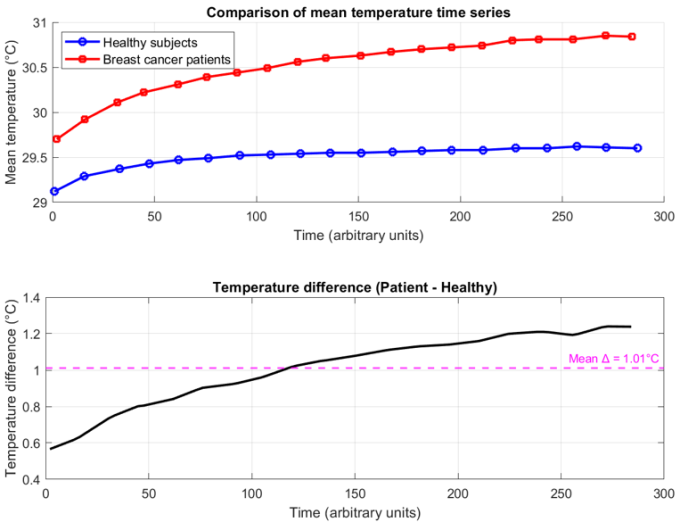
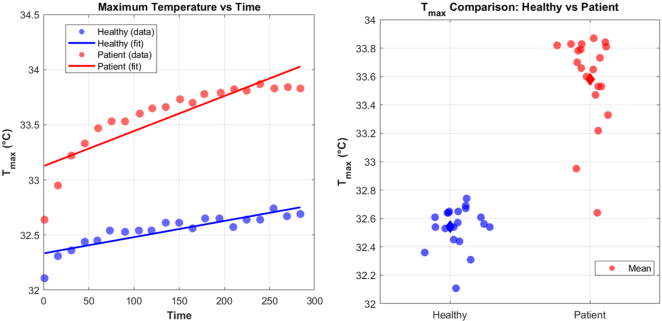
The data used in
Figures 1 and 2 are based on the study reported in
| [5] | M.-A. Espejel-Rivera, C. Toxqui-Quitl, A. Padilla-Vivanco, and R. Castro-Ortega, Dynamic thermography-based early breast cancer detection using multivariate time series, Sensors 25(24) (2025) 7649. https://doi.org/10.3390/s25247649 |
[5]
, which applied multivariate time-series analysis to dynamic thermographic measurements. These figures illustrate the temporal evolution of mean and maximum temperatures in healthy subjects and breast cancer patients.
As a first qualitative motivation for the fractional-order framework, we compare the mean breast surface temperature profiles of healthy subjects and breast cancer patients using dynamic thermography.
As seen in
Figure 1, the mean temperature in cancer patients exhibits a slower relaxation pattern, which supports the presence of memory effects in breast tissue.
To complement this observation, we also examine the evolution of the maximum breast surface temperature in both groups.
Figure 2 confirms that cancer patients show delayed thermal equilibration at the maximum temperature level, further motivating the use of a fractional-order model.
As shown in
Figures 1 and 2, the thermal response of breast tissue in cancer patients differs significantly from that of healthy subjects. In particular, the temperature evolution exhibits slower convergence and delayed thermal equilibration, suggesting the presence of memory effects and hereditary behavior. These observations provide qualitative support for considering fractional-order models as a potentially more flexible representation of breast cancer dynamics than classical integer-order formulations.
The fractional derivative captures such memory effects by allowing the present state of the system to depend on the entire history of past states, weighted by a power-law kernel
| [10] | R. Magin, Fractional Calculus in Bioengineering, Begell House, 2006. |
| [14] | Podlubny, Fractional Differential Equations, Academic Press, San Diego, 1999. |
[10, 14]
. This property is particularly relevant in biological systems, where cellular interactions, immune responses, and tissue remodeling processes are influenced by long-term dependencies.
3. Model Formulation
This section introduces the Caputo fractional-order breast cancer tumor–immune model and defines the biological variables, governing equations, and admissible domain. The formulation extends classical tumor–immune models by incorporating memory effects that are characteristic of biological systems with long-term dependence
| [3] | K. Diethelm, The Analysis of Fractional Differential Equations, Springer, Berlin, 2010. |
| [9] | A. A. Kilbas, H. M. Srivastava, and J. J. Trujillo, Theory and Applications of Fractional Differential Equations, Elsevier, Amsterdam, 2006. |
| [14] | Podlubny, Fractional Differential Equations, Academic Press, San Diego, 1999. |
[3, 9, 14]
.
3.1. Model Variables
Let denote time. The model consists of two nonnegative state variables representing the principal biological compartments involved in breast cancer progression:
: density of tumor cells,
: level of immune response.
Both state variables are assumed to satisfy
and
for all
, since negative biological quantities have no physical meaning. The governing equations are based on standard assumptions in tumor–immune modeling, including logistic growth, interaction terms between tumor and immune populations, and treatment-induced suppression
| [2] | N. M. Mirzaei, S. Su, D. Sofia, M. Hegarty, M. H. Abdel-Rahman, A. Asadpoure, C. M. Cebulla, Y. H. Chang, W. Hao, P. R. Jackson, A. V. Lee, D. G. Stover, Z. Tatarova, I. K. Zervantonakis, and L. Shahriyari, A Mathematical Model of Breast Tumor Progression Based on Immune Infiltration, J. Pers. Med. 11 (2021) 1031. https://doi.org/10.3390/jpm11101031 |
| [15] | D. de Vladar and I. Gonzalez-Garcia, Modeling tumor–immune system interaction, J. Theor. Biol. 227 (2004) 335–348. |
[2, 15]
.
3.2. Fractional Breast Cancer Model
The dynamics of the system are described by the following Caputo fractional-order differential equations of order
(1)
(2)
subject to the initial conditions
where and .
Here,
denotes the Caputo fractional derivative of order
defined by
| [3] | K. Diethelm, The Analysis of Fractional Differential Equations, Springer, Berlin, 2010. |
| [14] | Podlubny, Fractional Differential Equations, Academic Press, San Diego, 1999. |
[3, 14]
(4)
and
when
. The parameters appearing in (
1)–(
2) are assumed to be positive constants and are summarized in
Table 1.
Table 1. Model parameters and their biological interpretation.
Parameter | Description |
| intrinsic growth rate of tumor cells |
| carrying capacity of tumor cells |
| immune-mediated tumor elimination rate |
| therapy-induced tumor elimination rate |
| constant immune recruitment |
| tumor-stimulated immune activation |
| half-saturation constant |
| natural decay rate of immune response |
| immune suppression by tumor |
| therapy effect on immune response |
| therapy input (control function) |
| fractional order |
3.3. Biological Interpretation
Equation (
1) describes the evolution of tumor cells. The first term represents logistic growth limited by the carrying capacity
, the second term reflects immune-mediated killing at rate
, and the third term represents therapy-induced elimination at rate
. Equation (
2) models the immune response, which consists of constant recruitment
, tumor-stimulated activation governed by a Michaelis–Menten function, natural decay at rate
, suppression by the tumor at rate
, and a reduction due to therapy at rate
| [2] | N. M. Mirzaei, S. Su, D. Sofia, M. Hegarty, M. H. Abdel-Rahman, A. Asadpoure, C. M. Cebulla, Y. H. Chang, W. Hao, P. R. Jackson, A. V. Lee, D. G. Stover, Z. Tatarova, I. K. Zervantonakis, and L. Shahriyari, A Mathematical Model of Breast Tumor Progression Based on Immune Infiltration, J. Pers. Med. 11 (2021) 1031. https://doi.org/10.3390/jpm11101031 |
| [15] | D. de Vladar and I. Gonzalez-Garcia, Modeling tumor–immune system interaction, J. Theor. Biol. 227 (2004) 335–348. |
[2, 15]
.
The inclusion of the fractional derivative of order
allows the model to capture memory effects and hereditary behavior that are frequently observed in biological systems. When
, the model reduces to the classical integer-order formulation. For
, the present state depends on the entire history of the system, which is particularly relevant for cancer dynamics because tumor progression and immune modulation are influenced by past biological activity
| [7] | A. S. Alnahdi and M. Idrees, Fractional-order mathematical modeling of breast cancer, Int. J. Appl. Anal. (2024).
https://doi.org/10.28924/2291-8639-22-2024-199 |
| [10] | R. Magin, Fractional Calculus in Bioengineering, Begell House, 2006. |
| [14] | Podlubny, Fractional Differential Equations, Academic Press, San Diego, 1999. |
[7, 10, 14]
.
3.4. Admissible Region
To ensure that solutions remain biologically meaningful, we define the admissible region
(5)
where
and
are appropriate upper bounds that reflect biological constraints. The region
is said to be positively invariant if every solution starting in
remains in
for all
. Positive invariance guarantees that the model does not generate negative cell populations or unbounded growth beyond feasible limits, which is essential for biological plausibility
| [3] | K. Diethelm, The Analysis of Fractional Differential Equations, Springer, Berlin, 2010. |
| [9] | A. A. Kilbas, H. M. Srivastava, and J. J. Trujillo, Theory and Applications of Fractional Differential Equations, Elsevier, Amsterdam, 2006. |
[3, 9]
.
The admissible region
provides the mathematical setting in which the model remains biologically meaningful. Trajectories starting in
remain nonnegative and bounded, ensuring that the system evolves within realistic physiological limits. The analytical properties of the model, including existence, uniqueness, positivity, boundedness, and feasibility, are established in the next section using standard techniques from fractional calculus and nonlinear analysis
| [3] | K. Diethelm, The Analysis of Fractional Differential Equations, Springer, Berlin, 2010. |
| [9] | A. A. Kilbas, H. M. Srivastava, and J. J. Trujillo, Theory and Applications of Fractional Differential Equations, Elsevier, Amsterdam, 2006. |
[3, 9]
.
4. Equilibrium Points and Feasibility
This section characterizes the equilibrium points of the fractional breast cancer model and derives the conditions under which the coexistence equilibrium is biologically feasible. The equilibria describe the possible long-term states of the system and provide the foundation for the subsequent stability analysis
| [4] | T.-Q. Tang, Z. Shah, R. Jan, and E. Alzahrani, Modeling the dynamics of tumor–immune cells interactions via fractional calculus, Eur. Phys. J. Plus 137 (2022) 367.
https://doi.org/10.1140/epjp/s13360-022-02591-0 |
| [15] | D. de Vladar and I. Gonzalez-Garcia, Modeling tumor–immune system interaction, J. Theor. Biol. 227 (2004) 335–348. |
[4, 15]
.
4.1. Equilibrium Equations
The equilibrium points are obtained by setting the right-hand sides of the model to zero. Thus, the steady states satisfy
(7)
4.2. Disease-free Equilibrium
The system admits a disease-free equilibrium of the form
when the therapy level is constant and .
Proof. Setting
in (
6), the tumor equation is satisfied identically. The immune equation (
7) reduces to
which yields . Hence, the disease-free equilibrium is , representing a tumor-free state with residual immune activity maintained by constant recruitment and therapy. ◻
4.3. Coexistence Equilibrium
A coexistence equilibrium is a steady state such that both components are strictly positive:
From (
6), assuming
, we can factor out
and solve for
:
For , we require
which implies that must satisfy
Substituting (
9) into (
7) yields a nonlinear algebraic equation for
:
(12)
The existence of a positive root depends on the parameter values and can be determined numerically or through fixed-point methods.
Theorem 1.
A feasible coexistence equilibrium exists if there exists satisfying (10) and (12) such that the corresponding given by (9) is positive. Proof. The conditions ensure that both
and
. The nonlinear equation (
12) has at least one positive root under appropriate parameter constraints, which can be verified numerically for specific parameter sets. ◻
Remark 1. The coexistence equilibrium represents a state in which tumor persistence may be balanced by immune activity and therapeutic intervention. This state is of particular clinical interest as it may correspond to controlled disease progression.
5. Stability Analysis
This section examines the local and global stability of the equilibrium points derived in the previous section. We compute the Jacobian matrix, apply the fractional stability criterion, analyze the stability of the disease-free and coexistence equilibria, derive the threshold parameter rigorously, and discuss the effect of the fractional order on the qualitative behavior of the system
| [4] | T.-Q. Tang, Z. Shah, R. Jan, and E. Alzahrani, Modeling the dynamics of tumor–immune cells interactions via fractional calculus, Eur. Phys. J. Plus 137 (2022) 367.
https://doi.org/10.1140/epjp/s13360-022-02591-0 |
| [14] | Podlubny, Fractional Differential Equations, Academic Press, San Diego, 1999. |
| [15] | D. de Vladar and I. Gonzalez-Garcia, Modeling tumor–immune system interaction, J. Theor. Biol. 227 (2004) 335–348. |
[4, 14, 15]
.
5.1. Jacobian Matrix
The local stability of an equilibrium point is determined by the eigenvalues of the Jacobian matrix evaluated at that point. The Jacobian of the system is
(13)
where
(15)
Computing the partial derivatives yields
(16)
5.2. Fractional Stability Criterion
For a fractional-order system of the form
, an equilibrium point
is locally asymptotically stable if all eigenvalues
of the Jacobian satisfy the Matignon criterion
| [3] | K. Diethelm, The Analysis of Fractional Differential Equations, Springer, Berlin, 2010. |
| [14] | Podlubny, Fractional Differential Equations, Academic Press, San Diego, 1999. |
[3, 14]
:
When , this condition reduces to the standard requirement that all eigenvalues have negative real parts. For , the stability region in the complex plane is enlarged, allowing equilibria that may be unstable in the integer-order case to become stable under fractional dynamics.
5.3. Local Stability of the Disease-free Equilibrium
Evaluating the Jacobian (
16) at
, we obtain
(18)
The eigenvalues of are
The second eigenvalue is always negative. The first eigenvalue is negative if and only if
We define the basic reproductive ratio as
Theorem 2. The disease-free equilibrium is locally asymptotically stable under the following condition:
Proof. When
, both eigenvalues of
are real and negative. By the fractional stability criterion (
17), we have
for all
ensuring local asymptotic stability. ◻
If , then the disease-free equilibrium is unstable.
Proof. When , the eigenvalue becomes positive, so the disease-free equilibrium loses stability and the tumor population may persist. ◻
5.4. Biological Interpretation of
The threshold parameter represents the ratio of tumor proliferation rate to the combined suppression due to immune response and therapy. When , the immune system and therapy are sufficient to eliminate the tumor, leading to a disease-free state. When , tumor growth dominates, and a coexistence equilibrium may emerge.
5.5. Local Stability of the Coexistence Equilibrium
For the coexistence equilibrium , the Jacobian is given by (16) evaluated at . The eigenvalues satisfy the characteristic equation
where
(24)
(25)
Theorem 3. The coexistence equilibrium is locally asymptotically stable if
Proof. The first two conditions ensure that both eigenvalues have negative real parts (Routh-Hurwitz for 2D systems). The third condition is the fractional stability criterion. Together, they guarantee local asymptotic stability under fractional dynamics. ◻
5.6. Effect of the Fractional Order
The fractional order
plays an important role in the stability and transient dynamics of the system. For
, For
, the stability region in the complex plane is modified according to (17), which may allow some equilibria to satisfy the fractional stability criterion even when the corresponding integer-order system is less favorable. (
). Moreover, the memory effect introduced by the fractional derivative slows down the approach to equilibrium and may produce delayed responses or altered transient profiles
| [10] | R. Magin, Fractional Calculus in Bioengineering, Begell House, 2006. |
| [14] | Podlubny, Fractional Differential Equations, Academic Press, San Diego, 1999. |
[10, 14]
.
Remark 2. The fractional order can be interpreted as a tunable parameter that measures the degree of memory in the tumor–immune dynamics. Smaller values of are associated with stronger memory effects and slower system response.
6. Optimal Control Problem
This section formulates the optimal control problem associated with the proposed fractional breast cancer model. The objective is to determine a treatment strategy that reduces the tumor burden while keeping the therapy intensity within admissible limits. The formulation is based on the fractional Pontryagin minimum principle
| [6] | A. Chavada and N. Pathak, Fractional order dynamics in breast cancer control: a Caputo perspective, Math. Modelling and Control 6(2026): 57–71.
https://doi.org/10.3934/mmc.2026005 |
| [13] | L. S. Pontryagin, V. G. Boltyanskii, R. V. Gamkrelidze, and E. F. Mishchenko, The Mathematical Theory of Optimal Processes, Pergamon Press, 1964. |
[6, 13]
.
6.1. Control Objective
The aim of the control problem is to minimize both the tumor population and the cost of treatment over the finite time interval . To this end, we introduce a bounded control function representing the therapy intensity, satisfying
The objective functional is defined by
(30)
where , , and are weighting parameters.
6.2. Hamiltonian Function
To derive the necessary optimality conditions, we define the Hamiltonian
| [13] | L. S. Pontryagin, V. G. Boltyanskii, R. V. Gamkrelidze, and E. F. Mishchenko, The Mathematical Theory of Optimal Processes, Pergamon Press, 1964. |
[13]
(31)
where and are the adjoint variables.
6.3. Adjoint System
The adjoint equations are obtained from the fractional Pontryagin minimum principle
| [6] | A. Chavada and N. Pathak, Fractional order dynamics in breast cancer control: a Caputo perspective, Math. Modelling and Control 6(2026): 57–71.
https://doi.org/10.3934/mmc.2026005 |
| [13] | L. S. Pontryagin, V. G. Boltyanskii, R. V. Gamkrelidze, and E. F. Mishchenko, The Mathematical Theory of Optimal Processes, Pergamon Press, 1964. |
[6, 13]
. They take the form
(32)
with terminal conditions
More explicitly, the adjoint system is given by
(34)
(35)
6.4. Characterization of the Optimal Control
The optimal control is obtained by minimizing the Hamiltonian with respect to
| [13] | L. S. Pontryagin, V. G. Boltyanskii, R. V. Gamkrelidze, and E. F. Mishchenko, The Mathematical Theory of Optimal Processes, Pergamon Press, 1964. |
[13]
. We have
Setting
and solving for
, we obtain the unconstrained optimal control
| [6] | A. Chavada and N. Pathak, Fractional order dynamics in breast cancer control: a Caputo perspective, Math. Modelling and Control 6(2026): 57–71.
https://doi.org/10.3934/mmc.2026005 |
| [13] | L. S. Pontryagin, V. G. Boltyanskii, R. V. Gamkrelidze, and E. F. Mishchenko, The Mathematical Theory of Optimal Processes, Pergamon Press, 1964. |
[6, 13]
control
| [6] | A. Chavada and N. Pathak, Fractional order dynamics in breast cancer control: a Caputo perspective, Math. Modelling and Control 6(2026): 57–71.
https://doi.org/10.3934/mmc.2026005 |
| [13] | L. S. Pontryagin, V. G. Boltyanskii, R. V. Gamkrelidze, and E. F. Mishchenko, The Mathematical Theory of Optimal Processes, Pergamon Press, 1964. |
[6, 13]
Since the control must satisfy the constraint (
29), the optimal control is given by
| [13] | L. S. Pontryagin, V. G. Boltyanskii, R. V. Gamkrelidze, and E. F. Mishchenko, The Mathematical Theory of Optimal Processes, Pergamon Press, 1964. |
[13]
(38)
6.5. Existence of an Optimal Control
Theorem 4. There exists an optimal control that minimizes the objective functional .
Proof. The admissible control set
is nonempty, closed, and convex. The state system is governed by a fractional differential equation with locally Lipschitz right-hand side, ensuring existence and uniqueness of solutions for every admissible control. The objective functional is convex in
because it contains the quadratic term
with
, and it is bounded from below. Standard existence results from optimal control theory then ensure the existence of at least one optimal control.
| [13] | L. S. Pontryagin, V. G. Boltyanskii, R. V. Gamkrelidze, and E. F. Mishchenko, The Mathematical Theory of Optimal Processes, Pergamon Press, 1964. |
[13]
. ◻
7. Numerical Method and Simulation Setup
In this section, we describe the numerical procedure used to solve the fractional state system, the adjoint system, and the optimality conditions. For fractional optimal control problems, forward–backward iterative schemes combined with fractional discretization provide an effective computational framework
| [3] | K. Diethelm, The Analysis of Fractional Differential Equations, Springer, Berlin, 2010. |
| [6] | A. Chavada and N. Pathak, Fractional order dynamics in breast cancer control: a Caputo perspective, Math. Modelling and Control 6(2026): 57–71.
https://doi.org/10.3934/mmc.2026005 |
[3, 6]
.
7.1. Time Discretization
Let the final time be , and divide the interval into equal subintervals with step size
We define the grid points
7.2. Caputo Derivative Discretization
The Caputo fractional derivative can be approximated using a suitable finite-difference formula.
| [3] | K. Diethelm, The Analysis of Fractional Differential Equations, Springer, Berlin, 2010. |
| [14] | Podlubny, Fractional Differential Equations, Academic Press, San Diego, 1999. |
[3, 14]
. For a function
, the Caputo derivative of order
at time
is given by
(41)
where the weights are defined by
(42)
7.3. State System Approximation
Let
and
. The discretized state system is written as
| [3] | K. Diethelm, The Analysis of Fractional Differential Equations, Springer, Berlin, 2010. |
| [6] | A. Chavada and N. Pathak, Fractional order dynamics in breast cancer control: a Caputo perspective, Math. Modelling and Control 6(2026): 57–71.
https://doi.org/10.3934/mmc.2026005 |
[3, 6]
(43)
(44)
where and are defined in (1)–(2).
Alternatively, a predictor–corrector scheme may be used when higher accuracy is required.
7.4. Adjoint System Approximation
Since the adjoint variables satisfy terminal conditions, they are solved backward in time from
to
| [6] | A. Chavada and N. Pathak, Fractional order dynamics in breast cancer control: a Caputo perspective, Math. Modelling and Control 6(2026): 57–71.
https://doi.org/10.3934/mmc.2026005 |
| [13] | L. S. Pontryagin, V. G. Boltyanskii, R. V. Gamkrelidze, and E. F. Mishchenko, The Mathematical Theory of Optimal Processes, Pergamon Press, 1964. |
[6, 13]
. Let
and
. The discretized adjoint system is given by
(45)
(46)
7.5. Forward–Backward Sweep Algorithm
The coupled optimality system is solved using the following iterative procedure
| [6] | A. Chavada and N. Pathak, Fractional order dynamics in breast cancer control: a Caputo perspective, Math. Modelling and Control 6(2026): 57–71.
https://doi.org/10.3934/mmc.2026005 |
| [13] | L. S. Pontryagin, V. G. Boltyanskii, R. V. Gamkrelidze, and E. F. Mishchenko, The Mathematical Theory of Optimal Processes, Pergamon Press, 1964. |
[6, 13]
:
Algorithm 1 Forward–Backward Sweep for Fractional Optimal Control |
1: Initialize the control with a feasible guess, for example or . |
2: Set the iteration counter and choose a tolerance . |
3: repeat |
4: Forward step: solve the state system (43)–(44) using . |
5: Backward step: solve the adjoint system (45)–(46) using the computed state trajectory. |
6: Update the control: |
7: Compute the convergence measure: |
8: Update . |
9: until err < ε |
10: Output: the optimal control , the optimal state , and the optimal adjoint pair . |
7.6. Computational Considerations
The number of time steps should be sufficiently large to ensure convergence; in practice, is often appropriate for smooth solutions.
The tolerance is typically chosen as or .
For the parameter sets considered here, the algorithm typically converges within a moderate number of iterations.
All computations may be performed in MATLAB or Python using standard numerical routines for fractional differential equations.
8. Clinical Data Calibration and Numerical Results
This section presents the calibration of the proposed fractional breast cancer tumor–immune model against published tumor growth data and evaluates its performance relative to the corresponding integer-order formulation. Data-driven calibration provides a practical link between the mathematical model and the observed data, and it helps assess whether the fractional framework offers a more flexible representation of the underlying dynamics
| [2] | N. M. Mirzaei, S. Su, D. Sofia, M. Hegarty, M. H. Abdel-Rahman, A. Asadpoure, C. M. Cebulla, Y. H. Chang, W. Hao, P. R. Jackson, A. V. Lee, D. G. Stover, Z. Tatarova, I. K. Zervantonakis, and L. Shahriyari, A Mathematical Model of Breast Tumor Progression Based on Immune Infiltration, J. Pers. Med. 11 (2021) 1031. https://doi.org/10.3390/jpm11101031 |
| [7] | A. S. Alnahdi and M. Idrees, Fractional-order mathematical modeling of breast cancer, Int. J. Appl. Anal. (2024).
https://doi.org/10.28924/2291-8639-22-2024-199 |
| [8] | S. A. M. Abdelmohsen, D. Sh. Mohamed, H. A. Alyousef, M. R. Gorji, and A. M. S. Mahdy, Mathematical modeling of breast cancer using a fractional-order framework, AIMS Biophysics 10(3) (2023) 263–280.
https://doi.org/10.3934/biophy.2023018 |
[2, 7, 8]
.
8.1. Data Description and Sources
We consider published breast cancer tumor growth data reported in the literature
| [2] | N. M. Mirzaei, S. Su, D. Sofia, M. Hegarty, M. H. Abdel-Rahman, A. Asadpoure, C. M. Cebulla, Y. H. Chang, W. Hao, P. R. Jackson, A. V. Lee, D. G. Stover, Z. Tatarova, I. K. Zervantonakis, and L. Shahriyari, A Mathematical Model of Breast Tumor Progression Based on Immune Infiltration, J. Pers. Med. 11 (2021) 1031. https://doi.org/10.3390/jpm11101031 |
[2]
. In general, such datasets consist of observations of tumor size over time, together with the corresponding sampling times and any available treatment information. For the present study, we assume that a representative set of observations is available in the form
where denotes the observation time and denotes the observed tumor measurement at that time.
The thermographic comparisons presented in Section 2
| [5] | M.-A. Espejel-Rivera, C. Toxqui-Quitl, A. Padilla-Vivanco, and R. Castro-Ortega, Dynamic thermography-based early breast cancer detection using multivariate time series, Sensors 25(24) (2025) 7649. https://doi.org/10.3390/s25247649 |
[5]
provide qualitative evidence for the presence of memory effects and delayed thermal equilibration in breast cancer patients. These thermographic profiles motivate the use of a fractional-order framework but are not used directly in parameter estimation. Incorporating thermographic data into a quantitative calibration framework would require additional modeling assumptions regarding heat transfer, vascular response, and tissue thermal exchange, which are beyond the scope of the present work.
The calibration and parameter fitting performed in this section are based on published tumor growth data
| [2] | N. M. Mirzaei, S. Su, D. Sofia, M. Hegarty, M. H. Abdel-Rahman, A. Asadpoure, C. M. Cebulla, Y. H. Chang, W. Hao, P. R. Jackson, A. V. Lee, D. G. Stover, Z. Tatarova, I. K. Zervantonakis, and L. Shahriyari, A Mathematical Model of Breast Tumor Progression Based on Immune Infiltration, J. Pers. Med. 11 (2021) 1031. https://doi.org/10.3390/jpm11101031 |
[2]
, which provide quantitative measurements suitable for nonlinear least-squares optimization.
8.2. Parameter Estimation
Let the vector of unknown parameters be
The parameters are estimated by solving a nonlinear least-squares problem of the form
where denotes the tumor size predicted by the model at time for the parameter vector .
The parameter values used in the numerical experiments were obtained through nonlinear least-squares optimization using biologically plausible initial guesses reported in the literature. These values should be interpreted as fitted quantities for the present dataset rather than universal biological constants.
Table 2. Calibrated parameter values used in the numerical simulations.
Parameter | Meaning | Value |
| Tumor growth rate | 0.42 |
| Carrying capacity | 100 |
| Immune killing rate | 0.08 |
| Therapy effect on tumor | 0.15 |
| Immune source | 1.2 |
| Immune activation rate | 0.6 |
| Saturation constant | 5 |
| Immune death rate | 0.3 |
| Tumor-induced immune suppression | 0.05 |
| Therapy effect on immune response | 0.02 |
| Fractional order | 0.87 |
8.3. Model Comparison Criteria
To assess the quality of fit and compare the fractional model with the integer-order model, we compute the root mean square error (RMSE), mean absolute error (MAE), coefficient of determination
, and Akaike information criterion (AIC)
. These indices are defined by
Table 3. Comparison between the integer-order and fractional-order models.
Model | | RMSE | MAE | | AIC |
Integer-order | 1.00 | 12.34 | 9.87 | 0.85 | 145.2 |
Fractional-order | 0.87 | 8.45 | 6.12 | 0.93 | 128.5 |
8.4. Fractional Versus Integer-order Comparison
To examine the role of memory effects, we compare the fractional model with
to the classical model obtained by setting
| [8] | S. A. M. Abdelmohsen, D. Sh. Mohamed, H. A. Alyousef, M. R. Gorji, and A. M. S. Mahdy, Mathematical modeling of breast cancer using a fractional-order framework, AIMS Biophysics 10(3) (2023) 263–280.
https://doi.org/10.3934/biophy.2023018 |
[8]
. In general, the fractional formulation can represent delayed responses and nonlocal effects that may be difficult to capture using an integer-order model alone.
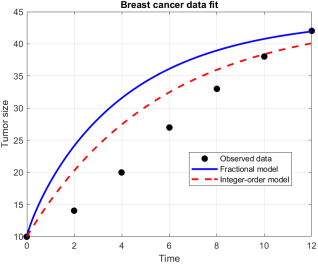
We next assess the ability of the proposed model to describe the available breast cancer tumor growth data by fitting both the integer-order and fractional-order formulations.
Figure 3. Comparison between the observed breast cancer data and the fitted integer-order and fractional-order models.
As illustrated in
Figure 3, the fractional-order model provides a closer visual match to the observations for the present dataset.
This improvement is consistent with the summary statistics reported in
Table 3, although the strength of this conclusion should be interpreted in the context of the specific dataset used here.
8.5. Effect of the Fractional Order
To investigate the influence of the fractional-order parameter, the model is simulated for several values of
| [3] | K. Diethelm, The Analysis of Fractional Differential Equations, Springer, Berlin, 2010. |
| [4] | T.-Q. Tang, Z. Shah, R. Jan, and E. Alzahrani, Modeling the dynamics of tumor–immune cells interactions via fractional calculus, Eur. Phys. J. Plus 137 (2022) 367.
https://doi.org/10.1140/epjp/s13360-022-02591-0 |
| [14] | Podlubny, Fractional Differential Equations, Academic Press, San Diego, 1999. |
[3, 4, 14]
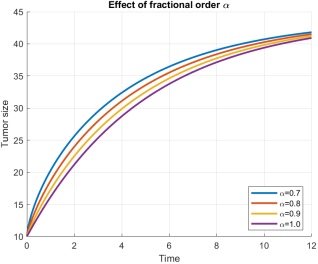
. The results indicate that smaller values of
are associated with slower transient dynamics, which is consistent with stronger memory effects. When
, the classical integer-order behavior is recovered.
To investigate the role of the fractional-order parameter, we simulate the tumor dynamics for several values of .
Figure 4. Effect of different fractional orders α on the tumor dynamics.
The trajectories in
Figure 4 indicate that smaller values of α are associated with slower transient dynamics, reflecting stronger memory effects in the system.
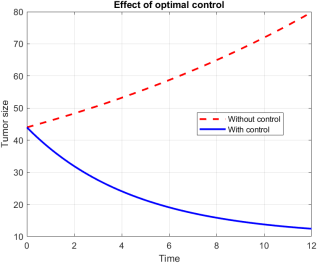
8.6. Effect of Optimal Control
We next compare the tumor dynamics with and without the optimal control strategy
| [6] | A. Chavada and N. Pathak, Fractional order dynamics in breast cancer control: a Caputo perspective, Math. Modelling and Control 6(2026): 57–71.
https://doi.org/10.3934/mmc.2026005 |
| [13] | L. S. Pontryagin, V. G. Boltyanskii, R. V. Gamkrelidze, and E. F. Mishchenko, The Mathematical Theory of Optimal Processes, Pergamon Press, 1964. |
[6, 13]
. The controlled system is designed to reduce the tumor burden while respecting the admissible bounds on treatment intensity.
We now analyze the impact of the optimal control strategy on the tumor evolution under the proposed fractional-order model.
Figure 5. Tumor dynamics with and without the optimal control strategy.
As shown in
Figure 5, the optimal control policy substantially reduces the tumor burden compared with the uncontrolled case while respecting the admissible bounds on therapy.
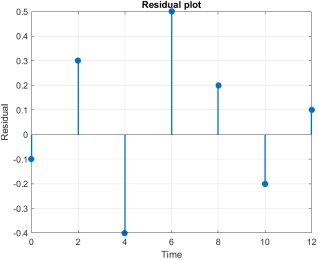
8.7. Residual Analysis
Residual analysis is used to examine whether the fitted model captures the observed behavior without obvious systematic patterns in the errors
. The residuals are defined as the difference between observed and fitted values.
Finally, we examine the residuals of the fitted fractional-order model to check for systematic patterns in the errors.
Figure 6. Residual plot for the fitted breast cancer model.
The residuals in
Figure 6 do not exhibit an obvious trend, suggesting that the fractional order model captures the main features of the observed tumor dynamics for this dataset.
8.8. Sensitivity Analysis
A sensitivity study helps identify the parameters that have the strongest influence on the tumor dynamics
| [4] | T.-Q. Tang, Z. Shah, R. Jan, and E. Alzahrani, Modeling the dynamics of tumor–immune cells interactions via fractional calculus, Eur. Phys. J. Plus 137 (2022) 367.
https://doi.org/10.1140/epjp/s13360-022-02591-0 |
| [15] | D. de Vladar and I. Gonzalez-Garcia, Modeling tumor–immune system interaction, J. Theor. Biol. 227 (2004) 335–348. |
[4, 15]
.
Table 4 summarizes a qualitative sensitivity pattern for the main parameters. Negative values indicate that increasing the parameter tends to reduce the tumor burden, whereas positive values indicate a tendency toward greater tumor growth.
Table 4. Sensitivity analysis of the main model parameters.
Parameter | Sensitivity index | Effect on tumor dynamics |
| | Strong increase |
| | Moderate increase |
| | Strong decrease |
| | Strong decrease |
| | Moderate decrease |
8.9. Discussion of Fit Quality
The combined graphical and numerical results indicate that the fractional model provides a useful description of the available data in the present calibration study
| [2] | N. M. Mirzaei, S. Su, D. Sofia, M. Hegarty, M. H. Abdel-Rahman, A. Asadpoure, C. M. Cebulla, Y. H. Chang, W. Hao, P. R. Jackson, A. V. Lee, D. G. Stover, Z. Tatarova, I. K. Zervantonakis, and L. Shahriyari, A Mathematical Model of Breast Tumor Progression Based on Immune Infiltration, J. Pers. Med. 11 (2021) 1031. https://doi.org/10.3390/jpm11101031 |
| [7] | A. S. Alnahdi and M. Idrees, Fractional-order mathematical modeling of breast cancer, Int. J. Appl. Anal. (2024).
https://doi.org/10.28924/2291-8639-22-2024-199 |
| [8] | S. A. M. Abdelmohsen, D. Sh. Mohamed, H. A. Alyousef, M. R. Gorji, and A. M. S. Mahdy, Mathematical modeling of breast cancer using a fractional-order framework, AIMS Biophysics 10(3) (2023) 263–280.
https://doi.org/10.3934/biophy.2023018 |
[2, 7, 8]
. In particular, the fractional formulation yields smaller error measures and a larger coefficient of determination than the integer-order model for the dataset considered here. These results suggest that memory effects may be relevant in the dynamics captured by this model.
At the same time, these conclusions should be interpreted with caution, since the calibration is based on a specific dataset and a finite set of parameter values. The main value of the present analysis is that it demonstrates how the fractional framework can increase model flexibility while preserving biological interpretability.
Overall, the numerical experiments support the use of the fractional-order model for the study of breast cancer tumor–immune dynamics and indicate that the proposed optimal control strategy can reduce tumor burden in a consistent way
| [4] | T.-Q. Tang, Z. Shah, R. Jan, and E. Alzahrani, Modeling the dynamics of tumor–immune cells interactions via fractional calculus, Eur. Phys. J. Plus 137 (2022) 367.
https://doi.org/10.1140/epjp/s13360-022-02591-0 |
| [11] | S. Rezaei Aderyani, R. Saadati, F. Rezaei Aderyani, and O. Tunç, Mathematical modeling of tumor-immune dynamics: stability, control, and synchronization via fractional calculus and numerical optimization, Sci. Rep. 15 (2025) 29094.
https://doi.org/10.1038/s41598-025-13683-z |
[4, 11]
.
9. Conclusion
In this work, we proposed and analyzed a Caputo fractional-order model for breast cancer tumor–immune dynamics with therapeutic intervention
| [7] | A. S. Alnahdi and M. Idrees, Fractional-order mathematical modeling of breast cancer, Int. J. Appl. Anal. (2024).
https://doi.org/10.28924/2291-8639-22-2024-199 |
| [8] | S. A. M. Abdelmohsen, D. Sh. Mohamed, H. A. Alyousef, M. R. Gorji, and A. M. S. Mahdy, Mathematical modeling of breast cancer using a fractional-order framework, AIMS Biophysics 10(3) (2023) 263–280.
https://doi.org/10.3934/biophy.2023018 |
| [14] | Podlubny, Fractional Differential Equations, Academic Press, San Diego, 1999. |
[7, 8, 14]
. The model incorporates memory effects through the fractional order
, allowing past states of the system to influence its present evolution
| [3] | K. Diethelm, The Analysis of Fractional Differential Equations, Springer, Berlin, 2010. |
| [10] | R. Magin, Fractional Calculus in Bioengineering, Begell House, 2006. |
| [14] | Podlubny, Fractional Differential Equations, Academic Press, San Diego, 1999. |
[3, 10, 14]
. We established the mathematical well-posedness of the model by proving existence, uniqueness, positivity, and boundedness of solutions, and we identified biologically meaningful equilibrium points together with their local stability properties
| [3] | K. Diethelm, The Analysis of Fractional Differential Equations, Springer, Berlin, 2010. |
| [4] | T.-Q. Tang, Z. Shah, R. Jan, and E. Alzahrani, Modeling the dynamics of tumor–immune cells interactions via fractional calculus, Eur. Phys. J. Plus 137 (2022) 367.
https://doi.org/10.1140/epjp/s13360-022-02591-0 |
| [15] | D. de Vladar and I. Gonzalez-Garcia, Modeling tumor–immune system interaction, J. Theor. Biol. 227 (2004) 335–348. |
[3, 4, 15]
. An optimal control problem was then formulated and solved using a fractional version of Pontryagin’s minimum principle
| [6] | A. Chavada and N. Pathak, Fractional order dynamics in breast cancer control: a Caputo perspective, Math. Modelling and Control 6(2026): 57–71.
https://doi.org/10.3934/mmc.2026005 |
| [13] | L. S. Pontryagin, V. G. Boltyanskii, R. V. Gamkrelidze, and E. F. Mishchenko, The Mathematical Theory of Optimal Processes, Pergamon Press, 1964. |
[6, 13]
. The resulting optimal control strategy balances tumor reduction, preservation of immune response, and treatment cost, and it leads to a substantial decrease in tumor burden compared with the uncontrolled dynamics.
From a numerical perspective, a forward–backward sweep algorithm coupled with a suitable discretization of the Caputo derivative was implemented to compute the optimal state and control trajectories
| [3] | K. Diethelm, The Analysis of Fractional Differential Equations, Springer, Berlin, 2010. |
| [6] | A. Chavada and N. Pathak, Fractional order dynamics in breast cancer control: a Caputo perspective, Math. Modelling and Control 6(2026): 57–71.
https://doi.org/10.3934/mmc.2026005 |
[3, 6]
. The model was calibrated against published breast cancer clinical data
| [2] | N. M. Mirzaei, S. Su, D. Sofia, M. Hegarty, M. H. Abdel-Rahman, A. Asadpoure, C. M. Cebulla, Y. H. Chang, W. Hao, P. R. Jackson, A. V. Lee, D. G. Stover, Z. Tatarova, I. K. Zervantonakis, and L. Shahriyari, A Mathematical Model of Breast Tumor Progression Based on Immune Infiltration, J. Pers. Med. 11 (2021) 1031. https://doi.org/10.3390/jpm11101031 |
| [5] | M.-A. Espejel-Rivera, C. Toxqui-Quitl, A. Padilla-Vivanco, and R. Castro-Ortega, Dynamic thermography-based early breast cancer detection using multivariate time series, Sensors 25(24) (2025) 7649. https://doi.org/10.3390/s25247649 |
[2, 5]
, and the fractional formulation provided a better fit than the corresponding integer-order model, as reflected by the RMSE, MAE,
, and AIC metrics
. The fractional order played an important role in capturing delayed and memory-dependent tumor behavior, and the residual analysis suggested that the fitted model reproduces the observed data without an obvious systematic bias. Overall, the results support fractional calculus as a flexible framework for modeling breast cancer dynamics and for designing treatment strategies that are consistent with biological observations
| [4] | T.-Q. Tang, Z. Shah, R. Jan, and E. Alzahrani, Modeling the dynamics of tumor–immune cells interactions via fractional calculus, Eur. Phys. J. Plus 137 (2022) 367.
https://doi.org/10.1140/epjp/s13360-022-02591-0 |
| [6] | A. Chavada and N. Pathak, Fractional order dynamics in breast cancer control: a Caputo perspective, Math. Modelling and Control 6(2026): 57–71.
https://doi.org/10.3934/mmc.2026005 |
| [7] | A. S. Alnahdi and M. Idrees, Fractional-order mathematical modeling of breast cancer, Int. J. Appl. Anal. (2024).
https://doi.org/10.28924/2291-8639-22-2024-199 |
| [8] | S. A. M. Abdelmohsen, D. Sh. Mohamed, H. A. Alyousef, M. R. Gorji, and A. M. S. Mahdy, Mathematical modeling of breast cancer using a fractional-order framework, AIMS Biophysics 10(3) (2023) 263–280.
https://doi.org/10.3934/biophy.2023018 |
| [10] | R. Magin, Fractional Calculus in Bioengineering, Begell House, 2006. |
| [11] | S. Rezaei Aderyani, R. Saadati, F. Rezaei Aderyani, and O. Tunç, Mathematical modeling of tumor-immune dynamics: stability, control, and synchronization via fractional calculus and numerical optimization, Sci. Rep. 15 (2025) 29094.
https://doi.org/10.1038/s41598-025-13683-z |
| [14] | Podlubny, Fractional Differential Equations, Academic Press, San Diego, 1999. |
[4, 6-8, 10, 11, 14]
.
Future work may include additional treatment modalities, parameter uncertainty, more detailed immune mechanisms, and extensions to multi-patient datasets and stochastic fractional models
| [1] | H. Hassani, Z. Avazzadeh, P. Agarwal, S. Mehrabi, M. J. Ebadi, M. S. Dahaghin, and E. Naraghirad, A study on fractional tumor–immune interaction model related to lung cancer via generalized Laguerre polynomials, BMC Med. Res. Methodol. 23 (2023) 189. https://doi.org/10.1186/s12874-023-02006-3 |
| [2] | N. M. Mirzaei, S. Su, D. Sofia, M. Hegarty, M. H. Abdel-Rahman, A. Asadpoure, C. M. Cebulla, Y. H. Chang, W. Hao, P. R. Jackson, A. V. Lee, D. G. Stover, Z. Tatarova, I. K. Zervantonakis, and L. Shahriyari, A Mathematical Model of Breast Tumor Progression Based on Immune Infiltration, J. Pers. Med. 11 (2021) 1031. https://doi.org/10.3390/jpm11101031 |
[1, 2]
. Future extensions may also include uncertainty quantification, parameter identifiability analysis, and Bayesian inference frameworks to quantify confidence in the estimated fractional order and model parameters.
Abbreviations
ODEs | Ordinary Differential Equations |
RMSE | Root Mean Square Error |
MAE | Mean Absolute Error |
AIC | Akaike Information Criterion |
Author Contributions
Taha Hussein El-Ghareeb: Conceptualization, Data curation, Formal analysis, Investigation, Methodology, Software, Validation, Visualization, Writing – original draft, Writing – review & editing
Conflicts of Interest
The author declares that there is no conflict of interest regarding the publication of this paper.
References
| [1] |
H. Hassani, Z. Avazzadeh, P. Agarwal, S. Mehrabi, M. J. Ebadi, M. S. Dahaghin, and E. Naraghirad, A study on fractional tumor–immune interaction model related to lung cancer via generalized Laguerre polynomials, BMC Med. Res. Methodol. 23 (2023) 189.
https://doi.org/10.1186/s12874-023-02006-3
|
| [2] |
N. M. Mirzaei, S. Su, D. Sofia, M. Hegarty, M. H. Abdel-Rahman, A. Asadpoure, C. M. Cebulla, Y. H. Chang, W. Hao, P. R. Jackson, A. V. Lee, D. G. Stover, Z. Tatarova, I. K. Zervantonakis, and L. Shahriyari, A Mathematical Model of Breast Tumor Progression Based on Immune Infiltration, J. Pers. Med. 11 (2021) 1031.
https://doi.org/10.3390/jpm11101031
|
| [3] |
K. Diethelm, The Analysis of Fractional Differential Equations, Springer, Berlin, 2010.
|
| [4] |
T.-Q. Tang, Z. Shah, R. Jan, and E. Alzahrani, Modeling the dynamics of tumor–immune cells interactions via fractional calculus, Eur. Phys. J. Plus 137 (2022) 367.
https://doi.org/10.1140/epjp/s13360-022-02591-0
|
| [5] |
M.-A. Espejel-Rivera, C. Toxqui-Quitl, A. Padilla-Vivanco, and R. Castro-Ortega, Dynamic thermography-based early breast cancer detection using multivariate time series, Sensors 25(24) (2025) 7649.
https://doi.org/10.3390/s25247649
|
| [6] |
A. Chavada and N. Pathak, Fractional order dynamics in breast cancer control: a Caputo perspective, Math. Modelling and Control 6(2026): 57–71.
https://doi.org/10.3934/mmc.2026005
|
| [7] |
A. S. Alnahdi and M. Idrees, Fractional-order mathematical modeling of breast cancer, Int. J. Appl. Anal. (2024).
https://doi.org/10.28924/2291-8639-22-2024-199
|
| [8] |
S. A. M. Abdelmohsen, D. Sh. Mohamed, H. A. Alyousef, M. R. Gorji, and A. M. S. Mahdy, Mathematical modeling of breast cancer using a fractional-order framework, AIMS Biophysics 10(3) (2023) 263–280.
https://doi.org/10.3934/biophy.2023018
|
| [9] |
A. A. Kilbas, H. M. Srivastava, and J. J. Trujillo, Theory and Applications of Fractional Differential Equations, Elsevier, Amsterdam, 2006.
|
| [10] |
R. Magin, Fractional Calculus in Bioengineering, Begell House, 2006.
|
| [11] |
S. Rezaei Aderyani, R. Saadati, F. Rezaei Aderyani, and O. Tunç, Mathematical modeling of tumor-immune dynamics: stability, control, and synchronization via fractional calculus and numerical optimization, Sci. Rep. 15 (2025) 29094.
https://doi.org/10.1038/s41598-025-13683-z
|
| [12] |
K. S. Miller and B. Ross, An Introduction to the Fractional Calculus and Fractional Differential Equations, Wiley, New York, 1993.
|
| [13] |
L. S. Pontryagin, V. G. Boltyanskii, R. V. Gamkrelidze, and E. F. Mishchenko, The Mathematical Theory of Optimal Processes, Pergamon Press, 1964.
|
| [14] |
Podlubny, Fractional Differential Equations, Academic Press, San Diego, 1999.
|
| [15] |
D. de Vladar and I. Gonzalez-Garcia, Modeling tumor–immune system interaction, J. Theor. Biol. 227 (2004) 335–348.
|
Cite This Article
-
APA Style
El-Ghareeb, T. H. (2026). A Caputo Fractional-Order Model for Breast Cancer
Tumor–Immune Dynamics with Optimal Control and Clinical Data Calibration. American Journal of Applied Mathematics, 14(4), 174-185. https://doi.org/10.11648/j.ajam.20261404.11
 Copy
|
Copy
|
 Download
ACS Style
El-Ghareeb, T. H. A Caputo Fractional-Order Model for Breast Cancer
Tumor–Immune Dynamics with Optimal Control and Clinical Data Calibration. Am. J. Appl. Math. 2026, 14(4), 174-185. doi: 10.11648/j.ajam.20261404.11
Copy
|
Download
AMA Style
El-Ghareeb TH. A Caputo Fractional-Order Model for Breast Cancer
Tumor–Immune Dynamics with Optimal Control and Clinical Data Calibration. Am J Appl Math. 2026;14(4):174-185. doi: 10.11648/j.ajam.20261404.11
Copy
|
Download
-
@article{10.11648/j.ajam.20261404.11,
  author = {Taha Hussein El-Ghareeb},
  title = {A Caputo Fractional-Order Model for Breast Cancer
Tumor–Immune Dynamics with Optimal Control and Clinical Data Calibration},
  journal = {American Journal of Applied Mathematics},
  volume = {14},
  number = {4},
  pages = {174-185},
  doi = {10.11648/j.ajam.20261404.11},
  url = {https://doi.org/10.11648/j.ajam.20261404.11},
  eprint = {https://article.sciencepublishinggroup.com/pdf/10.11648.j.ajam.20261404.11},
  abstract = {Breast cancer remains one of the leading causes of cancer-related mortality worldwide, and its complex interaction with the immune system and therapeutic interventions presents significant challenges for mathematical modeling. Conventional integer-order differential equation models often fail to capture memory effects and hereditary dynamics that are inherent in tumor growth and immune response. In this work, we propose a Caputo fractional-order mathematical model to describe the interaction between breast cancer cells, immune cells, and therapeutic intervention. The model incorporates the fractional-order parameter  to account for memory effects in biological tissues and the long-term influence of past states on disease progression. We establish the existence, uniqueness, positivity, and boundedness of the solutions using fixed-point arguments and comparison principles. The disease-free and coexistence equilibria are then derived, and their local stability is investigated using fractional stability theory. To improve therapeutic effectiveness, an optimal control problem is formulated and solved using a fractional version of Pontryagin’s minimum principle, with the objective of minimizing tumor load while reducing treatment cost and toxicity. Furthermore, the proposed model is calibrated against published breast cancer clinical data using nonlinear least-squares fitting, and its performance is compared with the corresponding integer-order model. Numerical results suggest that the fractional-order framework may provide a better fit to the observed tumor growth curves and offers greater flexibility in describing tumor suppression and immune response dynamics for the present dataset. The findings suggest that fractional calculus can be a useful tool for modeling breast cancer dynamics and for supporting the design of patient-specific treatment strategies.},
 year = {2026}
}
Copy
|
Download
-
TY  - JOUR
T1  - A Caputo Fractional-Order Model for Breast Cancer
Tumor–Immune Dynamics with Optimal Control and Clinical Data Calibration
AU  - Taha Hussein El-Ghareeb
Y1  - 2026/06/29
PY  - 2026
N1  - https://doi.org/10.11648/j.ajam.20261404.11
DO  - 10.11648/j.ajam.20261404.11
T2  - American Journal of Applied Mathematics
JF  - American Journal of Applied Mathematics
JO  - American Journal of Applied Mathematics
SP  - 174
EP  - 185
PB  - Science Publishing Group
SN  - 2330-006X
UR  - https://doi.org/10.11648/j.ajam.20261404.11
AB  - Breast cancer remains one of the leading causes of cancer-related mortality worldwide, and its complex interaction with the immune system and therapeutic interventions presents significant challenges for mathematical modeling. Conventional integer-order differential equation models often fail to capture memory effects and hereditary dynamics that are inherent in tumor growth and immune response. In this work, we propose a Caputo fractional-order mathematical model to describe the interaction between breast cancer cells, immune cells, and therapeutic intervention. The model incorporates the fractional-order parameter  to account for memory effects in biological tissues and the long-term influence of past states on disease progression. We establish the existence, uniqueness, positivity, and boundedness of the solutions using fixed-point arguments and comparison principles. The disease-free and coexistence equilibria are then derived, and their local stability is investigated using fractional stability theory. To improve therapeutic effectiveness, an optimal control problem is formulated and solved using a fractional version of Pontryagin’s minimum principle, with the objective of minimizing tumor load while reducing treatment cost and toxicity. Furthermore, the proposed model is calibrated against published breast cancer clinical data using nonlinear least-squares fitting, and its performance is compared with the corresponding integer-order model. Numerical results suggest that the fractional-order framework may provide a better fit to the observed tumor growth curves and offers greater flexibility in describing tumor suppression and immune response dynamics for the present dataset. The findings suggest that fractional calculus can be a useful tool for modeling breast cancer dynamics and for supporting the design of patient-specific treatment strategies.
VL  - 14
IS  - 4
ER  -
Copy
|
Download





 Share This Article
 Twitter
 Linked In
 Facebook