This study investigates the unsteady Magnetohydrodynamic (MHD) flow and heat transfer characteristics of a nonlinear third-grade non-Newtonian fluid with temperature-dependent viscosity and nonlinear thermal radiation, which are commonly encountered in advanced engineering systems such as polymer processing, metallurgical operations, liquid-metal cooling technologies, and energy conversion devices. Owing to its viscoelastic nature, which deviates from classical Newtonian assumptions, the fluid behavior is described by coupled nonlinear momentum and energy equations incorporating magnetic field effects, viscous dissipation, nonlinear shear contributions, variable thermal conductivity, and wall suction. The governing equations are non-dimensionalised to identify the key controlling physical parameters and solved numerically using an explicit finite difference scheme, enabling a detailed parametric analysis of the effects of magnetic strength, nonlinear material parameters, radiation intensity, and viscosity variation on velocity and temperature distributions within the boundary layer. The results indicate that increasing magnetic field strength suppresses fluid motion through Lorentz force effects, thereby thinning the momentum boundary layer and providing an effective mechanism for electromagnetic flow control. Additionally, nonlinear rheological parameters significantly alter momentum transport, while radiative heat transfer and viscous dissipation elevate the thermal energy within the fluid, and variations in thermal conductivity strongly influence heat diffusion and temperature gradients. These findings offer valuable design insights for enhancing flow regulation and thermal performance in industrial systems involving electrically conducting non-Newtonian fluids operating under magnetic fields and high-temperature conditions.
This is an Open Access article, distributed under the terms of the Creative Commons Attribution 4.0 International License (http://creativecommons.org/licenses/by/4.0/), which permits unrestricted use, distribution and reproduction in any medium or format, provided the original work is properly cited.
Third-grade fluids are non-Newtonian fluids with viscoelastic characteristics. Intuitively, non-Newtonian fluids do not obey the Newtonian law of viscosity, which makes the Navier-Stokes equations inadequate for such flow due to the higher-order differential of the momentum equations, unlike the flow of viscous fluids. The industrial and technological applications of non-linear third-grade flow have been an important area of interest in every concerned field of engineering, science, and technology, such as ceramic processing, oil recovery, polymer synthesis, and food processing.
It is in the light of these efforts, Chinyoka and Makinde
[1]
Chinyoka, T., & Makinde, D. O. (2015). Unsteady and porous media flow of reactive non-Newtonian fluids subjected to buoyancy and suction/injection. International Journal of Numerical Methods for Heat & Fluid Flow.
investigated the unsteady flow of a non-Newtonian fluid with reacting species in a parallel plate channel filled with a homogeneous, isotropic, and saturated porous medium. A differential type third grade constitute equation is employed to model the non-Newtonian character of the fluid. The coupled nonlinear partial differential equations governing the problem are derived and solved numerically using a semi-implicit finite difference scheme. Makinde et al,
[2]
Makinde, O. D., Chinyoka, T., & Rundora, L. (2011). Unsteady flow of reactive variable viscosity non-Newtonian fluid through a porous saturated medium with asymmetric convective boundary conditions. Computers & Mathematics with Applications, 62(9), 3343-3352.
investigated the unsteady flow of reactive variable viscosity non-Newtonian fluid through a porous saturated medium by assuming the exothermic chemical reactions take place within the flow system. Akinbowale
[3]
Akinshilo, A. T. (2017). Steady flow and heat transfer analysis of third-grade fluid with porous medium and heat generation. Engineering Science and Technology, an International Journal, 20(6), 1602-1609.
[3]
steady flow and heat transfer analysis of third-grade fluid with porous medium, adopting a domain decomposition method with temperature-dependent base viscosity.
Hayat et al,
[4]
Hayat, T., Naz, R., & Abbasbandy, S. (2011). Poiseuille flow of a third-grade fluid in a porous medium. Transport in porous media, 87(2), 355-366.
studied the flow of a third-grade fluid and heat transfer analysis between two stationary porous plates. The governing non-linear flow problem is solved analytically using the Homotropy Analysis Method (HAM). Ayub et al,
[5]
Ayub, M., Rasheed, A., & Hayat, T. (2003). Exact flow of a third-grade fluid past a porous plate using the homotropy analysis method. International Journal of Engineering Science, 41(18), 2091-2103.
studied the exact flow of a third-grade fluid on a porous wall using the analytical group method. Aksoy and Mehmet
[6]
Aksoy, Y., & Pakdemirli, M. (2010). Approximate analytical solutions for the flow of a third-grade fluid through a parallel-plate channel filled with a porous medium. Transport in Porous Media, 83(2), 375-395.
investigated the approximate analytical solutions for the flow of a third-grade fluid in a pipe with constant viscosity using the perturbation technique. Chauhan and Kumar
[7]
Chauhan, D. S., & Kumar, V. (2013). Entropy analysis for third-grade fluid flow with temperature-dependent viscosity in an annulus partially filled with porous medium. Theoretical and Applied Mechanics, 40(3), 441-464.
[7]
investigated the entropy analysis for third-grade fluid flow with temperature-dependent viscosity in an annulus partially filled with porous medium. Ali et al
[8]
Ali, N., Khan, S. U., & Abbas, Z. (2015). Unsteady flow of third-grade fluid over an oscillatory stretching sheet with thermal radiation and heat source/sink. Nonlinear Engineering, 4(4), 223-236.
[8]
studied the unsteady boundary layer flow and heat transfer analysis in a third-grade fluid over an oscillatory stretching sheet under the influences of thermal radiation and a heat source.
Sajid et al,
[9]
Sajid, M., Mahmood, R., & Hayat, T. (2008). Finite element solution for flow of a third-grade fluid past a horizontal porous plate with partial slip. Computers & Mathematics with Applications, 56(5), 1236-1244.
discussed the finite element solution for flow of a third-grade fluids past a horizontal porous plate with partial slip. Okoya
[10]
Okoya, S. S. (2016). Flow, thermal criticality, and transition of a reactive third-grade fluid in a pipe with Reynolds’ model viscosity. Journal of Hydrodynamics, 28(1), 84-94.
studied the steady incompressible flow of an exothermic reacting third-grade fluid with viscous heating in a circular cylindrical pipe, which is numerically studied for both cases of constant viscosity and Reynolds’ viscosity model. Ogunsola and Peter
[11]
Ogunsola, A. W., & Peter, B. A. (2014). Effect of variable viscosity on third-grade fluid flow over a radiative surface with Arrhenius reaction. International journal of pure and applied sciences and technology, 22(1), 1.
[11]
investigated the effect of variable viscosity on third-grade fluid over a radiative surface with Arrhenius reaction. Aziz et al
[12]
Aziz, T., Mahomed, F. M., Ayub, M., & Mason, D. P. (2013). Non-linear time-dependent flow models of third-grade fluids: a conditional symmetry approach. International Journal of Non-Linear Mechanics, 54, 55-65.
studied a non-linear time-dependent flow model of third-grade fluids in a porous half-space using a non-classical symmetry approach.
Ellahi et al,
[13]
Ellahi, R., Hayat, T., Mahomed, F. M., & Asghar, S. (2010). Effects of slip on the non-linear flows of a third-grade fluid. Nonlinear Analysis: Real World Applications, 11(1), 139-146.
investigated the effects of slip on the non-linear flows of a third-grade fluid between concentric cylinders. Gaffer et al,
[14]
Gaffar, S. A., Prasad, V. R., Reddy, P. R., & Khan, B. M. H. (2019). Radiative Flow of Third Grade Non-Newtonian Fluid from a Horizontal Circular Cylinder. Nonlinear Engineering, 8(1), 673-687.
[14]
studied the radiative flow of third-grade non-Newtonian fluid from a horizontal circular cylinder. Carapau and Correia
[15]
Carapau, F., & Correia, P. (2017). Numerical simulations of a third-grade fluid flow in a tube through a contraction. European Journal of Mechanics-B/Fluids, 65, 45-53.
investigated the numerical solution of third-grade fluid flow on a tube through a contraction using a director theory approach related to fluid dynamics. Adesanya et al,
[16]
Adesanya, S. O., Falade, J. A., Jangili, S., & Beg, O. A. (2017). Irreversibility analysis for reactive third-grade fluid flow and heat transfer with convective wall cooling. Alexandria Engineering Journal, 56(1), 153-160.
Ayub, M., Rasheed, A., & Hayat, T. (2003). Exact flow of a third-grade fluid past a porous plate using the homotropy analysis method. International Journal of Engineering Science, 41(18), 2091-2103.
Aksoy, Y., & Pakdemirli, M. (2010). Approximate analytical solutions for the flow of a third-grade fluid through a parallel-plate channel filled with a porous medium. Transport in Porous Media, 83(2), 375-395.
Chauhan, D. S., & Kumar, V. (2013). Entropy analysis for third-grade fluid flow with temperature-dependent viscosity in an annulus partially filled with porous medium. Theoretical and Applied Mechanics, 40(3), 441-464.
[8]
Ali, N., Khan, S. U., & Abbas, Z. (2015). Unsteady flow of third-grade fluid over an oscillatory stretching sheet with thermal radiation and heat source/sink. Nonlinear Engineering, 4(4), 223-236.
[4-8]
adopted the concept of analytical method for their solution, while others were solved numerically with different approaches.
[17]
Weli, A., Amadi, C. P., & Nwaigwe, C. (2019). Numerical investigation of transport in a Couette flow with unsteady suction. IOSR Journal of Mathematics, 15(6), 74-83.
[17]
investigated the fluid flow and transport phenomena within a vertical channel featuring an exponentially decaying suction and a moving wall. The governing equations are formulated under the assumptions of incompressible flow influenced by buoyancy effects and viscous dissipation. A finite difference method is developed and applied to solve the system. Numerical results are displayed graphically, revealing that higher values of the Brinkman number, suction parameter, and Prandtl number enhance the temperature distribution, while increases in the thermal Grashof number, mass Grashof number, and suction parameter lead to a rise in flow velocity.
This work aims at investigating multi-dimensional extensions of a new unconditionally stable solver for the convection-diffusion-reaction equation of non-linear radiation and temperature-dependent viscosity with suction. It also extends the idea of
[1]
Chinyoka, T., & Makinde, D. O. (2015). Unsteady and porous media flow of reactive non-Newtonian fluids subjected to buoyancy and suction/injection. International Journal of Numerical Methods for Heat & Fluid Flow.
Makinde, O. D., Chinyoka, T., & Rundora, L. (2011). Unsteady flow of reactive variable viscosity non-Newtonian fluid through a porous saturated medium with asymmetric convective boundary conditions. Computers & Mathematics with Applications, 62(9), 3343-3352.
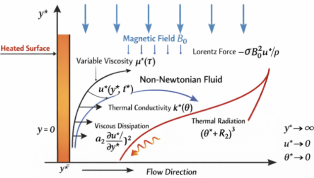
Consider the unsteady, incompressible magnetohydrodynamic flow and heat transfer of a nonlinear third-grade fluid along a vertical surface, considering temperature-dependent viscosity, nonlinear thermal radiation, viscous dissipation, and wall suction. Let denote the fluid velocity in the streamwise direction and the temperature field, where is the normal coordinate and is time.
The governing equations consist of the continuity, momentum, and energy equations expressed in dimensional form as follows.
The continuity equation for incompressible flow is
(1)
(2)
(3)
With the corresponding boundary Conditions,
,at
,as(4)
Non-dimensional Variable
,,,,,
,,
Non-dimensional Parameter
,,,,,
,
Applying the non-dimensional variables and parameters, we obtain the dimensionless equations for continuity, momentum, and energy equations.
(5)
(6)
(7)
,at
,as(8)
2.2. Numerical Solution
We adopted a Finite Difference Method (FDM) explicit numerical scheme to obtain our solutions and results.
To obtain approximate solutions of the coupled nonlinear governing equations, an explicit finite difference method (FDM) was employed. The computational domain in the transverse direction was discretized into a uniform grid defined by
where represents the spatial step size and is the total number of subintervals. Time was discretized using a uniform time step , and the solution variables were evaluated at discrete grid points , where denotes the spatial index and the time level.
2.3. Discretization of Derivatives
The spatial derivatives were approximated using finite difference operators. The forward difference operator in space is defined as
while the forward difference operator in time is given by
Second-order spatial derivatives were approximated using central difference schemes of the form
which ensures improved spatial accuracy. Convective and nonlinear terms were discretizedcarefully to preserve stability and consistency of the explicit formulation.
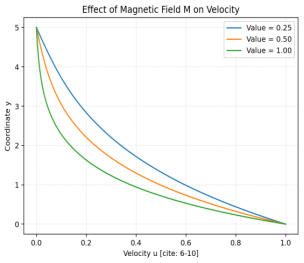
Figure 2. The effect of the variation of the magnetic field on velocity with some parameter values , , , , , .
The results of this study highlight the intricate behavior of non-linear third-grade fluids, revealing how their unique properties influence both velocity and temperature distributions within fluid systems.
The results demonstrate that increasing the magnetic field parameter significantly suppresses fluid velocity due to the Lorentz force, leading to a thinner momentum boundary layer; this provides an effective mechanism for controlling flow behavior in electrically conducting non-Newtonian fluids used in advanced thermal and industrial systems.
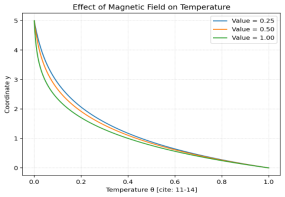
Figure 3. The effect of magnetic fluid on the temperature of some parameter values , , , , , .
Increasing magnetic field strength suppresses fluid motion via Lorentz forces, thereby reducing temperature distribution and thinning the thermal boundary layer, which provides an effective mechanism for controlling heat transfer in electrically conducting non-Newtonian fluids.
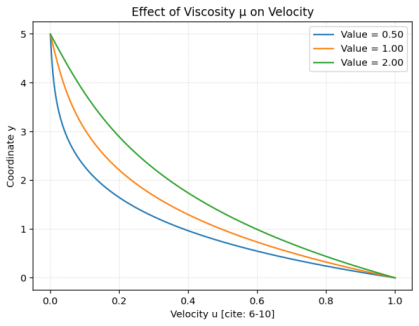
Figure 4. The effect of viscosity on velocity with some parameter values , , , , , .
The results indicate that increasing viscosity enhances momentum diffusion within the nonlinear third-grade fluid, resulting in higher velocities and a thicker hydrodynamic boundary layer. This behavior highlights the critical role of viscosity in controlling flow uniformity and stability in industrial processes involving highly viscous non-Newtonian fluids.
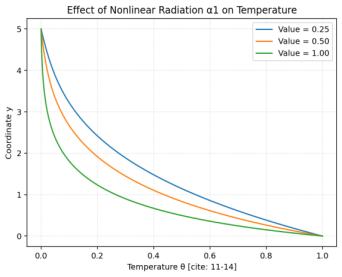
Figure 6. The effect of Nonlinear Radiation on temperature with some parameter values , , , , , .
This plot effectively illustrates the effect of the variation of nonlinear radiation on temperature distribution in a fluid system. The stronger nonlinear radiation (larger ) steepens temperature gradients and thins thermal boundary layers, confining buoyant forcing nearer the source and producing narrower, more intense near-source plumes while reducing far-field thermal penetration.
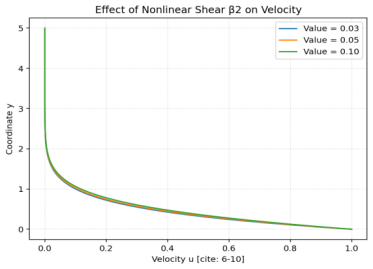
Figure 7. The effect of Nonlinear Shear on the velocity of some parameter values , , , , , .
This figure illustrates that increasing the nonlinear shear parameter slightly enhances the velocity gradient near the wall, reducing the momentum boundary layer thickness and increasing the local wall shear while exerting minimal influence on the outer flow. Thus, primarily affects localized shear stresses and near-wall transport, leaving the overall bulk velocity distribution largely unchanged at the values considered.
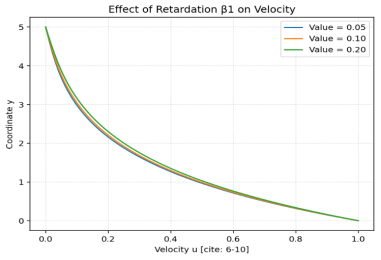
Figure 8. The effect of Retardation on velocity with some parameter values , , , , , .
The figure shows that the increase in the retardation parameter strengthens the near-wall momentum resistance, which thickens the momentum boundary layer, slightly increases pressure drop, and wall shear. It reduces near-wall convective heat and mass.
4. Conclusions
In this study, we investigated the second-order simulation of non-linear third-grade flow characterized by the governing equations that describe the dynamics of velocity and temperature The findings from our simulations reveal that the non-linear characteristics of third-grade fluids significantly influence both the velocity and temperature distributions. The presence of parameters such as and demonstrates their critical role in enhancing flow dynamics and thermal behavior, providing insights that are essential for applications in industrial processes involving complex fluids.
Significant Findings
1) The non-linear characteristics of third-grade fluids significantly affect both velocity and temperature distributions.
2) The use of time-dependent and spatial derivatives in the governing equations allows for a detailed understanding of flow and thermal behavior.
3) The finite difference method (FDM) proves effective in accurately simulating complex interactions in non-linear fluid systems.
Abbreviations
MHD
Magnetohydordynamics
FDM
Forward Differences Method
HAM
Homotopy Analysis Method
Acknowledgments
This goes to Rivers State University.
Author Contributions
Chukuwuemeka Paul Amadi: Visualization, Writing – original draft, Validation, Methodology
Chinyoka, T., & Makinde, D. O. (2015). Unsteady and porous media flow of reactive non-Newtonian fluids subjected to buoyancy and suction/injection. International Journal of Numerical Methods for Heat & Fluid Flow.
Makinde, O. D., Chinyoka, T., & Rundora, L. (2011). Unsteady flow of reactive variable viscosity non-Newtonian fluid through a porous saturated medium with asymmetric convective boundary conditions. Computers & Mathematics with Applications, 62(9), 3343-3352.
Akinshilo, A. T. (2017). Steady flow and heat transfer analysis of third-grade fluid with porous medium and heat generation. Engineering Science and Technology, an International Journal, 20(6), 1602-1609.
[4]
Hayat, T., Naz, R., & Abbasbandy, S. (2011). Poiseuille flow of a third-grade fluid in a porous medium. Transport in porous media, 87(2), 355-366.
Ayub, M., Rasheed, A., & Hayat, T. (2003). Exact flow of a third-grade fluid past a porous plate using the homotropy analysis method. International Journal of Engineering Science, 41(18), 2091-2103.
Aksoy, Y., & Pakdemirli, M. (2010). Approximate analytical solutions for the flow of a third-grade fluid through a parallel-plate channel filled with a porous medium. Transport in Porous Media, 83(2), 375-395.
Chauhan, D. S., & Kumar, V. (2013). Entropy analysis for third-grade fluid flow with temperature-dependent viscosity in an annulus partially filled with porous medium. Theoretical and Applied Mechanics, 40(3), 441-464.
[8]
Ali, N., Khan, S. U., & Abbas, Z. (2015). Unsteady flow of third-grade fluid over an oscillatory stretching sheet with thermal radiation and heat source/sink. Nonlinear Engineering, 4(4), 223-236.
[9]
Sajid, M., Mahmood, R., & Hayat, T. (2008). Finite element solution for flow of a third-grade fluid past a horizontal porous plate with partial slip. Computers & Mathematics with Applications, 56(5), 1236-1244.
Okoya, S. S. (2016). Flow, thermal criticality, and transition of a reactive third-grade fluid in a pipe with Reynolds’ model viscosity. Journal of Hydrodynamics, 28(1), 84-94.
Ogunsola, A. W., & Peter, B. A. (2014). Effect of variable viscosity on third-grade fluid flow over a radiative surface with Arrhenius reaction. International journal of pure and applied sciences and technology, 22(1), 1.
[12]
Aziz, T., Mahomed, F. M., Ayub, M., & Mason, D. P. (2013). Non-linear time-dependent flow models of third-grade fluids: a conditional symmetry approach. International Journal of Non-Linear Mechanics, 54, 55-65.
Ellahi, R., Hayat, T., Mahomed, F. M., & Asghar, S. (2010). Effects of slip on the non-linear flows of a third-grade fluid. Nonlinear Analysis: Real World Applications, 11(1), 139-146.
Gaffar, S. A., Prasad, V. R., Reddy, P. R., & Khan, B. M. H. (2019). Radiative Flow of Third Grade Non-Newtonian Fluid from a Horizontal Circular Cylinder. Nonlinear Engineering, 8(1), 673-687.
[15]
Carapau, F., & Correia, P. (2017). Numerical simulations of a third-grade fluid flow in a tube through a contraction. European Journal of Mechanics-B/Fluids, 65, 45-53.
Adesanya, S. O., Falade, J. A., Jangili, S., & Beg, O. A. (2017). Irreversibility analysis for reactive third-grade fluid flow and heat transfer with convective wall cooling. Alexandria Engineering Journal, 56(1), 153-160.
Weli, A., Amadi, C. P., & Nwaigwe, C. (2019). Numerical investigation of transport in a Couette flow with unsteady suction. IOSR Journal of Mathematics, 15(6), 74-83.
Amadi, C. P., Gobo, I. W. (2026). Unsteady Magnetohydrodynamic Flow of a Nonlinear
Third-grade Fluid with Variable Viscosity and Radiative Heat Transfer. American Journal of Applied Mathematics, 14(2), 66-73. https://doi.org/10.11648/j.ajam.20261402.14
Amadi, C. P.; Gobo, I. W. Unsteady Magnetohydrodynamic Flow of a Nonlinear
Third-grade Fluid with Variable Viscosity and Radiative Heat Transfer. Am. J. Appl. Math.2026, 14(2), 66-73. doi: 10.11648/j.ajam.20261402.14
@article{10.11648/j.ajam.20261402.14,
  author = {Chukuwuemeka Paul Amadi and Iyowuna Winston Gobo},
  title = {Unsteady Magnetohydrodynamic Flow of a Nonlinear
Third-grade Fluid with Variable Viscosity and Radiative Heat Transfer},
  journal = {American Journal of Applied Mathematics},
  volume = {14},
  number = {2},
  pages = {66-73},
  doi = {10.11648/j.ajam.20261402.14},
  url = {https://doi.org/10.11648/j.ajam.20261402.14},
  eprint = {https://article.sciencepublishinggroup.com/pdf/10.11648.j.ajam.20261402.14},
  abstract = {This study investigates the unsteady Magnetohydrodynamic (MHD) flow and heat transfer characteristics of a nonlinear third-grade non-Newtonian fluid with temperature-dependent viscosity and nonlinear thermal radiation, which are commonly encountered in advanced engineering systems such as polymer processing, metallurgical operations, liquid-metal cooling technologies, and energy conversion devices. Owing to its viscoelastic nature, which deviates from classical Newtonian assumptions, the fluid behavior is described by coupled nonlinear momentum and energy equations incorporating magnetic field effects, viscous dissipation, nonlinear shear contributions, variable thermal conductivity, and wall suction. The governing equations are non-dimensionalised to identify the key controlling physical parameters and solved numerically using an explicit finite difference scheme, enabling a detailed parametric analysis of the effects of magnetic strength, nonlinear material parameters, radiation intensity, and viscosity variation on velocity and temperature distributions within the boundary layer. The results indicate that increasing magnetic field strength suppresses fluid motion through Lorentz force effects, thereby thinning the momentum boundary layer and providing an effective mechanism for electromagnetic flow control. Additionally, nonlinear rheological parameters significantly alter momentum transport, while radiative heat transfer and viscous dissipation elevate the thermal energy within the fluid, and variations in thermal conductivity strongly influence heat diffusion and temperature gradients. These findings offer valuable design insights for enhancing flow regulation and thermal performance in industrial systems involving electrically conducting non-Newtonian fluids operating under magnetic fields and high-temperature conditions.},
 year = {2026}
}
TY  - JOUR
T1  - Unsteady Magnetohydrodynamic Flow of a Nonlinear
Third-grade Fluid with Variable Viscosity and Radiative Heat Transfer
AU  - Chukuwuemeka Paul Amadi
AU  - Iyowuna Winston Gobo
Y1  - 2026/03/19
PY  - 2026
N1  - https://doi.org/10.11648/j.ajam.20261402.14
DO  - 10.11648/j.ajam.20261402.14
T2  - American Journal of Applied Mathematics
JF  - American Journal of Applied Mathematics
JO  - American Journal of Applied Mathematics
SP  - 66
EP  - 73
PB  - Science Publishing Group
SN  - 2330-006X
UR  - https://doi.org/10.11648/j.ajam.20261402.14
AB  - This study investigates the unsteady Magnetohydrodynamic (MHD) flow and heat transfer characteristics of a nonlinear third-grade non-Newtonian fluid with temperature-dependent viscosity and nonlinear thermal radiation, which are commonly encountered in advanced engineering systems such as polymer processing, metallurgical operations, liquid-metal cooling technologies, and energy conversion devices. Owing to its viscoelastic nature, which deviates from classical Newtonian assumptions, the fluid behavior is described by coupled nonlinear momentum and energy equations incorporating magnetic field effects, viscous dissipation, nonlinear shear contributions, variable thermal conductivity, and wall suction. The governing equations are non-dimensionalised to identify the key controlling physical parameters and solved numerically using an explicit finite difference scheme, enabling a detailed parametric analysis of the effects of magnetic strength, nonlinear material parameters, radiation intensity, and viscosity variation on velocity and temperature distributions within the boundary layer. The results indicate that increasing magnetic field strength suppresses fluid motion through Lorentz force effects, thereby thinning the momentum boundary layer and providing an effective mechanism for electromagnetic flow control. Additionally, nonlinear rheological parameters significantly alter momentum transport, while radiative heat transfer and viscous dissipation elevate the thermal energy within the fluid, and variations in thermal conductivity strongly influence heat diffusion and temperature gradients. These findings offer valuable design insights for enhancing flow regulation and thermal performance in industrial systems involving electrically conducting non-Newtonian fluids operating under magnetic fields and high-temperature conditions.
VL  - 14
IS  - 2
ER  -
Department of Mathematics, Rivers State University, Port Harcourt, Nigeria
Biography:
Chukuwuemeka Paul Amadi received his B.Sc. degree in Mathematics and Computer Science from Rivers State Univer-sity of Science and Technology, Nigeria, and his M.Sc. degree in Applied Mathematics from Rivers State University, Port Harcourt, Nigeria. He is currently a Lecturer I in the Depart-ment of Mathematics at Rivers State University. His research interests include fluid dynamics, magnetohydrodynamics, nanofluid modelling, and numerical simulations. He is a regis-tered member of the Mathematical Association of Nigeria (MAN) and the Nigerian Mathematical Society (NMS). He has published several research articles in reputable local and inter-national journals, contributing to the advancement of applied mathematics research.
School of Engineering, University of Aberdeen, Aberdeen, Scotland
Biography:
Iyowuna Winston Gobo received the B.Tech. degree in elec-trical engineering from Rivers State University, Nigeria, MSc in electrical power engineering from the University of Stafford-shire, United Kingdom, and he is currently pursuing a PhD at the University of Aberdeen. His research interests include Dis-tributed Hybrid Renewable Energy Systems (DHRES) integra-tion, modelling, and Energy Transition. He is currently a senior lecturer in the Department of Electrical Engineering, Rivers State University, Nigeria. His professional and academic jour-ney has seen him actively engage in multifaceted roles as a re-searcher. He is recognized for his boundless energy and unwa-vering commitment, and he holds the esteemed status of a Reg-istered Engineer with COREN, NSE, and IEEE. Additionally, his contributions extend to the realm of academia and industry, with publications in both local and reputable international jour-nals, further enhancing his academic portfolio.
Amadi, C. P., Gobo, I. W. (2026). Unsteady Magnetohydrodynamic Flow of a Nonlinear
Third-grade Fluid with Variable Viscosity and Radiative Heat Transfer. American Journal of Applied Mathematics, 14(2), 66-73. https://doi.org/10.11648/j.ajam.20261402.14
Amadi, C. P.; Gobo, I. W. Unsteady Magnetohydrodynamic Flow of a Nonlinear
Third-grade Fluid with Variable Viscosity and Radiative Heat Transfer. Am. J. Appl. Math.2026, 14(2), 66-73. doi: 10.11648/j.ajam.20261402.14
@article{10.11648/j.ajam.20261402.14,
  author = {Chukuwuemeka Paul Amadi and Iyowuna Winston Gobo},
  title = {Unsteady Magnetohydrodynamic Flow of a Nonlinear
Third-grade Fluid with Variable Viscosity and Radiative Heat Transfer},
  journal = {American Journal of Applied Mathematics},
  volume = {14},
  number = {2},
  pages = {66-73},
  doi = {10.11648/j.ajam.20261402.14},
  url = {https://doi.org/10.11648/j.ajam.20261402.14},
  eprint = {https://article.sciencepublishinggroup.com/pdf/10.11648.j.ajam.20261402.14},
  abstract = {This study investigates the unsteady Magnetohydrodynamic (MHD) flow and heat transfer characteristics of a nonlinear third-grade non-Newtonian fluid with temperature-dependent viscosity and nonlinear thermal radiation, which are commonly encountered in advanced engineering systems such as polymer processing, metallurgical operations, liquid-metal cooling technologies, and energy conversion devices. Owing to its viscoelastic nature, which deviates from classical Newtonian assumptions, the fluid behavior is described by coupled nonlinear momentum and energy equations incorporating magnetic field effects, viscous dissipation, nonlinear shear contributions, variable thermal conductivity, and wall suction. The governing equations are non-dimensionalised to identify the key controlling physical parameters and solved numerically using an explicit finite difference scheme, enabling a detailed parametric analysis of the effects of magnetic strength, nonlinear material parameters, radiation intensity, and viscosity variation on velocity and temperature distributions within the boundary layer. The results indicate that increasing magnetic field strength suppresses fluid motion through Lorentz force effects, thereby thinning the momentum boundary layer and providing an effective mechanism for electromagnetic flow control. Additionally, nonlinear rheological parameters significantly alter momentum transport, while radiative heat transfer and viscous dissipation elevate the thermal energy within the fluid, and variations in thermal conductivity strongly influence heat diffusion and temperature gradients. These findings offer valuable design insights for enhancing flow regulation and thermal performance in industrial systems involving electrically conducting non-Newtonian fluids operating under magnetic fields and high-temperature conditions.},
 year = {2026}
}
TY  - JOUR
T1  - Unsteady Magnetohydrodynamic Flow of a Nonlinear
Third-grade Fluid with Variable Viscosity and Radiative Heat Transfer
AU  - Chukuwuemeka Paul Amadi
AU  - Iyowuna Winston Gobo
Y1  - 2026/03/19
PY  - 2026
N1  - https://doi.org/10.11648/j.ajam.20261402.14
DO  - 10.11648/j.ajam.20261402.14
T2  - American Journal of Applied Mathematics
JF  - American Journal of Applied Mathematics
JO  - American Journal of Applied Mathematics
SP  - 66
EP  - 73
PB  - Science Publishing Group
SN  - 2330-006X
UR  - https://doi.org/10.11648/j.ajam.20261402.14
AB  - This study investigates the unsteady Magnetohydrodynamic (MHD) flow and heat transfer characteristics of a nonlinear third-grade non-Newtonian fluid with temperature-dependent viscosity and nonlinear thermal radiation, which are commonly encountered in advanced engineering systems such as polymer processing, metallurgical operations, liquid-metal cooling technologies, and energy conversion devices. Owing to its viscoelastic nature, which deviates from classical Newtonian assumptions, the fluid behavior is described by coupled nonlinear momentum and energy equations incorporating magnetic field effects, viscous dissipation, nonlinear shear contributions, variable thermal conductivity, and wall suction. The governing equations are non-dimensionalised to identify the key controlling physical parameters and solved numerically using an explicit finite difference scheme, enabling a detailed parametric analysis of the effects of magnetic strength, nonlinear material parameters, radiation intensity, and viscosity variation on velocity and temperature distributions within the boundary layer. The results indicate that increasing magnetic field strength suppresses fluid motion through Lorentz force effects, thereby thinning the momentum boundary layer and providing an effective mechanism for electromagnetic flow control. Additionally, nonlinear rheological parameters significantly alter momentum transport, while radiative heat transfer and viscous dissipation elevate the thermal energy within the fluid, and variations in thermal conductivity strongly influence heat diffusion and temperature gradients. These findings offer valuable design insights for enhancing flow regulation and thermal performance in industrial systems involving electrically conducting non-Newtonian fluids operating under magnetic fields and high-temperature conditions.
VL  - 14
IS  - 2
ER  -






 Share This Article
 Twitter
 Linked In
 Facebook
 Copy
Copy Download