Abstract
The rapid development of generative AI (GenAI) technology has led to the widespread adoption of AI oral practice tools among university EFL (English as a Foreign Language) learners, yet the boundary conditions under which such tools improve oral proficiency remain underexplored. This study aims to investigate whether the assumption that more frequent use leads to better outcomes is universally valid or is conditioned by learners’ AI learning engagement willingness. Based on questionnaire responses from 248 university students across multiple institutions in China, this study examined the relationships among AI oral tool usage frequency, AI learning engagement willingness (comprising task value perception, willingness to invest resources, and AI-augmented self-efficacy), and self-reported English oral proficiency. Statistical analyses, including one-way ANOVA and hierarchical multiple regression, revealed that both AI learning engagement willingness and usage frequency were independently and positively associated with oral proficiency, displaying an additive rather than interactive relationship. These findings reframe the more use, better outcome logic by revealing a dual-path mechanism: usage frequency ensures the floor of language exposure, while AI learning engagement willingness determines the ceiling of deep processing. The study provides theoretical and practical implications for AI tool design and pedagogical implementation in college English education.
|
Published in
|
American Journal of Artificial Intelligence (Volume 10, Issue 2)
|
|
DOI
|
10.11648/j.ajai.20261002.14
|
|
Page(s)
|
209-218 |
|
Creative Commons
|

This is an Open Access article, distributed under the terms of the Creative Commons Attribution 4.0 International License (http://creativecommons.org/licenses/by/4.0/), which permits unrestricted use, distribution and reproduction in any medium or format, provided the original work is properly cited.
|
|
Copyright
|
Copyright © The Author(s), 2026. Published by Science Publishing Group
|
Keywords
AI Oral Tools, AI Learning Engagement, Usage Frequency, Oral Proficiency, College English Teaching
1. Introduction
The breakthrough development of generative artificial intelligence (GenAI) technology has brought new possibilities to EFL speaking instruction
| [12] | WEN Q F. Human-machine interaction negotiation competence: ChatGPT and foreign language education [J]. Foreign Language Teaching and Research, 2024, 56(2): 269-280. |
| [13] | YANG L R, WANG Y, SUN J W. Second language acquisition against the background of ChatGPT large language models [J]. Modern Foreign Languages, 2024, 47(4): 578-585. |
| [19] | YU H L. Paradigm shift of foreign language teaching in universities in the intelligent era [J]. Foreign Language Teaching and Research, 2024, 56(6): 913-923. |
| [20] | WEN Q F. Will foreign language education witness a subversive revolution in the artificial intelligence era [J]. Modern Foreign Languages, 2024, 47(5): 722-731. |
[12, 13, 19, 20]
. Zou and Wang’s
| [17] | ZOU L L, WANG Y. Research on inquiry-based discussion empowered by artificial intelligence in foreign language classrooms: Challenges, approaches and strategies [J]. Foreign Language Teaching and Research, 2026, 58(1): 121-130. |
[17]
’s research on AI-empowered foreign language classrooms has similarly revealed important insights. Cukurova
| [23] | CUKUROVA M. The interplay of learning, analytics and artificial intelligence in education: A vision for hybrid intelligence [J]. British Journal of Educational Technology, 2024, 56(2): 469-488. https://doi.org/10.1111/bjet.13514 |
[23]
proposed the perspective of hybrid intelligence, emphasizing the critical role of human–AI collaboration in education; Cukurova
further articulated a new paradigm of synergistic teacher–generative AI interaction. UNESCO’s
| [25] | UNESCO. AI competency framework for teachers [R]. Paris: UNESCO, 2024. |
[25]
AI Competency Framework also provides guidance for developing teachers’ AI literacy. Sun
| [21] | SUN X G. Research on interpreter classroom evaluation with teacher-AI-student collaboration [J]. Modern Foreign Languages, 2025, 48(5): 701-712. |
[21]
highlighted the importance of multi-party interaction in teacher–AI–student collaborative assessment research. AI oral practice tools represented by Doubao Oral English, Daily English Listening, and Liulishuo·English offer learners immediate feedback, low-pressure learning environments, and flexible practice scenarios
| [9] | HUANG F, TANG Z. AI-enhanced university English learners’ speaking learning [J]. Journal of Xi’an International Studies University, 2026, 34(1): 53-59. |
| [18] | XU J J, XIONG W X. Implementation strategies of personalized foreign language education under large language models [J]. Foreign Language Teaching and Research, 2025, 57(1): 81-91. |
[9, 18]
. However, whether the widespread adoption of AI oral tools can equally empower all learners remains an open question.
Zimmerman’s
cyclical phase model identifies three phases of self-regulated learning: forethought, performance, and self-reflection. Within the context of technology-assisted language learning, learners’ AI learning engagement willingness — defined as their perceived value of AI language learning tools, willingness to invest, and perceived efficacy — may influence their actual usage behavior and language learning outcomes
. The present study proposes that AI learning engagement willingness may moderate the relationship between AI oral tool usage frequency and oral proficiency, thereby constituting the boundary condition of “more use, better outcome.”
Although previous studies consistently report positive effects of AI-assisted oral practice, existing findings remain inconclusive regarding whether increased usage benefits all learners equally. Few studies have examined the boundary conditions under which usage frequency translates into improved oral proficiency. In particular, the moderating role of learners’ AI learning engagement willingness remains largely unexplored. Addressing this gap may contribute to a more nuanced understanding of how individual differences shape the effectiveness of AI-assisted language learning.
Based on the above analysis, this study addresses the following research questions: (1) Is AI oral tool usage frequency positively correlated with oral proficiency? (2) How does AI learning engagement willingness moderate the relationship between usage frequency and oral proficiency?
2. Literature Review and Theoretical Framework
2.1. Self-Regulated Learning and Language Learning
Zimmerman's
cyclical phase model of self-regulated learning (SRL) divides self-regulation into three phases: forethought, performance, and self-reflection. In second language acquisition, self-regulated learning ability has been shown to be significantly associated with language proficiency
found that Chinese university students' self-regulatory strategies in technology-assisted environments include goal setting, environment structuring, and self-evaluation.
confirmed in a study of intelligent personal assistant-assisted L2 oral practice that self-regulatory ability significantly influences both engagement and outcomes in oral learning. Beyond self-regulated learning frameworks, the Technology Acceptance Model (TAM) and Self-Determination Theory (SDT) have also been widely applied to understand learners' technology use behaviors. TAM posits that perceived usefulness and perceived ease of use jointly determine technology acceptance, focusing primarily on cognitive evaluation of the tool itself. SDT emphasizes intrinsic motivation and the satisfaction of basic psychological needs as drivers of sustained engagement. While both frameworks offer valuable insights into initial technology adoption and general learning motivation, they are less equipped to explain the contextualized willingness to actively engage with AI tools in oral practice. Despite growing research on self-regulated learning in technology-assisted language learning, three critical gaps remain. First, few studies have examined SRL in the specific context of AI oral practice tools, where human-AI interaction dynamics differ fundamentally from traditional technology-mediated learning. Second, the role of learners' willingness to engage with AI tools is a motivational antecedent distinct from both general SRL ability and technology acceptance remains underexplored. Third, whether the assumption that"more use leads to better outcomes"holds universally or is moderated by individual differences in engagement willingness has not been empirically tested. The present study aims to address these gaps.
2.2. The Issue of Effective Use in Technology-Assisted Language Learning
The Effective Use framework emphasizes that technology does not automatically lead to improved learning outcomes; rather, the key lies in how learners use the technology
| [18] | XU J J, XIONG W X. Implementation strategies of personalized foreign language education under large language models [J]. Foreign Language Teaching and Research, 2025, 57(1): 81-91. |
[18]
. In AI-assisted language learning, this framework carries particular significance: although AI tools provide abundant practice resources, whether these translate into actual improvement depends on learners' willingness to engage.
| [15] | KONG L, ZHONG H, WANG X M. Construction of foreign language learners’ engagement guarantee mechanism under human-computer collaborative environment [J]. Modern Foreign Languages, 2026, 49(1): 112-124. |
[15]
found that in human-computer collaborative environments, learners with higher engagement willingness use AI tools more strategically, forming a virtuous cycle of goal setting, progress monitoring, and strategy adjustment. Learners with lower engagement willingness, by contrast, tend toward passive use or disengagement.
| [14] | WANG H, CHEN M. Research on participation in AI-assisted online oral interactive assessment tasks [J]. Foreign Language Teaching and Research, 2025, 57(3): 439-449. |
| [16] | WANG H, LIU J D. Research on learners’ feedback engagement in AI-assisted oral diagnostic assessment [J]. Modern Foreign Languages, 2026, 49(3): 367-379. |
[14, 16]
showed that learners' quality of engagement with AI-assisted oral diagnostic feedback varies significantly and is closely related to self-regulatory ability.
further confirmed that learner autonomy is a critical factor influencing effective AI tool use. The concept of Digital Divide 2.0 also suggests that, as technology access becomes increasingly universal, the"usage gap"is replacing the"access gap"as a new source of inequality. However, existing Effective Use research has predominantly focused on general technology-mediated learning contexts, leaving the specific boundary conditions in AI-assisted oral practice.
2.3. Strengths and Limitations of AI Oral Tools
Research indicates that the core advantages of AI oral practice tools manifest in two aspects. First, immediate feedback: compared with traditional oral practice, AI tools can provide instant feedback on pronunciation, grammar, and fluency immediately after a learner speaks
. Second, a low-pressure learning environment: the non-judgmental, non-social nature of AI tools can effectively reduce speaking anxiety
| [1] | AYRES J, ZHANG L. Effects of artificial intelligence on English speaking anxiety and speaking performance [J]. Expert Systems, 2021, 38(4): e12667.
https://doi.org/10.1111/exsy.12667 |
[1]
. However, existing tools also exhibit significant limitations, including limited dialogue modes, overly rigid interaction, and speech recognition accuracy that still requires improvement
| [17] | ZOU L L, WANG Y. Research on inquiry-based discussion empowered by artificial intelligence in foreign language classrooms: Challenges, approaches and strategies [J]. Foreign Language Teaching and Research, 2026, 58(1): 121-130. |
[17]
. Critically, most existing studies have treated AI oral tools as a uniform condition, without adequately accounting for individual differences in how learners engage with them. The implicit assumption that tool access or usage frequency alone determines learning outcomes may overlook the crucial role of learners' willingness to engage actively and strategically with AI-generated feedback.
| [15] | KONG L, ZHONG H, WANG X M. Construction of foreign language learners’ engagement guarantee mechanism under human-computer collaborative environment [J]. Modern Foreign Languages, 2026, 49(1): 112-124. |
[15]
specifically noted that AI assistance may only improve the oral proficiency of highly autonomous students, and that differences in AI learning engagement willingness may exacerbate inequality in learning outcomes. This suggests that the effectiveness of AI oral tools is not uniform but contingent on learner characteristics.
2.4. Core Construct Definition and Research Hypotheses
Conceptualization of AI learning engagement willingness. The construct of"AI learning engagement willingness"proposed in this study refers to learners' comprehensive attitude toward tool value, willingness to invest resources, and perceived efficacy in AI-assisted oral practice scenarios. This construct is conceptually distinct from related constructs. Unlike self-regulated learning ability, which reflects a learner's general capacity to plan, monitor, and evaluate their own learning processes, AI learning engagement willingness captures the contextualized attitudinal predisposition to actively engage with AI tools specifically. SRL addresses whether learners can regulate their learning processes, whereas the proposed construct addresses whether they are willing to engage with AI tools. Distinction from motivation and technology acceptance. This construct also differs from intrinsic motivation as conceptualized in SDT and from technology acceptance as conceptualized in TAM. Intrinsic motivation concerns the inherent enjoyment of an activity, whereas AI learning engagement willingness incorporates value perception, willingness to invest tangible resources (including financial costs), and perceived self-efficacy in AI-mediated practice. Similarly, TAM focuses on perceived usefulness and ease of use of the technology itself, while the proposed construct extends to learners' comprehensive evaluation of the tool's role in their oral proficiency development, encompassing task value, investment willingness, and AI-augmented self-efficacy. Drawing on self-regulated learning theory and the Effective Use framework, this study proposes the following hypotheses: H1: AI oral tool usage frequency is positively correlated with oral proficiency (high-frequency users demonstrate significantly higher oral proficiency than low-frequency users). H2: AI learning engagement willingness is positively correlated with oral proficiency (learners with high engagement willingness demonstrate significantly higher oral proficiency than those with low engagement willingness). H3: AI learning engagement willingness moderates the relationship between usage frequency and oral proficiency (the Usage Frequency x AI Learning Engagement Willingness interaction term is significant).
3. Research Design
3.1. Participants
This study employed a convenience sampling method through an online questionnaire survey. Questionnaires were distributed to university students from multiple institutions across three types of universities in China, including comprehensive universities, normal (teacher-training) universities, and science and engineering institutions. A total of 248 valid responses were retained after excluding incomplete submissions and responses with excessive patterned answers. Respondents included both English majors (51%) and non-English majors (49%), covering a range of academic years.
3.2. Instruments
The questionnaire consisted of 24 items organized into four sections: (1) demographic information; (2) self-rated English oral proficiency (Q6–Q9, Q12–Q15), measured on a 9-point Likert scale; (3) AI oral tool usage (Q18–Q20); and (4) open-ended questions (Q21–Q24). The AI learning engagement willingness scale comprised three items: Q10 (“I believe that practicing English speaking is one of the most worthwhile self-investments during college,” measuring task value), Q11 (“I am willing to pay for ad-free, highly accurate, multi-scenario AI oral practice tools,” measuring AI investment willingness), and Q16 (“I believe that practicing speaking with AI can reduce my psychological burden and make me more willing to speak up,” measuring AI-augmented self-efficacy), all rated on a 9-point Likert scale (Cronbach’s α = 0.730). The oral proficiency scale was adapted from the “CET-4/6 Oral Test Self-Rating Scale”
| [14] | WANG H, CHEN M. Research on participation in AI-assisted online oral interactive assessment tasks [J]. Foreign Language Teaching and Research, 2025, 57(3): 439-449. |
[14]
, comprising 7 items with a Cronbach’s α of 0.936, indicating good internal consistency reliability. Harman’s single-factor test showed that the first unrotated factor accounted for 52.2% of the total variance, slightly above the 50% threshold, suggesting that common method bias was within an acceptable range. For the AI learning engagement willingness scale, Bartlett’s test of sphericity was significant (p<.001), KMO = 0.697, the single factor explained 64.9% of the total variance, and all item factor loadings exceeded 0.70, indicating acceptable construct validity. For the oral proficiency scale, the single factor explained 55.3% of the total variance, and all item loadings exceeded 0.70. The three items were designed to capture three theoretically grounded dimensions: (a) task value perception (Q10), drawing on expectancy-value theory; (b) willingness to invest resources (Q11), reflecting the behavioral commitment aspect of engagement; and (c) AI-augmented self-efficacy (Q16), grounded in social cognitive theory. Despite the limited number of items, the scale demonstrated acceptable internal consistency (Cronbach's alpha = 0.730) and construct validity (single factor explaining 64.9% of total variance, all factor loadings>0.70), supporting its use as a composite measure for this exploratory study.
3.3. Variable Definitions
The core variables of this study were as follows:
1) Independent variable: AI oral tool usage frequency, initially coded into four groups based on Q18 (whether the respondent had used at least one AI oral tool) and Q19 (number of uses in the past 30 days): non-use, low frequency (0–5 times/month), medium frequency (6–25 times/month), and high frequency (26–30 times/month). Because the high-frequency group had an insufficient sample size (n = 4), it was merged with the medium-frequency group for analysis, A preliminary analysis confirmed that these two groups did not differ significantly in their mean oral proficiency scores (p>.05), justifying the merge, which yielded three groups for comparison.
2) Dependent variable: a composite oral proficiency index calculated as the sum of Q6–Q9 and Q12–Q14 minus the reverse-scored Q15.
3) Moderator variable: AI learning engagement willingness, operationalized as the mean score of Q10, Q11, and Q16 (Cronbach’s α = 0.730).
4) Control variables: gender, institution type, years of study, and major.
3.4. Data Analysis Methods
This study employed descriptive statistics, one-way ANOVA, and hierarchical multiple regression analysis. The relationship between usage frequency and oral proficiency was examined through group mean comparisons. The independent association of AI learning engagement willingness and its interaction with usage frequency were tested via hierarchical regression analysis. Prior to conducting the regression analysis, the assumptions of normality, multicollinearity, and homoscedasticity were assessed. Normality of residuals was evaluated using the Shapiro-Wilk test and visual inspection of Q-Q plots. Multicollinearity was assessed via variance inflation factors (VIF), with all VIF values below 2.0, indicating no serious multicollinearity concerns. Homoscedasticity was examined using the Breusch-Pagan test, which was non-significant (p>.05), confirming the assumption was met.
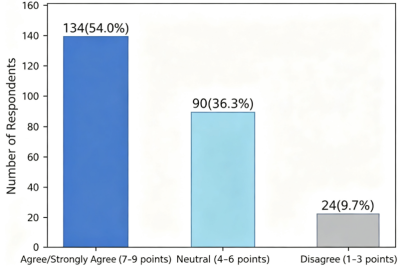
Participants’ agreement with the view that AI tools alleviate speaking practice anxiety is presented in
Figure 1. Over half of respondents (54.0%) expressed agreement (ratings of 7–9), while 36.3% held a neutral stance (ratings of 4–6) and 9.7% expressed disagreement (ratings of 1–3). The distribution of responses was positively skewed toward the agreement end. This pattern is consistent with previous research on AI-assisted language learning and underscores the potential of AI tools to lower affective barriers in speaking practice, while also indicating that a substantial minority (46.0%) of learners hold neutral or unfavorable views.
Figure 1. Participants’ attitudes toward AI tools in alleviating speaking practice anxiety.
As shown in
Figure 1, over half of respondents (54.0%) expressed agreement (ratings of 7–9) that AI tools can effectively reduce the psychological burden of oral practice, while 36.3% held a neutral stance (ratings of 4–6) and 9.7% expressed disagreement (ratings of 1–3). The distribution of responses was positively skewed toward the agreement end. This pattern is consistent with previous research on AI-assisted language learning and underscores the potential of AI tools to lower affective barriers in speaking practice, while also indicating that a substantial minority (46.0%) of learners hold neutral or unfavorable views.
4. Results and Findings
4.1. Relationship Between Usage Frequency and Oral Proficiency
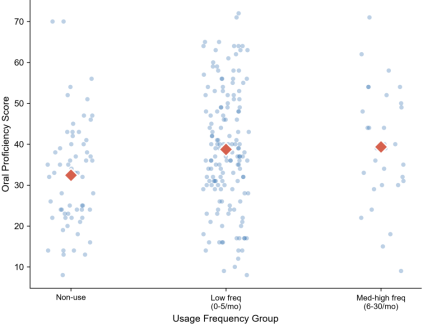
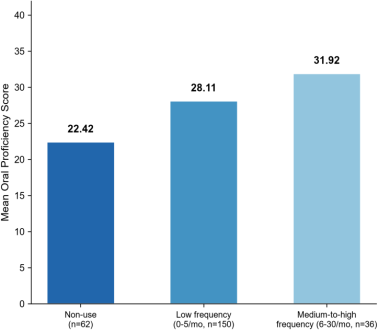
Table 1 shows a significant association between AI oral tool usage frequency and oral proficiency. One-way ANOVA revealed significant differences in oral proficiency across usage frequency groups (F(2, 218) = 7.952, p<.01, η² = 0.068). Post-hoc comparisons (Tukey HSD) indicated that the non-use group (M = 19.89, SD = 12.17) had significantly lower oral proficiency than the medium-to-high frequency group (M = 30.07, SD = 9.77), while the difference compared with the low-frequency group (M = 25.80, SD = 12.44) was marginally significant. The difference between the low-frequency and medium-to-high frequency groups was not significant. Correlation analysis showed a moderate correlation between usage frequency group and oral proficiency (r = 0.242). The distribution of oral proficiency scores across usage frequency groups is further illustrated in
Figures 3 and 4.
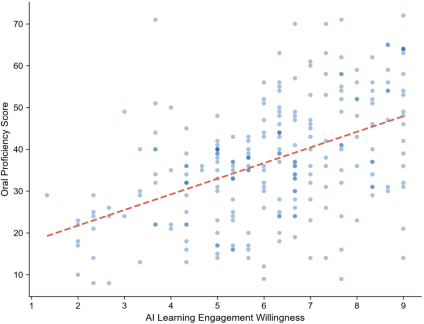
Figure 2. Scatter plot of AI learning engagement willingness and oral proficiency.
Figure 3. Scatter plot of usage frequency and oral proficiency.
Figure 4. Mean oral proficiency by usage frequency group.
Table 1. Descriptive statistics of oral proficiency by usage frequency group.
Usage Frequency Group | n | Mean Oral Proficiency (SD) |
Non-use | 62 | 19.89 (12.17) |
Low frequency (0–5/month) | 150 | 25.80 (12.44) |
Medium-to-high frequency (6–30/month) | 36 | 30.07 (9.77) |
4.2. Descriptive Analysis of AI Oral Tool Usage
The survey showed that 77.4% of respondents had used at least one AI oral tool. Among users, 60.5% spent 0–10 minutes per session, 30.1% spent 10–20 minutes, and only 9.4% exceeded 20 minutes, indicating that overall depth of use still requires improvement. Furthermore, 54.0% of respondents agreed (ratings of 7–9) that AI tools could effectively reduce the psychological burden of oral practice, while 36.3% held a neutral stance—a pattern consistent with previous findings
.
Content analysis of responses to the open-ended questions revealed that the main shortcomings reported by respondents included inaccurate pronunciation correction, high cost or excessive advertising, unnatural dialogue, insufficient scenario diversity, and inadequate speech recognition accuracy.
4.3. Moderating Role of AI Learning Engagement Willingness
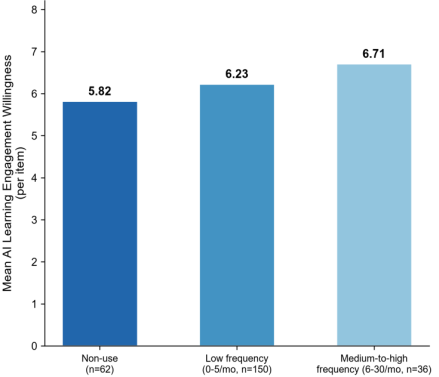
Table 2 shows differences in AI learning engagement willingness across frequency groups. Non-users had the lowest mean engagement willingness (5.65), which gradually increased with frequency (low-frequency: 5.85; medium-to-high frequency: 5.95). Correlation analysis showed that AI learning engagement willingness was significantly positively correlated with oral proficiency (r = 0.453, p<.001). The positive association between AI learning engagement willingness and oral proficiency is visually depicted in
Figure 2.
Hierarchical regression analysis showed that Model 1, which included only AI learning engagement willingness, yielded a significant association with oral proficiency (β = 3.438, 95% CI [2.43, 4.45], t = 6.695, p<.001, R2 = 0.189). In Model 2, after adding usage frequency, AI learning engagement willingness remained significant (β = 3.284, 95% CI [2.29, 4.28], t = 6.503, p<.001), and usage frequency also demonstrated an independent association (β = 3.932, 95% CI [1.41, 6.45], t = 3.077, p<.01, ΔR2 = 0.038), with the overall model R2 = 0.228. In Model 3, the interaction term (AI learning engagement willingness × usage frequency) was not significant (β = −0.682, 95% CI [−2.32, 0.96], t = −0.820, p>.05, ΔR2 = 0.003).
These results indicate that AI learning engagement willingness and usage frequency are each independently associated with oral proficiency, and their relationship is additive rather than interactive. To test the robustness of these findings, gender, major, and years of study were included as covariates in the regression model. The results showed that after controlling for these covariates, the association of AI learning engagement willingness remained significant (β = 3.546, 95% CI [2.66, 4.43], t = 7.903, p<.001), the independent association of usage frequency also remained significant (β = 3.932, 95% CI [1.41, 6.45], t = 3.077, p<.01), and none of the control variables were significant.
Table 2. Descriptive statistics of AI learning engagement willingness by usage frequency group.
Usage Frequency Group | n | AI Learning Engagement Willingness M (SD) |
Non-use | 62 | 5.65 (1.45) |
Low frequency (0–5/month) | 150 | 5.85 (1.65) |
Medium-to-high frequency (6–30/month) | 36 | 5.95 (1.66) |
Table 3. Results of hierarchical regression analysis.
Model | Variable | β | t | p | R2 | ΔR2 |
Model 1 | AI learning engagement willingness | 3.438 | 6.695 | <.001 | 0.189 | — |
Model 2 | AI learning engagement willingness | 3.284 | 6.503 | <.001 | 0.228 | 0.038 |
| Usage frequency | 3.932 | 3.077 | <.01 | | |
Model 3 | Interaction (Usage frequency × Engagement willingness) | −0.682 | −0.820 | >.05 | 0.231 | 0.003 |
Figure 5. Mean AI learning engagement willingness by usage frequency group.
5. Discussion
5.1. The Boundary of “More Use, Better Outcome”: From Technology Access to Effective Use
This finding further refines the framework of “access does not guarantee effective use”, revealing the independent pathways of “quantitative access” and “qualitative utilization” in oral English learning. From a theoretical perspective, the additive relationship identified in this study is not an empty null result but can be understood through classic second language acquisition theories. First, Krashen’s Input Hypothesis
| [10] | KRASHEN S. The Input Hypothesis: Issues and Implications [M]. London: Longman, 1985. |
[10]
emphasizes that comprehensible input is a necessary condition for language acquisition. Usage frequency can be regarded as a component of the “quantity” of AI language exposure — the higher the frequency, the more ample the comprehensible input exposure, which provides a foundational guarantee for oral proficiency. Second, Schmidt’s Noticing Hypothesis
posits that input can only be converted into intake when learners “notice” and deeply process it. AI learning engagement willingness is precisely the factor that determines this critical “deep processing” stage — learners with higher engagement willingness are more likely to notice linguistic forms, engage in strategic practice, and conduct self-reflection while using AI tools, consistent with the “performance phase” in Zimmerman’s cyclical model of self-regulated learning. In summary, AI learning engagement willingness and usage frequency operate on the two relatively independent aspects of “input exposure” and “deep processing” in language acquisition, thereby exhibiting an additive rather than an interactive effect. This finding suggests the boundary condition of “more use, better outcome”: frequency guarantees the floor (foundational language exposure), while engagement willingness determines the ceiling (depth of language processing); the two do not amplify each other but function independently. It should also be noted that overall usage frequency in the current sample was relatively low and may not yet have reached the “threshold” at which an interactive effect could emerge. If usage frequency increases further (e.g., multiple practice sessions per day), an interactive effect may appear in the high-frequency range.
5.2. Insufficient Learning Engagement: From “Technology Access” to “Effective Use” as a Barrier
The regression results showed that AI learning engagement willingness independently explained 18.9% of the variance in oral proficiency (R
2 = 0.189), which was higher than the explanatory power of usage frequency. This indicates that in an era where technology accessibility is already high, the key difference among learners is no longer “whether they can access” but “whether they can use it effectively”
| [9] | HUANG F, TANG Z. AI-enhanced university English learners’ speaking learning [J]. Journal of Xi’an International Studies University, 2026, 34(1): 53-59. |
[9]
. Learners with low AI learning engagement willingness tend to lack practice plans, struggle to maintain consistency, and lose patience with tool limitations. They also find it difficult to monitor their own progress consistently. This finding echoes Kong et al.’s
| [15] | KONG L, ZHONG H, WANG X M. Construction of foreign language learners’ engagement guarantee mechanism under human-computer collaborative environment [J]. Modern Foreign Languages, 2026, 49(1): 112-124. |
[15]
assertion that “AI assistance can only support self-assessment by highly self-driven students.” Tool design should incorporate self-regulatory support functions such as self-monitoring and goal setting. It should also emphasize that cultivating AI learning engagement willingness is as important as increasing usage frequency
| [9] | HUANG F, TANG Z. AI-enhanced university English learners’ speaking learning [J]. Journal of Xi’an International Studies University, 2026, 34(1): 53-59. |
[9]
.
5.3. Theoretical Implications and Practical Recommendations
The theoretical contributions of this study are fourfold. First, it extends the Effective Use framework from general technology-assisted learning to the AI oral practice context, validating the applicability of the view that “access alone does not guarantee effective use” in the AI oral domain. Second, it reveals that AI learning engagement willingness and usage frequency are independently associated with oral proficiency, and that their relationship is additive. This finding theoretically suggests boundary conditions for “more use, better outcome”: usage frequency guarantees the “quantity” of language exposure, providing a foundational guarantee for oral proficiency, while AI learning engagement willingness determines the “quality” of language processing, affecting whether exposure can be converted into actual ability improvement. Third, it engages in dialogue with international research.
found that AI assistance can enhance self-regulatory ability; the present study further reveals the mechanism through which this self-regulatory ability operates — by enhancing learners’ engagement willingness to improve “language processing quality” rather than simply promoting usage frequency. Wang and Xu’s
findings in the intelligent personal assistant context are consistent with those of this study, further confirming the central role of self-regulation in technology-assisted oral learning. Fourth, it provides empirical support for the learner engagement assurance mechanism proposed by
| [15] | KONG L, ZHONG H, WANG X M. Construction of foreign language learners’ engagement guarantee mechanism under human-computer collaborative environment [J]. Modern Foreign Languages, 2026, 49(1): 112-124. |
[15]
, demonstrating the critical role of AI learning engagement willingness in “engagement assurance.”
Theoretical implications: The “quantity guarantees the floor, quality determines the ceiling” framework proposed in this study reveals a dual-path mechanism of technology-assisted language learning, offering a new perspective for understanding “the gap between technology access and effective utilization.”Methodological implications: Future research should simultaneously attend to both the “quantity” and “quality” dimensions of technology use, avoiding information loss caused by relying solely on usage frequency. Practical implications: When promoting AI oral tools, equal attention should be paid to increasing both usage frequency and learning engagement willingness. For learners with low engagement willingness, supplementary monitoring mechanisms should be provided. Tool design should incorporate self-regulatory support functions such as self-monitoring and goal setting. Practical recommendations are organized along two dimensions: pedagogical application and tool design. In terms of pedagogical application, college English instruction could integrate AI oral tools into after-class autonomous learning systems with tiered practice tasks. For learners with weaker self-regulatory abilities, regular teacher feedback and check-in monitoring mechanisms should be provided to compensate for insufficient engagement willingness. In terms of tool design, AI oral products should embed self-regulation support modules — such as personalized learning goal setting, practice data review, and error pronunciation tracking — to lower the threshold for learners’ strategic use of the tools.
6. Conclusion
The present study identifies a critical boundary condition of the “more use, better outcome” assumption in AI-assisted oral practice: usage frequency and AI learning engagement willingness are independently and additively associated with oral proficiency, rather than interactively amplifying each other.
Specifically, three main findings support this conclusion. First, AI oral tool usage frequency was significantly positively correlated with oral proficiency (F(2, 218) = 7.952, p<.01), with significant between-group differences, indicating that frequent AI tool use provides a foundational level of language exposure. Second, AI learning engagement willingness emerged as a significant positive correlate of oral proficiency (beta = 3.438, t = 6.695, p<.001, R-squared = 0.189), accounting for a substantial proportion of variance. Third, after controlling for engagement willingness, usage frequency retained an independent association (beta = 3.932, t = 3.077, p<.01, delta-R-squared = 0.038), confirming an additive rather than an interactive relationship between the two factors. Taken together, these findings reframe the “more use, better outcome” logic: usage frequency guarantees the floor of language exposure, while AI learning engagement willingness determines the ceiling of deep processing—the two operate on distinct pathways and neither substitutes for the other. This study also has several limitations. First, regarding research design, this study adopted a cross-sectional questionnaire survey design, which can only reveal correlational relationships among variables and cannot infer causality. In particular, it cannot rule out reverse causality (learners with higher oral proficiency may be more willing to use AI tools), and future studies should employ longitudinal tracking designs. Second, with respect to variable measurement, oral proficiency was assessed through self-report, which carries a risk of common method bias. The AI learning engagement willingness scale was exploratory in nature (Cronbach’s α = 0.730), consisted of only three items, and has not yet been validated through confirmatory factor analysis; future research should adopt established scales (e.g., MSLQ or SRL-SRS). Third, in terms of sample representativeness, this study used convenience sampling, with the sample drawn from WeChat and QQ groups without a clear sampling frame, limiting external validity. The medium-to-high frequency group comprised only 36 participants, and the original high-frequency end (26–30 times/month) had only 4 participants, resulting in insufficient statistical power; future studies should expand the sample size. Fourth, regarding confounding variable control, although supplementary analyses showed that the core variables remained robust after controlling for gender, major, and years of study, key confounds such as English proficiency level and speaking anxiety were not controlled; future research should adopt stricter control designs. Despite these limitations, as an exploratory study, the value of this research lies in revealing the additive relationship between usage frequency and AI learning engagement willingness in AI-assisted oral English learning, thereby providing a theoretical framework and empirical foundation for future investigations.
Abbreviations
AI | Artificial Intelligence |
ANOVA | Analysis of Variance |
CET | College English Test |
CI | Confidence Interval |
CMB | Common Method Bias |
GenAI | Generative Artificial Intelligence |
HSD | Honestly Significant Difference |
KMO | Kaiser-Meyer-Olkin |
SDT | Self-Determination Theory |
SRL | Self-Regulated Learning |
TAM | Technology Acceptance Model |
VIF | Variance Inflation Factor |
EFL | English as a Foreign Language |
MSLQ | Motivated Strategies for Learning Questionnaire |
SD | Standard Deviation |
SRL-SRS | Self-Regulated Learning Self-Report Scale |
Author Contributions
Hu Shijie: Conceptualization, Project Administration, Resources
Zhao Yuyang: Formal Analysis, Visualization
Zeng Yuhan: Investigation
Li Jiani: Investigation
Funding
This study is sponsored by the Guangdong University of Technology Innovation and Entrepreneurship Training Program (Project No. xj2026118450630).
Conflicts of Interest
The authors declare no conflicts of interest.
References
| [1] |
AYRES J, ZHANG L. Effects of artificial intelligence on English speaking anxiety and speaking performance [J]. Expert Systems, 2021, 38(4): e12667.
https://doi.org/10.1111/exsy.12667
|
| [2] |
EBADI S, EBAD S. AI-based instruction improving L2 speaking skills and speaking self-regulation [J]. Frontiers in Psychology, 2023, 14: 1255594.
https://doi.org/10.3389/fpsyg.2023.1255594
|
| [3] |
KAMELABAD A M. Personalized language learning with an LLM chatbot [J]. Frontiers in Education, 2026, 11: 1703664.
https://doi.org/10.3389/feduc.2026.1703664
|
| [4] |
OXFORD R L. Teaching and researching language learning strategies [M]. London: Pearson, 2011.
https://doi.org/10.4324/9780203839063
|
| [5] |
QIAN Y, JING J. AI-assisted oral training for sustainable EFL learning [J]. Frontiers in Psychology, 2026, 17: 1803848.
https://doi.org/10.3389/fpsyg.2026.1803848
|
| [6] |
TENG L S, ZHANG L J. Technology-assisted self-regulated English learning [J]. Frontiers in Psychology, 2020, 11: 558466.
https://doi.org/10.3389/fpsyg.2020.558466
|
| [7] |
WANG W, XU Y. Self-regulation in L2 speaking with intelligent personal assistants [J]. BMC Psychology, 2024, 12: 1234.
https://doi.org/10.1186/s40359-024-02033-5
|
| [8] |
ZIMMERMAN B J. Attaining self-regulation: A social cognitive perspective [M] // Handbook of self-regulation. San Diego: Academic Press, 2000.
https://doi.org/10.1016/B978-012109890-2/50031-7
|
| [9] |
HUANG F, TANG Z. AI-enhanced university English learners’ speaking learning [J]. Journal of Xi’an International Studies University, 2026, 34(1): 53-59.
|
| [10] |
KRASHEN S. The Input Hypothesis: Issues and Implications [M]. London: Longman, 1985.
|
| [11] |
SCHMIDT R. The role of consciousness in second language learning [J]. Applied Linguistics, 1990, 11(2): 129-158.
https://doi.org/10.1093/applin/11.2.129
|
| [12] |
WEN Q F. Human-machine interaction negotiation competence: ChatGPT and foreign language education [J]. Foreign Language Teaching and Research, 2024, 56(2): 269-280.
|
| [13] |
YANG L R, WANG Y, SUN J W. Second language acquisition against the background of ChatGPT large language models [J]. Modern Foreign Languages, 2024, 47(4): 578-585.
|
| [14] |
WANG H, CHEN M. Research on participation in AI-assisted online oral interactive assessment tasks [J]. Foreign Language Teaching and Research, 2025, 57(3): 439-449.
|
| [15] |
KONG L, ZHONG H, WANG X M. Construction of foreign language learners’ engagement guarantee mechanism under human-computer collaborative environment [J]. Modern Foreign Languages, 2026, 49(1): 112-124.
|
| [16] |
WANG H, LIU J D. Research on learners’ feedback engagement in AI-assisted oral diagnostic assessment [J]. Modern Foreign Languages, 2026, 49(3): 367-379.
|
| [17] |
ZOU L L, WANG Y. Research on inquiry-based discussion empowered by artificial intelligence in foreign language classrooms: Challenges, approaches and strategies [J]. Foreign Language Teaching and Research, 2026, 58(1): 121-130.
|
| [18] |
XU J J, XIONG W X. Implementation strategies of personalized foreign language education under large language models [J]. Foreign Language Teaching and Research, 2025, 57(1): 81-91.
|
| [19] |
YU H L. Paradigm shift of foreign language teaching in universities in the intelligent era [J]. Foreign Language Teaching and Research, 2024, 56(6): 913-923.
|
| [20] |
WEN Q F. Will foreign language education witness a subversive revolution in the artificial intelligence era [J]. Modern Foreign Languages, 2024, 47(5): 722-731.
|
| [21] |
SUN X G. Research on interpreter classroom evaluation with teacher-AI-student collaboration [J]. Modern Foreign Languages, 2025, 48(5): 701-712.
|
| [22] |
WU J, CHEN Y, WANG H. AI-driven chatbots in second language education: A systematic review [J]. Ampersand, 2025, 14: 100224.
https://doi.org/10.1016/j.amper.2025.100224
|
| [23] |
CUKUROVA M. The interplay of learning, analytics and artificial intelligence in education: A vision for hybrid intelligence [J]. British Journal of Educational Technology, 2024, 56(2): 469-488.
https://doi.org/10.1111/bjet.13514
|
| [24] |
CUKUROVA M, SURAWORACHET W, et al. Towards synergistic teacher-AI interactions with generative artificial intelligence [J/OL]. arXiv, 2025.
https://doi.org/10.48550/arXiv.2511.19580
|
| [25] |
UNESCO. AI competency framework for teachers [R]. Paris: UNESCO, 2024.
|
Cite This Article
-
APA Style
Shijie, H., Yuyang, Z., Yuhan, Z., Jiani, L. (2026). Boundary Conditions of "More Use, Better Outcome":
The Role of Self-Regulation in AI-Assisted Oral Proficiency. American Journal of Artificial Intelligence, 10(2), 209-218. https://doi.org/10.11648/j.ajai.20261002.14
 Copy
|
Copy
|
 Download
ACS Style
Shijie, H.; Yuyang, Z.; Yuhan, Z.; Jiani, L. Boundary Conditions of "More Use, Better Outcome":
The Role of Self-Regulation in AI-Assisted Oral Proficiency. Am. J. Artif. Intell. 2026, 10(2), 209-218. doi: 10.11648/j.ajai.20261002.14
Copy
|
Download
AMA Style
Shijie H, Yuyang Z, Yuhan Z, Jiani L. Boundary Conditions of "More Use, Better Outcome":
The Role of Self-Regulation in AI-Assisted Oral Proficiency. Am J Artif Intell. 2026;10(2):209-218. doi: 10.11648/j.ajai.20261002.14
Copy
|
Download
-
@article{10.11648/j.ajai.20261002.14,
  author = {Hu Shijie and Zhao Yuyang and Zeng Yuhan and Li Jiani},
  title = {Boundary Conditions of "More Use, Better Outcome":
The Role of Self-Regulation in AI-Assisted Oral Proficiency},
  journal = {American Journal of Artificial Intelligence},
  volume = {10},
  number = {2},
  pages = {209-218},
  doi = {10.11648/j.ajai.20261002.14},
  url = {https://doi.org/10.11648/j.ajai.20261002.14},
  eprint = {https://article.sciencepublishinggroup.com/pdf/10.11648.j.ajai.20261002.14},
  abstract = {The rapid development of generative AI (GenAI) technology has led to the widespread adoption of AI oral practice tools among university EFL (English as a Foreign Language) learners, yet the boundary conditions under which such tools improve oral proficiency remain underexplored. This study aims to investigate whether the assumption that more frequent use leads to better outcomes is universally valid or is conditioned by learners’ AI learning engagement willingness. Based on questionnaire responses from 248 university students across multiple institutions in China, this study examined the relationships among AI oral tool usage frequency, AI learning engagement willingness (comprising task value perception, willingness to invest resources, and AI-augmented self-efficacy), and self-reported English oral proficiency. Statistical analyses, including one-way ANOVA and hierarchical multiple regression, revealed that both AI learning engagement willingness and usage frequency were independently and positively associated with oral proficiency, displaying an additive rather than interactive relationship. These findings reframe the more use, better outcome logic by revealing a dual-path mechanism: usage frequency ensures the floor of language exposure, while AI learning engagement willingness determines the ceiling of deep processing. The study provides theoretical and practical implications for AI tool design and pedagogical implementation in college English education.},
 year = {2026}
}
Copy
|
Download
-
TY  - JOUR
T1  - Boundary Conditions of "More Use, Better Outcome":
The Role of Self-Regulation in AI-Assisted Oral Proficiency
AU  - Hu Shijie
AU  - Zhao Yuyang
AU  - Zeng Yuhan
AU  - Li Jiani
Y1  - 2026/08/17
PY  - 2026
N1  - https://doi.org/10.11648/j.ajai.20261002.14
DO  - 10.11648/j.ajai.20261002.14
T2  - American Journal of Artificial Intelligence
JF  - American Journal of Artificial Intelligence
JO  - American Journal of Artificial Intelligence
SP  - 209
EP  - 218
PB  - Science Publishing Group
SN  - 2639-9733
UR  - https://doi.org/10.11648/j.ajai.20261002.14
AB  - The rapid development of generative AI (GenAI) technology has led to the widespread adoption of AI oral practice tools among university EFL (English as a Foreign Language) learners, yet the boundary conditions under which such tools improve oral proficiency remain underexplored. This study aims to investigate whether the assumption that more frequent use leads to better outcomes is universally valid or is conditioned by learners’ AI learning engagement willingness. Based on questionnaire responses from 248 university students across multiple institutions in China, this study examined the relationships among AI oral tool usage frequency, AI learning engagement willingness (comprising task value perception, willingness to invest resources, and AI-augmented self-efficacy), and self-reported English oral proficiency. Statistical analyses, including one-way ANOVA and hierarchical multiple regression, revealed that both AI learning engagement willingness and usage frequency were independently and positively associated with oral proficiency, displaying an additive rather than interactive relationship. These findings reframe the more use, better outcome logic by revealing a dual-path mechanism: usage frequency ensures the floor of language exposure, while AI learning engagement willingness determines the ceiling of deep processing. The study provides theoretical and practical implications for AI tool design and pedagogical implementation in college English education.
VL  - 10
IS  - 2
ER  -
Copy
|
Download




 Share This Article
 Twitter
 Linked In
 Facebook